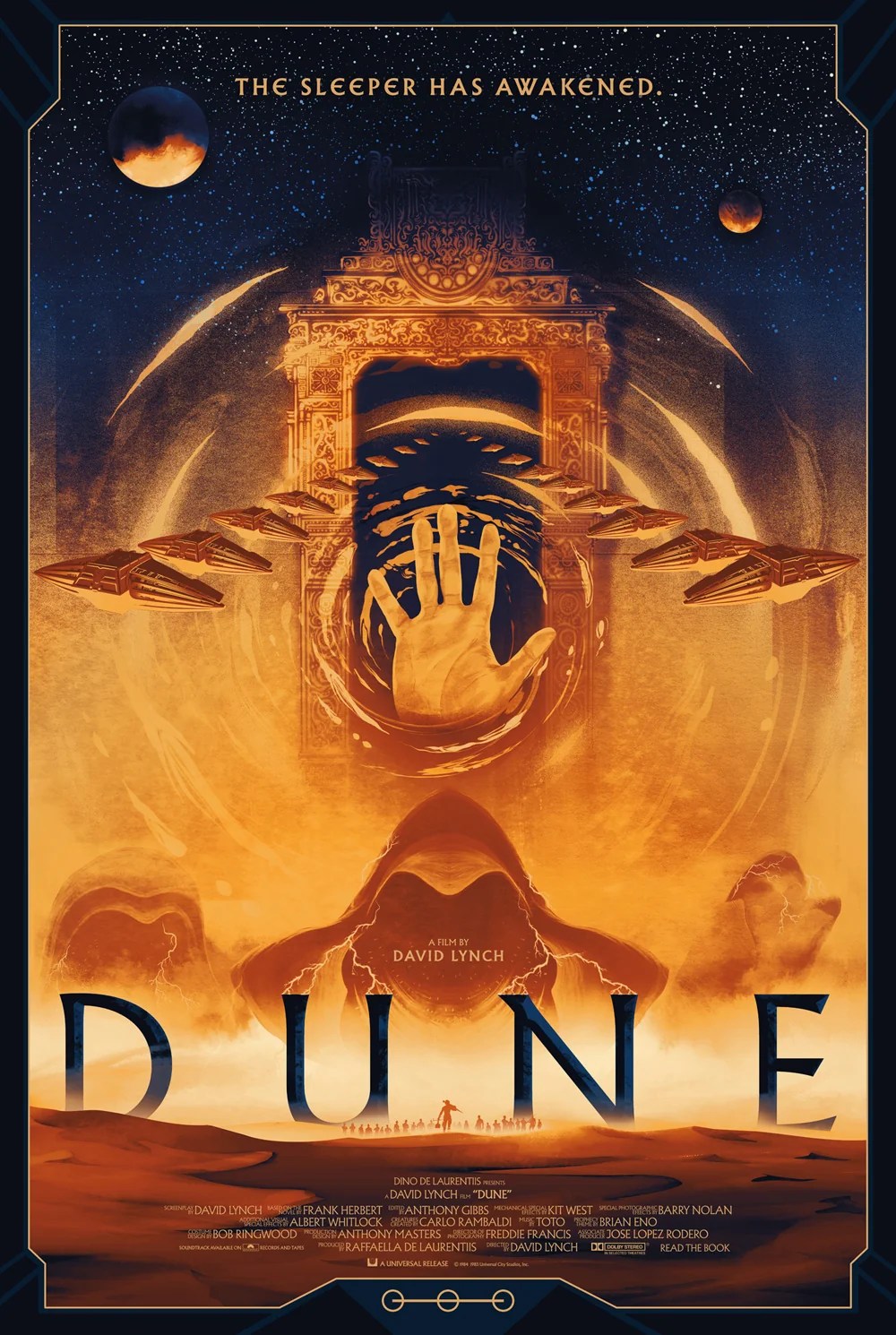
Review: Dune (dir. by David Lynch)


“The sleeper has awakened.” — Paul “Muad’Dib” Atreides

David Lynch’s Dune is one of those movies that somehow manages to be both a spectacular failure and a strangely hypnotic piece of cinema at the same time. It feels like a film willed into existence through pure creative tension: on one side, Frank Herbert’s dense, political, and spiritual sci‑fi novel; on the other, David Lynch’s surreal, psychological, dream‑logic sensibility. The result is a singular oddity—visually bold, dramatically uneven, and endlessly fascinating if you’re in the mood for something that feels more like a hallucination than a conventional space opera.

To call the adaptation ambitious is underselling it. After the collapse of Alejandro Jodorowsky’s infamous attempt to adapt Dune, the project eventually landed at Universal with producer Dino De Laurentiis, and Lynch—fresh off The Elephant Man—was brought in to turn Herbert’s galaxy‑spanning book into a two‑hour‑ish feature. On paper, it seems like inspired casting: Lynch had the visual imagination and emotional intensity to do something memorable with the material. But he was never a natural fit for streamlined blockbuster storytelling. His instincts live in mood, subconscious imagery, and uneasy psychological textures rather than clean plot mechanics. You can feel that clash all over the final film, and it’s part of what makes it so weirdly compelling.

Right from the opening, Dune doesn’t hold your hand. Princess Irulan’s floating head lays out a massive info‑dump about spice, the Imperium, and Arrakis that plays like someone reading you the glossary at the back of a sci‑fi novel. It’s dense, awkward, and kind of charming in its sincerity. The movie takes Herbert’s universe extremely seriously—no wink, no irony, no attempt to sand off the stranger edges. The Bene Gesserit, mentats, feudal houses, and prophecies are all presented straight, as if the audience will either keep up or be left behind. There’s something almost punk about that level of commitment.

Kyle MacLachlan, in his debut as Paul Atreides, is perfectly cast for Lynch’s take on the character. He’s got this earnest, slightly naive presence that gradually hardens as the story pushes him toward messiah status. Instead of leaning into a swashbuckling hero archetype, Lynch frames Paul’s evolution as something interior and dreamlike, almost like a spiritual awakening happening inside a hostile universe. Paul’s visions aren’t giant, crystal‑clear CGI prophecy sequences; they’re fragmented, flickering images, whispers, and flashes of desert and blood. You can feel Lynch trying to drag the sci‑fi epic into his own subconscious, even if the narrative doesn’t always keep up.

The supporting cast is packed with strong, sometimes delightfully bizarre performances. Francesca Annis gives Lady Jessica a sensual, haunted calm that fits the Bene Gesserit’s mix of discipline and manipulation. Jurgen Prochnow’s Duke Leto radiates dignified doom; he feels like a man who knows he’s walking into a trap but can’t step off the path. Then you get to the Harkonnens, where Lynch just lets his freak flag fly. Kenneth McMillan’s Baron is a grotesque comic‑book monster, oozing, cackling, floating on anti‑grav tech, and reveling in cruelty. It’s not subtle, but it is unforgettable. And of course Sting as Feyd‑Rautha, stalking around in barely‑there outfits and sneering like a rock star beamed in from another film entirely, just adds to the movie’s fever‑dream energy.

Visually, Dune is a feast and sometimes a bit of a choke. The production design leans into a kind of retro‑futurist baroque: cavernous sets, ornate technology, and spaces that feel less like functional environments and more like places out of a dark fantasy. Lynch and cinematographer Freddie Francis infuse everything with shadow, smoke, and texture, so even the quiet scenes feel heavy and loaded. The sandworms are huge, tactile, and worshipful in scale; the way they burst from the desert feels more like a religious manifestation than a monster attack. Even if you’re lost in the plot, the images stick with you—daggers, stillsuits, weirding whispers, blood on sand.

The sound and music do a ton of work in giving the film its identity. The score, primarily by Toto with contributions from Brian Eno, is this fusion of 80s rock sensibility and orchestral grandeur. It shouldn’t work, but it does; the main theme swells with tragic heroism, while other cues veer into eerie, synthy territory that matches Lynch’s off‑kilter tone. The sound design around the “weirding” abilities, the internal monologues, and the roar of the sandworms all help sell the world even when the script is sprinting past exposition. It’s one of those films where you might not fully grasp every detail, but the combined force of image and sound makes you feel like you’ve visited a real, deeply strange place.

The big structural problem, and the thing that most clearly separates Lynch’s adaptation from Denis Villeneuve’s two‑part version, is time and emphasis. Lynch is trying to cram the entire arc of Dune into a single film, and that means the plotting goes from methodical to breakneck halfway through. The first half lingers on the setup—Caladan, the move to Arrakis, the betrayal—while the second half rockets through Paul’s Fremen transformation, the guerrilla war, the sandworm riding, and the final confrontation. Subplots are hinted at and dropped, character arcs feel truncated, and the voiceover is forever trying to patch gaps the edits created. Themes like ecological transformation, the manipulation behind religious prophecy, and the long‑term horror of Paul’s rise are mostly reduced to gestures.

The best way to see Dune in Lynch’s version is actually through the extended cut, which adds a bit more context to certain scenes and lets the film breathe slightly more than the theatrical release. The theatrical cut is so aggressively compressed that pieces of motivation and setup just vanish, leaving the story feeling even more disjointed. The extended version restores some of the connective tissue—especially around Paul’s early time with the Fremen, the political maneuvering in the lead‑up to the final act, and the way certain characters orient themselves in the larger conflict. It doesn’t magically fix the studio‑driven structure or the inherent weirdness of Lynch’s choices, but it does make the film feel a little more complete, a little closer to the director’s original vision. It’s still messy, but less like a rushed homework assignment and more like a genuinely eccentric, if compromised, longform take on Herbert’s world.

Tonally, Lynch and Villeneuve are almost mirror images. Lynch’s film is cramped, loud in its weirdness, and often grotesque, playing like a baroque horror‑opera about destiny. Villeneuve’s is stately, slow‑burn, and solemn, more interested in the weight of empire, colonialism, and religious manipulation. Even their takes on Paul are distinct. In Lynch’s film, Paul ultimately plays more like a triumphant chosen one; whatever ambiguity is there gets overshadowed by the climactic victory and the literal act of making it rain as a grand, almost celebratory miracle. Villeneuve leans harder into the darker implications: Paul is framed as a potentially dangerous figure whose rise may unleash something terrible, and his two‑part arc emphasizes the holy war and fanaticism coalescing around him instead of treating his ascension as a clean win. Where Lynch’s ending lands somewhere between pulp myth and studio‑mandated uplift, Villeneuve’s execution feels closer to a tragedy about messianic power.

Knowing all that, Lynch’s Dune ends up feeling like a relic from an era when studios occasionally handed gigantic, unwieldy properties to filmmakers with intensely personal styles and just hoped for the best. It doesn’t “work” in a conventional plot sense, and if you’re coming to it after the sleek coherence of Villeneuve’s films, it can feel like a chaotic, cluttered alternate‑universe version of the same story. But that alternate universe has its own power. There’s a raw, handmade intensity to Lynch’s take—a sense that he’s trying to turn Dune into a waking dream about destiny, decay, and the seduction of power, even as the studio scissors are hacking away at his vision.

In the end, David Lynch’s Dune is a beautifully broken thing: a movie that fails as a straightforward adaptation but succeeds as a cinematic experience you can’t quite shake. Villeneuve gives you a clearer, more faithful, and philosophically aligned Dune, the one that explains itself and lets you sit with its implications. Lynch gives you the nightmare version, messy and compromised, but pulsing with strange life. If Villeneuve’s two‑part saga is the definitive modern telling, Lynch’s film—especially the extended cut—remains the haunting alternate path, a vision of Arrakis filtered through a very particular mind, sandblasted, grotesque, and unforgettable.
Horror On TV: Hammer House Of Horror #9: Carpathian Eagle (dir by Francis Megahy)


Tonight’s episode of Hammer House of Horror is Carpathian Eagle.

Men are being murdered in bed by a woman who removes their heart.  Inspector Clifford (Anthony Valentine) investigates with the help of a true crime historian named Natalie (Suzanne Danielle).  Natalie tells the story of an ancient Carpathian countess who murdered men in the same way and suggests that the murders might be the work of a modern-day descendant.  The truth turns out to be a bit more complicated, if also a bit predictable.

This is not my favorite episode Hammer House of Horror but still, it’s worth watching to catch a young Pierce Brosnan in an early small role.  This episode originally aired on November 8th, 1980.

Clash of the Titans (1981, directed by Desmond Davis)


High atop Mt. Olympus, Zeus (Laurence Olivier) and his fellow Gods look down on Earth and jealously manipulate its citizens.  When Zeus impregnates Danae (Vida Taylor), the daughter of the King of Argos, she and her son Perseus (Harry Hamlin) are banished to sea.  Zeus responds by ordering Poseidon (Jack Gwillim) to release the Kraken.

Years later, when Callibos (Neil McCarthy), the son of the Goddess Thetis (Maggie Smith), destroys all but one of Zeus’s flying horses, Zeus transformer Callibos into a tailed monster.  Thetis tries to get her revenge by having Callibos kill Perseus but instead, Perseus chops off Callibos’s hand, comes to possess Pegasus, the last of the flying horses, and also wins the right to marry Andromeda (Judi Bowker).

At the wedding, Cassiopeia (Sian Phillips) declares Andromeda to be even more beautiful than Aphrodite (Ursula Andress).  Big mistake.  Aphrodite demands that Andromeda by sacrificed to the Kraken.  Along with Pegasus, Ammon (Burgess Meredith), Thallo (Tom Pigott-Smith), and robot owl, Perseus goes on a quest to get the snake-haired head of Medusa so he can turn the Kraken into stone.

There’s a lot that I love about Clash of the Titans, from the Ray Harryhausen’s stop-motion special effects to the blind witches who pass one eyepiece among them to Burgess Meredith’s performance as Ammon.  I even like the robot owl.  But the thing that has always made the biggest impression on me is that Mt. Olympus is portrayed as having a shelf that holds a figurine for every human in the world.  The Gods casually move the pieces around and transform them on whims.  Of all the films that have been based on Greek mythology, Clash of the Titans is one of the few that really captures the idea of the Gods essentially being a bunch of petty and jealous libertines who view humans are just being their playthings.

Let’s not overthink Clash of the Titans, though.  The main appeal of Clash of the Titans is that it’s just a good, old-fashioned adventure movie.  In this age of CGI and humorless heroes, it’s hard not love the film’s mix of old-fashion stop-motion animation, strong characters, and occasional moments of humor.  (I like the owl and I won’t apologize for it.)  Also, Medusa has appeared in a lot of movie but she’s never been scarier than in this movie.  Who can forget the yellow glow of her eyes, followed by men turning to stone?  Who can forget the hiss of her tail or the moment when Perseus waits to strike while trying not to look into her eyes?  Beyond Medusa, who can forget the Kraken rising from the sea or the blood of Callibos giving birth to giant scorpions?  Without CGI, Clash of the Titans still captures the feel of living in a different time and a different land.  Clash of the Titans brings mythology to life in a way that few other films have been able to,

I loved the original Clash of Titans when I was a kid.  I rewatched it last month and I happy to say that I love it still.

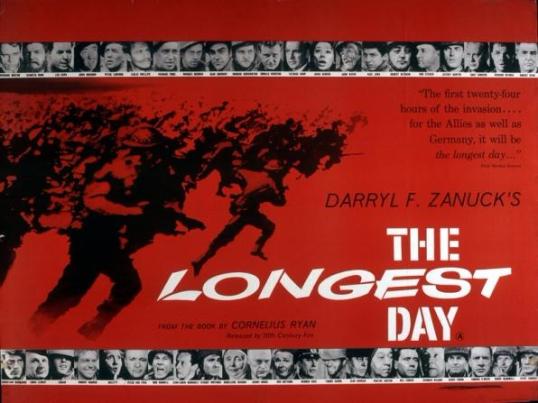
Lisa Reviews An Oscar Nominee: The Longest Day (dir by Ken Annakin, Andrew Marton, Bernhard Wicki, Gerd Oswald, and Darryl F. Zanuck)


As my sister has already pointed out, today is the 73rd anniversary of D-Day.  With that in mind, and as a part of my ongoing mission to see and review every single film ever nominated for best picture, I decided to watch the 1962 film, The Longest Day!

The Longest Day is a pain-staking and meticulous recreation of invasion of Normandy, much of it filmed on location.  It was reportedly something of a dream project for the head of the 20th Century Fox, Darryl F. Zanuck.  Zanuck set out to make both the ultimate tribute to the Allied forces and the greatest war movie ever.  Based on a best seller, The Longest Day has five credited screenwriters and three credited directors.  (Ken Annakin was credited with “British and French exteriors,” Andrew Marton did “American exteriors,” and the German scenes were credited to Bernhard Wicki.  Oddly, Gerd Oswald was not credited for his work on the parachuting scenes, even though those were some of the strongest scenes in the film.)  Even though he was not credited as either a screenwriter or a director, it is generally agreed that the film ultimately reflected the vision of Darryl F. Zanuck.  Zanuck not only rewrote the script but he also directed a few scenes as well.  The film had a budget of 7.75 million dollars, which was a huge amount in 1962.  (Until Steven Spielberg’s Schindler’s List, The Longest Day was the most expensive black-and-white film ever made.)  Not only did the film tell an epic story, but it also had an epic length.  Clocking in at 3 hours, The Longest Day was also one of the longest movies to ever be nominated for best picture.

The Longest Day also had an epic cast.  Zanuck assembled an all-star cast for his recreation of D-Day.  If you’re like me and you love watching old movies on TCM, you’ll see a lot of familiar faces go rushing by during the course of The Longest Day.  American generals were played by actors like Robert Mitchum, Robert Ryan, Henry Fonda, and John Wayne.  Peter Lawford, then the brother-in-law of the President of the United States, had a memorable role as the Scottish Lord Lovat, who marched through D-Day to the sounds of bagpipes.  When the Allied troops storm the beach, everyone from Roddy McDowall to Sal Mineo to Robert Wagner to singer Paul Anka can be seen dodging bullets.  Sean Connery pops up, speaking in his Scottish accent and providing comic relief.  When a group of paratroopers parachute into an occupied village, comedian Red Buttons ends up hanging from the steeple of a church.  When Richard Beymer (who is currently playing Ben Horne on Twin Peaks) gets separated from his squad, he stumbles across Richard Burton.  Among those representing the French are Arletty and Christian Marquand.  (Ironically, after World War II, Arletty was convicted of collaborating with the Germans and spent 18 months under house arrest.  Her crime was having a romantic relationship with a German soldier.  It is said that, in response to the charges, Arletty said, “My heart is French but my ass is international.”)  Meanwhile, among the Germans, one can find three future Bond villains: Gert Frobe, Curt Jurgens, and Walter Gotell.

It’s a big film and, to be honest, it’s too big.  It’s hard to keep track of everyone and, even though the battle scenes are probably about an intense as one could get away with in 1962 (though it’s nowhere near as effective as the famous opening of Saving Private Ryan, I still felt bad when Jeffrey Hunter and Eddie Albert were gunned down), their effectiveness is compromised by the film’s all-star approach.  Often times, the action threatens to come to a halt so that everyone can get their close-up.  Unfortunately, most of those famous faces don’t really get much of a chance to make an impression.  Even as the battle rages, you keep getting distracted by questions like, “Was that guy famous or was he just an extra?”

Among the big stars, most of them play to their personas.  John Wayne, for instance, may have been cast as General Benjamin Vandervoort but there’s never any doubt that he’s playing John Wayne.  When he tells his troops to “send them to Hell,” it’s not Vandervoort giving orders.  It’s John Wayne representing America.  Henry Fonda may be identified as being General Theodore Roosevelt II but, ultimately, you react to him because he’s Henry Fonda, a symbol of middle-American decency.  Neither Wayne nor Fonda gives a bad performance but you never forget that you’re watching Fonda and Wayne.

Throughout this huge film, there are bits and pieces that work so well that you wish the film had just concentrated on them as opposed to trying to tell every single story that occurred during D-Day.  I liked Robert Mitchum as a tough but caring general who, in the midst of battle, gives a speech that inspires his troops to keep fighting.  The scenes of Peter Lawford marching with a bagpiper at his side were nicely surreal.  Finally, there’s Richard Beymer, wandering around the French countryside and going through the entire day without firing his gun once.  Beymer gets the best line of the film when he says, “I wonder if we won.”  It’s such a modest line but it’s probably the most powerful line in the film.  I wish The Longest Day had more scenes like that.

The Longest Day was nominated for best picture of 1962 but it lost to an even longer film, Lawrence of Arabia.

Sci-Fi Review: Ewoks: The Battle For Endor (1985, dir. Jim Wheat & Ken Wheat)


vlcsnap-2015-12-15-20h50m07s161

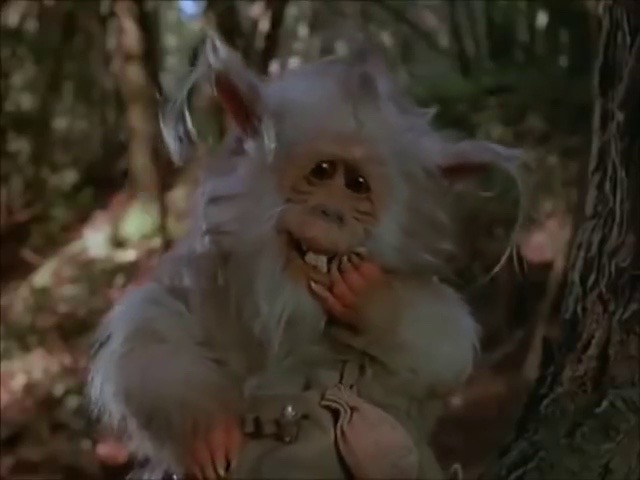
So one year later we returned to Endor to see the continuing saga of Wicket (Warwick Davis) and the family from The Ewok Adventure. What were those words Burl Ives left us with at the end of The Ewok Adventure again?

“Reunited, the families enjoy the simple pleasures of being together. Having learned something they already knew. That courage, loyalty, and love are the strongest forces in the universe.”

Well, those forces are apparently not that strong because this movie opens up with Cindel’s (Aubree Miller) family getting murdered. That’s nice!

I love that apparently Kilink’s ultimate weapon from Kilink vs. The Flying Man made it all the way from Turkey to the moon of Endor.

vlcsnap-2015-12-15-20h59m36s495

During all this killing we meet the two main villains of this movie.

vlcsnap-2015-12-15-21h04m09s948

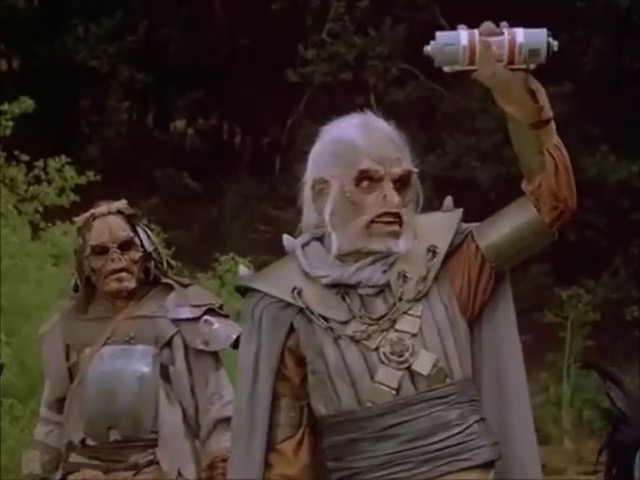
This guy (Carel Struycken) who looks like every generic bad guy from ever fantasy adventure movie ever made. He wants some sort of device from a spaceship that he thinks will make him powerful.

vlcsnap-2015-12-15-21h04m37s398

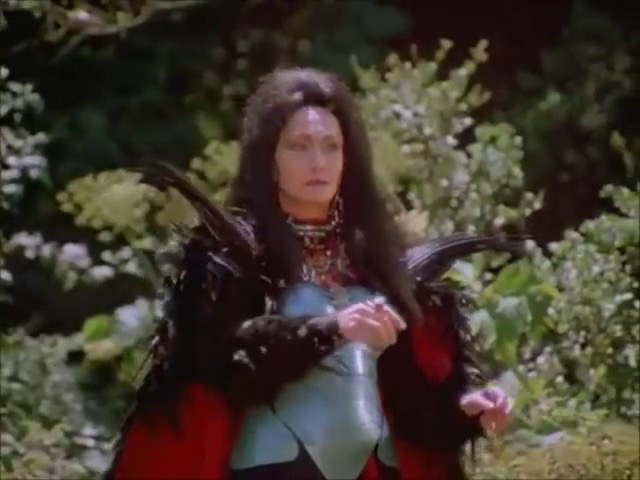
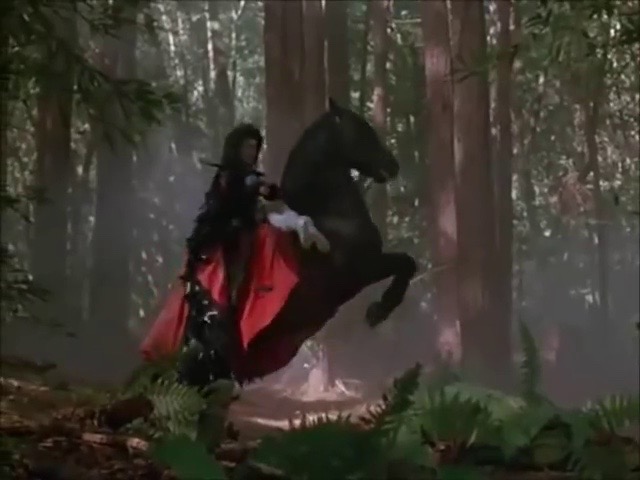
And this lady (Siân Phillips) who looks like she belongs in He-Man and The Masters Of The Universe.

After getting captured, then escaping, Cindel and Wicket do battle with something I’m pretty sure I once hit a golf ball into when I used to play miniature golf.

vlcsnap-2015-12-15-21h19m48s235

While trying to escape that dragon via a hang glider, they crash. Then they meet this guy who is quite annoying throughout this film.

vlcsnap-2015-12-15-21h24m05s487

I guess they figured since Wicket now speaks English, they needed something else small that doesn’t. That thing takes them to a house in the woods, but soon the owner comes home.

vlcsnap-2015-12-16-12h56m53s304

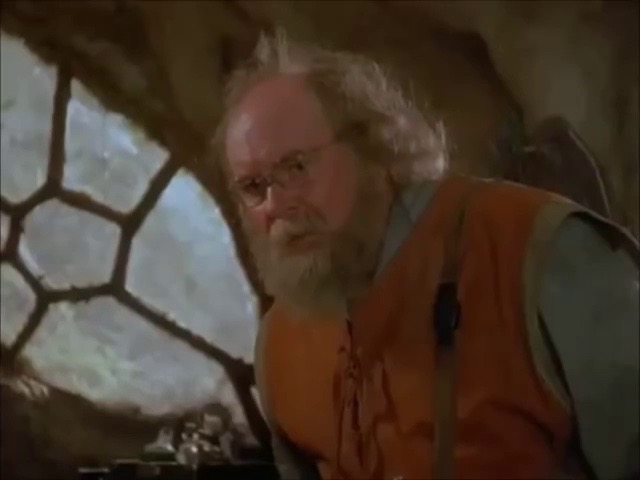
Yep, it’s Wilford Brimley. According to IMDb, he and the Wheats didn’t get along, so the production designer Joe Johnston directed all the scenes with Brimley. How did that work considering Brimley is in the majority of this film. Well, unfortunately Brimley did not bring Remo and Chiun with him. That would have made for a very short film.

A large chunk of this movie can now be described as Brimley talks to Cindel, the bad guys talk amongst themselves, and Brimley and crew decide to seek out the bad guys. Oh, and this happens.

vlcsnap-2015-12-16-13h32m50s356

Unfortunately, Chewbacca from The Star Wars Holiday Special isn’t around to tell little Cindel that something about this doesn’t smell right. Of course she pulls a switcharoo and kidnaps the kid.

vlcsnap-2015-12-16-13h33m44s513

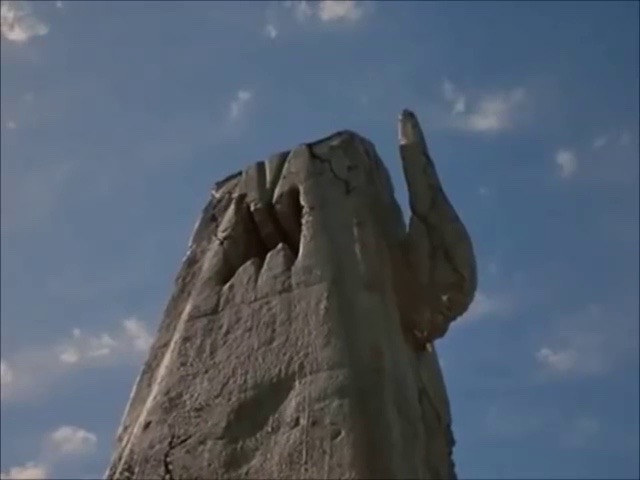
Now we get the annoying little creature, Wicket, and Brimley walking. For some reason we bump into a rock and get this shot of it.

vlcsnap-2015-12-16-13h39m31s750

Looks like a slot machine to me. They finally reach the evil castle, and after girl talk…

vlcsnap-2015-12-16-13h40m22s526

Brimley and crew scale the wall of the castle. Meanwhile, stuff is happening inside. Remember that whole Han and Greedo thing. Who shot first and all that. We can stop arguing about that. It’s time to start arguing over which one of these guys shot first.

vlcsnap-2015-12-16-14h21m19s918

There really isn’t much to talk about now because after they break the good guys (other Ewoks and Cindel) out of the castle, the rest of the film is a run and gun battle. At least this time Endor doesn’t scream Northern California like it did in The Ewok Adventure. Now shots like this just scream EBMUD watershed lands and Redwood Regional Park in the Oakland hills.

vlcsnap-2015-12-16-14h47m40s270

Eventually it all comes down to a battle between Brimley and the bad guy.

vlcsnap-2015-12-16-15h02m23s597

If you strike him down, he will become a more powerful spokesman for diabetes testing supplies then you can possibly imagine. But before that can happen, Wicket throws something that hits a thing on the bad guy’s chest and this happens to him.

vlcsnap-2015-12-16-15h04m20s530

With that done, it’s time for goodbyes and Brimley and Cindel leave the moon of Endor.

vlcsnap-2015-12-16-15h08m33s689

The question is whether this is any better than The Ewok Adventure. I would say no. Sure Wicket can talk, it feels more like we are on a foreign world, and there’s a lot more action to it, but that doesn’t make it better. The Ewok Adventure was a serviceable, but forgettable children’s sci-fi/fantasy adventure movie. This feels like they were contractually obligated to make a sequel so they threw together as generic a fantasy plot as possible and paid Brimley a few bucks to be in it. It’s super forgettable.

Now I just need to rewatch my childhood favorite Warwick Davis movie Willow (1988) and hope that The Force Awakens opens with Wicket pulling a Star Destroyer out of the sky using the force.