Today, the Shattered Lens wishes a happy birthday to director Amy Heckerling!
Today’s scene that I love comes from Amy Heckerling’s feature debut, 1982’s Fast Times At Ridgemont High. In just two minutes, Heckerling introduces us to almost all of the major characters, establishes the mall as the center of Ridgemont High culture, and leaves us with little doubt that we’ve entered a time machine and found ourselves in the 80s. Judge Reinhold looks like he’s on top of the world. Jennifer Jason Leigh bravely faces the pizza oven. Sean Penn makes us wish he had never lost his laid back stoner vibe. And the underrated Robert Romanus struts through the mall like a king overlooking his kingdom. With this scene, Heckerling announces that she has made the ultimate 80s high school film.
(And just a decade later, she would make the ultimate 90s high school film with Clueless.)
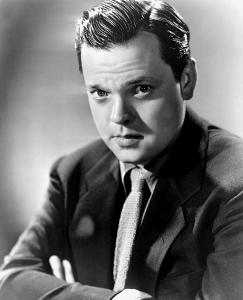
Orson Welles was fond of telling the story of how Franklin D. Roosevelt, shortly before his death, encouraged Welles to enter politics and run for Wisconsin’s U.S. Senate seat in 1946. Welles gave it some consideration but ultimately, he decided not to run. He was, after all, a movie star and, in the mid-40s, he had yet to be exiled from Hollywood.
Welles later said that a part of him regretted not running because, if he had, his opponent would have been Joseph McCarthy. Welles assumed that he would have easily beaten McCarthy and therefore, the McCarthy era never would have happened. Of course, the truth of the matter is that there’s no guarantee that Welles, as someone who had spent most of his life in New York and California, would have even won the Democratic primary, that Welles would have defeated McCarthy in the general, or that some other Senator wouldn’t have launched an anti-communist crusade in McCarthy’s place. But Orson Welles was never one for false modesty. That’s one thing that made him such an important and exciting filmmaker.
Welles also said that, despite his regrets, he was ultimately happy that he didn’t run because he would have felt the need to then run for President. President Welles! Imagine that. (Actually, it probably would have been a disaster but still …. President Orson Welles! If nothing else, a Welles presidential campaign would have spared America from having to look at Adlai Stevenson for two straight elections.)
Today’s scene that I love provides a glimpse of what an Orson Welles political campaign might have been like. In this scene, from 1941’s Citizen Kane, Charles Foster Kane runs for governor and gives the political speech of his life. Sadly, as we all know, Kane would never be governor and he would never again be as beloved by the masses as he was in this scene. Instead, he would die isolated, alone, and wishing for his childhood.
The great character actor Lance Henriksen is 84 years old today!
Ever since he made his film debut in 1970, the legendary Henriksen has played a collection of villains, bikers, police officers, soldiers, and even the occasional android. One of his earliest appearance was in 1975’s Dog Day Afternoon. His role is small but he definitely makes an impression. His faux friendly suggestions that Sal point his gun upwards is the line that sets off the film’s haunting ending. For viewers today, of course, we know that Sal and Sonny are screwed as soon as Lance Henriksen shows up outside of the bank.
In today’s scene that I love, Lance Henriksen does what only a great character actor can do. In less than a minute, he created a truly unforgettable character.
Today would have been the 95rd birthday of one of my favorite actresses, the wonderful Audrey Hepburn!
We’re all Audrey Hepburn fans here at the Shattered Lens. How could we not be? Long before she made her film debut, Audrey Hepburn literally risked her life as a part of the Dutch Resistance during World War II. After she retired from regularly appearing in the movies, she devoted herself to humanitarian causes and brought attention to the plight of refugees the world over. She was one of the greats and, for that reason, today’s scene that I love comes from one of her best films, 1967’s Two For The Road.
In this scene, Albert Finney and Audrey Hepburn play a married couple who discuss their troubled but loving marriage while on the road. This film features one Audrey’s best performances.
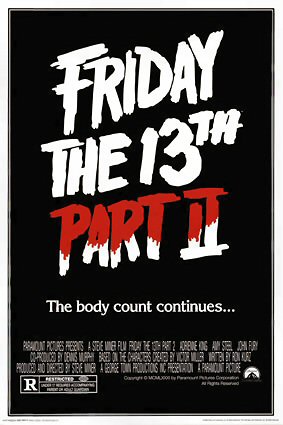
Today, the Shattered Lens wishes a happy birthday to Amy Steel, the actress who played Ginny, the strongest and most resourceful of all of the final girls to appear in the Friday the 13th franchise. Whenever I watch any of the Friday the 13th films, I always like to think that I would be Part 2’s Ginny, though I know, deep down, I would actually probably more likely be Part One’s Marci, getting stuck outside the rain in my underwear and somehow not hearing someone stepping up behind me with an axe.
Today’s scene that I love comes from Friday the 13th Part II. In this scene, Ginny proves herself to be the only camp counselor in history to be smart enough to confuse a backwoods vagrant who wears a flour bag over his head. This scene is one of the reasons why Ginny is one of the franchise’s most popular characters.
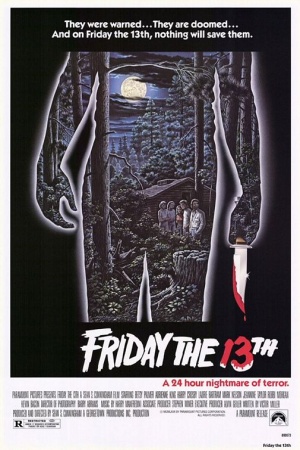
Today, the Shattered Lens wishes a happy 59th birthday to actor and musician Ari Lehman! Lehman made his debut in 1978’s Manny Orphans and so impressed director Sean S. Cunningham that Cunningham offered him a role in his next film. When Cunningham offered Lehman the role, he asked only one question. “Can you swim?”
At the age of 14, Ari appeared in Friday the 13th. He didn’t get much screen time but his performance and appearance as the young Jason Voorhees created a moment of fright that lives on today.
105 years ago, on this date, the great character actor Dan O’Herlihy was born in Wexford, Wexford County, Ireland.
O’Herlihy would have a long career as an actor, making his feature debut in 1947’s Odd Man Out and working steadily in film and television for the next 50 years. For modern viewers, he is perhaps best remembered for his role as The Old Man in the first two Robocop films and his performance as the sinister trickster, Conal Cochran, in 1982’s Halloween III: Season of the Witch.
Today’s scene that I love from from the latter film. O’Herlihy explains the mean of Halloween to a trapped Tom Atkins. O’Herlihy truly turned Conal Cochran into one of the great horror villains of the 80s and his performance is one of the main reasons that the rather oddball Halloween III retains a loyal audience to this day.
Today, the Shattered Lens wishes a happy birthday to the great Gal Gadot.
Perhaps not surprisingly, today’s scene that I love comes from the film that made Gadot a star worldwide, 2017’s Wonder Woman. Steve Trevor thinks that no one can cross No Man’s Land. Wonder Woman (played, of course, by Gal Gadot) is going to prove him wrong.
Reb Brown, the star of some of the loudest movies ever made, is 76 years old today but I bet he could still beat the evil doers and encourage us all by shouting, “Go! Go! Go!” A former college football player turned actor, Reb Brown holds the distinction of being one of the first actors to play Captain America and for also starring in classic films like Yor Hunter of the Future, Strike Commando and Strike Commando 2. Though he may not have ever become a household name, Reb Brown is a beloved figure amongst my circle of film-loving friends.
The scene below is from 1988’s Space Mutiny and it featured Reb doing what Red does best.
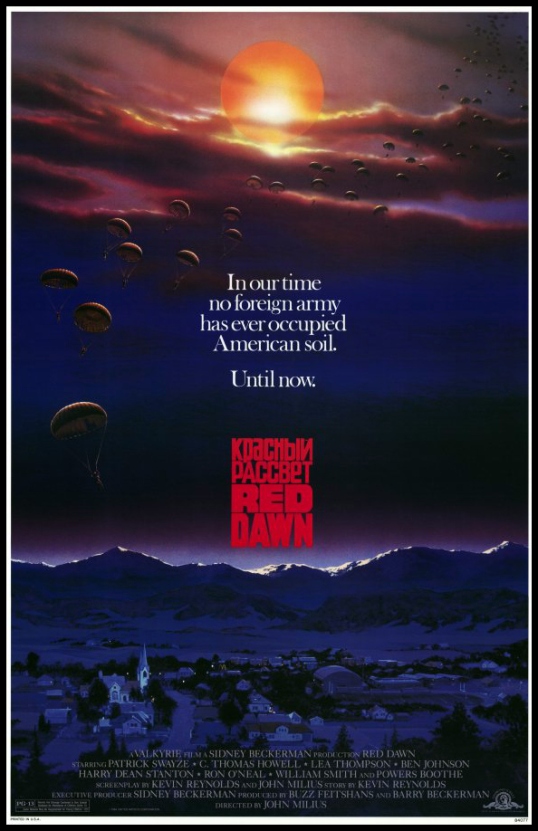
The original Red Dawn doesn’t get as much credit as it deserves.
It’s often described as just being an anti-communist film but actually, it’s a lot more complex than that. Yes, it’s about a group of teenagers who wage guerilla warfare against communist invaders. But it’s also about how those teenagers lose their innocence as a result and how they all come to realize that war is not as simple as they thought it was. The movie celebrates the Wolverines while also mourning that they were put in the position to have to risk and sacrifice their lives in the first place.
That’s what today’s scene that I love is all about. After they are tracked down and attacked by a group of Russian soldiers, the Wolverines discover that one of the original members of the group visited his father in town and was forced to swallow a tracking device. In this scene, the group is forced to deal with the reality of war. The fact that the traitor was a friend to all of them and popular enough to be president of his class just adds to the difficulty of emotionally processing with his betrayal. Patrick Swayze can’t bring himself to pull the trigger. C. Thomas Howell, on the other hand, is so quick to shoot his former friend that you realize just how consumed by hate he has become.
Today’s scene was directed by the brilliant John Milius.


 Through the Shattered Lens