Summer Rental (1985, directed by Carl Reiner)


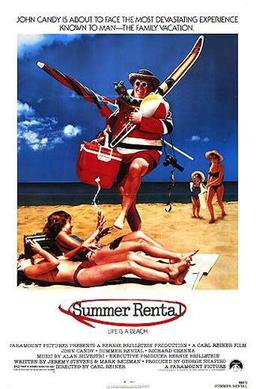
After a blow-up at work, air traffic controller John Chester (John Candy) is given five weeks of paid leave.  He takes his family to Florida, where they rent a beach house and discover that their summer town is controlled by snobbish sailing champion Al Pellett (Richard Crenna).  It’s the snobs vs slobs as Pellett tries to kick John and his family out of their summer rental and John tries to prove himself to his son and daughter (Joey Lawrence and Kerri Green) by winning the local sailing championship.  Luckily, John has Sully (Rip Torn), a modern-day pirate captain, on his side.

John Candy was a remarkable talent.  It’s just a shame that he didn’t appear in more good films.  He will always be remembered for films like Splash, Uncle Buck, Planes, Train, and Automobiles, and Only The Lonely but unfortunately, most of his starring roles were in lightweight, forgettable far like Summer Rental.  Candy is likable as John Chester and sympathetic even when he’s losing his temper over every minor inconvenience.  But the film itself never really does much to distinguish itself from all of the other 80s comedies about middle class outsiders taking on the richest man in town.  Candy is stuck playing a role that really could have been played by any comedic actor in 1985.  It’s just as easy to imagine Dan Aykroyd or even Henry Winkler in the role.  It feels like a waste of Candy.

The best thing about the film is Rip Torn’s performance as Sully.  Torn’s performance here feels like a dry run for his award-winning work as Artie on The Larry Sanders Show.  I would have watched an entire movie about Sully.  As it is, Summer Rental is inoffensive and forgettable.

The Boys In Company C (1978, directed by Sidney J. Furie)


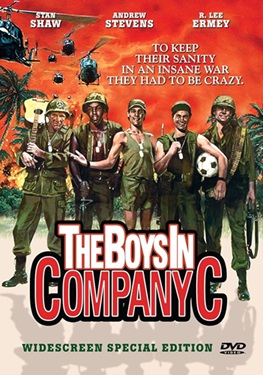
In 1967, a group of young men arrive at the Marie Corp. Recruit Depot in San Diego.  Tyrone Washington (Stan Shaw) is a drug dealer from Chicago who tells everyone not to mess with him and who soon emerges as a natural born leader.  Dave Brisbee (Craig Wasson) is a long-haired hippie who tried to feel to Canada and who shows up for induction in handcuffs.  Vinny Fazio (Michael Lembeck) is a cocky and streetwise kid from Brooklyn.  Billy Ray Pike (Andrew Stevens) is a country boy from Texas.  Alvin Foster (James Canning) is an aspiring writer who keeps a journal of his experiences.  Sgt. Loyce (R. Lee Ermey, making his film debut) molds them into a combat unit before they leave for Vietnam, where they discover that all of their training hasn’t prepared them for the reality of Vietnam.

The Boys In Company C has the same basic structure as Stanley Kubrick’s Full Metal Jacket, right down to R. Lee Ermey playing the tough drill sergeant.  The sharp discipline of basic training is compared to the chaos of Vietnam.  Ermey always said that he was playing a bad drill sergeant in Full Metal Jacket because he tore down the recruits but never bothered to build them back up.  In The Boys In Company C, Ermey plays a good drill sergeant, one who is tough but fair and who helps Washington reach his potential.  It doesn’t make any difference once the company arrives in Vietnam, though.  Both The Boys In Company C and Full Metal Jacket present the war in Vietnam as being run by a collection of incompetent officer who have no idea what it’s like for the soldiers who are expected to carry out their orders.

Of course, The Boys In Company C is nowhere near as good as Full Metal Jacket.  Full Metal Jacket was directed by Stanley Kubrick and it’s a chilling and relentless look at the horrors of combat.  The Boys In Company C was directed by Sidney J. Furie, a journeyman director who made a lot of movies without ever developing a signature style.  The basic training scenes are when the film is at its strongest.  When the company arrives in Vietnam, Furie struggles with the story’s episodic structure and it can sometimes be difficult to keep track of the large ensemble cast.  The Vietnam sequences are at their best when the emphasis is on the soldiers grumbling and bitching as their officers send them on one pointless mission after another.  The soccer game finale tries to duplicate the satire of the football game that ended Robert Altman’s M*A*S*H but it does so with middling results.  The Boys in Company C is a collection of strong moments that never manage to come together as a cohesive whole.

The movie is still important as one of the first major films to be made about the war in Vietnam.  However, it’s since been overshadowed by The Deer Hunter, Apocalypse Now, Platoon, and, of course, Full Metal Jacket.


Defiance (1980, directed by John Flynn)


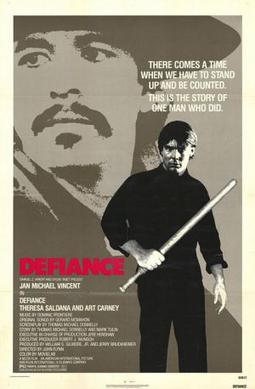
Serving out a six-month suspension, Merchant Seaman Tommy Campbell (Jan-Michael Vincent) rents an apartment on New York’s Lower East Side and passes the time painting and trying to learn Spanish in hope of getting assigned to a ship that is heading to Panama.

Tommy just wants to be left alone but he finds himself being drawn into the close-knit neighborhood.  He becomes friends with Carmine (Danny Aiello) and more than friends with his upstairs neighbor (Theresa Saldana).  He becomes a mentor to a street kid (Fernando Lopez) who lives with a punch-drunk boxer named called Whacko (Lenny Montana).  Abe (Art Carney), who owns the local bodega, agrees to let Tommy use his phone.

Tommy also finds himself drawing the attention of Angel Cruz (Rudy Ramos), head of the local street gang.  Tommy doesn’t want to get involved in any trouble.  He just wants to serve his suspension and sail to Panama.  But with Angel and his gang terrorizing the neighborhood and even robbing a church bingo game, Tommy and his friends finally stand up to the gang.

Defiance is more intelligent and realistic than many of the other urban vigilante movies that came out in the 70s and 80s.  Tommy never becomes a cold-blooded killer, like Charles Bronson did in the Death Wish films.  Instead, he spends most of the film trying to stay out of trouble and, when he does stand up for himself and the neighborhood, he does so realistically.  He fights the gang members but he doesn’t set out to the kill them.  About as deliberately destructive as he and Carmine get is that they destroy Angel’s car.  Rather than being a typical vigilante movie, Defiance is a portrait of a neighborhood where everyone takes care of everyone else.  Angel and his gang mistake the neighborhood’s kindness for weakness.  The neighborhood proves them wrong.

Defiance stars two actors who never quite got their due.  Theresa Saldana’s promising career was derailed when she was attacked and nearly killed by a deranged stalker in 1982.  Though she recovered and went on to do a lot of television, she never became the star that she should have.  Jan-Michael Vincent did become a star in the 70s and 80s but he later became better-known for his struggles with drugs and alcohol.  Both of them are very good in Defiance and leave you thinking about the careers that they could have had if things had just gone differently.

Late Night Retro Television Reviews: Baywatch Nights 1.3 “Silent Witness”


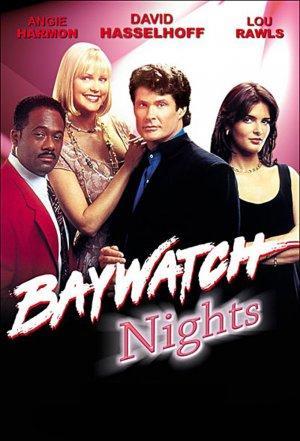
Welcome to Late Night Retro Television Reviews, a feature where we review some of our favorite and least favorite shows of the past!  On Tuesdays, I will be reviewing Baywatch Nights, an detective show that ran in Syndication from 1995 to 1997.  The entire show is currently streaming on Youtube!

This week, Mitch proves that he still has much to learn about being a private investigator.

Episode 1.3 “Silent Witness”

(Dir by Richard Friedman, originally aired on October 14th, 1995)

Have you ever wondered why Mitch’s career as a private investigator didn’t last longer than just two years?

The simple answer, of course, is that Baywatch Nights did not exactly get the best ratings and the show was canceled after two seasons.  Despite the fact that Baywatch Nights is an undeniably fun show, it was undoubtedly harmed by the fact that it didn’t feature lifeguards running in slow motion.  It was a Baywatch spin-off that had little of what attracted viewers to the original show.  Personally, I would think that the presence of David Hasselhoff would be enough but apparently, audiences in the 90s disagreed.

However, in-universe, I think Mitch’s failure to stick with the detective thing is that it doesn’t appear that he was very good at it.

Consider this episode.  Hayley Cartwright (Paige Moss) is a teenage runaway who, while walking along the beach, spots a man in the ocean being pulled under the water and drowned by someone wearing a diving outfit.  The murderer emerges from the ocean and tries to grab Haley.  Haley gets away but not before the killer shouts at her to keep quiet or she’ll be next.

Mitch, who is jogging across the beach, spots a stunned and bruised Haley collapsing on the beach.  Mitch checks out her injuries and assures her that she’s okay but Haley, who is understandably scared of everyone, runs away from him.

Later, Mitch is approached by a woman (Debby Boone) who says that her name is Lorraine and that she is Haley’s daughter.  Lorraine says that she just wants her daughter to come home and she asks Mitch to help find her.  Mitch agrees and sets out to find Haley while giving Lorraine regular updates.

Here’s what Mitch does not do.  He doesn’t bother to ask for any identification from Lorraine.  He doesn’t check out Lorraine’s story before agreeing to help her.  He doesn’t stop to consider that Haley might have a reason for acting like she’s scared for her life.  And really, it would have been good if Mitch had considered all of that because guess what?  LORRAINE IS NOT HALEY’S MOTHER!  Instead, she’s working with the killers!

Fortunately, Haley’s real mother (Janet Eilber) shows up and tells Ryan and Garner that she’s looking for her daughter.  Ryan and Garner actually ask the woman for identification and the woman reveals that she not only has her driver’s license but she also brought Haley’s birth certificate!  It’s a good thing that Haley’s real mom showed up because Mitch has found Haley hiding on a fishing boat and now, he’s having to defend her from the killers!  Now, fortunately, Mitch may not be a good detective but he’s still David Hasselhoff so he is able to beat up the killers and save Haley’s life.

It’s a fairly standard episode, in that it’s not particularly memorable but the California scenery is nice to look at and it’s a show you can relax with.  That said, the episode does have a brilliant opening, in which Mitch and Garner save Destiny from some bank robbers that are menacing her in an amusement park.  This leads to a fight on a Ferris wheel and a miracle-go-round.  Destiny is nearly run over by a miniature train!  It’s a fun and over-the-top sequence, one that has next to nothing to do with the rest of the episode but it does indicate that the people involved in the show knew better than to take any of this too seriously.

Finally, Ryan gets a minor plot, in which she buys a home in Malibu, just to discover that she’s basically purchased land in a trailer park.  It was silly but it showed off Angie Harmon and David Hasselhoff’s likable and playful chemistry.  Watching the two of them together, it’s hard not to regret that Mitch wasn’t a better detective.

Late Night Retro Television Reviews: Gun 1.1 “The Shot”


Welcome to Late Night Retro Television Reviews, a feature where we review some of our favorite and least favorite shows of the past!  On Tuesdays, I will be reviewing Gun, an anthology series that ran on ABC for six week in 1997.  The entire show is currently streaming on Tubi!

Produced by filmmaker Robert Altman, Gun was an anthology series that followed one gun from person-to-person.  Each week would feature a new cast and a new story.  The show itself didn’t catch on but, because of Altman’s prestige, is still managed to attract some prominent and interesting guest stars during it’s 6-episode run.

The first episode, for instance, brings the gun together with Daniel Stern, Ed Begley, Jr., and model Kathy Ireland.

Episode 1.1 “The Shot”

(Dir by James Foley, originally aired on April 12th, 1997)

The first episode of Gun opens with an unnamed dumbass purchasing a pearl-handed, .45 semi-automatic pistol.  When he takes it home, his kids are impressed but his wife threatens to kick him out if he ever fires the gun in the house.  Next thing you know, the dumbass is pretending to be Robert De Niro in Taxi Driver and pointing the gun at the television.  The final shoot-out from The Good, The Bad, and The Ugly leads to the TV getting shot.  The dumbass returns the gun.  Later, that night, someone breaks into the gun store and steals the gun.

Who stole it?  It turns out that it was just a guy who spends his time holding up convenience stores.  Unfortunately, his next attempt at a convenience store robbery does not go well, largely due to one aggravated customer.  Harvey Hochfelder (Daniel Stern) is already in an agitated state before the robbery even begins.  He just wants to leave Los Angeles for Virginia but, before he can leave, he had to stop off at the slowest convenience store in L.A.  Harvey loses it as soon as he realizes that the robbery is going to mean his escape to Virginia is going to be even further delayed.  When Harvey’s wife (Kathy Baker) enters the store, the robber is startled into first shooting at Harvey and then dropping the gun.  The robber runs outside and tries to steal Harvey’s car, with Harvey’s son and dog in the back seat.  Harvey grabs the gun and chases the robber down.  The robber crashes the car and Harvey holds him at gun point until the police arrive.

Harvey becomes a celebrity.  He even appears on the cover Newsweek, with the simple headline, “American Hero.”  Hollywood wants to make a made-for-TV movie about what happened in the convenience store, with Harvey playing himself and Kathy Ireland playing his wife.

Unfortunately, the friends of the robber are not happy that Harvey “fingered our homie” (yes, that’s actual dialogue) and they decide that they want to get revenge on Harvey.  When they force his car off the road and then pull guns of their own on him, Harvey diffuses the situation by offering them roles the movie.  Everyone wants to be a star!

Finally, the day of filming has arrived.  Under the guidance of the film’s director (Ed Begley, Jr.), Harvey prepares to climb into bed with a lingerie-clad Kathy Ireland….

Suddenly, Harvey is back in the convenience store, getting shot multiple times by the robber and expiring as a security camera records his final moments.  His entire time as a Hollywood star was just a dying fantasy which, honestly, was kind of obvious just by how cartoonish all of the Hollywood scenes were.

Well, as far as first episodes are concerned this was really, really …. bad.  Anthology shows are always a bit hit-and-miss and this episode was definitely almost all miss and no hit.  As good a character actor as he may be, Daniel Stern overacts to such an extent in this episode that it’s difficult to really have much sympathy for Harvey and the episode’s final twist largely fell flat.

The first episode of Gun is an almost entire …. dare I say it? …. misfire.