Lisa Marie Reviews An Oscar Nominee: King Richard (dir by Reinaldo Marcus Green)


The Slap.

Oh lord, the Slap.

I have to admit that I was hesitant about reviewing the 2021’s King Richard because the last thing that I wanted to do was talk about the moment that Will Smith slapped Chris Rock at the 2022 Oscar Ceremony.  That moment has been talked about and written about to death.  The last thing I want to do is rehash it but The Slap has actually overshadowed the Oscar that Smith won that night.  As King Richard was specifically made to win Smith that Oscar, the Slap has become a part of the film’s story.

For those who need to be reminded, Chris Rock was brought out on stage to introduce the presenters for Best Documentary Feature.  Rock did some material, which largely consisted of making jokes about the nominees in the audience.  Myself, I actually remember being a bit annoyed when Rock started in with his jokes because the ceremony was already boring enough without having to spend however long listening to Chris Rock go on about how Penelope Cruz losing Best Actress meant that Javier Bardem would be in trouble if he won Best Actor.  I had actually stopped paying attention when Rock made his now famous joke about Jada Pinkett Smith starring in G.I. Jane 2.  I did not see Pinkett role her eyes at Will when Will laughed.  I heard Rock say, “Uh-oh, here comes Richard,” but I initially missed the slap.  I hard the audience gasp.  I looked at the screen and I saw Smith yelling at Rock but the audio had been cut.  I had to go on YouTube to see an unedited clip of what happened.

Making the moment even more awkward was the knowledge that Will Smith would soon win his first Oscar for King Richard.  On Twitter, there were rumors that Smith had been escorted out of the theater but those turned out to be false.  After Smith was announced as the winner for Best Actor, I sat there and thought, “Oh no, he’s going to invoke God, isn’t he?”  Smith went on stage and promptly invoked God.

We all know what happened next.  For two weeks straight, the Slap discourse was nonstop.  Will Smith was described as being a bully, though I can only guess what we would have said about him if he hadn’t done anything in response.  (“Would you slap Chris Rock if he made fun of me?” I asked Jeff at one point.  Wisely, he promised he would.)  A lot of people predicted that Will Smith would never work again which, in retrospect, was a pretty stupid thing to predict.  America has forgiven its celebrities for a lot worse than just being a jackass at an awards ceremony.  Smith’s career has recovered just fine.  Quite frankly, no one is going to look at the trailer for a new Bad Boys or Men In Black movie and say, “But Will Smith slapped Chris Rock on national television.”

In the end, the most interesting thing about the Slap is that, before Chris Rock made that comment about Jada, the Oscars were supposed to be Will Smith’s greatest night.  From the minute the first trailer for King Richard dropped, it was obvious that the film was going to be the one the won Will Smith an Oscar.  It didn’t even matter whether or not he gave a good performance, though he does give a good one in the film.  The Academy will often decide that it’s an actor’s time and it was obvious that was what had been decided as far as Will Smith was concrned.  Will Smith had been a star for a long time.  He had made a lot of people a lot of money.  Before the Slap, the public perceived him as being a likable and goofy guy.  It was time to reward him.  From the start of 2021, everyone knew that Will Smith would be getting his Oscar.  For The Academy, it was also a chance to make up for not nominating him for his adequate if not particularly memorable performance 2015’s Concussion.  Smith not getting nominated for that film was often (incorrectly, I would argue) considered to be the starting point of the whole “#Oscarssowhite” movement.  (Personally, I would say the movement’s roots could actually be traced to Ava Duvernay not being nominated for directing Selma.)  Along with everything else, honoring Will Smith would be a way for the Academy to say, “See?  We learned our lesson!”

Will Smith does give a good performance in King Richard, playing Richard Williams, the father of Venus and Serena Williams (played, respectively, by Saniyya Sidney and Demi Singleton).  Smith does a good job of capturing both Richard’s stubbornness and his anger but, even importantly, he makes you believe that, as obsessed as he is with his daughters becoming champions, their will-being is still his main motivation and concern.  Richard and his daughters may go from practicing on dangerous courts at night to practicing at an exclusive Florida training center but, through it all, Richard always looks after his daughters.  Like 2024’s Saturday Night, this is a film where it’s important that the audience already knows what the future is going to hold for its main characters.  The coaches played by Tony Goldwyn and Jon Bernthal may not agree with Richard’s decision to keep his daughters out of the juniors tournaments but those of us watching know that Richard’s right and, as a result, we’re on his side.  Richard can be cantankerous and difficult.  We understand why his wife (Aunjanue Ellis-Taylor) get frustrated with him.  But, the important thing is that we know that he will be vindicated and Will Smith has such a likable screen presence that we root for Richard even when he’s acting like a jerk.

King Richard is not a bad sports films, though I do think there were other films more deserving of a Best Picture nomination in 2021.  (The Tragedy of MacBeth comes to mind.)  It’s unfortunate that Smith’s performance (which was so much better than his work in Concussion) will probably forever be linked to The Slap.  As for the film itself, it lost Best Picture to another heartwarming film, CODA.

Here Are the 2021 Nominations of the Washington D.C. Area Film Critics!


The Washington D.C. Area Film Critics have announced their nominees for the best of 2021!  The winners will be announced tomorrow so that means you have exactly one day to see all the nominees.  GET TO IT!

Best Film
Belfast
The Green Knight
The Power of the Dog
tick, tick…BOOM!
West Side Story

Best Director
Kenneth Branagh – Belfast
Jane Campion – The Power of the Dog
David Lowery – The Green Knight
Steven Spielberg – West Side Story
Denis Villeneuve – Dune

Best Actor
Nicolas Cage – Pig
Benedict Cumberbatch – The Power of the Dog
Andrew Garfield – tick, tick…BOOM!
Will Smith – King Richard
Denzel Washington – The Tragedy of Macbeth

Best Actress
Olivia Colman – The Lost Daughter
Nicole Kidman – Being the Ricardos
Lady Gaga – House of Gucci
Kristen Stewart – Spencer
Tessa Thompson – Passing

Best Supporting Actor
Jamie Dornan – Belfast
Ciarán Hinds – Belfast
Troy Kotsur – CODA
Jesse Plemons – The Power of the Dog
Kodi Smit-McPhee – The Power of the Dog

Best Supporting Actress
Caitríona Balfe – Belfast
Ariana DeBose – West Side Story
Ann Dowd – Mass
Kirsten Dunst – The Power of the Dog
Aunjanue Ellis – King Richard

Best Acting Ensemble
Belfast
The French Dispatch
The Harder They Fall
Mass
The Power of the Dog

Best Youth Performance
Jude Hill – Belfast
Emilia Jones – CODA
Woody Norman – C’mon, C’mon
Saniyya Sidney – King Richard
Rachel Zegler – West Side Story

Best Voice Performance
Awkwafina – Raya and the Last Dragon
Stephanie Beatriz – Encanto
Abbi Jacobson – The Mitchells vs. the Machines
Kelly Marie Tran – Raya and the Last Dragon
Jacob Tremblay – Luca

Best Original Screenplay
Kenneth Branagh – Belfast
Mike Mills – C’mon, C’mon
Zach Baylin – King Richard
Paul Thomas Anderson – Licorice Pizza
Fran Kranz – Mass

Best Adapted Screenplay
Siân Heder – CODA
Jon Spaihts and Denis Villeneuve and Eric Roth – Dune
Jane Campion – The Power of the Dog
Steven Levenson – tick, tick…BOOM!
Tony Kushner – West Side Story

Best Animated Feature
Encanto
Flee
Luca
The Mitchells vs. the Machines
Raya and the Last Dragon

Best Documentary
The First Wave
Flee
The Rescue
Summer of Soul (…Or, When the Revolution Could Not Be Televised)
Val

Best International/Foreign Language Film
Drive My Car
A Hero
Lamb
Titane
The Worst Person in the World

Best Production Design
Jim Clay, Production Designer; Claire Nia Richards, Set Decorator – Belfast
Patrice Vermette, Production Designer; Richard Roberts and Zsuzsanna Sipos, Set Decorators – Dune
Adam Stockhausen, Production Designer; Rena DeAngelo, Set Decorator – The French Dispatch
Tamara Deverell, Production Designer; Shane Vieau, Set Decorator – Nightmare Alley
Adam Stockhausen, Production Designer; Rena DeAngelo, Set Decorator – West Side Story

Best Cinematography
Haris Zambarloukos – Belfast
Greig Fraser – Dune
Andrew Droz Palermo – The Green Knight
Ari Wegner – The Power of the Dog
Bruno Delbonnel – The Tragedy of Macbeth

Best Editing
Úna Ní Dhonghaíle – Belfast
Joe Walker – Dune
Andrew Weisblum – The French Dispatch
Peter Sciberras – The Power of the Dog
Myron Kerstein & Andrew Weisblum – tick, tick…BOOM!

Best Original Score
Bryce Dessner & Aaron Dessner – Cyrano
Hans Zimmer – Dune
Alexandre Desplat – The French Dispatch
Jonny Greenwood – The Power of the Dog
Jonny Greenwood – Spencer

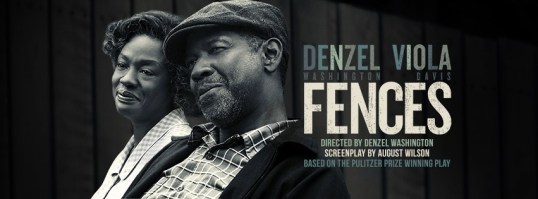
Playing Catch-Up: Fences (dir by Denzel Washington)


Well, 2016 is officially over and soon, it will be time for me to start posting my picks for the best of the year!  I’ve still got a lot of movies that I need to review (and, in some cases, watch) before making out that last so let’s not waste any time!  It’s time to start playing catch up!

fences

In Fences, Denzel Washington plays Troy Maxson.  When the film begins, Troy is 51 years old and lives in Philadelphia in the 1950s.  He’s a proud, charming, and often angry man.  He’s the type of man who can tell a wonderful story and who can make you laugh but, at the same time, you’re always aware that he could explode at any minute.  It’s hard not to like Troy Maxson but, at times, it’s hard not to be a little scared of him.

Troy is a garbage man, apparently destined to spend the rest of his working life hanging onto the back of a garbage truck because his union does not allow black to drive the trucks.  Troy has recently complained about the lack of black drivers and, as he tells his best friend, Bono (Stephen McKinley Henderson), he’s now expecting to be disciplined.  However, to his great surprise, he is instead reassigned to be a driver, making him the first black man to work as a driver for the Philadelphia Sanitation Department.

And that may not seem like much today but, as the film makes clear, that was a huge deal in the 1950s.

Troy, of course, didn’t grow up wanting to be a garbage man.  As he tells his son, Troy left home when he was just a teenager and made his living as a mugger.  During one robbery, he accidentally killed a man and spent the next decade in prison.  It was in prison that he first met and befriended Bono.  It was also in prison that Troy discovered that he was a pretty good baseball player.  Upon his release, he played for the Negro League.  Though everyone agrees that Troy was a good player (and Troy is always quick to claim that he was the best), he never played for the Major Leagues.  The film suggests that, after the league was integrated, Troy tried out but was rejected.  His wife, Rose (Viola Davis), says that Troy was rejected because, at the age of 40, he was too old.  Troy says it was because of the color of his skin.

As I said, it’s hard not to admire Troy.  He’s a man who stands up for himself and he seems to sincerely love his wife.  When his oldest son, a musician named Lyons (Russell Hornsby), comes by to ask for money, it’s hard not to laugh with and appreciate the style with which Troy shows his irritation.  Troy is so charming that, it’s only after Lyons leaves, that you realize that Lyons practically begged his father to come see him play and Troy pretty much blew him off.

And then there’s Troy’s youngest son, Cory (Jovan Adepo).  Cory is in high school.  He’s a football player and he’s recently been scouted by a college.  Troy tells Cory that he’s wasting his time and that no black man will ever be given a fair chance in the NFL.  He tells Cory that he needs to get a real job, like he did.  And as Troy continues to yell at Cory, you start to understand Troy’s jealousy.  Cory has an opportunity that Troy will never have, not due to any difference in talent as much as to the fact that Troy grew up at a time when segregation was the unquestioned law of the land whereas Cory is coming of age the beginning of the civil rights era.

At one point, Cory asks his father, “Why don’t you like me?”

“I don’t have to like you,” Troy replies and the words sting.

Troy is a character about whom you’ll have mixed feelings.  Beyond his anger at his son, he’s also exploiting his mentally impaired brother, Gabe (Mykelti Williamson).  Gabe has a metal plate in his head, the result of his service in World War II.  Gabe receives a monthly disability check and Troy has been using that money to support his family.

Through it all, Rose remains by his side, listening to him when he’s angry and, whenever she can get a word in, acting as his conscience.  But then, Bono asks Troy about his relationship with Alberta, the new girl at work and Troy confesses what the audience suspected.  Not only is Troy cheating on his wife but Alberta is pregnant….

Troy is a great character and Denzel Washington gives perhaps his best film performance in the role.  (Washington already played the role on stage.)  In many ways, Troy is a monster but, at the same time, it’s impossible not to feel for him.  His anger is real.  His selfishness is all too real.  But his pain and his (legitimate) frustrations are very real, as well.  Troy Maxson is a character who, like everyone, struggles to maintain his balance as he walks the line between right and wrong.  He makes several mistakes but he’s never less than fascinating and Washington’s volcanic performance is never less than enthralling.  Matching Washington every step of the way is Viola Davis, giving a powerful performance as the loyal but outspoken Rose.

In fact, the entire film is a master class of great acting.  (If Mykelti Williamson occasionally goes a bit overboard as Gabe, that has more to do with the character than the performer.)  Though the film is dominated by Washington and Davis, I think special mention has to be made of Stephen McKinley Henderson, who brings a lot of understated wisdom to the role of Bono.

Denzel Washington also directed Fences and, unfortunately, he’s not as good a director as he is an actor.  While he goes get brilliant performances from his cast, Fences never really breaks free from its theatrical origins.  It’s very much a filmed play as opposed to a cinematic work of art and, the few scenes that attempt to “open up” the play feel somewhat awkward.  In the end, Fences is best as a record of incredible acting.