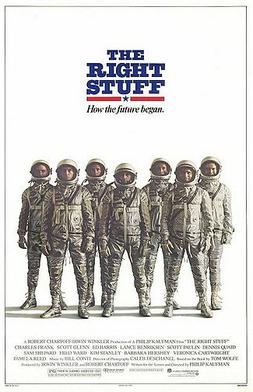
Lisa Marie Reviews An Oscar Nominee: The Right Stuff (dir by Philip Kaufman)


There’s a brilliant scene that occurs towards the end of 1983’s The Right Stuff.

It takes place in 1963.  The original Mercury astronauts, who have become a symbol of American ingenuity and optimism, are being cheered at a rally in Houston.  Vice President Lyndon Johnson (Donald Moffat) stands on a stage and brags about having brought the astronauts to his supporters.  One-by-one, the astronauts and their wives wave to the cheering crowd.  They’re all there: John Glenn (Ed Harris), Gus Grissom (Fred Ward), Alan Shephard (Scott Glenn), Wally Schirra (Lance Henrisken), Deke Slayton (Scott Paulin), Scott Carpenter (Charles Frank), and the always-smiling Gordon Cooper (Dennis Quaid).  The astronauts all look good and they know how to play to the crowd.  They were chosen to be and sold as heroes and all of them have delivered.

While the astronauts are celebrated, Chuck Yeager (Sam Shepard) is at Edwards Air Force Base.  Yeager is the pilot who broke the sound barrier and proved that the mythical “demon in the sky,” which was whispered about by pilots as a warning about taking unnecessary risks, was not waiting to destroy every pilot who tried to go too fast or too high.  Yeager is considered by many, including Gordon Cooper, to be the best pilot in America.  But, because Yeager didn’t have the right image and he had an independent streak, he was not ever considered to become a part of America’s young space program.  Yeager, who usually holds his emotions in check, gets in a jet and flies it straight up into the sky, taking the jet to the edge of space.  For a few briefs seconds, the blue sky becomes transparent and we can see the stars and the darkness behind the Earth’s atmosphere.  At that very moment, Yeager is at the barrier between reality and imagination, the past and the future, the planet and the universe.  And watching the film, the viewer is tempted to think that Yeager might actually make it into space finally.  It doesn’t happen, of course.  Yeager pushes the jet too far.  He manages to eject before his plane crashes.  He walks away from the cash with the stubborn strut of a western hero.  His expression remains stoic but we know he’s proven something to himself.  At that moment, the Mercury Astronauts might be the face of America but Yeager is the soul.  Both the astronauts and Yeager play an important role in taking America into space.  While the astronauts have learned how to take care of each other, even the face of government bureaucracy and a media that, initially, was eager to mock them and the idea of a man ever escaping the Earth’s atmosphere,  Chuck Yeager reminds us that America’s greatest strength has always been its independence.

Philip Kaufman’s film about the early days of the space program is full of moments like that.  The Right Stuff is a big film.  It’s a long film.  It’s a chaotic film, one that frequently switches tone from being a modern western to a media satire to reverent recreation of history.  Moments of high drama are mixed with often broad humor.  Much like Tom Wolfe’s book, on which Kaufman’s film is based, the sprawling story is often critical of the government and the press but it celebrates the people who set speed records and who first went into space.  The film opens with Yeager, proving that a man can break the sound barrier.  It goes on to the early days of NASA, ending with the final member of the Mercury Seven going into space.  In between, the film offers a portrait of America on the verge of the space age.  We watch as John Glenn goes from being a clean-cut and eager to please to standing up to both the press and LBJ.  Even later, Glenn sees fireflies in space while an aborigines in Australia performs a ceremony for his safety.  We watch as Gus Grissom barely survives a serious accident and is only rescued from drowning after this capsule has been secured.  The astronauts go from being ridiculed to celebrated and eventually respected, even by Chuck Yeager.

It’s a big film with a huge cast.  Along with Sam Shepherd and the actors who play the Mercury Seven, Barbara Hershey, Pamela Reed, Jeff Goldblum, Harry Shearer, Royal Dano, Kim Stanley, Scott Wilson, and William Russ show up in roles both small and large.  It can sometimes be a bit of an overwhelming film but it’s one that leaves you feeling proud of the pioneering pilots and the brave astronauts and it leaves you thinking about the wonder of the universe that surrounds our Earth.  It’s a strong tribute to the American spirit, the so-called right stuff of the title.

The Right Stuff was nominated for Best Picture but, in the end, it lost to a far more lowkey film, 1983’s Terms of Endearment.  Sam Shepard was nominated for Best Supporting Actor but lost to Jack Nicholson.  Nicolson played an astronaut.

Lisa Reviews a Palme d’Or Winner: Paris, Texas (dir by Wim Wenders)


With the 2022 Cannes Film Festival coming to a close in the next few days, I’ve been watching some of the films that previously won the prestigious Palme d’Or.  They’re an interesting group of films.  Some of them have been forgotten.  Some of them are still regarded as classics.  Some of them definitely deserve to be seen by a wider audience.  Take for the instance that winner of the 1984 Palme d’Or winner, Paris, Texas. This is a film that is well-regarded by cineastes but it definitely deserves to be seen by more people.

Though released in 1984, Paris, Texas opens with an image that will resonate for many viewers today.  A dazed man stumbles through the desert while wearing a red baseball cap.  Though the cap may not read “Make America Great Again,” the sight of it immediately identifies the owner as being a resident of what is often dismissively referred to as being flyover country, the long stretch of land that sits between the two coasts.  Travis (Harry Dean Stanton) is lost, both figuratively and literally.  After he stumbles into a bar and collapses, he’s taken to a doctor (played by German film director Bernhard Wicki) who discovers that Travis has a phone number on him.  When the doctor calls the number, he speaks to Travis’s brother, Walt (Dean Stockwell).  Walt has not seen Travis for three years and the viewer gets the feeling that Walt spent those years assuming that Travis was dead.  Walt agrees to travel to West Texas to retrieve his brother and take him back to Los Angeles.

When Walt retrieves his brother, he’s annoyed that Travis refuses to explain where he’s been for the past three years.  In fact, for the first fourth of the film, Travis doesn’t say anything.  He just stares into space.  Finally, when he does speak, it’s to tell Walt that he wants to go to Paris.  Walt tells him that going to Paris might have to wait.  Travis elaborates that he wants to go to Paris, Texas.  He owns an empty parking lot in Paris, Texas.

It takes a while to learn much about Travis’s past.  Like many of Wim Wenders’s films, Paris, Texas moves at its own deliberate pace and it features characters who tend to talk around their concerns instead of facing them head-on.  What we do eventually learn is that Travis has a son named Hunter (Hunter Black).  Travis’s wife, Jane, (played by Natassja Kinski) disappeared first.  Travis disappeared afterwards, leaving Walt and his wife (Aurore Clement) to raise his son.  At first, when Travis arrives in Los Angeles, he struggles to reconnect with Hunter but eventually, he does.  He tries to be a father but, again, he sometimes struggles because, while Travis has a good heart, he’s also out-of-step with the world.

As for Jane, we eventually learn that she’s in Houston.  She’s working in a tacky sex club, one where the customers and the strippers are separated by a one-way mirror.  The customer can see and talk to the stripper but the stripper can’t see the customers.  It’s all about manufactured intimacy.  The customer can delude themselves into thinking that the woman is stripping just for him while the woman doesn’t have to see the man who is watching her.  There are no emotions to deal with, just the illusion of a connection.

Even as Travis begins to make a life for himself in Los Angeles, he finds himself tempted to return to Houston to search for his wife….

As I said, Paris, Texas is a deliberately paced film.  With a running time of 2 hours and 20 minutes, it feels like it’s actually three films linked together.  We start with Travis and Walt traveling back to Los Angeles.  The second film deals with Travis’s attempts to bond with his son.  And the third and most powerful film is about what happens when Travis finally finds Jane.  It all comes together to form a deceptively low-key character study of a group of lost souls, all of whom are dealing with the mistakes of the past and hoping for a better future.  The film’s most memorable moment comes when Travis delivers a long and heartfelt monologue about his marriage to Jane.  Beautifully written by Sam Shephard (who co-wrote the script with L.M. Kit Carson) and wonderfully acted by Harry Dean Stanton, it’s a monologue about regret, guilt, forgiveness, and ultimately being cursed to wander.

Despite the heavy subject matter, Paris, Texas is an undeniably joyful film.  In a rare leading role, Harry Dean Stanton plays Travis as someone who is full of regrets but who, at the same time, retains a spark of hope and optimism.  Life has beaten him down but he has yet to surrender.  Once he reaches Los Angeles and Travis starts to fully come out of his fugue state, there’s a playful energy to Stanton’s performance.  The scene where he dresses up as what he thinks a dad should look like is a highlight.  For Travis, being a responsible adult starts with putting on a suit and walking his son home from school.  Stanton’s excellent performance is matched by good work from Dean Stockwell and, especially, Natassja Kinski.

Visually, the film is all about capturing the beauty and the peculiarity of the landscape of the American southwest.  Like many European directors, Wim Wenders seems to be a bit in love with the combination of rugged mountains and commercialized society that one finds while driving through the west.  In the scenes in which Stanton wanders through West Texas, the landscape almost seems like it might consume him and, later, in Los Angeles and Houston, the garishness of the city threatens to do the same.  Wherever he is, Travis is slightly out-of-place and the viewer can understand why Travis is compelled to keep wandering.  At times, it seems like Travis will never fit in anywhere but the fact that he never gives up hope is comforting.  In many ways, Travis’s own journey mirrors Stanton’s career in Hollywood.  He had the talent of a leading man but the eccentric countenance of a great character actor.  He may have never been quite fit in with mainstream Hollywood but he never stopped acting.

The film itself never visits Paris, Texas.  Travis just talks about the fact that he owns an empty lot in the town and that he would like to see it.  Still, I like to think Travis eventually reached Paris and I like to think that he did something wonderful with that lot.

Film Review: Frances (dir by Graeme Clifford)


https://www.youtube.com/watch?v=eilqT7dLoBY

Frances Farmer is one of the more tragic figures to come out of Hollywood’s Golden Age.

A talented and beautiful actress, Frances Farmer came out to Hollywood in the 30s and quickly developed a reputation for being difficult.  She was politically outspoken at a time when stars were expected to either be apolitical or unquestioningly patriotic.  She criticized scripts.  She argued with directors and studio heads.  She had a well-publicized affair with communist playwright Clifford Odets and she also had numerous run-ins with the police.  Some say that she was alcoholic.  Some say that she was bipolar.  Some say that she had a mental collapse as the result of the pressure that her mother put on her to succeed.  Frances Farmer ended up in mental institution, where she was subjected to shock therapy.  After she was released, her film career was basically over, though she did end up hosting a local television program.  She died in 1970, reportedly alone and struggling to make ends meet.  In a posthumously published autobiography called Will There Ever Be A Morning?, she wrote that she was beaten, sexually abused, and eventually given a lobotomy while she was institutionalized.  Over the years, there’s been a lot of doubt about whether or not Farmer was actually lobotomized but there is no doubt that Farmer was a woman who was ultimately punished for being ahead of her time.  Frances Farmer refused to conform to the safe manufactured image that Hollywood prepared for her and, for that, she was nearly destroyed.

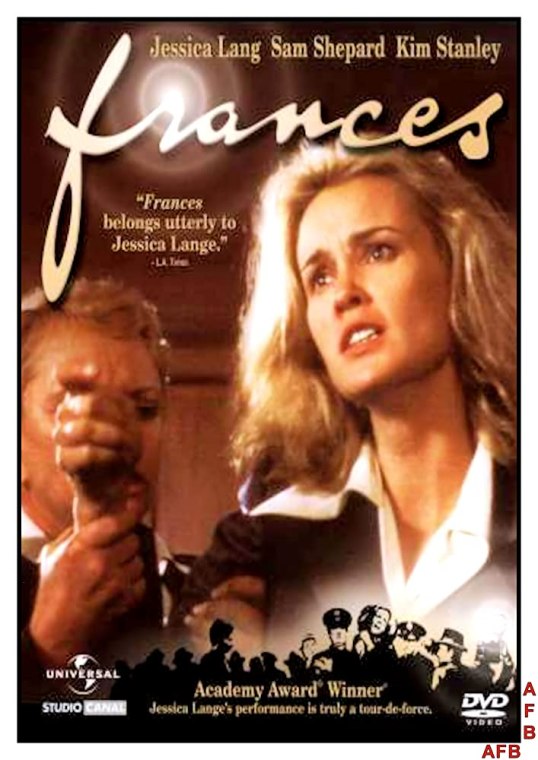
The 1983 film, Frances, is a biopic of Frances Farmer, starring Jessica Lange as Frances and Kim Stanley as her domineering mother.  It opens with Frances writing a school essay about why she’s an atheist and it ends with her smiling blankly at a television camera, her independent spirit broken by a lobotomy.  In between, we watch as Frances goes to Hollywood and has a self-destructive affair with Clifford Odets (played by Jeffrey DeMunn).  The infamous moment when Frances was dragged out of a courtroom while screaming at the judge is recreated and Frances’s time in the institution is depicted in Hellish detail.

We also learn about Frances’s relationship with a communist writer named Alvin York (Sam Shepard).  It seems like whenever Frances needs to be rescued or just needs someone to talk to, Alvin York pops up.  In fact, you could almost argue that York pops up too often.  Alvin York was a fictional character, one who was apparently created in order for audiences to have someone to relate to.  It’s unfortunate that the film felt that the audience would only be able to relate to Frances if it viewed her life through the eyes of a fictional character because York’s character is a bit of a distraction.  Sam Shepard does a good job of playing him and I certainly wasn’t shocked to learn that Sam Shepard and Jessica Lange were romantically involved during the filming of Frances (and for a long time afterwards) because Lange and Shepard do have a very real chemistry.  However, from a narrative point of view, Alvin York only works as a character if one accepts that he’s a figment of Frances’s imagination.  The film’s insistence that York is an actual person who just happens to show up at every important moment of Frances’s life just doesn’t work.

What does work is Jessica Lange’s performance.  Lange is amazing in the role of Frances, whether she’s playing Frances as a hopeful idealist, an out-of-control rebel, or, tragically, as a glass-eyed zombie who has been reduced to appearing on television and assuring audiences that her rebellious days are over.  Lange was nominated for Best Actress for Frances.  She lost to Meryl Streep for Sophie’s Choice.  I’ve seen Sophie’s Choice and Meryl was good but Jessica was better.

Frances was originally offered to David Lynch.  He turned the film down so he could work on Dune and instead, the film was directed by Graeme Clifford, who takes a far more straight-forward approach to the material than Lynch would have.  Still, Lynch’s interest in Frances Farmer would later lead to him working on stories that centered around a “woman in trouble.”  One of those stories became Twin Peaks.  Another would become Mulholland Drive.

Film Review: Hamlet (dir by Michael Almereyda)


What if Hamlet was a hipster douchebag?

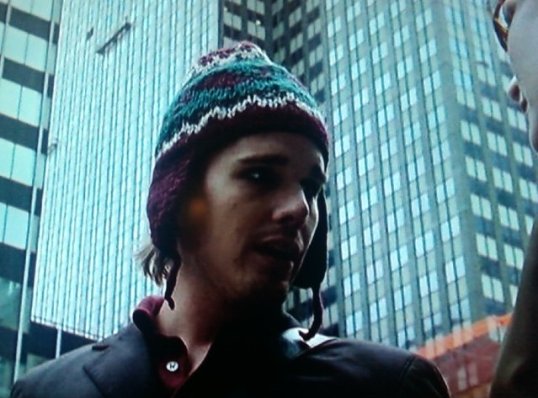
That appears to be the question at the heart of the 2000 film adaptation of William Shakespeare’s most famous play.  In this adaptation, a young Ethan Hawke plays a Hamlet who is no longer a melancholy prince but who is instead a film student with a petulant attitude.

As you probably already guessed, this is one of those modern day adaptations of Shakespeare.  Denmark is now a Manhattan-based corporation.  Elsinore is a hotel.  Hamlet ponders life while wandering around a Blockbuster and, at one point, the ghost of his father stands in front of a Pepsi machine.  While Shakespeare’s dialogue remains unchanged, everyone delivers their lives while wearing modern clothing.  It’s one of those things that would seem rather brave and experimental if not for the fact that modern day versions of Shakespeare have gone from being daring to being a cliché.

At the film’s start, the former CEO of the Denmark Corporation has mysteriously died and his brother, Claudius (Kyle MacLachlan), has not only taken over the company but he’s also married the widow, Gertrude (Diane Venora).  Hamlet comes home from film school, convinced that there has been a murder and his suspicions are eventually confirmed by the ghost of his father (Sam Shepard).  Meanwhile, poor Ophelia (Julia Stiles) takes pictures of flowers while her brother, Laertes (Liev Schreiber), glowers in the background.  Polonius (Bill Murray) offers up pointless advice while Fortinbras (Casey Affleck) is reimagined as a corporate investor and Rosencrantz (Steve Zahn) wears a hockey jersey.  Hamlet spends a lot of time filming himself talking and the Mousetrap is no longer a player but instead an incredibly over-the-top short film that will probably remind you of the killer video from The Ring.

I guess a huge part of this film’s appeal was meant to be that it featured a lot of people who you wouldn’t necessarily think of as being Shakespearean actors. Some of them did a surprisingly good job.  For instance, Kyle MacLachlan was wonderully villainous as Claudius and Steve Zahn was the perfect Rosencrantz.  Others, like Diane Venora and Liev Schreiber, were adequate without being particularly interesting.  But then you get to Bill Murray as Polonius and you start to realize that quirkiness can only take things so far.  Murray does a pretty good job handling Shakespeare’s dialogue but that doesn’t change the fact that he’s totally miscast as the misguided and foolish Polonius.  One could easily imagine Murray in the role of Osiric.  Though it may initially seem a stretch, one could even imagine him playing Claudius.  But he’s simply not right for the role of Polonius.  Murray’s screen presence is just too naturally snarky for him to be convincing as a character who alternates between being a “tedious, old fool” and an obsequious ass kisser.

Considering that he spends a large deal of the movie wearing a snow cap while wandering around downtown Manhattan, Ethan Hawke does a surprisingly good job as Hamlet.  Or, I should say, he does a good job as this film’s version of Hamlet.  Here, Hamlet is neither the indecisive avenger nor the Oedipal madman of previous adaptations.  Instead, he’s portrayed as being rather petulant and self-absorbed, which doesn’t necessarily go against anything that one might find within Shakespeare’s original text.  Hawke’s not necessarily a likable Hamlet but his interpretation is still a credible one.

At one point, while Hamlet thinks about revenge, we see that he’s watching Laurence Olivier’s version of Hamlet on television.  There’s Olivier talking to Yorick’s skull while Hawke watches.  It’s a scene that is somehow both annoying and amusing at the same time.  On the one hand, it feels rather cutesy and more than a little pretentious.  At the same time, it’s so over-the-top in its pretension that you can’t help but kind of smile at the sight of it.  To me, that scene epitomizes the film as a whole.  It’s incredibly silly but it’s so unapologetic that it’s easy to forgive.

Lisa Recommends Fool For Love (dir by Robert Altman)


As the day draws to a close, I’m going to recommend one final film.

It’s not, by any means, a perfect film.  In fact, it’s pretty damn imperfect.  It’s a film that occasionally tries too hard to be profound.  It’s based on a play and it never quite escapes its theatrical origins.  What was undoubtedly exciting on the stage, drags a bit on the screen.  It’s a fairly obscure film.  I just happened to catch it on This TV a month ago and the main reason that I watched it was because of the cast.

But no matter!  I still think you should watch this film if you get a chance.

The name of that film is Fool For Love.

First released in 1985 and based on a play by Sam Shepard, Fool For Love takes place over the course of one long night at a motel in the Southwest.  Staying at the motel is May (Kim Basinger), who is hoping to escape from her past.  Not eager to allow her to escape is her former lover, Eddie (Sam Shepard).  An aging cowboy, Eddie shows up at the motel and tries to convince May to return with him to his ranch.  As they argue, clues are dropped to the terrible secret that haunts their past.  Martin (Randy Quaid), a buffoonish but well-meaning “gentleman caller,” shows up to take May on a date and finds himself sucked into the drama between her and Eddie.

Meanwhile, on the edge of every scene, there’s the Old Man (Harry Dean Stanton).  The Old Man watches Eddie and May and offers up his own frequently sarcastic commentary.  It becomes obvious that he not only knows about the secret in their past but that he’s determined that they not get together.  Is the Old Man really there or is he just a figment of everyone’s imagination or is he something else all together?

As I said earlier, the film never quite escapes its theatrical origins.  As well, while Shepard and Kim Basinger both give authentic and charismatic performance, they don’t quite have the right romantic chemistry to really convince us that Eddie would chase May all the way to that isolated motel.  It’s hard not to feel that if May had been played by Shepard’s then-partner Jessica Lange or his Right Stuff co-star, Barbara Hershey, the film would have worked better.

And yet, even if it never comes together as a whole, Fool For Love is a film that should be seen just for its display of individual talent.  Of the film’s five main creative forces, only Kim Basinger is still with us.  Director Robert Altman died in 2006 while Sam Shepard and Harry Dean Stanton both passed away in 2017.  While Randy Quaid is still alive, it’s doubtful he’ll ever again get the type of roles that earlier established him as one of America’s best character actors.  Whenever I read another snarky article about Quaid hiding out in Vermont and ranting about the “star whackers,” I can’t help but sadly think about the perfect performances that Quaid used to regularly give in imperfect films like this one.

So, definitely track down Fool For Love.  Watch it and pay a little tribute to all of the wonderful talent that we’ve lost over the last 10 or so years.  Watch it for Robert Altman’s ability to turn kitsch into art.  Watch it for the rugged individualism of Sam Shepard and the once-empathetic eccentricity of Randy Quaid.  Watch it for Harry Dean Stanton, the legendary actor who, more than any other performer, seemed to epitomize the southwest and Americana.

Watch it and spare a little thought for all of them.

Lisa’s Homestate Reviews: Arkansas and Mud


Mud

When it comes to Arkansas, people seem to automatically think of two things.  Arkansas is the former home of Bill and Hillary Clinton and it’s also the state that accused three teenage boys of committing horrific acts of murder, largely on the basis of the fact that one of the boys used to dress in black and listen to heavy metal music.  Between the state’s largely rural image and repeat showings of Paradise Lost on HBO, Arkansas does not exactly have the best reputation.

Myself, I have a lot of childhood memories of Arkansas.  Some of them are good and some of them aren’t so good. My grandmother lived in Fort Smith so, even when my family was living in another state, we would still always find the time to come visit her every summer.  As well, I had (and still have) cousins spread out all over the state.  Almost every road trip that I’ve ever taken has involved at least a few stops in Arkansas.  When I think about Arkansas, I don’t think about the Clintons or Damien Echols.  Instead, to me, Arkansas is where I used to get excited whenever I saw we were approaching grandma’s house and where my mom once grabbed me right before I stepped on a snake that was hidden in the high grass that surrounded my cousin’s farm.

As often as I visited Arkansas while I was growing up, I also actually lived there twice.  I don’t remember the first time, because I was only two years old at the time, but my family spent 3 months living in Ft. Smith before going back to Texas.  Then five years later, we returned to Arkansas and, over the course of 19 months, we lived in Texarkana, Fouke, Van Buren, North Little Rock, and, finally, Ft. Smith once again.

Originally, for Arkansas, I was planning on reviewing The Legend of Boggy Creek, a 1974 psuedo-documentary that deals with a bigfoot-like creature that was said to live near the town of Fouke.  It made perfect sense as not only was The Legend of Boggy Creek filmed in Arkansas but it was produced by an Arkansan as well.  It remains one of the most financially successful independent films of all time and, because it’s presented as being a documentary, it features authentic Arkansans in the cast.  Even more importantly, my family actually lived in Fouke from August of ’93 to May of ’94.  I’ve been down to Boggy Creek!  (Though, to the best of my memory, the monster never made an appearance while we were living in Fouke.)

But then I thought about it and something occurred to me.  The Legend of Boggy Creek is not that good of a movie.  I watched it a few weeks ago and, once I got passed the fact that it was filmed in a town that I have vague memories of living in back when I was seven years old, I found the film itself to be almost unbearably dull.

So, instead of unleashing my snark on a 40 year-old exploitation film, I’m going to use this opportunity to recommend another film that was shot in Arkansas.  This film, however, was one of the best films of 2013.  It’s a film that, if you haven’t watched it yet, you owe it to yourself to see.

It’s a film called Mud.

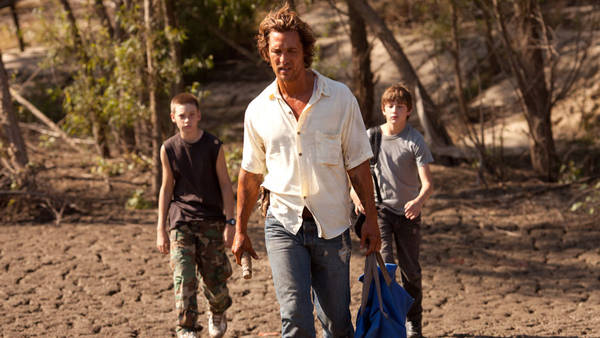
Directed by Jeff Nichols (who previously gave us the excellent Take Shelter), Mud takes place in the town of DeWitt, Arkansas.  Two teenage boys, Ellis (Tye Sheridan) and Neckbone (Jacob Lofland) spend their days going up and down the Arkansas River.  Ellis, the more introspective of the two, dreams of escaping his homelife with an abusive father (Ray McKinnon) and a compliant mother (Sarah Paulson).  Quietly watching over the two boys is Tom (Sam Shepard), an enigmatic older man who lives across the river from Ellis’s family.

One day, Ellis and Neckbone come across a mysterious man living on a small island.  The man’s name is Mud (Matthew McConaughey) and he tells them that he’s waiting for his girlfriend, Juniper (Reese Whitherspoon).  Mud explains that he killed a man who once pushed her down a flight of stairs while she was pregnant.  Ellis and Neckbone agree to help Mud, secretly supplying him with food and delivering notes from him to Juniper.

However, the father (Joe Don Baker) of the man who Mud killed has arrived in town as well.  He’s brought an army of mercenaries with him and, each morning, he gathers them together for a quick prayer and then sends them out to track down and kill Mud…

Mud is a wonderful film, one that is full of visually striking images and excellent performances.  (If Dallas Buyers Club hadn’t come out later that same year, Matthew McConaughey could have just as easily been nominated for his charismatic and sympathetic performance here.)  Even more importantly, the film is full of authentic local culture and color.  If, decades from now, someone asked me what Arkansas was like in the early 21st Century, Mud is the film that I would show them.

Much as how Richard Linklater can capture Texas in a way that a non-Texan never could, Mud is fortunate to have been directed by a native of Arkansas.  Watching Mud, it quickly becomes obvious that Jeff Nichols knows and understands Arkansas and, as such, he presents an honest portrait of the state.

Every state should hope to inspire a film as well-made and entertaining as Mud.

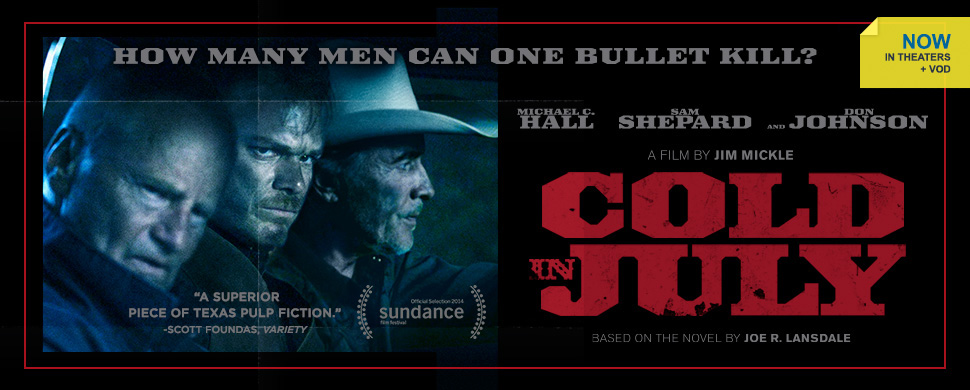
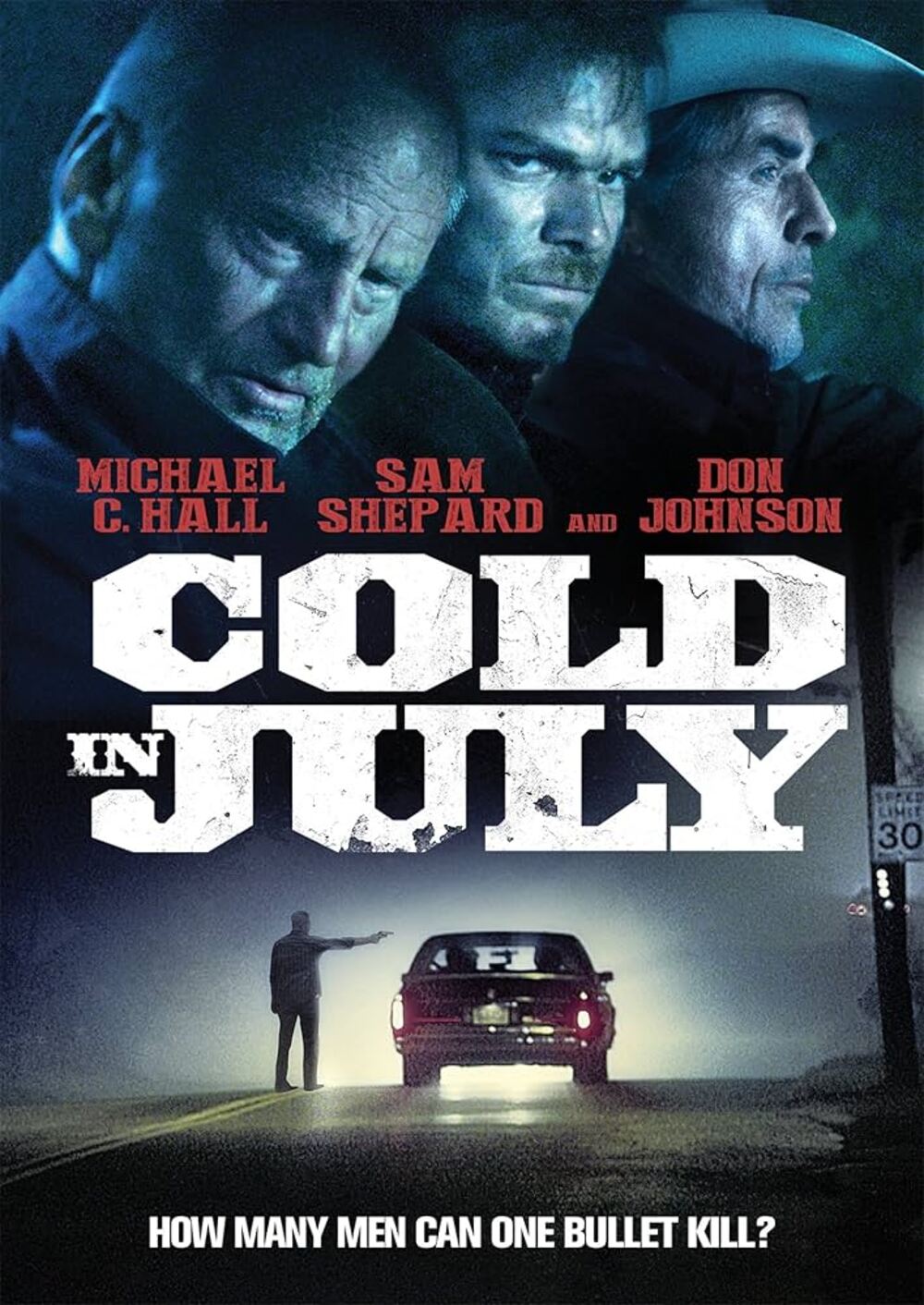
Film Review: Cold In July (dir by Jim Mickle)


Cold in July

Cold in July, which is currently available OnDemand and also playing in select theaters, is a great film.

To a large extent, you’re simply going to have to take my word about that because to give too much away about this twisty and emotionally resonant thriller would be a crime.  Quite frankly, I’d rather write a vague review than rob you of the pleasure of discovering this film’s secrets for yourself.

Here’s what I can tell you.

Cold In July takes place in east Texas and, speaking as a Texan, it manages to perfectly capture the odd mix of southern gothic and western stoicism that distinguishes that section of Texas from the rest of the state.  Cold in July is one of the best Texas-set films that I’ve ever seen, one that is uniquely Texan and yet still accessible for those viewers who live elsewhere (except maybe for Vermont).  Director Jim Mickle and cinematographer Ryan Samul fill Cold In July with hauntingly beautiful images of the landscape, capturing that unique Texas stillness that can be both tranquil and threatening at the same time.

Michael C. Hall plays Richard Dane, an ordinary guy who, at the start of the film, confronts and kills a burglar who has broken into his house.  While nearly everyone else in town is impressed by Richard’s actions, Richard is haunted by them.  While everyone else tells Richard that he should be proud for standing up against crime, Richard is obsessed with the bloodstains that now decorate his living room wall.  Richard grows even more uneasy when the town’s police chief informs him that the burglar’s father has recently been paroled from Huntsville Prison.

When Richard goes to the burglar’s funeral, he meets the quietly menacing Ben Russell (Sam Shepard).  Ben reveals that Richard killed his son and then goes on to suggest that maybe, in order to even the score, Ben should now go after Richard’s son.  Even after the police agree to protect Richard and his family, it quickly turns out that Ben is a lot more clever than anyone realized…

And that’s all I can tell you about this film’s plot without spoiling the many twists and turns.  I can, however, assure you that anything you may be assuming about this film or the relationship between Richard and Ben is probably incorrect.  This is a film that starts out like an effective but standard thriller and then, about 30 minutes into the action, the story suddenly goes off in an entirely different direction.  The fact that the film manages to pull off such a sudden shift in tone and plot is due to both Mickle’s confident direction and the excellent performances of Hall and Shepard.

I can also tell you that this film features a great and award-worthy supporting performance from Don Johnson.  Johnson plays Jim Bob Luke, a flamboyant private detective who also owns a pig farm and drives a red Cadillac with vanity plates that read “RED BTCH.”  Johnson brings a jolt of life to the film right when it most needs it.  Jim Bob starts out as comic relief but, as the film progresses, Johnson brings a surprising amount of gravitas to the role until finally, Jim Bob is as much the moral center of the story as Tommy Lee Jones was in the thematically similar No Country For Old Men.

Finally, I can tell you that Cold In July is a violent film but it’s not the empty, consequence-free mayhem that you might expect to see in a thriller like this.  It’s hard to explain without giving away too much of the plot but I would have to describe it as almost being “violence with heart.”  Cold In July may be violent but it’s never mindless and that makes all the difference.

As I said, it’s difficult to review Cold In July because to go into too much detail would run the risk of ruining the film’s many surprises.  So, instead, I’ll just say that Cold In July is one of the best films of the year so far.

It’s a film that you, as a lover of cinema, owe it to yourself to see.

Film Review: Killing Them Softly (dir. by Andrew Dominik)


Killing Them Softly is perhaps the most unpleasant film of 2012.

Taking place in 2008, Killing Them Softly tells the story of how a poker game got robbed in New Orleans and how that robbery led to a lot of people getting killed.  The poker game is run by Markie (Ray Liotta), a likable and well-meaning gangster who made a big mistake in the past.  A few years  previously, Markie arranged for one of his poker games to get robbed.  Though everyone knew that Markie was guilty, nobody could prove it and Markie continued to claim his innocence even while being tortured by a legendary hitman named Dillon (Sam Shepard).  So, years later, three small-time crooks figure that if they rob another one of Markie’s games, the Mafia will automatically blame Markie and hold him responsible.

Unfortunately, one of the crooks (played by Ben Mendelsohn, who was so good in Animal Kingdom) is also a heroin addict and something of an idiot.  He talks to the wrong people and soon the Mafia knows who was actually responsible.  Since Dillon is in the hospital, his protegé Jackie (Brad Pitt) is sent down to New Orleans to take care of the situation.  As Jackie explains to the mob’s representative (played by Richard Jenkins who gives a very Richard Jenkinsy performance here), not only do the three criminals have to die but Markie has to die as well.  It’s all strictly business.

Speaking of business, this entire story plays out against the backdrop of the 2008 elections.  For some reason, all of these sleazy criminals seem to be obsessed with watching CNN.  As a result, nearly every scene features either George W. Bush or Barack Obama speaking in the background.  At one point, Jackie says, “This is America,” just in case you couldn’t figure out that the film’s plot is supposed to be allegorical.

Killing Them Softly is an odd film, a well-made film that never quite convinces us that its story needs to be told.  Brad Pitt is miscast as Jackie and James Gandolfini has a truly annoying cameo as an alcoholic killer but otherwise, the film is perfectly cast.  Mendelsohn and Scoot McNairy are believable as two of the stupidest criminals to ever appear on-screen and Ray Liotta is likable and sympathetic as the tragic Markie.  Director Andrew Dominik makes good use of the New Orleans locations and the film has a few genuinely suspenseful moments.  That said, the film’s graphic and brutal violence quickly goes from being shocking to just being tedious.

If for no other reason, I did appreciate the fact that Killing Them Softly was brave enough to lump Barack Obama in with every other politician whose words are used to punctuate the film’s action.  Here in America, filmmakers tend to be very hypocritical when it comes to criticizing the government, going to almost ridiculous lengths to excuse Obama for following the same policies that they previously spent eight years attacking George W. Bush for instituting.  Instead of attempting to promote any partisan position, Killing Them Softly argues that the business of America will remains the same regardless of who is in charge.  Normally, that would seem to be a pretty obvious point but, in today’s cult-like political climate, it’s practically revolutionary.

Critics have been mixed on Killing Them Softly but, judging on both the film’s anemic box office and a lot of the comments that have been left online, audiences seem to absolutely loathe this film.  This isn’t particularly surprising because Killing Them Softly, with its constant emphasis on everything that’s ugly and dirty about life, seems to be a film that was specifically made to annoy audiences.  Even the film’s strengths ultimately serve to alienate the viewer.  I suspect that was Andrew Dominik’s ultimate goal and, on that count, he definitely succeeded.

Ultimately, I guess that’s why I ended up developing a strange sort of respect for Killing Them Softly, even though I found it impossible to enjoy the film itself and I would rather visit my gynecologist than ever have to sit through it again.  This is a film that stays true to itself, even at the risk of becoming unwatchable as a result.