4 Shots From 4 Films: Special Alfred Hitchcock Edition


4 Or More Shots From 4 Or More Films is just what it says it is, 4 shots from 4 of our favorite films. As opposed to the reviews and recaps that we usually post, 4 Shots From 4 Films lets the visuals do the talking!

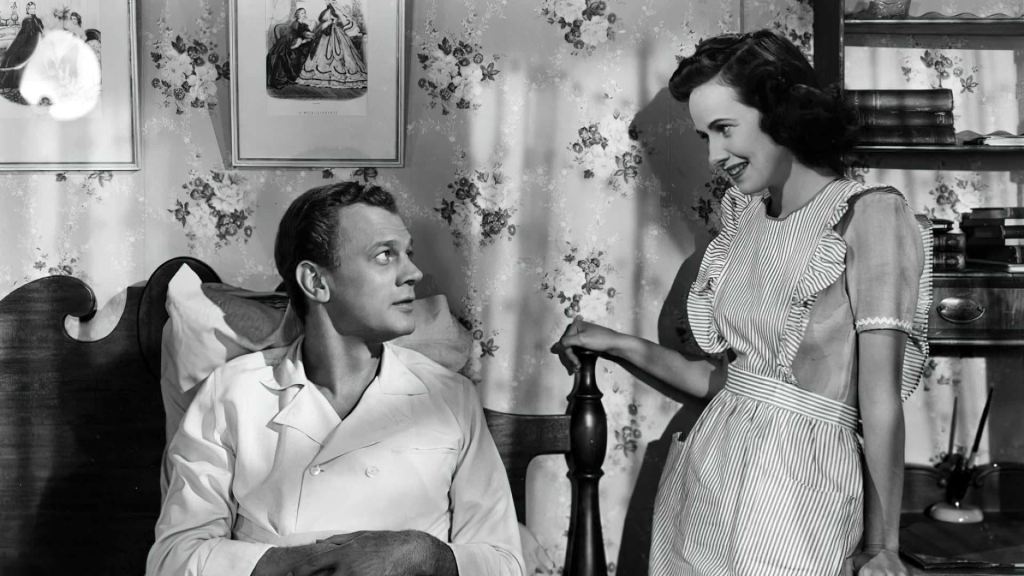
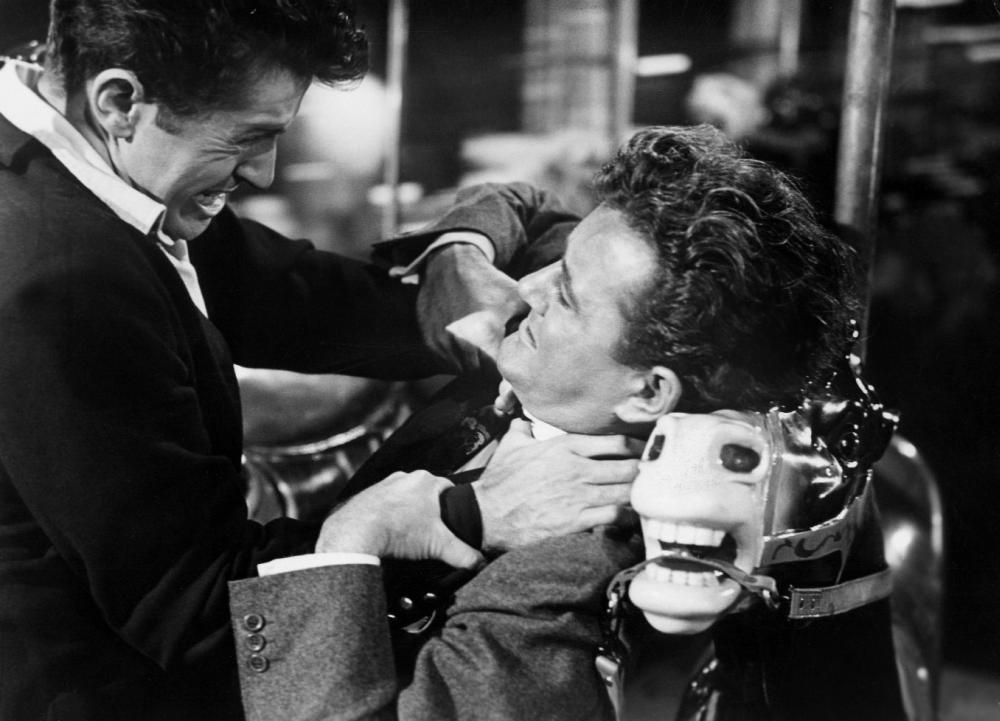
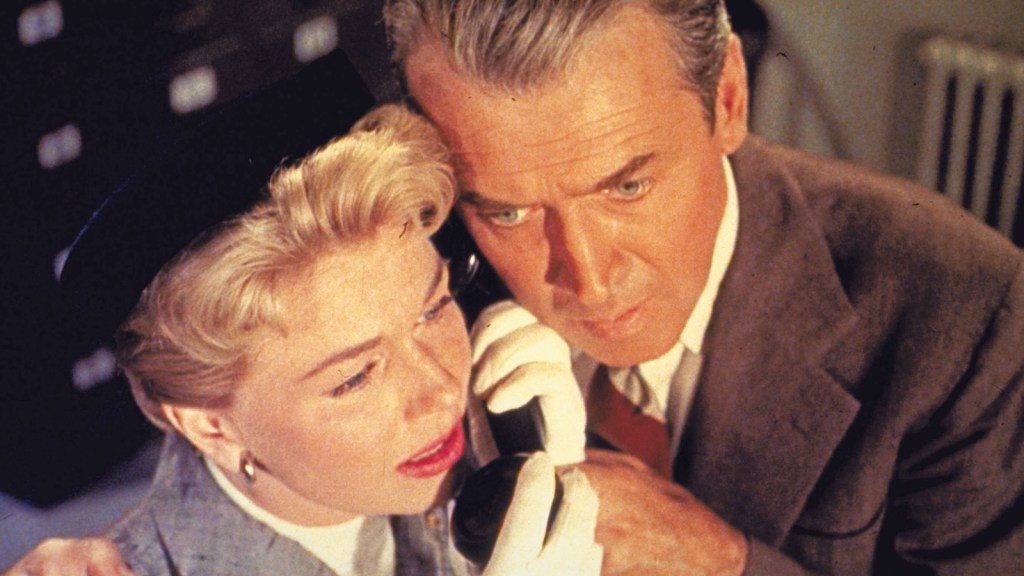
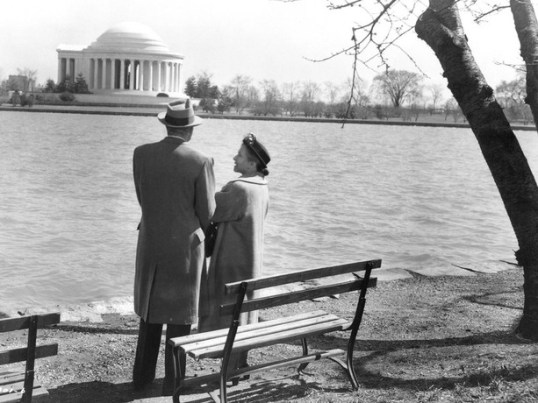
One of the all-time great directors in the history of cinema, Alfred Hitchcock, was born on this day in 1899. Today, I celebrate this master filmmaker with some images from some of his best films. Enjoy!

Shadow of a Doubt (1943)
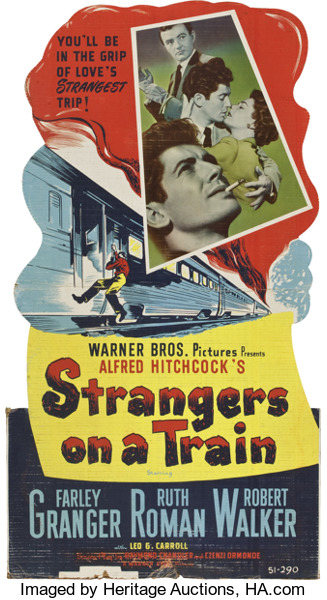
Strangers on a Train (1951)
The Man Who Knew Too Much (1956)
Frenzy (1972)

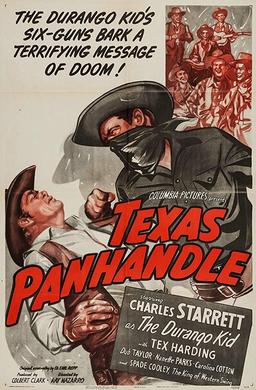
Texas Panhandle (1945, directed by Ray Nazarro)


Secret Service agent Steve Buckner (Charles Starrett) is told by his boss that his activities as the Durango Kid have led some in the Agency to suspect that Steve is himself an outlaw.  Even after Steve explains that he only takes on the Durango Kid identity when he needs to step outside of the law to protect innocent people, Steve is still suspended pending an investigation.

With nothing better to do, Steve rides off to the Texas panhandle, where he learns that outlaws have been robbing settlers and stealing government gold.  Working as the Durango Kid, Steve discovers that it’s not just outlaws that are targeting the new arrivals but it’s also the corrupt head of the local land office, Ace Gatlin (Forest Taylor).  Helping out Steve are settler Tex Harding and Cannonball (Dub Taylor), who works at the saloon and sings a few songs.

This is a standard Durango Kid film.  It has all the usual gunfights and horse chases but it doesn’t have Smiley Burnette.  Dub Taylor takes Smiley’s place as the comedic sidekick and, while Taylor isn’t bad, he’s still no Smiley Burnette.  Dub Taylor’s characters were usually more buffoonish than the clever helpers played by Smiley Burnette and, as a result, the Durango Kid movies with Taylor feel more juvenile than the ones with Smiley.  That’s the case here.

This installment is interesting because it reveals that Steve’s superiors knew about his Durango Kid side hustle and were as a confused about why he needed it as everyone else was.  Steve reveals he would rather lose his job than give up being Durango.  Luckily, at the end of the movie, he gets a telegram telling him that the investigation is over and he’s been reinstated with the Secret Service.  All’s well that ends well.

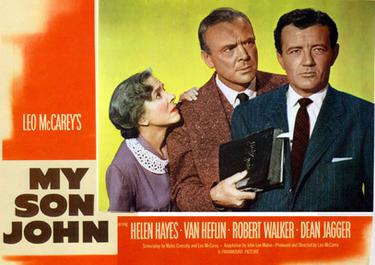
A Loyalty Day Film Review: My Son John (dir by Leo McCarey)


Oh my God, did you know that it’s Loyalty Day!?

Well, actually, it’s not Loyalty Day for everyone.  In fact, a lot of the world’s citizens are celebrating Communist May Day today.  However, here in the United States, it’s Loyalty Day.  Even if you are an American, it’s possible that you’ve never heard of Loyalty Day.  It was first celebrated in 1921 and it was intended to provide a non-Communist alternative to International Workers Day.  It wasn’t until 1955 that Loyalty Day was officially recognized by Congress.

From Wikipedia:

Loyalty Day is defined as follows in 36 U.S.C. § 115:

  • (a) Designation.— May 1 is Loyalty Day.
  • (b) Purpose.— Loyalty Day is a special day for the reaffirmation of loyalty to the United States and for the recognition of the heritage of American freedom.
  • (c) Proclamation.— The President is requested to issue a proclamation—
    • (1) calling on United States Government officials to display the flag of the United States on all Government buildings on Loyalty Day; and
    • (2) inviting the people of the United States to observe Loyalty Day with appropriate ceremonies in schools and other suitable places.

Though released before it officially became a holiday, the 1952 film, My Son John, is perfect for Loyalty Day.

The John of the title is John Jefferson (Robert Walker, in his final role), an employee of the State Department.  While his younger brothers (played by Richard Jaeckel and James Young) are two high school football stars who are looking forward to serving their country in Korea, John is an intellectual who considers concepts like patriotism to be simplistic and naive.  While his father (Dean Jagger) sings patriotic songs at the American Legion hall, John rolls his eyes at such middle class activities.  (“If you don’t like your Uncle Sammy,” move to another country, John’s father sings.)  The only person to whom John is especially close is his nervous mother, Lucille (Helen Hayes).

However, John is keeping a secret from even Lucille.  He’s a double agent, working for the communists!  With FBI agent Stedman (Van Heflin) hot on his trail, will John ever be able to see the light about the communists?  And, how will the communists respond to John having doubts about the cause?

My Son John was a dream project for Hollywood director Leo McCarey.  (It’s not a coincidence that the devoutly Catholic McCarey made a film about a devoutly Catholic family who discovers that one of their own has become a communist.)  McCarey carefully supervised every detail of the film and he was even able to talk stage legend Helen Hayes into starring in the film, her first in 14 years.  My Son John is full of scenes of shadowy communists, smug intellectuals, and all-American FBI agents marveling at the strength of Lucille Jefferson’s faith.  Everything that is today often cited as a negative aspect to living in the suburbs is presented as being a positive in My Son John.  The film’s communists come into a world of happy families, big houses, and well-manicured lawns and they set out to make everyone else as miserable as they are.  There’s nothing subtle about either McCarey’s approach or Helen Hayes’s performance but, as is often the case with propaganda, the film is crudely effective.

My Son John was Robert Walker’s final film.  In fact, he died before completing work on the film, leading the ending being rewritten.  (No longer would John personally deliver a commencement address.  Instead, his words come out of a tape player that has been rolled out on stage.  A holy light shines down on the player while The Battle Hymn of the Republic plays in the background.  It’s bizarre but it’s also probably the most memorable part of the movie.)  Scenes from Strangers On A Train were rather awkwardly spliced into final moments of My Son John, never mind the fact that Robert Walker’s gleefully evil performance as Bruno Antony had little in common with his self-tortured performance as John Jefferson.

Surprisingly, considering that My Son John was released at the height of the anti-Communist era, the film was not a success at the box office.  (Audiences seemed to better appreciate low-budget and pulpier anti-communist films, like I Was A Communist For The FBI.)  Still, thanks to the Internet, My Son John is still available to be viewed on this Loyalty Day.

So, remember — if you don’t like your Uncle Sammy …. well, actually, the cool thing about this country is that you don’t have to like your Uncle Sammy.  You have the right to decide for yourself how you feel about old Uncle Sammy.  That’s an idea that is worth being loyal to.

Streets of Ghost Town (1950, directed by Ray Nazarro)


Years ago, Bill Donner (George Cheseboro) double-crossed the other members of the Selby Gang and ran off with all of their stolen gold.  Now, Donner is blind and half-crazy.  When he says that he hid the gold in the ghost town of Shadeville, the Durango Kid (Charles Starrett), Smiley Burnette, and Sheriff Dodge (Stanley Andrews) ride off to find it.

Shadeville is long abandoned and, as the three men spend the night in a deserted saloon, Smiley is worried about ghosts.  The Durango Kid tells the story of the first time he met the Selby Gang.  The next morning, they discover that they are not the only ones who have come to Shadeville to look for the gold.

Like many of the later Durango Kid movies, Streets of Ghost Town is mostly made up of stock footage to Starrett’s earlier films.  This was a cost-cutting technique on the part of Columbia Pictures but it actually works because the flashbacks were always to the horse chases and the gunfights that the audience came to see in the first place.  In the days before home video and cable, those scenes were probably still new to many of the people sitting in the theater.

Starrett always made for a good hero and Smiley Burnett’s comic relief never took away from the films’s storylines.  This outing features a great scene where Durango shoots a skull in the dark just to let anyone watching him know that he’s a good shot.  I also enjoyed George Cheseboro’s manic performance as a man who really loves his gold.  Despite all of the stock footage, Streets of Ghost Town is still an above average Durango Kid film, predictable but entertaining if you’re a fan of the genre.

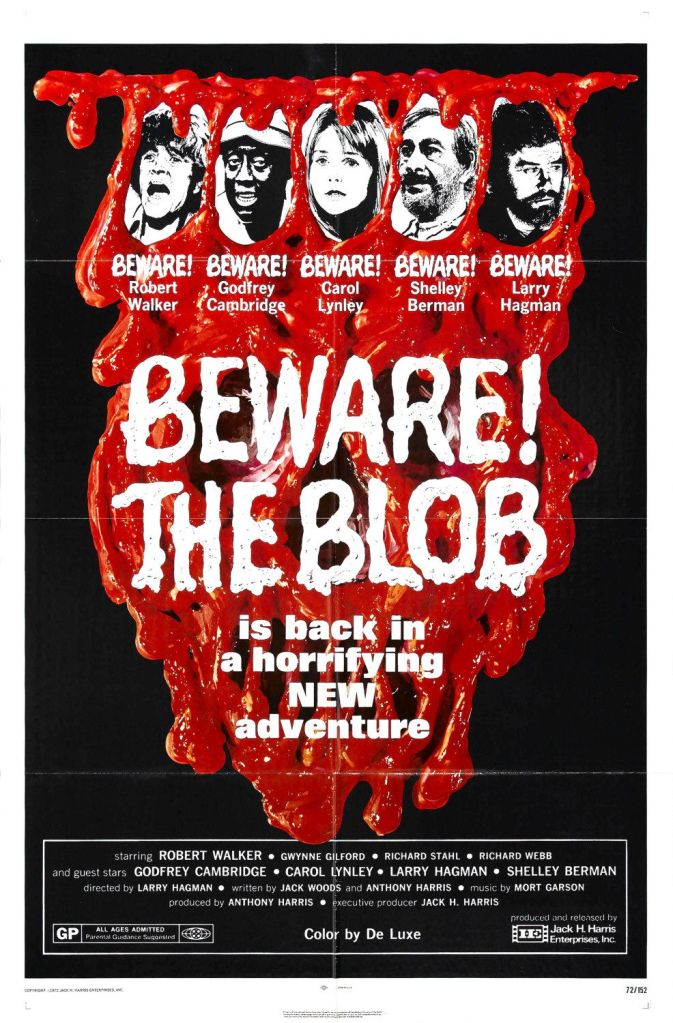
Movie Review: Beware! The Blob (by Larry Hagman)


Everyone has one movie or two that hit them so hard it caused them to develop habits. It could be shaking your shoes to confirm no spiders are in them, counting the seconds after a lightning strike for the thunder, or checking the back seat of your car before you get into it, just in case. Some movies kind of imprint themselves on you in different ways.

Beware! The Blob (or Son of The Blob in some circles) was the most terrifying film I saw as a kid. I watched it in front of my grandmother’s living room tv that had a little alarm clock on the floor beneath it. Unlike Friday the 13th and Halloween, where I could rationalize my fears, Beware! The Blob had me fearing the summer and any open crevice we had. On any visits to our local video store (in the Pre-Blockbuster days), I’d pick out video games to rent and could see the box for the film in the horror section. I’d never walk over there, even in my early teenage years.

Most consider the 1958 original a Classic, and Chuck Russell’s 1988 update often goes toe to toe with John Carpenter’s The Thing on the Best Remakes list. Beware! The Blob will probably never make that list, but it’s not a total loss, given a recent rewatch. The film’s greatest strengths are in the casting and the special effects. From a cinema history/trivia standpoint, the film marks one of the earliest credits for Cinematographer Dean Cundey. Cundey worked as a 2nd Unit Cinematographer for the film, particularly with the animal shots in the opening and later on. That might not sound like much, but Cundey would go on to be picked by Debra Hill to help out on Halloween in 1978. From there, he had The Fog, Halloween II, The Thing, Romancing the Stone, Back to the Future, Big Trouble in Little China, Who Framed Roger Rabbit?, and Jurassic Park, to name a few.

With 14 years since the first film, there were some tech upgrades to how the blob was made. A large plastic balloon was used for some scenes (particularly the bowling alley sequences). Additionally, silicone was added to a drum to allow for the “blob pov” during the bowling alley sequences. In most sequences, a red dyed powder mixed with water was used. To make sure the audience was aware the Blob was close, a high whistle would sound, giving anyone with even the slightest bit of tinnitus some cause to look over their shoulder. Academy Award Winner Tim Baar (The Time Machine) and Conrad Rothmann worked on the effects, along with Cundey.

In his film directing debut, Larry Hagman (TV’s I Dream of Jeannie, Dallas) weaves a tale of horror lurking through a town peppered with parties, hobos, a boy scout team, an angry bowling alley owner, some dune buggy aficionados and a sheriff (Richard Webb, The Phantom Stagecoach) who’s a little confused about some of the events happening in town. To his credit, it’s amazing to see who Hagman assembled here, as he called in some friends to join in on the fun. Comedian Godfrey Cambridge. Cindy Williams, just a few years shy of American Graffiti. Gerrit Graham, about two years before Phantom of the Paradise. Sid Haig (The Devil’s Rejects) is here as well. You can even spot Hagman in the film as one of three hobos squaring off with the Blob. It should be noted that the other two hobos with him are Burgess Meredith (Clash of the Titans) and Del Close (Chuck Russell’s The Blob).

The film flows like it’s namesake, with some chapters having little do to with anything – Dick Van Patten’s boy scouts, while funny, could have had one of their scenes cut for speed. It’s not incredibly terrible, but it’s exactly great, either. Most of the script, written by Anthony Harris, was tossed with ad-libbing done on set. Despite all this, it does looks like the cast enjoyed themselves making the film. It has that going for it, at least.

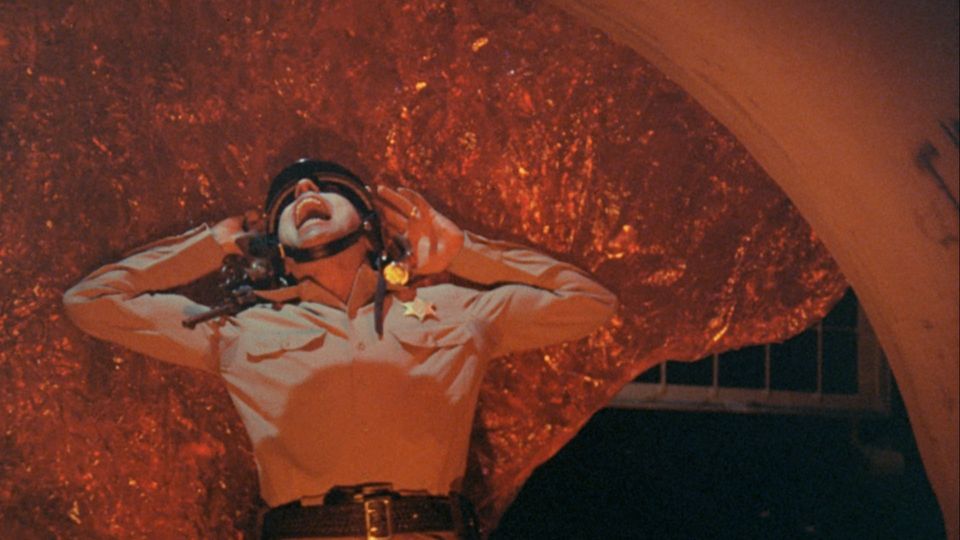
Sid Haig was caught unaware in Larry Hagman’s Beware! The Blob

Chester, A construction worker from the Arctic (Cambridge) is getting his camping gear stowed away when his wife, Marlene (Marlene Clark, The Beast Must Die) discovers a thermos in their freezer. He explains he performed some work and brought home a piece of what the found in the Arctic. Setting it on a countertop, the couple forget about the thermos, which pops open. The newly released blob absorbs a fly and a kitten before moving on to larger prey. Before we know it, Chester is having problems with his TV – which happens to be playing the original 1958 movie – as it slithers into his favorite recliner. It’s a sequence that’s burned into my mind. I always check a chair before sitting in it. Some check for thumbtacks, I check for alien goo.

When Lisa (Gwynne Gilford, Masters of the Universe & actor Chris Pine’s Mom) discovers Chester with his new friend, she dashes out and heads to her boyfriend, Bobby (Robert Walker, Easy Rider). By the time the couple return to Chester’s place, they find the house empty. Can the couple convince the cops and the town of the danger ahead before it’s too late? Most of Beware! The Blob‘s scenes are set up in a way where people are completely oblivious of it until it’s touched them, causing said individual to slip and fall into the camera. The climax of the film takes place in a bowling alley, which is actually impressive for the techniques used, but even with the casting, you might spend more time laughing than anything else. Perhaps that’s my way of rationalizing the film years later.

At the time of this writing, Beware! The Blob is currently available to watch on the Plex streaming service. We’re also labeling this an Incident – out of respect to the kitten – and returning the timer to Zero.

The Yin & Yang of Alfred Hitchcock’s STRANGERS ON A TRAIN (Warner Brothers 1951)


gary loggins's avatarcracked rear viewer

Alfred Hitchcock , like many great artists before and since, was in a bit of a career slump. The Master of Suspense’s previous four films (THE PARADINE CASE, ROPE, UNDER CAPRICORN, STAGE FRIGHT) were not hits with either critics or audiences, and did poorly at the box office. Then came 1951’s STRANGERS ON A TRAIN and Hitch was back on top with this devilish mélange of murder, suspense, romance, and humor, featuring a stunning star turn by Robert Walker, cast against type as a charming sociopath.

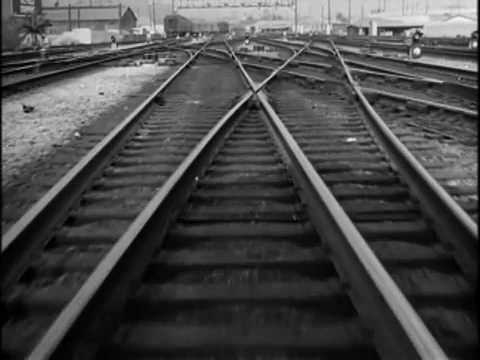
Our story opens with two pairs of shoes (one two-toned, one staid brown loafers) emerging from two separate cabs, walking separately to catch a train and their date with destiny, as we cut to two separate train tracks merging together. Hitchcock’s playing with one of his classic themes: “the double”, or more importantly, duality. Even Dimitri Tiomkin’s score highlights the differences, as a jaunty…

View original post 815 more words

Lisa Cleans Out Her DVR: Madame Curie (dir by Mervyn LeRoy)


(Lisa is currently in the process of cleaning out her DVR!  How long is it going to take her?  Probably about as long as it took scientists to discover radiation.  Still, she’s not giving up!  She recorded the 1943 best picture nominee, Madame Curie, off of TCM on February 16th.)

It would appear that if you wanted to produce a best picture nominee in the early 40s, the easiest way to do it was to cast Walter Pidgeon and Greer Garson as husband and wife.

Consider the evidence: In 1941, Blossoms in The Dust was nominated for best picture.  Greer Garson and Walter Pidgeon played wife and husband.

In 1942, Mrs. Miniver won best picture.  Greer Garson and Walter Pidgeon played husband and wife.  Interestingly enough, Garson actually starred in another best picture nominee that year, Random Harvest.  Random Harvest is a far better picture than Mrs. Miniver and actually featured a better performance from Garson but it did not include Walter Pidgeon.  Make of that what you will.

Then, in 1943, Greer Garson and Walter Pidgeon starred in Madame Curie.  Again, they played husband and wife and, again, their film was nominated for best picture.

As you can tell from the poster above, Madame Curie was advertised as being “Mr. and Mrs. Miniver together again.”  Actually, Garson and Pidgeon are playing characters far different from the stalwart and very British heroes of their previous film.  Instead, they are playing the Curies, Marie and Pierre.  The film opens with Pierre meeting Marie at a party and it juggles scenes of their romance with scenes of them discovering and playing with radiation.  Of course, it’s a struggle at times.  Their colleagues are dismissive of their efforts.  Both Pierre and Marie tend to get so caught up in their research that they close themselves off from the outside world.  Their efforts pay off when they isolate radium and win the 1903 Nobel Prize.  Of course, then Pierre gets run over by a horse while out buying his wife a pair of earrings.  Can Marie continue to do their research without him?

The unfortunate thing is that the movie pretty much ends with Marie winning her first Nobel Prize, which means that it leaves out some of the most interesting aspects of her life.  For instance, during World War I, she developed mobile X-ray units and worked in field hospitals.  She was also active in the struggle for Polish independence, even naming the first element that she ever discover polonium after her native country.  She spent almost her entire career working with radioactive material, often carrying radioactive isotopes in her pockets.  In 1934, Marie died of radiation poisoning.  Her research notes and other papers are so highly radioactive that they’re kept in a lead box and I assume that they probably glow whenever the lid is shut.  If you want to study Marie Curie’s notes, you have to put on a radiation suit.  Unfortunately, none of this is discussed in the resolutely positive movie.

Judging from what I’ve seen on TCM, Greer Garson appears to have been the Meryl Streep of her day, undeniably talented but a bit too obvious in her technique and just a little boring.  The same can be said of Madame Curie, which is a very well-made but not extremely memorable movie.  It’s like a lot of the films that were nominated for best picture in the 30s and the 40s — a big, prestige picture that never exactly comes to life.  The film is probably at its strongest in the beginning, when Walter Pidgeon does a pretty good job of playing Pierre as a brilliant introvert who is almost too shy to talk to Marie.  But, as the film progresses, it just becomes another slow-moving MGM biopic.

What movie beat Madame Curie for Best Picture?

None other than Casablanca.