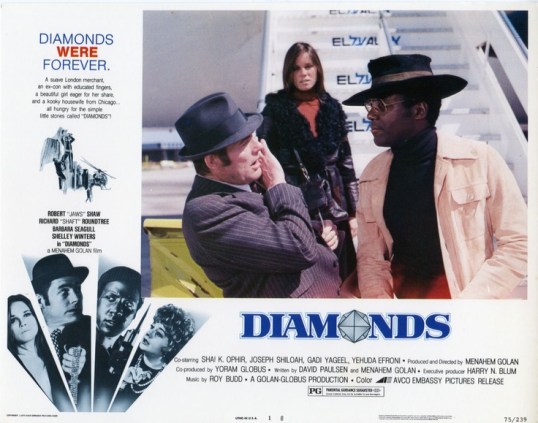
Originally, for today’s entry in Movie A Day, I was hoping to follow up my review of Mad Dog Coll by reviewing Hit The Dutchman. Unfortunately, I have not been able to find a review-worthy copy of Hit The Dutchman so, instead, I am going to review another film that was directed by Menahem Golan, Diamonds.
Filmed and set in Golan’s home country of Israel, Diamonds is a heist film. Richard Roundtree is Archie, an experienced thief who has just been released from prison. Sally (Barbara Hershey, though she was known as Barbara Seagull when she made this movie) is Archie’s girlfriend. Robert Shaw plays Charles Hodgman, the businessman who recruits Roundtree to help him break into a vault located in the Tel Aviv Diamond Exchange Center. The twist is that the vault was designed by Charles’s twin brother, Earl. Earl is also played by Robert Shaw and the two of them have an intense sibling rivalry. If you have ever wanted to see Robert Shaw fight himself in a karate match, Diamonds is the film to see!
(In true Golan fashion, Shaw wears a puffy wig whenever he is supposed to be Earl.)
If he had not died, in 1978, at the tragically young age of 51, Robert Shaw would probably be known as one of our greatest actors. As it is, he will always be remembered for playing Quint in Jaws and Red Grant in From Russia With Love. (I am also a fan of his performance in the original The Taking of Pelham One Two Three.) Diamonds is typical of the many films in which Shaw was better than what he had to work with. He gives two good performances but even he is occasionally overshadowed by the swaggering cool and floppy hats of Richard Roundtree. As for Barbara Seagull/Hershey, she was, as always, beautiful but she had little to do (which was a common problem for her until she rebooted her career with her performance in The Stunt Man). Shelley Winters is also in this movie, providing tepid comic relief as an American tourist. (It’s typical of the type of roles in which, following her performance in The Poseidon Adventure, Winters got typecast.)
Barbara Hershey’s beautiful. Richard Roundtree’s cool. Robert Shaw is Robert Shaw. The Israeli location distinguishes it from similar heist films. The plot may be implausible and the dialogue may be weak but, just as he did with Get Carter, Roy Budd offers up a great score. Diamonds is typical of many Golan films. It’s not good but it is damn entertaining.
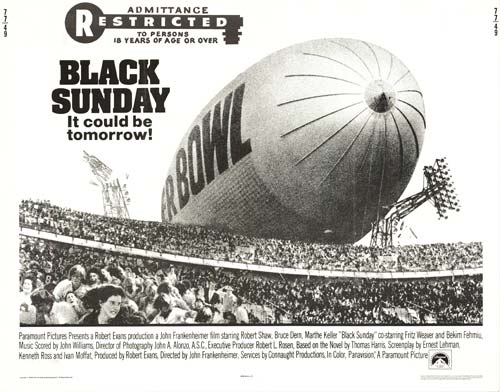
My New England Patriots aren’t in this year’s big game, and I can’t stand that big-headed Peyton Manning, so my interest in tonight’s Super Bowl is minimal. And the halftime show does nothing for me: Coldplay is probably one of my least favorite bands (Beyoncé’s OK, though). So if like me, you’re not planning on spending much time watching Roger Goodell’s season-ending spectacular (can’t stand Goodell, either) may I suggest an alternative, namely John Frankenheimer’s thriller BLACK SUNDAY.
No, it’s not the 1960 Barbara Steele/Mario Bava horror classic, this BLACK SUNDAY is a rousing political thriller about terrorist organization Black September plotting a strike against America at the biggest game of them all, the Super Bowl. Beautiful but deadly terrorist Dahlia (Marthe Keller) has recruited the bitter, unstable blimp pilot Michael Lander (Bruce Dern at his 70’s psycho best) to turn the blimp into the ultimate suicide bomb, with plastique explosives setting…
Earlier tonight, as a part of their 31 Days of Oscar, TCM aired The Sting, the film that the Academy selected as being the best of 1973. I just finished watching it and what can I say? Based on what I’ve seen of the competition (and there were a lot of great films released in 1973), I would not necessarily have picked The Sting for best picture. However, the movie is still fantastic fun.
The Sting reunited the director (George Roy Hill) and the stars (Robert Redford and Paul Newman) of Butch Cassidy and the Sundance Kidand told yet another story of likable criminals living in the past. However, whereas Butch Cassidy largely satirized the conventions of the traditional Hollywood western, The Sting is feels like a loving homage to the films of 1930s, a combination of a gritty, low-budget gangster film and a big budget musical extravaganza. The musical comparison may sound strange at first, especially considering that nobody in The Sting randomly breaks out into song. However, the musical score (which is famously dominated by Scott Joplin’s The Entertainer) is ultimately as much of a character as the roles played by Redford, Newman, and Robert Shaw. And, for that matter, the film’s “let-pull-off-a-con” plot feels like an illegal version of “let’s-put-on-a-show.”
The film takes place in the 1936 of the cultural imagination, a world dominated by flashy criminals and snappy dialogue. When con artists Johnny Hooker (Robert Redford) and Luther Coleman (Robert Earl Jones) inadvertently steal money from a gangster named Lonnegan (Robert Shaw), Lonnegan has Luther murdered. Fleeing for his life, Hooker goes to Chicago where he teams up with Luther’s former partner, veteran con man Henry Gondorff (Paul Newman). Gondorff used to be one of the great con artists but he is now living in self-imposed obscurity, spending most of his time drinking and trying to avoid the FBI. Hooker wants to get revenge on Lonnegan by pulling an elaborate con on him. When Gondorff asks Hooker why, Hooker explains that he can either con Lonnegan or he can kill him and he doesn’t know enough about killing.
The rest of the film deals with Hooker and Gondorff’s plan to con Lonnegan out of a half million dollars. It’s all very elaborate and complicated and a bit confusing if you don’t pay close enough attention and if you’re ADHD like me. But it’s also a lot of fun and terrifically entertaining and that’s the important thing. The Sting is one of those films that shows just how much you can accomplish through the smart use of movie star charisma. Redford and Newman have such great chemistry and are so much fun to watch that it really doesn’t matter whether or not you always understand what they’re actually doing.
It also helps that, in the great 70s tradition, they’re taking down stuffy establishment types. Lonnegan may be a gangster but he’s also a highly respected and very wealthy gangster. When Newman interrupts a poker game, Lonnegan glares at him and tells him that he’ll have to put on a tie before he’s allowed to play. Lonnegan may operate outside the law but, in many ways, he is the establishment and who doesn’t enjoy seeing the establishment taken down a notch?
As entertaining as The Sting may be and as influential as it undoubtedly is (Steven Soderbergh’s Ocean films may be a lot more pretentious — which makes sense considering that Soderbergh is one of the most pretentious directors in film history — but they all owe a clear debt to The Sting), it still feels like an unlikely best picture winner. Consider, for instance, that The Sting not only defeated American Graffiti and The Exorcistbut Ingmar Bergman’s Cries and Whispers as well. On top of that, when you consider some of the films that were released in 1973 and not nominated — Mean Streets, Badlands,The Candy Snatchers, Day of the Jackal, Don’t Look Now, Jesus Christ Superstar, and The Long Goodbye — it’s debatable whether The Sting should have been nominated at all. That’s not a criticism of The Sting as much as it’s an acknowledgement that 1973 was a very good year in film.
So, maybe The Sting didn’t deserve its Oscar. But it’s still a wonderfully entertaining film. And just try to get that music out of your head!
There’s little that is more intimidating than trying to write a review of the 1975 best picture nominee, Jaws.
I mean, seriously, what’s left to be said about this film? Jaws is one of those movies that everyone has seen and everyone loves. And, even if someone somehow hasn’t seen the film, chances are that they still know all about it. They know that it’s a movie about a giant shark that attacks Amity Island, just as the summer season is starting. They know that the town’s mayor refuses to close the beaches, because he doesn’t want to lose the tourist dollars. They know that the final half of the film is three men (Roy Scheider, Richard Dreyfuss, and Robert Shaw) floating around in a boat, searching for a shark. And they certainly know that, whenever you hear John Williams’s iconic theme music, it means that someone is about to get attacked.
What’s amazing about Jaws is that, even though everyone’s seen it and it’s been parodied a few thousand times, Jaws remains incredibly effective. I still find myself cringing whenever the shark catches Alex Kintner and that geyser of blood explodes out of the ocean. I still jump whenever the shark suddenly emerges from the water and scares the Hell out of Roy Scheider. I still laugh at Richard Dreyfuss’s hyperactive performance and I instinctively cover my ears whenever I realize that Robert Shaw is about to drag his nails across that chalk board.
And then there’s that music, of course! Even after being used, misused, and imitated in countless other films, the Jaws theme still fills me with a sort of existential dread. The mechanical shark was notoriously fake-looking and was rarely seen onscreen as a result. The camera and the music stand in for the shark and it works beautifully.
The one unfortunate thing about Jaws is that it’s been so critically acclaimed and so embraced by audiences that I think people tend to forget that it is primarily a horror film. Mainstream critics tend to look down on horror as a genre so, rather than admit the obvious, they claim that Jaws is more of a thriller than a horror film. Or they talk about how it’s actually meant to be a political allegory or an environmental allegory or an examination of male bonding.
So, let’s just make this clear. No matter what the elitist critics or even Steven Spielberg himself may say, Jaws is primarily a horror film, with that relentless killer shark serving as a prototype for such future horror fiends as Michael Myers, Jason Voorhees, Freddy Krueger, and both of the Ghostface and Jigsaw Killers. (Jaws even opens with a stereotypical slasher movie death, as a nude and stoned swimmer is suddenly attacked by an unseen killer.) If not for Scheider, Shaw, and Dreyfuss floating in the endless ocean, you would never have had films — like the Blair Witch Project — about people being lost and stalked in the wilderness. And when that shark attacks and graphically rips apart its victims, how different is it from something you might find in a George Romero or Lucio Fulci zombie film?
On the basis of Jaws and Duel, I think it can be argued that, if Steven Spielberg hadn’t become America’s favorite director of crowd-pleasing, Oscar-contending blockbusters, he could have been one of our best horror directors. Sadly, Spielberg has pretty much abandoned horror and I doubt that Jaws would be as effective if it were made today. (I suspect that the temptation to resort to a cartoonish CGI shark would be too great.)
But that’s all speculation.
What matters is that Jaws remains one of the greatest films ever made.
Hi there! The name’s Bowman, Lisa Marie Bowman. And tonight, I’m continuing the Shattered Lens’ look at the James Bond film franchise by reviewing 1963’s From Russia With Love.
The 2nd film in the Bond film series, From Russia With Love is considered by many to be one of the best entries in the franchise. I happen to agree with them. There’s a lot of talk right now that Skyfall could be the first James Bond film to receive an Oscar nomination for best picture. Personally, I think From Russia With Love (and not Tom Jones) should have been named the best picture of 1963, (Seriously, has anyone actually tried to watch Tom Jones recently?)
From Russia With Love opens with a tuxedo-clad James Bond sneaking around outside the type of opulent estate that every Bond villain seems to own. Suddenly, Bond is attacked by a hulking assassin named Red Grant (played by a pre-Jaws Robert Shaw) and, as the audience watches shocked, Bond is apparently killed. It’s only after Bond’s dead and on the ground that we learn the truth. The man in the tuxedo wasn’t James Bond at all — instead, he was just some random henchman in a James Bond mask! It turns out that Grant works for the villainous organization SPECTRE and this is all part of his training routine. Now, you would be justified in wondering why SPECTRE would go through the trouble to make a next-to-perfect James Bond mask for a simple training routine but. ultimately, it doesn’t matter. It’s a great sequence, that manages to be both fun and suspenseful at the same time. It’s also a great set-up for the rest of the film.
SPECTRE and its mysterious leader (and this is the first time in which we get to see that iconic image of a hand stroking a white cat while a disembodied voice says evil things) want Bond dead. The job of arranging Bond’s assassination is given to Kronsteen (played by Vladek Sheybal, who has a truly fascinating skeletal face). When he’s not off being evil, Kronsteen is a chess grandmaster and, not surprisingly, he views his assignment as if it’s just one big chess game. In order to kill Bond, he knows that he’s going to need a pawn.
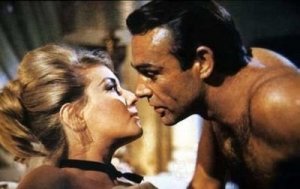
That’s where Tatiana Romanova (played by Daniela Bianchi) comes in. Tatiana is a cipher clerk at the Russian Embassy in Istanbul. She is approached and given an assignment by Rosa Klebb (Lotte Lenya), a Russian intelligence agent who, unknown to Tatiana, is also working for SPECTRE. Tatiana contacts MI6 and tells them that she’s willing to defect but only to James Bond. Tatiana explains that she came across Bond’s picture in a Soviet Intelligence file and the insinuation is that she fell in love (or, at the very least, lust) with that picture.
(Interestingly enough, this parallels the fact that audiences had previously seen Sean Connery in Dr. No and, like Tatiana, spent the year between the two films fantasizing about James Bond themselves. In that way, Tatiana is the perfect audience surrogate.)
James Bond is sent to Istanbul by M (Bernard Lee) but before he goes, he meets with the head of Q branch. Desmond Llewelyn makes his first appearance in the Bond franchise here. In a historic moment of film history, he gives Bond his first booby-trapped briefcase.
When Bond arrives in Istanbul, he meets with station head Kerim Bey (played by Pedro Armanderiz, who tragically committed suicide before From Russia With Love was released). With the help of Kerim Bey and Tatiana (who Bond first meets with she turns up, naked, in his bed), Bond steals the Lektor decoder device from the Russian consulate. Though Bond doesn’t realize this, he’s aided in this task by none other than Red Grant. Grant has been following Bond and perversely, he’s been protecting Bond from KGB assassins so that he might have the chance to kill Bond himself.
Bringing the Lektor device with them, Bond, Tatiana, and Kerim Bey board the Orient Express. It’s on the train that they meet Nash, a British agent who says that he’s been sent by MI6 to help make sure that Bond and Tatiana safely make it back to England. Of course, what the audience knows, is that the somewhat smug Nash is none other then … Red Grant!
I love From Russia With Love. Everything that makes the James Bond series so special — romance, memorable villains, spectacular locations, exciting action, and a rather sardonic sense of humor — is present in From Russia With Love. Playing Bond for the second time, Connery is more confident with the role here than he was in Dr. No and, as opposed to some of his later appearances in the series, Connery appears to be enjoying bringing this iconic character to life. There’s none of the boredom that marred some of Connery’s later performances. Instead, Connery is exciting to watch and it helps that he and Bianchi have a very real chemistry in this film. As opposed to some Bond girls, Tatiana is a believable, multi-layered character and you actually care what happens to her. The relationship between Tatiana and Bond feels real and, therefore, the film has a surprising emotional resonance to it.
As opposed to Dr. No, with its somewhat bland title character, the villains in From Russia With Love are a fascinating quartet of rogues. Lotte Lenya brings an unexpected amount of depth to the role of Rosa and her final battle with Bond is one of the best in the history of the franchise. Even more exciting than Bond’s fight with Rosa is his final fight with Red Grant. As played by Robert Shaw, Grant comes across as if he’s the literal personification of Bond’s dark side. Both men are killers and both are rather smug about it but the difference is that Bond is capable of caring about Tatiana whereas Grant has surrendered whatever emotions he may have once had. Shaw’s performance so dominates the film that, when I rewatched the film, I was surprised to discover that Grant is only in a handful of scenes.
If Dr. No was an enjoyable B-movie, then From Russia With Love was a cinematic masterpiece that transcended the limitations of genre. If Dr. No established the basic conventions of James Bond, From Russia With Love showed that those conventions could be used to make a great film.
Tomorrow, we’ll be taking a look at the third film in the Bond franchise, Goldfinger.


 Through the Shattered Lens