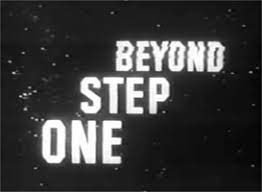
Tonight’s episode of One Step Beyond is called The Death Waltz. It’s about what happens when, in 1860, two calvary officers fall in love with the same young woman, Lillie (Elizabeth Montgomery). Lillie has a great time playing the two men against each other but, when one of them is killed by Apaches, she rather heartlessly goes to a dance with the surviving suitor.
Unfortunately, for her, the dead man’s ghost decides to go to the dance as well….
The episode originally aired on October 4th, 1960.
Welcome to Late Night Retro Television Reviews, a feature where we review some of our favorite and least favorite shows of the past! On Mondays, I will be reviewing CHiPs, which ran on NBC from 1977 to 1983. The entire show is currently streaming on Freevee!
This week, the first season comes to a close!
Episode 1.22 “Flashback!”
(Dir by Michael Caffey, originally aired on April 1st, 1978)
When a recent graduate from te motor school joins the unit, he immediately rubs everyone the wrong way. Brent Delaney (Joe Penny) may have graduated at the top of his class but, as Baker points out, he flunked public relations and everyone quickly tires of his holier-than-thou approach to policing. Add to that, his father is a bigshot politician and everyone assumes that Delaney is just some rich kid who got the job through his connections. Delaney’s arrogant and cocky attitude doesn’t do much to change that impression.
Fortunately, Baker and Ponch are both willing to look past Delaney’s cockiness. In fact, they spend the majority of the episode remembering how, one day, a CHiP officer named Jon Baker met a cocky dirt bike rider named Ponch (Erik Estrada) and also how Baker talked Ponch into applying for a spot on the force. No one gave Ponch much of a chance, largely because of his background as a juvenile delinquent and his friendship with a gang leader named Henry (Edward James Olmos). But, soon, Ponch and Baker were patrolling the streets and rescuing two women who were trapped in a car that they accidentally drove into a swimming pool. Ponch proved himself. Will Delaney?
Yes, this a flashback episode but, interestingly enough, most of the flashbacks appear to have been shot specifically for this episode. (There were two clips that I recognized as coming from the show’s pilot but the rest of the flashbacks appeared to be original.) The flashbacks don’t play out in a chronological order, either. Instead, they are somewhat randomly triggered by Ponch or Baker hearing an engine backfiring or spotting some person on a bike. This episode comes as close as one can to answering the question of what a cop show directed by Nicolas Roeg would look like.
As for Delaney, he eventually proves his worth when he takes down a group of bikers who were stealing CHP motorcycles. (One of the bikers is played by John Furey, who is best-known for playing Paul in Friday the 13th Part II.) It’s a pretty good thing that Delaney caught those guys, seeing as how his motorcycle was one of those that was stolen. Having proven himself, Delaney is welcomed into the CHP. Even the formerly skeptical Grossman and Bear end up shaking his hand and telling him that he did a good job. Way to go, Delaney! I imagine we’ll never see him again.
And so ends the first season of CHiPs. It was a fun season. There was nothing particularly challenging about any of the first 22 episodes but the scenery was gorgeous and some of the chase scenes were exciting. That’s really all you can ask for with a show like this. Though I understand that Larry Wilcox and Erik Estrada did not particularly like each other, that wasn’t obvious during the first season. In fact, even Estrada’s tendency to overact was nicely paired with Wilcox’s tendency to do the opposite. For the first season at least, they came across like legitimate partners and friends.
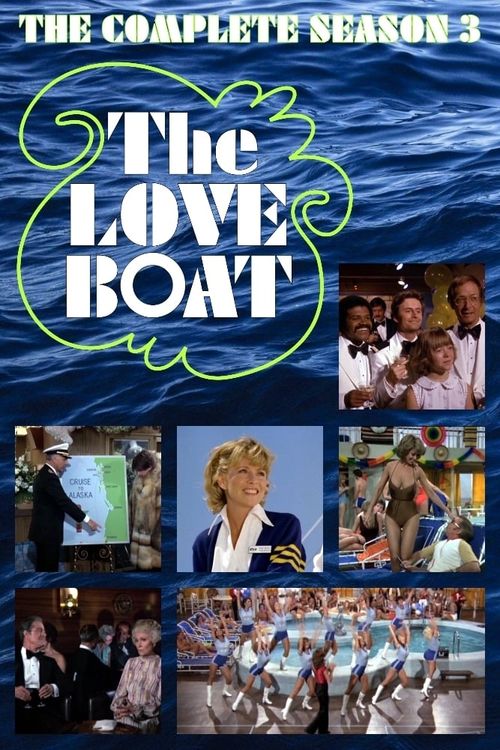
Welcome to Retro Television Reviews, a feature where we review some of our favorite and least favorite shows of the past! On Wednesdays, I will be reviewing the original Love Boat, which aired on ABC from 1977 to 1986! The series can be streamed on Paramount Plus!
This week, Gopher falls in love. Yes, Gopher.
Episode 3.15 “The Harder They Fall/The Spider Serenade/Next Door Wife”
(Dir by Richard Kinon, originally aired on December 8th, 1979)
After three seasons of being goofy comedic relief, Gopher finally got his heart broken in this episode. He fell in love with a passenger named Claire Dalrymple (Jill St. John), who is on the boat by herself because she has recently separated from her husband, Nelson (Robert Sampson). And Claire eventually fell in love with Gopher, especially after he dressed up like a mariachi singer and serenaded her with a song about the time that she asked him to kill a spider that was in her cabin. This time, it was Gopher who ended up waking up in a cabin with a passenger.
(I’m sure some would say it was a bit unrealistic that Claire, upon seeing a spider in her cabin, would run out into the hallway, screaming while wearing only a towel. I’ve done the exact same thing at a hotel because spiders are scary!)
But does Claire really love Gopher or if she just looking for someone to feel the void left by her separation. When her husband shows up on the boat, he turns out to be a pretty reasonable and polite guy. He tells Gopher that, while Gopher can give Claire anything she wants at sea, Nelson can give her everything she needs on land. Is Nelson suggesting some sort of special arrangement here? Well, if he is, it totally goes over Gopher’s head. At the end of the cruise, Claire decides to leave with Nelson and Gopher can only sadly watch as she leaves.
Awwwwwww! Poor Gopher!
It’s kind of weird to see Gopher in a sad story. That’s not the fault of Fred Grandy, who always likable and did a pretty good job with the role. Instead, it’s just that Gopher is such a goofy character that it takes a bit of adjustment to suddenly see him being sincere. His storyline here worked well-enough, once you got used to the idea of Gopher being serious. If anything, Gopher was so sad by the end of it that it suddenly made sense why he’s always telling jokes and trying to avoid any sort of emotional commitment. He’s hurting inside!
The other two storylines were goofy enough to make up for Gopher’s serious turn. Chet Hanson (James McArthur) is on the cruise with his girlfriend, Kim (Susan Buckner). Chet’s wife, Carol, (Joanna Pettet) also shows up on the cruise and gives Chet the papers to sign for their divorce. Chet and Carol are fairly friendly for a divorcing couple but Chet is still upset when Carol buys a ticket for the cruise and ends up staying in the cabin across the hall from him and Kim. Soon, Carol is stopping by constantly and telling Chet about a man that she’s been flirting with. Eventually, Chet realizes that he doesn’t want to get a divorce and he and Carol get back together. That really sucks for Kim, who is surprisingly tolerant of being followed around by her boyfriend’s wife. This storyline really did leave a sour aftertaste. Chet was a jerk and Kim deserved better.
Finally, Ed “Flash” Taylor (Milton Berle) and Jack McTigue (Alan Hale, Jr.) were both boxers in their youth. They fought one legendary fight, in which they not only beat the Hell out of each other but also knocked out the referee. Now, they are both cruise line executives and they both end up on their boat at the same time. As soon as they see each other, their rivalry reignites and they prepare for a rematch on the boat. When Captain Stubing tries to stop the fight, he is accidentally knocked out by the two boxers. Somehow, this leads to peace between Ed and Jack and not to Captain Stubing suing his bosses for punching him. Seriously, the Love Boat is floating HR nightmare.
This was an okay episode, largely due to Gopher’s unexpectedly sad story. The other two stories were just goofy but, when it comes to The Love Boat, the goofiness is the point.
Max Castle (John Davidson) is a conman who gets arrested in Florida because of a shady real estate deal. The judge releases him into the custody of his older brother, an attorney named Stephen (Robert Castle). Though Max is technically just a paralegal, he secretly helps out his brother’s clients but running elaborate scams on the people who have cheated them. When businessman Lyle Rafferty (Jack Kehoe) embezzles money from his own charity and then lets one of his employees take the fall, Max decides that Rafferty is going to be his next target.
Shell Game was a made-for-TV movie. It’s pretty obvious that it was meant to be the pilot for a weekly series, where I guess Max would have pulled a con on every different evildoer every week. Because the show is more interested in setting up who Max is and why he cons people, there’s not much dramatic tension in Shell Game. Max tricks Rafferty into buying a worthless gold mine and Rafferty falls for every single trick that Max pulls on him. Unfortunately, since Rafferty is such an easy target, there’s no real pay-off to seeing him get conned. It’s not like The Sting, where there were real stakes and dangers involved in Paul Newman and Robert Redford’s pursuit of Robert Shaw’s money. The con is just too easy.
On the plus side, Max’s old partner-in-crime is played by Tom Atkins. Atkins is so believable as a veteran conman with a heart of gold that he probably would have been a better pick for the lead role than the likable but bland John Davidson. The rest of the cast is forgettable.
Would Shell Game have worked as a weekly series? Maybe, especially if Tom Atkins was a part of the regular cast. The idea of a former conman now running scams on other con artists had the potential to be intriguing and Max hints that he was framed by his partners in Florida. I guess a weekly series would have explored that in greater detail. However, it was not to be. This shell game was played once and then forgotten.
In New York City, a group of people sit around a table, holding a seance. One of them, a woman named Mary (Catriona MacColl) has a vision. She sees a sickly, hollow-cheeked priest walking through a cemetery. She watches as he hangs himself and, as the priest dangles from a tree branch, Mary lets out a piercing scream and collapses to the floor. The police are called and they promptly declare that Mary has died. Later, while a hard-boiled reporter named Peter Bell (Christopher George) watches as two grave-diggers walk away from her half-buried coffin, he hears something coming from the grave. From insider her coffin, Mary is screaming and struggling to get out!
Peter grabs a pickax and smashes it down into the coffin. Peter may be trying to free her but what he doesn’t realize is that, with each blow of the pickax, he comes dangerously close to hitting Mary in the face. Somehow, Peter manages to avoid killing Mary. Once he gets her out of the coffin, Peter and Mary go and see a medium to try to figure out the meaning behind Mary’s previous vision.
What they don’t discuss is why or, for that matter, how everyone was convinced that Mary was dead for at least a day or two. Mary doesn’t mention that Peter nearly killed her with the pickax. In fact, for two people who have just met under the strangest and most disturbing of circumstances, Peter and Mary seem to be getting along famously. For that matter, they don’t appear to be too surprised when the medium informs them Mary’s vision indicated that the dead will soon be entering the world of the living.
And so begins Lucio Fulci’s wonderfully odd and surreal City of the Living Dead. Reading the paragraphs above, you might think that I was criticizing City of the Living Dead but nothing could be further from the truth. From the start, Fulci establishes that City of the Living Dead is going to fully embrace its own unique aesthetic.
The majority of City of the Living Dead takes place in a small town with the name of Dunwich, a name that immediately (and, I believe, intentionally) brings to mind the writing of H.P. Lovecraft. Dunwich is a town that always seems to be covered in fog. At the local bar, men talk about the recent suicide of Father Thomas and they discuss what to do about Bob (Giovanni Lombardo Radice), who the majority of them believe to be a a pervert. Meanwhile, Bob comes across an inflatable sex doll in a deserted warehouse and, for the most part, just tries to stay out of everyone’s way.
Even without the presence of the living dead, Dunwich doesn’t seem like the ideal place to live. A greedy morgue attendant attempts to steal a dead woman’s jewelry. A psychiatrist named Gerry (Carlo de Mejo) struggles to calm the nerves of his patient, Sandra (Janet Agren). At one point, one man gets so angry with another that he drills a hole in his head. That’s Dunwich, for you. Who needs the dead when you’re surrounded by the worst of the living?
Speaking of the dead, that dead priest is still wandering around town. When he comes across two teenagers making out in a jeep, he rips open the boy’s head while the girl bleeds from her eyes and proceeds to vomit up her intestines. (Somewhat inevitably, the boy is played by Michele Soavi who, before launching his own acclaimed directing career, always seemed to die in films like this. Even more inevitably, the girl is played Daniela Doria, who appeared in four Fulci films and suffered a terrible fate in every single one of them.)
By the time that Peter and Mary actually reach the town, the dead are already moving through the fog while storms of maggots crash through windows. Even the sight of a seemingly innocent child running towards the camera leads to the sound of people screaming off-screen….
Even though it’s actually one of Fulci’s more straight-forward films (i.e., a character says that Dunwich is going to be overrun by zombies and then Dunwich actually is overrun by zombies), it still plays out like a particularly intense dream. From the fog-shrouded visuals to the often odd dialogue, City of the Living Dead is a film that plays out according to its own unique logic. The film’s surreal atmosphere may have partially been the result of a rushed production schedule but it also serves to suggest that, as a result of the priest’s suicide, the nature of reality itself has changed.
City of the Living Dead is not a film for everyone. If I was introducing someone to Fulci for the first time, I would probably have them watch Zombi 2, The Black Cat andLizard In A Woman’s Skin long before I even suggested they take a look at City of the Living Dead. That City of the Living Dead is a gory film should come as no surprise. That was one of Fulci’s trademarks, after all. Instead, what makes City of the Living Dead a difficult viewing experience for some is just how bleak the film truly is. Even before the living dead arrive, Dunwich is a town the seems to epitomize the worst instincts of humanity. There’s a darkness at the heart of the City of the Living Dead and it has nothing to do with zombies.
First released in 1980, City of the Living Dead is generally considered to be the first part of Fulci’s Beyond trilogy. Catriona MacColl, who gives such a good performance here, appeared in the film’s two follow-ups, The Beyond and The House By The Cemetery. (MacColl played a different character in each film.) With each film, Fulci’s vision grew more and more surreal until eventually, he seemed fully prepared to reject the idea of narrative coherence all together.
Though initially dismissed by critics, The Beyond trilogy is today celebrated as one of the greatest achievements in the history of Italian horror. City of the Living Dead is probably the most narratively coherent film in the trilogy, even if its ending raises more questions than it answers. Personally, I love the ending of City of the Living Dead, even though it was apparently a last-minute decision. (According to Wikipedia — so take this with a grain of salt — someone spilled coffee on the original work print of the ending, which led to Fulci having to improvise.) It’s an ending that suggests that not only has the film broken apart but that the world is shattering right along with it. In the end, the world falls apart not with a bang but with one long scream.
Tonight’s episode of One Step Beyond is called The Death Waltz. It’s about what happens when, in 1860, two calvary officers fall in love with the same young woman, Lillie (Elizabeth Montgomery). Lillie has a great time playing the two men against each other but, when one of them is killed by Apaches, she rather heartlessly goes to a dance with the surviving suitor.
Unfortunately, for her, the dead man’s ghost decides to go to the dance as well….
The episode originally aired on October 4th, 1960.
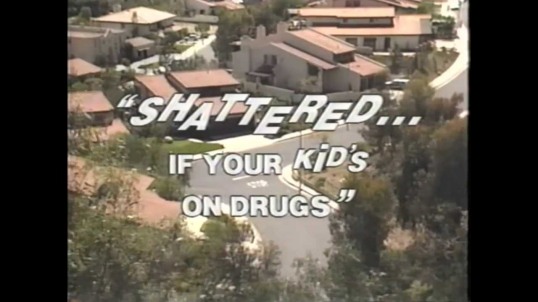
Shattered: If Your Kid’s On Drugs is a typical anti-drug video from the 1980s. The story is familiar after school special material. Kim (Megan Follows) and Rick (Rick Segall) are upper middle class kids who live in the suburbs. Rick is a track star. Kim is at the top of her class. That all changes when they start hanging out with the local drug dealer (Dermot Mulroney), who gets Rick hooked on marijuana and Kim hooked on cocaine. Kim gets an F on her report card. Rick can no longer jump the hurdles. Eventually, their parents stop drinking and taking valium long enough to force them into rehab. The message is that tough love is the only solution.
The only thing that makes Shattered: If Your Kid’s On Drugs noteworthy is the strange and unexpected presence of Burt Reynolds and Judd Nelson, playing themselves and commenting on the action. The first scene in the video is Burt and Judd driving their pickup truck through the suburbs, talking about how nice it is. “Lot of nice restaurants,” Burt says. “Are you going to buy me lunch?” Judd asks. “Lot of nice restaurants,” Burt replies. “This town is the American Dream,” Judd says. “Or the American nightmare,” Burt adds. When Kim and Rick are getting high in Dermot Mulroney’s chartreuse microbus, Burt and Judd sit on a picket fence and shoot the crap. Burt can’t understand why teens would use drugs and Judd reminds him that it has been a while since he was a teenager. Rumor has it that both Burt and Judd appeared in this video to fulfill court-ordered community service.
Everything works out in the end. If you have any doubt, just look at Burt giving us a thumbs up before the final credits roll.
“Who’s going to believe a talking head? Get a job in a sideshow.” — Herbert West
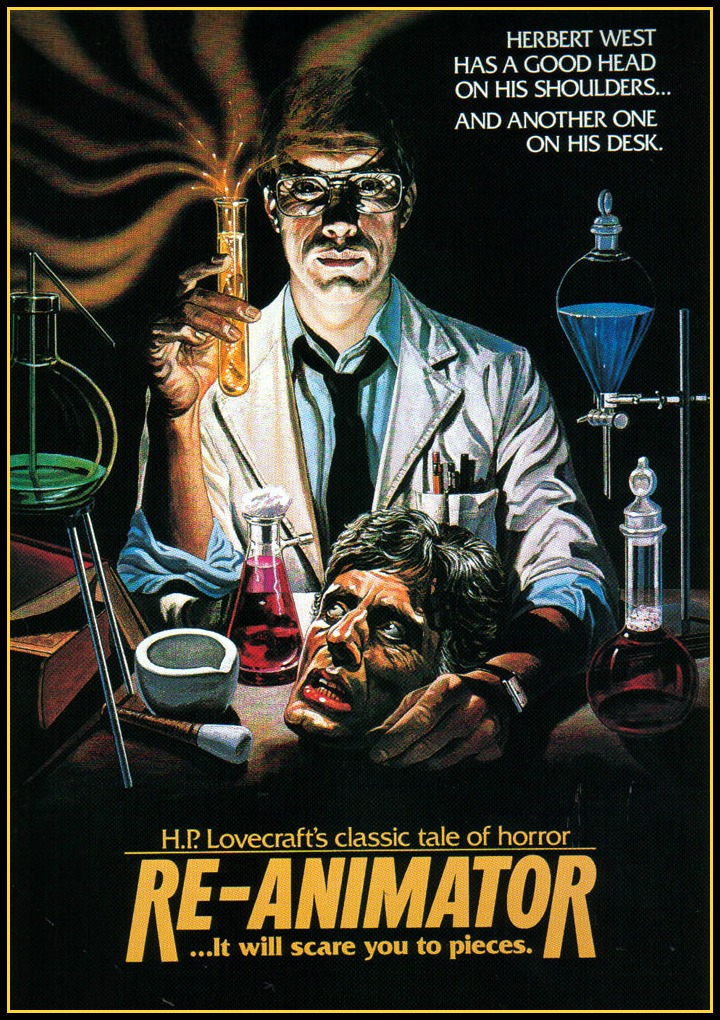
When discussing horror films of the 1980s, the conversation almost always turns to whether one has seen a particular cult classic. One such film is Re-Animator, Stuart Gordon’s 1985 adaptation of a little-known H.P. Lovecraft short story originally serialized from 1921 to 1922. While the story itself isn’t considered one of Lovecraft’s best, it inspired Gordon to create his own grisly take on the classic “Frankenstein monster” tale—with a unique blend of horror, humor, and gore.
The film follows Herbert West, a young, promising medical student obsessed with bringing the dead back to life. After being expelled from a Swiss university for his unorthodox experiments, West relocates to Miskatonic University in Arkham, Massachusetts, to continue his research in secret. He soon gains an unlikely partner in Dan Cain, a fellow medical student and landlord, who discovers West’s glowing green reagent and the terrifying results it produces.
Re-Animator plays out much like an over-the-top EC comic from the 1950s and early ’60s, full of lurid visuals and melodramatic dialogue. It’s a pulp horror film with a sci-fi twist, reveling in slapstick gore as the zombie-like corpses injected with West’s reagent come violently back to life. Unlike the flesh-eating zombies popularized by George A. Romero, these reanimated corpses are unique in their behavior, making the film stand out from typical zombie fare.
If the blood and gore weren’t enough, Re-Animator etched its place in exploitation horror history with one of the most infamous scenes ever: Megan (played by Barbara Crampton) and the severed reanimated head of West’s nemesis (played by David Gale) in a tense and chaotic encounter. This scene remains one of the most widely discussed moments in horror film history.
Gordon’s attempt to create his own “Frankenstein movie” was a huge success within the horror community, leading to two sequels. Jeffrey Combs continued to portray Herbert West in the follow-ups, though they never quite reached the original’s cult status. Still, Re-Animator firmly put both Stuart Gordon and Jeffrey Combs on the horror map—and horror fans everywhere are thankful they did.





 Through the Shattered Lens