Late Night Retro Television Review: 1st & Ten 1.1 “By The Bulls”


Welcome to Late Night Retro Television Reviews, a feature where we review some of our favorite and least favorite shows of the past! On Wednesdays, I will be reviewing 1st and Ten, which aired in syndication from 1984 to 1991. The entire series is streaming on Tubi.
For a few years now, first Prime and now Tubi have been recommending that I watch a sitcom called 1st & Ten.

My initial reaction, upon looking the show up online and discovering that it was about a football team that was owned by a woman and coached (from the second season on) by OJ Simpson, was to say, “Why would I want to watch this?”  And, to be honest, that’s still kind of my reaction.  Football is not my thing.  The only thing that is less my thing than football is soccer.

(“But in the rest of the world, soccer is called….”  Yeah, yeah, I know.  I don’t care.)

But then I read on and discovered that this is actually a historically significant show in that it was HBO’s first attempt to produce an original sitcom.  It was later sold into syndication, with all of the cursing and nudity edited out.  (Apparently, most of the episodes that are currently on Tubi are the edited syndication versions.)  That piqued my interest.  I may not care about football but I love historical footnotes.

So, without further ado, let’s get things started.

Episode 1.1 “By The Bulls”

(Dir by Rod Daniel, originally aired on December 2nd, 1984)

The show begins as wealthy Diane Barrow (Delta Burke) comes home to her mansion and discovers her husband, naked in their bedroom with another man.  “This is Ty Tylor,” her husband says, “he’s a tight end.”

“I bet he is!” Diane replies.

Later, while talking to her divorce lawyer (Earl Boen), Diane announces, “I want his Bulls!”

“You want his….?” the lawyer replies, glancing down at his crotch.

No, Diane doesn’t want his balls  She wants the Los Angeles Bulls, the football team that he owns.  When the lawyer replies that Diane’s husband loves the Bulls, Diane announces that if she doesn’t get the football team, she’ll let the world know that her husband’s gay.

(It’s the 1980s, folks.)

Diane gets the Bulls and she also gets a lot of attention due to being apparently the only woman to ever own a football team.  Everyone doubts her but Diane is determined to prove herself.  However, her sniveling general manager (and her husband’s nephew), Roger Barrow (Clayton Landey), tries to end her ownership before the season even begins by planting cocaine in her mansion,  His plan is that, during the pre-season party, one of the players will snort the cocaine and …. I don’t know.  I guess he’s hoping some will call the police or something.  It doesn’t seem like much of a plan, to be honest.

Fortunately, veteran Coach Ernie Denardo (Reid Scott) hears about the plan from a friend of his so he rushes over to the party and gets rid of the cocaine, though not before letting Diane know that she has powerful enemies.  That was nice of him since Diane previously fired him for being incompetent.  Needless to say, Denardo gets his job back.

And that’s it!  We did get to see a few snippets of the players, who all seem to be wild and wacky.  Carl Witherspoon (Sam Scarber) shows up at the party with his lawyer and demands a lot of money.  Another player, Kyle Brody (Robert Logan), tries to hit on Diane.  I checked with the imdb and this is Logan’s only appearance on the show so I’m not really sure what the point of him being at the party was.  It’s a pilot so I imagine that a lot of the background people in this episode will never be seen again.

Overall, my feeling about the pilot was that it …. well, it sucked.  The humor fell flat.  The acting was terrible.  Delta Burke showed some potential as Diane but I didn’t like how, after demanding, “I want his Bulls!,” Diane suddenly became this passive character who needed Denardo to tell her about the cocaine in her mansion.  But you know what?  It’s always unfair to judge a show by it’s pilot.  The Office, for instance, had a terrible pilot.  In the end, this particular pilot did what it was supposed to do — it introduced us to the main character and it set up the premise of the show.

We’ll see if things get better in the weeks to come.
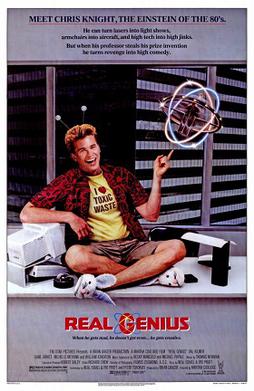
Real Genius (1985, directed by Martha Coolidge)


Mitch Taylor (Gabriel Jarrett) is a teenage genius who is recruited by Prof. Jerry Hathaway (William Atherton) to study at Pacific Tech University.  The real reason why Hathaway has recruited Mitch is because Chris Knight (Val Kilmer), another genius, has been slacking on developing the power source for an experimental laser called “crossbow.”  Hathaway hopes that Mitch can get Chris to take his work seriously and to focus on the project.  Instead, Chris teaches Mitch that he has to learn how to enjoy life or his great intelligence will become a burden and he’ll end up burned out and living in the tunnel underneath the university.  That’s what happened to Laszlo Holyfield (Jon Gries).  That’s what nearly happened to Chris.  Chris is determined not to let it happen to Mitch.

Real Genius combines college hijinks with a serious examination of the pressures of being a “real genius.”  Mitch knows everything about laser physics but he still misses his parents and cries after getting yelled at by Prof. Hathaway.  He’s just a kid, no matter how smart he is.  Chris proves himself to be a good friend, encouraging Mitch to relax and enjoy life.  Just because you’re a genius doesn’t mean that you can’t have fun.  As played by Val Kilmer, Chris Knight is the best friend that everyone wishes they could have, whether they’re a genius or not.  Even when the film gets sophomoric, Kilmer plays his role seriously and never loses sight of Chris’s humanity or why it’s so important to Chris that Mitch not become consumed by the pressure of being smarter than almost everyone else in the room.  This is one of the early Val Kilmer performances that showed just how good an actor he truly was.  With Chris’s encouragement, Mitch pursues a romance with Jordan Cochran (Michelle Meyrink) and gets revenge (more than once) on the arrogant Kent (Robert Prescott).

Eventually, Chris and Mitch realize that their research is being used to construct a weapon for the CIA and this leads to the film’s famous ending.  Ever since this movie came out, there’s been a debate over whether or not a laser could be used to make popcorn and, even more importantly, whether or not a gigantic amount of popcorn could actually destroy someone’s house.  I don’t know the answers to those questions but I’d like to think that Real Genius got it right and I have no interest in any evidence that suggests otherwise.  Sometimes, you owe it yourself to believe in the power of lasers and popcorn.  The next person who takes advantage of your hard work, destroy his house with popcorn and then sing Everybody Wants To Rule The World.  Learn the lessons of Real Genius.

Finally, when I was growing up, Real Genius was one of those films that seemed to be on HBO all the time.  Somehow, I always turned it on right when the popcorn started popping.  That popcorn-filled house, followed by Everybody Want To Rule The World, was a huge part of my childhood.  Real Genius will always bring back good memories for me.

Spaceballs (1987, directed by Mel Brooks)


°ëØ

A long time ago, in a galaxy far far away…

President Skroob (Mel Brooks), the evil and incompetent leader of Planet Spaceball, has squandered all of the air on his planet and is planning on stealing the atmosphere of the planet Druida.  To pull this off, he arranges for the idiotic Prince Valium (Jim J. Bullock) to marry Vespa (Daphne Zuniga), the princess of Druida.  (All together now: “She doesn’t look Druish.”)  Vespa and her droid, Dot Matrix (voice by Joan Rivers), flee Druida with Lord Dark Helmet (Rick Moranis) and Colonel Sandurz (George Wyner) in pursuit.

In debt to the intergalactic gangster, Pizza the Hut (voiced by Dom DeLuise), a mercenary named Lone Star (Bill Pullman) and his associate, the man-dog hypbrid Barf (John Candy), accept a contract from Vespa’s father (Dick Van Patten) to track down his daughter.  They take off in their space Winnebago to bring Vespa home.  Though they start only interested in money, Lone Star and Barf come to learn about love, freedom, and a mystical power known as the Schwartz.  (“No, the Schwartz!”)

Back when I was growing up and just being able to have HBO made you the coolest guy on the block, Spaceballs was one of my favorite movies.  I watched it every time that it came on cable.  As usual with Mel Brooks, there were a lot of double entendres that went over my young head but there was also enough goofy humor that I could laugh at what was going on.  I could quote all the lines.  I laughed whenever Rick Moranis showed up in his Darth Vader-costume.  I laughed at John Candy’s facial expressions.  I laughed when Mel Brooks showed up as Yogurt, the Spaceballs version of Yoda.  Pizza the Hut?  That’s hilarious when you’re a kid!

I recently rewatched the film.  Revisiting it was a lesson in how your memory can trick you.  I could still quote most of the lines with reasonable accuracy but nothing was quite the way I remembered it.  Rick Moranis and John Candy were still hilarious and, being older, I could better appreciated the frustration felt by George Wyner’s Colonel Sandurz.  I also realized what a good performance Bill Pullman gave as Lone Star.  While everyone else mugged for the camera, Pullman played his role straight.

I also discovered that a lot of the scenes that I remembered as being hilarious were actually just mildly amusing.  Mel Brooks was always hit-and-miss as a director, the type who would toss everything and the kitchen sink into his films.  Spaceballs has a lot of hilarious scenes but it’s obvious that Brooks didn’t have the same affection for the source material as he did with Young Frankenstein or Blazing Saddles or even High Anxiety.  Brooks is poking fun at Star Wars because it’s popular but he doesn’t seem to have any strong feelings, one way or the other, about George Lucas’s space epic.

I still laughed, though.  Even if Spaceballs wasn’t the masterpiece that I remembered it being, I still enjoyed rewatching it.  The jokes that hit were funny enough to make up for the ones that missed.  Even with his weaker films, Mel Brooks is a national treasure.

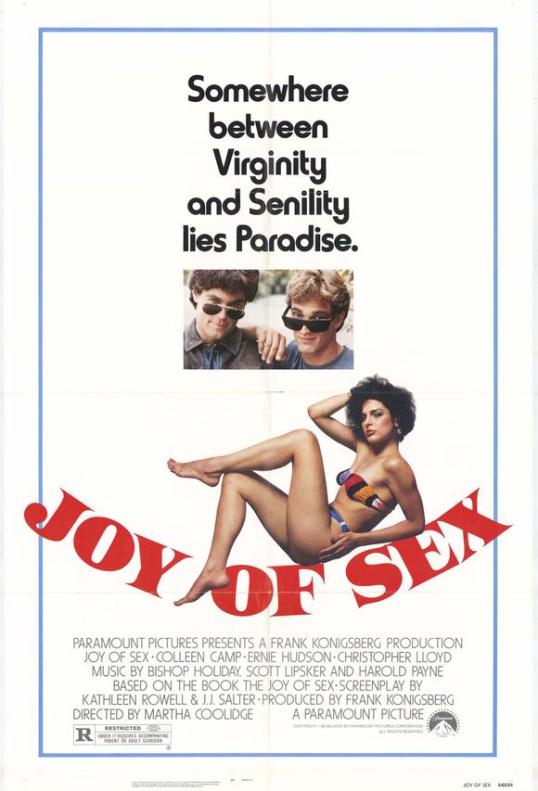
Back to School Part II #15: Joy of Sex (dir by Martha Coolidge)


Joy_of_Sex_Movie_Poster

Let’s say one positive thing about the 1984 “comedy” Joy of Sex.

The tag line on the poster: “Somewhere between virginity and senility, lies paradise,” is brilliant.  Whoever came up with it deserves a lot of credit because it sounds a lot better than anything that’s actually heard in the movie.

Let’s say something else good at Joy of Sex.  The two stars of the movie — Cameron Dye and Michelle Meyrink — both gave good and likable performances, even if their characters got a little bit annoying at times.  (Then again, just about everyone in Joy of Sex gets annoying.)  Also, there’s a subplot about an undercover cop (played by Colleen Camp) that predates 21 Jump Street and which occasionally shows off a few hints of genuine wit.

Otherwise, this is probably one of the worst of the 80s teen comedies that I’ll be reviewing for this series of Back to School reviews.  Joy of Sex is officially credited as being an adaptation of a sex manual that was popular back in the 70s.  According to the imdb and Wikipedia, Joy of Sex went through a rather tortured development.  At one point, it was going to be an anthology film, starring John Belushi and co-produced by National Lampoon.  However, Belushi died of a drug overdose, National Lampoon abandoned the project, and the final film turned out to be another high school film.  Imagine Fast Time At Ridgemont High … but really, really bad.

Leslie Hindenberg (Michelle Meyrink) is a student at Richard Nixon High School.  She’s the daughter of the school’s phys ed coach (Christopher Lloyd, playing what was probably meant to be the Belushi role) and, as a result, she is viewed as being untouchable, even by the sex-crazed boys of Nixon High.  The problem is that Leslie has recently discovered a mole on chest and is convinced that she has skin cancer.  Believing that she only has 6 weeks to live, Leslie sets out on a mission to lose his virginity.  However, she wants to lose it to the perfect guy and there aren’t many of those at her school.  (Can you really afford to be picky when you’ve only got 6 weeks to live?)  Add to that, everyone’s terrified of the coach…

Leslie’s lab partner is Alan (Cameron Dye), who is a nice guy.  He not only has a huge crush on Leslie but he’s also desperate to lose his virginity as well!  Problem solved, right?  Well, no.  See, Alan has been led astray by the new girl in school.  Liz (Colleen Camp) is tough, outspoken, and no-nonsense.  As soon as she shows up in school, she lets everyone know that she’s obsessed with two things — sex and drugs.  In fact, she’s especially interested in drugs…

A lot of students, of course, are suspicious of Liz.  She seems to be older than everyone else and speak in out-of-date slang.  “Could she be a narc?” some students wonder.  Well, actually, she is.  She is working undercover at Nixon High and is convinced that Alan knows who is supplying drugs to all of the students.  And, it must be said, that Colleen Camp really throws herself into the role.  As happens with most of the film’s subplots, the undercover narc storyline doesn’t really go anywhere but at least Camp made the effort.

Meanwhile, Leslie’s best friend has been kicked out of school because she’s pregnant.  Leslie approaches a local reporter, hoping to convince him to do a story about what’s happened.  And, while getting her best friend back into school, Leslie starts to wonder if maybe she’s found the right man to take her virginity…

(But wait!  We know she’s meant to be with Alan!  So, surely, the reporter will turn out to be a sleaze, right?)

But that’s not all!  Someone is running around the school and using superglue to play pranks.  Who could it be?  Will the crazy principle (Ernie Hudson) be able to maintain order until the big dance?  And will the portrayal of the school’s frequently confused foreign exchange student manage to get any more racist?

And what about Tom Pittman (Robert Prescott)?  Pittman is the most popular guy in school.  Pittman doesn’t really do a lot.  To make an undeserved comparison to Animal House, he’s kind of the Bluto character, just not as interesting.  Whereas Bluto smashed guitars and beer cans and gave inspiration speeches, Pittman tries to light his farts on fire and is something of a bully.  (There is a kinda funny scene where he’s suddenly nice to Leslie and everyone’s shocked.)  The most memorable thing about Pittman is that he wears thick black glasses which are held together by tape.  So, if nothing else, Joy of Sex is important chapter in the history of myopia in film.

Anyway, Joy of Sex has remarkably little joy and next to no sex.  I imagine that were riots in the theaters after this movie came out, as thousands of angry teenagers chanted, “We want joy!  We want sex!  When do we want them!?  NOW!”

There were a lot of great teen films released in the 80s.  Joy of Sex is not one of them.

Lisa Marie Bowman Does Michael Clayton (dir. by Tony Gilroy)


As part of my continuing mission to see and review every single film ever nominated for best picture, I recently rewatched the 2007 Best Picture nominee Michael Clayton

The title character (as played by George Clooney) is a sleazy attorney who “fixes” problems for one of the biggest law firms in New York.  When Arthur Edens (Tom Wilkinson), one of the firm’s partners and Michael’s mentor, has a nervous breakdown while at a deposition in Minnesota and ends up in jail, Michael is sent to retrieve him.  Michael soon discovers that Arthur’s mental collapse was due to a class action law suit involving an evil, faceless corporation.  Before he reveals any more details, Arthur flees and is subsequently murdered by two assassins.  With the police calling Arthur’s death a suicide, Michael soon finds himself being pursued by the same assassins.

Though I’ve owned the DVD for a couple of years, this was only the second time that I had ever actually sat down and watched this film.  (The first time was during its initial theatrical run.)  There have been many insomnia-filled nights when I’ve gone to my DVD collection, fully intending on grabbing Michael Clayton and allowing the images of an unshaven George Clooney to flicker in my dark bedroom.  However, every time, I always ended up suddenly remembering a film that I wanted to see more. 

That’s the thing with Michael Clayton.  Having seen the film a second time, I can say that it remains a well-made film and an entertaining film and I can also say that I noticed a whole lot of small details that I had either missed the first time or had subsequently forgotten about.  Like a lot of best picture nominees, Michael Clayton is a good film.  It’s just not a very memorable one.  Seriously, is anyone surprised when business executives and attorneys turn out to be the villains in these type of films?  And if you couldn’t guess that Tom Wilkinson was going to end up dead from the minute he turned up on-screen then you may need to surrender your filmgoer card.

That said, Michael Clayton remains a fun little film and I enjoyed watching it even if it was predictable.  In fact, I may have enjoyed it even more the second time around because I currently work for an attorney so I was able to spend the whole movie playing the “What would my boss do in this situation?” game.  (Hopefully, the first thing he would do would be to send his loyal and capable red-headed assistant on a nice, long, all-expense paid vacation Italy.)  Beyond that, Tony Gilroy’s direction is efficient and fast-paced, George Clooney gives one of his less-smug performances (It can be argued that Michael Clayton — along with Up In The Air and The Descendants — forms Clooney’s Mediocre White Man Trilogy) and Tilda Swinton deserved the Oscar she won for playing a villain who isn’t so much evil as just really insecure.   However, for me, the best performances in this film come from two unheralded actors by the name of Robert Prescott and Terry Serpico.  Playing the two assassins who pursue both Wilkinson and Clooney, Serpico and Prescott play their roles with a nonchalant sort of respectability that is both compelling and genuinely frightening.  During those brief moments when Serpico and Prescott are on-screen, Michael Clayton actually becomes the film that it is obviously trying so hard to be.