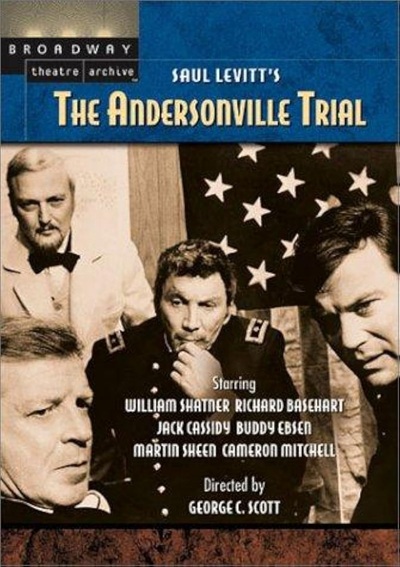
On Stage On The Lens: The Andersonville Trial (dir by George C. Soctt)


1970’s The Andersonville Trial takes place in one muggy military court room.  The year is 1865.  The Civil War is over but the wounds of the conflict are still fresh.  Many of the leaders of the Confederacy are still fugitives.  Abraham Lincoln has been dead for only a month.  The people want someone to pay and it appears that person might be Captain Henry Wirz (Richard Basehart).

Originally born in Switzerland and forced to flee Europe after being convicted of embezzlement, Henry Wirz eventually ended up in Kentucky.  He served in the Confederate Army and was eventually named the commandant of Camp Sumter, a prison camp located near Andersonville, Georgia.  After the war, Captain Wirz is indicted for war crimes connected to his treatment of the Union prisoners at the camp.  Wirz and his defense counsel, Otis Baker (Jack Cassidy), argue that the prison soon became overcrowded due to the war and that Wirz treated the prisoners as well as he could considering that he had limited resoruces.  Wirz points out that his requests for much-needed supplies were denied by his superiors.   Prosecutor Norton Chipman (William Shatner) argues that Wirz purposefully neglected the prisoners and their needs and that Wirz is personally responsible for every death that occurred under his watch.  The trial is overseen by Maj. General Lew Wallace (Cameron Mitchell), the same Lew Wallace who would later write Ben-Hur and who reportedly offered a pardon to Billy the Kid shortly before the latter’s death.  Wallace attempts to give Wirz a fair trial, even allowing Wirz to spend the trial reclining on a couch due to a case of gangrene.  (Agck!  The 19th century was a scary time!)

The Andersonville Trial started life as a 1959 Broadway production.  On stage, George C. Scott played Chipman, an experience he described as difficult because, even though Chipman was nominally the play’s hero, Wirz was actually a much more sympathetic character.  When the play was adapted for television in 1970, Scott returned to direct.  Admittedly, the television version is very stagey.  Scott doesn’t make much effort to open up the play.  Almost all of the action is confined to that courtroom.  We learn about the conditions at Fort Sumter in the same way that the judges learned about the conditions.  We listen as the witnesses testify.  We listen as a doctor played by Buddy Ebsen talks about the deplorable conditions at Fort Sumter.  We also listen as a soldier played by Martin Sheen reports that Wirz has previously attempted to suicide and we’re left to wonder if it was due to guilt or fear of the public execution that would follow a guilty verdict.  We watch as Chipman and Baker throw themselves into the trial, two attorneys who both believe that they are correct.  And we watch as Wirz finally testifies and the play hits its unexpected emotional high point.

As most filmed plays do, The Andersonville Trial demands a bit of patience on the part of the viewer.  It’s important to actually focus on not only what people are saying but also how they’re saying it.  Fortunately, Scott gets wonderful performances from his ensemble cast.  Even William Shatner’s overdramatic tendencies are put to good use.  Chipman is outraged but the play asks if Chipman is angry with the right person.  With many of the Confederacy’s leaders in Canada and Europe, Wirz finds himself standing in for all of them and facing a nation that wants vengeance for the death of their president.  Wirz claims and his defense attorney argues that Wirz was ultimately just a soldier who followed orders, which is what soldiers are continually told to do.  The Andersonville Trial considers when military discipline must be set aside to do what is morally right.

Admittedly, when it comes to The Andersonville Trial, it helps to not only like courtroom dramas but to also be a bit of a history nerd as well.  Fortunately, both of those are true of me.  I found The Andersonville Trial to be a fascinating story and a worthy production.
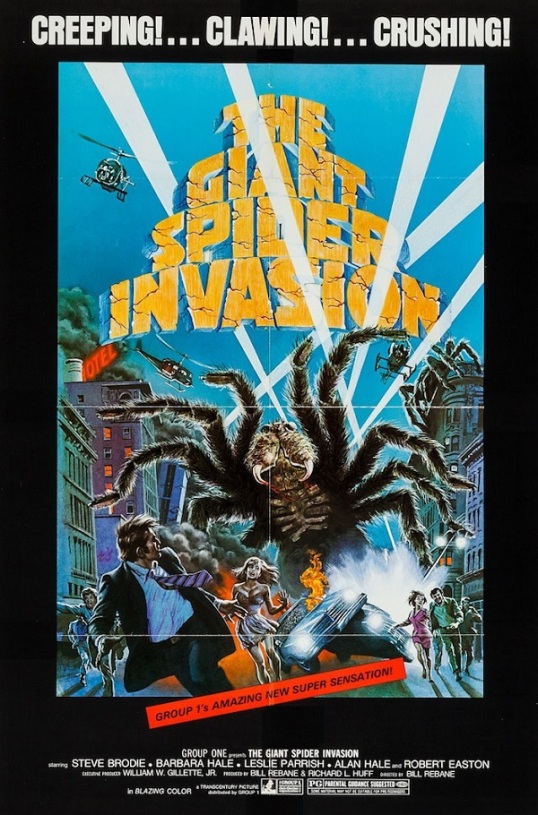
The TSL’s Horror Grindhouse: The Giant Spider Invasion (dir by Bill Rebane)


Welcome to rural Wisconsin, where everyone’s running around in their underwear and getting attacked by giant spiders!

That’s not meant to be a dig at the 1975 film, The Giant Spider Invasion, either.  I mean, let’s be honest.  If you’re going to be running around the trailer park in your underwear, the last thing that you want to do is walk straight into a giant spider web.  That happens a few times in The Giant Spider Invasion and I cringed every time because …. AGCK!  I mean, it’s a scary thought and The Giant Spider Invasion understands that.  Years ago, I was riding a horse and I rode head first into a spider web and oh my God!  I lost track of how many hours I spent washing my hair afterwards.  Of course, fortunately, I wasn’t in my underwear when I rode into that spider web.  So, it wasn’t as bad as it could have been.

Anyway, The Giant Spider Invasion opens with a meteorite crashing down to Earth.  As I previously mentioned, it lands in Wisconsin.  I can’t help but think that the alien spiders were a bit disappointed when they emerged out of their meteorite and discovered that they were in Wisconsin.  One would imagine that they were probably aiming for Washington D.C. and maybe they got off track.  Still, it works to the spiders’ advantage in that they’ve managed to land in a place so filthy and messy that no one is going to notice a few extra tarantulas crawling around.  Or, at least, they don’t notice until the tarantulas are gigantic and wandering through the fields.

(Go ask Alice …. when she’s ten feet tall…..)

We follow as various people deal with the giant spider invasion.  What we quickly discover is that, in 1975, America just wasn’t ready to make contact with alien spiders.  While Dr. Langer (Barbara Hale) and Dr. Vance (Steven Brodie) investigate the meteorite crash, the rest of the town is too busy with their own personal dramas to be of much help.  The Sheriff (Alan Hale, Jr.) is a buffoon who tries to coordinate a response from the safety of his office.  Dan (Robert Easton) and Ev (Leslie Parrish) obsess on whether or not the meteorites contain diamonds as well as spiders.  Dan has an affair with barmaid Helga (Christine Schmidtmer) while Ev’s younger sister, Terry (Dianne Lee Hart) dates Dave (Kevin Brodie), the son of the local newspaper editor.  Every 15 minutes or so, a crazed-looking preacher pops up and starts ranting about how the world’s going to end because of the sins of people like Dan, Eve, and Helga and, to be honest, the preacher seems to be the only person in town who understands just how much trouble they’re all in.

It’s all kind of silly but, because this is a Bill Rebane film, it all plays out with a certain unbridled enthusiasm that’s impossible to resist.  Rebane was never one to let a low-budget get in the way of his ambitions and the special effects in The Giant Spider Invasion may be cheap but they still have a charm all their own.  I mean, let’s face it.  Spiders are scary and any scene that features a giant one sneaking up on someone is going to be at least somewhat effective.  (I’ll even go on to say that a shot of a “giant” spider super-imposed over a field was actually rather effective and creepy.)  Add to that, The Giant Spider Invasion has only an 84-mintue running time so it doesn’t waste any time getting to the spiders.  This is a fun movie and a perfect one to watch in October.

Horror on TV: Kolchak: The Night Stalker 1.12 “Mr. R.I.N.G.” (dir by Gene Levitt)


Tonight on Kolchak….

After annoying his editor one too many times, Carl Kolchak has been assigned to write obituaries.  However, you can’t keep a good reporter down and, when Kolchak comes across the mysterious death of a scientist, Kolchak decides to investigate on his own.  Kolchak’s defeated vampires, werewolves, Cajun demons, and serial killers.  How will he do against something made by the government?

This episode originally aired on January 10th, 1975.

Enjoy!

http://www.youtube.com/watch?v=lTLYmO21S3c

Lisa Reviews An Oscar Nominee: Working Girl (dir by Mike Nichols)


(With the Oscars scheduled to be awarded on March 4th, I have decided to review at least one Oscar-nominated film a day.  These films could be nominees or they could be winners.  They could be from this year’s Oscars or they could be a previous year’s nominee!  We’ll see how things play out.  Today, I take a look at the 1988 best picture nominee, Working Girl!)

Welcome to the 80s!

Yes, Working Girl is definitely a film of its time.  It’s a film that’s obsessed with big things: big dreams, big offices, big money, and big hair.  It’s a movie where the heroes talk about hostile takeovers and where everyone’s dream is to eventually to be an executive on Wall Street.  You know all of those people who claim that The Big Short is the greatest movie ever made?  I can guarantee that the majority of them would totally hate every character in Working Girl.  Working Girl is such a film of the past that it even features Alec Baldwin doing something other than bellowing at people.  In fact, Baldwin’s actually sexy in Working Girl.  It was strange to see him in this film and realize that he was the same actor who currently spends all of his time picking fights on twitter and defending James Toback.

Of course, Alec Baldwin has a relatively small role in Working Girl.  He plays Mick Dugan, the type of blue-collar guy who gives his girlfriend lingerie for her birthday (“I just wish you would get me something that I could wear outside,” she says as she tries it on) and who then proceeds to cheat on her while she’s off at work.  From the minute we first meet Tess McGill (Melanie Griffith), we know that she deserves better than Mick.

Tess is a professional administrative assistant.  She’s just turned 30 but she’s not ready to give up her dreams and settle for a life of fighting off coke-snorting executives and coming home to some guy like Mick.  (Speaking of early performances from infamous actors, one of the coke-snorting executives is played by Kevin Spacey.)  Tess has got a bachelor’s degree in Business.  As she puts it, she has a “mind for business and a bod for sin.”

She’s also got a new boss, an up-and-coming executive named Katharine Parker (Sigourney Weaver).  It turns out that Katherine is 29 years old.  (“I’ve never worked for someone younger than me before,” Tess says as Katherine gives her a condescending smile.)  Katharine encourages Tess to think of her as being a mentor.  If Tess has any ideas for investments, she should feel free to bring them to Katharine.  Of course, when Tess does so, Katharine claims that her bosses shot the idea down.  It’s only after Katharine breaks her leg in a skiing accident and is laid up in Europe that Tess discovers that Katharine has actually been stealing her ideas and not giving her any credit for them.

What is Tess to do?  Well, she does what any of us would do.  She passes herself off as an executive and presents her idea to Jack Trainer (Harrison Ford) herself.  Jack is impressed with the idea but he’s even more impressed with Tess.  Of course, complicating things is that Jack was once in a relationship with Katharine and Katharine still thinks that she’s going to eventually marry Jack.  And, of course, there’s the fact that Tess is lying about actually being an executive…

Working Girl is a frequently amusing film, elevated by performances of Melanie Griffith and, in the role of Tess’s best friend, Joan Cusack.  Add to that, Harrison Ford is remarkable non-grouchy as Jack Trainer and Sigourney Weaver appears to be having the time of her life playing a villain.  Even as I laughed at some of the lines, here was a part of me that wished that the film had a bit more bite.  At times, Working Girl tries too hard to have it both ways, both satirizing and celebrating Wall Street culture.  In the end, the film works best as a piece of wish-fulfillment.  It’s a film that says that not only can you win success and Harrison Ford but you can get your bitchy boss fired too.

Despite being a rather slight (if likable) film, Working Girl was nominated for Best Picture of 1988.  However, it lost to Rain Man.