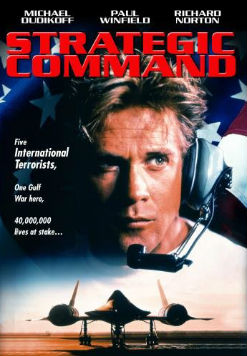
Every Monday night at 9:00 Central Time, my wife Sierra and I host a “Live Movie Tweet” event on X using the hashtag #MondayMuggers. We rotate movie picks each week, and our tastes are quite different. Tonight, Monday May 12th, we are showing STRATEGIC COMMAND (1997) starring Michael Dudikoff, Paul Winfield, Richard Norton, Amanda Wyss, Bryan Cranston, and Michael Cavanaugh.
This movie focuses on Rick Harding (Michael Dudikoff), a former Marines officer, who’s now working in the FBI as a chemical weapons designer. While packing up one night, a group of armed soldiers break into the FBI research lab. Interestingly, these soldiers are led by a man named Carlos Gruber (Richard Norton).
So, join us tonight for #MondayMuggers and watch STRATEGIC COMMAND! It’s on Amazon Prime. The trailer is included below:
As an obsessed Rutger Hauer fan of the early 90’s, I was working my way through the man’s back catalogue of films when I came across THE BLOOD OF HEROES (1989) on the shelves at my local video store. With its post-apocalyptic setting and its strange sport of jugger, I’ll admit that it was not the kind of film that I’m most drawn to. I generally preferred watching Hauer taking down the bad guys in movies like WANTED DEAD OR ALIVE (1986) and BLIND FURY (1989), which was released the very same year. However, it was a relatively recent Hauer film, so I rented it, cautiously optimistic that it would be entertaining. At the time, it was not my favorite Hauer film, but I remember an 18-year-old version of myself thinking it was okay. I’ve watched it a couple of times over the last 30 years, and even own the DVD, but it’s not one that I pull off the shelf very often. I decided it was time for a fresh viewing.
In the bleak, desolate, futuristic world of THE BLOOD OF HEROES, Rutger Hauer plays Sallow, the leader of a team of juggers. They go from town to town challenging the local team in a sport where you win by placing a dog skull securely on a stake. It’s an extremely violent game consisting of two teams with five players. Four players basically beat the crap out of the opposition with clubs and chains, in hopes that they can provide protection to their one player, the “quick,” who can get the skull on the stake. We meet Sallow’s team who consists of Dog Boy (Justin Monjo), Mbulu (Delroy Lindo), Big Cimber (Anna Katarina), and Young Gar (Vincent D’Onofrio) as they enter a town ready for a match. They win, but Dog Boy, their quick, has his leg broken in the process. Luckily for them, the opponent’s quick Kidda (Joan Chen), who was at least partially responsible for Dog Boy’s gruesome injury, is available to head towards the next town with the ragtag crew! She turns out to be a hell of a player, who’s willing to do whatever it takes to win, including biting an ear off when it’s required. This is what I call dedication. During the course of the story, we find out that Sallow used to be a professional jugger who played in “The League” in the underground cities where the rich, aristocratic people live and treat their champion juggers “almost” like one of them. He got banished when he engaged in a forbidden relationship with one of the overlord’s daughters. With his team of juggers, especially the super talented Kidda and Gar, Sallow leads them to the big city where they will challenge the professionals. For Sallow, it’s a shot at redemption. For the others, it’s a chance to be noticed by the League, which will lead to a much more luxurious life, when they’re not bashing their opponents brains in of course. I may have exaggerated a bit in my headline when I referred to this challenge as the “Jugger Super Bowl,” but it’s still kind of a big deal!
After rewatching THE BLOOD OF HEROES again, while it’s still not my favorite kind of film, I can confidently say that I enjoyed it very much this time around. Most of that joy stems from watching Rutger Hauer in his prime. He’s such a charismatic actor and that even comes across in such a grim setting. I also like his character type, that of the disgraced former hero searching for redemption against a system that had previously discarded him. There’s usually much satisfaction to be had with this type of character, and this movie delivers on that premise. Joan Chen is very good as the new addition to the team who dreams of escaping her town and becoming a jugger star! She and Hauer really carry the film. The rest of the cast also added to my enjoyment of the movie. For me, It’s a lot of fun watching actors like Vincent D’Onofrio and Delroy Lindo in relatively early roles in their long and distinguished careers. I really enjoyed seeing Australian actors Hugh Keays-Byrne and Max Fairchild, both veterans of the MAD MAX series, appear near the end of the film when they make it to the city. Max Fairchild is especially impressive as one of the League juggers and former friend to Hauer. I wanted to give one more shout out, and this one goes out to actor Gandhi MacIntyre, who plays the team manager and doctor in the film. He has a very likable presence and made me smile on multiple occasions. The movie’s pretty serious and dark, and Gandhi’s sense of humor is a welcome presence.
THE BLOOD OF HEROES is written and directed by David Webb Peoples. To date, it’s the only feature length film that Peoples has directed. In my opinion, he does a fine job. He certainly creates an interesting world, with huge contrasts between the barren, rocky outside landscapes and the overcrowded, underground cities. This is not a world I want to live in, but Peoples brought his vision to the screen, albeit within clear budget limitations. Considering it’s from the same guy who wrote BLADE RUNNER (1982) and UNFORGIVEN (1992), the story is pretty simple. And this is fine by me. The story of redemption for some, and of the dream of newfound glory for others, is a story that all of us can relate to at some point in our lives. At this point in my own life, I can relate to both! The movie features some ugly and violent images, but I found myself emotionally pulling for the ragtag group of underdogs in the big game at the end. It’s also pretty cool that Peoples made up his own game when writing the screenplay, albeit a game I would never want to play. The game Jugger, a less violent version of the game introduced in the film, is currently played all over the world.
One final thing I wanted to point out about THE BLOOD OF HEROES is the fact that an author named Danny Stewart has written a book called “Saluting the Blood of Heroes – Behind the Apocalyptic Film.” I just learned of this book while researching the film today for this review. It was published in July of 2024. I just love a world where a person is able to get a book published about the making of an obscure, low budget film from the late 80’s. I won’t be surprised if this ends up in my Amazon cart really soon.
I’ve included the trailer for THE BLOOD OF HEROES (AKA – THE SALUTE OF THE JUGGER) below:
The 1977 film, Abba: The Movie, is really two movies in one.
One of the movies, and the one that will probably most appeal to fans of the group, is a cinema verité-style look at ABBA touring Australia. This part of the movie not only features the band playing their best-known songs in concert but it also features some behind-the-scenes footage of the members of ABBA trying to enjoy their time Australia. They struggle to adjust to Australian culture and the English language. Agnetha Fältskog complains about the way the tabloids focus on her body as opposed to her singing. The emphasis is on the members of ABBA being down-to-Earth and friendly professionals who love making music but who, even more importantly, love hanging out together and making their fans happy.
The second movie is about an Australian DJ named Ashley Wallace (Robert Hughes) who is ordered to get an interview with ABBA before they leave the continent. It won’t prove easy. For one thing, Ashley really isn’t sure who ABBA is, beyond knowing that they’re a famous pop band. (Ashley’s musical tastes seem to learn towards country and western.) Secondly, ABBA is always surrounded by a mob of fans and bodyguards and it’s very difficult to get close enough to even ask them for an interview. Third, ABBA distrusts reporters, especially after the tabloids print a bunch of salacious articles about Agnetha. Fourth, Ashley is an idiot.
Seriously, Ashley is his own worst enemy. If ABBA heads to the west, you can be sure that Ashley will catch the next train heading east. Even when Ashley does finally manage to talk to ABBA’s manager and schedule an interview, he ends up oversleeping and missing his appointment! Seriously, just think about this. Ashley has been told that his entire future depends on getting an interview with ABBA, a task that soon proves to be nearly impossible. Then, when Ashley finally manages to get a chance to conduct this all-important interview, it doesn’t occur to him to set his alarm to wake him up early. There’s a word for that type of behavior and that word is “stupidity.”
As he struggles to get some time with ABBA, Ashley also takes time to interview people on the street about the opinion of ABBA. Surprise! Almost everyone loves ABBA! I guess that’s to be expected, considering that the movie is named after them. It would probably be counter-productive to have Ashley interview a bunch of people who can’t stand ABBA and would rather be listening to Led Zeppelin. (There are a few people who tell Ashley that they don’t like ABBA but they’re all losers.) Ashley spends so much time talking to people who love ABBA that he soon comes to love ABBA and appreciate their music as well. He even has a series of fantasy and daydreams. He imagines that the two men in ABBA are his best friends. He dreams of being loved by the two women in ABBA. Through Ashley, the audience is provided a view of how one goes from being indifferent to being a fan.
But most viewers won’t care about Ashley. They’ll be watching for ABBA. The performances are strong. The members of the band seem to truly enjoy being on stage and interacting with their fans. Interestingly, the members of ABBA are likable but a bit bland off-stage. They’re people who truly come alive when they’re performing but who are much more subdued and down-to-Earth offstage. Indeed, it almost seems as if Ashley is wasting his time trying to get an interview. In this film, to watch ABBA perform on stage is to know all that you need to know.
In the 1997 film, Strategic Command, Richard Norton plays a terrorist named Carlos …. wait for it …. Gruber. If that last name sounds familiar, that’s because the villain of Die Hard was named Hans Gruber and the bad guy from Die Hard With A Vengeance was named Simon Gruber. Gruber — the number one name in hostage situations!
Anyway, Carlos Gruber and his fellow terrorists steal a chemical called Bromax from the FBI. Bromax is a chemical weapon, one that can be used to kill thousands of people. It’s probably not a good idea for anyone to have Bromax, regardless of whether they are terrorists or the FBI. What’s the point of Bromax, really? It only has evil purposes. Plus, it has a stupid name.
Gruber proceeds to hijack Air Force Two, holding the Vice President (Michael Cavanaugh) and several journalists hostage. Gruber wants his fellow terrorists to be released from prison and he’s prepared to kill the Vice President if he doesn’t get what he wants. Perhaps because Gruber realizes how little the Vice President actually does, Gruber is also willing to spray Bromax over America.
Not wanting to see America get Bromaxed, the President sends an elite force of special op. soldiers after Air Force Two. Captain Rattner (Jsu Garcia, back when he was still using the name Nick Corri) is in charge of the mission and he doesn’t expect there to be any slip-ups. Accompanying Rattner’s men is Rick Harding (Michael Dudikoff!), the inventor of Bromax! Along with not wanting to see Bromax sprayed over America, Harding also wants to save the life of his wife, Michelle (Amanda Wyss, who co-starred with Jsu Garcia in the original Nightmare on Elm Street). Michelle is one of the journalists on the plane.
Strategic Command is stupid, yet strangely likable. It’s impossible not to admire the film’s attempt to be a huge action epic without actually spending any money. As a result, Air Force 2 is a commercial airliner. There’s a surprisingly small number of people involved on both sides of the plot. The viewer might expect the hostage situation to be one of those big, “all hands on deck” emergencies but, instead, the President is content to send 6 people to get the job done. Fortunately, there aren’t that many terrorists either. This is action on a budget.
Adding to the film’s overall strangeness is the miscasting of Michael Dudikoff as a quiet and somewhat nerdy scientist. This is one of those films where the viewer is meant to assume that a character is smart just because he’s wearing glasses. Dudikoff is so miscast that, again, it all becomes strangely likable. He and Richard Norton are so enthusiastic about chewing up the scenery that it’s kind of fun to watch. Also fun to watch is the legitimate great actor Bryan Cranston, cast here as a vain and cowardly anchorman. One gets the feeling that this is probably not a film that Cranston brags about but his performance isn’t bad at all. Every film like this needs to have a self-important reporter who can get humiliated in some fashion and Cranston handles the role like a pro.
Strategic Command is dumb but kind of fun, in the way that many 90s direct-to-video action films tend to be. It’s a good film for when you want to watch something that won’t necessarily require your full attention. In fact, the less thought one gives to what happens in Strategic Command, the better. Watch it for Dudikoff, Norton, and especially the one and only Bryan Cranston!
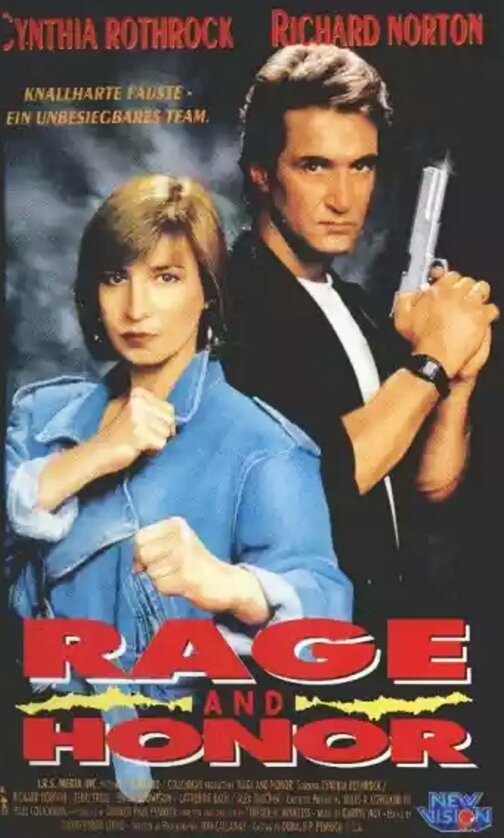
The 1992 film, Rage and Honor, tells the story of two people from different worlds, who come together to kick ass and save a declining American city.
Preston Michaels (Richard Norton) is a cop from Australia who has come to America as a part of an exchange program. When he’s not working undercover, he’s supplementing his income by working as a bodyguard for what appears to be an 80s cover band.
Kris Fairfield (Cynthia Rothrock) is a teacher at the local high school who also moonlights as a karate instructor. She’s haunted by the death of her parents and the subsequent disappearance of her brother. She cares about her students, even though hardly any of them actually appear in the film. In fact, the whole high school teacher thing never really matters much in the grand scheme of things.
Preston and Kris are teaming up to take down spacey drug lord Conrad Drago (Brian Thompson). Conrad has a fierce mullet, a cocaine addiction, and a knowledge of all of the body’s pressure points. His girlfriend is Rita (Terri Treas) and the only thing that could possibly prevent Drago and Rita from taking over the city is a tape that reveals Rita and a bunch of crooked cops killing someone. Kris and Preston are trying to find the tape before Drago and Rita find it. Somehow, it all eventually leads to a homeless stock broker named Baby (Stephen Davies) and a weird fight club that’s run by Hannah the Hun (Alex Datcher).
It’s an incredibly silly film, to be honest. It’s the type of film where Preston gets shot once in the side and once in the leg and neither time does it slow him down. (He does mention that his leg hurts at one point but he never starts to limp or anything like that.) Kris, meanwhile, is given a tragic backstory that is explained to us in-between scenes of awkward comedic relief. Hannah goes from being a calculating villainous to a heroic ally, without the film attempting any explanation as to why. Meanwhile, despite Brian Thompson’s best efforts to be menacing, Conrad is written as being some sort of flakey, New Age drug dealer. He’s about as intimidating as the biggest guy in a drum circle. There’s really not much rage or honor to be found in Rage and Honor.
And yet, it was impossible for me to dislike the film. Every time Cynthia Rothrock did a flying kick and sent some jerk flying, the film won me back. Unfortunately, she didn’t really get to do as much fighting as she should have. She had to share the screen with Brian Thompson and Richard Norton, who both received fight scenes of their own. All three of them looked good fighting but Cynthia was the clear star. What she lacked in actual acting ability, she made up for with pure enthusiasm. Watching her, you realized that she was not only good at fighting but she enjoyed it as well. For all the film’s flaws, Cynthia kicked everyone’s ass and that’s really all that mattered. It was empowering and, even more importantly, it was a lot of fun to watch.
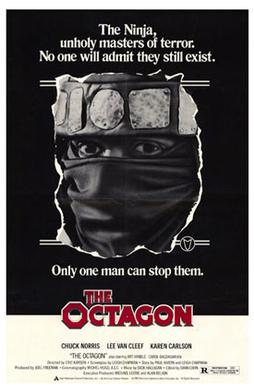
A ninja named Seikura (Tadashi Yamashita) is running a training camp where he shows mercenaries and terrorists how they can use martial arts to assassinate their enemies and disrupt the political system. Someone has to stop him.
This looks like a job for CHUCK NORRIS!
In this one, Chuck plays Scott James, a retired karate champion who, though a massive series of apparently unrelated coincidences, is drawn into the fight against Seikura’s terrorists. (Speaking of coincidences, Seikura just happens to be Scott’s half-brother.) One of the fun things about The Octagon is that there’s no real rhyme-or-reason as to how Scott gets involved. He just keeps running into people who want him to fight terrorists. His former mentor (played by Lee Van Cleef) tries to recruit him. Immediately after turning him down, Scott just happens to run into a woman (Karen Carlson) who is having car trouble and the woman tries to recruit him. Scott’s old friend, A.J. (Art Hindle) tries to recruit him. Even a dancer (Kim Lankford) who goes out on a date with Scott is more interested in talking about the terrorists than anything else. Even when the terrorists decide to go after Scott, it’s mostly just because he keeps talking to their enemies.
Scott does eventually get involved. He goes undercover, which means that he gives everyone a fake last name while asking them if they know where he can sign up for the terrorist training camp. (But he doesn’t shave his mustache or anything else so he’s still obviously Chuck Norris.) Eventually, Aura (Carol Bagdasarian) defects from the terrorists over to Scott’s side and the two of them launch an assault on the terrorist camp. While this is all going on, Scott has doubts about whether or not he can really defeat his half-brother and we hear them in voice over. It’s an interesting attempt to show what’s going on in an action hero’s head but, because Chuck was such an inexpressive actor early in his career, the contrast between his worries and his stone face creates a strange effect.
It doesn’t matter, though, that Chuck wasn’t an expressive actor or that the film’s plot is needlessly convoluted. The fight scenes are frequent and they all rock and that’s what really matters. Chuck throws a lot of punches and kicks in this film and, as opposed to some of his other early films, the director of The Octagon made sure that we could see every single one of them. Whether he’s fighting in a small hotel room and fighting off a dozen enemies in the terrorist camp, Chuck’s exciting to watch. Also exciting to watch is Carol Bagdasarian, who makes her role more than the typical action movie love interest. At times, she seems like she might even be a deadlier opponent than Chuck himself!
Finally, Lee Van Cleef! In this one, he drives a truck with a “Have You Hugged Your Gun Today?” bumper sticker. No film featuring Lee Van Cleef can be that bad. In fact, most, like The Octagon, are pretty damn entertaining.
As the title indicates, this is another Nam film, where a veteran reenters the jungle and finally rescues the POWs who were left behind when the United States fled Saigon. With Sylvester Stallone, Chuck Norris, and even Gene Hackman leading the way, these films were all the rage during the 80s. They provided American audiences with a chance to go back and win the only war that, up to that point, America had lost. Not only did they provide wish-fulfillment for audiences but they also confirmed what several suspected, that the only reason the U.S. lost in Vietnam was because our soldiers’s hands were tied by generals and Washington pencil pushers. If we had just let our men go in and fight the VC guerrilla-style, these films say, Saigon never would have fallen.
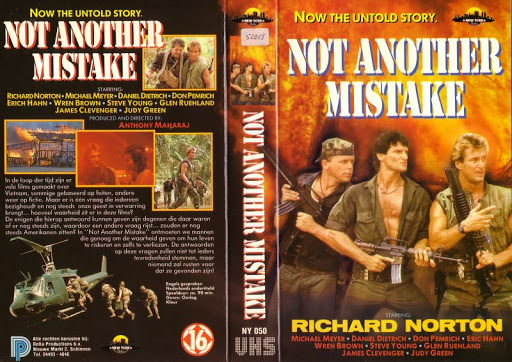
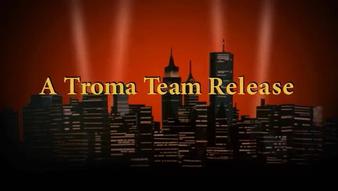
Not Another Mistake came out towards the end of the cycle and you know what type of film you’re about to get into as soon as the “A Troma Team Release” skyline appears at the start of it.
Don’t let that skyline scare you off. Not Another Mistake is slightly better than the average Troma film. Admittedly, that’s not exactly a high bar to clear.
Richard Norton plays Richard Straker, who served in a special ops unit during Vietnam and who was a key part of Operation Black Thunder. In other words, he’s a badass. After the war ended, Straker raised a family and found success as a businessman. One night, he returns home and interrupts a home invasion. He kills the thugs but not before his wife and daughter each suffer a slow motion death. (Straker has Vietnam flashbacks while shooting the thugs.) Straker spends a year drinking and then goes to Vietnam to lead a raid on a POW camp. What’s interesting is that Straker’s family being murdered doesn’t really figure into the rest of the plot. He never brings up his tragic past nor does it appear to have made him more willing to take crazy risks or anything else you’d expect it to do. Instead, his family is gunned down because I guess the movie had to start in some way.
Once Straker is sent to Vietnam, he’s given a ragtag group of soldiers to command. None of the soldiers have any personality but then again, neither do any of the POWs or the camp guards or anyone else in the movie, other than Straker. Richard Norton has appeared in a lot of movies like this and his appeal has always been that he seems like he could probably do everything that he does on film in real life. Norton is convincing in the action scenes and he does okay in the big dramatic scenes, like when he rescues an old friend, just to discover that, after years in a POW camp, the man is nearly dead.
It takes a while for Not Another Mistake to really get going. There’s a lot of extremely dark jungle scenes where you can’t really see what’s going on. Things pick up once they get to the POW camp and the rescue operation leads to some exciting action scenes. There’s a good chase scene on a train and this film features some of my favorite example of one man being able to blow up gigantic buildings with just one grenade launcher. One thing that I appreciated about the film is that it attempted to be honest about what type of state a person would be in after spending 20 years in a POW camp. This isn’t one of those films where the POWs can pick up a discarded machine gun and immediately follow Chuck Norris into battle. Also, as easy as it is compare Not Another Mistake to the other POW rescue films of the 80s, it has a surprisingly dark and abrupt ending, which suggests that maybe the film was meant to be more than just an exercise in jingoistic wish fulfillment. It’s the type of sober ending that you never would have seen happen to Norris or Sylvester Stallone but Richard Norton handles it like a champ.
Too long by at least 30 minutes and severely hampered by a low budget, Not Another Mistake still has enough surprises and enough Richard Norton to stand out from the rest of the POW rescue genre. If you’re a fan of the genre, watching this won’t be another mistake.

 Through the Shattered Lens