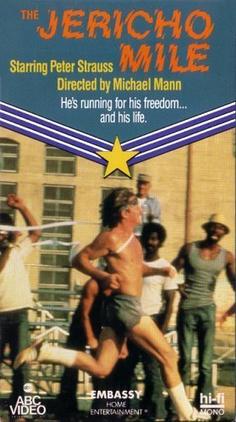
Made For TV Movie Review: The Jericho Mile (dir by Michael Mann)


1979’s The Jericho Mile tells the story of Larry Murphy (Peter Strauss).

Larry is serving a life sentence at Folsom Prison, convicted a crime that he admits to having committed.  Larry murdered his father, specifically to protect his stepsister from being raped.  Larry feels no guilt for his crime and, at the same time, he’s willing to quietly serve his sentence.  He’s a loner, avoiding the rival racial factions in the prison.  (Brian Dennehy leads the Aryans while Roger E. Moseley leads the black prisoners and Miguel Pinero is the head of the Mexican Mafia.)  Larry just wants to spend his time running around the prison yard.

When Dr. Bill Janowski (Geoffrey Lewis) sees how fast Larry can run, he arranges for a local track coach, Jerry Beloit (Ed Lauter), to come up to the prison with a few potential Olympians so that they can race Larry.  Larry manages to outrun all of them.  Jerry becomes convinced that Larry could qualify for the Olympics, if only he had a regulation track to run on.  The Warden, knowing good publicity when he sees it, assigns the inmates to build the track but doing so means dealing with Folsom’s highly charged racial politics.  No matter how fast Larry can run and no matter how inspiring it would be for Larry to go from serving a life sentence to competing in the Olympics, Folsom is still a prison and Larry is still a prisoner.  And while the guards may have the guns and may be the only ones who are allowed to go home at the end of the game, it’s the prison gangs who have all the power.  When the Aryans go on strike and refuse to work on the track, it puts Larry’s chances in jeopardy.

Of course, Larry’s chances are already in jeopardy just because of who he is.  Larry is a prisoner who refuses to show remorse.  While other prisoners embrace religion or politics and try to convince outsiders that they’ve either reformed or been wrongly convicted, Larry just wants to run.  Running is when he’s free.  (The film’s title refers to the Walls of Jericho coming down.)  And, for the other inmates, watching Larry run is a reminder that there are many ways once can escape from the drudgery of being locked away.

The Jericho Mile is a tough and rather cynical prison film, one that manages to combine downbeat social drama with a uplifting sports story.  You’ll want to cheer Larry while he’s running, even if you secretly suspect that he’s ultimately chasing something that will never happen.  Making his directorial debut, Michael Mann shot the film on location at Folsom and the cast is full of actual prisoners, all of whom bring some much need authenticity to the film’s story.  Mann never lets us forget that this is a film about people in a very dangerous situation and, even at its most inspiring, the film leaves you feeling as if violence could break out at any moment.  Peter Strauss, who usually played somewhat more refined characters, is totally believable as the taciturn Larry and character actors like Dennehy and Mosely skillfully blend in with the actual prisoners in the cast.  The Jericho Mile is a portrait of crime, punishment, and dreams.  It’s a movie that will stay with you.


Retro Television Reviews: Under the Influence (Dir by Thomas Carter)


Welcome to Retro Television Reviews, a feature where we review some of our favorite and least favorite shows of the past!  On Sundays, I will be reviewing the made-for-television movies that used to be a primetime mainstay.  Today’s film is 1986’s Under the Influence!  It  can be viewed on YouTube!

Noah Talbot (Andy Griffith) is an upstanding member of the community.  He owns a hardware store.  He has a large family.  He’s known as a gruff but folky storyteller.  He’s a deacon in his church and helps to collect the offering every Sunday.

He’s also a drunk and a bit of a bully.  His family walks on eggshells around him, fearful of setting him off on one of his benders.  He occasionally spends the night in jail, arrested for trying to drive drunk.  Even when he gets bailed out, his first instinct is to go back to the bar.  The folks at the bar love him, don’t you know.  The people at the bar are always happy to see him and never bother him about whether he’s had too much.  The people at the bar never let him down the way that he feels his family has left him down.

The members of his family each cope in their own individual way.  Noah’s wife (Joyce Van Patten) is in denial and spends a lot of her time popping pills.  His oldest daughter, Ann (Season Hubley), is driven to succeed at work and spends all of her time both hating her father and desperately hoping for his approval.  (When she tells him that she got a raise at work, he berates her for only getting a 6% increase in her salary.  “That’s just a cost of living increase!” he snaps at her.)  His eldest son, Stephen (Paul Provenza), fled to Los Angeles and is trying to make a career as stand-up comedian.  (“You’re no David Letterman,” Noah tells him.)  His youngest daughter, Terri (Dana Anderson), secretly replaces Noah’s liquor with water and food-coloring.  And his youngest son, Eddie (Keanu Reeves), is becoming an alcoholic himself.

Having read all that, you may be wondering just how exactly Keanu Reeves could be the son of Andy Griffith and it’s a fair question.  This was one Keanu Reeves’s first acting roles and he does a pretty good job in the role of Eddie.  That said, he looks so totally different from both Andy Griffith and Joyce Van Patten and the actors playing his siblings that I was half-expecting someone to mention that Eddie had been adopted.  Then again, Paul Provenza doesn’t really bear much of a resemblance to the actors playing his parents either.  Dana Anderson and Season Hubley do, at least, look like sisters.

Lack of family-resemblance aside, all of the actors in Under the Influence do a good job of inhabiting their characters.  For those who are used to seeing Andy Griffith playing friendly Southerners in reruns of The Andy Griffith Show and Matlock, it’s shocking and a little disturbing to see him playing an abusive, alcoholic jerk in Under the Influence.  Noah is someone who would not only destroy his own family to get a drink but who would then blame them for it happening in the first place.  Noah may be under the influence of alcohol but the entire family is suffering because they’re under the influence of Noah.  By the time Noah is spitting up blood and demanding that his youngest son sneak liquor into his hospital room, the viewer knows there is no hope for Noah but hopefully, his family will escape.

It doesn’t make for a particularly happy movie but, speaking as someone who grew up in an alcoholic household, I can attest that it does make for an honest portrayal of what addiction does not just to the addict but also to the people around the addict.  I cringed in sympathy through nearly the entire film, especially as I watched three of the four children react in the same ways that I did.  (Unlike Eddie, I never became much of a drinker and instead developed an aversion to alcohol in general.)  It’s a film that feels real and one’s heart aches for the entire family.  If it could happen to Andy Griffith, it could happen to anyone.

Horror Film Review: Poltergeist (dir by Tobe Hooper)


The 1982 film Poltergeist tells the story of the Freeling family.

There’s Steven the father (Craig T. Nelson) and Diana the mother (JoBeth Williams).  There’s the snarky teenager daughter, Dana (Dominique Dunne), who has a surprisingly good knowledge of the local motel scene.  There’s the son, Robbie (Oliver Robins), who is scared of not only a big ugly tree but also a big ugly clown doll that, for some reason, sits in his bedroom.  And then there’s the youngest daughter, Carol Ann (Heather O’Rourke).

They live in a planned community in Orange County, sitting just a few miles away from the cemetery.  (Or so they think….)  They’ve got a nice house.  They’ve got nice neighbors.  They’ve got a nice dog.  They’re getting a pool in the backyard.  There are hints that Steven and Diana may have once done the whole rebellion thing.  They still occasionally get high, though they do it with a smugness that somehow manages to make marijuana seem less appealing.  But, for the most part, Steven and Diana are happy members of the establishment.  Steven sells real estate and is a favorite of his boss, Mr. Teague (James Karen).  Diana is a stay-at-home mom who doesn’t get upset when some unseen spirit rearranges all the furniture in the kitchen (seriously, that would drive me crazy).  They’re the type of family that falls asleep in front of the TV at night, which is a bit of a mistake as Carol Ann has started talking to the “TV people.”

Strange things start to happen.  As mentioned earlier, furniture starts to rearrange itself.  Whenever Carol Ann sits down in the kitchen, an unseen force moves her across the floor.  Diana, for whatever reason, thinks this is the greatest thing ever.  Then, on the night of a big storm, the big ugly tree tries to eat Robbie and Carol Ann goes into a closet and doesn’t come out.  Though Carol Ann has vanished, the Freelings can still hear her voice.  Apparently, she’s been sucked into another dimension and she’s being encouraged to go into the light.

Of course, this leads to the usual collection of paranormal researchers moving in.  The house decides to pick on one unfortunate guy and he ends up not only eating maggot-filled meat but also imagining his face falling apart over a sink.  A medium named Tangina (Zelda Rubinstein) comes by and reprimands Steven and Diana for not doing exactly what she says.  Of course, it turns out that Tangina isn’t quite as infallible as she claims to be….

To me, Poltergeist is the epitome of a “Why didn’t they just leave the house” type of film.  Don’t get me wrong.  I understand that once Carol Ann vanished, Diana and Steven had to stay in the house to rescue their daughter.  I’m talking about all the stuff that went on before the big storm.  Seriously, if a ghost started moving furniture around in the kitchen, I’m leaving the house.  At the very least, I’m not going to take my youngest daughter and invite the ghost to push her around the kitchen.  Even stranger is that, at the end of the film, the Freelings still don’t leave the house even though the situation with Carol Ann has been resolved.  They hire a moving truck and make plans to leave but, instead of spending a night in a hotel, they instead decide to spend one more night in a house that’s apparently possessed by Satan.

Poltergeist is famous for bringing together two filmmakers who really seem like they should exist in different universes.  Steven Spielberg produced while Tobe Hooper directed.  It seems like it’s impossible to read a review of Poltergeist without coming across speculation as to how much of the film should be credited to Spielberg and how much should be credited to Hooper.  It must be said that the film does occasionally feel like it’s at war with itself, as if it can’t decide whether to embrace Spielberg’s middle class sensibilities or Hooper’s counter-culture subversiveness.  On the one hand, the emphasis on special effects and the early scenes where the Freelings watch TV and Steven gets into a remote control fight with his neighbor all feel like something Steven Spielberg would have come up with.  On the other hand, the obvious joy that the film takes in tormenting the Freelings feels more like Tobe Hooper than Steven Spielberg.  Or take the film’s finale, where the special effects are pure Spielberg but the scene of Diana getting assaulted in bed and then thrown around her bedroom feels like pure Hooper.  Really, it’s the mix of two sensibilities that make the film compelling.  Poltergeist’s planned community is appealing but it’ll still kill you.

Anyway, I like Poltergeist.  I certainly prefer the original to the remake.  It’s a silly film in many ways but it’s still effective.  Once you get over how stupid Diana acts during the first part of the film, JoBeth Williams gives a strong performance as a mother determined to protect her children.  And Craig T. Nelson gives a classic over the top performance, especially towards the end of the film.  Just listen as he screams, “Don’t look back!”  That said, my favorite performance comes from James Karen, who is perfectly sleazy as the outwardly friendly, cost-cutting land developer.

Poltergeist is still a good, scary film.  And, if anyone wants to play a lengendary prank this Halloween, show it to someone who has a fear of clowns.

Film Review: Streets of Fire (dir by Walter Hill)


File this one under your mileage may vary…

Okay, so here’s the deal.  I know that this 1984 film has a strong cult following.  A few months ago, I was at the Alamo Drafthouse when they played the trailer and announced a one-night showing and the people sitting in front of me got so excited that it was kind of creepy.  I mean, I understand that there are people who absolutely love Streets of Fire but I just watched it and it didn’t really do much for me.

Now, that may not sound like a big deal because, obviously, not everyone is going to love the same movies as everyone else.  I love Black Swan but I have friends who absolutely hate it.  Arleigh and I still argue about Avatar.  Leonard and I still yell at each other about Aaron Sorkin.  Erin makes fun of me for watching The Bachelorette.  Jedadiah Leland doesn’t share my appreciation for Big Brother and the Trashfilm Guru and I may agree about Twin Peaks but we don’t necessarily agree about whether or not socialism is a good idea.  And that’s okay.  There’s nothing wrong with healthy and respectful disagreement!

But the thing is — Streets of Fire seems like the sort of film that I should love.

It’s a musical.  I love musicals!

It’s highly stylized!  I love stylish movies!

It’s from the 80s!  I love the 80s films!  (Well, most 80s films… if the opening credits are in pink neon, chances are I’ll end up liking the film…)

It takes place in a city where it never seems to stop raining.  Even though the neon-decorated sets give the location a futuristic feel, everyone in the city seems to have escaped from the 50s.  It’s the type of city where people drive vintage cars and you can tell that one guy is supposed to be a badass because he owns a convertible.  All of the bad guys ride motorcycles, wear leather jackets, and look like they should be appearing in a community theater production of Grease.

Singer Ellen Aim (Diane Lane) has been kidnapped by the Bombers, a biker gang led by Raven (Willem DaFoe).  Ellen’s manager and lover, Billy Fish (Rick Moranis), hires Tom Cody (Michael Pare) to rescue Ellen.  Little does Billy know that Cody and Ellen used to be lovers.  Cody is apparently a legendary figure in the city.  As soon as he drives into town, people starting talking about how “he’s back.”  The police see Cody and automatically tell him not to start any trouble.  Raven says that he’s not scared of Cody and everyone rolls their eyes!

It’s up to Cody to track Ellen down and rescue her from Raven and … well, that’s pretty much what he does.  I think that was part of the problem.  After all of the build-up, it’s all a bit anti-climatic.  It doesn’t take much effort for Cody to find Ellen.  After Cody escapes with Ellen, it doesn’t take Raven much effort to track down Cody.  It all leads to a fist fight but who cares?  As a viewer, you spend the entire film waiting for some sort of big scene or exciting action sequence and it never arrives.  The film was so busy being stylish that it forgot to actually come up with a compelling story.

I think it also would have helped if Tom Cody had been played by an actor who had a bit more charisma than Michael Pare.  Pare is too young and too stiff for the role.  It doesn’t help to have everyone talking about what a badass Tom Cody is when the actor playing him doesn’t seem to be quite sure what the movie’s about.  Also miscast is Diane Lane, who tries to be headstrong but just comes across as being petulant.  When Cody and Ellen get together, they all the chemistry of laundry drying on a clothesline.

On the positive side, Willem DaFoe is believably dangerous as Raven and Amy Madigan gets to play an ass-kicking mercenary named McCoy.  In fact, if McCoy had been the main character, Streets of Fire probably would have been a lot more interesting.

I guess Streets of Fire is just going to have to be one of those cult films that I just don’t get.

The TSL’s Horror Grindhouse: Scream Blacula Scream (dir by Bob Kelljan)


Am I correct in assuming that everyone knows who Blacula was?

Blacula is often described as being the black Dracula but actually, it’s a little bit more complicated than that.  In life, he was an African prince named Mamuwalde who, in 1780, went to Dracula’s castle and asked for the count’s help in suppressing the slave trade.  Dracula turned him into a vampire instead and, after declaring that Mamuwalde would forever be known as Blacula, he proceeded to lock Mamuwalde in a coffin.  That’s where Mamuwalde remained for 290 years, until he managed to escape.  By that point, his coffin had been relocated from Transylvania to Los Angeles.

All of that was revealed in the 1972 film, BlaculaBlacula, which starred a distinguished Shakespearean actor named William Marshall in the lead role, was a surprise hit so, of course, Mamuwalde (played again by Marshall) returned the following year in a sequel.  It didn’t matter that the first Blacula ended with Mamuwalde deliberately ending his existence by walking out into the sunlight.  Blacula would return!

It also didn’t matter if anyone in the audience for Scream, Blacula, Scream had somehow missed seeing the first movie.  Scream, Blacula, Scream features lengthy flashbacks to the first film.  It makes sense, really.  Why waste money on all new footage when you can just pad the sequel with scenes from its predecessor?

I’m disappointed to say that Scream, Blacula, Scream did not feature any disco action.  When I saw that this movie would be airing on TCM Underground, I decided to watch it specifically because I figured there would be at least one scene of Blacula dancing underneath a spinning disco ball.  I mean, it was a movie from the 70s, right?  Honestly, I think that if Scream, Blacula, Scream had been made later in the decade, it would have featured at least one disco dance scene.

What the film did have was a lot of voodoo.  Judging from this movie, Live and Let Die, and the House on Skull Mountain, it would appear that people in the early 70s were really obsessed with voodoo.  When the movie opens, a voodoo priestess named Mama Loa is dying and she’s just named her apprentice, Lisa (Pam Grier), as the new head of the cult.  Mama Loa’s son, Willis (Richard Lawson), isn’t happy about this decision so, for some reason, he decides that it would be a good idea to bring Blacula back to life.

Willis apparently thought that the revived Blacula would be his servant but it doesn’t work out like that.  First off, Blacula was perfectly happy being dead.  Secondly, he is no one’s servant.  Blacula promptly bites Willis on the neck and then proceeds to vampirize nearly everyone that he comes across.  Soon, Blacula has an army of vampires but all he wants is to be human again.

And who can help him reach that goal?

How about the city’s newest voodoo priestess, Lisa?

Now, I will say this about Scream, Blacula, Blacula.  The main character is named Lisa and that automatically makes it an above average movie.  The entire movie features people saying, “Lisa” over and over again and you know I loved listening to that.

Other than that, though, the movie was kind of a mess.  It was obviously written and filmed in a hurry and, as a result, a lot of the action felt like padding.  For a subplot that wasn’t that interesting to begin with, the voodoo cult power struggle got way too much screen time.  On the plus side, William Marshall and Pam Grier were both a hundred times better than the material that they had to work with.  Regardless of how ludicrous the dialogue was, Marshall delivered it with dignity and just the right hint of ennui.

Scream, Blacula, Scream is not a particularly good film but it’s worth seeing for Marshall and Grier.