Retro Television Review: Miami Vice 5.8 “Hard Knocks”


Welcome to Retro Television Reviews, a feature where we review some of our favorite and least favorite shows of the past!  On Mondays, I will be reviewing Miami Vice, which ran on NBC from 1984 to 1989.  The entire show can be purchased on Prime!

This week, Switek takes center stage!

Episode 5.8 “Hard Knocks”

(Dir by Vern Gillum, originally aired on January 20th, 1989)

Stan Switek has a gambling problem!

That’s right.  The lovable Stan Switek, played by Michael Talbott, finally gets to be the center of another episode and it’s a pretty dark one.  It’s not as dark as the one where Stan discovered that his partner and best friend had been given a heroin overdose but it’s still pretty depressing.

There are a lot of things that lead to Switek becoming both an alcoholic and a gambling addict.  The death of Larry Zito still haunts him.  The job haunts him.  The fact that he’s continually stuck in “the black box,” and doing surveillance on terrible people haunts him.  At the start of the episode, he learns that he’s been turned down for a promotion and it will be another two years before he can apply again.  Castillo says it’s about money.  The Miami PD doesn’t have the money to pay Switek a sergeant’s salary.  “You’re the best at what you do,” Castillo tells Switek.  That’s of little help.

Switek is best friends with Mac Mulhern (Jordan Clarke), the father of a hotshot college quarterback named Kevin Mulhern (Richard Joseph Paul).  When Switek’s former bookie (Ismael “East” Carlo) is murdered by Goodman (Richard Jenkins, who apparently always looked like he was in his late 50s, even 40 years ago), Goodman orders Switek to tell Kevin to throw his upcoming game.  In order to make sure that it happens, Goodman kidnaps Mac and threatens to kill him.

Switek snaps.  Switek sets out to get his own justice against Goodman and to rescue Mac.  Fortunately, Crockett and Tubbs realize what’s happening and they show up in time to help Switek out.  Once Goodman is dead and Mac is free, Kevin is able to win the game.

Later, Crockett confronts Switek.  He says that Switek’s name is all over Goodman’s books.  What’s Crockett going to do?  Given that Crockett spent months as Miami’s biggest drug lord, I’m not sure that Crockett is in a position to judge anyone.  Fortunately, Crockett seems to understand that as well.  Crockett hands the evidence over to Switek and promises to keep quiet.  Switek — who has spent almost the entire series as comedic relief — breaks down and starts to cry.

That’s one dark episode!  It’s also a very well-done episode.  Michael Talbott gave an excellent performance as Switek, revealing the character’s dark side while still remaining true to who Switek has been since the series began.  Don Johnson and Philip Michael Thomas didn’t do much in this episode but the final scene between Switek and Crockett was wonderfully acted by both Talbott and Johnson.

This was a good episode but I’m worried about Switek now.  I hope everything works out because there’s only a few episodes left!

Speaking of which, Retro Television Review will be going on break for the holidays at the end of this week. Miami Vice will return on January 5th!
Late Night Retro Television Review: Pacific Blue 1.12 “The Big Spin”


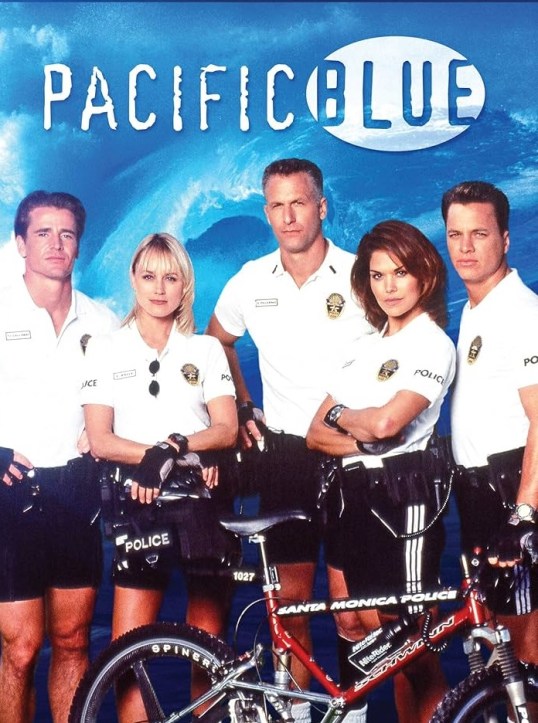
Welcome to Late Night Retro Television Reviews, a feature where we review some of our favorite and least favorite shows of the past! On Tuesdays, I will be reviewing Pacific Blue, a cop show that aired from 1996 to 2000 on the USA Network!  It’s currently streaming everywhere, though I’m watching it on Tubi.

Bike patrol expands its roster, this week.

Episode 1.12 “The Big Spin”

(Dir by Terrence O’Hara, originally aired on May 18th, 1996)

Bike patrol has a new recruit!  Scott Kramer (Richard Joseph Paul) has been a cop for ten years and, for nine of those year, he had a perfect record.  But lately, he’s became impulsive and too much of a risk taker.  Bike patrol is his last chance!  “I run things by the book,” Lt. Palermo says.

Chris is assigned to train Kramer and soon, the two of them are falling for each other.  Chris explains that Kramer, like her, is a rebel who breaks the rule.  One of the funnier things about Pacific Blue is that Chris is supposed to be a rebel who breaks the rule when she’s nothing of the sort.  Instead, she just kind of gets annoyed and pouts every episode.

Anyway, it turns out that Kramer is terminally ill so he doesn’t care if he dies while taking down the two motorcycle bandits who have been robbing people all across town.  And that’s a good thing because that’s pretty much what happens.  The bandits are captured but bike patrol loses a recruit.

“The last thing he saw was you,” Palmero tells Chris and I think that was supposed to comfort her.  Chris nods and then walks along the beach by herself.

Wow, it’s an edgy episode!  Well, no, not really.  It comes close to being an edgy episode.  Richard Joseph Paul gives a pretty good performance as Kramer.  But …. come on, folks …. they’re on bicycles!  I’m sorry that I keep harping on this and, since this stupid show has like a gillion episodes, I imagine I’ll continue to harp on it in the future but bicycles are not edgy!  The first season is nearly over and I still laugh whenever I see the bike cops hearing about a crime on their radio and then going, “Unit whatever responding.”  I’m just imagining the dispatcher being like, “Oh no, bike patrol again.”  Seriously, everyone on this show always has such a grim expression on their face and they’re determined to catch the bad guys but, again …. bicycles!

Anyway, season one comes to an end next week.

Film Review: Quick Change (dir by Bill Murray and Howard Franklin)


“Leave the Bronx …. it is time to leave the Bronx….”

Escape from New York….

“Someday, a real rain will come and watch all this scum off of the streets….”

“Kill, Berkowitz!” the Dog with John Turturro’s voice commands, “Kill!  KILL!”

And then there’s 1990’s Quick Change:

Of the many films that have been made about people desperately trying to get the Hell out of New York City, Quick Change is one of the funniest.  The appropriately-named Grimm (Bill Murray) works in the city planning office and has had all that he can take of New York’s crime and rudeness.  His solution is to dress up like a clown and rob a bank.  His girlfriend Phyllis (Geena Davis) and best friend Loomis (Randy Quaid) are already inside the bank, disguised as customers.  When Grimm, who claims to be a “crying on the inside” type of clown, takes everyone in the bank hostage and forces them into the vault, Phyllis and Loomis grab as much of the money as they can.  Talking on the phone to police chief Rotzinger (Jason Robards), Grimm makes a series of pointless demands.  Each demand that is met leads to Grimm releasing a group of hostages.  By removing his clown makeup, Grimm is able to join Phyllis and Loomis when they are “released.”  Rotzinger, who has even managed to procure a monster truck, thinks that the robber is still in the bank while Grimm, Phyllis, and Logan head for the airport.

Of course, things don’t go as planned.  What starts out as a energetic and good-natured Dog Day Afternoon parody quickly becomes an increasingly surreal journey through New York.  The streets are in terrible condition.  The signs that would have provided directions to the airport have been taken down by a road construction crew.  (They explain that they’re only taking down the signs today and it will be a few days before they get around to putting them back up.)  One of the few polite people they meet turns out to be a thief who steals four dollars from Grimm’s wallet but fails to notice that he’s got a million dollars taped around his waist.  Stanley Tucci shows up as a mobster.  Tony Shalhoub plays a well-meaning taxi driver who speaks his own indecipherable language.  Grimm keeps running into rude cops who, despite being on the hunt for the bank robbers, are frequently too busy being rude to notice what’s happening in front of them.

Best of all, Grimm, Phyllis, and the increasingly addled Loomis board a bus being driven by the film’s greatest character.  Played by Philip Bosco, the bus driver is a wonderful comedic creation.  “That’s not exact change,” the driver says when Loomis attempts to pay him with a hundred dollar bill.  “Behind the white line,” he says before starting the bus.  When Loomis, who has a habit of running into things and appears to be suffering from a concussion, tries to sit down, the bus driver informs him that he’s not allowed to sit until he receives exact change.  The driver has a schedule to keep and, to his credit, he largely manages to do so.  Bosco plays him with such deadpan determination that it’s hard not to admire his dedication to following every single regulation to his job.  As opposed to Grimm, the driver has learned to deal with living in New York by obsessively making every scheduled stop.

Quick Change struggles sometimes to balance its moments of humor and drama.  Scenes of Loomis running like a cartoon character are mixed with scenes of Phyllis worrying that Grimm might actually be a hardened criminal and struggling with whether or not to tell him that she’s pregnant.  This was Bill Murray’s first and only film as a director and sometimes, he does struggle to maintain a consistent tone.  But, in the end, what’s important is that it’s a funny film.  Bill Murray is one of those actors who can make you laugh just by existing and, as a director, he’s smart enough to give Jason Robards enough room to make Rotzinger into something more than just a standard comedic foil.

Quick Change is a comedic nightmare, one that made me laugh even as it also made me glad that I don’t have to drive in New York.  I get lost just driving around the suburbs of Dallas.  There’s no way I’d ever be able to find my way out of New York.

Vampirella (1996, directed by Jim Wynorski)


Intergalactic vampire Vlad Tepes (The Who’s Roger Daltrey) has come to Earth and is performing in Las Vegas under the name Jamie Blood.  Though most vampires now drink synthetic blood, Vlad is a purist who prefers to drink straight from the veins of others.  Vlad wants to unleash a horde of vampires on Earth.  Trying to stop him is Vampirella (Talisa Soto), another intergalactic vampire who wears a revealing red bodysuit and little else.

Jim Wynorski says this is the only film that he regrets directing.  Think about that.  This is a film that even Jim Wynorski regrets!  It’s easy to understand why.  Talisa Soto is attractive and convincing in the action scenes but she’s still miscast of Vampirella, a character who was as known for her voluptuous figure as for her status as one of the first vampire super heroes.  The movie has none of the subversive humor of the original Vampirella comic book and the special effects look cheap even by 1996 standards.  With the exception of Roger Daltrey’s devilish portrayal of Vlad,  Vampirella is an anemic take on a vampire legend.

Of course, in 1996, almost all comic book movies were as bad as Vampirella.  While there were exceptions like the Batman movies, most comic book films were low-budget affairs that were made for nice audiences and which no one put much effort into.  Comic books movies were not expected to be blockbusters or huge cultural events and most of them, like Vampirella, were released with very little fanfare.  Things have certainly changed.

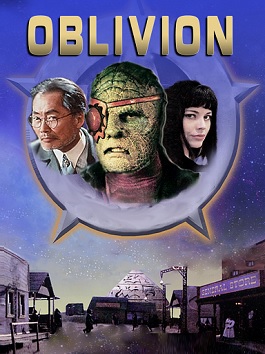
Oblivion (1994, directed by Sam Irvin)


In the far, far future, Earth has set up colonies all across the universe.  One of those colonies is the dusty town of Oblivion, which looks just like an old west town except the deputy is a cyborg and there’s an ATM outside the saloon.  A humanoid lizard named Red Eye (Andrew Divoff, covered in green scales) comes to town and kills the marshal.  Red Eye and his gang take over Oblivion, planning to turn it into their own personal pleasure palace.

The marshal’s son, Zack (Richard Joseph Paul), comes to town for the old man’s funeral.  Everyone thinks that Zack is a coward because he refuses to avenge his father’s death.  Zack, however, is no coward.  He’s just an empath who can’t handle the negative emotion that are generated by violence.  But seeing as how his father is dead, his best friend Buteo (Jimmie F. Skaggs) is being tortured in the town square, and lovely Mattie Chase (Jackie Swanson) wants Red Eye and his gang to get out of town, Zack knows that he’s going to have to do the right thing and conquer his empathy.

Oblivion is a haphazard mix of comedy, science fiction, and the western genre.  Some of the ideas come close to being clever but it never makes sense why an Earth colony in 3031 would resemble a one-horse town from a singing cowboy movie.  (The film probably would have worked better if it had been about Red Eye invading an actual Old West town in the 1800s instead of a colony designed to look like one.)  Andrew Divoff is entertaining as he hams it up as the main desperado but, as far Old West charisma is concerned, Richard Joseph Paul is no John Wayne or Henry Fonda.  Quite a few familiar names were somehow roped into appearing in this low-budget space oater, though most of them only appear for a few minutes and don’t contribute much to the overall story.  George Takei plays the alcoholic town doctor.  Julie Newmar is Miss Kitty, the owner of Oblivion’s “social” club.  In a nod to her most famous role, Newmar hisses at Red Eye and his gang but that’s all she gets to do.  It feels like a waste of a cameo.  Isaac Hayes and Meg Foster also make appearances, though again neither really gets to do anything interesting.

The idea of a space western isn’t a bad one and there actually have been a few good ones.  (Outland, for example.)  But Oblivion can never escape the drag of its low budget and its bland lead.