Actor Richard Boone was born on this day, June 18th, in 1917. While he was in some great movies in his day, he’ll probably always be remembered for the iconic role of Paladin in HAVE GUN, WILL TRAVEL. The first time I ever heard this song was when the boys were walking down that train track and singing it in the movie STAND BY ME (1984). Since then I’ve seen many episodes, and I can certainly understand how Paladin became an icon.
Happy Birthday in cinema heaven, Richard Boone! Enjoy the “Ballad of Paladin!”
Raymond Chandler’s detective classic, The Big Sleep, has twice been adapted for film.
The first version came out in 1946, just seven years after the book’s publication. That version starred Humphrey Bogart as detective Philip Marlowe and Lauren Bacall as Vivian, the daughter of a man who has hired Marlowe to discover who is trying to blackmail him. Directed by Howard Hawks and co-written by William Faulkner, this version of TheBigSleep is considered to be a classic noir, one that was cited as being a major influence on director Akira Kurosawa.
The 1978 version was directed by Michael Winner, takes place in London in the 1970s, and features Robert Mitchum as Marlowe. Despite a strong ensemble cast and an excellent lead performance from Mitchum, this version of TheBig Sleep still features one of the worst performances ever put on film.
Sarah Miles plays the role of Charlotte Sternwood Regan, the eldest daughter of General Sternwood (James Stewart). Miles is playing the role that Lauren Bacall played in the first film and, despite the fact that they both earlier co-starred to a certain amount of acclaim in Ryan’sDaughter, Miles and Mitchum do not have a hint of chemistry in this film. Actually, Miles doesn’t have chemistry with anyone in this film. She seems detached from the action and her frequent half-smiles come across as being not mysterious but instead somewhat flakey, as if she doesn’t quite understand that she’s in a noir. Sarah Miles is not a bad actress (as anyone who has seen Hope and Glory can tell you) but her performance here is incredibly dull. That said, she is not the one who gives the worst performance in the film.
Instead, that honor goes to Candy Clark, playing General Sternwood’s youngest daughter, Camilla. Camilla is meant to be mentally unstable and potentially dangerous. Clark plays the role like a giggly teenager, constantly fidgeting and literally hissing in more than a few scenes, as if she’s been possessed by a cat. Clark overacts to such an extent that you’ll be more likely to laugh at than be disturbed by her antics. It doesn’t help that she shares nearly all of her scenes with Robert Mitchum, a man who was a master when it came to underacting. If you’re going to give a bad performance, you don’t want to do it opposite someone who will make you look even worse by comparison.
The mystery of who is blackmailing General Sternwood is twisty and full of disreputable people. At times, the film feels like a a parade of character actors. Edward Fox, Joan Collins, Richard Boone, Oliver Reed, Harry Andrews, Richard Todd, and John Mills all show up throughout the film and, as a viewer, I was happy to see most of them. They all brought their own sense of style to the film, especially the menacing Oliver Reed. That said, director Michael Winner was never known for being a particularly subtle director and the film gets so mired in its own sordidness that it becomes be a bit of a slog to sit through. As a filmmaker, Winner was a shameless. That sometimes worked to a film’s advantage, as with the original DeathWish. That film needed a director who would dive into its Hellish portrayal of New York City without a moment’s hesitation and that’s what it got with Michael Winner. With Winner’s adaptation of The Big Sleep, however, the film gets so caught up in trying to shock and titillate that it’s hard not to miss the wit that made the first adaptation so special.
That said, TheBigSleep does feature the truly special opportunity to see Robert Mitchum and James Stewart acting opposite each other. Both give good and heartfelt performances, with Mitchum plays Marlowe as a cynic with a heart and Stewart capturing the pain of knowing that your children don’t deserve all that you do for them. Stewart and Mitchum bring a lot of emotion and sincerity to their scenes and, for at least a few minutes, The Big Sleep becomes about something more than just bloody murders and revealing photographs. It becomes about two aging men trying to find their place in a changing world. TheBigSleep was one of Stewart’s final feature films and he shows that, even late into his career, he was always one of the best.
1954’s Dragnet opens with a gangland slaying. We watch as a man is brutally gunned down in a field in Los Angeles. The rest of the film deals with the efforts of the LAPD to track down and arrest the killers.
Based on the televisions show that gave birth to the whole “cop show” format, Dragnet features Jack Webb as Sgt. Joe Friday, calmly and efficiently investigating the slaying. Working with Friday is Officer Frank Smith (Ben Alexander) but the film (just like the show) is ultimately about how the whole criminal justice system works together as a machine designed to protect the citizenry and to punish crime.
Or, at least, that’s the way it’s supposed to work. Especially if you’re only familiar with Dragnet from its late 60s incarnation and the countless parodies that followed, the 1954 Dragnet can seem surprisingly cynical and rough-edged. The killings are violent, the criminals are ruthless, and the cops are often frustrated in their attempts to solve crimes. In this film, at least, justice is not guaranteed.
The shooting victim is identified as a low-level gangster named Miller Starkie and Friday and Smith immediately suspect that he was killed on the orders of West Coast mob boss Max Troy (Stacy Harris). Friday and Smith know that Troy is guilty and they even figure out who worked with Troy to kill Starkie. But, throughout the film, they struggle to get any sort of concrete evidence tying Max to the crime. Dragnet is a police procedural that follows every bit of the investigation, including the attempts to convince a grand jury to indict Max. One of the more interesting moments in the film is when Friday gives his grand jury testimony and it becomes obvious that the district attorney was right to be skeptical about trying to bring charges. Friday really doesn’t have enough evidence to justify arresting Max for the crime that everyone knows he committed. To the film’s credit, it doesn’t attack the grand jury system or suggest that the system is unfairly rigged for the criminals. Friday may be frustrated but he understands that the system has to protect the rights accused first. One has to be presumed innocent until proven guilty even when everyone knows that person is guilty.
That said, Friday and Smith and the entire LAPD end up harassing Max Troy in a way that would probably not fly if the film were made today. At one point, a line of police cars park in front of Max’s house and then all shine their lights into his windows. Friday and Smith end up following Max everywhere that they he goes, stopping him and randomly frisking him before ordering him to empty his pockets. Today, I imagine this would lead to lawsuit. Even in the film, it doesn’t exactly pay off.
What does pay off is sending a police woman (played by Ann Robinson) into Max’s nightclub undercover, with a recording device. This whole sequence is interesting because it’s apparent that the idea of a tiny recording devices — something that we take for granted nowadays — was apparently a new and exciting concept in 1954. (Indeed, the one used in this film actually looks a bit bulky.) For a few minutes, the action stops so Dragnet can show off the LAPD’s latest toy.
I liked Dragnet. It’s an nicely-paced time capsule and, despite its docudrama style and television origins, director Jack Webb manages to come up with a few memorable visuals. As someone who has binged the late 60s version of Dragnet, it was interesting to see a tougher and much more cynical version of the series. While Webb was hardly an expressive actor, his dour demeanor serves him well as Joe Friday and Stacy Harris is appropriately sleazy as the crime boss. Despite all of Friday’s frustrations, the case eventually comes to a conclusion in the 1954 film, even if it’s not the one that Friday and his bosses wanted. Max may be able to escape the police but he can’t escape his own health. Friday and Smith move on to investigate the next case. As always, the names will be changed to protect the innocent.
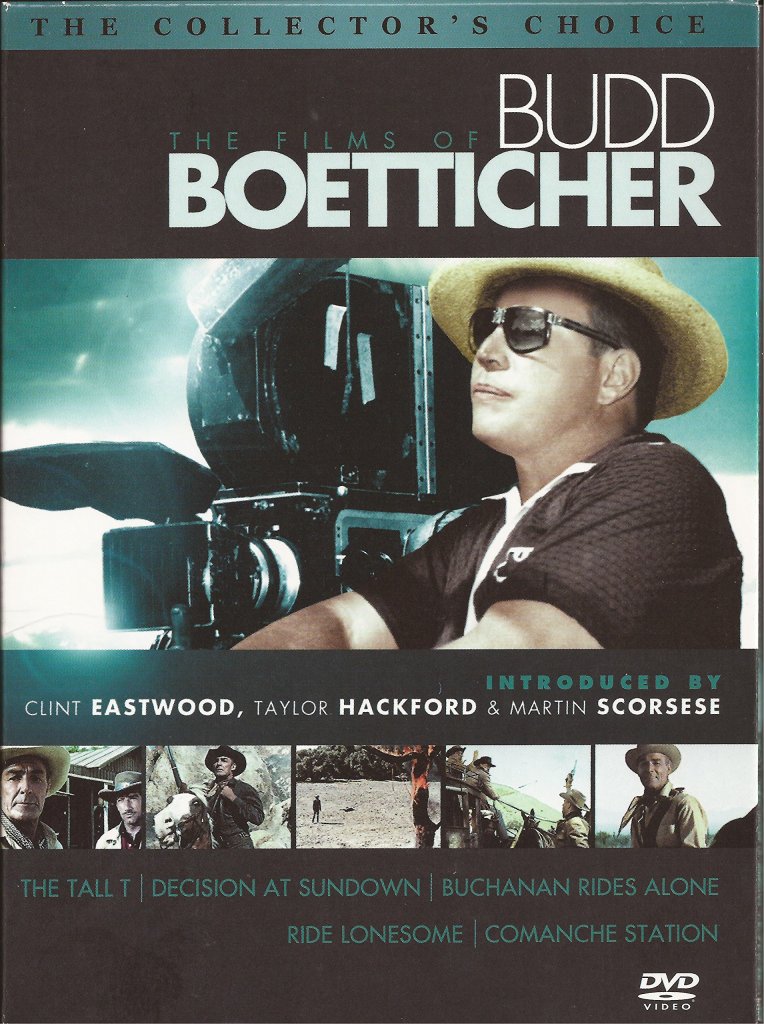
There was a time in my life, before streaming existed, where it seemed like I wanted to buy every movie that interested me in the slightest. The main ways I looked for new movie releases was to go to a store like the Hastings Entertainment Superstore and look at their inventory, or look at the new and recent releases on Amazon’s online store. I could spend hours looking for movies in either location, and I did. Sometime in 2008, I ran across a DVD box set described as “The Films of Budd Boetticher” that contained introductions by the likes of Martin Scorsese, Taylor Hackford, and Clint Eastwood. The films included on the box set were THE TALL T, DECISION AT SUNDOWN, BUCHANAN RIDES ALONE, RIDE LONESOME, and COMANCHE STATION. I remember seeing the names of these movies at various times in my life in my movie books. They had never really caught my attention, although I do remember that they would receive good reviews. This set did catch my attention, however, based on the interesting packaging and the fact that Scorsese and Eastwood were both singing the praises of the films. I did a little bit of quick research and decided to just buy the boxset. I’m glad to report that these films have turned into some of my very favorite movies, and I sing their praises to anyone who will listen.
Version 1.0.0
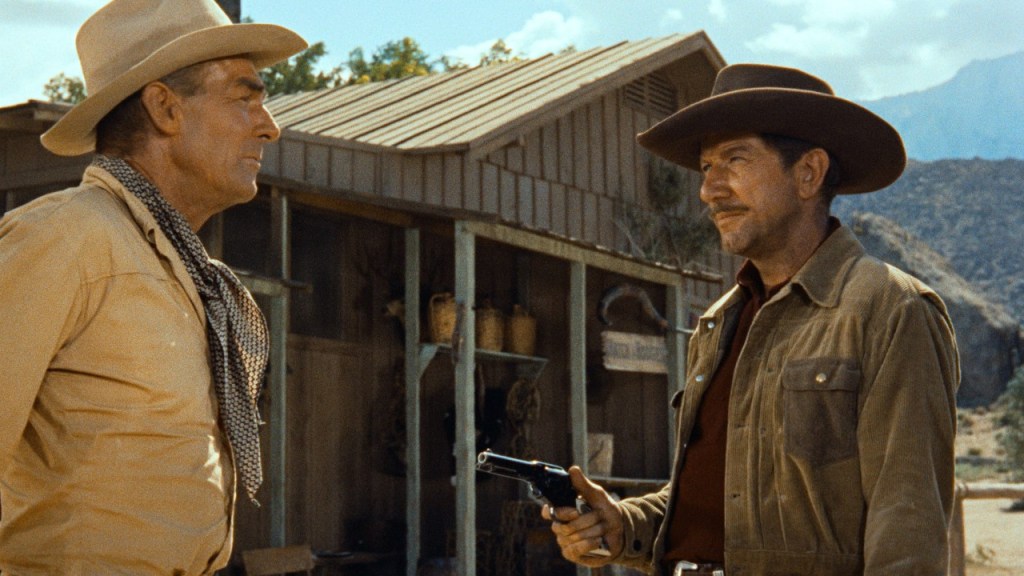
The earliest movie in this set is THE TALL T from 1957, which is based on Elmore Leonard’s short story, “The Captives.” The story opens with our hero Pat Brennan (Randolph Scott) stopping by the Sassabee Stagecoach Station and visiting with the owner Hank (Fred Sherman) and his son, Jeff (Christopher Olsen). Brennan seems like a good-natured guy who has a nice visit with the two and even agrees to purchase young Jeff some striped candy when he stops in the town of Contention later that day. Brennan heads on to Contention where we meet Ed Rintoon (Arthur Hunnicutt), a stagecoach driver who has been hired to take Willard and Doretta Mims (John Hubbard and Maureen O’Sullivan) to Bisbee for their honeymoon. Rintoon and Brennan are clearly old friends. As part of their various conversations, we learn that Doretta Mims is the daughter of Old Man Gateway, the man with the richest copper claim in the territory. After saying goodbye to Rintoon and buying young Jeff his striped candy, Brennan continues on to Tenvoorde’s (Robert Burton) ranch, in hopes of buying a seed bull for his own start-up ranch. For many years, Brennan had been the ramrod on Tenvoorde’s ranch, and the old man clearly wants him to come back. Tenvoorde offers Brennan a chance to get his bull for nothing, but he has to ride the bull to a stand still. If he can’t do it, then Tenvoorde keeps the bull and Brennan’s horse. Brennan takes him up on the offer, falls off the bull, dives into water trough to avoid getting stomped by the bull, and then heads back towards his ranch with nothing but his wet clothes and saddle. As he’s walking down the road, Rintoon comes by on his stagecoach with Mr. and Mrs. Mims. They pick Brennan up and give him a ride. When they stop back at the Sassabee Stagecoach Station, Hank and Jeff are nowhere to be seen. Rather, a voice from inside the station says “Drop your guns and come on down.” Frank Usher (Richard Boone) and young Billy Jack (Skip Homeier) emerge from the station with their guns drawn. When he’s getting down off the stagecoach, Rintoon goes for his shotgun and is shot down by another man, Chink (Henry Silva), whose been waiting in the shadows. These three men are waiting to rob the next stagecoach that comes along. They’ve already killed Hank and Jeff, and are planning to kill every person on this coach, when Willard tells them that his wife Doretta is from the richest family in the territory. Willard tells the three outlaws that Old Man Gateway will pay good money to get his daughter back, if they will just let them live. Usher, the leader of the bunch, likes this idea and sends Billy Jack and Willard back to Contention to request $50,000 from Gateway for the safe return of his daughter. With the endgame changed, Usher takes Brennan and Mrs. Mims to their hideout to wait to get their money from Gateway. Brennan knows that it’s just a matter of time before they are all killed, and he tells Mrs. Mims that they will need to be looking for any possible opportunity to escape.
THE TALL T is just so good. It’s amazing how much drama that director Budd Boetticher could fit into these films that all had running times of less than 80 minutes. The story is simple, but it deals with big themes like honor, cowardice, true love, sociopathic evil, and big dreams. Credit here has to be given to Elmore Leonard, the writer of the short story the film is based on. It must also be given to Burt Kennedy. Kennedy wrote the scripts for THE TALL T, RIDE LONESOME, and COMANCHE STATION. He’s not the credited writer for BUCHANAN RIDES ALONE but he did uncredited work on the script. Kennedy would go on to have a good career writing and directing his own westerns, like SUPPORT YOUR LOCAL SHERIFF, THE TRAIN ROBBERS, and HANNIE CAULDER, but his work with Boetticher is definitely some of his very best.
It’s also amazing how spare and simple everything looks in the THE TALL T. The land is just so dry, with nothing but big rocks and not a tree in sight. Growing up in Arkansas, I’m used to green fields and trees and flowers. It can almost feel like you’re choking on dust just watching this film.
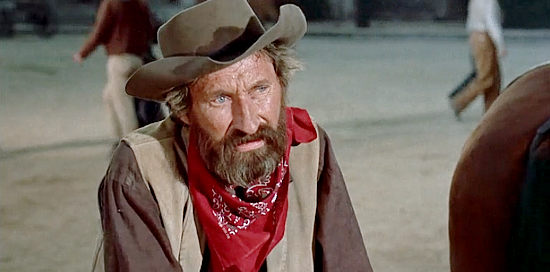
The casting always seems to be perfect in Boetticher’s films. Randolph Scott is simpatico with Boetticher. His character here is a good man who will do what it takes to survive while also keeping his honor intact. Boetticher and Scott are truly a match made in heaven. Richard Boone is great as Frank Usher, the leader of the outlaws. He could have killed Scott’s character Brennan, but he is glad to have an honorable man to talk to after spending all of his time with Billy Jack and Chink. Boone somehow makes his outlaw leader into an honorable man even though he’s done many dishonorable things. It’s an impressive feat. Maureen O’Sullivan has an important role as Doretta Mims, the rich but plain woman, who married Willard because she was afraid she’d end up all alone. Her career goes all the way back to the 1930’s where she played Jane in the original Tarzan movies. She’s a good actress whose character undergoes the widest arc in the entire movie. Henry Silva’s Chink is a sociopath who is keeping score of the number of people he kills. Boone’s Usher would have been much better off if he would have gone with Chink’s advice and put Brennan and the Mims’ in the well back at the Sassabee station! Based on his nonchalant penchant for violence, you can see how Henry Silva would go on to having an amazing career playing bad guys. The last person I want to mention in the cast is Arthur Hunnicutt, who played Ed Rintoon. Hunnicutt is special to me because he comes from the hills of Arkansas, from a little town called Gravelly. He attended the same college I attended, although it was called the Arkansas State Teachers College when he was there. It was the University of Central Arkansas when I came through. Hunnicutt specialized in wise, rural characters. He was even nominated for an Acadamy Award a few years earlier for a movie called THE BIG SKY. He’d go on to be in so many good movies, including playing “Bull” in EL DORADO with John Wayne. I’m just proud of the guy for growing up in extreme rural Arkansas and then becoming a great character actor in Hollywood. I’ll watch anything he’s in.
I recommend all of these Budd Boetticher / Randolph Scott westerns, and THE TALL T is one of the very best!
Welcome to Retro Television Reviews, a feature where we review some of our favorite and least favorite shows of the past! On Sundays, I will be reviewing the made-for-television movies that used to be a primetime mainstay. Today’s film is 1971’s In Broad Daylight! It can be viewed on YouTube.
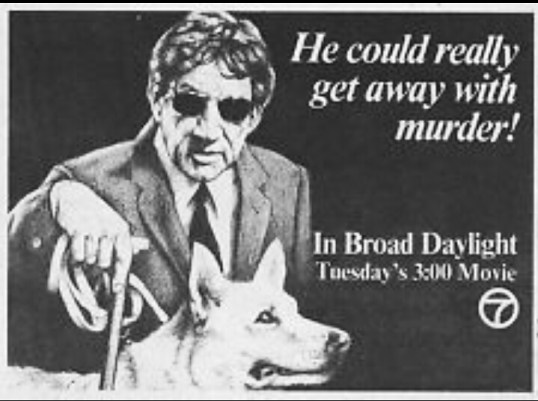
Tony Chappel (Richard Boone) is an actor who has just recently lost his sight as a result of an accident. Released from the hospital, Tony struggles to adjust to living in a world without his vision. When one cab driver says to him, “Didn’t you used to be Tony Chappel?,” he flinches as he realizes that his career as a famous actor is now considered to be over. One day, he comes home early and overhears his wife (Stella Stevens) fooling around with his lawyer and “best friend” (Fred Beir). Tony promptly decides to murder his wife and frame his friend for the crime.
Tony decides to use his acting skills to his advantage. He memorizes the the area around him so that he can make his way through it by memory. He puts on a fake beard, speaks with Greek accent, and makes a point of carrying a camera with him. He starts taking public transportation and going out of his way to be talkative and social Everyone that he meets, he tells them about how he’s been taking pictures of the city and how he can’t wait to see how they come out. When his wife is eventually murdered, the police receive a reports of a mysterious Greek man, one who was definitely not blind, in the area. However, Lt. Bergman (John Marley) has his doubts and comes to suspect that Tony is the killer.
In Broad Daylight was made from an early script written by Larry Cohen, who would later go on to direct films like God Told Me To. It’s a clever script, one that sets up an intriguing premise and which ends on a properly twisty and satisfactory note. The film works because it is as much of a character study as a thriller. Tony’s wife not only cheats on him but also betrays him at the moment when he needs her and his friends the most. Tony has gone from being a movie star to being a man who can barely walk from one room to another. He’s already angry. Discovering that his wife is laughing at him behind his back is the last straw.
Larry Cohen reportedly felt that Richard Boone was miscast as Tony. I felt that Boone did a pretty good job, even if he did overact a bit while Tony was trying to convince everyone that he was a Greek tourist. Stella Stevens is perfectly cast as his wife and Suzanne Pleshette is sympathetic as his nurse. Godfather fans will be happy to see John Marley not having to deal with a horse’s head but instead playing the clever detective who attempts to solve the murder.
In Broad Daylight is a clever and entertaining thriller and character study.
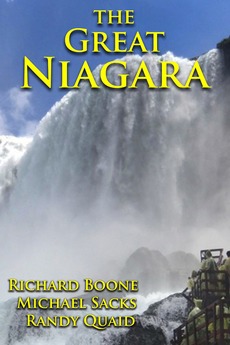
Welcome to Retro Television Reviews, a feature where we review some of our favorite and least favorite shows of the past! On Sundays, I will be reviewing the made-for-television movies that used to be a primetime mainstay. Today’s film is 1974’s The Great Niagara! It can be viewed on YouTube!
The Great Niagara takes place during the Great Depression.
With the world mired in economic uncertainty and the threat of war right around the corner, people are more desperate than ever for entertainment. One of the latest fads is attempting to conquer the Niagara by going over the falls in some sort of raft. If done correctly, it can lead to fame and fortune. But, if one mistake is made while trying to steer the raft against the rapids and the rocks, it can lead to death. In fact, death is the usual outcome of most people’s efforts to conquer the Niagara. It’s actually illegal to try to ride anything over the falls but people still try to do it and crowds still gather to watch the attempts.
Old Aaron Grant (Richard Boone) is obsessed with conquering the Niagara but, because he’s been injured in too many attempts, all he can do now is sponsor and try to help others who are willing to take the risk. Aaron is the type who will look out at the Niagara and angrily shake his fist. He hates the river and he hates the falls but they’re also the only thing that gives his life meaning. After Aaron’s latest protegee, Ace Tully (Burt Young), fails in his attempt to go over the falls, Aaron starts to put pressure on his sons to make the attempt. Lonnie Grant (Michael Sacks) knows that Aaron has allowed his obsession to drive him mad and he’s also promised his wife, Lois (Jennifer Salt), that he won’t go over the falls. However, Carl Grant (Randy Quaid) is desperate for his father’s approval and it’s not long before he’s getting ready to enter the barrel and risk his life.
The Great Niagara is a short but interesting film. It’s based on historical fact. There’s been a long history of people risking their lives with stunts at Niagara Falls. A few years ago, there was a live television broadcast of someone walking over the falls on a tightrope. It was a huge rating success and it was, of course, sold as a tribute to the human spirit. That said, it’s entirely believable that a good deal of the people watching were doing so because they were curious about what would happen if the guy fell off the wire. By that same token, the crowds that we see in The Great Niagara are far more concerned with seeing someone go over the falls than they are with whether or not that person survives the experience. Richard Boone gives an obsessive, half-mad performance as Aaron and Michael Saks does a good job as the voice of reason. Randy Quaid gives a poignant performance as poor Carl, who is so desperate for his father’s approval that he’s willing to risk his life to try to get it. That said, the true star of the film is the Niagara itself, which is beautiful but obviously dangerous. When Aaron shakes his fist at the falls, it’s hard not to feel that the Niagara isn’t doing the same back at him.
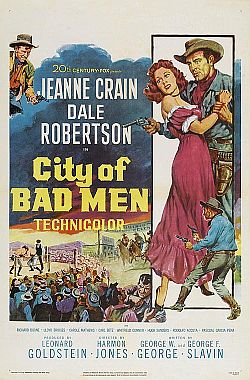
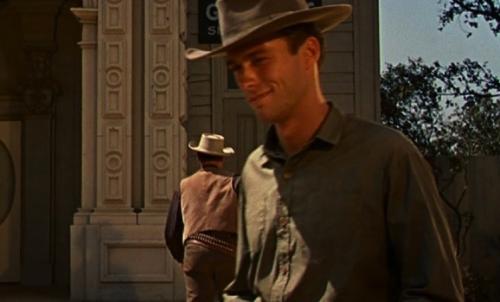
In the year 1897, an outlaw gang led by brothers Brett (Dale Robertson) and Gar (Lloyd Bridges) ride into the frontier town of Carson City, Nevada. Brett and Gar remember Carson City as being a sleepy town where not much happens but, when they arrive, they discover that a carnival-like atmosphere has broken out in the streets. A heavyweight fight between “Gentleman Jim” Corbett and Bob Fitzsimmons is scheduled to take place in Carson City and the once sleepy little town has become the center of the old west.
Sheriff Bill Gifford (Hugh Sanders) already knows that he’s going to have his hands full with all of the people coming to town for the fight so he’s not happy to see that Brett and Gar have returned. When the notorious outlaw Johnny Ringo (Richard Boone) also shows up for the fight, Gifford realizes that he’s going to have to do something unheard of. He deputizes the three outlaws, assigning them to keep the peace.
Even as deputies, the outlaws scheme to steal the money that’s raised by the fight. However, Brett is actually more interested in getting back together with his former girlfriend, Linda (Jeanne Crain). When Gar and Ringo realize that Brett might be backing away from the plan, it leads to a climatic showdown in Carson City.
This B-western tells a semi-true story. Corbett and Fitzsimmons did fight a match in Carson City in 1897. The fight lasted for over 90 minutes and ended with an upset victory for Fitzsimmons. It was the first boxing match to be filmed and it was later released into cinemas as The Corbett-Fitzsimmons Fight. It was the first film to last over an hour and it is considered to be the first feature film. It’s also considered to be the first pay-per-view event because the film of the fight made the boxers more money than the fight itself. The rest of the film is pure fiction. (The infamous outlaw Johnny Ringo had been dead for five years by the time of the Corbett/Fitzsimmons fight.) But even if there wasn’t an attempt to rob the Corbett/Fitzsimmons Fight, the use of the actual fight and the publicity surrounding it serves to remind the audience that the modern world is coming to the frontier.
For most, the main appeal of this film will be to see Dale Robertson, Richard Boone, and Lloyd Bridges acting opposite each other. All three are well known to western fans. Boone would later star in Have GunWill Travel while Robertson appeared in Tales of Wells Fargo, Iron Horse, and Death Valley Days. Lloyd Bridges previously played the resentful deputy in High Noon. The three of them are in top form in City of Bad Men, with Bridges especially making an impression as the less honest of the two outlaw brothers. The three of them play outlaws who know that the era of the lawless west is coming to an end and all three of them have to decide whether they want to go straight or if they want to go out with a bang (some more literally than others). With the fast-paced script and a dedicated cast, City of Bad Men is a film that will be appreciated by anyone who likes a good western tale.
Arizona rancher Wick Campbell (Richard Boone) is angered when he discovers that one of his servants, Maria (Donna Martell), would rather marry Howie Stewart (Skip Homeier) than be with Wick. Wick has had a long rivalry with Howie and his older brothers, John (Randolph Scott) and Adam (Lester Matthews). Determined to get rid of the Stewarts and to have Maria for himself, Wick hires notorious gunfighter Frank Scavo (Leo Gordon) to take over the town and defeat the Stewarts, one way or another.
Ten Wanted Men (the title refers to Scavo’s gang) is an above average Randolph Scott western. Scott was one of the best of the western heroes because he always seemed so authentic whenever he rode a horse, shot a gun, or even just put on a cowboy hat. Scott was also an underrated actor and, as he got older, he became Hollywood’s go-to choice whenever they needed a strong, silent lead for a western. That’s the role that he plays in Ten Wanted Men, as the patriarch of the Stewart family. He’s instinctively fair but he will do whatever has to be done to protect his brothers.
Wick Campbell is John Stewart’s opposite, an oily rancher who hires other men to bully his enemies and who abuses his servant in a way that the Stewarts never would consider. Though Richard Boone became best known for playing the hero on Have Gun–Will Travel, Wick is the type of cowardly villain who everyone will be happy to see get exactly what he deserves. As played by Leo Gordon, Frank Scavo is a brutish outlaw and, unlike Wick, he doesn’t pretend to be anything else.
Ten Wanted Men is a good western. The plot may not be surprising but the gunfights are exciting and Randolph Scott is as ideal a hero as always. Fans of the genre will enjoy it.
The time is the late 1800s and the place is the town of Gunlock. Gunlock is split between the ranchers and the farmers, with the ranchers eager to buy all of the land around the town and the farmers refusing to sell. Trying to keep the peace is Sheriff Bill Jorden (John Agar), who not only wants to keep war from breaking out in Gunlock but who also wants to live up to the example of his legendary father.
There’s a prisoner in the Gunlock city jail. Sam Hall (Richard Boone) is a notorious gunman who has been convicted of killing three farmers. He’s due to hang at sunset but everyone in town believes that Sam will somehow escape the executioner. (They’re even taking bets down at the local saloon and casino.) Everyone knows that Sam was hired by the ranchers but Sam has yet to name which rancher specifically invited him to come to town. The farmers want to lynch Sam. The ranchers want to break him out of jail and arrange for him to be killed in the resulting firefight. Meanwhile, Sheriff Jorden insists that he’s going to carry out Sam’s sentence by the letter of the law. Complicating matters for Jorden is that he’s engaged to Ellen Ballard (Mamie Van Doren), the sister of the main rancher, George Ballard (Leif Erickson).
I was really surprised by Star in the Dust, which turned out to be far better than I would normally expect a John Agar/Mamie Van Doren western to be. Though Agar, Boone, and Van Doren get top-billing, Star in the Dust is really an ensemble piece, with several different people responding to the possible hanging of Sam Hall in their own way. Sam’s girlfriend, Nellie Mason (Colleen Gray), tries to figure out a way to keep Sam alive. One of the ranchers, Lew Hogan (Harry Morgan), is morally conflicted about whether or not to honor his word to help Sam escape, especially after he finds out that Sam tried to rape his wife (Randy Stuart). Even the old deputies (played by James Gleason and Paul Fix) get a few minutes in the spotlight before the shooting begins. The town of Gunlock comes to life and everyone, from the villains to the heroes, has a realistic motivation for reacting in the way that they do to Sam’s pending execution.
Mamie van Doren’s role is actually pretty small. She doesn’t have enough screen time to either hurt or help the film overall. John Agar is as stiff as always but, for once, it works for his character. Sheriff Jorden isn’t written to be a bigger-than-life John Wayne type. Instead, he’s just a small town lawman trying to do his job and keep the peace. Not surprisingly, the film is stolen by Richard Boone, who brings a lot of unexpected shading and nuance to the role of Sam Hall. Hall may be a killer but he has his own brand of integrity and, if he’s going to die, he’s determined to do it his way.
Produced by the legendary Albert Zugsmith, Star in the Dust is a surprisingly intelligent and well-acted B-western. If you watch carefully, you might even spot Clint Eastwood playing a ranch hand named Tom who wants to know if he should put money down on Sam Hall being hanged. Though he was uncredited in this tiny role, Star in the Dust was Eastwood’s first western.
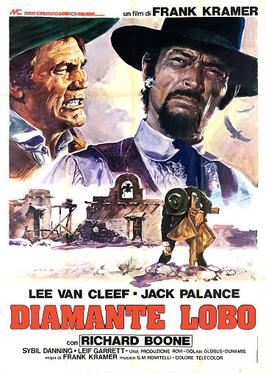
During the dying days of the old west, outlaw Sam Clayton (Jack Palance) ride into the town of Juno City and try to take things over. Because the sheriff (Richard Boone, who reportedly walked off the film before shooting was complete) is old and ineffectual, it falls to the town priest, Father John (Lee Van Cleef), to chase them off. Father John is hardly your typical priest. He’s a former gunfighter who, even though he no longer carries a weapon, still knows how to throw a punch. Though he manages to put Sam and the gang behind bars, they are all eventually released. The first thing they do is gun down Father John in front of his own church.
A mute child, Johnny O’Hara (Leif Garrett), flees town to track down Father John’s twin brother, Lewis (also played by Lee Van Cleef). What Johnny doesn’t know is that Sam, who years ago raped Johnny’s mother (played by Sybil Danning), might actually be his father. When Johnny finds Lewis, he finally manages to communicate what’s happened. Lewis and Johnny head back to town so Lewis can get his vengeance The only catch is that Lewis promised his brother that he would no longer carry a gun so he’s going to have to use his wits to get his revenge.
God’s Gun is a strange film. It was one of the last of Spaghetti westerns but, though the director was Italian, it was filmed in Israel and it was produced by none other than Menahem Golan. Golan brings the same producing aesthetic to God’s Gun that he later brought to many Cannon films — a few recognizable veteran actors (Jack Palance, Lee Van Cleef), an up-and-coming star (Leif Garrett), an international sex symbol (Sybil Danning), and a spin on a popular genre. Like many of Golan’s films, the plot is occasionally incoherent and the entire production feels cheap and rushed but, at the same time, it’s hard to resist the mix of Van Cleef, Palance, and Danning.
Adding to the film’s strange feel is that every actor is dubbed, even the ones with trademark voices like Jack Palance and Lee Van Cleef. Palance sneers throughout the entire film and could be giving a good performance but every time he starts to speak, you hear a voice that is clearly not Jack Palance’s and it makes it hard to get into the story. There’s also an annoying squawking sound effect that explodes on the film’s soundtrack whenever someone is shot or whenever Lewis makes an appearance.
It’s not all a loss, though. The Israeli desert is an effective Western backdrop and there are a few good camera shots. When Lee Van Cleef and Jack Palance have their final confrontation, the picture starts to spin around and it’s pretty cool. Finally, if you’re a Van Cleef fan, this is a rare chance to see him playing a traditional hero. Because he’s dubbed, it’s hard to judge Van Cleef’s dual performances but this film does show that he could do more than just be a smirking killer. He’s actually a pretty convincing priest. Who would have guessed?


 Through the Shattered Lens