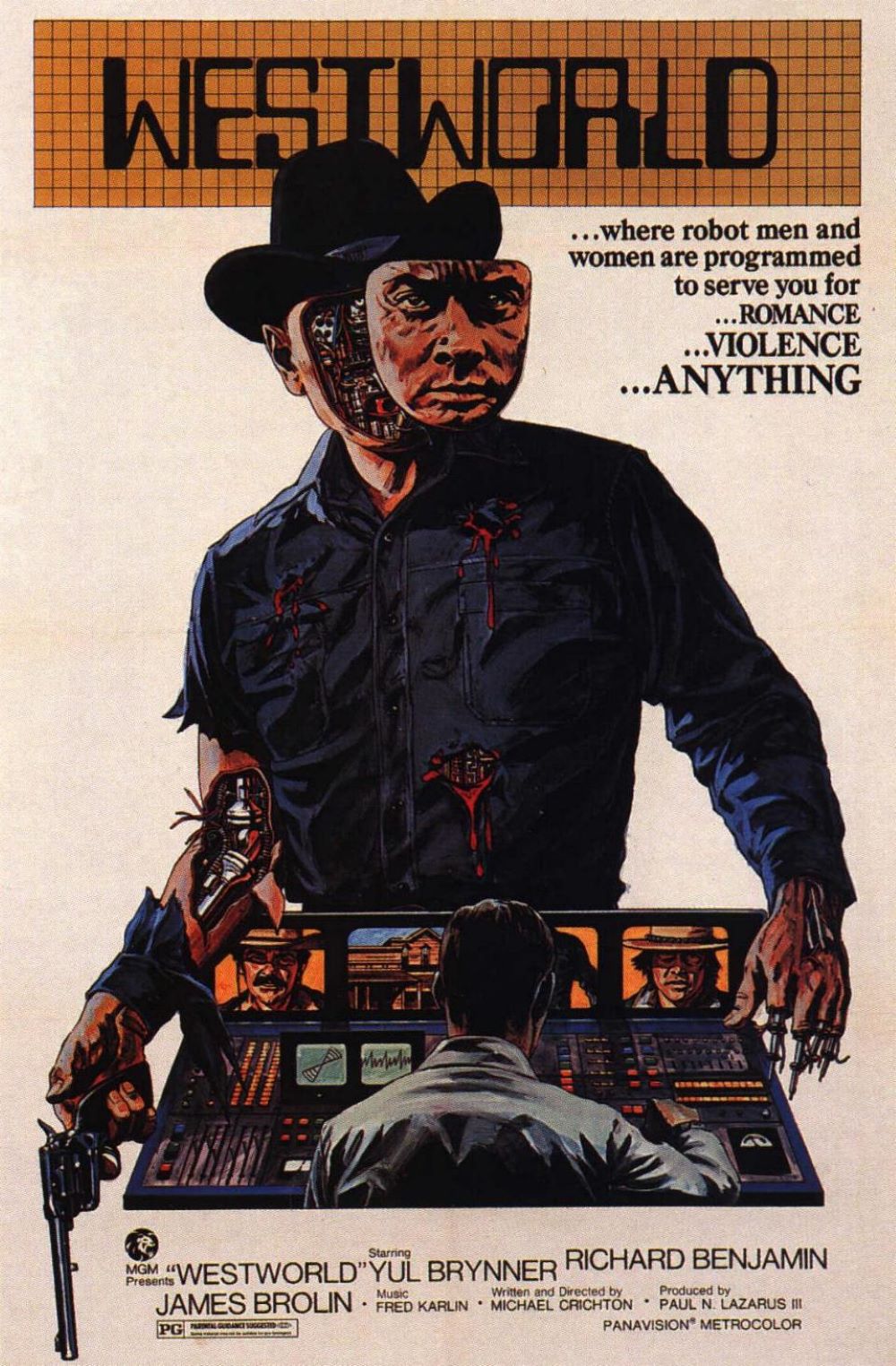
Review: Westworld (dir. by Michael Crichton)


“There’s no way to get hurt in here, just enjoy yourself.” — John Blane

Michael Crichton’s Westworld (1973) is a pioneering sci-fi thriller that uniquely melds futuristic technology with classic Western motifs to explore the dark side of immersive fantasy. The film is set in Delos, a high-tech amusement park divided into three themed worlds—Roman, Medieval, and Western—where guests can live out their fantasies with lifelike androids programmed to serve them. The story focuses on friends Peter Martin (Richard Benjamin) and John Blaine (James Brolin), who embark on a vacation to Westworld, only to find the androids malfunctioning with deadly consequences.

One of Westworld’s greatest strengths lies in its compelling premise. The concept of a theme park filled with near-human robots designed for guests’ amusement feels both visionary and deeply relevant even decades later. It touches on early concerns about the dangers of AI, the ethics of escapism, and how technology could spiral out of control. The film’s gradual shift from playful adventure to tense horror keeps the viewer engaged, illustrating how quickly paradise can turn into a nightmare. Yul Brynner’s portrayal of the robotic Gunslinger is especially memorable, embodying a calm yet unstoppable menace that has echoed through decades of genre cinema. His near-silent, mechanical stalking of the protagonists in the film’s thrilling climax defines the archetype of the relentless android assassin.

Technologically, Westworld was groundbreaking for its era. It featured some of the first uses of computer-generated imagery to simulate the Gunslinger’s “robot vision,” providing a novel and eerie perspective that laid the groundwork for the visual language of future sci-fi films. The movie’s restrained approach to horror and suspense—which leans heavily on atmosphere and tension rather than gore—remains effective. The juxtaposition of idyllic fantasy and mechanical terror gives Westworld a unique texture that feels both nostalgic and fresh.

However, the film is not without flaws. Its pacing is uneven—while the first half indulges in leisurely world-building and character interactions, it can feel slow and unfocused, weighing down the narrative momentum. The characters, particularly Peter and John, are somewhat archetypal and underdeveloped, serving more as audience surrogates than fully fleshed-out individuals. This limits emotional investment in their plight, which could have deepened the film’s impact. Some dialogue and scenes feel dated or clichéd, something Crichton himself acknowledged by deliberately shooting certain sequences as cinematic clichés to evoke a stylized old-movie atmosphere.

The tonal shift from lighthearted theme-park romp to suspenseful thriller, while intriguing, feels abrupt and uneven in spots. The horror elements emerge forcefully in the second half but are preceded by a comparatively slow start that may test some viewers’ patience. The film’s logic around the park’s safety and the androids’ malfunctioning is also inconsistent—what begins as programmed fantasy behavior suddenly becomes lethal with little explanation or foreshadowing. These plot holes can detract from the immersion if one is seeking tightly reasoned sci-fi.

World-building is another area where Westworld shows its age; the other park zones like Romanworld and Medievalworld are barely touched on, serving more as exotic backdrops than dynamic settings. The film lightly explores AI ethics and humanity’s hubris but refrains from delving deeply into philosophical questions, which later adaptations and works inspired by the film would expand upon more thoroughly. The 1970s social attitudes reflected in the cast and scenarios can also feel outmoded to modern sensibilities.

Despite these issues, Westworld remains a cult classic and a fascinating artifact of sci-fi cinema history. Its influence is enormous, seeding ideas that blossomed into franchises like The TerminatorJurassic Park, and the HBO Westworld series. It stands as Michael Crichton’s directorial debut and an early example of a film grappling with human-machine interaction and the consequences of technological spectacle.

Westworld is a smart, ambitious blend of sci-fi, Western, and horror that captivates with its high-concept premise, pioneering visuals, and iconic villainy. While its uneven pacing, thin character development, and occasional logical gaps reveal its age, these flaws do little to diminish its charm and significance. For genre fans, it’s an essential watch—both as a suspenseful thriller and a creative blueprint for many modern tales of technology run amok. It’s a film that showcases the thrilling promise and lurking threat of immersive fantasy, wrapped in the dust and desolation of the Wild West.
Horror Film Review: Love At First Bite (dir by Stan Dargoti)


Disco Dracula!

In 1979’s Love At First Bite, George Hamilton plays Dracula, who goes from living in Transylvania to trying to make it in New York City.  Even when you’re the King of the Vampires, it turns out that New York can be a difficult place to live.  No one has much respect for the tanned man in the cape, even after he shows off his powers.  He falls in love with a model, Cindy Sondheim (Susan Saint James), but she doesn’t buy into the idea that he’s a vampire.  She’s a New Yorker and she’s in therapy.  Her therapist, Dr. Jeffrey Rosenberg (Richard Benjamin), is a direct descendant of Prof. Van Helsing and he does believes that “Vladimir” is a vampire but he can’t get anyone to believe him.  When he takes his concerns to the NYPD, Lt. Ferguson (Dick Shawn) dismisses him as being insane.  Which, to an extent, he is but only because no one will believe him….

Meanwhile, Dracula’s faithful servant, Renfield (Arte Johnson), starts every morning by leaning out of his apartment window and pretending to be a rooster.  It’s his signal to let Dracula know that it’s time to come home.  Dracula is so in love with Cindy that he sometimes forgets to keep track of time.  It’s a New York love story….

Love At First Sight is a comedy that essentially gets a lot of mileage out of a handful of jokes.  The main joke is the idea of George Hamilton, with his perpetual tan, playing Dracula and speaking with a Bela Lugosi-style accent.  Hamilton plays Dracula as being very confident and very smooth but also rather befuddled by 1979.  He’s a gentleman of the “old world” after all.  The other big joke is that Dracula is in New York, a city where no one is impressed by anything.  This is very much a “New Yorkers Will Be Rude To Anyone” movie, a genre that was very popular in the 70s.  Some films, like Taxi Driver, used the rudeness of New York as a metaphor for paranoia and detachment.  Love At First Bite uses it for laughs.

(For the record, my favorite “New Yorkers Will Be Rude To Anyone” movie is the original The Taking of Pelham One Two Three.  Also, the last time I briefly visited New York, everyone was very nice and polite to me.  Only once did someone yell, “Look out, lady!” and I’m still not really sure what I was supposed to be looking out for.)

There’s a lot to like about Love At First Sight.  Susan Saint James and George Hamilton don’t exactly have a ton of chemistry but Hamilton himself is fun to watch.  “Children of the night — shut up!” he yells at the wolves and it’s hard not to smile.  It’s just so goofy.  Hamilton and Arte Johnson are a good comedic team and, for that matter, so are Richard Benjamin and Dick Shawn.  It’s a film of set pieces.  Dracula and Renfield rob a blood bank.  Jeffrey confronts Dracula at dinner.  Dracula pops out of his coffin at a church.  Some of the set pieces work better than others and this is very much a film of its time but overall, it’s a genial and amusing send-up of the vampire genre.

And it features Dracula at a disco!  It’s a 70s movie and it stars George Hamilton so it’s not really surprising that the action moves to a disco.  Still, if you can’t appreciate the sight of a caped Dracula showing off his best moves, I don’t know what to tell you.

Love At First Sight is a reminder that not every Halloween movie has to be terrifying.  Some of them can just make you laugh.

Film Review: City Heat (dir by Richard Benjamin)


In 1984’s City Heat, Clint Eastwood plays Lt. Speer, a tough and taciturn policeman who carries a big gun, throws a mean punch, and only speaks when he absolutely has to.

Burt Reynolds plays Mike Murphy, a private investigator who has a mustache, a wealthy girlfriend (Madeleine Kahn), and a habit of turning everything into a joke.

Together, they solve crimes!

I’m not being sarcastic here.  The two of them actually do team up to solve a crime, despite having a not quite friendly relationship.  (Speer has never forgiven Murphy for quitting the force and Murphy has never forgiven Speer for being better at everything than Murphy is.)  That said, I would be hard-pressed to give you the exact details of the crime.  City Heat has a plot that can be difficult to follow, not because it’s complicated but because the film itself is so poorly paced and edited that the viewer’s mind tends to wander.  The main impression that I came away with is that Speer and Murphy like to beat people up.  In theory, there’s nothing wrong with that.  Eastwood is legendary tough guy.  Most people who watch an Eastwood film do so because they’re looking forward to him putting the bad guys in their place, whether it’s with a gun, his fists, or a devastating one-liner.  Reynolds also played a lot of tough characters, though they tended to be more verbose than Eastwood’s.

That said, the violence in City Heat really does get repetitive.  There’s only so many times you can watch Clint punching Burt while various extras get gunned down in the background before it starts to feel a little bit boring.  The fact that the film tries to sell itself as a comedy while gleefully mowing down the majority of the supporting cast doesn’t help.  Eastwood snarls like a pro and Reynolds flashes his devil-may-care smile but, meanwhile, Richard Roundtree is getting tossed out a window, Irene Cara is getting hit by a car, and both Kahn and Jane Alexander are being taken hostage.  Tonally, the film is all over the place.  Director Richard Benjamin was a last-minute replacement for Blake Edwards and he directs without any sort of clear vision of just what exactly this film is supposed to be.

On the plus side, City Heat takes place in Kansas City in 1933 and the production design and the majority of the costumes are gorgeous.  (Unfortunately, the film itself is often so underlit that you may have to strain your eyes to really appreciate it.)  And the film also features two fine character actors, Rip Torn and Tony Lo Bianco, are the main villains.  For that matter, Robert Davi shows up as a low-level gangster and he brings an actual sense of menace to his character.  There are some good things about City Heat but overall, the film is just too messy and the script is a bit too glib for its own good.

Burt Reynolds and Clint Eastwood had apparently been friends since the early days of their careers.  This was the only film that they made together.  Interestingly enough, Reynolds gets the majority of the screentime.  Eastwood may be top-billed but his role really is a supporting one.  Unfortunately, Reynolds seems to be kind of bored with the whole thing.  As for Clint, he snarls with the best of them but the film really doesn’t give him much to do.

A disappointing film, City Heat.  Watching a film like this, it’s easy to see why Eastwood ended up directing himself in the majority of his films.

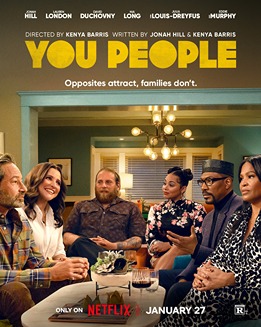
Film Review: You People (dir by Kenya Barris)


Ezra Cohen (Jonah Hill) and Amirah Mohammed (Lauren London) have been dating for six months.  Ezra is a Jewish atheist who works at a brokerage firm but who says his lifelong dream has been to be a podcaster.  Lauren is Black and a devout Muslim.  A graduate of Howard University, she is pursuing a career as a designer.  Despite coming from very different backgrounds, Ezra and Amirah are deeply in love and want to get married.  However, becoming engaged also means …. MEETING THE PARENTS!

Shelley and Arnold Cohen (played by Julia Louis-Dreyfus and David Duchovny) are self-styled progressives who immediately embarrass Ezra by going out of their way to trying to show how liberal and non-racist they are.  Shelley, in particular, goes out of her way to bond with Amirah but it’s immediately obvious that Shelley views Amirah as being more someone to show off than as an actual human being.  Meanwhile, Akbar Mohammed and Fatima Mohammed (played by Eddie Murphy and Nia Long) are members of the Nation of Islam who admire Louis Farrakhan and who claim that the Jews were behind the slave trade.

Just from that plot description, you can see a huge part of the problem with the new film, You People.  Whereas Shelley’s problem is that she’s too quick to brag about how much she loves the idea of having a black daughter-in-law, Akbar’s problem is that he’s an anti-Semite.  His main objections to Ezra are that 1) Ezra isn’t black and 2) Ezra’s Jewish.  While Shelley takes Amirah shopping, Akbar tries to get Ezra killed by tricking him into wearing “the wrong colors” to a barbershop.  While Shelley shows off Amirah to all of her liberal friends, Akbar shoves Ezra onto a basketball court.  While Shelley is awkwardly trying to prove that she’s an ally, Akbar is inviting himself to Ezra’s wild Las Vegas bachelor party.  (Akbar is disturbed to discover that Ezra has a “coke guy.”  If this film had been made ten years ago, Ezra would have had a weed guy and it would have been easier to buy the film’s contention that Akbar is being unreasonable.)  Shelley is certainly obnoxious and she fully deserves to get called out for her behavior.  But Akbar is an anti-Semite who peddles the type of conspiracy theories that have been at the center of the alarming rise in recent hate crimes.  Whereas Shelley is clueless, Akbar is actually malicious.  And while that’s a story that one certainly could try to tell, it also makes it a bit difficult to buy the film’s fanciful ending.  The movie ultimately can’t decide if it wants to be a fearless satire of race relations or a feel-good romcom.  The tone of the film switches from scene to scene and Kenya Barris’s direction is so inconsistent that he makes Judd Apatow look like a disciplined filmmaker by comparison.

The cast is full of talent but the characters are largely one-dimensional.  Jonah Hill is undoubtedly a good actor but he’s also nearly 40 years old and, with his full beard, he looks about ten years older, which makes it a bit hard to believe that he would be that concerned with getting the approval of his future in-laws.  At first, a role of Akbar would seem ideal for Eddie Murphy but, with the exception of a scene where Akbar quizzes Ezra on his favorite Jay-Z song in an attempt to trick Ezra into saying the “n-word,” Murphy doesn’t really get to do much other than stand around with a pained expression on his face.  Probably the most interesting performance in the film comes from Mike Epps, who plays Akbar’s brother and who is one of the few characters willing to call everyone out on their hypocrisy.  But, unfortunately, Epps is only in a handful of scenes and the film uses him as more of a dramatic device than a fully rounded character.

As I watched You People, I couldn’t help but think about another film about an interracial wedding, Rachel Getting Married.  That film provided a believable and multi-layered look at two different cultures coming together.  You People, however, can’t quite make up its mind what it believes or what it wants to say and, unfortunately, what it does say is often said with a surprising lack of self-awareness.  At times, it’s so proud of itself that it feels like it almost could have been written by Shelley Cohen.

You People is streaming on Netflix.

Film Review: Westworld (dir by Michael Crichton)


“Draw,” says Yul Brynner.

“Whatever,” says a tourist who has spent a lot of money to spend their vacation at the Delos amusement park.

BANG!  Down goes the tourist, as the robot revolution of 1983 begins.

Recently, TCM broadcast the 1973 science fiction thriller, Westworld.  Since I am absolutely obsessed with the more recent HBO revival, there was no way I could resist watching the original film.  It was an interesting experience.  While the film is far more simpler and straight-forward than the television series, they both essentially tell the same story.  A bunch of rich humans pay a lot of money to pretend to be either cowboys or knights or Roman citizens for a week.  Everyone has a great time until, eventually, the robots stop doing what they were supposed to do and instead, begin to fight back.

One thing that the movie and the series definitely shared is a less-than-positive view of humanity.  The movie focuses on two businessmen.  Peter (Richard Benjamin) is the nerdy one.  John (James Brolin) is the hypermasculine one.  Peter is visiting Westworld for the first time.  John is a frequent guest who loves gunning down any robots who looks at him the wrong way.  Neither one of these characters is particularly likable.  Peter starts out as a self-righteous hypocrite who ends up sleeping with a sexbot, despite being married.  John brags about how easy it is to kill the robots, mostly because the robot’s are programmed to not fight back.

Meanwhile, the human engineers who work behind-the-scenes and keep Delos running are all blandly incompetent.  When the robots start to malfunction, the engineers can only shrug and wonder why.  They’re so ineffective that, halfway through the movie, they get sealed up in their own control room, slowly suffocating to death while the park collapses around them.

As opposed to the TV series, the robots in Westworld never achieve any sort of real consciousness.  Even when they malfunction, it doesn’t lead to a true rebellion as much as it just causes them to ignore any previous directives about killing the guests.  When the Gunslinger (Yul Brynner) starts stalking Peter and John across the park, it’s not an act of ideology or, for that matter, even revenge.  It’s simply that the Gunslinger has been programmed to be a killer and this is what a killer does.

It all leads to an extended chase sequence involving the Gunslinger and Peter and, despite the fact that it doesn’t have much of a personality, it’s hard not to be on The Gunslinger’s side.  If nothing else, the Gunslinger is at least good at what it does.  Peter, on the other hand, is perhaps one of the most incompetent heroes to ever show up in a movie.  After spending the first half of the movie being smug and dealing with robots programmed not to fight back, Peter now has to try to win on an even playing field.

Westworld was the directorial debut of writer Michael Crichton.  The film’s flaws are largely the flaws that you would expect from a first-time director.  Occasionally, the pacing falters and the first half of the film sometimes moves a bit too slowly.  (There’s one saloon fight that seems to go on forever.)  During the first half of the film, there’s several scenes involving another tourist (played by Dick Van Patten) who seems like he’s going to play a major role in the film but, after the first hour, the character literally vanishes from the film.

Despite those flaws, Westworld remains an exciting mix of suspense and science fiction.  Though his actual screentime is rather limited, Yul Brynner easily dominates the entire film.  In the role of the Gunslinger, Brynner is a relentless killing machine.  What makes the character especially disturbing is that Brynner plays him without a hint of emotion or expression.  The Gunslinger gets no pleasure out of killing nor does he seek to accomplish any sort of identifiable goal.  The Gunslinger simply kills because that’s what he was programmed to do.

While I prefer the HBO series, the original Westworld is still an exciting and entertaining film, one that probably seems a lot more plausible today than when it was first released 46 years ago.  Watch it the next time your home robot gets bored.

Glory Daze: Peter O’Toole in MY FAVORITE YEAR (MGM 1982)


gary loggins's avatarcracked rear viewer

The world of 1950’s live TV gets the comic treatment in Richard Benjamin’s MY FAVORITE YEAR, a hilarious homage to those golden days of yore. Executive producer Mel Brooks had first-hand knowledge of the era, and much of the hysterical Norman Steinberg/Dennis Palumbo screenplay is based on his experiences, though completely exaggerated and laugh-out-loud funny. The film earned star Peter O’Toole an Oscar nomination for his role as Alan Swann, a dissipated movie star based on swashbuckling Errol Flynn .

Swann arrives at NBC’s 30 Rock, scheduled to be the week’s special guest on “Comedy Calvacade”, totally smashed, much to the displeasure of gruff show host Stan ‘King’ Kaiser (Joseph Bologna in a brilliant Sid Caesar parody), who immediately wants to fire him. But young comedy writer Benjy Stone (Mark Linn-Baker, later of TV’s PERFECT STRANGERS), who idolizes the movie great, pleads with Kaiser to give Swann another chance. He…

View original post 428 more words

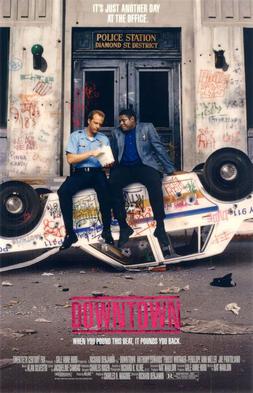
A Movie A Day #262: Downtown (1990, directed by Richard Benjamin)


Alex (Anthony Edwards) is a patrolman assigned to the nicest neighborhood in Philadelphia but, after he gets in trouble for pulling over a wealthy businessman (David Clennon), he is told that he can either be suspended or he can take a transfer downtown, to the Diamond Street precinct.  Alex takes the transfer, even though everyone on the force says that “not even the Terminator would go to Diamond Street.”  Alex gets assigned to work with seasoned Sgt. Dennis Curren (Forest Whitaker), who is still emotionally scarred by the death of his former partner and does not want to have to babysit a naive white cop from the suburbs, especially one who is obsessed with the Beach Boys.  At first, Alex struggles with his new assignment and his new partner but, when an old friend is murdered by a notorious hitman (Joe Pantoliano), Alex is determined to crack the case and bring the killer to justice.
Downtown is a combination of other, better cop films: Alex’s situation is Beverly Hills Cop in reverse and his partnership with Dennis is lifted straight from Lethal Weapon.  Art Evans is the captain who is always yelling at Alex and Dennis and telling them to drop the case and the character is so familiar that I had to check to make sure that Evans had not played the same role in Lethal Weapon.  As the bad guys, Clennon and Pantoliano could just have easily been replaced by Beverly Hills Cop‘s Steven Berkoff and Jonathan Banks and no one would have noticed.  The only real difference is that Downtown is neither as exciting nor as funny as those two films.  Downtown was directed by Richard Benjamin, who will never be known as a particularly versatile filmmaker and who struggles to balance the fish-out-of-water comedy with some surprisingly brutal violence.  Beverly Hills Cops had Eddie Murphy and Lethal Weapon had Mel Gibson and Danny Glover.  Downtown has Anthony Edwards and Forest Whitaker, who are both good actors but who both seem to be woefully miscast here.  (If Downtown were made today, Whitaker could play Dennis but, in 1990, he was too young to be the cop who was “too old for this shit.”)    Of the many Lethal Weapon ripoffs that came out in late 80s and early 90s, Downtown is one of the most forgettable.


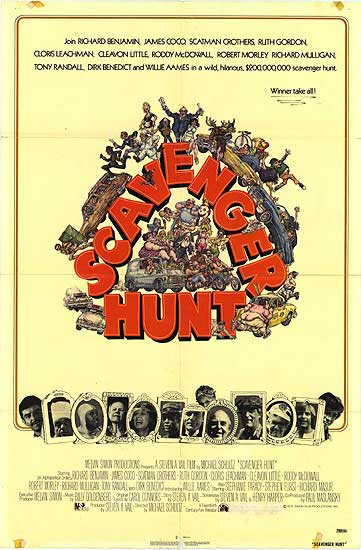
A Movie A Day #114: Scavenger Hunt (1979, directed by Michael Schultz)


When game designer Milton Parker (Vincent Price) dies, all of his greedy relatives and his servants gather for the reading of his will.  Parker’s lawyer, Benstein (Robert Morley), explains that Parker is leaving behind a $200 million dollar estate to whoever can win an elaborate scavenger hunt.  Dividing into five teams, the beneficiaries head out to track down as many items as they can by five o’clock that evening.  Among the items that they have to find: a toilet, a cash register, an ostrich, a microscope, and an obese person.  Hardy har har.
The five teams are made up of a who’s who of sitcom and television actors who had time to kill in 1979.  The Odd Couple‘s Tony Randall is Henry Motely, who is Parker’s son-in-law and who works with his four children.  Soap‘s Richard Mulligan plays a blue-collar taxi driver named Marvin Dummitz (because funny names are funny) who teams up with his friend, Merle (Stephen Furst).  The Mary Tyler Moore Show‘s Cloris Leachman (an Oscar winner, no less) gets stuck with the role of Milton’s greedy sister, Mildred.  She works with her conniving lawyer (Richard Benjamin) and her stupid son (Richard Masur).  Maureen Teefy plays Milton’s niece while his nephews are played by Willie Aames and Dirk Benedict.  Cleavon Little, James Coco, Roddy McDowall, and Stephanie Faracy play the servants.

It doesn’t stop there, though.  Avery Schreiber plays a zookeeper.  Meat Loaf plays a biker who beats up Richard Benjamin.  Ruth Gordon, Stuart Pankin, Pat McCormick, and Scatman Crothers all have cameos.  Even Arnold Schwarzenegger makes an appearance as a gym instructor who knocks Tony Randall out of a second story window.

There are a lot of famous people in Scavenger Hunt.  It’s just too bad that the movie itself is barely watchable and not at all funny.  It tries to go for the zaniness of It’s A Mad, Mad, Mad, Mad World but, unless watching Willie Aames steal a clown head from Jack in the Box is your idea of hilarity, the film never comes close to succeeding.  Michael Schultz directed some classic films (like Car Wash) during the 1970s but, unfortunately, he also directed Sgt. Pepper’s Lonely Hearts Club Band and this.

Scavenger Hunt used to show up on a late night television, where it was always advertised as starring Arnold Schwarzenegger.  (He barely has five minutes of screentime.)  It was released on DVD/Blu-ray earlier this year but watching for the cameos is the only reason to take part in this Scavenger Hunt.

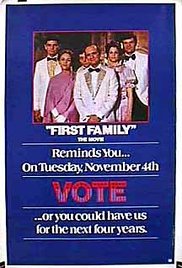
A Movie A Day #20: First Family (1980, directed by Buck Henry)


first-familyLike any newly inaugurated President, Manfred Link (Bob Newhart) faces many new challenges.  The biggest challenge, though, is keeping control of his family and his White House staff.  His wife (Madeline Kahn) is an alcoholic.  His 28 year-old daughter (Gilda Radner) is so desperate to finally lose her virginity that she is constantly trying to sneak out of the White House.  General Dumpson (Rip Torn) wants to start a war.  Press Secretary Bunthorne (Richard Benjamin), Ambassador Spender (Harvey Korman), and Presidential Assistant Feebleman (Fred Willard) struggle and often fail to convince everyone that all is well.
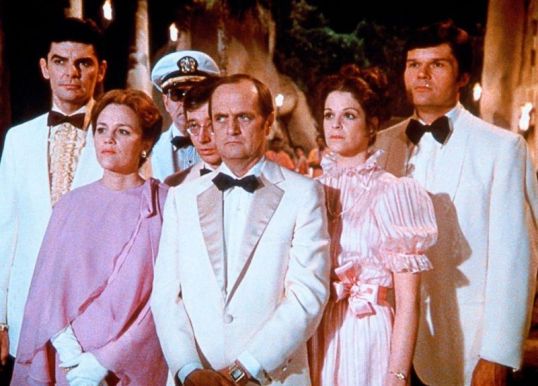
President Link needs to form an alliance with the African country of Upper Gorm, a country that speaks a language that only one man in America, Prof. Alexaner Grade (Austin Pendleton), can understand.  The President of Upper Gorm (John Hancock) orders that the kidnapping of Link’s daughter.  Holding her hostage, he demands that Link send him several white Americans so that the citizens of Upper Gorm can know what it is like to have a minority to oppress.

First Family not only featured a cast of comedy all-stars but it was also directed by one of the funniest men in history, Buck Henry.  So, why isn’t First Family funnier?  There are a few amusing scenes and Newhart can make a pause hilarious but, for the most part, First Family feels like an episode from one of Saturday Night Live‘s lesser seasons.  Reportedly, Henry’s first cut of First Family tested badly and Warner Bros. demanded that certain scenes, including the ending, be reshot.  Perhaps that explains why First Family feels more like a sitcom than a satire conceived by the man who wrote the script for The Graduate and whose off-center perspective made him one of the most popular hosts during Saturday Night Live‘s first five seasons.  Famously, during one SNL hosting gig, Henry’s head was accidentally sliced open by John Belushi’s samurai sword.  Without missing a beat, Henry finished up the sketch and performed the rest of the show with a band-aid prominently displayed on his forehead.  Unfortunately, there’s little sign of that Buck Henry in First Family.

first-family-2