Late Night Retro Television Review: Degrassi High 2.11 “Showtime, Part 2”


Welcome to Late Night Retro Television Reviews, a feature where we review some of our favorite and least favorite shows of the past!  On Sunday, I will be reviewing the Canadian series, Degrassi High, which aired on CBC and PBS from 1989 to 1991!  The series can be streamed on YouTube and Tubi

In yourself, you must believe….

Episode 2.11 “Showtime Part 2”

(Dir by Kit Hood, originally aired on January 28th, 1991)

The students of Degrassi High struggle to move on from the suicide of Claude Tanner.  The talent show goes on, with all of the money raised being given to Claude’s parents.  Snake, for his part, goes to therapy and stays home from school.  When Joey visits him, Snake mentions that, when he found Claude, half of his face was missing.  Meanwhile, Caitlin is haunted by visions of Claude, smiling and trying to hand her a flower.

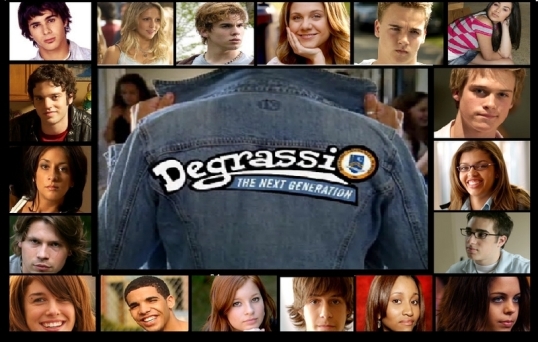
This episode was not quite what I was expecting.  Instead of embracing the melodrama (as Degrassi: The Next Generation would have), this episode is low-key and realistic about showing the ways that people deal with grief and trauma.  Snake is understandably shaken but what makes his scene so poignant is that he’s obviously struggling to pretend like he isn’t or that life can go back to normal after what he’s seen.  I spent this entire episode waiting for Caitlin to breakdown.  She didn’t and really, I have to commend the show for that because I sometimes think we put too much pressure on people to release all of their emotions before they’re ready to do so.  Caitlin is still emotionally number and it’s going to be a while before she’s ready to really talk about what happened.  And that’s okay!  Sometimes, it takes a while.  It’s only now, nearly a year after he died, that I’m really starting to realize how depressed I’ve been over the past year.  All those times that I thought I was moving on, I was really just distracting myself from the pain.  And now, with that one year anniversary approaching, I find myself crying at the most random of times.  It’s not pleasant.  My heart hurts on most days.  But I know that eventually, I’ll make it through.  Everyone grieves in their own way and apparently, this is the way that I grieve.

This was a good Joey episode.  Not only did Caitlin agree to tutor him in his science class but Wheels finally paid back the money that he stole from Joey’s mother.  During their study session, Joey and Caitlin talked about the suicide, with Joey asking if Caitlin knew Claude.  I guess the show’s writers forgot that, last season, Joey was intensely jealous over Caitlin and Claude’s relationship.  Still, regardless of that continuity error, the scenes between Joey and Caitlin were well-written, well-acted, and emotionally honest.

In other words, this was a good episode.  I’ve seen a lot of shows that have dealt with suicide.  I’ve rarely seen any that dealt with it as well and as honestly as Degrassi High.

10 Movies For The Week (7/20/25)


Here Comes Shark Week

This upcoming week is Shark Week.  At the risk of making the most obvious recommendation ever, Jaws (1975) is currently on Netflix.  I doubt that I need to sell anyone on the film.  Jaws is one of those films that everyone accepts is a classic.  I’ll just say that every time that I watch Jaws, I’m surprised at how well it has held up over the years.  I watched it a few weeks ago while flying to Hawaii and, even when viewed in less than ideal conditions, it still held my attention and made me jump a little.  To be honest, I sometimes miss the Spielberg who directed Jaws.  It’s such a fun and scary movie, all the more so because it was made by a director who clearly lived for film.  Jaws is currently streaming on Netflix.

Jaws 2 (1978) does not get the same respect as the first Jaws, nor does it deserve it.  That said, I can’t help but kind of like Jaws 2.  If the first Jaws has a timeless quality to it, Jaws 2 is proudly a product of the 1970s.  Jaws 2 has some pacing issues but it also features Roy Scheider going totally crazy at the end of the film.  After giving a fairly subdued performance in the first Jaws, Scheider went all out for Jaws 2.  Just listen to him yell at that shark!  Jaws 2 is also on Netflix.

Jaws 3 (1983) is a bit of a guilty pleasure, largely because it was originally filmed in 3-D and the special effects are charmingly bad.  Roy Scheider does not return for this one but Dennis Quaid shows up as Chief Brody’s son.  This film was shot at SeaWorld Orlando but the main message seems to be, “Stay away from Seaworld!”  For the record, I relate to Lea Thompson’s character.  It can be viewed on Netflix!

The makers of Jaws: The Revenge (1987) decided to see what would happen if they made a Jaws film that centered on the least interesting character from the first film.  With Chief Brody having died of a heart attack and one of her sons having been eaten by a shark, Mrs. Brody heads down to the Caribbean and is apparently followed by a shark.  Its dumb but Michael Caine is charming and I’m a completist at heart.  If you’re going to watch one this week, you might as well watch all four!  Jaws: The Revenge is on Netflix.

Great White (1981) is an Italian film that was also released under the title The Last Shark.  Directed by Enzo G. Castelleri, Great White was so similar to Jaws that Universal actually sued the filmmakers in an attempt to keep the film from being released in the States.  To me, that’s always seemed like an overreaction.  There were hundreds of Jaws rip-offs released after 1975.  Great White is actually a pretty entertaining film.  James Franciscus and Vic Morrow team up to take on a giant shark.  The shark eats a helicopter.  This film can currently be viewed on YouTube.

In Praise of Joseph Sargent

Jaws: The Revenge was directed by Joseph Sargent.  Sargent would have been a hundred years old on July 22nd.  Sargent was a classic, no-nonsense director who could handle many different genres.  Here’s a few Sargent films that are not Jaws: The Revenge.

The Taking of Pelham One Two Three (1974) is probably Sargent’s best film.  Four criminals hijack a subway train.  The police spend their time negotiating, arguing, and searching.  It’s certainly my favorite example of the “New Yorkers Will be Rude To Anyone” genre.  Featuring great performances from Walter Matthau, Robert Shaw, Jerry Stiller, and Martin Balsam, this is one of the great New York heist films.  It can be viewed on Tubi.

Maybe I’ll Come Home In The Spring (1972) is a personal favorite of mine, a made-for-television film featuring a young Sally Field as a hippie who returns home and David Carradine as her controlling boyfriend.  This is a lowkey but effective look at life in the suburbs and it features an excellent performance from Sally Field.  It can be viewed on Tubi.

Tribes (1970) features Jan-Michael Vincent as a peace-loving hippie who is drafted and Darren McGavin as the drill sergeant who tries to turn him into a soldier.  Jan-Michael Vincent is absolutely gorgeous in this film.  It can be viewed on YouTube.

Odds and Ends

Paul Verhoeven celebrated a birthday a few days ago.  The original (and still the best) Robocop (1987) is available on Tubi.  Much like Jaws, it’s a film that has stood the test of time and survived countless imitations.

Finally, with the sequel due to be released on the 25th, this week is a great time to amuse yourself with the original Happy Gilmore (1996)!  I love this film and I make no apologies for it.  Bob Barker beating up Adam Sandler?  Seriously, how can you not love this film? Personally, I’ve always felt bad for Shooter McGavin.  Making him hit that ball off of Richard Kiel’s foot?  Totally unfair!  Happy Gilmore is streaming on Netflix.

Click here for last week’s movies!


Retro Television Review: Homicide: Life On The Street 3.18 “In Search of Crimes Past”


Welcome to Retro Television Reviews, a feature where we review some of our favorite and least favorite shows of the past!  On Sundays, I will be reviewing Homicide: Life On The Street, which aired from 1993 to 1999, on NBC!  It  can be viewed on Peacock.

This week, Giardello sets a dangerous precedent.

Episode 3.18 “In Search of Crimes Past”

(Dir by Kenneth Fink, originally aired on April 14th, 1995)

A woman (Felicia Shakman) takes Colonel Barnfather hostage, pointing a gun at his head and demanding that Bolander reopen the investigation into a murder that occurred sixteen years ago.  Bolander was the primary on the murder and the man that he arrested is scheduled to be executed in just a matter of hours.  The woman with the gun is the man’s daughter.  Russert wants to bring in the hostage negotiators but Giardello instead orders Bolander to take a look at the files and the evidence and to try to see if he arrested the wrong man.

I’m not really sure I buy Giardello’s response.  Giardello claims he has no choice but actually, it seems to me that Giardello is setting a dangerous precedent.  In Baltimore, if you think a relative has been wrongly convicted, you can apparently just take someone hostage and demand the case be reopened.  I’m not sure those are the rules that anyone wants to set.

Now, of course, it turns out that Bolander did arrest the wrong guy.  It perhaps would have been more interesting if Bolander had look at the files and said, “Yeah, I got the right guy,” but then this episode wouldn’t be able to make a statement against the death penalty.  Bolander realizes that he made a mistake and also that the actual murderer is a man who committed suicide that very evening.

While that’s going on, Pembleton and Bayliss investigate the death of an elderly woman who appears to have slipped and drowned in her bathtub.  Her husband (Barnard Hughes) seems to be heartbroken.  Of course, the husband actually killed her.  He has fallen in love with another woman and he killed his wife so that he could be with her.  I preferred this storyline to the Bolander one, just because it featured a lot of Pembleton/Bayliss scenes and a good performance from Barnard Hughes.

Finally, Munch hired a new bartender.  He didn’t bother to tell his partners beforehand but how could Lewis and Bayliss possibly complain about Munch hiring Jerry Stiller to tend bar?  (Technically, Stiller was playing an Irishman named McGonical.)  This was a minor but likeable storyline, mostly because of Jerry Stiller’s likably bizarre performance.

So, this was yet another good but not great episode.  The Bolander storyline was a bit too melodramatic for its own good.  It’s not the sort of thing that would have happened during the show’s first two seasons, back when the whole point was to be realistic.  But that Bayliss/Pembleton storyline featured the show’s two most compelling characters doing what they did did best.  This episode was not perfect but it held my attention nonetheless.

Music Video of the Day: The Other Side by Public Service Broadcasting (2015, dir by Rafe Gibbons)


Today’s music video is for Public Service Broadcasting’s inspiring tribute to space exploration, The Other Side! Yes, those are the voices of actual NASA engineers and astronauts, experiencing the dark side of the moon for the very first time. This is from PSB’s classic album, Race for Space.

Enjoy!

Late Night Retro Television Review: Good Morning, Miss Bliss 1.1 “Summer Love”


Welcome to Late Night Retro Television Reviews, a feature where we review some of our favorite and least favorite shows of the past!  On Saturdays, I will be reviewing Good Morning, Miss Bliss, which ran on the Disney Channel from 1988 to 1989 before then moving to NBC and being renamed Saved By The Bell.  The entire show is currently streaming on Prime!

With Check It Out! finished, it’s time to review a new show.  Continuing this feature’s tradition of highlighting the work of executive producer Peter Engel, it’s time for Good Morning, Miss Bliss, the show that would eventually become Saved By The Bell!

Episode 1.1 “Summer Love”

(Dir by Burt Brinckerhoff, originally aired on November 30th, 1988)

It’s the first day of school at JFK Junior High, located in beautiful Indianapolis, Indiana.

Miss Carrie Bliss (Hayley Mills), our narrator, is looking forward to a new year as a history teacher.  The school’s principal, Richard Belding (a surprisingly thin Dennis Haskins) is worried about a new year of out-of-control students and angry parents.  Miss Bliss’s best friend, Ms. Tina Palladino (Joan Ryan), worries that Mr. Belding has given her a bad schedule because of a disappointing school play she directed the previous year.

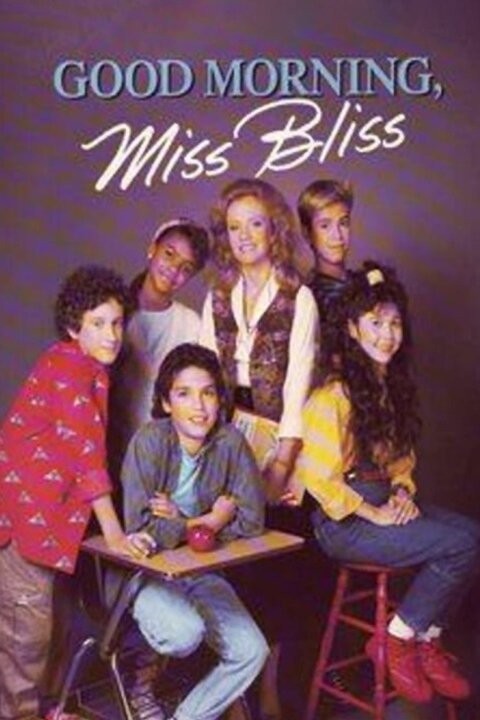
Miss Bliss has a date, the first one since her husband died.  Brian (Barry Jenner) is handsome and successful but romance will have to wait as Miss Bliss deals with the problems of her homeroom students.  Over the summer, pathological liar Zack Morris (Mark-Paul Gosselaar) told a girl named Karen (Carla Gugino, in one of her first roles) that he would soon be starting the 9th grade.  Of course, Zack is actually starting the 8th Grade but he figured that he would never see Karen again so why not…. oh my God, this kid is a terrible human being!  Anyway, Karen transfers to JFK and Zack has to pretend to be in the 9th Grade.  He does this despite the fact that all of his friends, Mickey (Max Battimo), Nikki (Heather Hopper), Lisa (Lark Voorhees), and the nerdy Screech (Dustin Diamond), are in the 8th Grade and Zack’s homeroom is in an 8th grade classroom.

Got all that?

Needless to say, this episode would not be remembered today if not for the fact that it was the first appearance of Mr. Belding, Zack Morris, Lisa Turtle, and Screech Powers.  These characters were, of course, later retconned to be Californians when Saved By The Bell started.  Miss Bliss did not make the transition to California and for that, we should all be happy.  Even in this first episode, Miss Bliss comes across as being a self-righteous know-it-all who obviously feels that she’s too good for a junior high in Indiana.  In her first scene, she brags about getting a good class schedule, dismisses Tina’s concerns about her own class schedule, and then smirks as Mr. Belding talks about his anxiety.  This would pretty much be Miss Bliss’s signature style for the rest of the short life of Good Morning, Miss Bliss.

How do our regulars do in their first appearance as the characters that would make them famous?  Dennis Haskins gives a semi-realistic performance as Belding, playing him as being a harried pencil-pusher as opposed to the cartoonish figure he would become later on.  Mark-Paul Gosselaar and Lark Voorhies do well-enough as Zack and Lisa, though both of their characters are far more simpler here than they would become later.  Dustin Diamond was only 11 year old when he was cast as Screech and he looked and comes across as being several years younger.  (I recently saw an interview with Mark-Paul Gosselaar where he explained that the main reason why Diamond struggled to fit in with the rest of the cast was because he was considerably younger than everyone else on the show.  I would say that he was probably too young.  Imagine looking back on your life as an actor and realizing that you were permanently typecast by a role you first played when you were 11.)

Anyway, this was a forgettable but historically important episode.  Just imagine if it had never aired.

Lisa Marie’s Week In Television: 7/13/25 — 7/19/25


Amy Bradley Is Missing (Netflix)

I watched this on Netflix true crime docuseries on Tuesday.  I was already familiar with the Amy Bradley case but it was still an interesting and heartbreaking story..  The sad truth of the matter is that with almost every case of a missing person, there are “sightings” that occur after the person has vanished.  Often times, the sightings are obvious mistakes or even lies but I can’t blame Amy’s family for clinging on to whatever hope they can.

Big Brother 27 (24/7, CBS, Paramount+, Pluto TV)

I am continuing to watch and write about Big Brother for the Big Brother Blog.  It’s an interesting group of houseguests.  At first, I thought I was going to dislike Ava because she seemed like she was trying too hard to be quirky but she’s now become my favorite.  With her ribald but sweet sense of humor and her quiet strength, she reminds me a lot of my sister, the Dazzling Erin.  My least favorite houseguest, as of now, is Jimmy because he’s trying too hard to be iconic.  As for Rachel the returning player, she makes for good television but I can already tell this season is going to be rigged to keep her around for as long as possible.  Julie Chen Moonves’s habit of saying “Love one another,” continues to annoy me because it just feels so insincere.

Captain Planet and the Planeteers (Prime)

For some reason, a lot of people on X/Twitter were posting clips from this old environmentalist cartoon on Thursday.  I watched two episodes on Prime, one where Captain Planet taught about drug abuse and another where Captain Planet taught about AIDS.  Captain Planet had God-like powers but mostly he just flew around and lectured people.

T.J. Hooker (Tubi)

I was looking for a new show to review so I watched an episode of T.J. Hooker on Tubi.  William Shatner is a hard-nosed cop and gives a very Shatnerish performance.  Adrian Zmed is his frequently half-naked partner.  I’m not ready to review T.J. Hooker yet but maybe soon.  From what I saw, it looks like one of the most 80s shows ever made.


Retro Television Review: The American Short Story Episode 7: The Displaced Person


Welcome to Retro Television Reviews, a feature where we review some of our favorite and least favorite shows of the past!  On Saturdays, I will be reviewing The American Short Story, which ran semi-regularly on PBS in 1974 to 1981.  The entire show can be purchased on Prime and found on YouTube and Tubi.

This week, we have an adaptation of Flannery O’Connor’s longest short story.

Episode #7: “The Displaced Person”

(Dir by Glenn Jordan, originally aired in 1977)

Life at a Georgia farm is thrown into turmoil when the farm’s owner, widow Mrs. McIntyre (Irene Worth), agrees to give a job to a Polish refugee named Mr. Guizac (Noam Yerushalmi).  As World War II has just ended and Father Flynn (John Houseman) has assured Mrs. McIntyre that Guizac can drive a tractor, Mrs. McIntyre is happy to give Guizac a home in America.  Less happy are the people who already work at the farm, most of whom see the hard-working Guizac as being a threat.  Mrs. Shortley (Shirley Stoler) worries that her husband (Lane Smith) is going to lose his job to Guizac.  Meanwhile, a young farmhand named Sulk (Samuel L. Jackson) enters into a business arrangement with Guizac, one that causes Mrs. McIntyre to change her opinion of Guizac.  Needless to say, it all ends in tragedy.

This adaptation is based on a short story that Flannery O’Connor wrote after her own mother hired a family of Polish refugees to work at their family farm, Andalusia.  This adaptation was actually filmed at Andalusia, only a few months after Flannery O’Connor’s death.  The furniture seen in the house was O’Connor’s own furniture.  The peacocks the drive Mrs. McIntyre crazy and which cause Father Flynn to have a religious epiphany are the same peacocks that roamed the farm when Flanney O’Connor lived there.  The cemetery that Mrs. McIntyre visits is the O’Connor family cemetery.  It brings a sense of authenticity to the film, one that is often missing from films made about the South.

The adaptation moves at a deliberate pace but it’s well-acted and it stays true to O’Connor’s aesthetic.  Those who might complain that there are only two likable characters in the film — Mr. Guizac and Father Flynn — are missing the point of O’Connor’s story.  Even Mrs. McIntyre, who initially seems to be trying to do the right thing, is blinded by the prejudices of race and class.  Father Flynn never gives up on trying to redeem both Mrs. McIntyre and the rest of the world but one gets the feeling that he might be too late.

The cast is what truly makes this adaptation stand-out.  Irene Worth, John Houseman, Lane Smith, Robert Earl Jones, they all give excellent performances.  Samuel L. Jackson was very young when he appeared in The Displaced Person but he already had the screen presence that has since made him famous.  The best performance comes from Shirley Stoler, who plays Mrs. Shortley as being a master manipulator who, unfortunately, happens to be married to a worthless man.  Mrs. Shortley does what she does to protect her husband.  Mr. Shortley does what he does because he’s a loud mouth bigot.  Everyone has their own reasons, to paraphrase Jean Renoir’s The Rules of the Game.  In this story, those reasons lead to tragedy.

Late Night Retro Television Review: Friday the 13th: The Series 3.20 “The Charnel Pit”


Welcome to Late Night Retro Television Reviews, a feature where we review some of our favorite and least favorite shows of the past! On Fridays, I will be reviewing Friday the 13th: The Series, a show which ran in syndication from 1987 to 1990. The entire series can be found on YouTube!

This week, we say goodbye to Friday the 13th.

Episode 3.20 “The Charnel Pit”

(Dir by Armand Mastroianni, originally aired on May 14th, 1990)

All things come to an end and that includes the adventures of Micki, Jack, and Johnny.

Friday the 13th: The Series ends with an episode about a professor (Vlasta Vrana) who owns a two-sided painting that he can use to send people into the past.  He sends female victims back to the time of the Marquis de Sade (Neil Munro) and the Marquis sends the professor his unpublished works.  If you’ve ever seen an episode of this show, you will not be surprised to learn that eventually Micki is sent back to the Marquis and briefly finds herself fascinated by the man for whom sadism is named.  Micki  gets to dress up in a cleavage-baring costume and Neil Munro plays another villain.  All the bad guys end up dead and the painting is tossed in the Curious Goods vault.  It’s Friday the 13th!

It might not seem like much of a finale.  Unfortunately, the cast and crew were not informed that the series wouldn’t be returning for a fourth season until they were almost finished filming this episode.  As a result, Friday the 13th did not get a proper send-off.  The series ended with many of the cursed antiques still out there and Jack, Micki, and Johnny apparently destined to spend the rest of their lives searching for them.

On the one hand, I enjoyed this series and I regret that it didn’t get a proper ending.  Micki, Jack, and even Johnny suffered so much that it seemed like they deserved to end things with some sort of triumph.  At the same time, it does feel appropriate that — after a season that featured some ill-thought experimentation with the show’s format — Friday the 13th went out with a traditional episode.  This show was always at its best when it focused on antiques and creepy villains.  That’s certainly the way that I’ll remember the show.

I enjoyed watching and reviewing Friday the 13th.  Was it uneven?  Sure.  It was a low-budget, syndicated show.  A certain uneveness is a part of the package.  At its best, though, it was a genuinely creepy show that was blessed with some wonderful chemistry between Chris Wiggins, Robey, and John D. LeMay.  (The show never really recovered from LeMay’s exit.)  On the whole, the good definitely outweighed the bad, even during the final season.  And who knows?  Perhaps, if there had been a fourth season, the writers would have finally figured out a way to make Johnny into a compelling character.

I’ll miss reviewing this series.

Next week, something new will premiere in this time slot.  What will it be?  You’ll find out next week!