International Horror Film Review: The Bridge Curse (dir by Lester Hsi)


The 2020 Taiwanese film, The Bridge Curse, is …. well, I don’t quite know how to describe it. It’s a horror film. It’s a found footage film. It’s a ghost film. What it’s not is a particularly memorable film.

It opens with a reporter and her cameraman doing a story on five college students who disappeared after visiting a bridge that is reputed to be haunted by the vengeful spirit of a young girl. There’s a good deal of “found footage”, featuring shaky shots of the students either heading to the bridge or running around campus. And then there’s frequent flashbacks to what actually happened, which basically amounts to slightly less shaky shots of the students either heading to the bridge or running around campus. The important thing is that everything always seems to lead back to the same bridge. The bridge has a curse, by the way. The title is not a lie.

This is one of those films that’s so derivative of other horror films that, as you watch it, you really can’t bring yourself to believe that there isn’t some grand twist hiding somewhere in the film. I watched all 87 minutes of this film, waiting for something to happen that would take me by surprise. By the 20th minute, I was prepared to get on my knees and pray for a surprise. 30 minutes in, I was offering to donate 25% of my next paycheck to charity. After an hour, I was angry and I announced that I actually didn’t care whether the film was going to surprise me or not. 75 minutes in, I admitted that a surprise would be nice but if I didn’t get one, that would be okay. 81 minutes in, I yelled, “PLEASE! SURPRISE ME!” 82 minutes in, I took a break, grabbed a Coke, and played with the cat. 84 minutes in, I announced, “Surprise!,” hope in would be a self-fulfilling prophecy. However, the much hoped-for surprise never happened. Instead, this is just a standard stalker ghost film featuring a bunch of personality-lacking college students being chased around campus by a ghost who is soaking wet. Perhaps if someone would just offer the ghost a towel, a lot of trouble could be avoided.

However, despite the fact that the movie is about as predictable as the leaves changing colors in the fall, The Bridge Curse does have a few effective jump scares. The ghost looks creepy and it has a habit of suddenly appearing in the shadows. The ghost made me jump a few times. That said, the movie’s story certainly didn’t stick with me. It’s been about 30 minutes since I watched the film and it’s already disappearing from my memory. The ghost might grab you but the movie never does. It ends with the promise of a sequel but I can’t imagine what else there’s left to do with this story. I guess more students can go hang out on the bridge but, at some point, you would think people would notice that spending the night on the bridge is a one way ticket to terror. Personally, I’d probably just find a different bridge to visit, one that doesn’t have a history of tragedy and mystery. But that’s just me.

The Bridge Curse isn’t terrible as much as it’s just blandly forgettable. It can currently be viewed on Netflix.
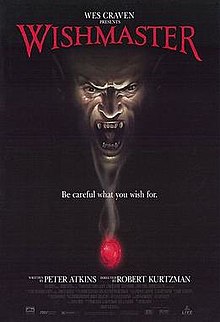
Horror Film Review: Wishmaster (dir by Robert Kurtzman)


Do you all remember Wishmaster?

Played by Andrew Divoff, the Wishmaster was a genie (or a djinn) who made his film debut in the 1997 film of the same name. The Djinn’s schtick is to randomly approach people and say something like, “Would you like to be rich?” or “Would you like all of your enemies to suffer?” He grants wishes but he does so in ironic ways. So, if you say want to be rich, you might very well turn into someone named Rich who is on the verge of getting hit by a bus. If you say that you want to escape from your mundane life, you might end up in a straight-jacket under water, struggling to perform one of Harry Houdini’s signature escapes.

I rewatched Wishmaster a few months ago and what I immediately discovered was the the Djinn wasn’t really that good at his job. He pretended to be clever in the way that he would fool humans but, honestly, it often seemed less like he was tricking people and more like he really wasn’t playing fair. Take the security guard who made the mistake of wishing for an escape. As I just mentioned, The Djinn immediately put him underwater in a straight-jacket. But the guard’s wish was not to have to escape. The guard’s wish was to simply escape. So, putting him in a life-and-death situation and telling him to figure it out for himself wasn’t fulfilling the guard’s wish. It just seemed like the Djinn wanted to drown someone and he decided to use his wish-granting job as an excuse.

The guard, by the way, was played by Tony Todd, one of the many horror icons who appeared in small roles in Wishmaster. (Today, Tony Todd is best known for the Final Destination films but, when Wishmaster came out, he was known for playing the Candyman.) Among the other cameos:

From Phantasm, Angus Scrimm provided the narration while Reggie Bannister played an unlucky pharmacist.

From Friday the 13th, Kane Hodder played a security guard who made the mistake of saying that he wished he could see the Djinn try to walk straight through him.

Day of the Dead’s Joseph Pilato played a crane operator.

John Carpenter vet George “Buck” Flower played an angry homeless man.

Sam Raimi’s brother, Ted Raimi, showed up long enough to get crushed by a crate.

And finally, Robert Englund played the somewhat pretentious professor who was responsible for bringing the Djinn to America in the first place.

As you can probably guess by looking at all of the cameos, Wishmaster is not a film that’s meant to be taken seriously. It’s often deliberately campy. Wes Craven may have produced it and was undoubtedly responsible for recruiting many of the actors who appeared in it but the film’s direction was handled by special effects maestro, Robert Kurtzman and he puts more emphasis on the visual effects than on any sort of serious exploration of the somewhat random series of events that make up the film’s storyline. Of course, when seen today, the film’s special effects look a bit cheap but, for many viewers (like me!), that’s actually a part of the film’s grisly charm.

Wishmaster does have a plot but it’s not particularly important. The Djinn tries to make Alexandra (Tammy Lauren) make three wishes so that he can unleash the forces of Hell. Why he spends all of his time granting wishes to other people instead of just concentrating on Alex is never really explained. It may be an often dumb movie but it’s also undeniably entertaining when taken on its own terms. Andrew Divoff is enjoyably sinister as the Djinn, playing the character with a sarcastic wit to go along with his evil schemes. It’s a fun movie to watch, even if it does feel like it was basically slapped together in a handful of days.

You should always be careful what you wish for but Wishmaster is still an entertaining piece of 90s horror.

(Author’s Note: Wow, this is embarrassing.  Right after I posted this review, I discovered that I previously reviewed Wishmaster in 2018!  Whoops!  Well, it’s nice to see that my thoughts on the film have remained consistent. — LMB)

A Blast From The Past: The Procrastinator (dir by Herk Havey)


Goddammit, Jean let everyone down again!

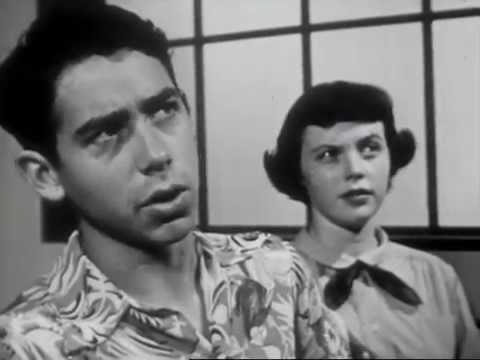
Jean is at the center of The Procrastinator, a short educational film from 1952.  Jean has a history of putting stuff off and letting down her friends, her parents, her peers, and probably the entire state of Kansas as well.  Still, despite the fact that Jean has repeatedly shown that she can’t be trusted with any responsibility, her fellow students decide to give her some responsibility.  When Jean continues to procrastinate, they all get mad at her but you know what?  Is it really Jean’s fault that they gave her a job that she obviously couldn’t handle?

What I’m saying is stop being so judgmental!  Everyone has their own way.  Some people get things done early.  Some people wait until the last minute.  And then there are people like me who make plans to do everything early but who still end up waiting until the last second regardless.  For example, my original plan for this year was to write all of my Horrorthon reviews in May and June and then spend October in a state of blissful relaxation.  Needless to say, that didn’t happen.  But, to be honest, I kind of enjoy the pressure of having to get things done at the last minute.  I do my best work under pressure, I think.

Now, if you’re wondering why I’m sharing this video in October, it’s because this film was directed by Herk Harvey.  Harvey made a career out of directing short educational films but, to horror audiences, he’s best known for directing a classic horror film called Carnival of Souls.  Carnival of Souls is a film that I’ll be sharing in a few days.  On the surface, The Procrastinator may not appear to have much in common with Carnival of Souls.  However, I think you can compare Jean’s refusal to do things in a timely fashion to Candace Hilligoss’s refusal to accept the reason for why she keeps seeing ghosts following her everywhere she goes.  So, in way, both of these films take place in the same universe.  Call it the Herkiverse.

Watch and decide for yourself!

Lisa Marie’s Grindhouse Trailers: 6 Trailers For The Fourth Tuesday In October


Halloween City by Karl Pfieffer

Since today is Pumpkin Day (yes, they get their own day!), it only makes sense that today’s edition of Lisa Marie’s Favorite Grindhouse trailers should feature just that!

Without further ado, here are today’s pumpkin-centered trailers!  Happy Pumpkin Day, everyone!

  1. Pumpkinhead (1988)

Hey, I reviewed this movie earlier this month!  The monster’s impressive, though I wish his head was a bit more pumpkin-like.  This movie gave Lance Henriksen a rare starring role and we will always be thankful.  Lance is the best!

2. Pumpkinhead II (1994)

Eventually, Pumpkinhead returned.  Consider this proof that you can’t keep a good pumpkin down.

3. Pumpkinhead 3 (2006)

After the first sequel, Pumpkinhead took a 12-year hiatus from appearing in the movies.  It’s rumored that he blew all of his money on cocaine and it was either make a third movie or go to jail for tax fraud.  For whatever reason, he eventually returned in yet another sequel.

4. Pumpkinhead 4 (2007)

To date, this has been the final Pumpinhead movie. Hopefully, Pumpkinhead is doing a better job managing his money and his lifestyle now and he won’t be forced to do a Pumpkinhead 5 just to pay the rent.

5. Pumpkins (2019)

Just when I was getting worried that I might have been too hasty when I decided to devote this edition of Lisa Marie’s Favorite Grindhouse Trailers to movies about pumpkins, I discovered that there literally is a movie called Pumpkins. And here’s the trailer!

6. Trick ‘r’ Treat (2009)

Hey, that kid is dressed like a pumpkin …. kind of. And there are pumpkins in the trailer so, a far as I’m concerned, close enough!

What do you think, Pumpkin Trailer Kitty?

Horror On The Lens: House On Haunted Hill (dir by William Castle)


The original The House on Haunted Hill is a classic and one that we make it a point to share every Halloween.  And since October is nearly over, now seems like the perfect time to do so!

Be sure to check out Gary’s review by clicking here!

Enjoy Vincent Price at his best!

The TSL’s Grindhouse: Mulberry Street (dir by Jim Mickle)


Rats are the freaking worst, aren’t they?

Seriously, I can see the good in almost all of the creatures of the world but I hate rats and I hate cockroaches and I hate both of them for the exact same reason. They’re just so dirty! I mean, they are two of the filthiest animals on the planet. Look up the source of any plague that nearly wiped out humanity in the pre-modern era and rats are somehow going to be to blame. I’m very proud to say that there has never been a single rat or a mouse in any home in which I’ve ever lived. (When I was in college, however, I did once see a mouse running from classroom to classroom. Consider that. I keep my home cleaner than the average college.)

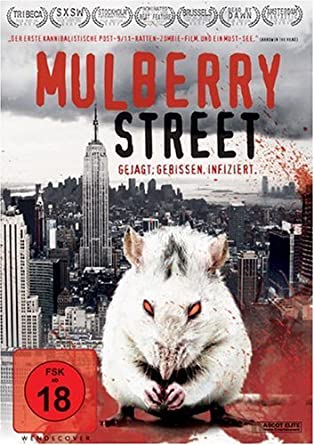
Mulberry Street is a horror film from 2006 that gives us an entirely new reason to dislike rats. Not only do they spread the Bubonic Plague but they also turn people into human/rat/zombie hybrids! At least, that’s what happens in this film. Set in New York City during one very long and very hot summer day, Mulberry Street imagines a world in which the rats get tired of hiding in the subways and they finally take over Manhattan. People are bitten. People are transformed into humanoid rats. People go crazy and attempt to infect other people. It get wild out there. They say you can see anything in New York and apparently, you can. Unfortunately, the cost of seeing is turning into a rat. That kind of sucks.

Casey (Kim Blair) has just returned from serving her country in Iraq and she would rather not be turned into a rat. Her father, Clutch (Nick Damici), is an ex-boxer and he would also rather not turn into a rat. In a world dominated by rats, what are the ratphobic to do? Clutch, Casey, and a handful of others barricade themselves inside their apartments and they try to survive the night while the rats scratch at the door.

Yes, Mulberry Street is yet another zombie film. I mean, they may be rat hybrids as opposed to being the undead but, in the end, they might as well be a zombies. However, Mulberry Street works better than the average zombie film because it was shot guerilla-style on the streets of New York City. There’s a raw authenticity to Mulberry Street, with its jittery camerawork and it’s cast of talented but unknown actors. The threat feels real. The struggle to survive feels real. The fears feels real. At no point are you confident that Casey, Clutch , and their friends are going to survive the night. Mulberry Street feels as real as any film featuring human/rat hybrids can. Even before the rats attack, Mulberry Street presents us with a New York that feels sick and dying. In the end, the rats are just the next logical step. The city has devolved to such an extent that an attack of zombie rats feels predestined.

Mulberry Street was well-directed by Jim Mickle. Mickle would go on to direct Cold in July, one of the best modern noirs to be released over the past few years. Be sure to check out both films.

Horror Scenes That I Love: The Final Scene of The Birds


From 1963’s The Birds and directed by Alfred Hitchcock, this is one of the best horror endings ever.

The birds have won. Or, at least they have until Birdemic….

Horror Book Review: Killer’s Kiss by R.L. Stine


R.L. Stine’s 1997 YA novel, Killer’s Kiss, tells the story of Karina and Delia.

Karina and Delia have always been rivals.  If one gets a good grade, the other has to get a better grade.  If there’s a competition for a prestigious prize, you can bet that Karina and Delia will be at the center of it.  You can’t be friends with Karina if you’re going to be friends with Delia, that’s just a given.  And, since this is an R.L. Stine book, Karina and Delia are especially competitive when it comes to boys!

That’s where Vincent comes in.  When the book open, Vincent is making out with Delia and Delia mentions how happy she is that Vincent chose her over Karina.  Well, it turns out that Vincent is either totally wishy washy or just has a bad sense of humor because guess what?  He didn’t chose Delia over Karina.  Instead, he chose both of them!  Vincent is secretly seeing both girls but you know how it is on Fear Street.  You can’t keep a secret for long.

Soon, Delia and Karina are competing for more than the Conklin Award (which is one of those weird high school prizes that always end up leading to murderous drama on Fear Street).  They’re competing for Vincent, who really doesn’t seem like he deserves all the attention but again, it’s an R.L. Stine book.  When Vincent turns up dead, it not only means that prom night is going to have to be replanned.  It also means that either Delia or Karina is the murderer!  Karina accuses Delia!  Delia accuses Karina!  Who is the guilty party!?

As you may have guessed from my strained attempts to fake some enthusiasm while discussing the plot of this novel, Killer’s Kiss is not one of the better Fear Street entires.  Basically, it’s a book about two rivals competing for the chance to date a complete jerk.  It’s hard to get emotionally involved in something like that.  Beyond that, the whole rivalry between Delia and Karina just feels exaggerated and fake.  They’re both kind of annoying.  I wouldn’t want to know either one of them.  Finally, the mystery itself is pretty easy to figure out.  The novel does end with a bit of deus ex machina that simply has to be read to believed but, otherwise, this is lesser Stine.

Book Review: The Complete Jack The Ripper: A to Z by Paul Begg, Martin Fido, and Keith Skinner


We will never actually know who Jack the Ripper actually was.

People will always be offering up theories, of course.  His crimes were so terrible and his nickname was so memorable and the fact that he was never caught is, to modern audiences spoiled by true crime shows and detective movies, so improbable that there’s a tendency to assume that Jack the Ripper must have been someone significant in his everyday life.  Everyone from Queen Victoria’s son to Lewis Carroll to Oscar Wilde has been accused over the years.

My personal theory is that Jack the Ripper was a nobody.  He didn’t have any medical training.  He wasn’t a part of a grand conspiracy.  He had no motive beyond his own hatred of women.  He stalked prostitutes because they were easy targets.  His murders were savage because he was a sadist who wanted to show off the power that he felt he had over his victims.  He got away with his crimes not because he was clever or protected but just because, in 1888, the police had no experience with a serial killer like Jack the Ripper.  In all probability, the killer was some anonymous loser, one of the many strange and angry men who could probably be spotted in Whitechapel on any foggy night.  

Unfortunately, after more than a 130 years of mystery, no one wants to admit that Jack the Ripper was probably some guy that no one’s ever heard of.  There’s a tendency to assume that he had to be someone important or, at the very least, someone who was at least mentioned in a handful of books about the Whitechapel murders.  Sadly, far too many people are under the impression that Patricia Cornwell solved the case in 2002.  In Portrait of a Killer, Cornwell accused the painter Walter Sickert of being the murderer.  Her main argument consisted of an inconclusive DNA test and an apparent inability to appreciate Victorian-era art.  Cornwell didn’t care much for Sickert’s paintings and therefore, Sickert had to be history’s most notorious murderer.  It’s a bit silly but a lot of people bought into it because it was Patricia Cornwell making the accusation.

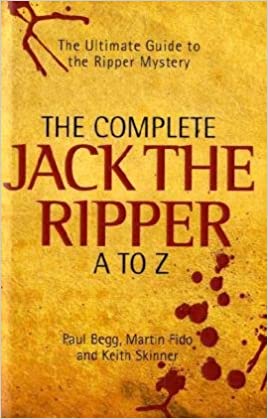
To those people who insist that the murderer had to be a Victorian celebrity, I would point them to The Complete Jack the Ripper: A to Z.  Published in 2010, this book is the definitive guide to the Ripper murders.  It contains entries for every suspect, every victim, every policeman, every clue, and every theory.  There’s a lot of information to be found in this book.  In fact, there’s so much information that it’s easy to see how the actual killer could slip through the cracks and, unseen by the overwhelmed and underprepared legal authorities, disappear into the dark shadows of history.  Along with presenting a clear-eyed and nonbiased look at the suspects and the theories, the book is also to be commended for what it tells us about Jack the Ripper’s victims, who are too often forgotten when it comes to discussing the crimes.  So much time is spent on Jack’s identity that the women he murdered are often pushed to the side.  This book does not make that mistake.

This is the definitive book on Jack the Ripper, whoever he may have been.

International Horror Review: The Mark of the Wolfman (dir by Enrique López Eguiluz)


The 1968 Spanish film, The Mark of the Wolfman, is a strange one.

Just try to keep this straight:

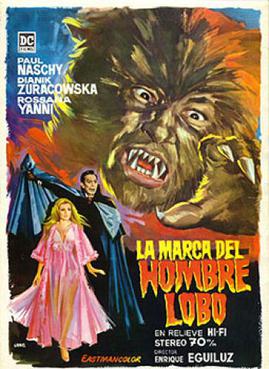
In Eastern Europe, two gypsies accidentally bring back to life a feared werewolf named Imre Wolfstein.  (Beware any supernatural creature who has an ironic name.)  Wolfstein proceeds to terrorize the countryside, attacking both the good and the bad alike.  He also finds the time to attack a Polish nobleman named Waldemer Danisky (Paul Naschy).  Danisky survives the attack but now he’s a werewolf!  Unlike Wolfstein, Danisky is not happy about being a werewolf, especially when he discovers that he’s been killing innocent people while transformed.  So, Danisky decides to go to a local scientist named Dr. Janos Mikhelov (Julian Ugarte).  Unfortunately, it turns out that Dr. Mikhelov is a vampire and so is his wife!  They’ve got special plans for both of the werewolves!

The Mark of the Wolfman was the first of many films in which Naschy would play Count Danisky.  They were extremely popular in Europe and Paul Naschy became a big star in Spain.  In fact, he was sometimes called the Spanish Lon Chaney and given that Naschy often talked about how The Wolf Man (starring Lon Chaney, Jr.) was one of his favorite films when he was a child, that undoubtedly brought him a lot of pleasure.  And indeed, Naschy’s performance as Danisky did owe a bit to Lon Chaney Jr’s performance as Larry Talbot.  They’re both tortured souls, desperately seeking an escape from their curse and continually being brought back to life against their will.  The main difference between the two was that Danisky never got quite as whiny as Talbot.  Whereas Lon Chaney Jr. played Larry Talbot as being just a big dumb lug, Naschy played Danisky as being a far more aggressive character.  Danisky wasn’t just depressed over being a werewolf.  He was pissed off about it.

The plot of Mark of the Wolfman may sound complicated but, by the standards of Naschy’s other films, it’s actually rather straight-forward and uncomplicated.  Of course, it can be difficult for an American to judge Naschy’s films because many of them were never released here in the United States and those that were can usually only be found in poorly dubbed and crudely edited versions.  For instance, Mark of the Wolfman was released in the United States as Frankenstein’s Bloody Terror, despite the fact that neither Frankenstein nor his monster were anywhere to be found in the original film.  However, the distributors needed a film to go on a double bill with another Frankenstein movie.  To justify the title change, narration was added to the start of the film that established that Wolfstein was a descendant of Frankenstein.  Apparently, the price for playing God was to be cursed with lycanthropy.  It’s actually kind of charming in a drive-in sort of way.

Even if you know nothing about the subsequent career of Paul Naschy or the many sequels that followed this film, The Mark of the Wolfman holds up well as an entertaining horror film.  It’s only 88 minutes long and it manages to pack drunken gypsies, tortured werewolves, devious vampires, and a dungeon into its brief running time.  As a result, it’s never boring. Visually, the film is a treat, with the camera swiftly moving across the wilderness or tracking through gothic castles.  (Mark of the Wolfman was originally filmed in 3D and, watching the film, I found myself thinking that it probably looked pretty damn impressive to audiences in 1968.)  Because the version that I saw was badly dubbed into English, it wasn’t always easy to judge the performances but Naschy played Danisky with a properly haunted look.

The Mark of the Wolfman is an enjoyable work of Spanish horror, one that undoubtedly helped to revitalize Spanish horror just as assuredly at the Blind Dead and Jess Franco.