The TSL’s Grindhouse: Terrifier (dir by Damien Leone)


Are you scared of clowns?

I’ve never really had much of a problem with clowns, beyond the fact that some of them really do need to learn how apply lipstick without getting it all over their face. That said, two years ago, I watched the 2016 horror film, Terrifier, on Netflix and I now totally understand why some of my friends are totally terrified of the grinning men in the white makeup. I mean, I will send a Pennywise GIF to my clownphobic friends without even worrying about what damage I may or may not be doing to their mental well-being but I can guarantee you right now that I will never send any of them a picture of Art the Clown.
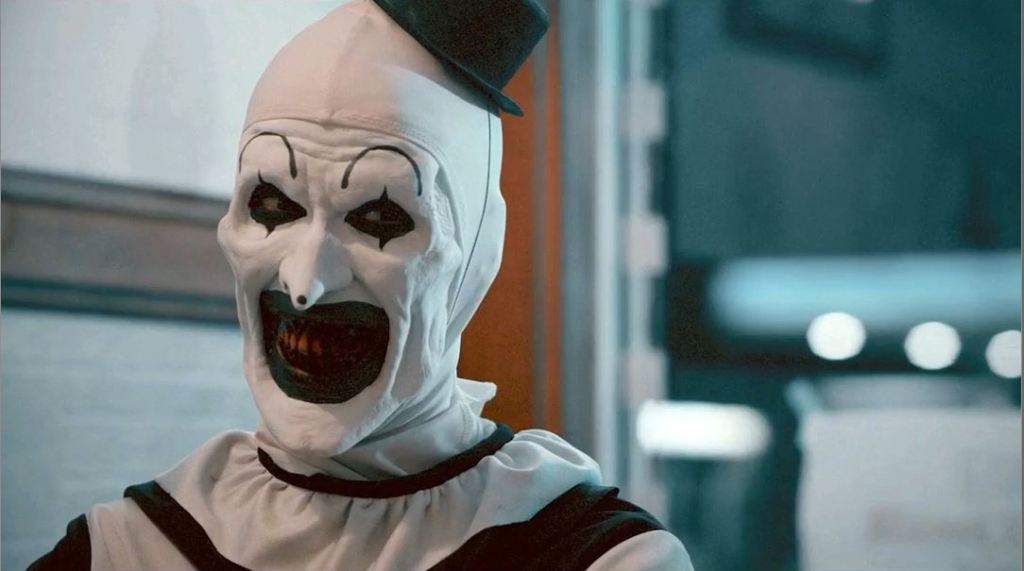
Art the Clown

Art (who is played by David Howard Thornton) is the clown at the center of Terrifier and, as you can tell from looking at the picture above, he’s not exactly a clown that you want to meet in the middle of the night. Unfortunately, over the course of the film, several innocent people do just that. There’s the homeless woman who meets him in an abandoned building. There’s the two drunk girls who, after leaving a Halloween party, make the mistake of laughing at Art. There’s the owner of the pizzeria who makes the mistake of kicking Art out of his establishment. Art, it turns out, doesn’t deal well with rejection. It also turns out that Art can turn just about anything into a deadly weapon. (We also later learn that Art just happens to have a chainsaw. Agck!)

Art doesn’t speak. We never learn where Art came from and why he insists on killing everyone that he meets. This lack of motivation makes Art a very scary clown indeed. We can only assume that he kills because he’s evil and, being a creature of pure evil, there’s really no way to reason with him or to rationalize his actions. Art is pure chaos released into the world and, as a result, he’s terrifying. If nothing else, Terrifier is a film that lives up to its name.

Director Damien Leone made Terrifier with a budget of a $100,000 and he uses that low budget to his advantage. The deserted building where Art stalks the majority of his victims is a genuinely atmospheric location and, even if they were done cheaply, the gore effects are disturbingly nightmarish. Fortunately, Leone gets some good performances from his cast, which makes the film all the more frightening. David Howard Thornton has enough presence to make Art the Clown intimidating, even when he’s just standing still and staring at nothing. As the film’s “final girl,” Samantha Scaffidi gives a likable and relatable performance. Wisely, the film neither turns her into a super warrior nor a simpering fool. Instead, she’s just a normal person trying to survive the night, much like those of us watching the film in what we hope is the safety of our own home.

Terrifier is an effectively scary little slasher film. It’s not for everyone, of course. It’s a film for horror fans and it has little interest in reaching out to people who don’t normally enjoy the genre. The violence is brutal and the film doesn’t shy away from gore. Those of you who easily fall prey to nightmares may want to stay away. As for those of you who are scared of clowns …. well, Terrifier will prove the correctness of your phobia. Seriously, if clowns scare you, don’t watch this movie. It’ll be safer for you just to watch It again….

Book Review: Night of the Living Dead by John A. Russo


A few years ago, I found a slightly beat-up copy of John Russo’s novelization of Night of the Living Dead at Half-Price Books. Of course, I immediately purchased it. From my own knowledge of the making of George Romero’s classic horror movie, I knew that John Russo was the one who came up with an idea involving zombies which led to Romero writing a story outline for Night of the Living Dead which Russo then turned into the film’s screenplay.

I also knew that Romero and Russo had a falling out of sorts after the success of Night of the Living Dead. With the film in the public domain as the result of a screw-up on the part of the movie’s distributor, there was some controversy over who had the rights to the original’s story. That’s one reason why the titles of Romero’s subsequent zombie films (i.e., Dawn of the Dead, Day of the Dead, Land of the Dead, and the rest) were all about “the Dead” as opposed to “the Living Dead.” Russo’s subsequent zombie-themed work (i.e. Return of the Living Dead) featured the term “Living Dead” and was also sold as a sequel to the original Night of the Living Dead.

With all that in mind, I was curious to see what Russo’s novelization would be like. What extra information would the book contain about the characters? Would there be any extra details that were cut from the film? How about an alternate ending? It’s been known to happen. (Check out the novelization for Halloween if you want to see how much a novelization can differ from the film that inspired it.)

Well, it turns out that novelization of Night of the Living Dead is pretty much a straight recreation of the film. We do learn a bit more about just how bad a relationship Barbara has with her brother Johnny. And it’s firmly established that Ben was a truck driver before the dead came back to life. Otherwise, it’s pretty much just the movie in novel form. We don’t learn much about the characters that we didn’t already know. Harry is still stubborn and cowardly. Ben is still the designated hero who manages to get everyone killed through his own stubbornness. Barbara is still catatonic for most of the book. (I know some would complain about Barbara being so passive but her stunned disbelief is perhaps the most realistic part of the film and the novel. That’s how most of us would react to going through what she’s just been through.) Russo is a good writer and he does a good job capturing the tension in that little house. The final few chapters — which recreate the film’s downbeat ending — are particularly well-done. But there’s not much in the book that isn’t also in the movie.

One interesting thing about the novelization is that it was originally published in 1974, six years after the release of Night of the Living Dead. Was it written in an attempt to help establish that Russo and/or Romero owned the rights to the film? Or did it just take the publisher that long to realize that they’re might be a market for a novel based on the film? Who knows?

The book doesn’t add much to the overall story but I’m still glad I’ve got a copy, You can never have enough Night of the Living Dead memorabilia.

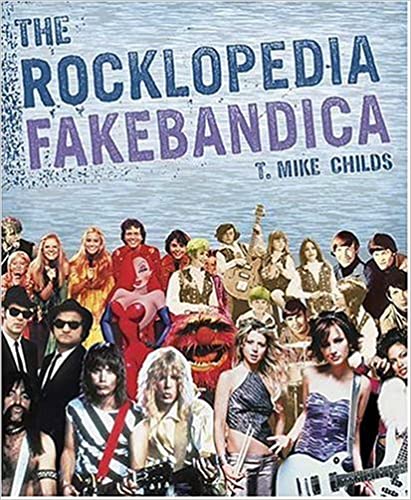
Book Review: The Rocklopedia Fakebandica by T. Mike Childs


Have you ever asked yourself, “Who was the imaginary band that sang that song that doesn’t actually exist in that fictional movie that I watched back in 2004?”

Well, fear not! The Rocklopedia Fakebandica can answer all of your fake band questions. This is a reference books that is solely devoted to fictional bands from the movies and from television. It may not be complete (because it was published 2004 and I don’t there’s ever been an updated edition) but it’s still pretty damn entertaining. California Dreams? They’re in here. Zack Attack? They get an entry. Of course, Rex Manning gets a mention but so does Berko, the musician who encouraged Gina to sing her heart out on the roof of Empire Records! Stillwater, the band from Almost Famous and not the recent Matt Damon film, is represented, along with a listing of the bands that the members were in before coming together. Spinal Tap gets an entry, of course. So does 4Skore, the boy band that Hank Hill thought was “kind of like Doo Wop” on King of the Hill.

It’s a fun book, written in an enjoyably sarcastic manner. Most fake bands aren’t that good and T. Mike Childs has no fear of calling them out. Take that, Zack Attack!

Incidentally, this one of the many books in my collection that I originally found at Recycled Books of Denton, Texas. Be sure to support your used bookstores. This not a book that I would have found if I was just searching on Amazon. This is a book that I found because I went down to a used bookstore and I walked up and down the aisles, seeing what they had available. I saw it, I was intrigued by the title, I pulled it off shelf, I smiled as I skimmed through it, and I bought it and, in the years since, it’s provided me with a lot of entertainment. Support physical media. Support book stores. You’ll miss them if you don’t.

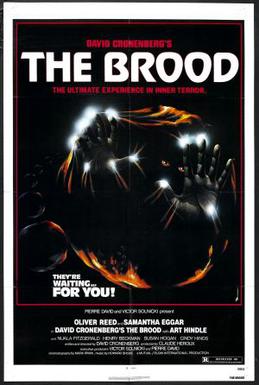
International Horror Film Review: The Brood (dir by David Cronenberg)


O Canada!
Our home and native land!
True patriot love in all of us command.
With glowing hearts we see thee rise,
The True North strong and free!
From far and wide,
O Canada, we stand on guard for thee.
God keep our land glorious and free!
O Canada, we stand on guard for thee.

Canada!  It always seems like such a nice country until you watch a David Cronenberg film.  Hailing from Toronto, Cronenberg started his film career with two satirical, black-and-white science fiction shorts and then went on to become one of Canada’s best-known filmmakers.  At a time when most people associated Canada with politeness and maple syrup, Cronenberg made visceral and often-disturbing films, ones that often mixed sexuality with graphic body horror.  At a time when the genre was being dominated by Italian filmmakers, Cronenberg brought a uniquely Canadian sensibility to horror.

Take 1979’s The Brood, for instance.

The Brood tells the story of one very doomed marriage.  Frank (Art Hindle) and Nola (Samantha Eggar) Carveth are fighting for custody of their five year-old daughter, Candice (Cindy Hinds).  (Not coincidentally, Cronenberg was going through his own custody battle when he first came up with the idea for The Brood.)  Nola, who has been emotionally scarred by both her alcoholic parents and her troubled marriage to Frank, is a patient at Somafree Institute.  Her psychotherapist, Dr. Hal Raglan (Oliver Reed), practices a technique called “psychoplasmics.”  Though it’s not easy to describe (and, wisely, Cronenberg doesn’t spend too much time trying to justify the science of it), it basically involves channeling anger and suppressed emotions into body modification.  What you or I might consider to be a hive or a welt is what Dr. Raglan would call a major breakthrough.

Frank is skeptical about Dr. Raglan’s theories but he still takes Candice to visit her mom.  However, when Candice returns from one visit bruised and scratched, Frank is convinced that Nola has been abusing her.  Hoping to both win custody of Candice and prove that Dr. Raglan’s methods are dangerous, Frank starts his own investigation into just what exactly has been happening at the Somafree Institute.

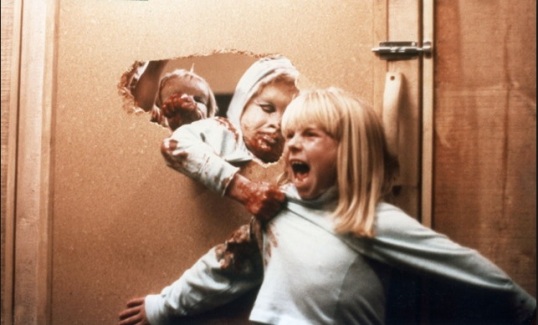
That’s when the children start to show up.  The children are small, with pale skin and light hair and oddly featureless faces.  They never smile.  They never speak.  They show up without any warning and violence always seems to follow them.  They attack both Nola’s mother and father.  When Nola suspects that Frank might be having an affair with Candice’s teacher, two of the children suddenly appear in her classroom.  Candice is scared of the children but still seems to have some sort of connection to them…

Even if you didn’t know this was a Cronenberg film, it would take just one look at the snow-covered landscape to identify The Brood as being a Canadian film.  As was often the case with Cronenberg’s early horror films, the imagery is frequently cold and chilly.  However, The Brood is not a cold film.  With its look at dysfunctional families and its emphasis on Frank’s attempts to protect his daughter, The Brood is actually one of Cronenberg’s most emotional films.  It’s a film about not only anger but also how people deal with that anger.  The killer kids are both literally and metaphorically children of rage.

Even by the standards of Cronenberg, things get grotesque.  Fortunately, the film’s talented cast keeps you interested, even when the bloody visuals might make you want to find a nice comedy to watch instead.  Art Hindle and Cindy Hinds are sympathetic as the father and daughter.  Oliver Reed keeps you guessing as to what exactly Dr. Raglan is actually trying to accomplish.  Nicholas Campbell and Robert A. Silverman, two members of the Cronenberg stock company, both make an impression in smallish roles.  And Samantha Eggar totally throws herself into her role, turning Nola into an absolutely terrifying monster.

Though it never quite reaches the flamboyant heights of either Scanners or ShiversThe Brood is still an effective horror film.  As opposed to some of his other films of the period, Cronenberg actually seems to not only care about the characters in the film but it also comfortable with encouraging us to care about them as well.  As a result, The Brood becomes about more than just trying to shock the audience.  The Brood is a film that sticks with you.

The Brood (1979, dir by David Cronenberg DP: Mark Irwin)

A Blast From The Past: Shake Hands With Danger (dir by Herk Harvey)


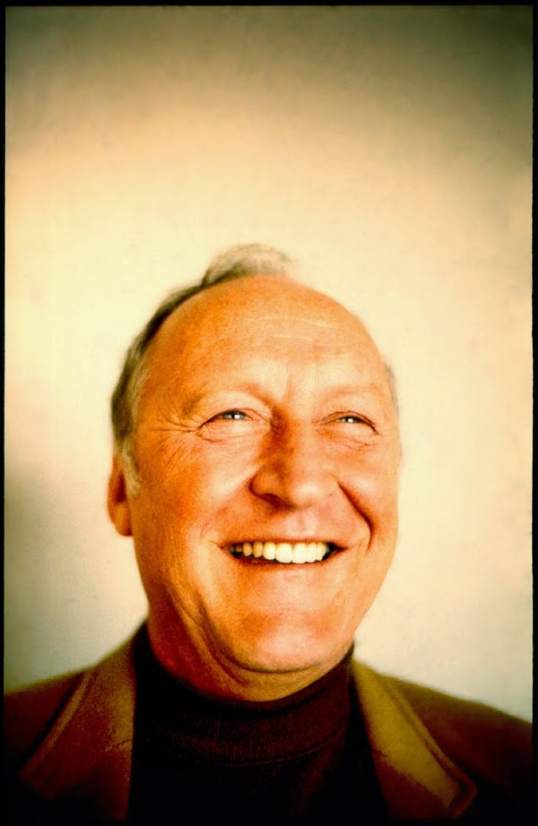
Director Herk Harvey

Since I’m going to be sharing Herk Harvey’s Carnival of Souls on Saturday, I’ve been preparing by showing some of the short films that Harvey directed before and after making his only feature. 1980’s Shake Hands With Danger was actually one of Harvey’s final films and, needless to say, it came out long after Carnival of Souls.

This short film is all about being safe while working with heavy machinery. If Candace Hilligoss had shown more caution, she wouldn’t have had to shake hands with danger in Carnival of Souls. See, it’s all connected! Welcome to the Herkiverse.

Here’s the film. Watch and learn:

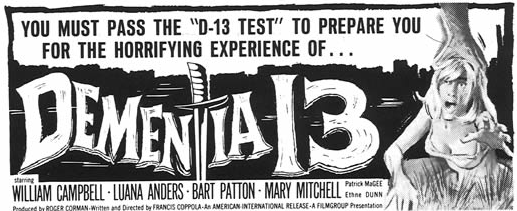
Horror Film Review: Dementia 13 (dir by Francis Ford Coppola)


So, imagine that the year is 1963 and you are the legendary producer/director Roger Corman. You’ve just finished shooting your latest film and it turns out that you didn’t spend all of the money that you had allocated to make it! You’ve got an Irish castle at your disposal and some extra cash. Why not assign your ambitious assistant to make a quick little movie that’s specifically designed to cash-in on the success of Psycho and it’s numerous imitators?

And that, of course, is how Francis Ford Coppola came to direct his first film. Today, of course, Coppola is best known for directing three of the best American films of all time, The Godfather, The Conversation, and The Godfather Part II. (Some people would include Apocalypse Now in that list, as well.) In 1963, he was just another aspiring filmmaker making his debut under the watchful eye of Roger Corman.

Coppola both wrote and directed Dementia 13. The film’s a pretty nifty little horror/mystery. Of course, the plot doesn’t make much sense if you give it too much thought but any fan of the Roger Corman-style of film making should be used to that by now.

Luana Anders plays Louise Haloran, the film’s greedy femme fatale. When we first meet her, she’s calmly watching her husband drop dead of a heart attack. After learning that she’s not going to be receiving any sort of inheritance because her husband died before his mother, Louise decides to invite herself to the Haloran family castle, where her mother-in-law, Lady Haloran (Eithne Dunne), is about to take part in an annual ceremony that is meant to pay tribute to Haloran’s dead daughter, Kathleen. Looking for a way to try to trick Lady Haloran into making Louise her heir, Louise tries to fool Lady Haloran into believing that Kathleen is trying to contact her from beyond the grave.

Got all that? Because I’m not going to try to type it out again.

Anyway, I don’t want to spoil the rest of the plot but let’s just say that it all leads to a midnight swim and a shocking axe murder. Who could be the killer be? Could it be one of Louise’s two brother-in-laws, Richard (William Campell) and Billy (Bart Patton)? Could it be the local doctor, Justin Caleb (Patrick Magee?) Or how about Richard’s fiancee, the oddly named Kane (Mary Mitchell?” Or how about Simon (Karl Schnazer), the local poacher? Or maybe Kathleen really has risen from the dead? Or how about….

Well, look, it could be a lot of people. Dementia 13 has a labyrinth plot and it’s got a few twists that you probably shouldn’t spend too much time thinking about. It’s very much a young director’s film but, at the same time, that’s also the film’s greatest strength. Coppola reportedly got in trouble when the film went overbudget (which is something that had never previously happened on a Corman film) but the end result is a film that features several spooky visuals, an ominous atmosphere, and one very shocking murder. You wouldn’t necessarily watch a film like Dementia 13 and think that the director would go on to make something as great as The Godfather. But Coppola’s talent, even if it’s a bit unformed, is still very much noticeable while watching his directorial debut.

Speaking of watching the film, it’s in the public domain so it’s very easy to watch! Pick up a Mill Creek 50-DVD box set and there’s a good chance you’ll find Dementia 13 included within. Or, you can just go over to YouTube and watch it for free!

Enjoy!

Horror On The Lens: Gammera The Invincible (dir by Noriaki Yuasu and Sandy Howard)


Okay, I’ll be the first to admit that 1966’s Gammera The Invincible is not really a horror film.  Maybe there was a time when people found the idea of a giant, fire-breathing turtle to be scary but I kind of doubt it.

But let’s think about this!  What better time is there to watch a movie about giant, fire-breathing turtle than in October?

Seriously, this is a fun movie and if you’ve got some time to kill this morning, I guarantee this movie will make you smile.

As I wrote in my 2014 review of this film, Gammera is one hell of a turtle.

Enjoy!

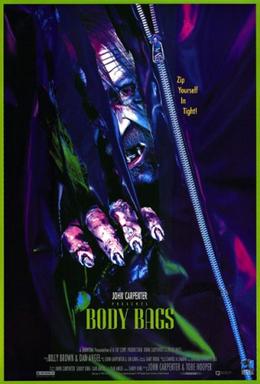
The TSL’s Grindhouse: Body Bags (dir by John Carpenter and Tobe Hooper)


An odd but mildly likable film, that’s the best description of Body Bags.

Originally, Body Bags wasn’t even meant to be a film.  Instead, in 1993, Showtime wanted to do a horror anthology show, one that would mix comedy and chills in the style of HBO’s Tales From The Crypt.  Three episodes were filmed.  Two were directed by John Carpenter.  The other was directed by Tobe Hooper.  Robert Carradine, Stacy Keach, and Mark Hamill all agreed to appear on the show.  That’s an impressive collection of talent but, for whatever reason, Showtime decided not to pursue Body Bags as a series.  So the three episodes were strung together in an anthology film.  Linking the stories was a warp-around segment where Carpenter played a coroner and Tobe Hooper and Tom Arnold played morgue attendants!

Now, it must be said that John Carpenter probably made the right decision when he decided to become a director instead of an actor.  That said, what Carpenter lacked in acting technique, he made up for with unbridled enthusiasm.  Carpenter appears to be having a blast playing an old style horror host.  Who can blame him?  In fact, I would say one the most appealing things about John Carpenter as a personality is that he always seems to be truly enjoying himself, regardless of all the crap that he’s had to put up with in Hollywood.

As for the segments …. well, they’re uneven.  That’s not really a shock. Part of the problem is that, because they weren’t originally envisioned as all airing together, a lot of ideas and story points are repeated from segment to segment.  The first segment is about a serial killer.  The second segment is about a transplant.  The third segment is about both a transplant and a serial killer.  It gets a bit repetitive.

Carpenter directed the first two segments, The Gas Station and HairThe Gas Station is a bit too simple for its own good.  Robert Carradine is a serial killer who harasses a woman at a gas station.  That’s pretty much it.  Carradine gives a good performance ad Halloween fans will get a laugh out of a reference to Haddonfield but there’s not much else going on.  Hair is a bit better.  Stacy Keach plays a businessman who gets a hair transplant, just to discover that the hair is extraterrestrial in origin.  Hair is clever and playful, like an above average episode of The Twilight Zone.  Keach plays his role with the right mix of comedic outrage and genuine horror.

The third segment is called Eyes and it was directed by Tobe Hooper.  Mark Hamill plays a baseball player who is losing his eyesight as the result of a car accident.  He gets an eye transplant.  At first, everything seems fine but soon, he’s having visions of himself murdering people!  It turns out that the eye once belonged to a serial killer.  You can guess where this is going but Mark Hamill really throws himself into the role and Tobe Hooper’s direction is appropriately intense.

Body Bags is a pretty minor entry in the filmographies of two great directors but, at the same time, it’s enjoyable in its own silly way.  There’s a likable goofiness to John Carpenter’s wrap-around segment and it lets us know that we shouldn’t take any of this too seriously.  Watch it for your own amusement.

The Unnominated: Star 80 (dir by Bob Fosse)


Though the Academy of Motion Picture Arts and Sciences claim that the Oscars honor the best of the year, we all know that there are always worthy films and performances that end up getting overlooked.  Sometimes, it’s because the competition too fierce.  Sometimes, it’s because the film itself was too controversial.  Often, it’s just a case of a film’s quality not being fully recognized until years after its initial released.  This series of reviews takes a look at the films and performances that should have been nominated but were,for whatever reason, overlooked.  These are the Unnominated.

First released in 1983, Star 80 is an examination of fame, obsession, misogyny, and finally madness.  All four of those qualities are exemplified in the character of Paul Snider (Eric Roberts), a man with a charming smile, a ludicrous wardrobe, and the personality of a pimp.  When we first see Paul Snider, he’s naked and he’s covered in blood and he’s ranting about how the world is trying to destroy him.  Even if he wasn’t holding a rifle, he would be terrifying.  Suddenly, we flash back to a few years earlier.  Snider is being dangled out a window by two men.  Snider pathetically begs to be pulled back into the room.  The men laugh at him before pulling him up.  Snider, looking fairly ridiculous in a cheap suit that he probably thinks makes him look like a celebrity, fights off tears as he says he deserves to be treated with dignity.

Star 80 is based on a true story.  Mariel Hemingway plays Dorothy Stratten, the actress and Playboy playmate who was murdered by Paul Snider.  Snider, who often claimed credit for having “made” Dorothy, was married to her at the time, though Dorothy had filed for divorce and was dating director Peter Bogdanovich.  Unwilling to let her go and return to being a small-time hustler, Snider shot Dorothy and then himself.  Director Bob Fosse, who was best known for directing musicals like Cabaret and All That Jazz, was attracted to the story because he understood that type of world that produces sleazes like Paul Snider.  According to Eric Robets, Fosse even said that he probably would have ended up like Paul Snider if not for his talent.

Snider, the film quickly establishes, really doesn’t have any talent beyond the ability to manipulate people who are too naïve to see through his bullshit.  Snider wants to be a star.  He wants to be rich.  He wants people to kiss his ass.  When he meets Dorothy, he sees her as his ticket.  Dorothy’s mother (a poignant performance from Carroll Baker) sees straight through him from the start.  Tragically, Dorothy doesn’t realize the truth abut who he is until they’re already in Hollywood.  As Dorothy tries to break away from him, Paul desperately tries to find some sort of success, all the while complaining that the world is conspiring to keep him from being a man. 

Eric Roberts dominates the film and it’s one of the scariest performances that I’ve ever seen.  Roberts is convincing when he’s ranting and raving against the world that he feels is against him but what’s even more disturbing is that he’s convincing when he’s turning on the charm.  Paul Snider may not be smart.  Paul Snider may not be talented.  But he know how to gaslight.  He knows how to destroy someone’s fragile confidence, largely because his own confidence has been shattered so many times that he’s become an expert in exploiting insecurity.  Snider is a tacky dresser and nowhere near as smooth as he thinks but, intentionally or not, he uses that to his advantage.  He tries so hard to impress that it’s easy to see how someone could feel sorry for him and want to help him.  However, because Fosse lets us know from the start what Snider is really going on inside of Sinder’s head, we never make the mistake of trusting him.  We know who Paul Snider is because we’ve all known a Paul Snider.

Eric Roberts’s performance is so intense that it’s unfortunate but not surprising that it was overlooked at the 1983 Oscars.  He was playing a truly repellent character and he did it so convincingly that I imagine many viewers had a hard time realizing that Eric Roberts was not Paul Snider but was instead an actor playing a terrible character.  Some probably said, “Why should we honor such a loathsome character?” and again, the answer is because there are many Paul Sniders out there.  Roberts captured much more than just one man’s breakdown.  He captured a sickness at the heart of a fame-driven culture.

Of course, Paul Snider was not the only symptom of that sickness to be depicted in Star 80.  Every man that Dorothy either uses her in some way or just views her as being a commodity.  Hugh Hefner (Cliff Robertson) presents himself as being a fatherly mentor but Robertson plays him as being just as manipulative and ultimately narcissistic as Paul Snider.  Director Aram Nicholas (Roger Rees, playing a character based on Peter Bogdanovich) seems to love Dorothy but their relationship still feels out-of-balance.  Aram, afterall, is the director while Dorothy is the actress.  The private detective (Josh Mosel) that Paul hires to spy on Dorothy seems to have no lingering guilty over the role he played.  Even Snider’s roommate (David Clennon) is more interested in talking about his dog and his car then about the murder/suicide of two people with whom he lived.

It’s a dark film and not one to be watched when depressed.  At the same time, it’s a portrait of obsessiveness, misogyny, and an overwhelming need to be “someone” that still feels relevant today.  Along with Sweet Charity, it was the only Bob Fosse film not to be nominated for Best Picture.  (This was back when there were only five best picture nominees.  Three of the nominated films — Terms of Endearment, Tender Mercies, and The Right Stuff — hold up well.  Two of the nominees — The Dresser and The Big Chill — are a bit more iffy.)  Eric Roberts was not nominated for the best performance of his career.  Again, it’s a shame but not a surprise.  This was a dark and disturbing film, a true Hollywood horror story.  One imagines that most members of the Academy wanted to escape it far more than they wanted to honor and be reminded of it.

Previous entries in The Unnominated:

  1. Auto Focus 

Horror Scenes That I Love: The Ending of The Thing


Since I paid tribute to John Carpenter earlier today, it only seems appropriate that today’s horror scene that I love should come from one of his best films. The final scene of 1982’s The Thing is chilling, both literally and figuratively. Watch below but remember, it’s also a spoiler if you haven’t seen Carpenter’s film yet.