The Films of Dario Argento: Opera


It can be argued that 1987’s Opera is one of Dario Argento’s most personal films.

In the mid-80s, Argento was hired to direct an opera, in this case a production Giuseppe Verdi’s Macbeth.  Argento described the opportunity to direct an opera as being a case of one of his childhood dreams coming true.  Unfortunately, certain people were scandalized with the idea of hiring a director of violent horror films to direct the opera, even though Macbeth is one of the most horrific of Shakespeare’s plays.  I mean, if any story seems to be custom-made for a director who is known for his complex set pieces and his willingness to indulge in graphic imagery, it would seem to be Macbeth.  Despite this, the production was canceled and Argento was left feeling like an outsider in his own industry.

Along with his disappointment over the canceled production of Macbeth, Argento was also suffering on a personal level when he directed Opera because he had just separated from his long time partner and collaborator, Daria Nicolodi.  The two of them had a notoriously volitale relationship, one that led to some of Argento’s best films and reportedly some of his biggest on-set fights.  Despite the fact that they had split up, Argento still wrote a role for her in his latest film.  At first, Nicolodi refused the role but she changed her mind when Argento promised her the most spectacular death scene in the movie.  However, when it came time to shoot the scene, Nicolodi apparently grew paranoid that Argento was planning to kill her for real.  Fortunately, Nicolodi was incorrect about that and Argento was totally correct about her scene being one of the best in the film.
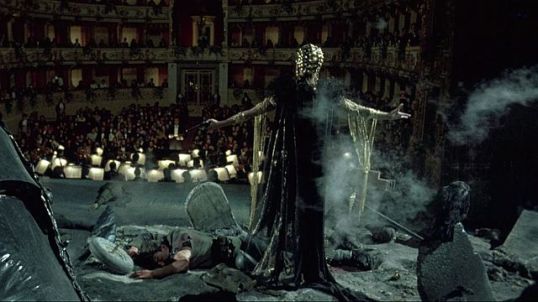
Opera takes place during a production of Macbeth, one that is directed by a controversial horror director named Marco (played by Ian Charleson, the star of the Oscar-winning Chariots of Fire).  When his star is injured in an auto accident, Marco is forced to cast the young understudy, Beth (Cristina Marsillach), as Lady Macbeth.  Despite the doubts of many, Betty gives a strong performance in the role.  She stuns the audience.  Perhaps the power of her performance is due to her own traumatic memories of her mother being murdered by a never captured assailant.

Speaking of murder, people around Betty start dying as well, often while Betty is forced to watch.  The black-gloved killer often come out of nowhere, gags Betty, and ties her to whatever is nearby.  The killer always tapes a row of needles under Betty’s eyes, keeping her from being able to close them or to look away as the killer then proceeds to murder her friends.  The first victim is Betty’s handsome boyfriend, Stefano (William McNamara).  The second murder is a costumer (Barbara Cupisti).  Three of the opera’s ravens are killed, leaving the remaining ravens determined to get revenge.

Betty, it should be noted, refuses to go the police about what she has witnesses because she thinks that the killer is the same person who murdered her mother.  You have to wonder at her logic or the fact that director Marco agrees with her decision.  Personally, if I witnessed a murder as brutal as the murder of Stefano, I would go to the police.  It’s hard to really sympathize with Betty’s decision, as much as the film seems to think that I should.

Opera has a lot of fans and it does feature some of Argento’s strongest visuals.  Towards the end of the film, there’s an extended raven attack in the opera house that is one of Argento’s greatest set pieces.  And, for all of her fears that she was about to be killed for real, Daria Nicolodi’s shocking death scene is Argento at his best.  Both Ian Charleson and Urbano Barberini give excellent performance and, even if the genesis of the film was found in Argento’s anger over his canceled version of Macbeth, there’s a lot of affection to be found in the film’s portrayal of what goes into putting on a massive production.  One gets the feeling that, for once, Argento actually likes the majority of the characters in the film.

That said, I have to admit that there are a few things that I don’t particularly care for in Opera.  If I liked Phenomena more than most viewers, I like Opera a bit less.  After each murder, Argento attacks our ears with heavy metal and I assume the point is to contrast the stateliness of the opera with the chaos of the killer’s actions.  But, while I can respect Argento’s logic (assuming that was his logic), the music itself tends to be repetitive and, after the second time that we hear it, it gets kind of boring.  And Betty is not a particularly sympathetic protagonist, both due to the way she’s written and also Cristina Marsillach’s less than convincing performance in the role.  Reportedly, Argento and Marsillach did not get along during filming and perhaps that explains why her performance never really seems to come alive.  Everyone in the film insists the Betty is a revelation of Lady Macbeth but there’s nothing about Marsillach’s performance that makes us believe that.  It’s hard not to feel that the film would have been improved if Cristina Marsillach and Barbara Cupisti had switched roles.

(Director Michele Soavi, who has a small role in this film, did later cast Cupisti as the lead in his film Stage Fright and watching Cupisti in that film, it’s even easier to imagine her as the lead in Argento’s film.)

The film ends on a strange note, one that seems to serve as a call-back to Phenomena.  What I find interesting is that critics who like the film overall tend to be critical of the ending and the idea of Marsillach talking to a lizard.  Whereas I, someone who does not like the film quite as much as some others, absolutely loves the ending because it’s just so weird and it comes to use from out-of-nowhere.  It’s as if Argento is saying, “You might have kept me from directing an opera but it’s my movie and I’m in control here.”

Opera did well in Italy and the rest of Europe but, as was so often the case, Argento was screwed by his American distributors.  Opera was originally supposed to get an American theatrical release but, when the distributor went bankrupt, the film was only given a video release, with much of the gore edited out to ensure that the film received an R-rating and could be carried by Blockbuster.  (That’s right.  Blockbuster wouldn’t carry anything above an R.  Where’s your God now, video nerds?)  Fortunately, all that was edited out was put back in when Opera was released on DVD in 2002.

The (Reviewed) Films of Dario Argento:
  1. The Bird With The Crystal Plumage
  2. Cat O’Nine Tales
  3. Four Flies on Grey Velvet
  4. Deep Red
  5. Suspiria
  6. Inferno
  7. Tenebrae
  8. Phenomena 

Horror Film Review: Army of Darkness (dir by Sam Raimi)


This is not going to be a traditional film review because let’s just state the obvious.  Army of Darkness is great.  Everyone knows that Army of Darkness is great.  Everyone loves Army of Darkness.  It’s not like you’re reading this review because you need to know whether or not Army of Darkness is a good film.

Now, interestingly enough, not everyone recognized just how good Army of Darkness was when it was first released.  A lot of reviewers were confused by director Sam Raimi’s mix of of horror (because the Deadites are scary under any circumstances) and slapstick comedy.  Today, we’re used to films and television shows that attempt to mix comedy and horror.  Ryan Murphy’s built an entire career out of mixing gore with camp and, as a result, he’s the favorite horror filmmaker of people who think they’re too good for horror.  In 1992, when Army of Darkness was first released, mixing horror and comedy caught critics and audiences off-guard.  What’s interesting is that 31 years later, Army of Darkness still feels fresh while many of the comedy horror films that followed feel tired.

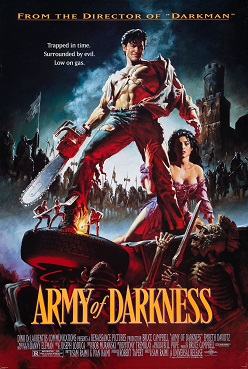
I think one reason why the film continues to work is because it’s obvious that both Sam Raimi and Bruce Campbell were truly committed to bringing their demented vision to screen.  The film features Campbell as Ash Williams, the S-Mart clerk who, after a night of fighting the Deadites and losing his hand, has found himself in the Middle Ages, captured by Lord Arthur (Marcus Gilbert) and expected to live the life of a medieval slave.

Ash is often described as being one of the dumbest movie heroes of all time but, as this film shows, Ash’s stupidity is also his secret weapon.  While others heroes would probably get caught up trying to rationalize or understand the situation in which they’ve found themselves, Ash just accepts it.  While others heroes would strategize or try to figure out a clever way to get out of their situation, Ash simply fights back and runs straight into trouble.  “This is my boomstick!” Ash yells at one point and, while it establishes himself as being a great warrior, it’s also a case of Ash bragging on himself.  Ash is a big fan of bragging and it must be said that it usually works out for him..  When Ash is attacked by evil Ash and several miniature Ashes, the mindless delight that all of these different Ashes take in trying to destroy each other is infectious.

Of course, Ash’s stupidity can also be his biggest downfall.  For me, the best part of this film is when Ash tries to recover the Necronomicon from the haunted forest.  He is given three simple words that he needs to repeat before taking the book.  Before entering the forest, he practices by repeating the words twice but refuses to repeat them a third time because “I’ve got them!”  Of course, Ash doesn’t have them so he does what any of us would do.  He attempts to mumble the third world.  This, of course, raises an army of the dead.

(My second favorite part of the film is that the army of the dead is surprisingly talkative as they rise from their graves.  My third favorite part of the movie is Ted Raimi continually popping up as different supporting characters, occasionally even arguing with himself.  My fourth favorite part of the movie — well, I’ve got a lot of favorite parts of this movie.  Army of Darkness is one of those endlessly quotable movies about which you can spend hours saying, “Remember when….”)

“Shop smart, shop S-mart,” Ash says at one point and it’s tempting to laugh because Ash isn’t smart but he’s determined and his oddly confident and he manages to find a strange sort of joy in every situation that he finds himself.  He’s the ultimate blue collar hero and Army of Darkness is the ultimate celebration of Ash Williams, Bruce Campbell, and Sam Raimi.

Horror Film Review: The Giant Claw (dir by Fred Sears)


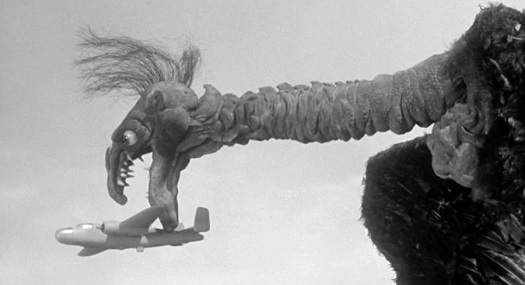
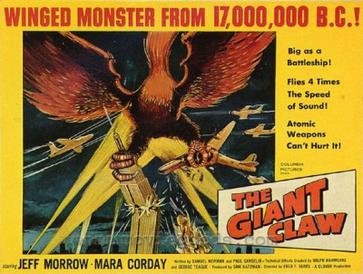
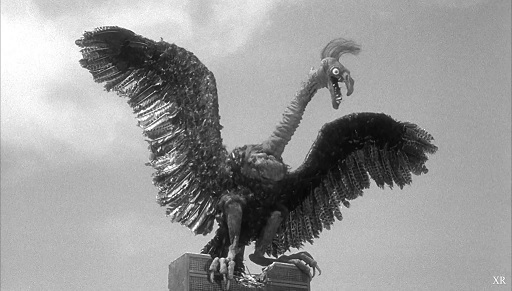
You know, a lot of people are a bit of dismissive of 1957’s The Giant Claw because they say that the monster — a big flying turkey from an anti-matter universe that has somehow slipped into our universe — is not convincing.

They make fun of the fact that, instead of hiring Ray Harryhausen like they were originally planning to do, the producers decided to save money by going for his non-union, Mexican equivalent.

They make fun of the scene in which a French-Canadian trapper announces that the Turkey Monster is actually a mythological beast that has the body of a woman, the head of a wolf, and the wings of a bat because the Turkey Monster certainly looks nothing like that.

They laugh at the scene where the Turkey Monster chases an airplane, even though I think that would be pretty terrifying if I was actually on the airplane.  I mean, the last time we were flying home from the UK, we hit a bit of turbulence and it traumatized me for days.  I can only imagine how I would feel if I looked out the window and I saw a giant flying turkey chasing after the plane.

Critics will even make fun of how the turkey sounds, mocking it for its weird “caw caw” noises.

Well, alright.  Let’s just admit it.  The turkey isn’t the most menacing monster in the world and yes, it does sometimes sound a bit hoarse and it could definitely stand to put on a little weight but seriously, how can you not love this thing?

As for the film itself, it not only features one of the greatest monster of all time but it’s also a love story!  Mitch MacAfee (Jeff Morrow) is a pilot who sees a UFO and who faces an attempt, by the government, to cover up what he’s seen.  As happened to so many of the people who saw UFOs in the 50s, he’s accused of being either mistaken or an outright hoaxer.  Meanwhile, Sally Caldwell (Mora Corday) is a mathematician who is originally skeptical of Mitch and his claims but who realizes that he was right when they’re attacked by the Turkey Monster.  Their plane crashes in Canada, where they are rescued by a French-Canadian trapper named Pierre Brousssard (Lou Merrill).  While the Turkey Monster is terrifying the world, Sally and Mitch are falling in love and since Jeff Morrow and Mara Corday are the most attractive people in the film, it only seems right.  They’re a cute couple, who cares if the script makes any sense?

Anyway, back to the Turkey Monster.  The Turkey Monster is protected by an anti-matter shield, which makes it impossible for it to be attacked by missiles and planes.  A high-ranking general is left repeating, “Missiles and bombs,” after realizing that they’re all useless against the turkey.

Eventually, the Turkey Monster makes its way to New York City and announces that it’s not going anywhere!

Well, you know what, Giant Turkey?  If you can make it there, you can make it anywhere!

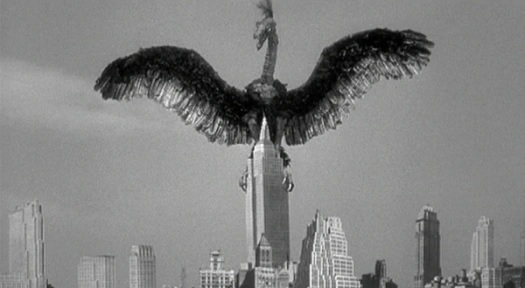
Sadly, the Turkey’s New York visit doesn’t end well and that’s a shame.  Benjamin Franklin famously suggested that America’s official bird should have been the turkey as opposed to the eagle.  Looking at the Giant Turkey sitting on the Empire State Building, how can you disagree?

Seriously, don’t listen to the critics.  The Turkey Monster is one of the most entertaining monsters of all time and The Giant Claw is tons of fun!

Horror On The Lens: Haunted House of Horror (dir by Michael Armstrong)


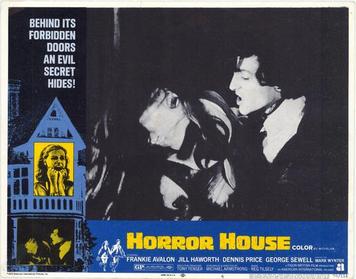
First released in 1969, The Haunted House of Horror features a group of 20-somethings who, bored with the usual parties, decide to that it might be a kick to hang out in a supposedly haunted mansion.  Once they’re in the mansion, they decide that it might be even more fun to hold a seance!

(Seriously, what is the deal with people holding séances in haunted mansions?  That really seems like the last place where you would want to mess with potentially malevolent spirits!)

The party becomes much less fun once someone starts killing off the group, one-by-one.

This film is notable for two reasons.  First off, it features Frankie Avalon in one of his attempts to break free of his Beach Party typecasting.  Secondly, the role of Richard, who is played by Julian Barnes, was originally offered to a young singer named David Bowie.  Reportedly, Bowie was quite excited about doing the film but, in the end, the producers worries that he and Frankie Avalon would not get along.  I’m not sure why.  David Bowie had a sense of humor and, judging from his Casino cameo, so does Frankie.

October Positivity: Patmos (dir by Jimmy Murphy)


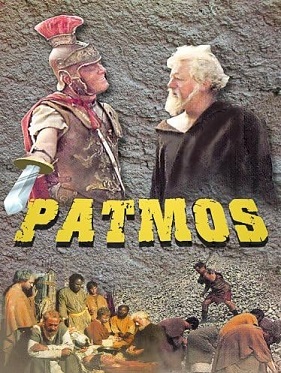
First released in 1985, Patmos imagines the final days of St. John the Evangelist.

The film opens with John (Louis Rolston), the last surviving member of Jesus’s original disciples, having been arrested by the Romans and sentenced to the penal colony of Patmos.  At Patmos, he lives in a cave and, despite being an elderly man, he is expected to take part in hard manual labor.  The commandant of Patmos is Catalinus (Mark Mulholland), an arrogant centurion who is known for his temper.  For Catalinus, being assigned to Patmos is a bit of a demotion and he’s eager to take his anger out on John.

John, however, refuses to allow Catalinus to break him and his quiet dignity starts to impress some of the Roman centurions.  (“I’m not paid to think,” one centurion replies, when asked for his opinion on John.)  It also starts to impress John’s fellow prisoners.  When John starts to have visions of the eventual apocalypse, the other prisoners help him to record them.  When Catalinus starts to execute the other prisoners and demands that John renounce his religion and his visions,  John is faced with a difficult decision.  Should he claim to have rejected God or should he stand firm in his beliefs, even in the face of Catalinus’s cruelty?

Well, there’s never really any question as to what John is going to do.  This film was made to be shown in church basements and at religious camps so there’s no way that John is going to renounce his faith.  That said, the film deserves a good deal of credit for not making it appear as if John’s decision was an easy one.  Everyday, as John is led out of his cave, he has to pass the people who have been crucified in an attempt to intimidate him into silence.  His fellow prisoners soon start to demand that John give into Catalinus’s demands, even as John tries to explain why he cannot.  Catalinus’s cruelty is actually supported by what we know about the techniques that some Romans used to keep order in their prison colonies so the idea that he would execute everyone but John is not an outlandish one.  The cruelty, as the saying goes, is the point.

(Indeed, Catalinus’s arrogance and his anger at being defied should seem familiar to anyone who has ever had to deal with a middle management bureaucrat.)

That said, when a film is called Patmos and deals with the final years of St. John the Evangelist, most people are going to be watching because they want to see how the film portrays the visions of revelation.  Patmos, being a low-budget film, goes for a simple approach.  We see horsemen riding across Patmos, each bringing a plague to Earth.  There are occasional shots of people begging for food and there’s also a sepia-toned sequence that takes place in Heaven.  As I said, it’s simple and it’s obvious that the film’s low budget played a huge role in how the apocalypse was presented.  But that simplicity is actually rather effective.  After sitting through so many flamboyant and over-the-top portrayals of the end of the world, it’s hard not to appreciate the starkness of Patmos’s imagery.

The acting is a bit uneven but Louis Rolston is appropriately wise as John and Mark Mulholland is appropriately arrogant as Catalinus.  Patmos is an effectively done apocalypse film, one that makes good use of its low budget.

Late Night Retro Television Reviews: Nightmare Café 1.4 “The Heart of Mystery”


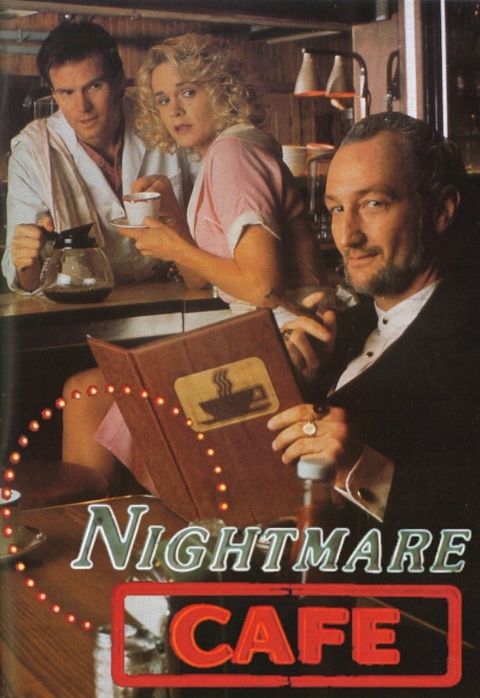
Welcome to Late Night Retro Television Reviews, a feature where we review some of our favorite and least favorite shows of the past!  On Mondays, I will be reviewing Nightmare Café, which ran on NBC from January to April of 1992.  The entire show is currently streaming on YouTube!

This week, a dying detective is allowed a chance to solve one last case.

Episode 1.4 “The Heart of Mystery”

(Dir by John Harrison, originally aired on March 20th, 1992)

This week’s episode of Nightmare Café is the first to largely focus on a guest star.  While Jack Coleman and Lindsay Frost do play roles in this week’s episode and Robert Englund’s Blackie actually gets to do more than usual, the majority of the episode is still dominated by Timothy Carhart as Detective Stan Gates.

One dark night, Stan chases a young thief (played by Alfonso Quijada) into a dark alley.  When the thief pulls a gun on him, Stan explains that he’s a police officer and he’s not trying to take the thief to jail.  He explains that he knows the young man is on drugs and is not in full control of his actions.  He asks the young man to give him the gun.

Meanwhile, in the nearby Nightmare Café, a bored Frank and Fay are playing a game of Clue.  (Colonel Mustard did it.)  Stan walks into the café and asks for a cup of coffee.  Robert Englund’s Blackie suddenly appears sitting in a booth and eating from a bag of popcorn.  He introduce himself to Stan and then leads Stan over to a window.  Looking through the window, Stan can see himself and the thief in the alley.  The thief has fired the gun and the bullet appears to be suspended in the air.  Blackie explains that the café has slowed down time to give Stan the chance to solve one last case before the bullet hits and kills him.

The case involves the death of Charlotte Bening (Laura Mae Tate), a wealthy woman with whom Stan was in love.  One night, when Stan was investigating a break-in at her mansion, Stan fired his weapon at what he believed to be the burglar.  Someone hit him from behind, knocking him out.  When Stan woke up, he discovered that the person who was actually shot was Charlotte!  While the police ruled it an accidental shooting, Stan was convinced that someone specifically set him up.  Could it have been Charlotte’s brother, a frustrated artist named Philip (Denis Forest, who also appeared in last week’s episode of Friday the 13th)?  Or could it have been …. well, there is no one else, actually.  The great Lochlyn Munro does make a brief appearance as one of Charlotte’s more aggressive suitors but he’s only onscreen for a few minutes.  There’s not much suspense to this mystery.

That said, I did enjoy this episode of Nightmare Café, which not only pays homage to film noir but which also features Robert Englund at his quippy best as he passive-aggressively pushes Stan into solving the case.  Fay does briefly leave the café so that she can pretend to be the producer of a true crime series and interview some of the people who knew Charlotte and Stan but, for the most part, this episode is centered around Timothy Carhart and Robert Englund and both of them carry things nicely.  Though the episode’s format probably confused those who, on the basis of the previous three episode, didn’t realize that Nightmare Café was originally envisioned as being an anthology series, The Heart of Mystery holds up very well.

October Hacks: Sweet Sixteen (dir by Jim Sotos)


1983’s Sweet Sixteen takes place in a small town in Texas.

Sherriff Dan Burke (Bo Hopkins) does his best to try to maintain the peace but it’s not always easy.  Not when a good majority of the town is prejudiced against the Native Americans living on a nearby reservation.  There’s a major archeological dig happening on the reservation, headed up by Dr. John Morgan (Patrick Macnee), but the town doesn’t care about any of the artifacts that Dr. Morgan and his team might discover.  They’re too busy harassing local activist Jason Longshadow (Don Shanks) for stepping into the wrong bar.

However, a distraction from all of the casual racism has arrived in the form of Dr. Morgan’s daughter, Melissa (Aleisa Shirley).  Soon, it seems like every teenage boy and young man in town is lusting after Melissa.  Melissa, for her part, is only fifteen years old and is struggling to deal with all of the attention.  Sometimes, she enjoys the attention.  Sometimes, she just wants to be left alone.  (Believe me, as someone who had adults hitting on her when she was 13, I could relate.)  Melissa’s birthday is coming up and her mother (Susan Strasberg) is planning on throwing a big party and inviting the whole town to come over and celebrate.  Sheriff Burke thinks it’s a great idea.  “This town could use something to celebrate.”

The only problem is that any boy who so much as looks at Melissa ends up getting brutally murdered.  When an old Native American man named Greyfeather (Henry Wilcoxin) is spotted near the scene of one of the crimes, the local redneck blame him for the murders and tragedy ensues.  Sheriff Burke has to find the real murderer and, whether he likes it or not, he’s going to get some help from his kids, Hank (Steve Antin) and Marci (Dana Kimmel).

Hank and Marci really are this film’s secret weapons.  In the past, I’ve been pretty critical of Dana Kimmel’s performance in Friday the 13th Part 3 and her insistence that her character be re-written to reflect her own religious beliefs and desire to be a good role model.  However, Kimmel is really likable (and perhaps more appropriately cast) as the fiercely intelligent but still relatively innocent Marci, who reads murder mysteries and is totally excited about the prospect of getting to solve a real murder.  Hank is perhaps a bit less enthusiastic about about crime-solving than Marci but he still helps out his sister because she’s his sister.  Awwwwww!

Sweet Sixteen is a bit of an untraditional slasher film, one that is as concerned with social issues as is it was stalking and slashing teenagers.  Perhaps that explains why it has a slightly better cast than the typical 80s slasher, with veteran actors like Patrick McNee, Susan Stasberg, and Bo Hopkins acting opposite equally capable but younger actors like Kimmel, Antin, and Aleisa Shirley.  It’s also a surprisingly likable slasher film, due to the Dana Kimmel and Steve Antin’s engaging lead performances.  Honestly, I think it’s kind of a shame that there weren’t a series of films featuring Marci and Hank solving crimes.  Dana Kimmel and Steve Antin make quite a team in this above average slasher.

The TSL Horror Grindhouse: Blood Thirst (dir by Newt Arnold)


Filmed in 1965 but not released until 1971, Blood Thirst takes place in Manila.  Young women, many of whom work at or near the Bario Club, are turning up dead with all of their blood drained from their body.  Inspector Miguel Ramos (Vic Diaz) thinks that the crimes are the work of one homicidal maniac but there are whispers that the women are falling victim to a cult of devil worshippers.  Hoping to solve the case before a full-fledged panic breaks out, Ramos summons a friend of his from New York, Detective Adam Rourke (Robert Winston).

Detective Rourke, who is perhaps a bit too quick to smirk, thinks that it’s going to be easy to solve this case but it turns out the opposite is true.  He goes undercover as a visiting writer and starts to hang out at the Bario Club.  He gets to know the people who work there and he introduces himself to the club’s owner, Calderone (Vic Silayan).  Calderone is immediately suspicious of Rourke, something that he ascribes to his natural concern for his employees.  However, the club’s most popular dancer — the beautiful blonde Serena (Yvonne Nielsen) — informs Rourke that Calderone murdered his previous wife.

Both Detective Rourke and Miguel’s sister, Sylvia (Katherine Henryk), suspect that the killer is Calderone.  However, the viewers have a bit more information than Rourke and Sylvia.  We know that the killer is a horrifyingly disfigured monster who always seem to emerge from the shadows.  What is the monster and why is it obsessed with draining the blood of young, beautiful women?  That’s the mystery that Rourke will eventually have to solve.

Just from the plot description, Blood Thirst might not sound that impressive and I have to admit that I went into the film with low expectations.  But I was actually surprised to discover that the film was far more effective than I was expecting.  Visually, the stark black-and-white cinematography creates an appropriately ominous atmosphere and the scenes in the club feel like they could have been lifted from the best examples of film noir.  Characters literally emerge and occasionally disappear into the darkness, with shadows often obscuring half an actor’s face as if to remind us that any one of the characters could be the murderer (and, by that same token, any of them could actually be innocent).  When Serena performs in the club, her blonde hair and pale skin almost seem to glow in the darkness.  The monster itself is effectively frightening as it makes it way through the film, moving like a crazed animal that has found itself outside of its natural habitat.

Of course, it’s hardly a flawless film.  Rourke is a remarkably unlikable character, one who smirks his way through the entire film.  The scenes where he flirts with Sylvia are cringeworthy and redeemed only by Sylvia’s habit of both slapping him and kicking him out of her car.  There are a few moments of humor that don’t quite work.  The film is at its best when it focuses on atmosphere and shadows as opposed to the characters.  Blood Thirst works as a filmed dream, a vision of dark and disturbing things.

Retro Television Reviews: Miami Vice 1.7 “One Eyed Jack”


Welcome to Retro Television Reviews, a feature where we review some of our favorite and least favorite shows of the past!  On Mondays, I will be reviewing Miami Vice, which ran on NBC from 1984 to 1989.  The entire show is currently streaming on Tubi!

This week, Vice gets a new leader!

Episode 1.7 “One Eyed Jack”

(Dir by Lee H. Katzin, originally aired on November 2nd, 1984)

Oh, that Sonny Crockett.  He’s got problems!

For one thing, animal control is still showing up at the harbor and trying to repossess his pet alligator, Elvis.  Sonny manages to talk them out of it by explaining that Elvis is actually employed by the Miami Police Department.  Sonny even flashes his badge as proof, which I found strange since I thought the whole idea of Sonny living on the boat was so that he could convince everyone that he was actually a big time drug dealer.  For someone who is supposed to be deep undercover, Sonny never seems to make much of an effort to hide the fact that he’s a cop.

Crockett and Tubbs have been assigned to stakeout a bookie in the hope that it’ll lead to the arrest of his boss, a supposedly “untouchable” gangster named Al Lombard (Dennis Farina, who was always a totally convincing gangster despite actually being a Chicago cop).  Crockett is shocked to see his ex-girlfriend, Barbara (Janet Constable), begging the bookie for more time to pay off her gambling debts.  Apparently, Barbara is so far in debt that Lombard’s second-in-command, Vince DeMarco (played by former Andy Warhol superstar, Joe Dallesandro), has stolen the tools that Barbara’s husband needs to make a living.

Seeking to help out his ex, Crockett approaches Vince and requests that he return the tools.  Vince explains that the tools have already been destroyed and then offers Crockett an envelope full of cash as payment for them.  Crockett takes the envelope and is promptly arrested by Internal Affairs Detective Schroeder (Dan Hedaya, as wonderfully sleazy as ever).  It turns out that Vince agreed to expose a dirty  cop in return for being granted immunity on some racketeering charges.

Everyone knows that Crockett has been framed.  In the past, Lou Rodriguez would have stood by Crockett but Rodriguez died two episodes ago and the new head of vice is Lt. Martin Castillo (Edward James Olmos).  Accurately described as being “Charles Bronson by way of Havana,” by Tubbs, Castillo is an enigmatic figure, one who rarely speaks or shows the slightest hint of emotion.  He has a withering stare that can be terrifying in its intensity.  When Tubbs, feeling that Castillo isn’t being properly supportive of Crockett, demands to know, “Whose side are you on?,” Castillo replies, “Don’t ever come up to my face like this again, Detective,” and the viewer is left with no doubt that Castillo is perhaps the most terrifying man in Miami.

After Barbara turns up dead, Tubbs goes undercover.  After meeting with DeMarco, Tubbs works his way up to Lombard.  Tubbs claims to be a gangster from Philadelphia who is looking to get in on the action in Miami.  (“If Miami doesn’t have it,” DeMarco assures him, “nobody’s thought of it yet.”)  Lombard takes a liking to Tubbs and hires him to deal with his Black and Spanish “clientale.”  Soon, Tubbs and DeMarco are hitting the cockfights and going to the club with Lombard.  Tubbs also frames DeMarco for the theft of $2,000.  Realizing that Lombard is probably going to try to kill him, DeMarco not only signs a paper exonerating Crockett but he also wears a wire the next time that he and Tubbs visit Lombard’s yacht.

Good news, right?  Well, it would be …. except that Barbara’s husband Jerry (Jimmie Ray Weeks) sneaks onto the yacht and shoots DeMarco dead before Lombard says anything incriminating.  Jerry goes to prison and Lombard goes free.  Crockett and Tubbs end up on Crockett’s boat, fishing at ten o’clock at night.  Crockett says that it’s the only way to stay sane.

What a dark episode!  Crockett was exonerated but his otherwise perfect plan fell apart.  This episode truly presented Miami as being a decadent playground, one that could make someone rich just as easily as it could destroy them.  While Jerry and Barbara lived in a small, run-down house, DeMarco wore expensive suits and Lombard lived on an expensive yacht and neither one gave much thought to the people whose lives were destroyed by their activities.  With Crockett sidelined by the IA investigation, Tubbs finally got his chance to shine and Philip Michael Thomas did a good job of capturing the adrenaline rush of becoming a part of Lombard’s world.  As opposed to the cynical and weary Crockett, Tubbs seems like he could be seriously tempted to switch sides in the war on crime.  In the end, Tubbs outsmarted DeMarco not by being better than him but instead by being even more ruthless.  And yet, for all the dark vibes to be found in this episode, the glamour of life in Miami was undeniably appealing.  Where else, the episode asked, can you arrest the bad guys while also working on your tan and hanging out on the beach?

Indeed, I find myself feeling a bit jealous of Gina (played by Saundra Santiago).  So far, she hasn’t gotten to do much on the show beyond being Sonny’s sometime girlfriend.  But she still gets to wear the best clothes and hang out with the coolest people and she gets to do it all while carrying a gun.  What more could one ask for?

Next week, Bruce Willis makes his television debut!

Horror Scenes That I Love: Daria Nicolodi in Deep Red


Born in Florence, the outspoken Daria Nicolodi had already appeared in a quite a few films before Dario Argento cast her as the female lead in 1975’s Deep Red.  Nicolodi would spend the rest of her career being closely associated with Argento, both as Dario’s partner and as the mother of Asia Argento.  Dario and Daria had a notoriously volatile relationship.  While one can sense Argento falling in love with Nicolodi while watching the way he films her in Deep Red, she is noticeable in her absence from Suspiria despite the fact that she is generally acknowledged as being the one who came up with the idea of the film.  (Angered that, despite the collaborative nature of their partnership, Argento did not offer her the lead role in Suspiria and instead offered a supporting role that Nicolodi felt was not particularly interesting, she instead accepted an offer from Mario Bava and gave what is generally considered to be her best performance in Shock.)  She appeared in Dario’s subsequent films, through Opera.  She eventually split with Argento and continued her film career, playing Asia’s mother in Scarlet Diva.  Daria Nicolodi also became a popular and witty interview subject, one who was always good for a few shocking quips.  While Daria could be very critical of Dario in those interviews, she was also often the quickest to defend his talent as a director.

Daria Nicolodi appeared in a lot of horrifying scene but today, I want share this rathe gentle scene from Deep Red, in which Daria’s journalist playfully challenges David Hemmings to a little arm-wrestling.  It is scenes like this that make Deep Red one of the greatest examples of the giallo genre.