Today’s music video of the day is the latest from Kate Hudson. You could say that it’s right on time and you would be correct on many different levels. Try it and see!
Enjoy!
Today’s music video of the day is the latest from Kate Hudson. You could say that it’s right on time and you would be correct on many different levels. Try it and see!
Enjoy!
Welcome to Late Night Retro Television Reviews, a feature where we review some of our favorite and least favorite shows of the past! On Fridays, I will be reviewing Friday the 13th: The Series, a show which ran in syndication from 1987 to 1990. The entire series can be found on YouTube!

This week, a bunch of new characters show up! What the Hell!?
Episode 3.3 “Demon Hunter”
(Dir by Armand Mastroianni, originally aired on October 14th, 1989)
I have read that one of the biggest mistake that aspiring screenwriter make when they attempt to create a compelling spec script for their favorite show is that they’ll often introduce new characters. Instead of focusing on the established stars of the show, they’ll have a new character show up and suddenly become the center of the story. It’s a mistake because, no matter how good the script may be, it doesn’t work as an episode of the series that the writer is trying to get a job with. Showrunners don’t want a writer who can write about new characters. They want a writer who can work within the framework of what the show has already established.
This week’s episode of Friday the 13th feels very much like a failed spec script.
Make no mistake. Jack and Micki are in it. They spend the entire episode at Curious Goods, where they are originally seen putting a cursed dagger in the vault. With Ryan having been transformed into a child in the previous episode, Micki makes Jack a partner in the shop. Johnny Ventura (played by new series regular Steve Monarque) is also in this episode, though he’s called to the store a bit later than Micki and Jack. I guess Johnny is now a part of the group, even if he doesn’t have a job at the shop. For all the time the show spent establishing Johnny as being an edgy delinquent during the second season, this episode finds Johnny as a rather conventional leading man. He listens to a baseball game and, at one point, he’s seen making a model ship.
That said, the majority of the episode is dominated by a bunch of new characters. The Cassidys are a family of militia types who, having rescued Bonnie Cassidy (Allison Mang) from a bunch of cultists, are now on the run from a demon that is determined to kill them. The Cassidys have some sort of demon tracker device that leads both them and the demon to Curious Goods, where Micki, Jack, and Johnny join in the effort to destroy the demon. The Cassidys are so prominently featured in this episode and take up so much screentime that the episode almost feels like a backdoor pilot about them. The Cassidys are even featured in black-and-white flashbacks that show us how they rescued Bonnie.
The problem, of course, is that we don’t know the Cassidys so its a bit jarring to see them take over the episode. After what happened in the previous episode, I think most viewers would have a lot of questions about what happened after Jack, Micki, and Johnny returned from France. For instance, what did they do with Ryan? Did they drop Ryan off with his mother? Did they leave him in France? We don’t find out in this episode and it’s actually kind of insulting to anyone who has spent the previous two seasons getting wrapped up in Ryan and Micki’s adventures. Instead of answering the questions that they had to know that viewers would be asking, the show’s writers expect us to care about the Cassidys.
Even without John D. LeMay, Robey and Chris Wiggins had a likable chemistry. Micki and Jack were the strongest thing this series had gone for it as the start of season 3. Why push them to the side for a family that we’ve never seen before and will probably never see again? As far as guessing what the rest of Season 3 will be like is concerned, it’s not a good sign.
Hopefully, I’ll be proven wrong in the weeks to come.
2009’s Amazing Racer is the story of a teenage girl who meets her mother and learns how to ride a horse.
Shannon Greene (Julianne Michelle) is traumatized when her father dies and, having been told that her mother died giving birth to her, she now believes herself to be an orphan. However, Dr. Rita Baker (Daryl Hannah) reveals that Shannon’s father was just a damn liar. First, he told Shannon’s mother that her baby was stillborn. Then, as Shannon was growing up, he told her that her mother was dead. This is a lot to take in for both Shannon and the viewer. Myself, I wondered not only how someone could do that but why they would do that. Making the scene in which Shannon hears the truth even more surreal was the presence of Michael Madsen and Joanna Pacula, playing Shannon’s guardians. Madsen played his good guy role in much the same way he played his bad guy in Reservoir Dogs.
Anyway, Shannon ends up living with her mother, Dr. Christine Pearson (Claire Forlani), and her mother’s boyfriend, Eric (Jason Gedrick). Understandably, considering everything that she’s been through, Shannon is initially difficult and bratty but eventually, she comes to enjoy working on Eric’s horse ranch. She even starts riding a horse and winning races! This brings her to the attention of evil Mitchell Prescott (Eric Roberts), who wants her horse for himself and even has a spy working on the ranch….
There are a lot familiar faces in this movie. Charles Durning makes his final film appearance as Floyd. Steve Guttenberg has a bizarre cameo as a guy transporting a horse trailer. Scott Eastwood and Kirsta Allen show up. When it’s time for Shannon to finally start training for the big race, Lou Gossett Jr. pops up as the trainer. The film itself a fairly predictable horse ranch movie and it’s enjoyable if you like that sort of thing. (Myself, I like ranches and I like horses so I don’t mind movies like this.) But really, most of the movie’s entertainment value comes from guessing who is going to show up next. Some of the famous faces are bit distracting. But sometimes, it really pays off. I really wish Lou Gossett, Jr.’s role had been bigger because he does a great job with what little time he has.
As for Eric Roberts, he gets a bit more screentime than usual. One gets the feeling that he may have actually spent more than two days shooting his scenes for this one. Roberts is playing a villain here and he gives a enjoyably avuncular performance as the evil Mitchell. Roberts has fun with the role and, as a result, he’s fun to watch in this movie.
I enjoyed Amazing Racer. It had horses and it has Eric Roberts. What more could you want?
Previous Eric Roberts Films That We Have Reviewed:
Valentine’s Day is nearly over! A day like today …. it can justify three songs of the day can’t it? Originally, I wanted to cap things off with Carly Simon’s Nobody Does It Better but that song has already been our Song of the Day once this year.
So, instead, our final song of the day is another wonderfully romantic song from the James Bond franchise. Of course, it may be bring a tear to your eye if you’ve seen On Her Majesty’s Secret Service. It turns out that Bond and Tracy did not have all the time in the world. But at least they had the time that they did!
Here is the amazing Louis Armstrong with the saddest Bond song ever!
We have all the time in the world
Time enough for life to unfold
All the precious things love has in store
We have all the love in the world
If that’s all we have, you will find
We need nothing more
Every step of the way
Will find us
With the cares of the world
Far behind us
We have all the time in the world
Just for love
Nothing more, nothing less
Only love
Every step of the way
Will find us
With the cares of the world
Far behind us, yes
We have all the time in the world
Just for love
Nothing more, nothing less
Only love
Only love
Songwriters: John Barry / Hal David
Valentine’s Day is a big deal! It can have more than one song of the day, right?
I mean, how can I let this day go by without sharing my favorite Bond theme song? All Time High may have been written because there weren’t many words that rhymed with Octopussy but it’s still not only one of my favorite Bond themes but also one of my favorite love songs.
Plus, it’s one of the few songs that I used to absolutely kill with during karaoke night at Grandpa Tony’s.
(Grandpa Tony’s was a nice little restaurant. The owner was a former boxer who had a crush on my mom so he had no problem with her four daughters singing their hearts out every Friday! The older you get, the more you treasure memories like that.)
All I wanted was a sweet distraction for an hour or two
Had no intention to do the things we’ve done
Funny how it always goes with love, when you don’t look, you find
But then we’re two of a kind, we move as one
We’re an all-time high
We’ll change all that’s gone before
Doing so much more than falling in love
On an all-time high
We’ll take on the world and win
So hold on tight, let the flight begin
I don’t want to waste a waking moment, I don’t want to sleep
I’m in so strong and so deep, and so are you
In my time, I’ve said these words before, but now I realize
My heart was telling me lies, for you, they’re true
We’re an all-time high
We’ll change all that’s gone before
Doing so much more than falling in love
On an all-time high
We’ll take on the world and win
So hold on tight, let the flight begin
So hold on tight, let the flight begin
We’re an all-time high
Songwriters: Tim Rice / John Barry
Welcome to Retro Television Reviews, a feature where we review some of our favorite and least favorite shows of the past! On Fridays, I will be reviewing St. Elsewhere, a medical show which ran on NBC from 1982 to 1988. The show can be found on Hulu and, for purchase, on Prime!
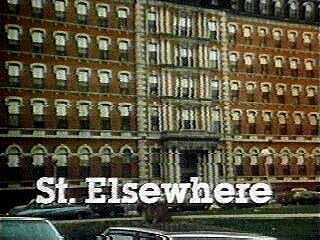
This week, things get dark.
Episode 1.12 “Release”
(Dir by Victor Lobl, originally aired on February 1st, 1983)
The gunshot victim (Tom Hulce) who was saved by Samuels last week has woken up but he has no idea who he is. He is labeled John Doe #12, meaning there’s at least eleven other people at St. Eligius who are suffering from amnesia! That’s a scary thought. There’s a lot of things that I don’t want to suffer from and amnesia is high on the list. I can’t imagine how frightening that would be, not having any idea who you are or where you belong.
Dr. Chandler tries to help John Doe #12 get his memory back but, in this episode at least, neither has any luck. Even an attempt at hypnosis reveals that John can’t remember anything before being rolled into the ER. At one point, an older couple step into the room to discover if John is their son, who has been missing for two years. He’s not, which leaves the couple in tears.
As serious and as heart-breaking as this all is (and both Washington and Hulce give outstanding performances in this episode), there is one moment where Dr. Westphall makes a reference to a “Lt. Gerard,” who is searching for John’s parents. It seems like a throw-away reference, unless you’re familiar with either the 1950s television show The Fugitive or the subsequent 1993 film adaptation. Lt. Gerard was the name of the detective who was hunting for that show’s main character, Dr. Richard Kimble. Ed Flanders delivers the line solemnly and it occurs at a serious moment. There’s no winking at the audience. Instead, it’s simply a reward for the pop culture-literate who might be watching the episode.
For the most part, this was a grim episode. After losing a patient to cancer, Dr. Peter White was ordered to talk his family into signing a release for an autopsy. The autopsy was largely to protect the hospital from getting sued. The family didn’t want an autopsy. Peter didn’t feel the autopsy was necessary. But, having been bullied by his superiors, Peter proceeded to bully and manipulate the dead man’s son into signing the release. In the end, it turned out that Peter was correct. The man did die of cancer. The autopsy was not necessary. Upset over the whole process, Peter said that he felt like he had “raped” a mourning family. The doctor who ordered Peter to get the release merely smiled and said he would see Peter at rounds the next day.
Meanwhile, Dr. Craig was shocked and angered when he discovered that his old friend (played by Andy Romano) had checked into the hospital for gender-affirming surgery. This led to the episode final scene, in which Craig talked about not liking the way the world had changed since he was a young man. The scene was well-acted by William Daniels, who was one of the best when it comes to giving a monologue of frustration.
And finally, Dr. Samuels and Dr. Paxson disagreed on how to treat a patient and this storyline would have been interesting if either Samuels or Paxson had been an interesting character. But they’re not. I don’t care about them. I don’t care about their boring relationship. And, knowing that neither is going to be around once this season ends, I really didn’t care that much about their storyline. With all of the interesting stuff that happened in this episode, I groaned whenever I realized I was going to waste a few minutes watching Samuels and Paxson argue.
This episode left me feeling pretty depressed. Between Peter bullying that family and John Doe searching for his identity, there wasn’t much hope to be found. Still, I have faith that John Doe will find his identity and maybe Peter will even become a better doctor. (He certainly can’t get much worse.) If Lt. Gerard could find Richard Kimble, then anything’s possible!

Based on a play by Somerset Maugham, 1929’s Charming Sinners takes place amongst the very rich.
Kathryn Miles (Ruth Chatterton) is married to Robert Miles (Clive Brook). Robert is wealthy and a respected businessman and, through her marriage, Kathryn is also wealthy and …. well, she’s not quite respected. The fact of the matter is that everyone is gossiping about the fact that Robert is cheating on Kathryn. Kathryn denies that Robert is being unfaithful but she knows that he is. She also knows that Robert is cheating with her best friend, Anne-Marie Whitley (Mary Nolan). Even when Anne-Marie’s husband, George (Montagu Love), comes to suspect that Anne-Marie is cheating with Robert, Kathryn tells George that it isn’t true and defends her cad of a husband.
Why is Kathryn doing this? As Kathryn explains it, she doesn’t feel that marriage necessarily means that you have to love someone. Kathryn married Robert for the money and the status and, as long as she has that, she’s willing to overlook Robert’s dalliances. Admitting that Robert is cheating would obligate her to go through a divorce and potentially lose everything that she has. If this film had been released just a few years later than it was, the Production Code would have insisted that Kathryn suffer for her less-than-reverent attitude towards the institution of marriage. Since this is a pre-code film, Kathryn is portrayed as being strong and determined. What the Production Code would have deemed a drama, the pre-code era considered to be a comedy.
Still, Kathryn does get revenge on her husband by openly flirting with a former lover, Karl Kraley (William Powell, handsome and suave as ever). Kathryn also makes some money on her own, proving to her husband that she could be a success even if she hadn’t married him. Kathryn informs Robert that she is going to be living her own life, even if they are married. And if Kathryn wants to take a lover, that’s her decision.
And good for Kathryn! Seriously, Robert is so smug and sure of himself that it’s deeply satisfying to watch as Kathryn reveals that Robert was never as clever as he thought it was. Though the film does not end with the dramatic divorce that some might expect, it does end with Kathryn taking control of her own life and making her own decisions about how she’s going to live it. That type of ending is rare enough today. One can only imagine how audiences in 1929 reacted to it.
But is the film itself any good, you may be asking. It’s an early sound picture and while the cast all proves their ability to handle dialogue, the largely stationary camera often makes the film feel like a filmed play (which is largely what it was). Like many pre-code films, the emphasis here is on how the rich have better clothes and better homes than the majority of the people watching the movie. That’s not a problem for me. I like looking at nice clothes and wonderfully decorated houses. Some others may dismiss this film as just being about the problems of the rich but my personal opinion is that everyone has problems. Wouldn’t you rather have problems as a wealthy person than a poor one? The most important thing is that the film features two of the best actors of Hollywood’s early Golden Age, Ruth Chatteron and William Powell, and they both give excellent and charming performances.
Charming Sinners is a bit of time capsule and probably not for everyone. If you’re not interested in the film’s era, it probably won’t hold your attention. But, to a fashionable history nerd like me, Charming Sinners definitely had its charms.
Today’s Valentine’s Day song of the day is my favorite song of all time, performed by the wonderful Yvonne Elliman.
I don’t know why I’m surviving every lonely day
When there’s got to be no chance for me
My life would end, and it doesn’t matter how I cry
My tears of love are a waste of time
If I turn away, am I strong enough to see it through?
Go crazy is what I will do
If I can’t have you, I don’t want nobody, baby
If I can’t have you, ah-ah-ah, oh
If I can’t have you, I don’t want nobody, baby
If I can’t have you, ah-ah-ah
Can’t let go, and it doesn’t matter how I try
I gave it all so easily to you, my love
To dreams that never will come true
Am I strong enough to see it through?
Go crazy is what I will do
If I can’t have you, I don’t want nobody, baby
If I can’t have you, ah-ah-ah, oh
If I can’t have you, I don’t want nobody, baby
If I can’t have you, ah-ah-ah, oh
If I can’t have you, I don’t want nobody, baby
If I can’t have you, ah-ah-ah, oh
If I can’t have you, I don’t want nobody, baby
If I can’t have you, ah-ah-ah (I’m in love with nobody)
If I can’t have you, I don’t want nobody, baby
If I can’t have you, ah-ah-ah, oh
If I can’t have you, I don’t want nobody, baby
If I can’t have you, ah-ah-ah, no
(Lyrics by Maurice Ernest Gibb / Robin Hugh Gibb / Barry Alan Gibb)
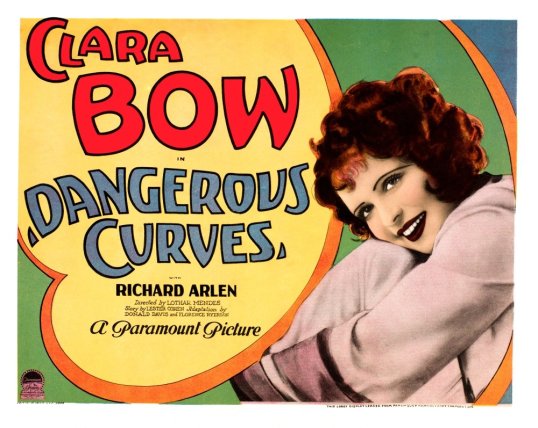
The 1929 film, Dangerous Curves, takes place at the circus.
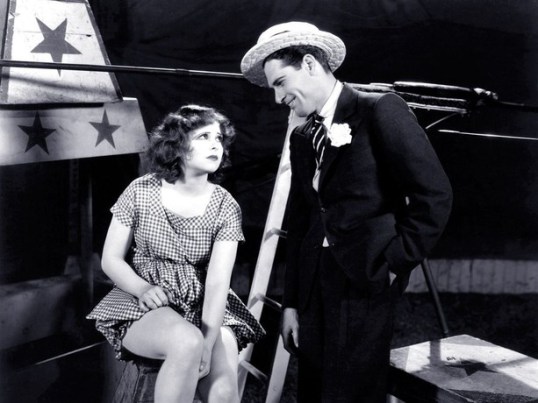
Larry Lee (Richard Arlen) is a tightrope walker and, when we first meet him, he’s a bit of a cad. He knows he’s the best and he knows that the crowds are specifically showing up to watch him risk his life on a nightly basis. Every woman at the circus is crushing on him but Larry hardly notices because he’s used to being desired. He’s in love with his tightrope-walking partner, Zara (Kay Francis). Everyone can tell that Zara is manipulative and not even loyal to her relationship with Larry. She wastes his money and Larry sometimes spends so much time thinking about her that it breaks his concentration on the tight rope.
Eventually, Larry discovers that Zara has been cheating on him! When Larry finds out about Zara and Tony (David Newell), he cannot get the image of them kissing out of his head. When he tries to walk across the tight rope, he loses his focus and, as the audience gasps, Larry falls to the ground below. (In an impressively-edited sequence, we see Larry falling from about five different angles before we finally see him hitting the ground.) Larry recovers but his confidence has been broken. Instead of returning to the circus, he just wants to drink and obsess on Zara and Tony.
Can bareback rider Patricia Delaney (Clara Bow) convince him to return to the circus? Can she give him the confidence to once again walk across the tightrope? Will Larry then teach Pat how do the tightrope act herself? Will Larry finally realize that Pat loves him and that he loves her? And how will Pat react when, after all she’s done for Larry, he suddenly decides that he wants to bring Zara back into the act?
Dangerous Curves is a mix of melodrama and romance, all taking place at the circus. It’s also a pre-code film, which means it’s a bit more honest about the relationships between the characters and Larry’s subsequent drinking problem than it would have been if the film had been made just a few years later. As a result, this is a melodrama with an edge. The members of the circus community are living on the fringes of polite society and they’ve built their own community, one that is based on their unique talents. Larry’s sin isn’t so much that he’s arrogant and tempermental. It’s that he doesn’t properly respect the community of which he’s a part. He thinks he’s above the rest of the circus. His fall from the high wire humbles him. His relationship with Patricia eventually redeems him.
That said, the main appeal of this film is that it features Clara Bow in one of her early sound-era performances. Bow became a star during the silent era but, unlike many of her contemporaries, she was able to make the transition to sound. I absolutely love Clara Bow and this film features one of her best performances. She’s determined and energetic and she plays the stereotypical “good” girl with just enough of a mischievous glint in her eye to make her compelling. She may be willing to help Larry get back on the tightrope and then subsequently learn how to walk the tightrope herself but she also shows that she’s not going to put up with him taking her for granted. As well, both Clara and Kay Francis get to wear a lot of cute outfits, which is always one of the pleasures of a pre-code film.
Dangerous Curves is worth watching for the chance to see Clara Bow at her best.
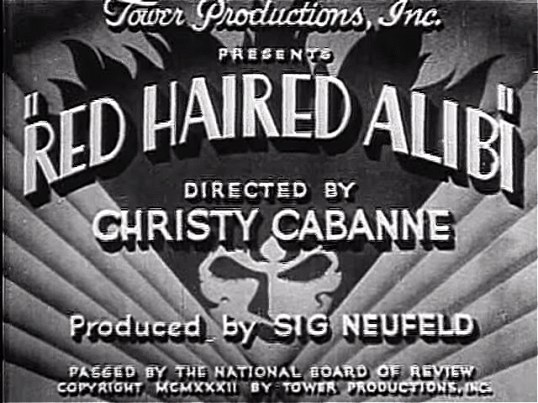
1932’s The Red-Haired Alibi tells the story of Lynn (Merna Kennedy).
When we first meet Lynn, she is working at a store in Manhattan. She has red hair. The film is in black-and-white but we have no doubt that her hair is red because every single character who meets her mentions that she has red hair and she continually reminds people that she has red hair. Everyone seems to be so stunned to meet a redhead! And I have to say that this is the most realistic part of this movie. I have red hair. I’ve had complete strangers tell me that they like my hair. I’ve also had complete strangers ask me if I’m a natural redhead (and I am!) and some other things that I’m not going to repeat here. Personally, I love having red hair. I’m a member of the proud 2%. I don’t care if some people claim that people with red hair don’t have souls. When you’ve got red hair, what else do you need?
As for the movie, Lynn meets a charming man named Trent Travers (Theodore van Enz). Trent offers to give Lynn a job, away from the drudgery of working in sales. Trent will pay Lynn to be his companion at night. And since this is a pre-code film, Red-Haired Alibi is pretty open about what that means. Lynn agrees. Trent is handsome and rich and who couldn’t use the money during the Great Depression? I imagine the film’s audience agreed. One thing that always comes through in these Depression-era pre-code films is that morals don’t really matter when you’re struggling to pay your rent and not starve to death.
The problem is that Trent is a gangster. Trent spends his nights committing crimes and then using Lynn as his alibi. Eventually, Lynn realizes that she’s gotten herself into a dangerous situation. The police suggest to her that she should get out of town before Trent takes things too far. (I guess they didn’t have witness protection in 1932.)
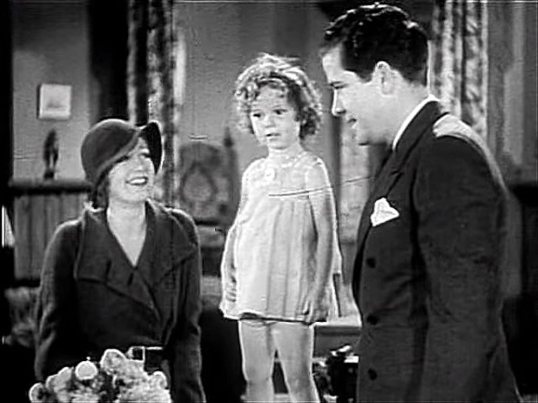
Lynn flees New York and builds a new life for herself in White Plains. She meets a charming widower named Bob Wilson (Grant Withers). They marry and settle into a life of domestic bliss. Lynn becomes the stepmother to Bob’s young daughter (played by Shirley Temple, in what is believed to have been her film debut). Everything seems to finally be perfect for Lynn. Or at least it does until Trent shows up….
The Red-Haired Alibi is a generally well-acted but somewhat slow 1930s melodrama. Comparing this film to some of the other films of the early 30s, it’s a relief to see a cast that knows how to deliver dialogue in the sound era but director Christy Carbanne sometimes struggles to maintain the sort of narrative momentum necessary to make a film like this compelling. The ending feels a bit silly but, at least during the pre-code era, there wasn’t a need to try to punish Lynn for having a less-than-perfect past.
Dancer and former silent actress Merna Kennedy was best-known for her work with Charlie Chaplin and she gives a likable performance as Lynn. Two years after making this film, she married Busby Berkley and retired from acting. Tragically, she died of a heart attack in 1944, when she was only 36 years old.
 Through the Shattered Lens