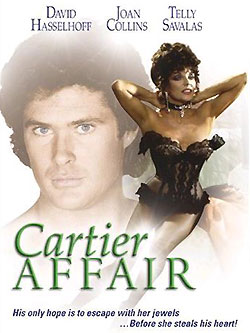
Made-For-TV Movie Review: The Cartier Affair (dir by Rod Holcomb)


In 1984’s The Cartier Affair, David Hasselhoff plays Curt Taylor.  He has spent the last few years in prison, having been convicted of selling deeds to fake oil wells.  He has passed the time by watching a soap opera that stars actress Cartier Rand (Joan Collins).  He has also managed to get in debt to the local prison mob boss, Phil Drexler (Telly Savalas).

When Curt learns that he’s being released from prison, Drexler informs him that he’s still expected to find a way to pay off his debt.  On the outside, Curt discovers that even his parole officer (Ed Lauter) works for Drexler!  Curt is assigned to become the private secretary of Cartier Rand and to steal her jewelry.  In order to get the job, Curt has to pretend to be gay.  That’s the only way that Cartier’s boyfriend (Charles Napier) would be willing to accept the idea of a male private secretary.

(Wouldn’t it just be simpler for Curt to rob a bank or something?)

Once he’s a part of the household staff, Curt discovers that Cartier is more than just the star of his favorite soap opera.  She’s someone who is tired of reciting melodramatic dialogue and kissing her co-stars.  She has serious ambitions.  Curt is immediately attracted to her and soon, Cartier is attracted to Curt.  But, of course, Curt is pretending to be gay and, to his horror, Cartier sets Curt up with one of her gay friends.

Meanwhile, the bad guys want their money….

The first half of the film is taken up by scenes of people mistaking Curt for being gay and there are more than a few moments and jokes that a film wouldn’t be allowed to get away with today.  A scene where Curt finds himself in a gay bar is cringey because, rather than asking us to laugh at Curt for panicking about finding himself in the rather innocuous location, the film asks us to instead laugh at the sight of men slow-dancing with other men.  Early on in the film, there’s a few scene where Hasselhoff overplays his attempts to come across as being gay.  Fortunately, Hasselhoff soon stops doing that and his performance improves as the film goes on.

The film gets slightly better during the second half, when Cartier learns the truth about Curt and the two of them somewhat implausibly go on the run from the bad guys.  They end up getting chased out to the desert, trading one-liners all the way, and I do have to admit that Collins and Hasselhoff displayed a surprising amount of chemistry during those scenes.

The film is tonal mishmash that doesn’t really work.  It tries to parody the type of soap operas that made Cartier Rand a star and it also tries to be a relatively exciting chase film but it keeps getting bogged down in plot points that ultimately feel rather superfluous.  My main issue that, if Drexler really wanted to get him money from Curt, it seems like he would have come up with a less complicated scheme, like robbing a bank or fencing stolen goods or something like that.  Instead, Curt is supposed to go undercover, pretend to be gay, and rob one of the most famous women on the planet.  I mean, Hell, he could have just broken into a jewelry store and gotten it all done in one night.  That said, Hasselhoff and Collins have a bit of charm to them.  It’s a shame they didn’t co-star in a better film.

I review TIGHTROPE (1984) – starring Clint Eastwood! 


In TIGHTROPE, a psychiatrist makes the following comment to New Orleans police detective Wes Block (Clint Eastwood) while he’s trying to catch a serial killer who’s targeting sex workers:

“There’s a darkness inside all of us, Wes; you, me, and the man down the street. Some have it under control. Others act it out. The rest of us try to walk a tightrope between the two.”

This statement definitely hits home to Wes, whose personal life has gotten rather dark. His wife has recently left him and their two daughters (Alison Eastwood and Jenny Beck), and the detective seems to be drowning himself in his work, at times in a bottle, and at other times in the arms of some of the local ladies of the night. Whenever he does try to plan something with his girls, his job always seems to get in his way. As he investigates the murders in a variety of the seediest locations in New Orleans, we learn that Wes is very much into the kinds of women who inhabit these places, and he gives into his secret desires on multiple occasions. This becomes personal when the killer, who knows that Wes is the detective in charge of the case, begins targeting and killing some of the very same women who helped ease Wes’ emotional pain, and then taunts him about it. It becomes even more personal when the killer goes after his daughters and his new “legitimate” lady friend Beryl Thibodeaux (Geneviève Bujold), a rape counselor Block has gotten to know as part of the broader investigation. As the bodies continue to pile up, will Wes be able to stop the killer in time to save the most precious people in his life?!!

TIGHTROPE is a special movie to me. I’ve mentioned this before in other reviews, but FOX-16 out of Little Rock played a lot of good movies in the mid to late 80’s when I was a teenager. Some of those movies hold a strong nostalgic value in my life because I first discovered them and my true love of movies during those years. The channel advertised and showed TIGHTROPE, and many other Eastwood films, quite often. Of course, the movie broadcast on FOX-16 was heavily edited, and I didn’t realize the true sexual complexity of detective Wes Block until I was quite a bit older. In the original DIRTY HARRY, there’s a running gag where different people ask Eastwood’s iconic character, “Why do they call you Dirty Harry?” From what we see in TIGHTROPE, if someone asked, “Why do they call you Dirty Wes,” the answer would be more than obvious as he engages in various kinky forms of sexual relations with at least three of the sex workers he hits up for information. The killer knows of his sexual activities with these women, even watching on occasion. The movie leans hard into this connection between Wes’ kinky sex that often involves handcuffs, and the kinship that the killer feels with Wes when he’s perpetrating violence on these same women. It adds an uneasy and unsettling quality to the proceedings when the killer publicly taunts his rival, who understandably doesn’t want his peers to know of his more private nocturnal activities. He can’t fool his new lady friend, the tough as nails Beryl Thibodeaux, who senses his hidden desires and accepts him for who he is, especially after spending some quality time with him and his daughters. I like Genevieve Bujold in the role and the French-Canadian actress is able to even nail the local accent on a couple of occasions. I also wanted to mention the excellent chemistry between Clint Eastwood and his real-life daughter Alison, who play father and daughter in the movie as well. Alison was only 12 years old when TIGHTROPE was released, but she gives a strong performance as the older daughter who’s still trying to come to terms with her parents’ divorce. The killer really messes up when he targets her. 

I’ll tell anyone who’s willing to listen that I love the city of New Orleans as a movie location. I personally love to visit the city and partake in its fun atmosphere and wide variety of excellent cuisine. TIGHTROPE hits many of the highlights of New Orleans in 1984… Bourbon Street, Jackson Square, the Super Dome, the Creole Queen, a warehouse full of Mardi Gras floats, the famous cemeteries, Randi Brooks in a hot tub, etc. etc. One thing about New Orleans is that its famous streets like Bourbon Street have not been cleaned up or become “family friendly” in the same way as a place like Times Square in New York City. To this day, it retains that same feeling of sexual decadence that is portrayed here in 1984. 

I personally consider TIGHTROPE to be a must-see film for fans of Clint Eastwood, as Wes Block is a wholly unique addition to his cavalcade of tough cop characters, and he makes us justifiably uncomfortable at times. Eastwood’s conflicted performance, the serial killer storyline and the fun New Orleans locations add up to a very good movie that’s aimed squarely at adults. 

Film Review: Cop (dir by James B. Harris)


First released in 1988, Cop stars James Woods as Lloyd Hopkins, a homicide detective who does not …. wait for it …. GO BY THE BOOK!

Actually, has there ever been a movie about a homicide detective who always made sure to go by the book?  I’m sure there has been but I really can’t think of any off the top of my head.  Whenever a homicide detective shows up as the main character of a movie, you can be sure that he’s going to drink too much, carouse too much, and get yelled at by his superiors.  If the movie involves a serial killer, you can be sure that the detective and the killer are going to be mirror images of each other, two renegades who have found differing ways to work out their issues with the world.

As much as we talk about the cliché of the cop who does it his way, would we really want to see a movie about a cop who plays by the rules?  I mean, most people dread having to deal with cops.  It’s not just that cops usually bring bad news.  It’s also that dealing with a cop means having to spend a lot of time while they slowly and methodically go through all of their procedures.  There have been so many times that I’ve been pulled over speeding and I’ve just wanted to yell, “Just write the ticket!”  Most people agree that we need some sort of police force, regardless of what the Defund folks say.  But most people also hate following the rules, especially when those rules feel rather arbitrary.  That’s the appeal of the renegade cop.  The renegade cop fills a purpose in society but, at the same time, he dislikes dealing with all of the usual cop nonsense as much as the rest of us.

As for Lloyd Hopkins, he’s hyperactive, jittery, sleazy, and a terrible father and husband.  He cheats on his wife.  He tells his daughter all about the gory details of his job.  (His daughter, it should be noted, seems to enjoy hearing them.)  He obsesses on the crimes that he investigates and he pursues murderers with a fanaticism that suggests that Lloyd knows that he’s just one bad life choice away from becoming one of them himself.  (And, indeed, Lloyd kills quite a few people over the course of Cop, even allowing one person to get into another room and get a shotgun just so Lloyd will have an excuse to shoot him.)  Lloyd is someone who is dangerous to know but, at the same time, he’s also probably the only person who can stop the killer who is seemingly committing random murders in Los Angeles.

The plot is typical of films about obsessive detectives pursuing faceless killers but Cop stands out due to the director of James B. Harris and the lead performance of James Woods.  Harris creates an atmosphere of continual unease, one in which the viewers gets the feeling that anyone could become the killer’s next victim at any moment.  James Woods, meanwhile, plays Lloyd as being a live wire, someone who simply cannot stop thinking and talking because he knows that the minute he does, he’s going to have to take a serious look at the wreck of his life and his own less-than-stable behavior.  Lloyd may be a self-destructive bastard but he’s a compelling self-destructive bastard and, in this film’s version of Los Angeles, he’s about as close as one can get to avenging angel.  The film is full of good actors, like Charles Durning, Lesley Ann Warren, and Raymond J. Barry, but it is ultimately James Woods’s show.  Lloyd gets the film’s final line and it’s a killer but it works because, by the time he utters it, the viewer feels as if they have gotten to know Lloyd.

Cop is based on Blood on the Moon, a novel by James Ellroy.  I have not read that novel so I don’t know how closely Cop sticks to Ellroy’s original plot.  Nor do I know how James Ellroy felt about Cop, which was the first movie to be based on his work.  That said, Ellroy’s writing and Harris’s film share a dark vision of humanity and a subversive sense of humor.  Ellroy has often declared himself to be the world’s great crime novelist and, from what I’ve read of his work, I would tend to agree.  Cop is certainly not the greatest crime movie ever made (nor is it the best film to ever be adapted from Ellroy’s writing) but it’s still pretty damn good.

Retro Television Reviews: The Master 1.4 “Hostages”


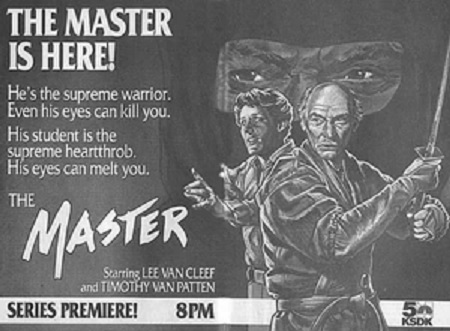
Welcome to Retro Television Reviews, a new feature where we review some of our favorite and least favorite shows of the past! On Fridays, I will be reviewing The Master, which ran on NBC from January to August of 1984. The show can be found on Tubi!

This week, The Master teams up with an old enemy.

Episode 1.4 “Hostages”

(Dir by Ray Austin, originally aired on February 10th, 1984)

“Hi, I’m Max Keller….”

This episode of The Master opens with Max (Timothy Van Patten) flying high above California in a motorized hang glider.  Apparently, this is the latest part of Max’s ninja training, though I have to wonder where the hang glider came from and whether or not being able to use a hang glider is a specific ninja skill.  The more I think about it, the more it seems that McAllister (Lee Van Cleef) is just leading Max on for his own amusement.

Max spots a woman (Jennifer Runyon, who later took over the role of Marcia Brady in A Very Brady Christmas) who is sitting behind the wheel of an out-of-control car.  Apparently, the brakes have failed and the car will soon careen over the side of a cliff!  Max swoops down and rescues the woman, minute before her car crashes and explodes.

The woman is Alice Clayton, the extremely talkative daughter of U.S. Senator Sam Clayton (Robert Dowdell).  Don’t worry, no one was trying to kill her.  The brakes just failed on their own.  A grateful Alice invites Max and McAllister to come to a party that the senator is throwing at his hillside mansion.

Soon, Max and McAllister are wearing tuxedos and hanging out at the party.  A CIA agent named Malory (one-time Bond star, George Lazenby) recognizes McAllister and accuses him of running a “subversive ninja school.”  Meanwhile, by an amazing coincidence, Okasa (Sho Kosugi) — McAllister’s former student who has taken a vow to kill him — also happens to be at the party.  He even takes the time to throw a ninja star at McAllister.

But that’s not all!  The party is also crashed by a group of terrorists, lead by Serena (Randi Brooks) and Castile (David McCallum).  The terrorists kidnaps Alice, her father, and the wives of several European diplomats.  The head of the CIA (Monte Markham) orders McAllister and Malory to set aside their differences and to rescue the hostages.  Max also decides to help which means that the hang glider makes another appearance as Max soars above the terrorist compound.

Lee Van Cleef’s stunt double gets quite a workout in this episode of The Master.  Not only do Okasa and McAllister have a brief fight but McAllister also gets to take on an entire compound full of terrorists.  Of course, McAllister wears his full of ninja uniform while doing all of this, all the better to hopefully keep us from noticing that Lee Van Cleef isn’t the one doing all of the kicking and hitting.  And I will say that, in this episode, the fights were fairly well-done.  The plot was predictable but the fights were probably about as exciting as you could hope from a network television show that aired in the 80s.

Other than the fights, the best thing about this episode was the chance to see George Lazenby playing a character who was Bond in everything but the name.  Lazenby himself has said that one of the reasons he struggled with the role of James Bond was because he was too young when he starred in On Her Majesty’s Secret Service.  In this episode of The Master, Lazenby is older and a bit more weathered and he’s totally believable as a spy who is tough but who still enjoys the better things in life.  As well, David McCallum does a good job as the cynical terrorist, though his character isn’t really given much to do.

I actually kind of enjoyed this episode of The Master.  As opposed to the previous three episodes, it focused on the action and it didn’t really have any slow spots.  It was a fun episode.