Released in 1958, How To Make A Monster is a clever little horror satire from American International Pictures in which the stars of Teenage Werewolf and Teenage Frankenstein are hypnotized into believing that they actually are the monsters that they played! The main culprit is a movie makeup artist (Robert H. Harris) who has been deemed obsolete by the new bosses at AIP.
“Don’t count on me to make you feel safe.” — The Stranger
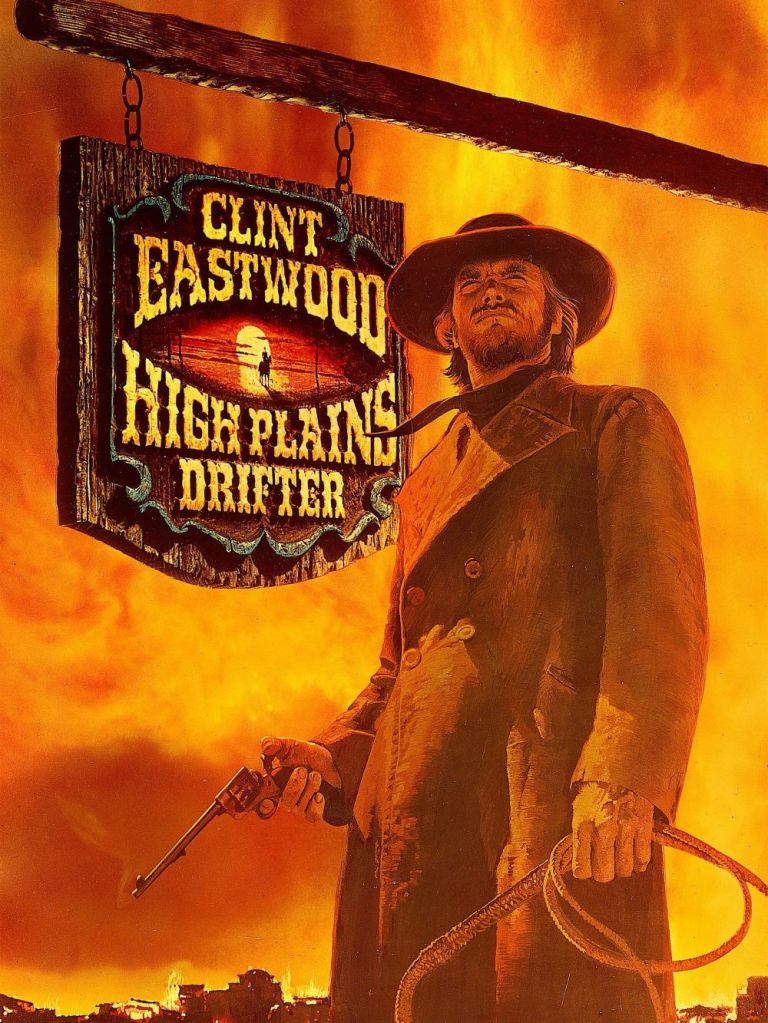
High Plains Drifter stands as one of the bleakest, most enigmatic entries in Clint Eastwood’s filmography—a Western that bleeds unmistakably into the realms of psychological and supernatural horror. This 1973 film is not just another dusty tale of lone gunfighters and frontier justice. It’s a nightmare set in broad daylight, a morality play whose hero is more monster than man.
Eastwood’s Stranger comes riding into the town of Lago from the shimmering desert, a silhouette both akin to and apart from his famed Man With No Name persona. The townsfolk are desperate, haunted by fear—less afraid of imminent violence, more of the sins they’ve half-buried. This is a place where a lawman was brutally murdered by outlaws while the townspeople looked away, their silence paid for with cowardice and greed. When the Stranger assumes command, he does so with often-gleeful sadism—kicking people out of their hotel rooms, replacing the mayor and sheriff with the dwarf Mordecai, and ordering that the entire town be painted red before putting “Hell” on its welcome sign.
There’s a surface plot: the Stranger is hired to protect Lago from the same three outlaws who once butchered its marshal. But he’s there for far more than that. The story unspools through dreamlike sequences, flashbacks that suggest the Stranger may well be an avenging spirit or a revenant—the dead lawman, spectral and merciless, returned to claim what the townsfolk owe to Hell itself.
The horror here isn’t about jump scares or gothic haunted houses. The supernatural lurks everywhere and yet nowhere. The Stranger moves with the implacable calm—and violence—of a slasher villain, transforming Lago into his personal stage for retribution. His nightmares, full of images of past atrocities, are painted with the same vivid brutality as the daytime violence. Eastwood’s use of silence, the squint of a face, the twitch of a pistol replaces musical cues in amplifying dread. The sound design evokes otherness—a howling wind, footsteps echoing across empty streets—that builds a shadow of terror around the Stranger’s presence.
This violence is hurried and brutal; its sexual politics unflinching. When the Stranger enacts revenge, he punishes not just the outlaws, but the townsfolk complicit in their crimes. There is little comfort in his sense of justice—the pleasures he takes border on sadistic. The film’s moral ambiguity cuts deeper than most Westerns or horrors: this is not a clear-cut tale of good versus evil, but a brutal reckoning of collective guilt, cowardice, and corruption.
Lago itself acts almost like a town stuck in purgatory—a holding pen between redemption and eternal damnation. The infamous “Welcome to Hell” sign the Stranger paints at the town’s entrance serves as a grim message. It’s no welcome to law and order, but a symbolic beacon to the very outlaws the Stranger is hired to confront, suggesting that Lago is a place where sin festers and punishes itself. The town’s dance with Hell is both literal and metaphorical. The inhabitants aren’t just awaiting judgment; they have invited it in their desperate attempts to hide their cowardice and greed under the guise of civilization.
This notion of Lago as purgatory stands in sharp contrast to other recent horror Westerns, which serve as prime examples of the genre’s thematic spectrum. These films tend to focus on the primal terror of nature barely held at bay by the fragile veneer of civilization the settlers claim. They pit human beings against the ancient, untamed forces of the wilderness—whether monstrous creatures or surreal phenomena—emphasizing that the supposed order and progress of the West remain fragile and constantly threatened. This dynamic symbolizes the uneasy balance between civilization’s reach and nature’s primal power, often revealing how thin and tenuous that barrier truly is.
Among these, Bone Tomahawk and Ravenous stand out as vivid examples. Bone Tomahawk confronts menacing cannibals lurking in the wild, reminding viewers that the West’s order is fragile and under perpetual threat from untamed wilderness. Ravenous uses cannibalism and survival horror as metaphors for nature’s savage predation hidden beneath the polite façade of civilization—nature’s horrors masked but not erased.
By contrast, High Plains Drifter directs its horror inward, exposing the corruption that manifest destiny imposed on settlers themselves. Instead of fearing nature as an external force, the film presents settlers as haunted by their own moral failures and complicity in violence and betrayal. The Stranger’s vengeance is a reckoning with the darkness festering inside the community, a brutal meditation on guilt, collective cowardice, and the price of greed disguised as progress.
Eastwood’s film strips away the mythic promises of the American West as a land of freedom and opportunity, revealing instead the brutal reality of communities locked in complicity, violence masquerading as justice, and the moral rot at the heart of manifest destiny. This moral ambiguity and psychological depth give High Plains Drifter a unique position in the horror Western subgenre, elevating it beyond simple scares to a profound exploration of American cultural myths.
The Stranger is not a traditional hero but a spectral judge, embodying divine or supernatural retribution. His calm yet ruthless punishment exposes the cruelty, cowardice, and malevolence within Lago’s population, meting out a justice that is neither neat nor forgiving. His supernatural aura and sadistic tendencies make him an unforgettable figure of terror and fate.
Visually, the film’s harsh daylight contrasts with the romanticized Western landscapes of earlier films. Instead of shadows hiding evil, blinding light exposes the town’s moral decay. Characters are reduced to symbols of greed, fear, and cruelty, highlighting that the true horror lies within human nature and the failure to uphold justice.
High Plains Drifter operates on multiple levels—a Western, a ghost story, a horror film, and a dark morality play. It is a relentless meditation on justice and punishment and a dismantling of the traditional Western hero myth. Through layered narrative, stark visuals, and Eastwood’s chilling performance, it remains an essential entry in the horror Western canon.
For those seeking a Western that doesn’t just entertain but unsettles and challenges, High Plains Drifter offers an unforgiving descent into darkness. It strips away the comforting myths of the frontier and exposes the raw, rotting core beneath. Unlike other modern horror Westerns such as Bone Tomahawk and Ravenous, which confront external terrors lurking in the wilderness, this film turns its gaze inward—on the moral decay, guilt, and violence festering within the settlers themselves. It’s a brutal, haunting reckoning, and Eastwood’s Stranger is the cold, relentless agent of that reckoning. This is a journey into a hell both literal and psychological, where justice is merciless and safety is a long-forgotten promise.
In 1973’s High Plans Drifter, Clint Eastwood plays …. The Stranger.
No, not the Man With No Name. The Stranger has a name but he chooses not to share it. That said, when one person says that he doesn’t even know the Stranger’s real name, the Stranger replies, “Yes, you do.” The Stranger appears to emerge from the heat of the desert, riding into the small mining town of Lago and gunning down the three bullies that the townspeople hired to protect them after the murder of their town marshal. With no other option, the townspeople accept the Stranger as the town’s new protector.
The Stranger is drawn to the town and the townspeople but he doesn’t seem to particularly like any of them, with the exception of Mordecai (Billy Curtis), the dwarf that the Stranger appoints as the town’s new sheriff. The townspeople, the majority of whom are cowardly and motivated by greed, aren’t particularly likable themselves. The Stranger rules the town like a dictator, kicking everyone out of the hotel so that he can have it for himself and ordering that every building in the town be painted red. Over the town’s welcome sign, he paints one word: “Hell.” When the townspeople see how well the Stranger can shoot, they celebrate in the belief that they’ll always be safe. The Stranger responds by leaving town just as three sadistic outlaws, led by Stacey Bridges (Geoffrey Lewis), approach. The Stranger may be looking for revenge on Bridges but he also seems as if he wants to make the town suffer for its sins as well.
Much as with the case of The Man With No Name, the Stranger is not motivated by kindness or any sort of concern for the safety of the townspeople. He often shows a cruel-streak when it comes to dealing with the cowardly townspeople. He doesn’t attack unless he’s attacked first but once you’re on his bad side, he’ll gun you down without a hint of emotion. When the Stranger sleeps, he is haunted by nightmares of the previous marshal (played by Buddy Van Horn, Clint Eastwood’s stunt double) being murdered by Bridges and his men while the townspeople stood by and did nothing. We learn that the townspeople, worried that it might be bad for their business interests, didn’t even give the late marshal a decent headstone after his death. One woman mentions that spirits can’t rest unless they have a proper marker….
Getting the idea?
High Plains Drifter is probably the closest that Eastwood has ever come to making a supernatural horror film. The Stranger may or may not be a vengeful ghost (the movie leaves that for you to decide) but he turns the small town of Lago into his own personal version of Hell and, when he attacks the men who killed the marshal, he moves with the ruthless determination of a slasher villain. The scene where Bridges and his men ride into the town is like a filmed nightmare. This is a dark film, one in which Eastwood’s Stranger is not the hero because he’s particular heroic but just because everyone else in the film is so bad.
This was also Eastwood’s second film as a director (following Play Misty For Me) and also the first of many westerns that Eastwood would direct. The imagery is often haunting, all the more so because some of the most violent scenes take place in broad daylight. The scenes where the Stranger seems to materialize out of the desert’s heatwaves perfectly capture the mythology of the old west and its “heroes.” Eastwood gets good performances out of his ensemble cast and, even more importantly, he shows that Eastwood the director had a perfect understanding of Eastwood the actor. As the Stranger, Eastwood says more with a snarl or a half-smile than most actors could say with a multi-page monologue.
High Plains Drifter is violent, often disturbing, and ultimately unforgettable.
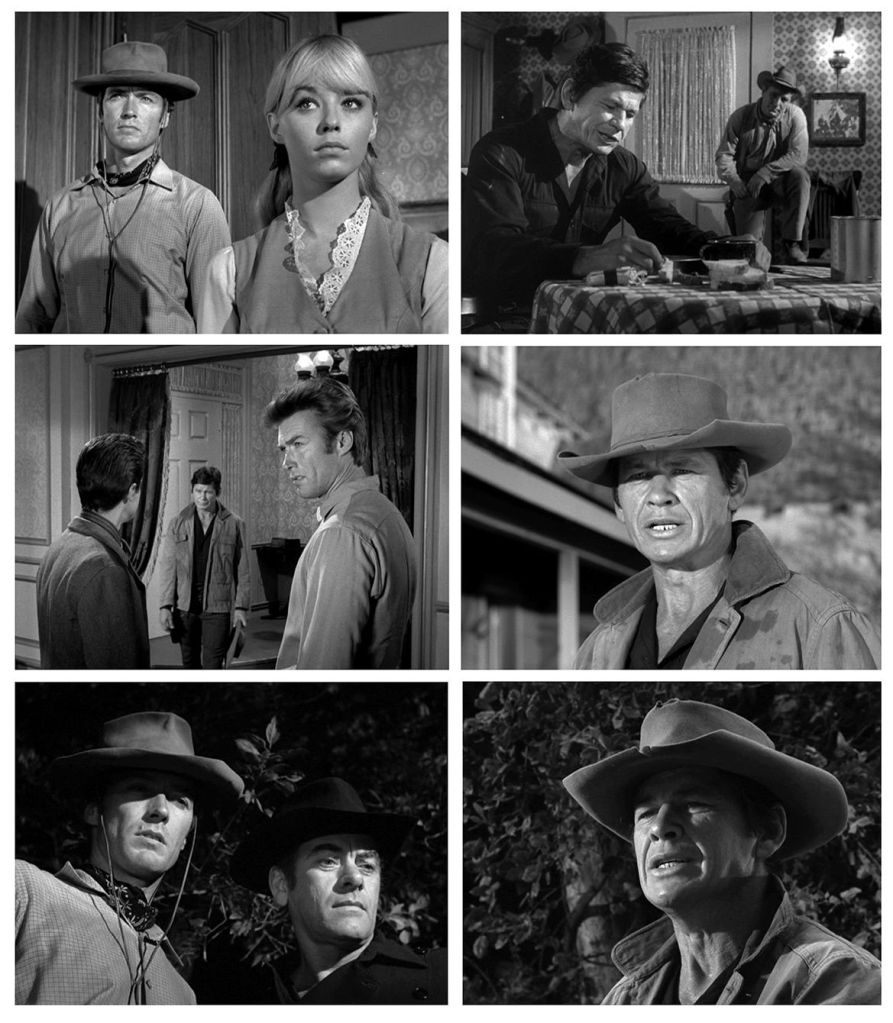
This episode of the classic western TV series RAWHIDE opens as Rowdy Yates (Clint Eastwood) and his group of drovers agree to drive 750 head of cattle belonging to rancher Mason Woodruff (Larry Gates) to market. The deal gets off to a bad start when Roman Bedford (Brendon Boone), who’s part of Yates’ outfit, finds himself trying to romance Vicki Woodruff (Jill Haworth), the daughter of the ranch owner. Woodruff’s foreman and world class A-hole, Del Lingman (Charles Bronson) sees Roman making his move and gets pissed. You see, Del wants Vicki for himself, so he tries to bully Roman into a gunfight. Luckily for young Roman, Rowdy and Mason Woodruff are able to momentarily diffuse the situation before the cowboy can be blown away by the experienced gunman. Unable to accept the humiliation that he suffered at the hands of Del, Roman challenges him to a duel to settle the score. Roman is a good shot, but he’s not a fast draw, so a couple of the men with Yates’ crew, Jed Colby (John Ireland) and Simon Blake (Raymond St. Jacques), try to teach him some tricks that just may give him a chance against Del’s superior gunplay. To complicate matters even further, Mason Woodruff has a hidden criminal past that Roman may know about. Because of this, the rancher has another reason to want Roman dead, and Del Lingman is just the man to take care of the problem. Who will survive the duel at daybreak?!!
As hard as it is to believe, my viewing of “Duel at Daybreak” is the only episode of RAWHIDE that I’ve ever watched, and it’s special to me for two reasons. First, the episode premiered on my mom’s 14th birthday, November 16, 1965. And second, it’s the only time that tough guy icons Clint Eastwood and Charles Bronson would appear on screen together. For historical reference, this was the last season of RAWHIDE, with only three episodes of the classic series to come after this. Eastwood was at the beginning of his legendary movie career after filming FISTFUL OF DOLLARS (1964) and FOR A FEW DOLLARS MORE (1965) for director Sergio Leone. Bronson, who was already a well-respected character actor, was two years away from making THE DIRTY DOZEN (1967) and three years away from breaking out as an international superstar by playing Harmonica in Leone’s masterpiece, ONCE UPON A TIME IN THE WEST (1968).
For the episode itself, Charles Bronson is the true standout as Del Lingman. He’s the kind of mean SOB who would goad a man into a gunfight, kill him, and then sit down for dinner without a care in the world. Bronson has a face that makes for a good villain, and he often played the bad guy in his early TV shows and movies. He projects real menace and danger in this role. Clint Eastwood’s Rowdy Yates may be the star of the show and the trail boss, but he’s a bit more of a secondary character in this specific episode as the main tension is between Bronson and the young cowboy played by Brendon Boone. Looking back now, it’s an incredible missed opportunity that the “duel at daybreak” wouldn’t feature Eastwood versus Bronson. Eastwood mostly tries, and fails, to play peacemaker in the episode. The two legends do exchange a potentially badass back and forth when Eastwood is trying to deescalate the situation and keep Bronson from shooting the young cowboy over a little mud on his pants:
Rowdy Yates: “Putting a high price on a pair of pants, ain’t you?”
Del Lingman: “Perhaps you’d like to pay for them.”
Rowdy Yates: “Any time, mister.”
It’s a good scene, but it’s just a shame that they didn’t get a chance to mix it up at the end.
As Charles Bronson’s biggest fan, I enjoyed seeing a couple of actors who worked with him in the 80’s. John Ireland, who plays Jed Colby in this episode, co-starred with Bronson in MESSENGER OF DEATH (1988) as Morman patriarch Zenus Beechum. It’s not one of Bronson’s best, but one of the highlights of the film is its strong cast. Ireland has roles in so many great films, including MY DARLING CLEMENTINE (1946), RED RIVER (1948), GUNFIGHT AT THE O.K. CORRAL (1957) and FAREWELL MY LOVELY (1975). He would appear in 11 episodes of RAWHIDE. Raymond St. Jacques, who plays Simon Baker in this episode, has a very memorable role in Bronson’s disturbing hitman thriller THE EVIL THAT MEN DO (1984). In a unique twist in the Bronson filmography, Jacques’ bodyguard character Randolph gets duped into thinking he’s about to get some three-way action with Bronson and Theresa Saldana only to end up dead with a knife sticking out of his throat. It’s a memorable meet and kill. I noticed he played a character named “Coffin” Ed Johnson in COTTON COMES TO HARLEM (1970). With a name like that, he’s got to be good! He would appear in 13 episodes of RAWHIDE.
Overall, “Duel at Daybreak” is a special episode of RAWHIDE since it put Eastwood and Bronson on screen together for the only time in their careers. I wish they could have fought with fists or guns, but it wasn’t meant to be. Beggars can’t be choosers, and at this point, I’ll gladly take what we got.
Released in 1958, How To Make A Monster is a clever little horror satire from American International Pictures in which the stars of Teenage Werewolf and Teenage Frankenstein are hypnotized into believing that they actually are the monsters that they played! The main culprit is a movie makeup artist (Robert H. Harris) who has been deemed obsolete by the new bosses at AIP.
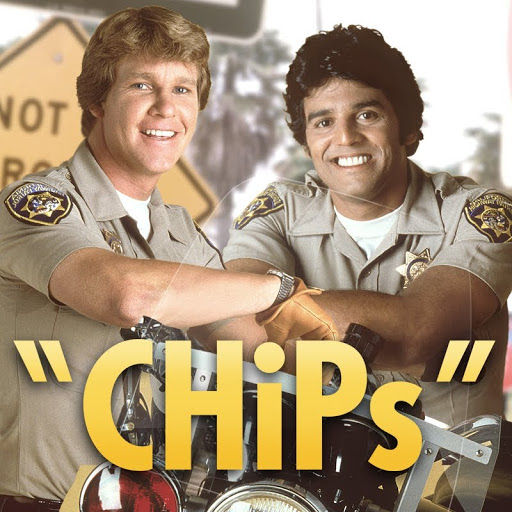
Welcome to Late Night Retro Television Reviews, a feature where we review some of our favorite and least favorite shows of the past! On Mondays, I will be reviewing CHiPs, which ran on NBC from 1977 to 1983. The entire show is currently streaming on Freevee!
This week, Ponch takes a deep breath and he gets real high.
Episode 1.2 “Undertow”
(Dir by Christian I. Nyby II, originally aired on September 22nd, 1977)
On tonight’s episode of CHiPs, a true crisis breaks out.
The California Highway Patrol’s basketball team loses a game!
Now, they would have won the game if Ponch had been playing. I’m only two episodes into this series and it’s already pretty obvious that there’s apparently nothing that Ponch can’t do. However, while at the scene of an accident on the highway, Ponch stood right in front of a leaky cannister of nitrous oxide! He ended up getting so high that he started seeing double, dancing in the halls of the station, and basically just acting like a total jackass. Of course, he smiled the whole time. Baker was less amused.
Because of his temporary high, Ponch was sent home and ordered to stay in bed for a day. He missed the game and the CHiPs lost to some other off-duty branch of California law enforcement. Fortunately, Sgt. Getraer is able to set up a rematch and, with Ponch now able to play, the CHiPs win by two points! And, of course, the winning shot is taken by Ponch because there’s nothing that Ponch can’t do. This episode ends with a series of freeze frames of Ponch winning the game and proving that California has the best highway patrol in the country.
Of course, the basketball game is only the B-plot of this episode of CHiPs. The main storyline deals with fake tow truck driver (Angelo de Meo) who is listening to the police radio for calls from women who have broken down on the highway. The driver goes to wherever the women are calling from but, instead of towing their car, he instead steals their money! The first time that Ponch and Baker chase him, the crooked tow truck driver gets away. The second time, they catch him. Of course, both of the chases lead to multi-car wrecks on the highway. This episode features the first instance of a car flipping over in slow motion on this show. Apparently, that would go on to become a CHiPs trademark.
Of course, there are other little things that Ponch and Baker have to deal with. They pull over a drunk driver (Jim Backus) and Ponch, who is high from the nitrous oxide, struggles to give him a sobriety test. They also pull over an old surfer (Paul Brinegar), who has a talking myna bird in his truck. The bird was cute. These scenes did not add up too much but I imagine they were included to drive home the idea that Ponch and Baker are professionals, even if they do spend a lot of time talking about basketball.
This episode was actually kind of fun. Erik Estrada is not a particularly subtle actor to begin with and this episode actually gives him an excuse to overact even more than usual. As much fun as it is to watch Estrada bounce off the walls, it’s even more interesting to glance over at Larry Wilcox and see just how much he appears to resent having to work with someone who always has to be the center of every scene. Neither Wilcox nor Baker seem particularly unhappy about Ponch being sidelined for a good deal of the episode. Just as in the pilot, the chase scenes were genuinely well-filmed and it was impossible not to enjoy the shots of the motorcycles weaving in and out of traffic.
Next week, Ponch will probably save someone’s life while Baker seethes in the background. We’ll see!
Released in 1958, How To Make A Monster is a clever little horror satire from American International Pictures in which the stars of Teenage Werewolf and Teenage Frankenstein are hypnotized into believing that they actually are the monsters that they played! The main culprit is a movie makeup artist (Robert H. Harris) who has been deemed obsolete by the new bosses at AIP.
Released in 1958, How To Make A Monster is a clever little horror satire from American International Pictures in which the stars of Teenage Werewolf and Teenage Frankenstein are hypnotized into believing that they actually are the monsters that they played! The main culprit is a movie makeup artist (Robert H. Harris) who has been deemed obsolete by the new bosses at AIP.
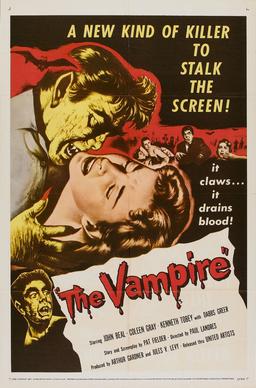
And if you didn’t already know that, you will know it after watching the 1957 film, The Vampire.
Like many films of this kind, The Vampire starts with death.
Actually, I take that back. Technically, it’s true but it’s also little bit too melodramatic. And, to be honest, The Vampire starts with a 14 year-old boy, who is very much alive, riding his bicycle down the street of Anytown USA. He has a box with him, one that has air holes. On the back of his bike, a cardboard sign reads: “Bobs Pet Zoo! If Its Alive We Got It!” Apparently, the kid is smart enough to run his own zoo but not smart enough to know when to use an apostrophe.
Anyway, the kid comes up to a creepy old house, one that looks somewhat out of place in the otherwise pristine suburban neighborhood. Originally, I thought that maybe Pennywise lived in the house but then I reminded myself that The Vampire was made decades before It. Instead, the house belongs to Dr. Campbell, a scientist who is doing experiments with blood and who needs a never-ending supply of animal test subjects. (Boooooo! Animal testing! Hiss!) Apparently, the kid keeps Dr. Campbell supplied with animals. When the kid enters the house, Dr. Campbell is nowhere to be seen. It’s not until the kid enters the laboratory that he discovers Campbell, dead and slumped over his desk.
As news spreads of Campbell’s death, his friend, Dr. Paul Beecher (John Beal), searches through Campbell’s belongings and he comes across a mysterious bottle of pills, which he promptly takes home with him. Dr. Beecher is kindly doctor, the type that we all wish we could deal with whenever we had to go in for a check up. However, he suffers from terrible migraines. That night, when he’s literally blinded with a headache, he asks his daughter to get him his pills. She retrieves a bottle of pills but guess what? They’re the wrong pills! They’re not headache pills! Instead, they’re Dr. Campbell’s vampirism pills!
The pills cause Beecher to blaxk out. Whenever he comes to, he never has any memory of what he may or may not have done while he was out. However, strange things are happening to his friends and his patients. One of his longtime patients dies of fright when he comes by her house. On her neck, he finds two puncture wounds…
So, it’s not a spoiler for me to tell you that Dr. Beecher has been transformed into a vampire. And I know what you’re thinking. Why doesn’t he just stop taking the pills? The simplest answer is that the pills are addictive. The more complex answer is that he doesn’t want to. The pills have brought out his dark side and, now that it’s free, it’s not planning on going anywhere.
In a strange way, The Vampire reminded me of Nicholas Ray’s Bigger Than Life. In Bigger Than Life, James Mason plays a gentle and good-hearted professor who, after taking steroids, turns into a monster who dreams of creating a master race. Bigger Than Life was unsettling for the exact same reason that The Vampire is unsettling. Both suggest that the pills didn’t turn their user into a monster. Instead, the pills just allowed his true self to come out.
The Vampire was a low-budget film, a B-movie as many would probably call it. The musical score is overly melodramatic and so are some of the actors. But I would say that The Vampire is actually a bit of a subversive masterpiece. This 1957 film suggests that behind the pristine facade of suburbia, there lurked monsters. Even an outwardly successful and respected man like Dr. Beecher can turn into something totally different behind closed doors, this film is saying. That’s a message that it as relevant today as it was when this film was first released. In its own way, The Vampire is a brilliant and important movie.

 Through the Shattered Lens