And so, another Cannes film festival has come to a close! Despite my initial predictions and some generally respectful reviews, Ken Loach did not win a third Palme d’Or for The Old Oak so I’m happy about that. Here’s what did win:
COMPETITION
Palme d’Or: “Anatomy of a Fall,” Justine Triet
Grand Prix: “The Zone of Interest,” Jonathan Glazer
Director: Tran Anh Hung, “The Pot au Feu”
Actor: Kōji Yakusho, “Perfect Days”
Actress: Merve Dizdar, “About Dry Grasses”
Jury Prize: “Fallen Leaves,” Aki Kaurismaki
Screenplay: Sakamoto Yûji, “Monster”
OTHER PRIZES
Camera d’Or: “Inside the Yellow Cocoon Shell,” Thien An Pham
Short Films Palme d’Or: “27,” Flóra Anna Buda.
Short Films Special Mention: “Fár,” Gunnur Martinsdóttir Schlüter
Queer Palm: “Monster”
UN CERTAIN REGARD
Un Certain Regard Award: “How to Have Sex,” Molly Manning Walker
Jury Prize: Asmae El Moudir, “Hounds”
Best Director Prize: “The Mother of All Lies,” Asmae El Moudir
Freedom Prize: “Goodbye Julia,” Mohamed Kordofani
Ensemble Prize: “The Buriti Flower,” cast and crew
New Voice Prize: “Omen,” Baloji
DIRECTORS’ FORTNIGHT
Europa Cinemas Label: “Creatura,” Elena Martín
Society of Dramatic Authors and Composers Prize: “A Prince,” Pierre Creton
CRITICS’ WEEK
Grand Prize: “Tiger Stripes,” Amanda Nell Eu
French Touch Prize: “It’s raining in the house,” Paloma Sermon-Daï
GAN Foundation Award for Distribution: Pyramide Films, “Inshallah a boy”
Louis Roederer Foundation Rising Star Award: Jovan Ginić, “Lost Country”
As far as the Oscars are concerned, I think the big winner at Cannes was Martin Scorsese’s Killers of the Flower Moon. Yes, it was screened out of competition but the response to the film was so enthusiastic that it pretty much confirmed that, for now, it’s the Oscar front runner. If nothing else, the response temporarily silenced those who have been insisting that Killers of the FlowerMoon would be a disappointment. (Bizarrely, there’s a whole generation of film commentators who seem to be obsessed with claiming that Scorsese is somehow overrated. I’d hate to think this is all about something as petty as Scorsese’s criticism of the Marvel films but then again, we live in petty times.) I would also keep an eye on Jonathan Glazer’s The Zone of Interest, which many expected would win the Palme but which had to settle for the jury prize. From what I’ve read, Glazer’s film sounds like it could be an Oscar contender.
I like to think a person’s love of film reflects who they are. Please bear with me on this one.
The movies that move us, make us smile or laugh or cry tend to paint a picture. In some ways, this works out well. When your friend sits you down, shows you The Shawshank Redemption, watches you ball your eyes out and then laugh by the end, you get that slow nod that says..”This fellow, they understand.” The movie love spreads like that tape in The Ring. I’ve had this happen on separate occasions my Live Tweet experiences. The Manitou was an an absolute blast that had me laughing and asking myself just what the hell I was watching. A Field in England was a weird, wild trip that made me flinch at times. They may be stranger films, but they were were also great experiences. Without them, I wouldn’t have my eyes opened to what’s out there in terms of cinema.
I also believe the idea of loving anyone unconditionally is possible under the right conditions, but is a difficult concept. I’ve found that people are usually ready to “ride or die” with you as long as you are both moving along the same path, sharing the same mindset. However, there will always be something that puts a relationship (family/friends/lovers) to the test and maybe a line is drawn that can’t be crossed. It takes a lot for someone to bear all of their flaws before another person, just as it does to see them and say, “You’re cool with me.” It’s no different from having a family that loves you right up until that moment where your political or religious views diverge and you suddenly find yourself disowned because of it. That’s just my opinion.
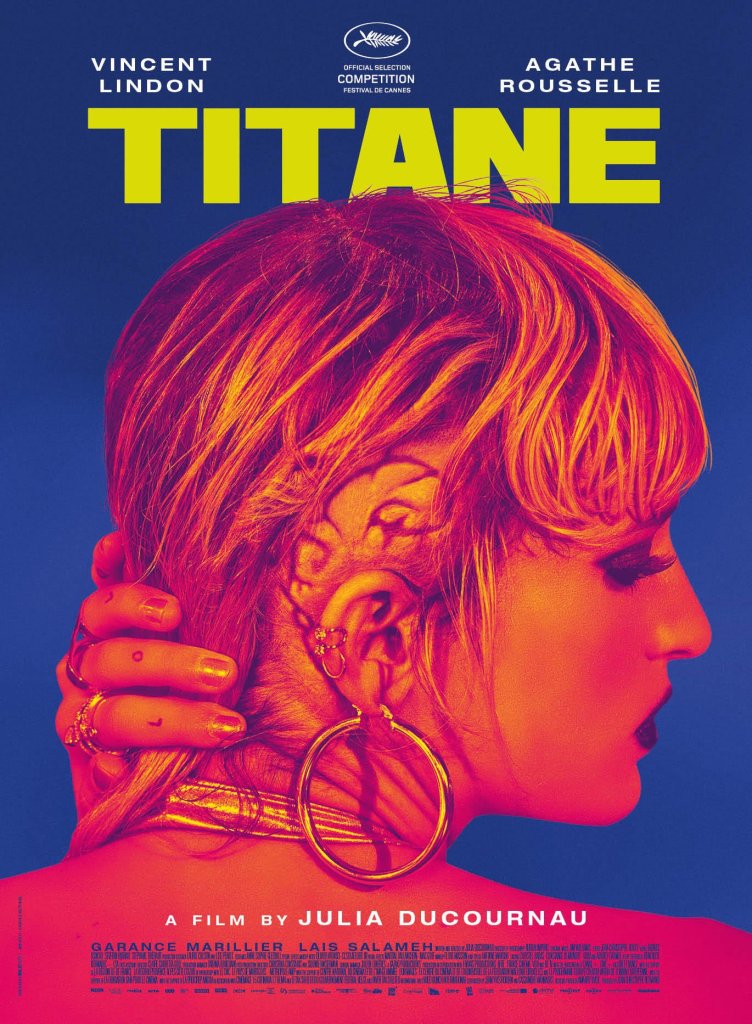
I caught Julia’s Ducournau’s Titane last Thursday Night in a near empty theatre in Midtown Manhattan. I’ve been thinking about it in some form or another ever since. I went to catch it because I needed to get out and about for a little while, and I enjoyed Raw immensely. Just like Malignant, I went in blind, only really knowing it was a Ducournau film and seeing an image of a girl laying across a car. Maybe it was because by the end, I applauded like a seal and caught some strange looks from people on the way out of the theatre, but I kind of feel weird for enjoying this film as much as I did. I didn’t know what the hell I just watched, but it made me feel something, and that was enough. I’m not entirely sure of what that says about me as a person.
Agathe Rousselle as Alexia in Julia Ducournau’s Titane
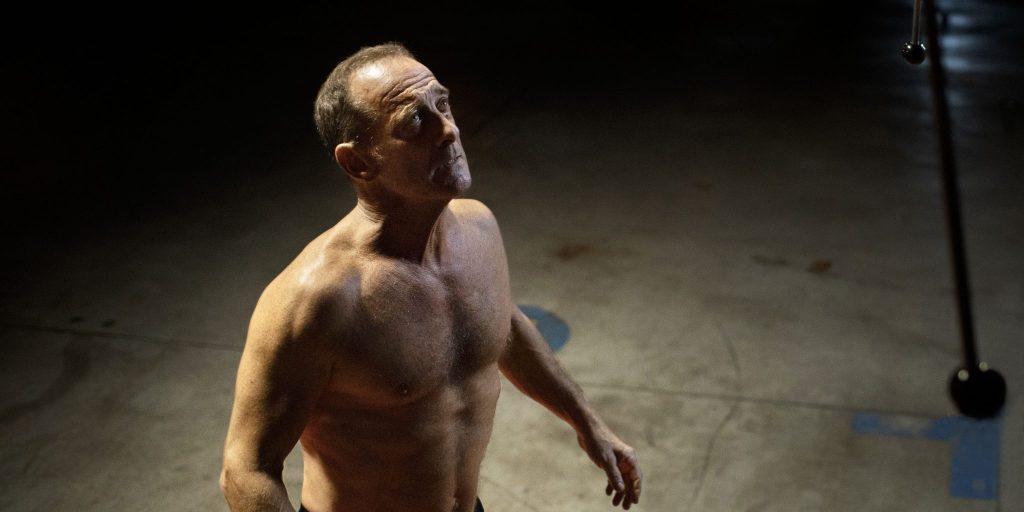
Alexia (Agathe Rousselle, in her first full length film) is a live wire. Introduced to the audience as a child, we can see she works off of pure instinct. She also has a love for cars. When she sustains major injuries from a car accident, Alexia has to have a titanium plate (hence the movie’s title in one form) put into her skull that leaves a wild pattern on her skin. Alexia’s instincts carry with her into adulthood, but I saw her as being very feral. Whether it’s food or drink, or darker desires, she throws herself fully into it. Vincent (Vincent Lindon), is a leader and a rescue specialist coping with the loss of his son, who went missing some time ago. When their lives intersect, the plot for Titane seemed to change and for me, became a story about unconditional love. There is horror throughout Titane, suffer no illusions. Blood, broken limbs and all kids of fluids, but there’s also a sense of acceptance and forgiveness despite how dark things really get. Much like the automobile Alexia dances alongside, the plot felt like it shifted gears to the point I wasn’t sure what I really watching. Mind you, I didn’t really see a trailer or anything, so I didn’t have recognizable snippets to reference and say “Ah, I remember that from the trailer.” It may make the film a little hard for some audiences to follow. What I enjoyed, though I list it as a possible con, is that the film never bothers to tell you any of the how’s or why’s for anything you’re seeing. No explanations on why Alexia is who she is or how certain elements are possible. There’s no clear cut answer, like in Malignant.
It just is what it is.
Vincent (Vincent Lindon), testing his limits in Julia Ducournau’s Titane
Both actors carry their roles very well. Rousselle’s Alexia moves between passion, violence and vulnerability in the blink of an eye and I hope that Titane serves as a launchpad for her in future roles. Lindon also goes through the same process, though his character is more nurturing (though just as broken). It’s really hard to imagine other actors doing all of this. Garance Marillier (Raw) reunites with Ducournau as Justine, one of the other dancers Alexia knows. This also brings up something I found interesting. With the exception of Vincent, the names of all of the principal characters are the same character names from Raw. I have to wonder if that’s just coincidence or maybe Ducournau just has a fondness for those names.
During the New York Film Festival, Ducournau said in the post movie Q&A that the film was based on a nightmare she had. She doesn’t play around at all here, and puts it all on view. Titane could easy sit on a shelf among Antonia Bird’s Ravenous, Mary Harron’s American Psycho, and Coralie Fargeat’s Revenge. The blood flow is vicious and mostly brutal. There was at least once sequence that made me flinch in my seat and say..”Oh damn!” while instinctively reaching for a body part. While the movie does contain some sexual scenes and nudity, they’re not terribly explicit. The sound quality in my theatre was loud and rich, so the squishes and breaks were pretty impacting. Ruben Impens returns to work with Ducournau as the Director of Photography and for the most part, the visuals were solid. Colors were vibrant and there weren’t any scenes that seemed like they didn’t work.
So, overall, I truly enjoyed Titane. Did I fully get it? I don’t know. A lot of it is up to interpretation, but I guess that can be said of any film. I give Ducournau and the actors credit for making something that felt strange. When I get a physical copy, I’ll probably sit it next to Jean-Luc Godard’s Weekend, easily one of the most confusing films I’ve seen (that I love).
Still, I have to wonder what that all says about me.
On a side note, I was about to publish this when I realized that Titane is also the winner of this year’s Palme D’or, which is the highest recognition given to a film at the Cannes Film Festival. While I haven’t enough personal knowledge to fully explain how good or bad that may be, Cannes has been in existence since the the mid 1940s. The Shattered Lens has followed Cannes for some time now. Titane shares the win with other films over the years such as Francis Ford Coppola’s Apocalypse Now, Martin Scorsese’s Taxi Driver, Bob Fosse’s All That Jazz and as recently as Jong Boon Ho’s Parasite. Ducournau’s only the second woman to have won the prize, along with Jane Campion for The Piano.
In Tokyo, Osamu Shibata is married to Nobuyo, who live in poverty. Osamu receives occasional employment and Nobuyo has a low-paying job, but the family relies in large part on the grandmother’s pension. Osamu takes his son Shota shoplifting for groceries, and discover a girl, Yuri, homeless. Osamu takes Yuri to their home, where the family informally adopts her. However, the Tokyo police, aware Yuri is missing, begin to search for her.
This year’s strangely low-key Cannes Film Festival has come to a close! Here’s what won at Cannes this year:
In Competition
Palme d’Or: Shoplifters by Hirokazu Kore-eda
Grand Prix: BlacKkKlansman by Spike Lee
Best Director: Paweł Pawlikowski for Cold War
Best Screenplay:
Alice Rohrwacher for Happy as Lazzaro
Jafar Panahi for 3 Faces
Best Actress: Samal Yeslyamova for Ayka
Best Actor: Marcello Fonte for Dogman
Jury Prize: Capernaum by Nadine Labaki
Special Palme d’Or: Jean-Luc Godard
Un Certain Regard
Un Certain Regard Award: Border by Ali Abbasi
Un Certain Regard Jury Prize: The Dead and the Others by João Salaviza and Renée Nader Messora
Un Certain Regard Award for Best Director: Sergei Loznitsa for Donbass
Un Certain Regard Jury Award for Best Performance: Victor Polster for Girl
Un Certain Regard Award for Best Screenplay: Meryem Benm’Barek-Aloïsi for Sofia
Cinéfondation
First Prize: The Summer of the Electric Lion by Diego Céspedes
Second Prize:
Calendar by Igor Poplauhin
The Storms in Our Blood by Shen Di
Third Prize: Inanimate by Lucia Bulgheroni
The question that we ask every year is whether the Cannes Film Festival will have any effect on the Oscar race. We especially ask that whenever an American film wins the Palme d’Or or an American or British performer takes home one of the acting prizes. This year, BlacKkKlansman was the highest rewarded American film, though it didn’t pick up the Palme. That said, even if it didn’t win the top prize, BlacKkKlansman did receive rapturous reviews, certainly enough justify it’s current status as a possible Oscar nominee.
In the history of Cannes Film Festival, only two documentaries have won the Palme d’Or.
The second documentary to win was Michael Moore’s Fahrenheit 9/11, which won in 2004 despite not being a particularly good film. In fact, even by the standards of Michael Moore, it was deceptive and sloppy. However, it was also anti-Bush at a time when the entire world was anti-Bush and that was enough for it to win. (Hilariously, at the time, there was serious talk that Fahrenheit 9/11 would somehow keep Bush from winning reelection, as if anyone who was even thinking of voting for Bush would have ever bothered to sit through Moore’s film.)
Far more interesting than Moore’s screed is the first documentary to win the Palme, 1956’s The Silent World. Narrated and co-directed (with Louis Malle) by the famed oceanographer, Jacques Cousteau, the film follows Cousteau and the crew of Calypso over the course of two and a half years, as they explore the Mediterranean Sea, the Persian Gulf, the Red Sea and the Indian Ocean. The film was one of those first to make use of underwater color photography, which at the time was quite revolutionary. Chances are that, for many audiences in 1956, The Silent World was their first chance to see what the undersea world was actually like.
Unfortunately, Jacques and his merry band of divers spend a good deal of the documentary destroying stuff. Watching the film, it’s obvious that the divers don’t understand the potential damage of their actions and Cousteau would go on to renounce a lot of the exploration techniques used in The Silent World but still, it’s hard not to occasionally cringe. Watching the divers as they explore the underwater depths, you immediately notice that they seem to be rather grabby, snatching everything that they can off of the ocean floor. When Cousteau feels that a coral reef is getting in the way of his research, he solves the problem with dynamite. Then there’s the scene where the crew of Calypso kill several sharks that are eating the carcass of a baby whale. (Cousteau explains that the shark is the diver’s natural enemy, which may be true but doesn’t excuse the slaughter that follows.) Making all of this even worse is that the baby whale wouldn’t have died in the first place if it hadn’t been hit by the Calypso’s propeller. Scenes like that leave you wondering if maybe it would be better for everyone is Jacques and his crew just went home.
And yet, at the same time, this documentary features scenes of underwater beauty that remains breathtaking even after 62 years. The underwater camera captures schools of beautiful fish ducking out-of-the-way of the human invaders and, in the films most haunting sequence, we follow a diver as he explores a sunken ship. In these moments, the beauty of the underwater world overwhelms you and you forget about your reservations about what’s going on with the crew of the Calypso. In these moments, you embrace the beauty of it all and the world suddenly seems as if its full of limitless possibilities.
In those moments, you can understand why The Silent World not only won an Oscar for Best Feature Documentary but the coveted Palme d’Or as well.
The 1982 film Missing takes place in Chile, shortly after the American-backed military coup that took out that country’s democratically elected President, Salvador Allende.
Of course, the film itself never specifically states this. Instead, it opens with a narrator informing us that the story we’re about to see is true but that some names have been changed “to protect the innocent and the film.” The film takes place in an unnamed in South America, where the military has just taken over the government. Curfew is enforced by soldiers and the sound of gunfire is continually heard in the distance. Throughout the film, dead bodies pile up in the streets. Prisoners are held in the National Stadium, where they are tortured and eventually executed. Women wearing pants are pulled out of crowds and told that, from now on, women will wear skirts. The sky is full of helicopters and, when an earthquake hits, guests in a posh hotel are fired upon when they try to leave. About the only people who seem to be happy about the coup is the collection of brash CIA agents and military men who randomly pop up throughout the film.
Again, the location is never specifically identified as Chile. In fact, except for the picture of Richard Nixon hanging in the American embassy, the film never goes out of its way to point out that the film itself is taking place in the early 70s. If you know history, of course, it’s obviously meant to be Chile after Allende but the film itself is set up to suggest that the story its telling is not limited to one specific place or time.
Charlie Horman (John Shea) is an American who lives in the country with his wife, Beth (Sissy Spacek). Charlie is a writer who occasionally publishes articles in a local left-wing newspaper. In the aftermath of the coup, Charlie is one of the many people who go missing. All that’s known is that he was apparently arrested and then he vanished into the system. The authorities and the American ambassador insist that Charlie probably just got lost in the confusion of the coup and that he’ll turn up any day. Even though thousands have been executed, everyone assumes that Charlie’s status as an American would have kept him safe. As brutal as the new government may be, they surely wouldn’t execute an American….
Or, at least, that’s what Ed Horman (Jack Lemmon) believes. Ed is Charlie’s father, a businessman from New York who simply cannot understand what’s going on. He can’t understand why his son and his daughter-in-law went to South America in the first place. He can’t understand why his government is not doing more to find his son. And, when he eventually arrives in South America himself, Ed cannot understand the violence that he sees all around him.
Working with Beth, Ed investigates what happened to his son. At first, Ed blames Beth for Charlie’s disappearance and Beth can barely hide her annoyance with her conservative father-in-law. But, as their search progresses, Beth and Ed come to understand each other. Beth starts to see that, in his way, Ed is just as determined an idealist as Charlie. And Ed learns that Charlie and Beth had good reason to distrust the American government…
Costa-Gavras is not exactly a subtle director and it would be an understatement to say that Missing is a heavy-handed film. The Embassy staff is so villainous that you’re shocked they don’t all have mustaches to twirl while considering their evil plans. When, in a flashback, Charlie meets a shady American, it’s not enough for the man to be a CIA agent. Instead, he has to be a CIA agent from Texas who heartily laughs after everything he says and who brags on himself in the thickest accent imaginable. When Charlie talks to an American military officer, it’s not enough that the officer is happy about the coup. Instead, he has to start talking about how JFK sold everyone out during the Bay of Pigs.
As the same time, the film’s lack of subtlety also leads to its best moments. When Beth finds herself out after curfew, the city turns into a Hellish landscape of burning books and dead bodies. As Beth huddles in a corner, she watches as a magnificent white horse runs down a dark street, followed by a group of gun-toting soldiers in a jeep. When Ed and Beth explore a morgue, they walk through several rooms of the “identified” dead before they find themselves in a room containing the thousands of unidentified dead. It’s overwhelming and heavy-handed but it’s also crudely effective. While the film itself is a bit too heavy-handed to really be successful, those scenes do capture the horror of living under an authoritarian regime.
(Interestingly, Missing was a part of a mini-genre of films about Americans trapped in right-wing South American dictatorships. While you can’t deny the good intentions of these films, it’s hard not to notice the lack of films about life in Chavez’s Venezuela or the political dissidents who were lobotomized in Castro’s Cuba.)
Missing won the Palme d’Or at the 1982 Cannes Film Festival (an award that it shared, that year, with the Turkish film Yol) and it also received an Oscar nomination for best picture of the year. (It lost to Gandhi.)
As I watched the 2016 film, I, Daniel Blake, two thoughts ran through my head.
First: This is one of the saddest, most powerful films that I’ve ever seen.
Second: It’s a pity that, for all of his talent, Ken Loach is such an anti-Semitic twat.
Daniel Blake (Dave Johns) is a carpenter who lives in Newcastle. He’s a widower who lives alone in a small flat, keeps an eye on his neighbors, and always tries to do the right thing. As he explains it, he’s never asked for nor accepted charity. He’s worked hard all of his life and all he’s ever asked is to be treated with respect in return. After suffering a heart attack, he is told by his doctor that it will be a while before he can safely return to work. However, when Blake goes to the Department of Work and Pensions, he is told that he had been evaluated and he only “scored 12 points.” In order to receive an employment and support allowance, he would need to score 14 points. How does one score 14 points? No one seems to be quite sure. Fortunately, there is an appeals process but no one appears to be willing to give Dan a straight answer as to how the process works. He’s told that it can’t even start until he gets an official call informing him that his application for the allowance has been denied. Of course, Dan already knows that he’s been denied because, through a bureaucratic snafu, Dan received a letter telling him that he’s been denied. However, it doesn’t matter that he already knows it. What matters is that he wait for the official phone call.
In the meantime, it is continually suggested that Dan go online to solve all of his problems, despite the fact that Dan is 59 year-old and has next to no idea how to work a computer. (When he does go online, he’s forced to ask strangers for help with everything from using the mouse to submitting his forms.) Broke, Dan applies for a jobseeker’s allowance and is told that he had to spend 35 hours a week looking for employment, despite the fact that his doctor has not cleared him to work. Whenever someone is willing to hire Dan, Dan is forced to admit that he can’t take the job, adding to the list of his daily humiliations.
Meanwhile, Dan befriends a single mother, Katie (Hayley Squires), who is literally starving herself so that her children will have enough to eat. (In one of the film’s most powerful scenes, Katie has a breakdown at a food bank.) When she’s caught shoplifting, a security guard offers to help her out but his help comes with a price of its own.
And through it all, the state continues to grind both Dan and Katie into the ground. With its harrowing portrayal of two people literally being destroyed by a combination of poverty and authoritarian bureaucracy, I, Daniel Blake is the rare movie that can be enjoyed by both socialists and libertarians. At no point does I, Daniel Blake romanticize the poverty of its characters. From the minute we first see Daniel, he is obviously a very ill man and the film does not flinch from showing the personal toll of the daily humiliations of his struggle to just get someone to listen to his voice. As we watch, we hope things will work out for Dan and Katie, even though we know they won’t. Katie is fond of saying that she’s going to go back to school and Dan even makes her a bookcase for her future school books but again, we know it’s a dream that will probably never come true. It’s not a happy film but it is a powerful one.
That said, I nearly didn’t watch I, Daniel Blake because of the fact that it is a Ken Loach film. Loach is one of the world’s most acclaimed directors, a filmmaker and activist who has been making movies since the late 1960s. Loach is known for his willingness to make films that both deal with social issues and challenge the British status quo. Though he may not be well-known in the States, he’s a controversial figure in the UK. He’s also one of the leading supporters of the despicable BDS movement and, when one looks over his public comments, it’s hard not to get the impression that his criticism of Israel is motivated by more than just disagreement with Israeli government policy.
But I did watch because, ultimately, I feel that art can be separated from the artist. Ken Loach may be loathsome but this film is not. I, Daniel Blake won the Palme d’Or at the 2016 Cannes Film Festival, beating out such films as American Honey, Elle, The Neon Demon, and Toni Erdmann.
(With this year’s Cannes Film Festival coming to a close, I figured that I would start of today by looking at some previous winners of the Palme d’Or. We start things off with 1986’s The Mission.)
The Mission opens with a man stoically plunging over a waterfall. That man is a priest who, in the 1740s, has been sent to convert the natives of the Paraguayan jungle to Christianity. The natives’ reaction to the priest’s arrival was to tie him to a wooden cross and send him over the falls. It’s an opening that perfectly captures one of the main themes of The Mission: the contrast between the beauty of nature and the savagery of man.
The majority of the film deals with two men. Father Gabriel (Jeremy Irons) is the Spanish Jesuit who replaces the martyred priest. Father Gabriel is a pacifist who manages to win the trust of the natives through a shared love of music. Gabriel plays the oboe and, when it is snatched away from him, reacts not with anger but with acceptance. With the help of Father John Fielding (Liam Neeson), Father Gabriel builds a mission and works to educate the natives. This brings him into conflict with the local plantation owners, the majority of whom just see the natives as being potential slaves.
That’s where Mendoza (Robert De Niro) comes in. A brutish and violent man, Mendoza makes his living kidnapping natives and selling them into slavery. When Mendoza discovers that his fiancée, Carlotta (Cherie Lunghi), has fallen in love with his younger brother, Felipe (Aidan Quinn), Mendoza snaps and, in a moment of anger, kills his brother. Seeking forgiveness for his violent past, Mendoza travels to Father Gabriel’s mission, dragging all of his armor and weaponry in a bundle behind him. When Mendoza finally reaches the mission, he is not only forgiven by the natives but he also eventually ends up becoming a Jesuit himself.
And, for a while, everything is perfect. That is until the Spanish turn over their land in South America to the Portuguese and the new colonials decide that having a mission around will make it a little bit too difficult to enslave the natives. When Father Gabriel is ordered to close the mission, he refuses to do so. He says that he will stay and that he is willing to be martyred if the Portuguese forces attack. Gabriel believes that violence is a sin against God. Mendoza, on the other hand, announces that he will stay and he is prepared to once again pick up weapons to defend the mission…
Dramatically, The Mission is uneven. While Jeremy Irons and Liam Neeson are both believable and sympathetic as Father Gabriel and Father Fielding and fit right in with the film’s period setting, Robert De Niro seems miscast and out-of-place. As good an actor as De Niro is, he just doesn’t belong in the jungles of South America. Whenever he shows up or speaks, your mind immediately goes to New York City. The film tries to juggle so many theological and political issues that it can get a bit exhausting trying to keep up with it all. Watching the film, it was hard not to wish for a chance to see what a director like Werner Herzog or Terrence Malick would have done with the same material.
That said, The Mission is a visually impressive film, one that captures the beauty, the innocence, and the danger of the jungle. The scenes of both Gabriel and Mendoza climbing the waterfall are stunning to watch and, in the end, the film does have a sincere message about the ongoing fight for the rights of indigenous people. That counts for something.
The Mission received an Oscar nomination for Best Picture, though it lost to Platoon. It also won the Palme d’Or, beating out such films as After Hours, Down by Law, Mona Lisa, Runaway Train, and The Sacrifice.
4 Shots from 4 Films is just what it says it is, 4 shots from 4 of our favorite films. As opposed to the reviews and recaps that we usually post, 4 Shots from 4 Films lets the visuals do the talking!
All four of these films have one thing in common: they all won the Palme d’Or at Cannes!
Every year there’s always going to be that one filmmaker who takes on the challenge of putting their personal take on one of William Shakespeare’s classic dramas. It’s been going on since the advent of motion pictures and I don’t see it ending anytime soon.
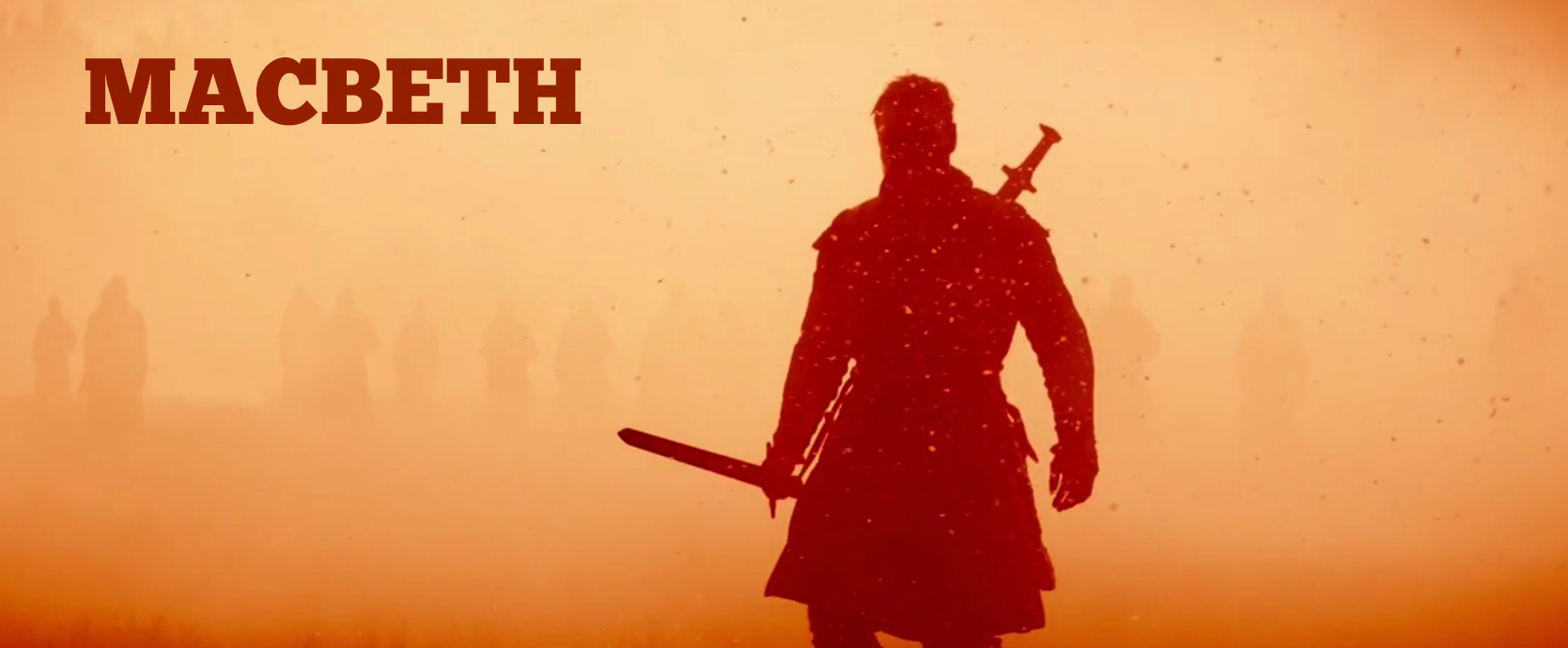
This year it looks like we may have a winner with the latest adaptation of Shakespeare’s MacBeth. The film stars Michael Fassbender and Marion Cotillard as Lord and Lady MacBeth with Australian filmmaker Justin Kurzel in the director’s chair.
MacBeth has been getting such advance rave reviews due to it’s screening at this year’s Cannes Film Festival where it entered for competition for the Palme d’Or. The film itself just judging from the trailer below looks like a visual feast that one’s up the dark, gritty aesthetic of HBO’s Game of Thrones.
There’s still no announced release date for MacBeth for the North American market but with the critical buzz surrounding the film after Cannes it won’t be too long til it get one.




 Through the Shattered Lens