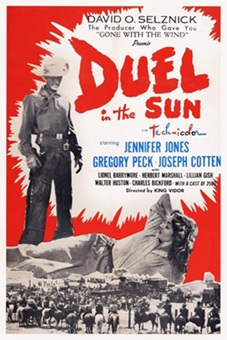
Duel In The Sun (1946, directed by King Vidor)


After her father is executed for killing her mother and her mother’s lover, “half-breed” Pearl Chavez (Jennifer Jones) is sent to live with her father’s second cousin, Laura Beth McCanles (Lillian Gish).  Laura is the wife of rancher, politician, and all-around racist Senator Jackson McCanles (Lionel Barrymore).  Worried that Pearl’s beauty and uninhibited manner will get her into trouble, Laura arranges for Pearl to meet with a minister known as The Sinkller (Walter Huston) who instructs Pearl on how to be a “good” girl.

Wanting to make Pearl bad and his, Lewton “Lewt” McCanles (Gregory Peck) becomes obsessed with Pearl and is soon forcing himself on her on a regular basis.  When the good McCanles brother, Jesse (Joseph Cotten), leaves the ranch despite being in love with Pearl, Pearl tries to find a good husband in the form of Sam Pierce (Charles Bickford).  Lewt responds by gunning Sam down and then goes on the run.  It all leads to an overwrought duel in the sun as the two doomed lovers take aim at each other.

Duel In The Sun is credited to veteran director King Vidor and there are a few shots of the western landscape that do feel typical of Vidor’s work.  However, Duel In The Sun’s true auteur was its producer, David O. Selznick.  Still looking to recapture his earlier success with Gone With The Wind and eager to make his future wife, Jennifer Jones, into an even bigger star than she was, Selznick obsessed over every detail of Duel In The Sun, pushing Vidor and a host of other directors (including Josef von Sternberg, William Dieterle, William Cameron Menzies, Otto Brower, and Sidney Franklin)  to make the film more steamy, more melodramatic, more violent, and more visually epic.  Reportedly, while Video was trying to shoot the film’s titular duel, he had to call cut several times when Selznick ran into the scene with a water bottle to spray more “sweat” onto Jones and Peck.  Today, the stiff Peck seems miscast as the black sheep of the family, the reserved Jones is even more miscast as a mestiza, and the plot is clearly too simplistic to carry the film’s epic ambitions.  A few impressive shots aside, Duel In The Sun is just boring,  In the 40s, though, the film’s relative openness about sex generated enough controversy to make Duel In The Sun into a box office hit.  It was one of the two top-grossing westerns of the 40s, beating out Red River, My Darling Clementine, Fort Apache, The Ox-Bow Incident, and several other films that were actually good.

Unlike Jones, Peck, and even usually reliable stalwart like Lionel Barrymore and Walter Huston, Joseph Cotten at least emerges from this film with his dignity intact.  Playing the good brother, Cotten gets to underplay while everyone else is overplaying and it turns out to be the right approach for him.  Surviving Duel In The Sun was no easy feat but Cotten pulled it off.
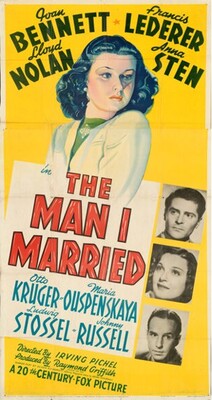
Film Review: The Man I Married (dir by Irving Pichel)


In 1940’s The Man I Married, Joan Bennett stars as Carol Cabbott Hoffman.

Carol is a New York-based art critic.  She is young, sophisticated, wealthy, and politically naive.  Because she has been married to a German for seven years, she has been keeping up with what has been happening in Germany but it’s clear that she doesn’t really understand the full story of what she’s hearing.  As she says, at one point, she has heard bad things about the Nazis but she also tries to keep an open mind and not get drawn in by “propaganda.”

Her husband, Eric Hoffman (Francis Lederer), has not been back to Germany in ten years and he says that he has little interest in ever returning.  But, when he receives a letter from his father (Otto Kruger), Eric announces that he has to return home for a visit.  Before Carol, Eric, and their son, Ricky (Johnny Russell), leave for Germany, they are approached by their friend, Dr. Hugo Gerhardt (Ludwig Stossel).  He explains that his brother has been imprisoned in a concentration camp and he asks Carol and Eric to deliver money to him and to appeal to the American embassy for help.  Carol agrees to do so.  Eric is noticeably reticent.

As soon as they arrive in Germany and Eric learns that his father wants him to take over the family’s factory, Eric starts to change.  He and a former schoolmate named Freida (Anna Sten) are a bit too happy to see each other again.  Eric insists on listening to the nightly radio broadcasts from Dr. Goebbels.  When Freida mentions that it is illegal to joke about Hitler, Eric surprises Carol by defending the law.  With Eric spending all of his time with Freida and dismissing Carol’s understandable suspicions by saying that she’s just being jealous, Carol meets an American correspondent named Keith (Lloyd Nolan) who reveals to her the truth of life in Nazi Germany.  Carol discovers that, rather than being the economically-strong paradise that Eric and Freida claim it to be, Germany is a place where many citizens live in fear of being heard saying the wrong thing and, as a result, they’ve chosen to close their eyes to what is going on around them.

The Man I Married is an interesting film.  It’s an anti-Nazi film that was released at a time when America was still technically a neutral nation.  Indeed, the film almost feels like it was made to prepare Americans for the inevitability of war with Germany.  When Keith mocks Carol for trying to be neutral about the Nazis, it’s clear that he’s meant to be speaking to the audience watching the film.  Eric begins the film as an erudite and seemingly charming man but, as soon as he arrives in Germany and is reunited with Freida, he reveals himself to be a fervent Nazi.  The film warns the audience not to trust those who were trying to excuse or dismiss Germany’s actions.

This is also one of the few films made before World War II that really acknowledged just how central anti-Semitism was to the Nazi ideology, acknowledging the concentration camps at a time when many in the West were refusing to admit they existed, either because they were in denial or because they just didn’t care.  Towards the end of the film, a major character is discovered to have had a Jewish mother and the reaction to the news reveals the hate that was at the heart of the Third Reich.

The Man I Married, with its portrayal of a populace that has convinced itself that their government is never to be questioned and that all dissent must be punished, is a film that feels just as relevant today as it did in 1940.  It’s a film that warns viewers of the risk of disbelieving their own eyes.

Yo-Ho-Hollywood!: TREASURE ISLAND (MGM 1934)


gary loggins's avatarcracked rear viewer

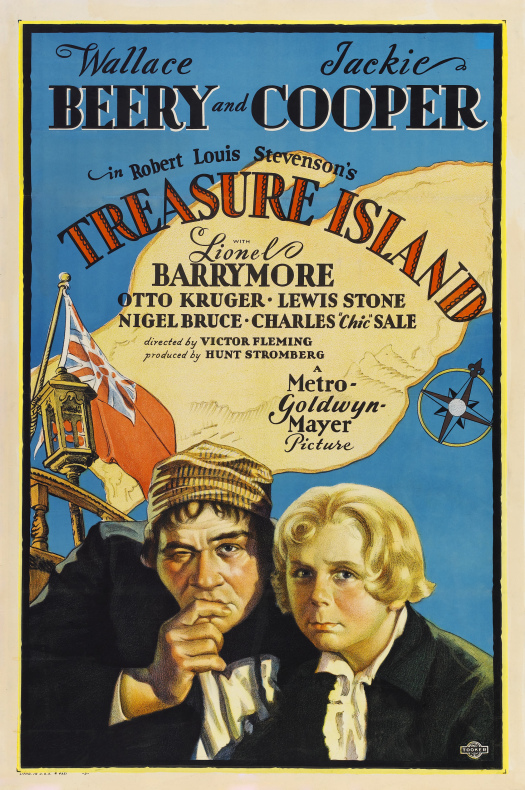
Robert Louis Stevenson’s  venerable 1883 adventure novel TREASURE ISLAND has been filmed over 50 times throughout the years, beginning with a 1918 silent version. There was a 1920 silent starring Charles Ogle (the original screen FRANKENSTEIN monster!) as that dastardly pirate Long John Silver, a 1972 adaptation with Orson Welles, a 1990 TV Movie headlined by Charlton Heston, and even a 1996 Muppet version! Most movie buffs cite Disney’s 1950 film as the definitive screen TREASURE ISLAND, with Bobby Driscoll as young Jim Hawkins and Robert Newton as Long John (and Newton would go on to star in the TV series LONG JOHN SILVER, practically making a career out of playing the infamous fictional buccaneer), but…

…a case can certainly be made for MGM’s star-studded 1934 interpretation of the story, teaming Wallace Beery and Jackie Cooper as Long John and Jim. This was the first talking TREASURE ISLAND, and the…

View original post 572 more words

Halloween Havoc!: JUNGLE CAPTIVE (Universal 1945)


gary loggins's avatarcracked rear viewer

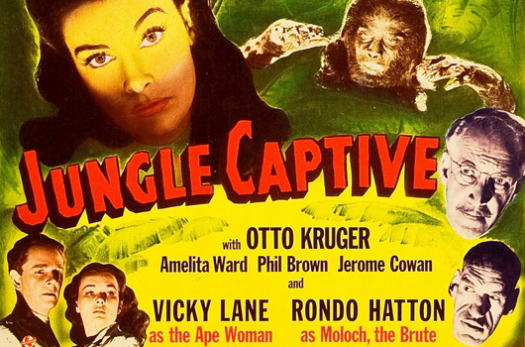
The third and final entry in Universal’s Paula Dupree/The Ape Woman series, JUNGLE CAPTIVE was released in 1945. I’m happy to report it’s a slight upgrade on JUNGLE WOMAN – by no means a classic horror movie, but certainly more enjoyable than that wretched sequel to CAPTIVE WILD WOMAN . The budget is lower-than-low, but the performances and script are far better, and it makes a good finale to the Ape Woman saga.

Hulking brute man Moloch, henchman of biochemist Mr. Stendahl (who’s not a doctor, by the way), strangles a morgue attendant and steals the body of the Ape Woman from it’s slab (where we left it in the last film). Inspector Harrigan is called in on the case, and a lab smock found near the abandoned crashed-and-burned meat wagon leads him to Stendahl’s lab, where he encounters pretty assistant Ann and her fiancé Don working (actually, they’re necking…

View original post 299 more words

Halloween Havoc!: DRACULA’S DAUGHTER (Universal 1936)


gary loggins's avatarcracked rear viewer

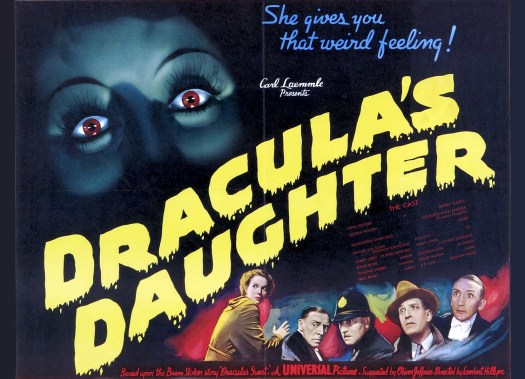
After the success of BRIDE OF FRANKENSTEIN , Universal decided it was time for a sequel to everybody’s favorite vampire, Dracula , with James Whale scheduled to direct. Whale opted out, putting DRACULA’S DAUGHTER in the hands of Lambert Hillyer , an old pro who dated back to silent William S. Hart Westerns, and was more comfortable with sagebrush sagas than Gothic horror. The result was an uneven film saved by Gloria Holden’s performance as the title character, Countess Marya Zaleska.

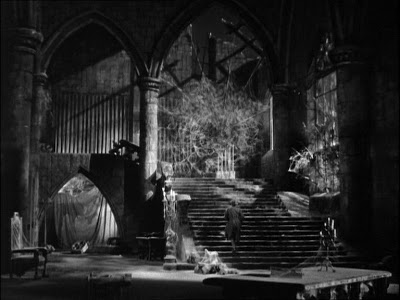
I’ll give Hillyer credit for some atmospheric scenes scattered throughout the movie. The opening scene at Carfax Abbey, cobwebbed as ever, picks up where DRACULA left off, with Edward Van Sloan’s Van Helsing (inexplicably renamed Von Helsing here) caught by constables shortly after staking the undead Count. The Countess burning the body of her vampiric father, hoping to free herself of her curse, is spooky, as is the return…

View original post 360 more words

Sweet Land of Liberty: Alfred Hitchcock’s SABOTEUR (Universal 1942)


gary loggins's avatarcracked rear viewer

The Master of Suspense puts the pedal to the metal once again in SABOTEUR, another “double chase” spy thriller that doesn’t get the attention some of Alfred Hitchcock’s other films do, but should. I’ve always enjoyed the performance of Robert Cummings as the “ordinary man caught in an extraordinary situation”; his naturally laid-back, easygoing charm makes him perfect playing Barry Kane, accused of sabotaging a wartime aircraft plant and killing his best friend in the process, who winds up on a cross-country chase alongside reluctant heroine Priscilla Lane . SABOTEUR is certainly an  important film in Hitchcock’s body of work for one important reason: it’s the director’s first film for Universal Pictures, a studio he’d have a long and profitable association with, and where he’d later create some of his finest movies.

SABOTEUR is in many respects a loose remake of Hitchcock’s THE 39 STEPS , transplanted to America and…

View original post 701 more words

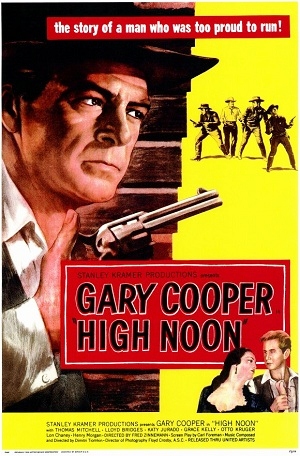
Lisa Cleans Out Her DVR: High Noon (dir by Fred Zinnemann)


(I am currently in the process of cleaning out my DVR!  I recorded the 1952 best picture nominee, High Noon, off of Retroplex on January 28th.  This review is scheduled to posted at 12 noon, central time.  Clever, no?)

High Noon is a testament to the power of simplicity.

It’s a famous film, one that continues to be influential and which is still studied today.  It’s known for being one of the greatest westerns ever made but it’s also a powerful political allegory.  Even people who haven’t seen the film know that High Noon is the moment of the day when someone shows their true character.  Just as everyone knows the plot of Star Wars, regardless of whether they’ve actually watched the film, everyone knows that High Noon is about a town marshal who, after the entire town deserts him, is forced to face down a gang of gunmen on his own.

And yet, it really is a surprisingly simple movie.  It’s the quintessential western, filmed in black-and-white and taking place in the type of frontier town that you would expect to find hiding on the back lot of an old movie studio.  Though wonderfully brought to life by a talented cast, the majority of the characters are familiar western archetypes.

There’s the aging town marshal, a simple man of integrity.  Gary Cooper won an Oscar for playing the role of Will Kane.  When we first see Will, he’s getting married in a frontier courtroom.  All of the town leaders have come to his wedding and all of them wish him luck in the future.  Will is retiring and everyone agrees that the town would never have survived and prospered if not for Will Kane.  After all, Will is the one who captured the notorious outlaw, Frank Miller.  When the news comes that Miller has been pardoned and will be arriving back in town on the noon train, everyone tells Will that he should just leave town and go on his honeymoon.  However, the new marshal will not be arriving for another day and Will is not willing to abandon the town.  However, the town is more than willing to abandon him.

Will’s new wife is Amy Fowler (Grace Kelly).  Amy is a Quaker and a pacifist.  Amy begs Kane to leave town but Kane says that he’s never run from a fight.  Amy tells him that she’ll be leaving on that noon train, with or without him.  Helen Ramirez (Katy Jurado) is the former girlfriend of both Kane and Miller.  She is one of the few people in town to call out everyone else’s cowardice but she is still planning to leave before Miller arrives.  As she explains it to Amy, she would never abandon Kane if he were her man but he’s not her man anymore.

The townspeople, who first appear to be so friendly and honest, soon prove themselves to be cowards.  None of them are willing to stand behind Will.  The Mayor (Thomas Mitchell) publicly castigates Will for staying in town and putting everyone else in danger.  Deputy Harvey Pell (Lloyd Bridges) says that he’ll only help Will if Will recommends him as his replacement.  The town minister (Morgan Farley) is more concerned with why Will was married by the justice of the peace, instead of in the church.  The town judge (Otto Kruger) leaves early, saying he can be a judge in some other town.  One of the few people to show Will any sympathy is the former marshal (Lon Chaney, Jr.) but, unfortunately, he is too old and crippled by arthritis to provide any help.

Though it all, Frank’s gang sits at the train station and waits for Frank to arrive.  One gang member is played be Lee Van Cleef.  He looks really mean!

With a brisk running time of 84 minutes, High Noon unfolds in real time.  Throughout the film, as Kane grows increasingly desperate in his attempt to find anyone brave enough to stand with him, we see clocks in the background of nearly every scene.  We hear the ticking.  We know that both noon and Frank Miller are getting closer and closer.  We know that, soon, Will will have no other option but to stand on the street by himself and defend a town that doesn’t deserve him.

It’s simple but it’s undeniably powerful.

It’s been said that High Noon was meant to be a metaphor for the blacklist.  Frank Miller and his gang were the fascists that, having been defeated in World War II, were now coming back to power.  Will Kane was a stand-in for all the men and women of integrity who found themselves blacklisted.  The townspeople represented the studio execs who refused to challenge the blacklist.  That’s the theory and it’s probably true.  But, honestly, the political metaphor of High Noon works because it can be applied to any situation.  Will Kane is anyone who has ever had to face down the forces of totalitarianism.  He is anyone who has ever had the courage to take a lonely stand while everyone else cowered in the corner.

It’s a powerful metaphor and it’s also a genuinely entertaining movie.  The gunfight is thrilling.  The romance between Will and Amy feels real.  Even the town feels like an actual place, one that has its own history and culture.  It’s a simple film but it’s a great film.

Like a lot of great films, High Noon was nominated for best picture.  And, like a lot of great films, it lost.  In High Noon‘s case, it lost to a film that is almost its exact opposite, The Greatest Show on Earth.  However, Gary Cooper did win an Oscar for his unforgettable performance as Will Kane.

I think we tend to take classic films for granted.  Don’t do that with High Noon.  See it the next chance you get.

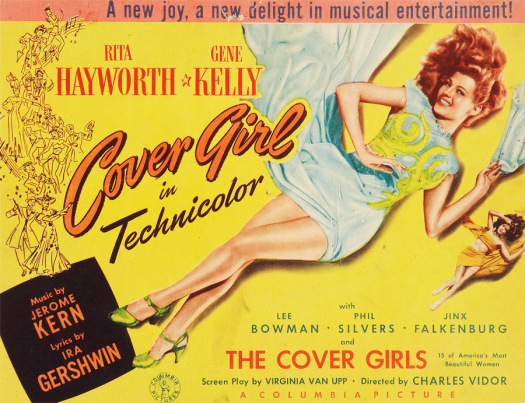
She Was Never Lovelier: Rita Hayworth in COVER GIRL (Columbia 1944)


gary loggins's avatarcracked rear viewer

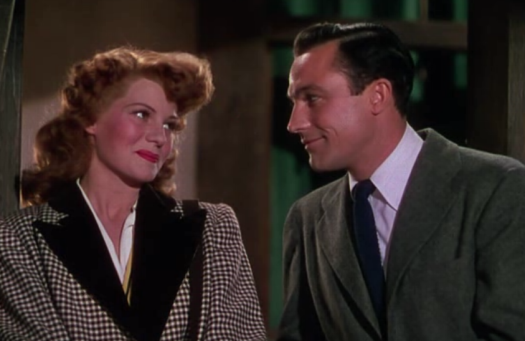
Bright, bold, and bouncy, COVER GIRL was a breakthrough film for both Rita Hayworth and Gene Kelly. Sultry, redheaded Rita had been kicking around Hollywood for ten years before Columbia Pictures gave her this star-making vehicle, while Kelly, on loan from MGM, was given free rein to create the memorable dance sequences. Throw in the comedic talents of Phil Silvers   and Eve Arden , plus a bevy of beauties and songs by Jerome Kern and Ira Gershwin, and you have what very well may be the quintessential 40’s musical.

Rusty Parker (Rita) is a hoofer at Danny McGuire’s (Kelly) joint in Brooklyn (where else?). She enters a contest sponsored by Vanity Magazine to find a new cover girl for their 50th anniversary issue. Editor John Coudair ( Otto Kruger ) spots her and is reminded of the girl he once loved and lost (who turns out to have been…

View original post 696 more words

Horror Film Review: Dracula’s Daughter (dir by Lambert Hillyer)


draculas_doughter_original_poster_1936

Did you know that Dracula had a daughter!?

Well, Bram Stoker might disagree but, according to Universal Studios, he did.  Her name was Countess Marya Zaleska and, as played by Gloria Holden, she is the title character in 1936’s Dracula’s Daughter!  Like her father, the Countess was also a vampire.  The film never gets into just how she became a vampire.  Was she born a vampire or, far more disturbingly, was she once a mortal who turned into a vampire by her own father?  The film doesn’t tell us but it does establish early on that she hates being one of the undead.  Unlike her father, she struggles with her urge to drink blood.  When she discovers that Dracula has been staked, she and her servant, Sandor (Irving Pichel), steal the body from the morgue and burn it.  The Countess thinks that this will cure her of her urges.

Sadly, it does no such thing.

So, what’s a reluctant, 20th century vampire to do?  Well, she can always go to a psychiatrist and hope that science can somehow break the curse.  She ends up as a patient of Dr. Jeffrey Garth (Otto Kruger).  By coincidence, Dr. Garth has another famous patient — Dr. Edward Von Helsing.  (That’s right, they changed the “van” to a “von” in Dracula’s Daughter.  Despite the name change, Edward van Sloan returns to play the veteran vampire hunter.)

Von Helsing in on trial, accused of murdering Dracula in the previous film.  Oddly enough, nobody mentions Renfield who, seeing as how we’re told Dracula’s Daughter starts exactly where Dracula left off, would have been found dead in the crypt as well.  Even stranger, no one steps forward to defend Von Helsing.  Dr. Seward, Mina, Johnathan Harker?  Forget about them.  Not a single one is to be found while Von Helsing is accused of murder.

Bastards.

Fortunately, Von Helsing has a defense!  Since Dracula was already dead and had been for 500 years, Von Helsing could not have killed him.  Helping him out with this defense is Dr. Garth…

Meanwhile, the Countess tries to resist the urge to attack every woman that she sees.  She pours her frustrations out into painting.  One night, Sandor brings the Countess a new model, a beautiful young woman named Lil (Nan Grey).  The Countess orders Lil to undress and then, after staring at her, gives into her urges and attacks…

If you’re thinking that there’s a subtext here, that’s because there is.  (In fact, Universal’s tagline for the film was, “Save the women of London from Dracula’s Daughter!”)  Perhaps even more so than in Dracula, Dracula’s Daughter uses vampirism as a metaphor for forbidden sex.  When the Countess stares at Lil and, later, when she prepares to bite the neck of Dr. Garth’s fiancée, she is embodying the hysterical fears of a puritanical society.  When she unsuccessfully seeks a cure for her vampirism, we’re reminded that, in the 1930s, psychiatry classified homosexuality as being a mental illness.  When the Countess struggles with her urge to drink blood, she is a stand-in for everyone who has struggled with their sexuality.

Gloria Holden plays the Countess as being as much a victim as a victimizer.  Whereas Bela Lugosi turned Dracula into the epitome of evil, Gloria Holden gives a performance that is full of ambiguity.  In fact, she at times seems to be so tortured by her vampiric state that, when she finally fully embraces the fact that she’s a vampire, you have to cheer a little.  At least she’s finally being honest with herself!  At least she’s no longer making apologies or allowing society to punish her for being who she is.  Was Countess Zaleska the first reluctant vampire in film history?  I’m not sure but Holden’s performance undoubtedly set the bar by which all other self-loathing vampires should be judged.

Dracula’s Daughter holds up surprisingly well.  It’s definitely one to look for during this Halloween season.

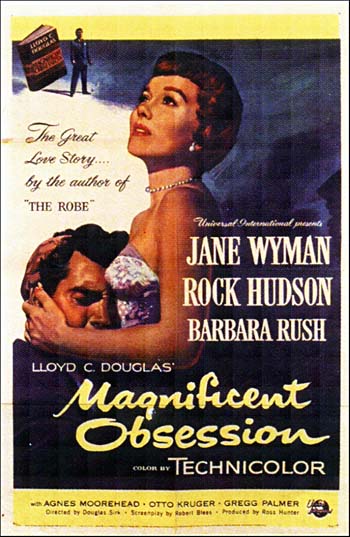
Embracing the Melodrama Part II #20: Magnificent Obsession (dir by Douglas Sirk)


Magnificent_obsessionThere’s a scene early on in the 1954 melodrama Magnificent Obsession in which formerly carefree millionaire Bob Merrick (Rock Hudson) meets with an artist named Edward Randolph (Otto Kruger).  We know that Randolph’s brilliant because he speaks in a deep voice, tends to be unnecessarily verbose, and often stares off in the distance after speaking.  Bob wants to know about a dead doctor who was a friend of Randolph’s.  Randolph explains the late doctor’s philosophy of doing anonymous good works.  Bob’s mind is blown.  (Hudson, who was never the most expressive of actors, conveys having his mind blown by grinning.)

“This is dangerous stuff,” Randolph warns him, “One of the first men who used it went to the cross at the age of 33…”

And a heavenly chorus is heard in the background…

And that one line pretty much tells you exactly what type of film Magnificent Obsession is.  It’s a film that not only embraces the melodrama but which also holds on tight to make sure that the melodrama can never escape.  There’s not a single minute in this film that is not hilarious overwritten.  It’s not just Randolph who tends to be portentous in his pronouncements.  No — everyone in the film speaks that way!

The dead doctor is dead specifically because of Bob.  Apparently, the doctor had a heart attack but the local hospital’s only resuscitator was being used to save the life of Bob who, while the doctor was dying, was busy recklessly driving a boat.

Helen (Jane Wyman), the doctor’s widow is, at first, bitter towards Bob and when Bob offers to donate $250,000 to the hospital, Helen refuses to accept his check.  This leads to Bob doing a lot of soul-searching and eventually having his life-changing conversation with Randolph.  Excited at the prospect of doing anonymous good works for the rest of his life, Bob tracks down Helen and tries to tell her that he’s a changed man.  Helen, however, wants nothing to do with Bob and ends up getting hit by a car while running away from him.  Helen survives but now, she’s blind!

Now, at this point, you might think that Bob has done enough to ruin Helen’s life.  At least, that’s the way that Helen’s family views it and when Bob attempts to visit her in the hospital, they order him to go away.

Eventually, Helen comes home from the hospital and starts to adjust to a life without eyesight.  One day, she meets a man on the beach and they start up a tentative romance.  What she doesn’t realize, at first, is that the man is Bob!  By the time she does realize who the man is, Helen has fallen in love with him.  However, she feels that it wouldn’t be fair to Bob to pursue a relationship with him and she leaves him.

So, of course, Bob’s response is to go to medical school and become a neurosurgeon.  Many years later, Helen has a brain tumor and needs an operation to survive.

Can you guess who her surgeon turns out to be?

Magnificent Obsession is almost a prototypical 1950s melodrama.  It’s big, it’s glossy, it’s self-important, and undeniably (and occasionally unintentionally) funny.  Even the total lack of chemistry between Hudson and Wyman somehow adds to the film’s strange charm.  It’s hard not to admire a film that starts out over-the-top and just grows more excessive from there.

Watching Magnificent Obsession is a bit like taking a trip into a parallel, technicolor dimension.  It’s strange, fascinating, and far more watchable than it should be.