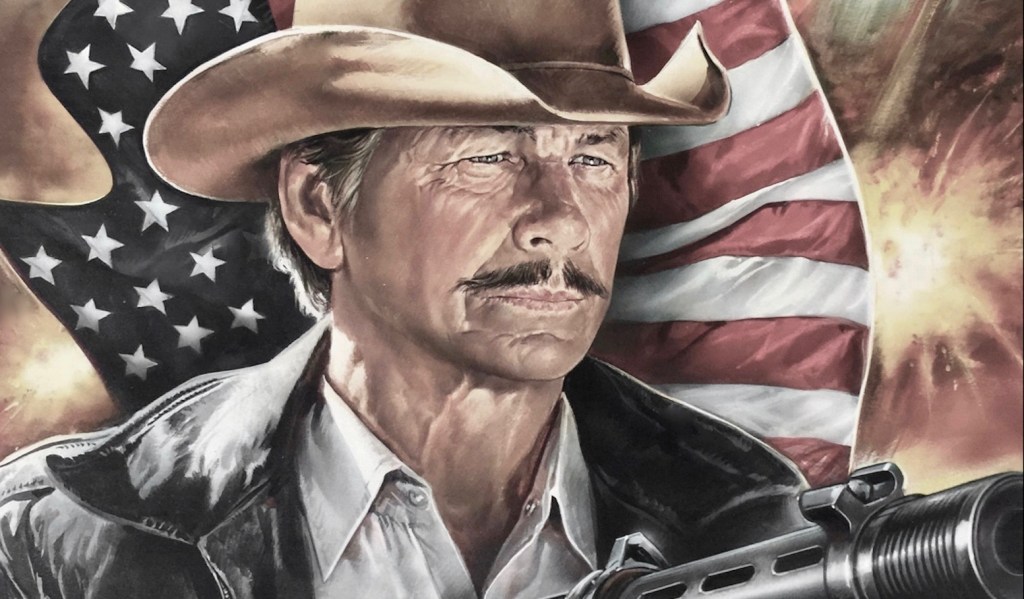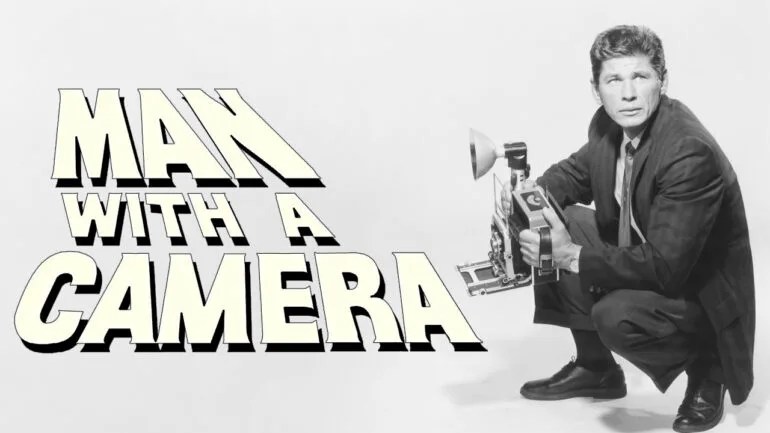
MAN WITH A CAMERA (TV Series) – starring Charles Bronson – S1, E8: Blind Spot 


First, I want to say Happy Thanksgiving to all of you who read this review! I’m so thankful for The Shattered Lens and the opportunity to share my love of movies, TV and pop culture with all of you! Now on with the show…

Originally airing on December 5th, 1958, “Blind Spot” opens with free-lance photographer, Mike Kovac (Charles Bronson), receiving a phone call from his best friend Terry Ross (Norman Alden), who is in Lisbon, Portugal. A very nervous Terry tells Kovac that he will be airmailing him some very important negatives for something “dynamite” that he’s working on. While they’re on the phone, an imposing man with a wide-brimmed, boater hat steps into Terry’s room and shoots him dead. Hearing the shots, Kovac is on the next plane to Lisbon to talk to the police and try to find out what happened. Apparently this is big news as the Lisbon paper even reports that Kovac is on his way. The killer, who we soon learn is named Al Alviella (Mario Alcalde), is waiting on Kovac in front of the police station and through a variety of events, is able to convince him that he was Terry’s friend and can help him in his investigation. It seems the police believe that Terry was working for an underworld espionage organization and that he got killed for it. Kovac doesn’t believe there’s any possibility that his old wartime photographer buddy could be involved in anything dirty. But with the killer Al’s false stories and leads, as well as Kovac’s discovery of Terry’s wife Renee (Chana Eden), when he didn’t even know Terry was married, Kovac begins to question how well he really knew his old friend. When the truth finally all comes to light, will Kovac be able to get out of Lisbon alive?!

After the disappointing melodrama of the previous episode, MAN WITH A CAMERA gets back on track with “Blind Spot.” First, we get a somewhat intriguing crime storyline in this episode. While we know from the beginning that Kovac’s friend was murdered and who the killer is, the story still has a few surprises up its sleeve. The final reveal and fight scenes are very well handled, with Bronson continuing to prove that no one can throw a punch quite like him. Second, the episode has an appealing theme of “friendship forged by fire,” in this case by serving together in World War II. With the circumstantial evidence mounting, Kovac begins to doubt his old friend, and it’s here that the new wife steps in and says “Terry said you were his friend… his best friend!” Kovac knows in his heart that his friend just couldn’t have done these things, no matter how bad it looks, and he keeps pushing to find out the truth. I want to have friends like that! 

Finally, “Blind Spot” contains some solid performances and an interesting guest appearance. Bronson himself is quite emotional and demonstrative in this episode. He yells at the police when they tell him they believe his old buddy is dirty. He yells at the shadowy underworld “man” who tells him that his buddy was on his payroll, and then proceeds to start punching henchmen until they get the upper hand on him. And I’ve already mentioned the coolness of the final fight scenes where he clearly does his own stunts! I also found Mario Alcalde to be charismatic as the killer Al Alviella. There’s something about him, maybe it was his voice, that kind of reminds me of Andy Garcia, an actor I really like. Alcalde appeared on most of the good TV shows of the late 50’s and 60’s, but unfortunately died at the young age of 44 in 1971. One last thing about the casting that I found interesting involves character actor Frank DeKova, who has one scene here as a shadowy, Lisbon underworld figure credited only as “The Man.” DeKova would play one scene as a shadowy underworld figure known only as “The Man” 14 years later in Bronson’s action classic THE MECHANIC! 

“Blind Spot” isn’t a perfect episode, as it does have a fairly slow build up after its entertaining opening scene. However, the excitement of the ending scenes, the more interesting storyline, and the good performances from its main players are more than enough to get a recommendation from me. 
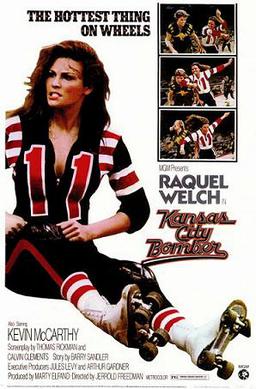
The Unnominated #14: Kansas City Bomber (dir by Jerrold Freedman)


Though the Academy of Motion Picture Arts and Sciences claim that the Oscars honor the best of the year, we all know that there are always worthy films and performances that end up getting overlooked.  Sometimes, it’s because the competition too fierce.  Sometimes, it’s because the film itself was too controversial.  Often, it’s just a case of a film’s quality not being fully recognized until years after its initial released.  This series of reviews takes a look at the films and performances that should have been nominated but were, for whatever reason, overlooked.  These are the Unnominated.

In 1972’s Kansas City Bomber, Raquel Welch stars as KC Carr.

KC. is a star on the roller derby circuit, a tough fighter who is loved by the audience and who shows no fear when it comes to skating around the track and getting into brawls with the other team.  The audience especially loves it when she fights Jackie Burdette (Helena Kallianiotes), madly cheering over every punch landed and every elbow thrown and every strand of hair pulled.  It’s not glamorous work but KC loves the adulation of the crowds and the comradery of her team.  She’s a single mother and putting on roller skates and getting bruised in fights allows her to support her daughter, Rita (a pre-Taxi Driver Jodie Foster).

But then KC is traded to another team, the Portland Loggers.  It takes KC a while to fit in with her new team.  She’s viewed with suspicion, especially when she starts to date the owner of the team, Burt Henry (Kevin McCarthy).  Burt may seem charming but KC soon discovers that he has a jealous side.  When KC spends too much time with her best friend and roommate, Burt trades her to another team.  When a male skater named “Horrible” Hank (Norman Alden) reveals that he has a rather obvious crush on KC, Burt goes out of his way to humiliate Hank.  Burt wants to start a new team in Chicago and he’s promised to make KC a star.  Will KC give up her own freedom to be Burt’s well-compensated star or will she stand up for herself and show that she doesn’t belong to anyone?

You already know the answer.  The wonderful thing about Raquel Welch is that she was tough.  She didn’t let people push her around and, if that resulted in people in Hollywood whispering that she was difficult, so be it.  Like KC Carr, Raquel Welch didn’t make any apologies.  Kansas City Bomber is one of the few of Welch’s early 70s films to celebrate and show how just how tough she was.  For once, Welch is given an actual character to play and she proves herself to be a strong and fierce actress.  It’s fun and more than a little empowering to watch her performance here.  Everyone underestimates KC Carr, just as everyone underestimated Raquel Welch.  In both cases, the doubters are proven wrong.

Kansas City Bomber is not a great film.  (The pacing is totally off and the supporting characters are not quite as memorable as either Welch or Kevin McCarthy.)  But Raquel Welch gave a great performance.  That Welch was never Oscar-nominated isn’t really a surprise.  She didn’t appear in the type of movies that received Oscar attention and she was often cast in roles that didn’t give her much of an opportunity to show off what she could do.  She definitely deserved a nomination for Kansas City Bomber.  

Previous entries in The Unnominated:

  1. Auto Focus 
  2. Star 80
  3. Monty Python and The Holy Grail
  4. Johnny Got His Gun
  5. Saint Jack
  6. Office Space
  7. Play Misty For Me
  8. The Long Riders
  9. Mean Streets
  10. The Long Goodbye
  11. The General
  12. Tombstone
  13. Heat

The TSL Grindhouse: The Wild Angels (dir by Roger Corman)


“What is it exactly that you want?” a preacher (Frank Maxwell) asks a congregation of leather-clad bikers.

“We want to get loaded!” Heavenly Blues (Peter Fonda) replies, “And we want to have a good time!”

And have a good time, they proceed to have.  Of course, it’s a good time for them.  Everyone else who meets the bikers at the center of 1966’s The Wild Angels are horrified by this collection of rebellious and violent outsiders.  Sure, Heavenly Blues might actually be a soulful guy who mistakenly believes that he can control the gang’s more excessive tendencies.  His girlfriend, Mike (Nancy Sinatra), actually seems rather reserved and conservative when compared to the rest of the gang.  But make no mistake about it, the majority of the members of the gang are into violence for its own sake.  They are bullies who couldn’t make the football team so, instead, they hopped on a motorcycle and formed their own society.  They’re self-styled rebels  but what are they rebelling against?  What have you got?

I know, I know.  That famous line comes from Marlon Brando and it was uttered in The Wild One.  Peter Fonda, to put it lightly, was no Marlon Brando and, as directed by Roger Corman, The Wild Angels doesn’t have the societal concerns that lay at the hear of The Wild One.  As Corman was often the first to admit, his main concern when it came to making movies was to make money.  Corman wasn’t necessarily against message films.  He often stated that, as a director, 1962’s The Intruder was the film in which he took the most pride.  The Intruder took a firm stand against racism and it let everyone know where Corman stood on when it came to the Civil Rights Movement.  It was also one of his few films to lose money.  The Wild Angels celebrates rebellion but one gets the feeling that celebration is motivated by the fact that younger filmgoers would be happy to pay to see a movie about a bunch of “youngish” people telling the old folks to shut up and get out of the way.  The Wild Angels themselves don’t seem to be motivated by any sort of grand ideology.  Heavenly Blues preaches about getting loaded and having a good time and celebrating freedom but he also allows the members of the gang to drape a Nazi flag over a casket.  What does Heavenly Blues actually believe in?

Heavenly Blues believes in loyalty to his friends.  For all the fights and the orgies and the scenes of motorcycles roaring down country roads, this is ultimately just a film about a guy who wants to give his best friend a decent burial.  The Loser (Bruce Dern) dies about halfway through the film and one gets the feeling that he probably would have lived if the gang hadn’t kidnapped him from the hospital.  Heavenly Blues wants to give The Loser the type of wild funeral that Blues thinks he would have wanted though I think The Loser probably would have been happier not have been killed by the actions of his idiot friends.  Diane Ladd, who was married to Bruce Dern at the time and who has said Laura Dern was conceived during the filming of The Wild Angels, is heart-breaking as The Loser’s girlfriend, Gaysh.  Gaysh wants to mourn her boyfriend while the rest of the gang is more concerned with figuring out who her next boyfriend is going to be.

Does Heavenly Blues ever realize that he’s traveling with a bunch of animals?  He does but one gets the feeling that he’s accepted his fate.  There’s no going back.  The past can’t change and the future cannot be controlled so Heavenly Blues is content to live in the present.  All he can do is try to give his friend a decent burial while the sirens of cops shriek in the distance.

The Wild Angels was a controversial film when it was first released.  It also made a lot of money and led to a whole cycle of outlaw biker films, culminating with Easy Rider.  Seen today, it’s a portrait of a society coming apart, with the establishment and the bikers not even willing to stop fighting long enough to allow for a simple burial.  It’s definitely a time capsule film, one of those productions that epitomizes an era.  There’s not much going on underneath the surface and most of the film’s bikers really are awful people but there is something touching about Blues giving it all up just to try to give his friend a decent burial.

BORDERLINE (1980) – Charles Bronson battles human smuggler Ed Harris (in his first major film role)!


After a couple of decades of toiling away in TV and supporting roles, Charles Bronson became a huge international film star in 1968 when he starred in the films FAREWELL, FRIEND (with Alain Delon), and Sergio Leone’s ONCE UPON A TIME IN THE WEST (with Henry Fonda). For the next 5 years, Bronson would star in successful international co-productions, before hitting it big in the United States with the influential 1974 blockbuster, DEATH WISH. From 1974 to 1977, Bronson had his pick of any role that he wanted. This was probably the most interesting time in his career as he truly tried to expand his range with films like the depression-era HARD TIMES (1975), the romantic comedy FROM NOON TILL THREE (1976), the Raymond Chandler-esque ST. IVES (1976), and the surreal western THE WHITE BUFFALO (1977). But after 1977’s TELEFON and a series of underwhelming box office returns in the states, Bronson’s star was on the wane. He wouldn’t have his next #1 box office hit until he joined forces with the infamous Cannon studios in 1982 for the sequel to his biggest hit and DEATH WISH II. Cannon Studios would provide Bronson with a guaranteed paycheck and a non-stop presence on cable TV and at the video store for the remainder of the decade. I call the films that Bronson made between 1977 and 1982 the in-betweens. They don’t really fit into his European phase (1968-1973), his post-DEATH WISH phase (1974-1977) or his Cannon phase (1982-1989). To be completely honest, it seemed his career was somewhat in limbo at this point, and the movies he made during these years are some of his least well-known.

One of the movies that Charles Bronson made during the in-between years was 1980’s BORDERLINE. In this film, he plays Jeb Maynard, a border patrolman and expert tracker who will stop at nothing to find the human smuggler responsible for killing his friend and fellow patrolman Scooter, played by Wilford Brimley. I like this lower-key Bronson film. Director Jerrold Freedman has made a more realistic film than a lot of the movies in Bronson’s filmography. Outside of the murder that gets the story going, and the final showdown with the lead smuggler (a young Ed Harris), most of the film is made up of good old-fashioned field work and investigation. Bronson even based much of his performance on the technical advice of legendary border patrolman Albert Taylor. Now that doesn’t mean there aren’t some solid, action-packed scenes during the movie. My favorites include a scene where an undercover Maynard goes into Mexico with the mother of a young Mexican boy who was accidentally killed at the same time as Maynard’s friend Scooter. Maynard poses as a family member of the woman in hopes of being smuggled across the border so he can see how the illegal immigrants are being brought in. When thieves intercept the group, all hell breaks loose, and Maynard and the woman must fight their way out. Another badass moment occurs when Bronson beats needed information out of one of the smugglers in a nasty bathroom. This last scene is especially enjoyable for us Bronson fans.

There are so many good actors in this film. Outside of Bronson, Brimley, and Ed Harris, the cast is filled out by other veterans like Bruno Kirby, Bert Remsen, Michael Lerner, John Ashton, and Charles Cyphers. On a side note, Ed Harris gets the “introducing” credit here, even though he had appeared in several TV shows, as well as the movie COMA with Michael Douglas. This was his first major role in a feature film though. I also want to throw out special mention to Karmin Murcelo. She’s not a household name, but she’s excellent as the mother of the young boy who gets killed with Wilford Brimley’s character, who then helps Bronson in his quest to find the killer. Her career extended over 3 decades, and it’s easy to see why based on this performance.

BORDERLINE may not be an explosive action film like some of Bronson’s other work, but it’s an effective drama with a good performance from the star. I think he embodies the character perfectly. It’s also just as relevant in 2025 as it was in 1980, and I give the film a solid recommendation.

Retro Television Review: Fantasy Island 5.7 “The Perfect Husband/Volcano”


Welcome to Retro Television Reviews, a feature where we review some of our favorite and least favorite shows of the past!  On Tuesdays, I will be reviewing the original Fantasy Island, which ran on ABC from 1977 to 1984.  Unfortunately, the show has been removed from most streaming sites.  Fortunately, I’ve got nearly every episode on my DVR.

Yay!  It’s finally time to return to the Island.

Episode 5.7 “The Perfect Husband/Volcano”

(Dir by Philip Leacock, originally aired on November 21st, 1981)

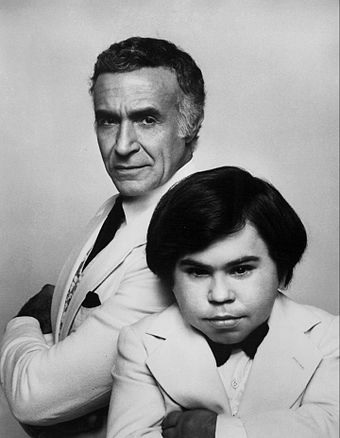
This week, it’s Tattoo’s turn to serve as Roarke’s sidekick while Julie is sent off to deal with two weddings and a tour for “the seniors.”

On the one hand, it’s incredibly awkward for Roarke to have two sidekicks and it’s pretty obvious that Julie was only hired to serve as insurance in case Herve Villechaize walked off the set.

On the other hand, it is kind of nice to be reminded of the fact that there’s a lot happening on Fantasy Island.  Fantasy Island is not just a mystical nation that is ruled over by the enigmatic Mr. Roarke.  It’s also a resort that hosts vacations and retirement homes.  Apparently, you don’t have to have a fantasy in order to spend some time on Fantasy Island.  Instead, you can just come to Fantasy Island for a nice tropical vacation.  That’s kind of nice.

But, that said, the fantasies are why we’re here.  We’ve got two good ones this week.

Dorothy Nicholson (Susan Sullivan) is a newspaper publisher who has been feeling unfulfilled ever since her husband was killed by a drunk driver.  She want to find the perfect husband, a man without any flaws whatsoever.  After giving her his customary “You may not like what you find,” warning, Roarke sends her to Paradise Cove.  Operated by the sinister Anton Jagger (Rossano Brazzi), Paradise Cover is a resort where wealthy women are assigned the perfect companion.  Dorothy’s perfect man is Gilbert (Lyle Waggoner).  Gilbert is handsome, suave, charming, and attentive.  Unfortunately, like all of the perfect men at Paradise Cove, he’s also a robot and a part of Jagger’s scheme to cheat women out of their money!  Dorothy figures out the truth after Gilbert doesn’t even flinch after his hand catches on fire.  Can she defeat Jagger’s plans and rescue the real Gilbert?

(Of course, she can.  It’s Fantasy Island!)

Dr. Hal Workman (George Maharis) thinks that he’s figured out a way to detect when a volcano is going to erupt.  He wants to go to Fantasy Island’s own active volcano to test out his methods.  Roarke agrees, even though he worries that Dr. Workman only cares about science and not about people.  (Honestly, who cares?  A volcano detection system sounds like it would be a good thing, regardless of the motives of the man who created it.)  Workman is led to the volcano by a disillusioned former priest named Lauria (Richard Romanus).  However, Workman and Lauria are not the only people at the volcano.  There’s also a shady tycoon, Joseph Butler (Norman Alden), and his girlfriend, Terri (Misty Rowe).  You can probably guess what happens.  Workman falls in love with Terri.  Lauria finds his faith.  And Butler presumably dies when the volcano erupts and a deluge of what appears to be very thin tomato sauce comes pouring down the mountain.

Both of these fantasies were cheerfully ridiculous, which made them a lot of fun.  You may wonder why Roarke would send one of his guests to a resort that’s being run by a madman and that’s a legitimate question.  But the important thing is that the viewer gets a montage of all of the robots malfunctioning at once.  And you may wonder at the wisdom of allowing someone to go to an active volcano but the important thing is that we get a scene of George Maharis and Richard Romanus running away from the least realistic lava flow ever caught on film.  Fantasy Island is a lot of fun when it goes over the top and embraces its beautiful absurdity and that’s exactly what this episode did.

What a wonderful trip to the Island!

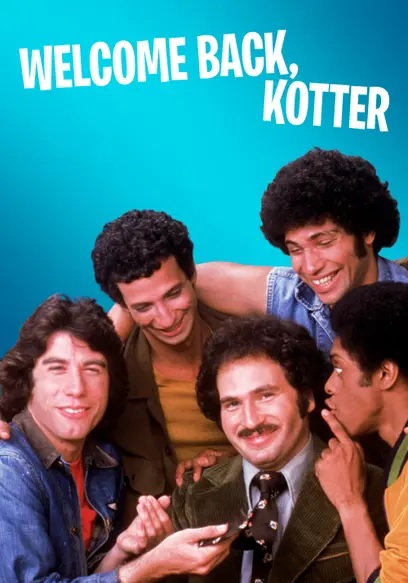
Mini Retro Television Review: Welcome Back Kotter 3.23 “Goodbye, Mr. Kripps”


Welcome to Retro Television Reviews, a feature where we review some of our favorite and least favorite shows of the past!  On Saturdays, I will be reviewing Welcome Back Kotter, which ran on ABC  from 1975 to 1979.  The entire show is currently streaming on Tubi!

As I mentioned yesterday, I’ve got a sprained wrist so typing is kind of painful.  For that reason, today’s review is going to be a quick one.  You might even call it a …. MINI REVIEW!

Episode 3.23 “Goodbye, Mr. Kripps”

(Dir by Bob Claver, originally aired on February 16th, 1978)

Shop teacher Mr. Kripps (Jack Fletcher) is famous for being cranky and for not liking the Sweathogs.  Even when Gabe was a student at the school, Mr. Kripps was a teacher known for his bad temper.  When Mr. Kripps drops dead of a heart attack, only Barbarino is shocked.  Barbarino also feels guilty because Mr. Kripps was yelling at him when he died.

Woodman, Gabe, and the Sweathogs attends the funeral and then all return to Gabe’s apartment.  I get that the Sweathogs are in a co-dependent relationship with Gabe but why is Woodman at the apartment?  Gabe and the Sweathogs are depressed.  Woodman talks about how July is the best month for a funeral.  “August is too hot!”

Barbarino turns himself into the police for murder.  Awwwww, poor Barbarino!  Seriously, this is an unbelievably dumb thing to do but John Travolta is so crestfallen and child-like as Babarino that your heart still breaks for him.  No-nonsense Lt. Eddie Lasky (Norman Alden) comes down to the school to investigate Mr. Kripps’s death.  Gabe and Lasky help Barbarino to understand that it’s not his fault that Mr. Kripps had anger problems.  And again, it’s kind of dumb but Gabe Kaplan and Norman Alden play off of each other really well and Travolta’s puppy-dog earnestness just makes you want to hug him.

Woodman gets upset when he sees that Lasky parked in his spot.  Woodman vandalizes Lasky’s car and gets taken to jail.  When he returns to the school, Gabe cheers him up with a joke about Uncle Willie, who was sentenced to a 99-year sentence.

This was a good episode.  It felt like a throwback to the humane and sweet-natured episodes of the first season.  Travolta once again shows why he’s the Sweathog who ended up with the Oscar nominations.

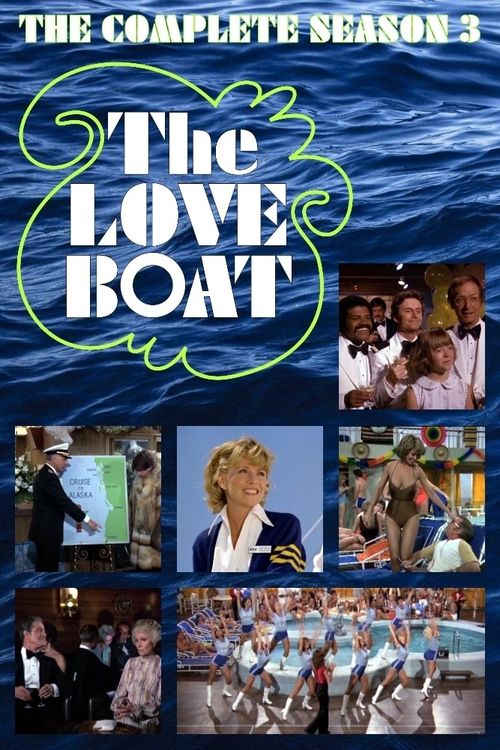
Retro Television Reviews: The Love Boat 3.25 “Celebration/Captain Papa/Honeymoon Pressure”


Welcome to Retro Television Reviews, a feature where we review some of our favorite and least favorite shows of the past!  On Wednesdays, I will be reviewing the original Love Boat, which aired on ABC from 1977 to 1986!  The series can be streamed on Paramount Plus!

This week, an important question is finally answered!

Episode 3.25 “Celebration/Captain Papa/Honeymoon Pressure”

(Dir by Richard Kinon, originally aired on March 29th, 1980)

Ever since Vicki first came aboard the ship, I have been wondering how exactly a 12 year-old can live (and apparently work) on an ocean liner.  One of my main questions has concerned how she is getting an education while sailing back and forth to Mexico.

With this episode, I finally got my answer.  When social worker Susan Stoddard (Lois Nettleton) boards the ship to decide whether or not to recommend that the Captain be given custody of Vicki, one of the first question that she asks is about school.

“Chief Petty Officer Dooley has a master’s in education,” Stubing replies, before saying that this never-before-mentioned character served as Vicki’s tutor.

Well, I’m glad that’s been cleared up.  Still, it is interesting that we’ve never before seen or even heard of this Dooley character.  We don’t even see Dooley in this episode.  You would think the social worker would want to talk to the person who is in charge of Vicki’s education.  Instead, Susan sees the rest of the crew, all of whom try to be on their best behavior in order to convince her that the Love Boat is not the floating HR nightmare that we all know it is.

(Still, at least the crew tried.  I’m surprised Doctor Bricker didn’t just try to sleep with her or something….)

This would be a really depressing episode of the Captain wasn’t awarded custody.  Luckily, Susan is so impressed by the crew that she says she will definitely file a positive report.  As she put it, Vicki not only has one wonderful parent.  She has “Five wonderful parents!”  Let’s see — Stubing, Julie, Gopher, Isaac, Doc …. yep, that’s five.  I’m sure Chief Petty Officer Dooley appreciates being left out of the group.

Isaac has more to worry about than just Captain Stubing’s situation.  Isaac is convinced that an old man named Gordon (Noah Beery, Jr.) is bank robber!  Gordon, who works as a bank guard at the port, is sailing on the Love Boat with his wife of 30 years, Betty (Alice Faye).  Gordon is spending a lot of money.  Isaac worries that Gordon stole the money but actually, it turns out that Gordon is just spending his life savings because his wife is in poor health and he wants to make sure that she has a wonderful vacation.  Unfortunately, Gordon spends too much on a diamond ring.  His wife, realizing what Gordon has done, secretly exchanges the ring for a cheaper one and tells her husband that she doesn’t need a life of luxury.  She just needs him.  Awwwwwww!  What a sweet old couple.

Finally, there are two real criminals on the boat.  Ralph (Norman Alden) and Ben (Richard Bakalyan) are two mob enforces who have been sent to accompany the boss’s daughter (Eve Plumb) on her honeymoon with her un-connected husband, Mark (Sal Viscuso).  Ralph and Ben’s presence makes Mark so uncomfortable that he can’t even consummate his marriage.  Ralph and Ben try to make things romantic for the couple.  Eventually, Doc Bricker tells the gangsters that Mark has a fictional disease, which causes Ralph and Ben to back off.  The married couple finally gets to celebrate their honeymoon.  But Mark still married into a mafia family so he’ll probably be machine-gunned as soon as he steps off the boat.

With the exception of the stupid Mafia story, this was a sweet episode.  I’m glad things worked out for the old couple and for Vicki and the Captain.  The Love Boat is not really a show that you watch for the acting but Gavin MacLeod’s natural sincerity always served him well whenever the show focused on his role as Vicki’s father.  Plus, I no longer have to worry about whether or not Vicki is going to have more than a sixth grade education.  So that’s a good thing.

Retro Television Reviews: Fantasy Island 3.12 “The Cheerleaders/Marooned”


Welcome to Retro Television Reviews, a feature where we review some of our favorite and least favorite shows of the past!  On Tuesdays, I will be reviewing the original Fantasy Island, which ran on ABC from 1977 to 1986.  Almost entire show is currently streaming is on Youtube!

Let’s see what’s happening on the Island this week….

Episode 3.12 “The Cheerleaders/Marooned”

(Dir by Earl Bellamy, originally aired on December 8th, 1979)

I’m just going to be honest here.  This week’s episode of Fantasy Island is not a good one.  Neither one of the fantasies work.  In fact, they’re both really, really annoying.  Usually, this show does a fairly good job of balancing a fun fantasy with a serious fantasy.  This episode, though, both fantasies are meant to be humorous.  They’re not.  They are both rather shrill.

That said, this episode did feature the return of Roarke and Tattoo bantering before going to meet their guests.  When Roarke steps out of his office to meet the plane, he’s surprised to see that Tattoo is hiding in a red fire hydrant costume.  When Roarke demands to know what Tattoo is doing, Tattoo explains that he’s training to be a secret agent.  Roarke rolls his eyes so violently that I’m surprised he didn’t injure himself.  Later, Tattoo attempts to disguises himself as a bale of hay and ends up getting chased by an enraged bull that just happens to be wandering around the Island.  Roarke laughs and laughs because there’s nothing that makes him happier than the idea of his assistant suffering a terrible injury.  That said, though it was all a bit mean-spirted, it was nice to see the return of the banter.

As for the two fantasies …. God, I don’t even want to talk about them.

The marginally more interesting one featured Vic Tayback as a blue collar guy named Melvyn whose fantasy was to spend some time with his favorite movie star, a total diva named Liz Merrill (Jayne Meadows).  When Liz shows up on the Island, it turns out that her fantasy is for everyone to think that she’s lost at sea before she’s eventually found on a tropical island.  She’s told that Melvyn has been hired to row the boat taking her to the island.  Instead, Melvyn and Liz get lost and really do end up on a deserted island, where Liz eventually drops her arrogant attitude and Melvyn wins her love by barking orders at her.  The fact that this was the “better” fantasy should tell you just how bad the other fantasy was.

The other fantasy features Georgia Engel and Patty McCormack as Cathy and Marg, two roommates whose fantasy is to be cheerleaders for their favorite football team, the Titans.  Fortunately, the Titans training camp happens to be on Fantasy Island!  Marg has a crush on quarterback Roger Mosely (played by Dan Pastorini) but Roger is more interested in Cathy.  This leads to the two friends not being friends anymore but then Mr. Roarke tells them that there’s nothing more important than friendship.  It’s a nice message but it’s hard to believe either Georgia Engel or Patty McCormack as cheerleaders and Engel and Pastorini had absolutely zero chemistry.  The whole thing just felt too silly for its own good.

(I even forced Erin to watch this episode with me so that I could get her perspective as a former cheerleader.  She agreed with me.  As far as cheerleader stories go, this was no Bring It On.)

Sigh.  This week’s episode was not great.  Hopefully, next week’s will be better!

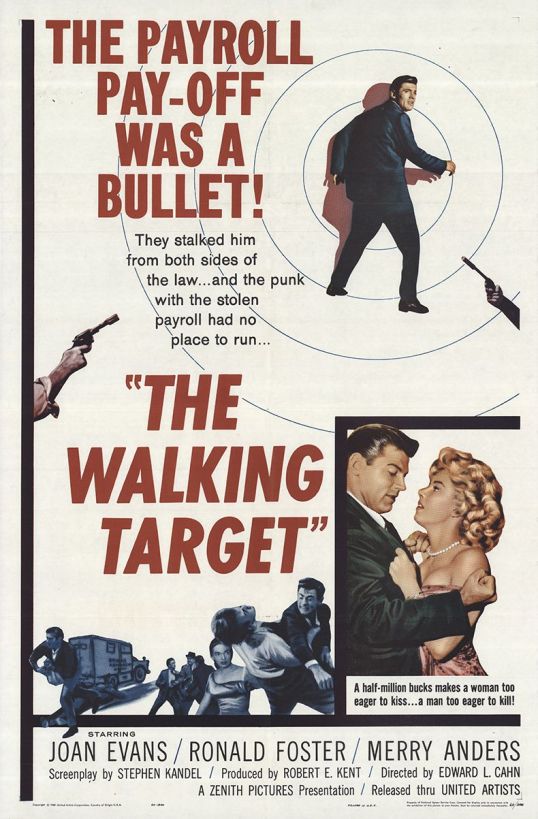
30 More Days of Noir #9: The Walking Target (dir by Edward L. Cahn)


In this 1960 noir, Nick Harbin (Ronald Foster) is a walking target!

That’s because he’s just been released from prison.  As the only survivor of a gang that pulled off a daring payroll robbery, Nick has done his time and he’s ready to get on with his life.  He even got himself an education while he was behind bars.  He’s decided to reform and no longer be the angry criminal that he once was.

But first, there’s a little matter of some money.

Only Nick knows where he buried the loot from the robbery.  Everyone wants it.  The press wants to know because it’ll make a great story.  A nosy detective wants to know because he’s convinced that Nick hasn’t changed his ways.  Susan (Merry Anders), who used to be involved with one of Nick’s criminal associates, wants to know because she’s only in it for the cash.  Susan’s current boyfriend, Dave (Robert Christopher) wants to know because …. well, again, it all comes down to greed.  Greed is also what’s motivating a local gangster to provide backing for Susan and Dave in their quest to find the money.  Dave is even willing to send Susan to seduce Nick.

However, all Nick wants to do is find the money and then split it with Gail (Joan Evans).  Gail is the widow of one of the robbers and Nick wants to do the right thing for her.  Of course, Nick is himself kind of in love with Gail.  Can Nick get the money, find love with Gail, and avoid slipping back into his criminal ways?  It won’t be easy.  Life is never easy when you’re….

THE WALKING TARGET!

Okay, that was a little bit melodramatic on my part but then again, it’s a melodramatic film.  Everyone is constantly plotting and double-crossing.  Appropriately, it all leads to a battle in the desert as modern-day outlaws prove themselves to be no more trustworthy than their vintage ancestors.

The Walking Target is a low-budget noir, one that clocks in at only 70 minutes and which, as a result, doesn’t waste much time when it comes to jumping into its story.  That’s one good thing about these B-movies.  They had neither the budget nor the time for red herrings.  As a result, you pretty much know what you’re going to get before the movies even begins.  The Walking Target features all of the usual tough dialogue and morally ambiguous characters that you would expect to see in a noir.  Merry Anders is an adequate femme fatale, though I do wish that Susan had been a smarter character.  (Nick sees through her way too easily.)  The film opens with the prison’s warden telling Nick that, even though he’s done his time, he’ll always be a no-good crook and that’s the perfect way for a noir to open.  Unfortunately, the film’s cinematography doesn’t really have the right noir look.  There aren’t enough shadows and the film often looks like it could just be an episode of an old TV show.  I guess that’d due to the budget but it really does keep the film from making the transition from being good to being great.

The Walking Target is a diverting-enough film.  I liked Ronald Foster’s uneasy performance as Nick and it was enjoyable to watch everyone plotting and scheming.  The Walking Target is currently available on Prime and I recommend it to anyone looking for a good, if lesser-known, B-noir.

Embracing the Melodrama Part II #66: Desperate Lives (dir by Robert Michael Lewis)


DL-cov2YouTube, my old friend, you have failed me.

For the longest time, the 1982 anti-drug melodrama Desperate Lives has been available for viewing on YouTube.  I first watched it two years ago, after I read an online article about a scene in which a teenage Helen Hunt takes PCP and jumps through a window.  And, when I watched it, I was stunned.  I knew that the film was going to be over-the-top and silly, largely because it’s hard to imagine how a film featuring a teenage Helen Hunt taking PCP could be anything other than that.  But, even with my experience of watching over the top message movies, nothing could have quite prepared me for Desperate Lives.

So, I figured, for this review, that I’d say a few snarky words about Desperate Lives and then I’d just add something like, “And you can watch it below!”  And then I would embed the entire movie and all of y’all could just click on play and watch a movie on the Lens.

Unfortunately, Desperate Lives has been taken off of YouTube.  I assume the upload violated some sort of copyright thing.  And really, it’s kinda stupid because seriously, Desperate Lives is one of those films that really deserves to be seen for free on YouTube.

Oh well.  You can still watch a video of Helen Hunt jumping through that window.  The video below also features some additional elements from Desperate Lives.

For instance, you get to see Diana Scarwid playing the angriest high school guidance counselor in the world.  Scarwid knows that students like Helen Hunt are using drugs and that her fellow faculty members are turning a blind eye to everything’s that’s happening.  From the minute she first appears on screen, Scarwid is shouting at someone and she doesn’t stop screaming until the film ends.

And you also get to see Doug McKeon, playing Helen Hunt’s brother.  McKeon goes for a drive with his girlfriend, who has just taken PCP herself.  As their car goes flying off a mountain, she says, “Wheeee!”

In the video below, you also get to see that the only reason Helen Hunt used drugs was because her boyfriend begged her to.  That’s a scenario that seems to show up in a lot of high school drug films and it’s strange because it’s something that I’ve never actually seen happen or heard about happening in real life.  In fact, in real life, most users of hard drugs are actually very happy to not share their supply.

Unfortunately, the video below does not feature any scenes of Sam Bottoms as the world’s most charming drug dealer and that’s a shame because he gives the only good performance in the entire film (sorry, Helen!).

Even worse, the video doesn’t include any scenes from the film’s memorably insane conclusion, in which Scarwid searches every single locker in the school and then interrupts a pep rally so she can set everyone’s stash on fire in the middle of the gym.  Making it even better is that all the students are so moved by Scarwid’s final speech that they start tossing all of the drugs that they have on them into the fire.

Which means that the film essentially ends with the entire school getting high off of a huge marijuana bonfire.

No, that scene cannot be found in the video below.  But you can find Helen Hunt jumping through a window so enjoy.

http://www.youtube.com/watch?v=rEpyLzHeozY