Review: By Dawn’s Early Light (dir. by Jack Sholder)


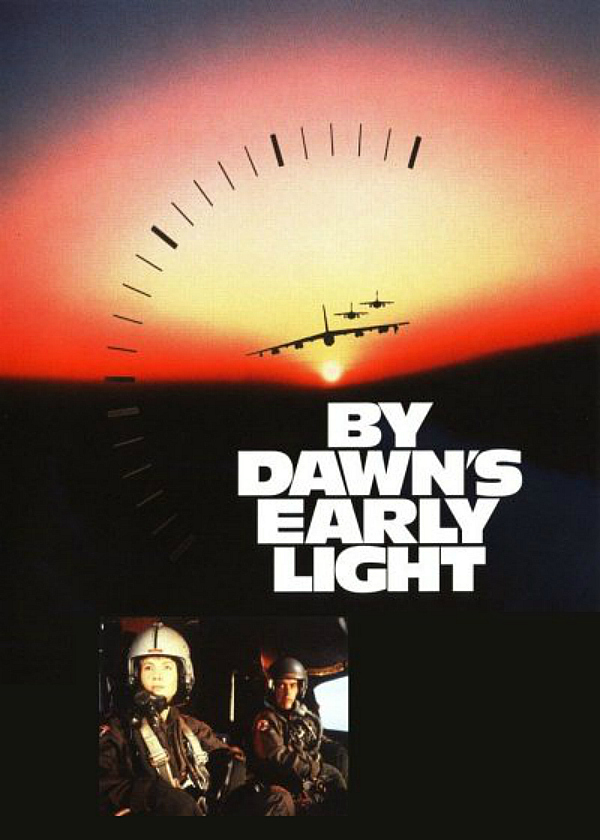
1990’s By Dawn’s Early Light is a film adaptation by HBO of William Prochnau’s novel Trinity’s Child. The film, when it first aired on HBO, seemed dated since the Soviet Union was ultimately going through its death throes as the military build-up initiated during the Reagan Administration crippled the USSR economically (they too tried to match the build-up in conventional and nuclear forces). Yet, despite the ending of the Cold War, recent events domestically and around the world has shown that the world never truly left behind the shadow of nuclear war.

The film is simplicity in the way the plot unfolds. A failed coup by dissident Soviet military commanders fails, but it’s after-effects of creating a “hot war” between the US and the USSR succeeds as both US President and Soviet Premiere make mistakes in their decisions. Decisions heavily influenced by their military commanders who see only black and white in how their respective nations should respond militarily. By Dawn’s Early Light shares some similarities to the classic 60’s Cold War films like Dr. Strangelove and Fail-Safe. Both films deal with the human frailties and flaws helping influence events that could lead to nuclear Armageddon for the whole planet. By Dawn’s Early Light concentrates on several storylines to highlight the stress and difficulties individuals must face to either follow their orders to their inevitable conclusion or allow their conscience to help make the moral decisions in trying to stop the madness spiraling out of control. Though some people’s decisions are left wanting, the film ends with a glimmer of hope that may just bring the world from the brink of annihilation.

The acting by the cast of Rebecca DeMornay, Powers Boothe, James Earl Jones, Darrin McGavin, Martin Landau and Rip Torn are well done. Rebecca DeMornay and Powers Boothe anchor one of the subplots as romantically involved B-52 crew pilots whose conflict comes from their own intimate closeness affecting command decisions and from the stress of families lost by the rest of the bomber crew. Darrin McGavin, Rip Torn and Martin Landau anchor the other subplot of competing Presidents. One a physically incapacitated US leader trying to avert escalating the conflict to the point of no return with another recently sworn in who fears of losing a nuclear war and thus wanting to strike back full and hard. In between these two leaders is the diabolical performance by Rip Torn as a warmongering Army colonel who sees only winning the war as the only objective. At times, the performances do become hampered by the simplicity of the script, but the cast power through to the end.

In the end, the film might look a bit dated in its production design (this was 1990 and many years before HBO became known for premiere television production) but the story itself is very current and relevant.  What might have been a nice Cold War relic fairy tale when it first aired in 1990 on HBO has taken on more of a cautionary tale as more nations begin to acquire nuclear weapons with some of these nations not just enemies of the US and the world in general, but also led by men whose hold on sanity seem tenuous at best. By Dawn’s Early Light is a great piece political “what if” that hopefully remains just that and not a prediction of reality to come.
Lisa Marie Reviews An Oscar Nominee: Reds (dir by Warren Beatty)


In the 1981 film Reds, Warren Beatty plays Jack Reed, the radical journalist who, at the turn of the century, wrote one of the first non-fiction books about Russia’s communist revolution and then went on to work as a propagandist for the communists before becoming disillusioned with the new Russian government and then promptly dying at the age of 32.

Diane Keaton plays Louise Bryant, the feminist writer who became Reed’s lover and eventually his wife.  Louise found fame as one of the first female war correspondents but then she also found infamy when she was called before a Congressional committee and accused of being a subversive.

Jack Nicholson plays Eugene O’Neill, the playwright who was a friend of both Reed and Bryant’s and who had a brief affair with Bryant while Reed was off covering labor strikes and the 1916 Democratic Convention.

Lastly, Maureen Stapleton plays Emma Goldman, the anarchist leader who was kicked out of the country after one of her stupid little dumbass followers assassinated President McKinley.  (Seriously, don’t get me started on that little jerk Leon Czolgosz.)

Together …. well, I was going to say that they solve crimes but that joke is perhaps a bit too flippant for a review of RedsReds is a big serious film about the left-wing activists at the turn of the century, one in which the characters move from one labor riot to another and generally live the life of wealthy bohemians.  Reed spends the film promoting communism, just to be terribly disillusioned when the communists actually come to power in Russia.  For a history nerd like me, the film is interesting.  For those who are not quite as obsessed with history, the film is extremely long and the scenes of Reed and Bryant’s domestic dramas often feel a bit predictable, especially when they’re taking place against such a large international tableaux.  At its best, the film is almost a Rorschach test for how the viewer feels about political and labor activists.  Do you look at Jack Reed and Louise Bryant and see two inspiring warriors for the cause or do you see two wealthy people playing at being revolutionaries?

Reds was a film that Warren Beatty spent close to 20 years trying to make, despite the fact that the heads of the Hollywood studios all told him that audiences would never show up for an epic film about a bunch of wealthy communists.  (The heads of the studio turned out to be correct, as the film was critically acclaimed but hardly a success at the box office.)  It was only after the success of the 1978, Beatty-directed best picture nominee Heaven Can Wait that Beatty was finally able to get financing for his dream project.  He ended up directing, producing, and writing the film himself and he cast his friend Jack Nicholson as O’Neill and his then-romantic partner Diane Keaton as Louise Bryant.  (Gene Hackman, Beatty’s Bonnie and Clyde co-star, shows up briefly as one of Reed’s editors.)  One left-wing generation’s tribute to an early left-wing generation, Reds is fully a Warren Beatty production and, for his efforts, Beatty was honored with the Oscar for Best Director.  That said, the Reds lost the award for Best Picture to another historical epic, Chariots of Fire.  Chariots of Fire featured no communists and did quite well at the box office.

The film is good but a bit uneven, especially towards the end when we suddenly get scenes of Louise Bryant trudging through Finland as she attempts to make it to Russia to be reunited with Reed.  The film actually works best when it features interviews with people who were actual contemporaries of Reed and Bryant and who share their own memoires of the time.  In fact, the interviews work almost too well.  The “witnesses,” as the film refers to them, paint such a vivid picture of the Reed, Bryant, and turn of the century America that Beatty’s attempt to cinematically recreate history often can’t compete.  One can’t help but feel that Beatty perhaps should have just made a documentary instead of a narrative film.

(Interestingly enough, many of the witnesses were people who were sympathetic to Reed’s politics in at the start of the century but then moved much more to the right as the years passed.  Reed’s friend and college roommate, Hamilton Fish, went on to become a prominent Republican congressman and a prominent critics of FDR.)

That said, Jack Nicholson gives a fantastic performance as Eugene O’Neill, adding some much needed cynicism to the film’s portrayal of Reed and Bryant’s idealism.  Keaton and Beatty sometime both seem to be struggling to escape their own well-worn personas as Bryant and Reed but Beatty does really sell Reed’s eventually disillusionment with Russia and the scene where he finally tells off his Russian handler made me want to cheer.  Fans of great character acting will want to keep an eye out for everyone from Paul Sorvino to William Daniels to Edward Herrmann to M. Emmet Walsh and IanWolfe, all popping up in small roles.

Reds is not a perfect film but, as a lover of history, I enjoyed it.


Film Review: The Pursuit of D.B. Cooper (dir by Roger Spottiswoode and Buzz Kulik)


The story of D.B. Cooper has always fascinated me.

D.B. Cooper is the name assigned to a man who, in 1971, hijacked an airplane, demanded $200,000, and then jumped off the plane after he got the money.  Reportedly, he was well-dressed and unfailingly polite during the entire hijacking.  When he jumped off the plane, he was about 10,000 feet over the Washington wilderness.  After he jumped, no further trace was found of him.  Over 50 years after the incident, the identity and the location of D.B. Cooper remains a mystery.

It’s been said that, even though Cooper had a parachute with him when he jumped, there’s no way that he could have survived the jump.  And yet, no body has ever been found.  (Of course, finding a body in the wilderness is not as easy as some people assume.)  Nine years after the the skyjacking, some of the money that Cooper received was found on the banks of the Columbia River, which was several miles away from the area that Cooper jumped over.  Did Cooper survive the jump and lose the money?  No one can say for sure.

Over the years, many people have come forward to say that they know the identity of D.B. Cooper.  Many distant fathers and secretive boyfriends and long lost friends have been accused of being D.B. Cooper.  Some of those suspects are more likely than others.  Even John List, the murderer who inspired the Stepfather films, was suspected at one point.

D.B. Cooper remains a fascinating character precisely because he’s never been captured and the mystery itself will probably never be solved.  Because he remains an enigma, it’s easy to project your own pet obsessions on him and his story.  Myself, I always imagine D.B. Cooper as being some sort of clever, fun-loving international rogue, even though there’s not really any evidence to back that up.  But, the fact of the matter is that I have a weakness for clever, fun-loving international rogues so, of course, that’s who I’m going to imagine D.B. to be.

I certainly would never imagine him to be like the character at the center of 1981’s The Pursuit of D.B. Cooper.

In this film, D.B. Cooper turns out to be Jim Meade (Treat Williams), a Vietnam vet and all around jackass who steals the money so that he can get back together with his estranged wife, Hannah (Kathryn Harrold).  Hannah does take him back because, seriously, who is going to say no to that much money?  Jim and Hannah spend the entire film running from one wilderness location to another.  They steal cars.  They steal trucks.  Meade steals an airplane at one point.  Hannah gets worried often and Jim tends to yell, “Woo hoo!” whenever he gets excited about anything.  At one point, Jim and Hannah are chased across some white water rapids.  When Hannah and Jim reach dry land, Jim gives the finger to the river.  I will say that, as someone who grew up in the South, Jim is a type of character who seems very familiar to me.  I’ve known a lot of Jim Meades and Treat Williams doesn’t do bad job playing Meade as being an impulsive, loud-mouthed good old boy.  The only problem is that, at no point, does Jim Meade come across like someone who could have pulled off what D.B. Cooper pulled off.

Jim is being pursued by two old army buddies.  The scruffier of the two is Remson (Paul Gleason), who somehow manages to keep popping up like a cartoon character at the most inopportune of times.  No matter what bad thing happens to Remson, he still shows up good-as-new a few minutes later.  Paul Gleason gives an energetic performance as Remson, a character who has little in common with the uptight authority figures that Gleason later played in The Breakfast Club and Die Hard.

The other person chasing Jim is Bill Gruen (Robert Duvall), who served with Meade in Vietnam but who is now working as an insurance investigator.  Gruen says that he knew Meade had to be D.B. Cooper because only Meade could survive jumping out of a plane over wilderness terrain.  Gruen wants some of the money for himself.  Despite his greed, it’s hard not to like Gruen because he’s played by Robert Duvall.  The best scene in the film is one where Duvall and Williams, exhausted from chasing each other, have a weary but friendly conversation.  It’s the one moment where Williams actually calms down and provides some hint that there’s actually something going on underneath Meade’s manic exterior.  Acting opposite Duvall brings out the best in him.

The Pursuit of D.B. Cooper had a notoriously troubled production and apparently, there was never a completed script during shooting.  Reportedly, bits of the film were directed by Robert Mulligan, John Frankenheimer, and Buzz Kulik before Roger Spottiswoode took over.  It’s a film that was obviously inspired by 70s chase films like Smokey and the Bandit but it also somehow managed to attract actors like Robert Duvall, who does his best to class up the joint.  The action quickly gets repetitive and the movie never seems to know if it wants to be a comedy or a drama.  On the plus side, Treat Williams and Kathryn Harrold make for a cute couple.

When this picture first came out, Universal Pictures offered a million dollar reward for any information that would lead to the capture and arrest of the real D.B. Cooper.  No one collected.

An Olympic Film Review: Goldengirl (dir by Joseph Sargent)


The 1979 film Goldengirl is a film that I had wanted to see ever since I first came across this trailer on one of the 42nd Street Forever compilation DVDs:

Wow, I wondered.  What was Goldengirl’s secret and why was she ordering James Coburn to kiss her feet?  For that matter, why did James Coburn have a haircut that made him look exactly like this old lady who used to live next door to my grandma in Fort Smith?  What did it all have to do with the villain from The Spy Who Loved Me and just how drunk was Robert Culp when he shot his scenes?  Even more importantly, why did Goldengirl keep running into that wall?  That looked painful!

I did some research.  (That’s a fancy way of saying that I looked the movie up on Wikipedia.)  I discovered that Goldengirl was made in 1979.  It was originally meant to be a television miniseries that would not only air during the 1980 Summer Olympics but which would feature Goldengirl competing at those Olympics!  However, during production, it was decided to just use the material for a feature film instead. (Hmmmm, I thought, behind-the-scenes drama!  Intriguing!)  The film was released in June of ’79 and, despite one rave review from Vincent Canby in the New York Times, the film failed at the box office.  Add to that, the U.S. ultimately boycotted the 1980 summer games, which made Goldengirl‘s Olympic-set climax a bit awkward.

I also discovered that Goldengirl is nearly impossible to see.  It’s never been released on DVD or Blu-ray or any digital or streaming service.  So, I resigned myself to the fact that I’d probably never see Goldengirl and, the more I thought about it, the more I realized that I really didn’t care that much.

However, for the past few days, I have been absolutely obsessed with the Winter Olympics.  Even though it was a Summer Olympic movie, I decided to go on YouTube and see if anyone had uploaded Goldengirl since I last checked.

And guess what?

They had!

Now, here’s the problem.  The two guys who uploaded Goldengirl also talked over the entire movie.  Don’t get me wrong.  The movie looked about as good as a VHS copy of a movie from 1979 is ever going to look.  And I could still follow Goldengirl‘s story, even if I sometimes had to really strain to hear the dialogue over the two guys “commenting” on it.  Still, it meant that I had to put a bit more effort into watching this movie than it perhaps deserved.  It was kinda hard not to resent that.

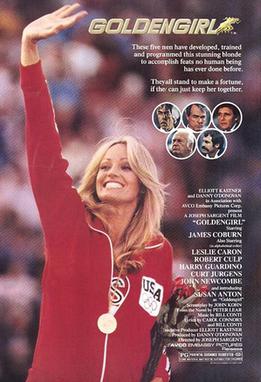
Anyway, I have finally seen Goldengirl and I can now tell you that it’s a pretty lousy movie.  Goldengirl is Goldine (Susan Anton).  Her father is a German scientist who used to work for the Nazis.  When he came to the United States, he decided to prove that his theories of eugenics were correct by adopting a daughter and breeding her to be the world’s greatest athlete.  Working with a psychiatrist named Dr. Lee (Leslie Caron, for some reason), they have not only turned Goldine into the world’s greatest athlete but they’ve also turned her into a bright, smiling media personality.  (Dr. Lee has trained Goldine, through the use of a vibrator, to always give the right answer when she’s asked a question.)  Now, they just need Goldine to win three gold medals at the Summer Olympics and for PR agent Jack Dryden (James Coburn) to make Goldine into a star.  Dryden is the only person who really cares about Goldine as something other than an experiment or a way to make money.

Goldine spends almost the entire movie running.  There’s one running montage that seems to go on forever.  Susan Anton was a model when she was cast as Goldine.  She’s got the right look to be a celebrity but she’s never convincing as an Olympic-class athlete.  Whenever Goldine competes, we either get a close-up of Anton running in slow-motion with no other runners around her or else a long-shot that’s designed to keep us from noticing that Anton isn’t really on the track.

Really, that’s entire film.  On the basis of the trailer, I was expecting that Goldengirl would turn out to be a robot or something like that.  Instead, it just turns out that her stepfather has spent years injecting her with vitamins and hormones and now, as a result, she has diabetes.  Seriously, that’s it.  She gets pretty mad when she finds out that her handlers have put her health at risk just so she could win a race.  But then she goes ahead and runs the race anyway so I guess it was all for the best.  Seriously, that’s the entire freaking movie.  It doesn’t help that Anton’s acting is amateurish and the rest of the cast seems bored.  Only Curt Jurgens really makes much of an impression, mostly because he’s too sinister not to be memorable.

The trailer is better than the movie.  That’s the secret of Goldengirl.

A Movie A Day #326: MacArthur (1977, directed by Joseph Sargent)


The year is 1962 and Douglas MacArthur (Gregory Peck), the legendary general, visits West Point for one last time.  While he meets the graduates and gives his final speech, flashbacks show highlights from MacArthur’s long military career.  He leaves and then returns to Philippines.  He accepts the Japanese surrender and then helps Japan rebuild and recover from the devastation of the war.  He half-heartedly pursues the Presidency and, during the Korean War, gets fired by Harry Truman (Ed Flanders).
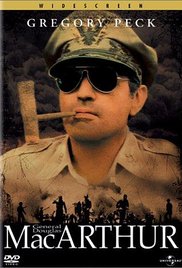
MacArthur is a stolid biopic about one America’s most famous and controversial generals.  It was produced by Frank McCarthy, a former general who knew MacArthur and who previously won an Oscar for producing Patton.  McCarthy was obviously hoping that MacArthur was do its subject what Patton did for George Patton and both films follow the same basic pattern. a warts-and-all portrait of a World War II general with all of the action centered around the performance of a bigger-than-life actor in the title role.  Though obviously made for a low budget, MacArthur is a well-made and well-acted movie but it suffers because Douglas MacArthur was just not as interesting a figure as George Patton.  Gregory Peck does a good job subtly suggesting MacArthur’s vanity along with capturing his commitment to his duty but he never gets a scene that’s comparable to George C. Scott’s opening speech in Patton.  The main problem with MacArthur, especially when compared to Patton, is that George Patton was a born warrior while Douglas MacArthur was a born administrator and it is always going to be more exciting to watch a general lead his men into battle then to watch him sign executive orders.

Hallmark Review: Flower Girl (2009, dir. Bradford May)


IMG_2172

Before I start talking about the movie I need to mention a couple of funny things.

First, I kind of like actress Marla Sokoloff. I first saw her on an episode of Melissa & Joey where she played a chiropractor that Joey Lawrence’s character goes to see. I enjoyed her performance. Her and Joey end up in a relationship together. It turns out she’s a virgin. As I recall, he can’t follow through with it. It was humorous to me given the title of this film.

Another coincidence that is similar to that one is another place I had seen Marla before watching this film. The previous film I saw her in was Scents and Sensibility (2011). In this movie Marla’s character will bring up that she enjoys more serious books rather than things like romance novels. There is even a scene where they mention Jane Austen who of course wrote Sense and Sensibility.

Weird that not only were both of those things done after Flower Girl, but that they were the only two other places I had seen her before, which also happen to somehow tie back to this film. Bizarre!

The second thing is something that only someone like myself who, for some reason, has now seen 164 Hallmark movies would notice. All but 5 of which have been since last July.

Screen Shot 2016-03-13 at 8.51.32 PM

I think IMDb nailed it here. Let’s go through those recommendations:

  1. Perfect On Paper is about a girl who is given a job editing romance novels. She is encouraged to date men who are perfect on paper. She eventually comes around to the guy who isn’t perfect on paper, but perfect for her. This movie has romance novels at the center of it, and Marla is encouraged to date a doctor because he is perfect on paper. Also, the actor playing the right guy in this movie is the wrong guy in Perfect On Paper. His last name in that was Cooper, which just so happens to be the last name of the right guy in this movie.
  2. So You Said Yes is about a girl who runs a bridal shop that tries to cater more to the brides actual wants rather than just whatever is the standard wedding they are told they want by the owner. Marla will several times talk about how she does just that. She listens to her clients and uniquely tailors the flowers to be used at the wedding even when that includes something like matching flowers to biker tattoos.
  3. Recipe For Love is about a girl who is given a chance to help ghostwrite a cookbook for a famous cook who is hiding behind a persona that isn’t the real him. Someone ghostwriting books is an important part of this film. That person is also using someone else to pretend that they are the person who is writing the books.
  4. My Boyfriends’ Dogs is about a girl who goes through a series of boyfriends accumulating the dogs they buy together along the way. During all this she passes through a dog store where she keeps running into a guy that winds up being for her. Okay, the connection here is a little weak, but it was written by Gary Goldstein, and he has written both of the Flower Shop Mystery movies.
  5. Bridal Wave is about a girl who is going to be married to a doctor, but at the last minute leaves him for another guy. They will break up when they both realize that they were getting married because it seemed like the next logical step. They both worked together all the time with him as the doctor and her as his assistant. In this movie, one of the two men Marla is dating is a doctor. She will also break it off with him because she thinks both of them were rushing into a possible marriage because they were both just looking for someone. Also, just as in Bridal Wave, they will never make the wrong guy out to be a jerk. He is just not the right guy for her.
  6. In The Wish List, a girl starts the movie as a little girl who is very organized and drawing pictures of her prince charming. It then cuts to her in the present as an adult. She will proceed to make a big list of the things that must be in a guy for him to be perfect for her. She will end up choosing between a doctor and a barista. To try and decide between the two, she makes a list comparing the two of them. The doctor will go away to South America at one point in the movie. This movie also starts off with Marla as a little girl. She is in her grandma’s flower shop before cutting to the present where she now runs the place. Her grandma will even tell her to make a list comparing the two guys she meets. One of them is a doctor. Oh, and yes, the doctor is going to go to South America in this one too.

Like I said, I think IMDb nailed it this time with their recommendations.

I think I’ve nearly laid out the whole plot right there for you. I’ll try to be brief.

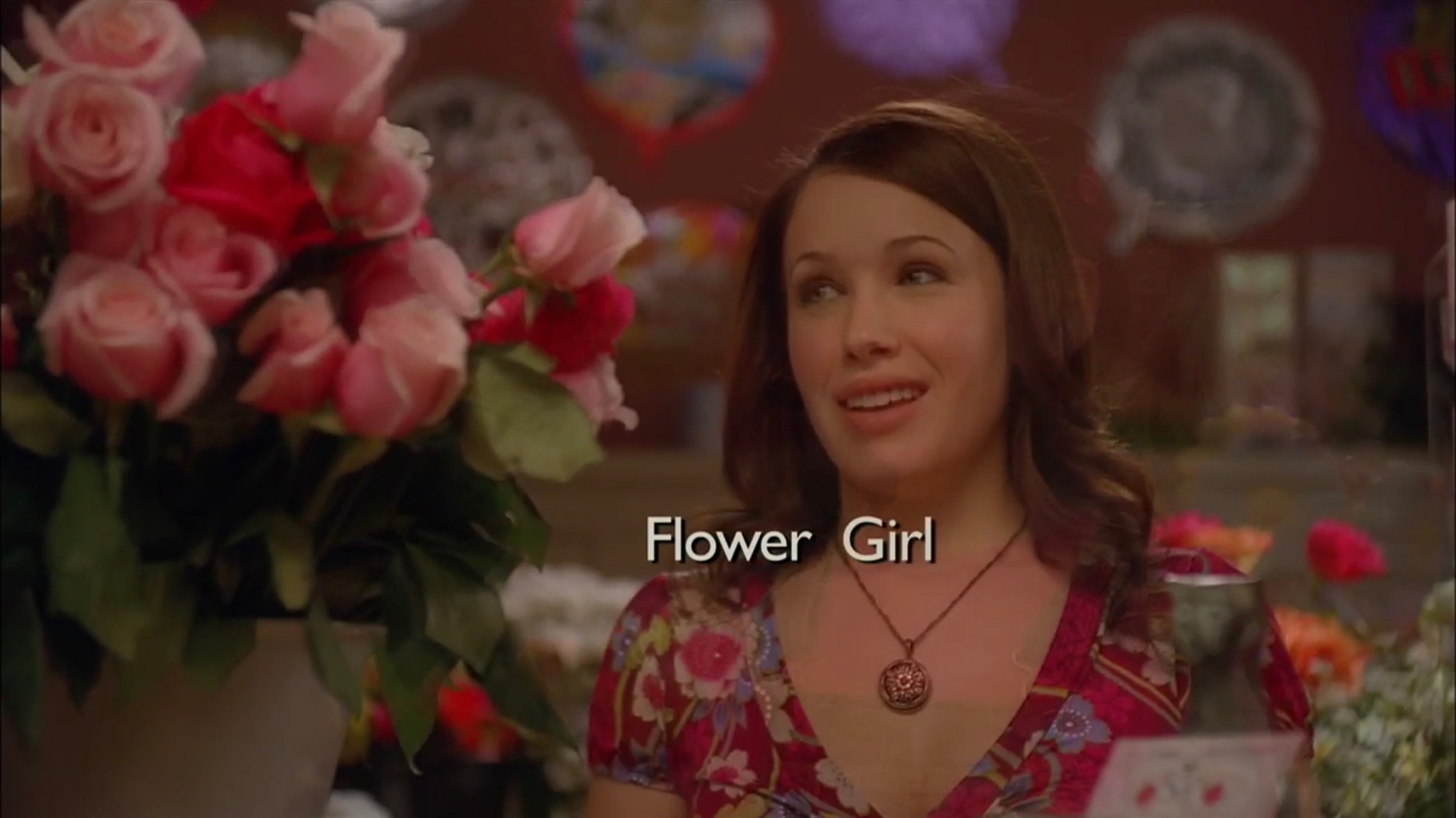
The film begins by showing us Laurel Haverford (Marla Sokoloff) as a little girl for what I think was about two seconds. It’s actually kind of cute. When the little girl is onscreen it only says “Flower”, but when it then cuts to Laurel it adds “Girl” to give us the full title. Marla does flowers for weddings.

We are quickly introduced to the two main ladies in Laurel’s life. One is her grandmother Rose (Marion Ross). The other is a friend named Brooke oddly enough played by Brook Kerr. I’m not reading that off of IMDb either. It says it in the credits that the character is Brooke with an ‘e’ and the actress is Brook without an ‘e’. I have no idea why. To add even further confusion to this, the captions say her name is Brook without an ‘e’.

IMG_2814

The introductions are over a wedding as well as a run with Rose and Brooke. Grandma Rose wants her daughter to get hooked up. Brooke might as well be Sarah Fischer from The Wish List cause she has her list of things that must be present in a guy. Well, at least things that show he is up for commitment and jobs he can’t have. Sorry wedding photographers who moonlight as guitar playing bartenders, but Brooke says you won’t do. I actually did know a community college speech teacher who moonlit as a bartender. He was a wonderful teacher.

IMG_2289

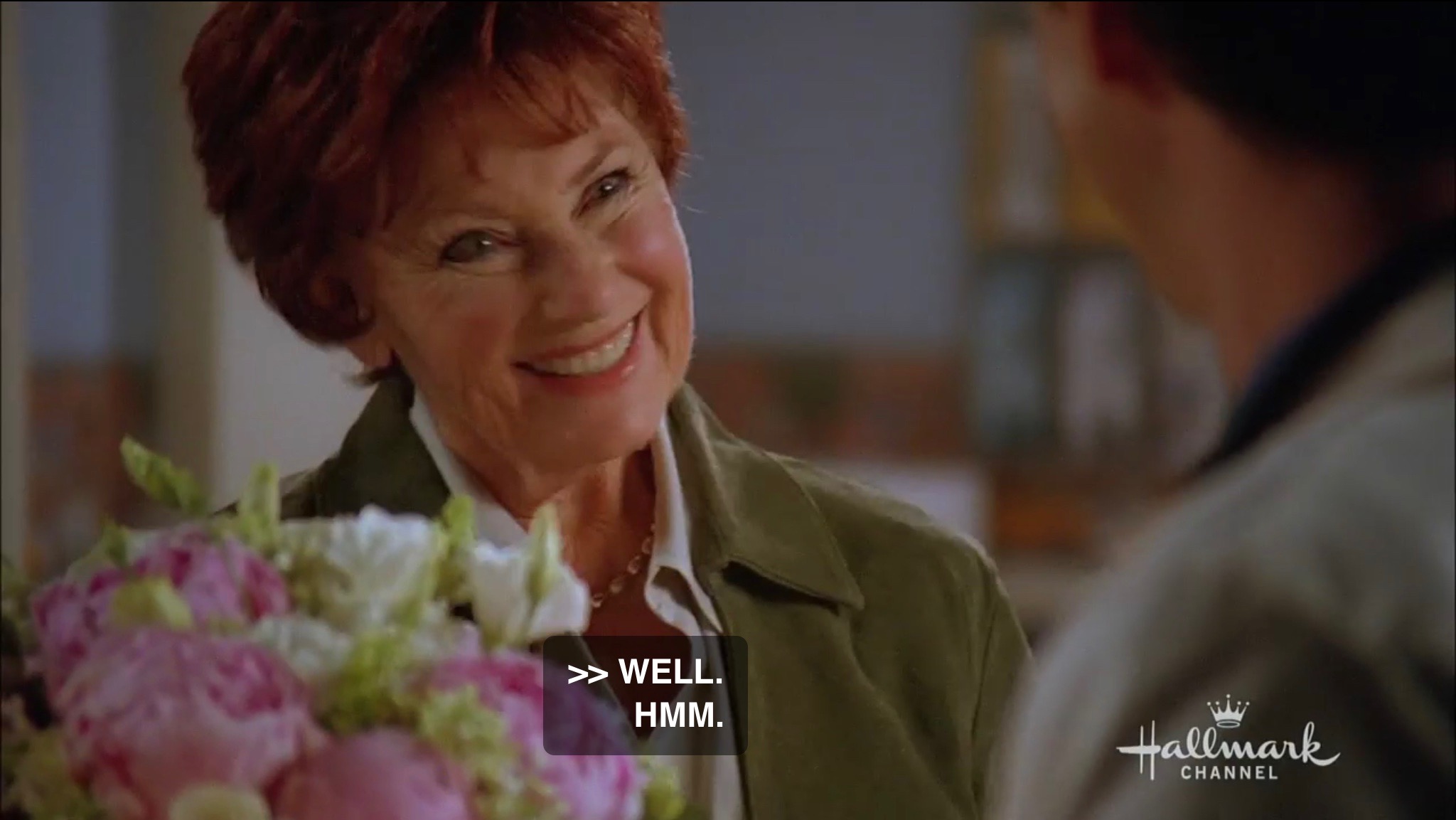
This movie wastes no time. Grandma runs right into Dr. Evan Cooper (Terry Maratos) as she is finishing up delivering some flowers. I love the looks on Marion Ross’ face here as she talks with the doctor. First it’s surprise that he knows the Latin name of the flowers. Then it’s kind introductions. That’s followed by a sly look and a question about his marital status. After she finds out he’s not married, she springs up with this face.

IMG_2356

The next major plot point is when Laurel runs into Stephen Banks (Kieren Hutchison) at a wedding. He will be kind of a man of mystery throughout this film. She later runs into him at a table with a bunch of books on it. Stephen suggests a book by Victoria Darling (Bonnie Root).

IMG_3077

I’m not even going to take a guess at what the guy on the cover is holding. I don’t think I want to know.

That’s it for setup. There is a small subplot with an older guy named Gavin played by Nicolas Coster. If you look at Nicolas Coster’s filmography, then you will find that he seems to have been in everything. He’s probably most notable for being on the soap opera Santa Barbara. However, you can also see him in Betsy’s Wedding (1990) that a cross country coach I had liked to Goldengirl (1979) that The Cinema Snob put an impassioned plea out to get it a proper release when he reviewed it to All The President’s Men (1976). In this movie, he might as well not be there.

The remainder of the film is a series of dates with Stephen and Evan. I kind of already gave away the surprise earlier about the romance novels, but trust me, it’s not much of a surprise. The movie really sends you clear messages about it. In the end, she decides to be with Stephen. The film ends with them being married, then getting into a pretty neat looking carriage.

IMG_4552

So, do I recommend it? Honestly, I have to say no. It has things to like about it sure. I really do like Marla. They obviously didn’t have a big budget for the movie, but tailored the film to fit that budget. They didn’t try to fake things like in Bradford May’s film Cloudy with a Chance of Love. Still, for the life of me, I can’t recommend it to anyone off the street. If you happen to turn it on with nothing else to watch, then sure. I do recommend though if you like Marla Sokoloff.