The Central Florida Critics Honors The Tragedy of Macbeth!


The Critics Association of Central Florida (CAFC) is a new group of critics.  Today, they announced their picks for the best of 2021 and it was a victory for a film that, so far, has been a bit quiet on the precursor front, Joel Coen’s The Tragedy of Macbeth.

Here are all the winners from Central Florida:

Best Picture
Winner: The Tragedy of Macbeth
Runner-up: Licorice Pizza

Best Director
Winner: Denis Villenueve – Dune
Runner-up: Joel Coen – The Tragedy of Macbeth

Best Actor
Winner: Andrew Garfield – tick, tick… BOOM!
Runner-up: Peter Dinklage – Cyrano

Best Actress
Winner: Renate Reinsve – The Worst Person in the World
Runner-up: Alana Haim – Licorice Pizza

Best Supporting Actor
Winner: Bradley Cooper – Licorice Pizza
Runner-up: Troy Kotsur – CODA

Best Supporting Actress
Winners (tie): Ann Dowd – Mass/Aunjanue Ellis – King Richard
Runner-up: Ariana DeBose – West Side Story

Best Cast
Winner: Dune
Runner-up: Mass

Best Documentary
Winner: Flee
Runner-up: Summer of Soul (… or, When the Revolution Could Not Be Televised)

Best International Film
Winner: A Hero
Runner-up: Drive My Car

Best Animated Film
Winner: The Mitchells vs. the Machines
Runners-up (tie): Flee/Luca

Best Screenplay
Winner: Fran Kranz – Mass
Runner-up: Aaron Sorkin – Being the Ricardos

Best Cinematography
Winner: Greig Fraser – Dune
Runner-up: Bruno Delbonnel – The Tragedy of Macbeth

Best Score
Winner: Hans Zimmer – Dune
Runner-up: Johnny Greenwood – Spencer

Best Original Song
Winner: “No Time to Die” – No Time to Die
Runner-up: “Be Alive”- King Richard

Best Central Florida FIlm
Winner: King Richard

Best Achievement in Diversity
Winner: Eternals

Cleaning Out The DVR: An American Dream (dir by Robert Gist)


Loosely based on a novel by Norman Mailer, the 1966 film, An American Dream, tells the story of Stephen Rojack (Stuart Whitman).  Rojack’s a war hero, a man who has several medals of valor to his credit.  He’s married to Deborah (Eleanor Parker), the daughter of one of the richest men in the country.  He’s an acclaimed writer.  He’s got his own television talk show in New York.  He’s been crusading against not only the Mafia but also against corruption in the police department.  He has powerful friends and powerful enemies.  You get the idea.

He’s also got a marriage that’s on the verge of collapse.  Deborah calls Rojack’s show and taunts him while he’s on the air.  When Rojack goes to her apartment to demand a divorce, the two of them get into an argument.  Deborah tells him that he’s not a hero.  She says he only married her for the money and that she only married him for the prestige.  She tells him that he’s a lousy lover.  Being a character in an adaptation of a Norman Mailer novel, the “lousy lay” crack causes Rojack to snap.  He attacks Deborah.  The two of them fight.  Deborah stumbles out to the balcony of her apartment and it appears that she’s on the verge of jumping.  Rojack follows her.  At first, he tries to save her but then he lets her fall.  She crashes down to the street, where she’s promptly run over by several cars.  The cars then all run into each other while Rojack stands on the balcony and wails.  There’s nothing subtle about the first 15 minutes of An American Dream.

Actually, there’s nothing subtle about any minute of An American Dream.  It’s a film where everything, from the acting to the melodrama, is so over-the-top and portentous that it actually gets a bit boring.  There’s no relief from the screeching and the inauthentic hard-boiled dialogue.  When a crazed Rojack starts to laugh uncontrollably, he doesn’t just laugh.  Instead, he laughs and laughs and laughs and laughs and laughs and …. well, let’s just say it goes on for a bit.  It’s like a 60s version of one of those terrible Family Guy jokes.

Anyway, the police don’t believe that Deborah committed suicide but they also can’t prove that Rojack killed her.  Meanwhile, within hours of his wife’s death, Rojack meets his ex-girlfriend, a singer named Cherry (Janet Leigh).  Rojack is still in love with Cherry but Cherry is also connected to the same mobsters who want to kill Rojack.  Meanwhile, Deborah’s superrich father (Lloyd Nolan) is also on his way to New York City, looking for answer of his own.

An American Dream is a very familiar type of mid-60s film.  It’s a trashy story and it’s obvious that the director was trying to be as risqué as the competition in Europe while also trying to not offend mainstream American audiences.  As such, the film has hints of nudity but not too much nudity.  There’s some profanity but not too much profanity.  Rojack, Deborah, and Cherry may curse more than Mary Poppins but they’re rank amateurs compared to the cast of Who’s Afraid of Virginia Woolf?  It’s an unabashedly melodramatic film but it doesn’t seem to be sure just how far it can go in embracing the melodrama with alienating its target audience so, as a result, the entire film feels somewhat off.  Some scenes go on forever.  Some scenes feel too short.  The whole thing has the washed-out look of an old cop show.

All of that perhaps wouldn’t matter if Stephen Rojack was a compelling character.  In theory, Rojack should have been compelling but, because he’s played by the reliably boring Stuart Whitman, Rojack instead just comes across as being a bit of a dullard.  He’s supposed to be a charismatic, two-fisted Norman Mailer-type but instead, as played by Whitman, Rojack comes across like an accountant who is looking forward to retirement but only if he can balance the books one last time.  There’s no spark of madness or imagination to be found in Whitman’s performance and, as a result, the viewer never really cares about Rojack or his problems.

Noman Mailer reportedly never saw An American Dream, saying that it would be too painful to a bad version of his favorite novel.  In this case, Mailer made the right decision.

Scenes That I Love: Nicolas Cage in Wild At Heart


Today is Nicolas Cage’s birthday!

How old is Nicolas Cage today?  It doesn’t matter.  Nicolas Cage is timeless.  He has no age.  You could say that Nicolas Cage has always been there and will always be there.

On a more realistic note, you could say that Nicolas Cage is the nephew of director Francis Ford Coppola and that he started his film career as Nicolas Coppola.  (That was the name he used when he made his film debut with a small role in Fast Times At Ridgemont High.)  Not wanting people to assume that he only got work because of his family connections, Nic soon changed his last name to Cage in honor of Marvel’s Luke Cage.  Nicolas Cage has gone on to become one of the best-known actors in the world, an iconic figure of sorts.  When he’s good, Nicolas Cage is great.  When he’s appearing in a bad film, Nicolas Cage is often fascinating.  Cage may have a reputation for being an eccentric and for appearing in almost anything but often Cage’s brand of weirdness is just what is needed to elevate a film like Mandy or Pig from good to great.

In honor of his birthday, here are two scenes that I love from a very good film, David Lynch’s Wild At Heart.  Watch as Nicolas Cage explains the meaning of his snakeskin jacket.  Stick around to watch Nicolas Cage serenade Laura Dern with the world’s greatest Elvis impersonation.

Happy birthday, Nicolas Cage!

International Film Review: Kapo (dir by Gillo Pontecorvo)


What turns someone into a collaborator?

That’s the question that is at the heart of the 1960 Italian-French film, Kapo.

The film opens in Nazi-occupied France, with 14 year-old Edith (played by 22 year-old Susan Strasberg) practicing the piano at her teacher’s house.  Edith wears the yellow star on her dress and, as she finishes her lesson, her teacher instructs her to be careful returning home.  Edith cheerfully states that she and her family have nothing to worry about.  Edith walks home and, as the opening credits roll, we follow her as she walks through what appears to be a very robust and busy city.  Other than the yellow star on Edith’s dress, there are no outward signs of the occupation in the city.  However, when Edith finally reaches her neighborhood, she sees that her family and her neighbors are being rounded up the Germans.

Edith and her parents are sent to a concentration camp but get separated as soon as they arrive.  Wandering around the camp, Edith meets another prisoner named Sofia (Didi Perago).  Sofia takes Edith to the camp doctor.  He arranges for Edith to switch identities with a non-Jewish prisoner who has just died.  Edith’s new name is Nicole and her yellow star is removed and replaced by a black triangle, which designates Edith/Nicole as being “asocial.”

Edith is transferred to another concentration camp, this one in Poland.  She comes to think of herself as being Nicole.  When another prisoner, Terese (Emmanuelle Riva), asks her is she’s Jewish, Nicole replies that she’s not.  Nicole quickly grows hardened to life in the camp and exchanges sex for food.  She becomes the lover of a guard named Karl (played by future spaghetti western mainstay Gianni Garko) and is made a Kapo, a prisoner who also works as a guard.  However, when Nicole then falls in love with a Russian prisoner-of-war and he asks her to help him and his comrades escape, she is forced to finally decide whether she is Nicole or whether she’s Edith.

To return to the question that started this review: What makes someone a collaborator?  That’s the question that Kapo attempts to answer and it’s a question that was undoubtedly close to  Director Gillo Pontecorvo’s heart.  Pontecorvo was one of the most political of the post-World War II Italian filmmakers.  He was born in 1919 and, as a child, saw firsthand the rise of Mussolini.  As a Jew, he also experienced anti-Semitism firsthand and, in 1938, he left Italy for France.  In France, he befriended Sartre and many other key members of the International Left.  He was reportedly emotionally and politically moved by his friends who left France to fight on the Republican side during the Spanish Civil War.  During World War II, he joined the Italian communist party and fought in the resistance.  It’s perhaps not a surprise that, in Kapo, Nicole’s chance at redemption comes about as a result of falling in love with a communist soldier.

Unfortunately, Kapo struggles to answer the question of why one would collaborate with the enemy.  The main problem is that Susan Strasberg is miscast of Edith/Nicole, never convincing us that she’s a naïve teenager or a hardened collaborator.  She’s also not helped by a script that continually reduces everything down to who Edith/Nicole happens to be in love with at any given point of time.  It also doesn’t help that Strasberg find herself acting opposite Emmuelle Riva, Gianni Garko, and other actors who all authentic in a way that she’s not.

Kapo is more valuable as an examination of the horrors of the camps than as a character study.  The film’s most powerful moment comes early on, when Edith/Nicole learns that, in the eyes of the Nazis, it’s preferable that someone be a criminal to being a Jew.  In that moment, the film captures both the brutal horror and the arbitrary absurdity of prejudice.  The scene is followed by another harrowing moment, in which Edith can only helplessly watch as her parents are marched to gas chambers.  In those brief moments, Kapo becomes an important film.  You may not remember much about Edith/Nicole but you will remember those scenes.

I should also note that, regardless of its flaws, the film does end on a powerful note, one that will leave many viewers asking how much they would be willing to sacrifice to do the right thing.  Would you sacrifice your life to save hundreds of others?  It’s a question that Edith/Nicole has to answer, though the film leaves it ambiguous as to whether her final decision was made by her or if it was made for her.  Still, the film’s final images do stay with you.

In America, Kapo received a nomination for what was then known as the Best Foreign Film Oscar.  In Europe, though, many critics criticized Pontecorvo for making a film that they felt sentimentalized the Holocaust.  Stung by their criticism, Pontecorvo’s next film, which would be considered by many critics to be his masterpiece, would be the documentary-style The Battle of Algiers, one of the most resolutely anti-sentimental political films ever made.

The Power of the Dog Wins In North Carolina!


Yesterday, the North Carolina Film Critics Association became the latest critic group to announce that Jane Campion’s The Power of the Dog was their pick for best picture of 2021!

Here are all of the winners and the nominees from North Carolina!

(Winners are in bold!)

BEST NARRATIVE FILM
Drive My Car
Dune
The French Dispatch
The Green Knight
Licorice Pizza
Mass
Pig
The Power of the Dog
West Side Story
The Worst Person in the World

BEST DOCUMENTARY FILM
Flee
The Sparks Brothers
Summer of Soul
Val
The Velvet Underground

BEST ANIMATED FILM
Encanto
Flee
Luca
The Mitchells vs. The Machines
Raya and the Last Dragon

BEST FOREIGN LANGUAGE FILM
Drive My Car
A Hero
Riders of Justice
Titane
The Worst Person in the World

BEST DIRECTOR
David Lowery – The Green Knight
Denis Villeneuve – Dune
Jane Campion – The Power of the Dog
Paul Thomas Anderson – Licorice Pizza
Steven Spielberg – West Side Story

BEST CINEMATOGRAPHY
Dune
Nightmare Alley
The Power of the Dog
The Tragedy of Macbeth
West Side Story

BEST ACTOR
Andrew Garfield – tick, tick… BOOM!
Benedict Cumberbatch – The Power of the Dog
Dev Patel – The Green Knight
Nicolas Cage – Pig
Will Smith – King Richard

BEST SUPPORTING ACTOR
Alex Wolff – Pig
Jason Isaacs – Mass
Jeffrey Wright – The French Dispatch
Kodi Smit-McPhee – The Power of the Dog
Woody Norman – C’mon C’mon

BEST ACTRESS
Alana Haim – Licorice Pizza
Jessica Chastain – The Eyes of Tammy Faye
Kristen Stewart – Spencer
Olivia Colman – The Lost Daughter
Renate Reinsve – The Worst Person in the World

BEST SUPPORTING ACTRESS
Aunjanue Ellis – King Richard
Ann Dowd – Mass
Ariana DeBose – West Side Story
Kirsten Dunst – The Power of the Dog
Ruth Negga – Passing

BEST VOCAL PERFORMANCE IN ANIMATION OR MIXED MEDIA
Abbi Jacobson – The Mitchells vs. The Machines
Danny McBride – The Mitchells vs. The Machines
Jacob Tremblay – Luca
Kelly Marie Tran – Raya and the Last Dragon
Stephanie Beatriz – Encanto

BEST ACTING ENSEMBLE
Dune
The French Dispatch
Licorice Pizza
Mass
The Power of the Dog

BEST ORIGINAL SCREENPLAY
C’mon C’mon
The French Dispatch
Licorice Pizza
Mass
Pig

BEST ADAPTED SCREENPLAY
Drive My Car
Dune
The Green Knight
Passing
The Power of the Dog

BEST EDITING
Dune
The French Dispatch
The Last Duel
The Power of the Dog
West Side Story

BEST SPECIAL EFFECTS
Dune
The Green Knight
The Matrix Resurrections
Spider-Man: No Way Home
The Suicide Squad

BEST STUNT COORDINATION
Black Widow
The Matrix Resurrections
No Time To Die
Shang Chi and the Legend of the Ten Rings
Spider-Man: No Way Home

BEST COSTUME DESIGN
Cruella
Dune 
Last Night in Soho
Nightmare Alley
Spencer

BEST HAIR & MAKE-UP
Cruella
Dune
The Eyes of Tammy Faye
House of Gucci
Nightmare Alley

BEST PRODUCTION DESIGN
Dune
The French Dispatch
The Green Knight
Nightmare Alley
West Side Story

BEST SCORE
Don’t Look Up
Dune 
No Time To Die
The Power of the Dog
Spencer

BEST ORIGINAL SONG
Every Letter – Cyrano
Guns Go Bang – The Harder They Fall
Just Look Up – Don’t Look Up
No Time To Die – No Time To Die 
So May We Start – Annette

BEST SOUND DESIGN
Dune 
Nightmare Alley
No Time To Die
tick, tick… BOOM!
West Side Story

BEST DIRECTORIAL DEBUT
Fran Kranz – Mass
Lin-Manuel Miranda – tick, tick… BOOM!
Maggie Gyllenhaal – The Lost Daughter
Michael Sarnoski – Pig
Rebecca Hall – Passing

BEST BREAKTHROUGH PERFORMANCE
Alana Haim – Licorice Pizza
Cooper Hoffman – Licorice Pizza
Emilia Jones – CODA
Woody Norman – C’mon C’mon
Rachel Zegler – West Side Story

KEN HANKE MEMORIAL TAR HEEL AWARD
Anthony Mackie (Falcon and the Winter Soldier; Synchronic; Outside the Wire; The Woman in the Window) – Studied at the University of North Carolina School of the Arts
Ariana DeBose (West Side Story; Schmigadoon) – From Raleigh, North Carolina
Brian Tyree Henry (Eternals; The Woman in the Window; Godzilla vs. Kong) – From Fayetteville, North Carolina
Jonathan Majors (The Harder They Fall, Loki) – Studied at the University of North Carolina School of the Arts
Stephen McKinley Henderson (Dune; Bruised) – Studied at the University of North Carolina School of the Arts
Licorice Pizza Wins In Oklahoma


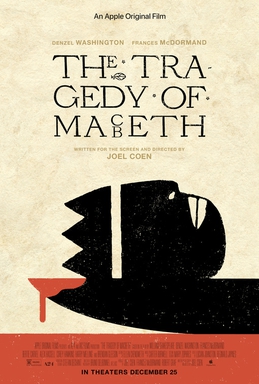
The Oklahoma Film Critics Circle have named Paul Thomas Anderson’s Licorice Pizza the best film of 2021!

Actually, I really like the OFCC’s picks.  They spread the wealth pretty evenly between Licorice Pizza and The Power of the Dog and they remembered two of my favorite films of the year, Pig and The Green Knight.  They also gave out an award for Most Disappointing Film Of The Year and how can I not cheer their selection of Don’t Look Up?

Here are the winners in Oklahoma!

Best Picture
“Licorice Pizza”

Top 10 Films
1. Licorice Pizza
2. The Power of the Dog
3. West Side Story
4. The Green Knight
5. Summer of Soul
6. The French Dispatch
7. Tick, Tick…Boom!
8. C’mon C’mon
9. Dune
10. Nightmare Alley / Pig / Red Rocket (TIE)

Best Director
Winner: Jane Campion – “The Power of the Dog”
Runner-Up: Paul Thomas Anderson – “Licorice Pizza”

Best Actress
Winner: Alana Haim – “Licorice Pizza”
​Runner-Up: Jessica Chastain – “The Eyes of Tammy Faye”

Best Actor
Winner: Benedict Cumberbatch – “The Power of the Dog”
​Runner-Up: Andrew Garfield – “Tick, Tick…Boom!”

Best Supporting Actress
Winner: Kirsten Dunst – “The Power of the Dog”
​Runner-Up: Ariana DeBose – “West Side Story”

Best Supporting Actor
Winner: Kodi Smit-McPhee – “The Power of the Dog”
Runner-Up: Ciaran Hinds – “Belfast”

Best Adapted Screenplay
Winner: “The Power of the Dog” – Jane Campion
​Runner-Up: “Dune” – Jon Spaihts, Denis Villeneuve & Eric Roth

Best Original Screenplay
Winner: “Licorice Pizza” – Paul Thomas Anderson
​Runner-Up: “The French Dispatch” – Wes Anderson

Best Animated Film
Winner: “The Mitchells vs the Machines”
​Runner-Up: “Encanto”

Best Documentary
Winner: “Summer of Soul (…Or, When the Revolution Could Not Be Televised)”
​Runner-Up: “The First Wave”

Best Foreign Language Film
Winner: “Drive My Car” (Japan)
​Runner-Up: “The Worst Person in the World” (Norway)

Best First Feature
Winner: “The Lost Daughter” – Maggie Gyllenhaal
​Runner-Up: “Tick, Tick…Boom!” – Lin-Manuel Miranda

Best Ensemble
Winner: “The French Dispatch”
​Runners-Up: “Licorice Pizza” & “The Power of the Dog” (TIE)

Best Cinematography
Winner: “Dune” – Greig Fraser
​Runner-Up: “The Power of the Dog” – Ari Wegner

Best Score
Winner: “The Power of the Dog” – Jonny Greenwood
​Runner-Up: “Dune” – Hans Zimmer

Best Body of Work
Winner: Lin-Manuel Miranda (“Tick, Tick…Boom!,” “Encanto,” “In the Heights” & “Vivo”)
​Runner-Up: Andrew Garfield (“Tick, Tick…Boom!,” “The Eyes of Tammy Faye” & “Spider-Man: No Way Home”)

Most Disappointing Film
Winner: “Don’t Look Up”
​Runners-Up: “Halloween Kills” & “Spencer” (TIE)

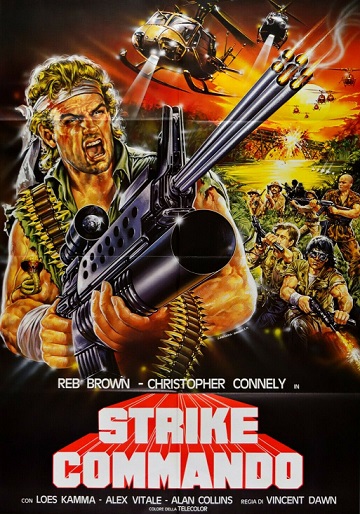
The TSL’s Grindhouse: Strike Commando (dir by Bruno Mattei)


“American,” a young Vietnamese refugee says to Sgt. Mike Ransom, “tell me about Disneyland.”

Ransom tells him all about Disneyland, a magical place where, according to Rasom, the trees are made of ice cream and genies pop out of lamps.  Ransom breaks down in tears, sobbing as he realizes that his friend will never get to experience Disneyland firsthand.

Years later, Ransom is in Manila, blowing up a former American military officer who gave aid to the communists.  “DIE!  DIE!” Ransom shrilly yells as the man literally explodes in front of him.  And while the man may not have been one of the good guys and he did a lot of bad things during the Vietnam War, it’s hard not to feel that Ransom’s attitude would get him banned from Disneyland.  Not even the ghost hitchhikers at the Haunted Mansion would want to accept a ride from the “Die!  Die!” guy.

That Mike Ransom, he’s a complicated man.  As played by Reb Brown, he’s also at the center of the 1987 Italian film, Strike Commando.  As you can probably guess from the film’s title, he’s the leader of an elite squad of soldiers, a team of strike commandoes who are determined to lead America to victory during the Vietnam War.  We’re continually told that Ransom is the best, though we don’t see much of evidence of it.  He’s the type of commando who specializes in sneaking behind enemy lines and hitting the communists before they even realize he’s there but he’s so bulky and loud that it’s hard to imagine that he’s ever been able to successful sneak around anywhere.  He has a particularly bad habit of shrilly screaming every word that he says.  Even when he’s not telling people to die, he’s yelling.  He’s like the athletic coach from Hell.

In fact, as I watched Strike Commando, I started to wonder what it would be like to live next door to someone like Mike Ransom.

“Hi, Mike, are you doing okay?”

“I’M DOING GREAT!  GREAT!  GREAT!”

“Any plans for the day?”

“I’M MOWING THE LAWN!  MOWING!  MOWING!  MOWING!”

“I think I’ve got some mail for you that accidentally left in my mailbox….”

“THE POSTAL SERVICE LIED!  LIED!  LIED!  LIED!”

At first, living next door to Mike Ransom would probably be entertaining but I imagine it would get kind of boring after a while.  Yelling can be an effective way to express yourself but it loses its power if that’s the only thing you ever do.  The same can be said for Strike Commando as a film.  It gets off to a good start, with several extremely over-the-top action sequences and, of course, Mike telling a little refugee child about Disneyland.  But the second half of the film, which involves Mike being held in a POW camp and meeting a fearsome Russian torturer named Jakoda, drags a bit because there’s only so much time you can listen to Ransom yell before you start to tune him out.  It doesn’t help that the second half of the film features some particularly nasty torture scenes.  Still, it is somewhat redeemed by a scene where the Viet Cong attempt to force Ransom to broadcast a propaganda message over their radio station.  “KEEP FIGHTING!” Ransom yells into the microphone.  Hell yeah! You tell ’em, Ransom!

Strike Commando was directed by Bruno Mattei, an Italian exploitation filmmaker who was never one to just turn things up to ten when he could turn them up to 11 instead.  Strike Commando was obviously meant to capitalize on the success of the Rambo films.  In typical Mattei fashion, the action is over-the-top, nonstop, and more than a little silly.  Mattei was never shied away from embracing excess and Strike Commando has everything that you would expect from one of his war films: lots of stuff blowing up, heavy-handed use of slow motion, and plenty of grainy stock footage.  You have to admire Mattei’s dedication to always finding something for Reb Brown to yell about.

6 Shots From 6 Films: Special Robert Duvall Edition


4 Or More Shots From 4 Or More Films is just what it says it is, 4 shots from 4 of our favorite films. As opposed to the reviews and recaps that we usually post, 4 Shots From 4 Films lets the visuals do the talking!

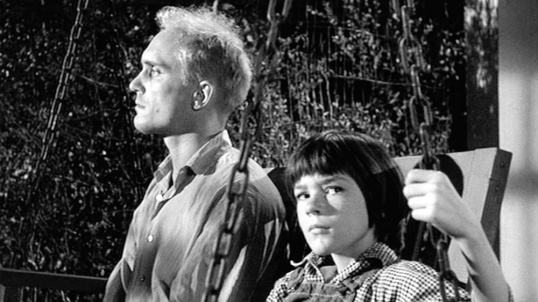
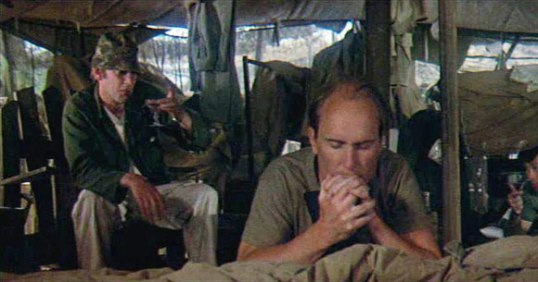
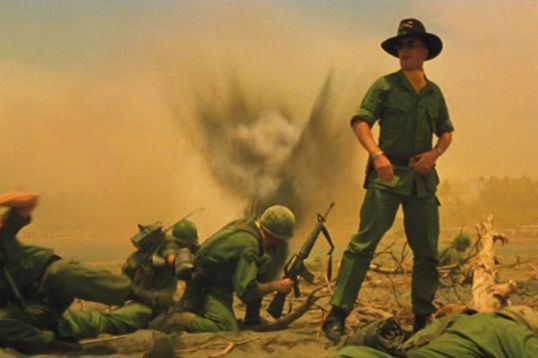
Today, we celebrate the 91st birthday of one of the finest American actors out there, Mr. Robert Duvall.  Ever since he made his film debut in 1962’s To Kill A Mockingbird, Duvall has been a regular presence in American cinema.  He’s an actor who has appeared in some of the best American films ever made (The Godfather, Network, Apocalypse Now, To Kill A Mockingbird, Tender Mercies, and others) and he’s played a wide variety of characters.  He’s been everything from a lawyer to a cowboy to a network executive to a professional criminal to a cop and he’s never been less that convincing.  He’s got a filmography about which anyone would be jealous.  And, at an age when most actors have retired, Duvall is still working and taking the occasional part.

On a personal note, I have to say that, for someone who was born in California, raised in Maryland, and who started his career in New York, Robert Duvall is one of the few actors to have perfected both the Southern and the Southwestern accent.  Whenever I see him playing a Texan, I always have to remind myself that he’s not actually from around here.

In honor of Robert Duvall’s birthday, here are….

6 Shots From 6 Robert Duvall Films

To Kill A Mockingbird (1962, dir by Robert Mulligan, DP: Russell Harlan)

MASH (1970, dir by Robert Altman, DP: Harold E. Stine)

Apocalypse Now (1979, dir by Francis Ford Coppola, DP: Vittorio Storaro)

True Confessions (1981, dir by Ulu Grosbard, DP: Owen Roizman)

The Apostle (1997, dir by Robert Duvall, DP: Barry Markowitz)

The Judge (2014, dir by David Dobkin, DP: Janusz Kamiński)

Scenes That I Love: The Robot Montage from George P. Cosmatos’s Cobra


On this date, in 1941, future director George Pan Cosmatos was born in Italy.  Cosmatos would go on to direct some of the most financially successfully (if critically lambasted) films of the 80s.  He’s also credited as being the director on Tombstone, though it’s generally agreed that Cosmatos largely deferred to Kurt Russell on that film.  (Cosmatos was a last minute replacement for the film’s original director.)

Other than Tombstone, Cosmatos is best-known for the films that he did with Sylvester Stallone.  And today’s scene that I love comes from the 1986 film, CobraCobra stars Stallone as a motorcycle-riding cop who never asks question when he can just shoot a big gun instead.  Stallone’s show-no-mercy attitude may upset his superiors but it turns out to be just what’s needed to take care of a murderous cult.  Now, Cobra may be a fairly dumb film but it does have one sequence that pretty much epitomizes an era.  If nothing else, George Pan Cosmatos deserves to be remembered for Cobra’s famous robot montage.  While Sylvester Stallone searches for the murders who are decimating his city, model Brigitte Nielsen poses with a bunch of life-size robots.

One reason why this sequence works is because it really does seem to come out of nowhere.  The film goes from Stallone promising to wipe out the bad guys to a bunch of adorable robots.  It’s all very 80s.  And we have George Pan Cosmatos to thank for it.

Here’s a scene that I love:

Film Review: East of the Mountains (dir by SJ Chiro)


Sometimes, a good film just sneaks up on you.

That was certainly the case with me and East of the Mountains, an independent film which came out last September.   I have to admit that the film completely slipped past me when it was initially released.  In fact, I didn’t even know that the film existed until it was nominated for Best Motion Picture Drama by the Satellite Awards in December.  I wasn’t alone in that.  I remember when the Satellite nominations were announced, there were a lot of people who looked at the list of nominees and, upon seeing an unfamiliar title mixed in with West Side Story, The Power of the Dog, and Don’t Look Up, said, “East of what?”

Because I’m always on the lookout for an overlooked gem, I rented East of the Mountains on Prime. I watched it yesterday.  My initial reaction was that it was a well-made film, featuring both pretty scenery and an excellent lead performance from veteran actor Tom Skerritt.  (Skerritt is also credited as being an executive producer on the film.)  I appreciated that, in a time when so many film feels as if they’re at least ten minutes too long, East of the Mountains was a remarkably short film.  It only needed 79 minutes to tell its simple but effective story and it didn’t waste a single one of them.  At the time, I also thought that the film’s direction was perhaps a bit too low-key for the film to really work.  I thought it was a good film but I also thought it was one that I would probably forget about in a day or two.

Instead, the opposite has happened.  East of the Mountains has stuck with me.  Even as I sit here typing, I can still picture the film’s final few scenes in my head.  That’s the type of film that East of the Mountains is.  It’s a film that sneaks up on its audience, capturing their attention so subtly that it’s not until several hours later that they realize that they’re still thinking about the film.

Based on a novel by David Guterson, East of the Mountains is a character study.  Tom Skerritt plays Ben Givens.  Ben is a retired doctor and a veteran of the Korean War.  He lives in Seattle.  His wife has passed away.  He’s estranged from his brother.  His daughter is busy with a family of her own.  Ben’s only companion is his dog, Rex.  When he tells his daughter (played by Mira Sorvino) that he’s planning on going bird hunting for the weekend, she’s concerned.  She knows that her father has been depressed.  She also knows that Ben has recently been diagnosed with cancer.  Ben assures her that he just wants to see his “old stomping grounds” one last time but his daughter worries that Ben may be planning on never coming back.

She’s not wrong.  Since we’ve already seen Ben pressing the barrel of a rifle against his forehead, we know that she has every reason to be concerned about his plans.  Ben is considering ending it all, east of the mountains where he grew up, fell in love, and experienced his happiest moment.  However, from the minute that Ben sets off on what he plans to be his final hunting trip, fate seems to be determined to keep him alive.  After his SUV breaks down, he’s given a ride by a mountain climbing couple and their love reminds Ben of when he first met the woman who he would eventually marry.  After a run-in with a half-crazed mountain man, Ben loses his prized rifle, the one that was given to him by his father and which Ben planned to use to end his own life.  After an unexpected dog fights leads to Ben taking Rex to the local animal hospital, he meets a young veterinarian who can tell that Ben needs someone to talk to.

The plot is rather simple but Tom Skerritt’s performance brings the story a certain depth that it might not otherwise possess.  It would be easy to sentimentalize a character like Ben or to portray him as being flawless.  Instead, Skerritt plays Ben as someone who is genuinely well-meaning and naturally kid but who also can occasionally be a bit self-absorbed.  Watching Ben, one can understand why his brother is estranged from him, which makes their eventual, if rather prickly reunion all the more poignant.  (Ben’s brother is well-played by an actor named Wally Dalton.  He and Skerritt play off of each other with such skill that it’s hard to believe that they actually aren’t brothers.)  The viewer hopes that Ben will find what he needs to find in order to achieve some sort of peace for himself, even if Ben himself doesn’t always seem to be quite sure what that possibly mythical thing would be.

Skerritt’s performance here is comparable to Robert Redford’s turn in All Is Lost, with the main difference being that Ben is far more lost than even Reford’s unnamed sailor.  However, much like the sailor in All is Lost, it’s impossible to look away from Ben’s journey.  It’s also tempting to compare Skerritt’s performance to Rchard Farnsworth’s Oscar-nominated turn in David Lynch’s The Straight Story.  (Indeed, the scene between Skerritt and Dalton is comparable to the final scene between Farnsworth and Harry Dean Stanton.)  Much like Farnsworth in Lynch’s film, Tom Skerritt may move slowly but the viewer is always aware of his mind working.

East of the Mountains may sound like a depressing or heavy-handed film but actually it’s not.  If anything, it’s life-affirming.  The audience is right alongside Ben, learning with him that the world is not as terrible a place as he had convinced himself it was.  In the end, the viewer cares about Ben and worries about what his ultimate fate will be.  The film’s ending sneaks up on you and it stays with you afterwards.

There is one scene involving a dog fight that is difficult to watch but otherwise, East of the Mountains is a simple but poignant film that deserves more attention than it’s received.