Horror Film Review: Beginning of the End (dir by Bert I. Gordon)


The 1957 film, Beginning of the End, is perhaps the ultimate horror film for people who dislike Illinois.

Because it’s a Bert I. Gordon film and Gordon took his “Mr. Big” nickname seriously, it deals with giant monsters.  In this case, the monsters are a bunch of locust who ate all of this radioactive grain that was being stored in a silo.  The locusts grew to giant size and then they went on a rampage.

Fortunately, the rampage appears to be localized to Illinois.  Apparently, the locusts have enough respect for state boundaries that they know better than to hop into Indiana, Missouri, or Wisconsin.  Instead, the locusts take out the farming community of Ludlow and then start making their way to Chicago, perhaps hoping to battle the Chicago Outfit for control of the city’s politics.  Do they seriously think Mayor Daley is just going to sit back while a bunch of locusts overrun his city?

The government wants to cover up the locust rampage because they don’t want to risk a mass panic in the 47 states that they actually care about.  (This film came out before Alaska and Hawaii joined the Union.)  However, when enterprising reporter Audrey Aimes (Peggie Castle) comes across the remains of Ludlow and discovers that the U.S. military has taken over the area, she is determined to discover what happened.  She hooks up with Dr. Ed Wainwright (Peter Graves), whose work in making food bigger led to the giant locust attacks in the first place.  In most movies, Ed would shoulder most of the blame for the locust attack but Beginning of the End seems to understand that these things happen when you’re dousing food with radiation and then keeping the food in a poorly secured silo.

Of course, the main reason why it’s not Ed’s fault is that Ed is played by Peter Graves and seriously, who could blame anything on Peter Graves?  Graves was one of those actors who could deliver even the silliest of dialogue with a straight face and he certainly gets to do that in Beginning of the End.  He seems to be taking the situation seriously, even if no one else is.

One reason why it is a little bit difficult to take the situation seriously is because it’s about giant locusts.  Now, make no mistake about it.  I’m enough a country girl that I know how destructive locusts can be.  The problem is that locusts may be destructive but they don’t look all that menacing.  Even giant locusts just look like really ugly grasshoppers.  This film uses a lot of rear projection and still photography to create the idea of giant locusts crawling over buildings and threatening the soldiers who have been sent to fight them.  As is so often the case with Bert I. Gordon’s film, there’s a definite charm to the cheap special effects.  But still, locusts are locusts.

Chicago haters will love the scene where General Hanson (Morris Ankrum) announces that the locusts have only left him with one option, the drop an atomic bomb and wipe the city off the face of the Earth.  Fortunately, Ed is there to suggest another solution.  Good old Peter Graves.  I don’t know what we would have done without him.

As a final note, I’ll just mention that the poster for this film is actually more exciting than the film itself:

Horror on the Lens: Baffled! (dir by Philip Leacock)


Leonard Nimoy is a race car driver who can see into the future and who uses his powers to solve crimes!

Seriously, if that’s not enough to get you to watch the 1973 made-for-TV movie Baffled!, then I don’t know what is.  In the film, Nimoy takes a break from racing so that he and a parapsychologist (played by Susan Hampshire) can solve the mystery of the visions that Nimoy is having of a woman in a mansion.  This movie was meant to serve as a pilot and I guess if the series had been picked up, Nimoy would have had weekly visions.  Of course, the movie didn’t lead to a series but Baffled! is still fun in a 70s television sort of way.  Thanks to use of what I like to call “slow mo of doom,” a few of Nimoy’s visions are creepy and the whole thing ends with the promise of future adventures that were sadly never to be.

Enjoy Baffled!  Can you solve the mystery before Leonard?

October Positivity: Image of the Beast (dir by Donald W. Thompson)


1981’s Image of the Beast picks up from where A Distant Thunder ended.

The world is in economic and political chaos, largely as a result of millions of people vanishing a few years before.  (The government says the people were abducted by UFOs but everyone left behind knows it was actually the rapture.)  Brother Christopher and the United Nations are controlling the world.  Order is kept by UNITE.  Those who fail to get the Mark on either their palm or their forehead are not allowed to buy food or get healthcare.  In fact, Brother Christopher has declared that the mark is no longer optional and anyone who refuses to get it will be executed.

A Distant Thunder ended with Patty Myers (Patty Dunning) facing the guillotine and that’s where Image of the Beast picks up.  She is given one final chance to voluntarily take the mark before being put under the blade but, in obvious fear and shock, Patty says nothing.  Two UNITE soldiers tie her the ground, with her neck directly under the guillotine’s blade.

Finally, Patty yells, “I want the mark!”

However, at the same time that Patty makes the declaration, an earthquake hits and the skies turn black.  The cowardly soldiers run off, leaving Patty under the blade.  Realizing that she is witnessing the breaking of one of the apocalyptic seals, Patty attempts to free herself from her bounds.  Unfortunately, she moves around so much that the loosened blade comes crashing down and she promptly loses her head.

So much for Patty!

The action then shifts to a new character, a Christian rebel named David Michaels (William Wellman, Jr., who also played a different role in every single Billy Jack movie).  David, who has disguised himself as a member of UNITE, is looking for Leslie (Wenda Shereos), another Christian who escaped from execution during the earthquake.  David doesn’t find her but he does stumble upon Kathy (Susan Plumb), Kathy’s son (Ben Sampson), and the Rev. Matthew Turner (Russell S. Doughten, JR., who not only produced the Thief In The Night films but who also directed films like Nite Song).  Rev. Turner lives in a farmhouse and looks a lot like Santa Claus.  He has a helpful graph on his wall that can be used to understand just how far along the world is into the apocalypse.

As Rev. Turner explains it, computers are the new “golden calf.”  Why, people believe that computer can do anything better than humans!  They’re letting computer run their lives and Brother Christopher is using that to his advantage!  (Keep in mind, this film was made in 1981 so the computer that he’s talking about are those big, boxy computers that took hours to do the simplest tasks.)  Fortunately, David used to be a computer technician and he thinks that he’s come up with a way to 1) create a counterfeit mark and 2) corrupt Brother Christopher’s precious computer system!

(Calculators, interestingly enough, are referred to as being hand computers.  If nothing else, this film proves that paranoia about technology is hardly a new phenomena.)

Much like the previous films in the series, there’s a lot of scenes of the heroes trying to sneak around Des Moines without blowing their cover and revealing themselves to be believers.  And like A Distant Thunder, there’s a lot of talk about events that are happening that we never actually see.  This one of those films that deals with its low budget by having all of the big events happen off-screen.  The characters in this film spend a lot of time listening to breathless news reports on the radio and on television.  And while that can feel a bit anti-climatic, it’s also strangely effective in its way.  It captures the feeling of finding yourself in a situation where you’re never quite sure if you’re hearing the truth and it also captures the feeling of helplessness that comes from knowing that there are huge things happening that you can’t control.  While the film is a bit too talky for its own good, director Donald W. Thompson does a good job of creating an atmosphere of sustained paranoia.  Every time that David and Kathy walk around Des Moines, you’re expecting someone to grab them.  The fact that Des Moines, itself, is hardly a shadowy metropolis adds to paranoia.  “If this could happen in Iowa,” the film seems to be saying, “it could happen anywhere.”

Image of the Beast was a success on the church circuit and it was followed by one final Thief in the Night film, which I will discuss tomorrow.

October Hacks: Valentine (dir by Jamie Blanks)


A holiday slasher, 2001’s Valentine tells the story of five girls and the nosebleed-prone incel who has never forgiven them for not dancing with him in high school….

Well, no, actually, it’s a bit more serious than that.  In high school, dorky Jeremy Melton asked four popular girls to dance with him at the Valentine’s Day dance.  Shelley, Lilly, and Paige rejected him and were rather rude about it.  Kate was polite and promised that maybe she would dance with him later.  Only Dorothy agreed to dance with him but when Dorothy and Jeremy were subsequently discovered making out underneath the bleachers, Dorothy falsely claimed that Jeremy forced himself on her.  School jock Joe beat up Jeremy and humiliated him in front of the entire school.  Jeremy ended up in a reform school and was eventually sent to a mental institution.

Years later, everyone has grown up.  Shelley (Katherine Heigl) is a medical student.  Lily (Jessica Caufiel) is dating an artist named Max (Johnny Whitworth) and having to deal with Max’s angry ex, Ruthie (Heddy Burress).  Dorothy (Jessica Capshaw) is insecure and dating the caddish Campbell (Daniel Cosgrove).  Paige (Denise Richards) is still living her life as if she’s everyone’s favorite mean girl.  And Kate (Marley Shelton) is in an on-and-off again relationship with Adam (David Boreanaz), a recovering alcoholic and writer.  No one is really sure what has happened to Jeremy but when someone starts picking off the members of their group and they start to get morbid Valentines in the mail, everyone starts to wonder if maybe Jeremy has returned.

Of course, this group isn’t going to let the fact that a murderer is stalking them keep them from throwing a big Valentine’s party as Dorothy’s house.  These are extremely stupid people, as you may have guessed.  It’s a bit of an awkward party, largely because everyone is having relationship issues and Ruthie Walker shows up and yells at everyone.  Things get even more awkward when the a killer wearing a cupid’s mask shows up and starts killing everyone at the party.

I always remember Valentine as being a really big deal when it was first released but, when I was doing a little research for this review, I discovered that Valentine was actually considered to be a flop at the box office.  Maybe I just got in into my head that it was some sort of huge success because Valentine was one of those films that used to show up on Showtime constantly.  I think I’ve seen the film’s ending over a hundred times, just while waiting for the next movie to start.

As far as slasher films go, it’s adequate without being particularly memorable.  The killer is creepy but the victims are all so shallow that it’s difficult to have much sympathy for them.  Probably the most interesting thing about this film is that all of the supporting characters are so strange and perverse that it almost feels as if they’ve wondered over from an old giallo film.  This the type of film where everyone’s either an ex-addict or a notorious con artist or an underwear thief.  Undoubtedly, the best supporting character is Ruthie Walker, if just because she’s the only character in the film who is willing to call out everyone on their shallowness.  Unfortunately, Ruthie doesn’t come to a good end but she does get the best death scene in the film and, when it comes to something like Valentine, that has to be considered a triumph.

Anyway, Valentine ends with the set up for a sequel but it never happened.  Valentine’s Day remains an awesome holiday!  Don’t let any killer cupids ruin it for you.

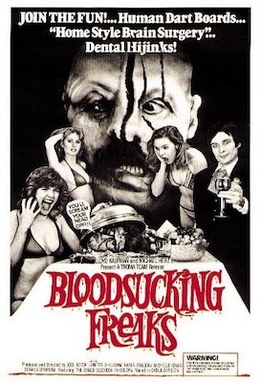
The TSL Horror Grindhouse: Blood Sucking Freaks (dir by Joel M. Reed)


Well, with a title like Blood Sucking Freaks, it has to be good!

Right?

First released in 1976, Blood Sucking Freaks is one of those not particularly good films that every horror fan has to sit through at least once.  Historically, it’s important as an example of a film that generated a thoroughly unnecessary moral panic, largely amongst people who had never actually seen the stupid thing.  It tells the story of Master Sardu (Seamus O’Brien), who runs a Grand Guignol-style theater in SoHo.  Wealthy New Yorkers flock to the theater on a nightly basis, to watch as Sardu and his dwarf assistant, Ralphus (Luis de Jesus), torture women on stage.  The crowd thinks that it’s all fake but what they don’t know is that Sardu and Ralphus are abducting real women and forced them to live in a cage underneath the theater, where they are occasionally brought out to be abused by high-paying patrons.  All of the torture and death that takes place on stage is real.

Most members of the audience enjoy the show and consider Sardu to be a master of transgressive art.  However, critic Creasy Silo (Alan Dellay) doesn’t think much of Sardu or his show and he writes a review in which he refers to whole thing as being pretentious.  Sardu apparently considers “pretentious” to be the worst insult that can be uttered against his production of pain and murder so he orders his followers to abduct Silo.  Held prisoner in the theater, Silo is told the truth about the show and then brainwashed to become a part of the show himself.

Meanwhile, Sardu’s followers have also kidnapped a ballerina named Natasha (Viju Krem).  Sardu feels that, if Natasha can be brainwashed to perform in the show, it’ll lead to greater things.  The show might move to Broadway and then someone might make a movie about Master Sardu!  Natasha’s lunkhead boyfriend, Tom (Niles McMaster), is not happy about Natasha being kidnapped.  He teams up with a sleazy cop (Dan Fauci) and they head down to the theater.

Much as with Snuff, Blood-Sucking Freaks generated a lot of controversy when it was first released, with some speculating that the murders in Blood-Sucking Freaks may have actually been real murders.  It was originally released in grindhouse theaters with an R-rating.  That R-rating might take some people by surprise when you consider how graphic the film supposedly was but it must be understood that the R-rating was self-imposed.  The filmmakers refused to submit the film to the MPAA and just rated it themselves.  When Troma acquired the film and submitted an edited version of the film to the MPAA, the organization refused to even watch the film.  That’s how controversial Blood-Sucking Freaks is!  The MPAA won’t even watch it long enough to tell other not to!

Also, much like Snuff, Blood-Sucking Freaks is actually a pretty boring movie.  Blood-Sucking Friends does deserve some credit for satirizing the pretentions of the underground arts scene but, for the most part, it’s a slow-moving and terribly acted film and the gore, while plentiful, is not particularly convincing.  Seamus O’Brien, who was murdered in an unrelated incident shortly after the film’s release, gives an absolutely lousy performance as Sardu.  Controversy aside, it’s a dumb movie and the only thing that really redeems it is that it knows it’s a dumb movie and doesn’t pretend otherwise.

The main lesson of Blood-Sucking Freaks is that it’s the type of movie that probably would have vanished into obscurity if not for the controversy that it has generated over the years.  Outrage sells.

A Horror Blast From The Past: The Wave (dir by Alexander Grasshoff)


First broadcast in 1981, The Wave stars Bruce Davison as Ben Ross, a high school social studies teacher who conducts a social experiment.

Frustrated by the fact that he can’t answer his students questions of how the German people could have allowed the Holocaust to occur, Ben decides to teach his students a lesson.  He starts by introducing a bunch of seemingly arbitrary rules to his classroom, concerning the proper way for students to sit at their desks and to address the teacher.  Ben is somewhat surprised to see how quickly his students adapt to the new rules, even taking pleasure in showing how quickly and efficiently they can follow orders.  The next day, Ben tells his students that they are now members of The Wave, a national youth organization with membership cards and a secret salute.

And that is when all Hell breaks loose.  Ben only meant to show his students what it’s like to be a member of a mass movement but the students take The Wave far more seriously than Ben was expecting.  Soon, other students are joining The Wave.  When the popular football players announce that they are a part of The Wave, others are quick to flock to the organization.  The formerly likable David turns into a fanatic about bringing people into the organization.  Robert, a formerly unpopular student, revels in his new job of reporting anyone who deviates from the rules of The Wave.  When a student reporter writes an article that is critical of the organization, she and the school paper are targeted.  Has Ben’s social experiment spiraled out of control?

42 years after it was originally produced, The Wave remains a powerful and sobering look at how people can be manipulated into doing things as a mob that they would never do as an individual.  If anything, the film feels more relevant today than it probably did in 1981.  The character of Robert, in particular, is a familiar one.  He’s someone with no self-esteem who latches onto a movement and finds his identity by taking down others and accusing them of failing to follow the rules.  One can find people like Robert all over social media, searching through old posts for any example of wrongthink that they can broadcast all through their social world.  It’s tempting to smirk at how quickly the members of The Wave sacrificed their freedom and their ability to think for themselves but it’s no different from what we see happening in the real world every day.  (Indeed, if the film had been made just two or three years ago, The Wave would probably be the people policing whether or not the rest of us were observing quarantine and wearing our facemasks correctly.)  People like to feel that they belong to something, even if that means sacrificing their humanity in the process.

Featuring a good performance from Bruce Davison as the well-meaning teacher who is both fascinated and terrified by the experiment that he’s set in motion, The Wave can be viewed below:

Horror Scenes That I Love: Vincent Price in Masque of the Red Death


Today’s horror star is the great Vincent Price.

Born in Missouri and blessed with both an aristocratic profile and a resonant voice, Vincent Price started his career as a romantic leading man before eventually before finding more success a character actor.  Starting in the late 40s and continuing until his death in 1993, Price was a beloved horror icon, bringing his witty presence to several different horror films.

Price always cites Roger Corman’s Edgar Allan Poe adaptations as being amongst his favorite of the horror films in which he appeared.  In this scene from 1964’s The Masque of the Red Death, Vincent Price delivers a monologue on the meaning of terror as only he could.

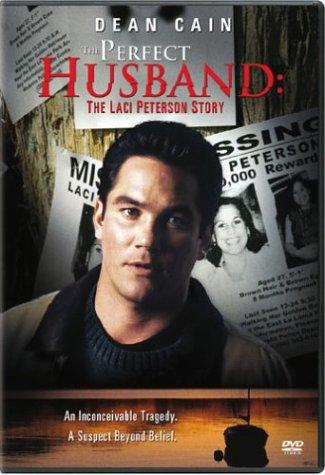
October True Crime: The Perfect Husband: The Laci Peterson Story (dir by Roger Young)


In December of 2002, most likely on Christmas Eve, Laci Peterson was murdered in Modesto, California.  At the time, she was eight months pregnant and, by all account, looking forward to the birth of her first child, Connor.  Suspicion immediately fell on her husband Scott Peterson, who seemed reluctant to contact police when Laci first disappeared and who was later revealed to be cheating on his wife, both before and after his disappearance.  Though Scott and Laci’s friends and family may have thought of Scott Peterson as being the perfect husband, the truth was far different.

After the bodies of both Laci and unborn Connor were discovered, Scott was arrested and charged with murder.  Scott insisted that his wife had been kidnapped and murdered by a gang of meth-dealing Satanists.  The jury disagreed and Scott was found guilty.  Originally sentenced to death, Scott is now serving a life sentence.

The disappearance and subsequent murder of Laci Peterson was national news and Scott Peterson, with his cold demeanor and his history of infidelity, was a perfect villain.  (The case would serve as one of the inspiration for the novel and film, Gone Girl.)  Today, unfortunately, the case has received renewed attention due to a docuseries called The Murder of Laci Peterson.  Though the documentary may have Laci’s name in the title, she’s treated largely as an afterthought.  Instead, the documentary focuses on making excuses for all of Scott’s incriminating behavior and, in the final episode, it goes as far as to include cheesy reenactments of Satanists stalking the streets of Modesto.  This heavy-handed work of propaganda, which was produced by a friend of Scott Peterson’s family, can be found on Hulu and is regularly re-aired on stations like A&E.  Whenever it airs, one can be sure that the dumbest people on twitter will start tweeting stuff like, “I lowkey think Scott Peterson might be innocent!”  The documentary ends with Scott’s creepy sister-in-law delivering an unconvincing monologue about how she often goes to the beach where Laci was found and thinks about her and Connor.  It’s one of the few times that anyone in the documentary mentions anything about Laci.

The 2004 made-for-TV movie, The Perfect Husband: The Laci Peterson Story, also keeps Laci off-screen but it still feels like a more honest look at the Peterson case than the documentary.  Because the movie was put into production before Scott’s trial had actually begun, the film does maintain a sense of ambiguity as to whether or not Scott is actually guilty but, unlike the docuseries, it also doesn’t deny just how suspicious Scott’s behavior was in the days following Laci’s disappearance.  While his friends and his family frantically look for Laci, Scott calls his mistress and flirts over the phone.  (As shown in the film, Scott’s girlfriend did not know that Scott was married and was shocked to see Scott on television, talking about his missing wife.)  When his friends and family beg Scott to help get the word out about his missing wife, Scott retreats into his own shell.  And when Laci’s body is discovered, Scott puts on a fake beard, dyes his hair, and heads to San Diego with a bag full of money.  In the docuseries, Scott’s condescending father claimed that Scott was just trying to get away from the media.  The film leaves little doubt that he was trying to get away from his crimes.

Dean Cain does a good job in the role of Scott Peterson.  Because Scott’s trial had yet to begin, Cain couldn’t play him as being an outright murderer so, instead, he focused on playing Scott as being petulant, insecure, and self-centered, the type of guy who seems to be annoyed that Laci’s disappearance is inconveniencing him.  Dee Wallace and G.W. Bailey have a few good scenes as, respectively, Laci’s mother and the detective investigating the case.  David Denman (who is probably best-known for playing Roy, Pam’s lunkhead fiancé on The Office) gives the film’s strongest performance as a friend of Scott’s who desperately wants to believe that he’s innocent even though the evidence keeps piling up against him.

The Perfect Husband probably gets closer to the truth of the case than any of the documentaries that have followed.  Scott’s a killer.  RIP, Laci and Connor.

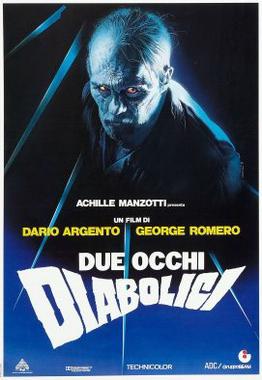
The Film of Dario Argento: Two Evil Eyes


In 1990, long-time friends George Romero and Dario Argento collaborated on Two Evil Eyes, anthology film that was based on the writings of Edgar Allan Poe.  An Italian-American co-production, Two Evil Eyes featured two stories.  The first was directed by George Romero, while the second was directed by Argento.

The Facts In The Case of Mr. Valdemar

(Dir by George Romero)

The first story is Romero’s, a modernized version of The Facts In The Case of M. Valdemar.

Jessica Valdemar (Adrienne Barbeau) is the 40 year-old wife of 65 year-old, Ernest Valdemar (Bingo O’Malley).  Jessica only married Ernest for her money and, now that he’s on his death bed, she and her lover, Dr. Robert Hoffman (Ramy Zada), have hypnotized to him to do and say whatever they tell him to say and do.  Even though Ernest is essentially comatose, the hypnosis allows them to force Ernest to sign his name to legal documents and to tell his suspicious attorney (E.G. Marshall) that he indeed wants to leave all of his money to Jessica.

When Ernest dies while under the influence of hypnosis, Jessica and Robert attempt hide his body in the basement.  But is Ernest really dead?  Jessica is convinced that she hears groaning from the basement and she wonders if the hypnosis has somehow left Ernest in limbo, between life and death.  Robert thinks that Jessica is being foolish but it turns out that she’s not.  After much paranoia and betrayal, one conspirator is dead and the other is a part of the living dead.

Usually, I like Romero’s work but this one didn’t work for me.  From the flat cinematography to the shallow performances, this film felt more like an episode of a television show than anything else.  Perhaps if it had been a stand-alone film, Romero could have found a way to make the material a bit more cinematic.  (The story’s final shot, of blood dripping on a hundred dollar bill, is the film’s strongest moment and the part that feels the most Romeroesque.)  But as a shortened chapter of an anthology film, it fell flat.

The Black Cat

(Dir by Dario Argento)

The Dario Argento segment is based on several different Poe stories.  While the majority of the story is taken from The Black Cat, it also contains elements of Annabel Lee, Telltale Heat, The Pit and the Pendulum, and Buried Alive.  Though this segment doesn’t really work, it’s obvious that Argento is a fan of Poe’s work and, for other Poe fans, there’s a lot of fun to be found in all of the Poe references that Argento sneaks into his story.

Harvey Keitel stars as Rod Usher, a crime scene photographer who loves his work a bit too much.  He’s excited about the fact that his book of photography is about to be published.  He’s less happy about the fact that his girlfriend, Annabel (Madeleine Potter), has adopted a black cat that is constantly glaring at Rod.  Rod is eventually driven mad by both the cat’s apparent hatred of him and the fact that the cat itself keeps showing up no matter how far he goes to get rid of it.  (This film features violence against a cat, which I hated.  But it also featured a cat getting revenge and I appreciated that.)  Eventually, Rod’s paranoia leads to violence and murder.

Look, this is a film about a guy who has an obsessive hatred of a cat.  Obviously, this is not a film that I’m going to enjoy because I love cats.  That said, I can still judge the film on its merits, even if it’s not for me on a personal level.  While Argento is able to build up a good deal of tension and suspense in this film, the overall film doesn’t work because Harvey Keitel, supremely talented actor that he is, was totally the wrong choice for Rod Usher.  Keitel, who reportedly did not get along with Argento during filming, gave a self-indulgent performance that featured a lot of bellowing.  It’s as if Keitel is trying to compete with the constantly moving camera.  The problem is that a star of a film like this has to be the director and Keitel’s histrionics take the viewer right out of the story.

Considering all of the talent involved, Two Evil Eyes is a disappointment.

The (Reviewed) Films of Dario Argento:

  1. The Bird With The Crystal Plumage
  2. Cat O’Nine Tales
  3. Four Flies on Grey Velvet
  4. Deep Red
  5. Suspiria
  6. Inferno
  7. Tenebrae
  8. Phenomena
  9. Opera

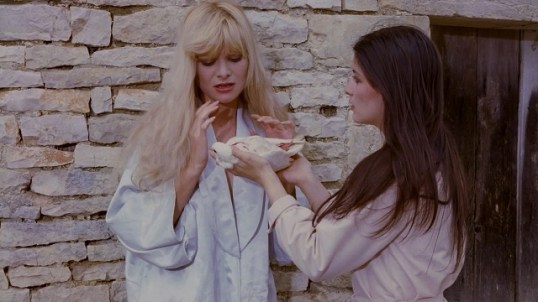
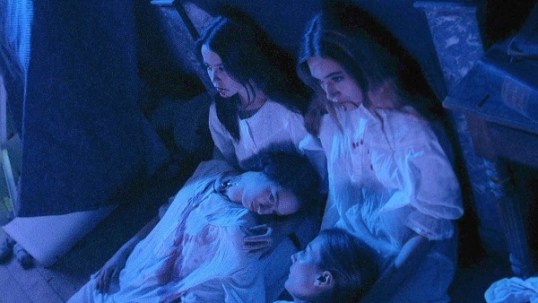
4 Shots From 4 Horror Films: Special Jean Rollin Edition


4 Shots From 4 Films is just what it says it is, 4 shots from 4 of our favorite films. As opposed to the reviews and recaps that we usually post, 4 Shots From 4 Films is all about letting the visuals do the talking.

This October, I am going to be using our 4 Shots From 4 Films feature to pay tribute to some of my favorite horror directors, in alphabetical order!  That’s right, we’re going from Argento to Zombie in one month!

Today’s director: the master of French surrealism, Jean Rollin!

4 Shots From 4 Jean Rollin Films

Requiem For A Vampire (1971, dir by Jean Rollin)

Night of the Hunted (1980, dir by Jean Rollin)

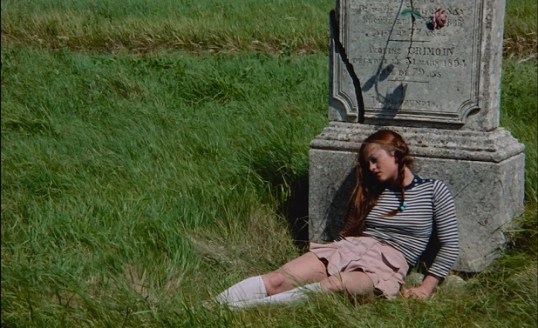
The Living Dead Girl (1982, dir by Jean Rollin)

Two Orphan Vampires (1997, dir by Jean Rollin)