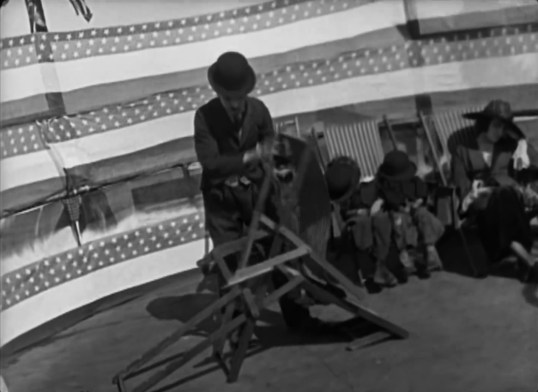
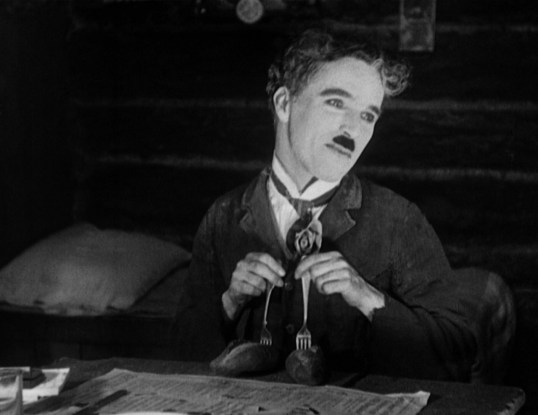
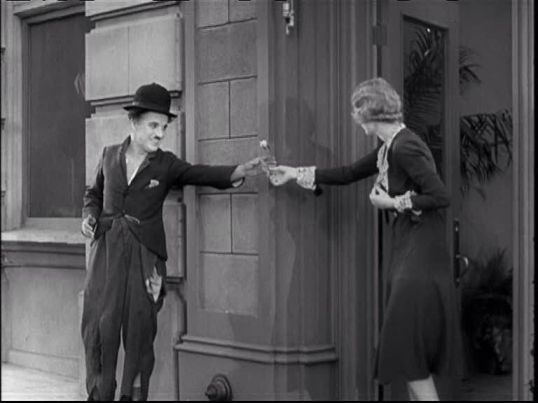
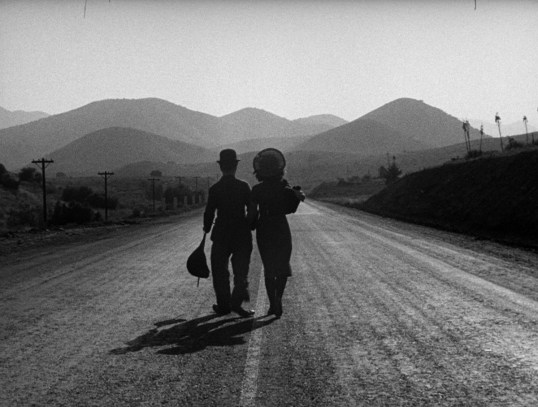
4 Or More Shots From 4 Or More Films is just what it says it is, 4 shots from 4 of our favorite films. As opposed to the reviews and recaps that we usually post, 4 Shots From 4 Films lets the visuals do the talking!
136 years ago today, film and comedy pioneer Charlie Chaplin was born. It’s time for….
Opening with a swarm of helicopters spaying for medflies and ending with an earthquake, 1993’s Short Cuts is a film about life in Los Angeles.
An ensemble piece, it follows several different characters as they go through their own personal dramas. Some of them are married and some of them are destined to be forever single but they’re all living in varying states of desperation. Occasionally, the actions of one character will effect the actions of another character in a different story but, for the most part, Short Cuts is a portrait of people who are connected only by the fact that they all live in the same city. There are 22 principal characters in Short Cuts and each one thinks that they are the star of the story.
Jerry Kaiser (Chris Penn) cleans the pools of rich people while, at home, his wife, Lois (Jennifer Jason Leigh), takes care of their baby and works as a phone sex operator. Jerry’s best friend is a makeup artist named Bill (Robert Downey, Jr.) who enjoys making his wife, Honey (Lili Taylor), looks like a corpse so that he can take her picture. One of her photographs is seen by a fisherman (Buck Henry) who has already discovered one actual corpse that weekend. He and his buddies, Vern (Huey Lewis) and Stuart (Fred Ward), discovered a dead girl floating in a river and didn’t report it until after they were finished fishing. (The sight of Vern unknowingly pissing on the dead body is one of the strongest in director Robert Altman’s filmography.)
Stuart’s wife, Claire (Anne Archer), is haunted by Stuart’s delay in reporting the dead body. A chance meeting Dr. Ralph Wyman (Matthew Modine) and his wife, artist Marian (Julianne Moore), leads to an awkward dinner between the two couples. Claire works as a professional clown and Ralph ends up wearing her clown makeup while his marriage falls apart.
Earlier, Claire was stopped and hit on by a smarmy policeman named Gene Shepard (Tim Robbins), who just happens to be married to Marian’s sister, Sherri (Madeleine Stowe). Gene is already having an affair with Betty Weathers (Frances McDormand), the wife of a helicopter pilot named Stormy (Peter Gallagher). When Stormy discovers that Betty has been cheating, he takes a creative revenge on her house.
Doreen Pigott (Lily Tomlin) lives in a trailer park with her alcoholic husband, Earl (Tom Waits). Driving home from her waitressing job, Doreen hits a young boy. The boy says he’s okay but when he gets home, he passes out. His parents, news anchorman Howard Finnegan (Bruce Davison) and his wife, Anne (Andie MacDowell), rush him to the hospital, where his doctor is Ralph Wyman. As Howard waits for his son to wake up, he has a revealing conversation with his long-estranged father (Jack Lemmon, showing up for one scene and delivering an amazing monologue). Meanwhile, a baker named Andy (Lyle Lovett) repeatedly calls the Finnegan household, wanting to know when they’re going to pick up their son’s birthday cake.
Based on the short stories of Raymond Carver and directed by Robert Altman, Short Cuts can sometimes feel like a spiritual descendent of Altman’s Nashville. The difference between this film and Nashville is that Short Cuts doesn’t have the previous film’s satiric bite. As good as Nashville is, it’s a film that can be rather snarky towards it character and the town in which it is set. Nashville is used as a metaphor for America coming apart at the seams. Short Cuts, on the other hand, is a far more humanistic film, featuring characters who are flawed but, with a few very notable exceptions, well-intentioned. If Nashville seem to be a portrait of a society on the verge of collapse, Short Cuts is a film about how that society ended up surviving.
It’s not a perfect film. There’s an entire storyline featuring Annie Ross and Lori Singer that I didn’t talk about because I just found it to be annoying to waste much time with. (The Ross/Singer storyline was the only one not to be based on a Carver short story.) The conclusion of Chris Penn’s storyline wasn’t quite as shocking as it was obviously meant to be. But, flaws and all, Altman and Carver’s portrait of humanity does hold our attention and it leaves us thinking about connections made and sometimes lost. Seen today, Short Cuts is a portrait of life before social media and iPhones and before humanity started living online. It’s a time capsule of a world that once was.
1986’s Nomads opens with anthropologist Jean-Charles Pommier being rushed into an emergency room, badly beaten and struggling for his life. Despite the best efforts of Dr. Eileen Flax (Lesley-Anne Down), Pommier dies in the ER. Flax is shocked by Pommier’s death and, naturally, she’s upset that she couldn’t save him. But, at the same time, people die in hospitals. It happens to the best of doctors.
Except soon, Flax is seeing flashes of the events that led to Pommier’s death. Pommier has somehow entered her mind and soon, she’s reliving his investigation into the origins of a group of destructive, urban nomads that Pommier witnessed causing havoc throughout Los Angeles. Pommier often felt like he was the only person who was capable of seeing the nomads and he grew to be tortured by his fear that they were specifically stalking him. We soon learn that there was reason for that….
Now, based on his name, you’re probably assuming that Pommier is meant to be French. And he is! He’s from France, though he considers himself to be a citizen of the world. He’s traveled everywhere, taking pictures of different cultural rituals across the globe. However, in Nomads, the very French Jean-Charles Pommier is played by Pierce Brosnan. Pierce Brosnan is, needless to say, not French. He’s Irish, even though a lot of people seem to be shocked when they first learn that. Brosnan normally speaks with an accent that could best be described as a mix of posh London and mid-Atlantic American. Everything about him screams the UK. In short, Pierce Brosnan is one of the least convincing French people ever seen on film and he delivers his lines in an accent that sounds like every accent other than the French accent. Watching this film, I found myself thinking about the Monty Python skit where Terry Jones and Carol Cleveland starred in a French movie. (“I see you have a cabbage.” “Oui.”) Brosnan is not a bad actor and it’s entertaining to watch him overact in Nomads. But there’s nothing French about him and every time that someone referred to him as being French, it totally took me out of the movie.
Which is a shame because Nomads may be narratively incoherent but it’s got some memorably surreal visuals and it does a good job of generating a properly ominous atmosphere. Director John McTiernan (who later went on to do Predator, Die Hard, and The Hunt For Red October) makes smart use of slow motion and a handheld camera to keep the audience off-balance. At its best, Nomads achieves a dream-like intensity that makes up for the fact that the story doesn’t make the least bit of sense. The nomads themselves are a memorable and creepy. While Adam Ant plays their leader (and the scene where he smiles as Brosnan attempts to throw him off a building is truly disturbing), the most frightening of the nomads is Mary Woronov as Dancing Mary. Seriously, after I watched this film, I checked all the locks in the house. No urban nomads were going to interrupt me in my sleep!
My suggestion to everyone is to do a Nomads/Nomadlanddouble feature. You’ll never get in another van.
That’s not actually the tag line that was used to advertise 2007’s Into The Wild but perhaps it should have been. Based on the true story of Chris McCandless, a college graduate who gave away all of his money and then roamed the country for two years before starving to death in an abandoned bus in Alaska, Into The Wild seems to be Sean Penn’s attempt to make a modern-day Easy Rider. Just as Dennis Hopper and Peter Fonda crossed the country and met several different people over the course of that seminal road film, Into The Wild follows Emile Hirsch’s Chris McCandless as he takes on the identity of Alexander Supertramp and hikes across the continent. Along the way, he meets and befriends hippies (Catherine Keener and Brian H. Dierker), blue collar workers (Vince Vaughn), wayward teenagers (Kristen Stewart), and, most poignantly, a retired man (Hal Holbrook) who sincerely tries to help Chris make peace with his wanderlust.
You would think that this would be the type of film that would bring out Sean Penn’s worst directorial instincts but Penn actually directs with a very real sensitivity and a willingness to see the good in just about everyone that Chris meets. It is true that, especially at the start of the film, Chris can sometimes be a bit difficult to take. He’s so self-righteous and sure of himself. He mistakes his college diploma for being a badge of experience and occasionally, he can come across as being incredibly condescending. But, as the film progresses, Chris starts to realize that he doesn’t know everything and that he can’t do everything by himself. Sometimes, he does need help, even if he doesn’t want to admit it. The film’s most moving moments feature Chris and Hal Holbrook’s Ron Franz. Ron has the years of experience that Chris lacks and Ron also becomes one of the few people to whom Chris is willing to truly listen. And yet, when Ron offers to adopt Chris and give him a permanent home, Chris’s response is to promise to talk to him about it when Chris returns from Alaska. As Chris leaves, it’s obvious that Ron knows that he’s never going to see Chris again. Dying in Alaska, Chris finally makes some sort of inner peace with the parents (William Hurt and Marcia Gay Harden) and the sister (Jena Malone) that he earlier abandoned. It’s an amazingly touching scene. Penn, whose other directorial efforts have been a bit didactic, seems to be willing to grant a certain grace to everyone in the film, even those whose politics or cultural attitudes he might not necessarily share. Penn not only captures the visual beauty of the America wilderness but also the beauty of the people, a beauty that too many other directors chose to downplay.
It’s a strong film and certainly the best of Penn’s directorial efforts. Emile Hirsch is not always likable as Chris but, then again, the heart of the film is found in the people that Hirsch meets and Penn gets excellent performances from his entire supporting cast. Hal Holbrook received a much deserved Oscar nomination. I also liked Vince Vaughn’s performance as guy who teaches Chris about hard work before getting arrested for stealing cable and also Jena Malone as Chris’s sister, the one person who understands him, even if she’s not invited to travel with him.
Into The Wild is a poignant portrayal of both wanderlust and the often-neglected corners of America. Did Chris find a little of something that he was looking for before he died in that bus? One can only hope.
What’s an Insomnia File? You know how some times you just can’t get any sleep and, at about three in the morning, you’ll find yourself watching whatever you can find on cable or streaming? This feature is all about those insomnia-inspired discoveries!
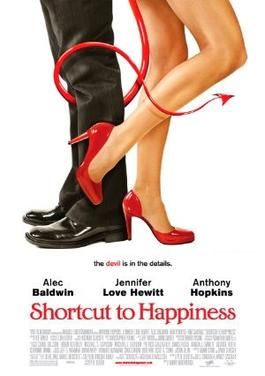
If you’re having trouble getting to sleep tonight, you can always jump over to Tubi and watch Shortcut to Happiness, a.k.a. The Devil and Daniel Webster.
When was Shortcut to Happiness released? There’s some debate about that. Though the film’s credited director is Harry Kirkpatrick, it was actually directed by Alec Baldwin. (Please, no Rust jokes.) The film was shot in 2001, in New York City. However, shortly before filming could be completed, the film’s financiers were arrested and charged with bank fraud which led to the film ending up in limbo. A rough cut of the movie appeared at a few film festivals in 2003. By that point, Baldwin had started to distance himself from the film, claiming that he wasn’t given a chance to shoot all of the scenes that he needed to and that the film was taken away from him in post-production. A newly edited version of the film was finally released in 2007, six years after filming began.
Alec Baldwin not only directed the film but starred as Jabez Stone, an aspiring writer who makes a deal with the devil (Jennifer Love Hewitt) to become a successful published author. Stone gets his wish but it comes with a price. In ten years, he will have to give up his soul. Stone becomes rich and successful, writing books that have absolutely no literary merit. He loses all of his friends and, by the time the ten year deadline rolls around, Stone is miserable. Stone sues to keep his soul. He’s defended by Daniel Webster (Anthony Hopkins), a man who Stone thought was just a publisher but who apparently is actually the famed 19th century statesman. (The film is rather vague on this point.) In one of the film’s few funny moments, the jury is revealed to be made up of deceased writers, including Ernest Hemingway and Mario Puzo. The trial plays out and …. well, again, it’s hard to really follow any of the arguments made by either Webster or the Devil. The film is so tonally inconsistent and poorly directed that I was often left wondering if Hopkins and Hewitt had even been on the set at the same time.
Both Hopkins and Hewitt give good performances. The problem is that they both seem to be appearing in different films. Hewitt gives a broadly comedic performance as the Devil, pouting whenever Webster argues with her. Hopkins, meanwhile, seems to be recycling his dignified and very serious performance from Amistad. Meanwhile, Baldwin the director totally miscasts Baldwin the actor. For the film to work, Jabez needs to be young and hungry. Instead, Baldwin comes across as someone who is already old enough to know better than to make a deal with the Devil.
It’s a true mess of a film but worth seeing just because of the story behind it. That said, the 1941 version of The Devil and Daniel Webster remains the one to beat.
In 2010’s The Client List, Jennifer Love Hewitt stars as Samantha Horton.
Samantha’s a former beauty queen whose mother (Cybill Shepherd) always hoped would go on to win Miss Texas and then maybe appear in movies and on television. Instead, Samantha got knocked up by her boyfriend, Rex (Teddy Sears). Rex was a football star at UT so marrying him didn’t seem like it would be a dead-in but then Rex blew out his knee. Now, they’re living in small town Texas, they’ve got three children, and they’ve got a bank threatening to foreclose on their home. When Samantha and Rex head down to the bank, their loan officer spends the entire time staring at Samantha’s chest while Samantha reveals that she has a photographic memory.
Desperately needing a job and with Rex drinking away his troubles, Samantha gets a job at a massage parlor the next town over. Naively, Samantha assumed that her job would actually just be to give men massages. Instead, it turns out that the massage parlor is actually a brothel where the workers continually tell each other that it “beats the heck out of waitressing.”
(They don’t say “heck” but I gave up cursing for Lent.)
At first, Samantha is disgusted by the idea of working as a prostitute. But, with Rex drinking too much and the house about to bet taken away, Samantha goes back to the parlor and soon becomes the most popular person working there. She works herself to exhaustion but one of her clients has just the solution for that. “I’ve never even smoked weed before,” Samantha says while looking at the baggie of cocaine. I’m sorry …. you dated someone who went to UT without ever smoking weed? I don’t buy that.
Samantha can now stay awake for hours, going to work and buying her family a lot of Christmas presents. Samantha’s clients include some of the most powerful men in the county. When one of her co-workers confesses to having doubts about the job, Samantha sends her to a church group so she’ll have someone to talk to. Soon, words gets out that the massage parlor is a house of prostitution and Samantha is getting arrested and led out of the parlor in her underwear while TV cameras roll. “That looks kind of like your wife,” someone says to Rex.
The Client List caused quite a stir when it aired on Lifetime back in 2010. (It also led to a TV series where Jennifer Love Hewitt starred as a different character.) It’s an enjoyably sordid story, one that embraces the melodrama and mixes morality and sex in a way that would have made Cecil B. DeMille proud. The film takes place in my homestate and, fortunately, it stars a lot of Texas-born actors so the accents are authentic, even if the dialogue was obviously written by a Yankee. (“She’s as busy as popcorn,” a character said at one point and I nearly went blind from rolling my eyes.) That the film actually carries some emotional weight is totally due to the lead performance of Jennifer Love Hewitt, who I’ve always liked because we’re both Texas girls and we’ve both got big boobs so I feel like we share the same struggle. Hewitt gives an authentic and heartfelt performance here, leaving no doubt that everything that Samantha does, she does for her family. The Client List is a true Lifetime classic.
Though the Academy of Motion Picture Arts and Sciences claim that the Oscars honor the best of the year, we all know that there are always worthy films and performances that end up getting overlooked. Sometimes, it’s because the competition too fierce. Sometimes, it’s because the film itself was too controversial. Often, it’s just a case of a film’s quality not being fully recognized until years after its initial released. This series of reviews takes a look at the films and performances that should have been nominated but were, for whatever reason, overlooked. These are the Unnominated.
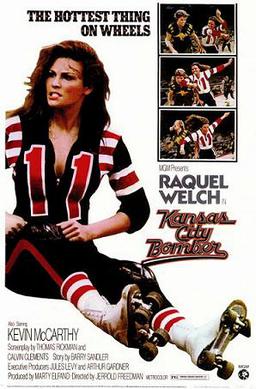
In 1972’s Kansas City Bomber, Raquel Welch stars as KC Carr.
KC. is a star on the roller derby circuit, a tough fighter who is loved by the audience and who shows no fear when it comes to skating around the track and getting into brawls with the other team. The audience especially loves it when she fights Jackie Burdette (Helena Kallianiotes), madly cheering over every punch landed and every elbow thrown and every strand of hair pulled. It’s not glamorous work but KC loves the adulation of the crowds and the comradery of her team. She’s a single mother and putting on roller skates and getting bruised in fights allows her to support her daughter, Rita (a pre-Taxi Driver Jodie Foster).
But then KC is traded to another team, the Portland Loggers. It takes KC a while to fit in with her new team. She’s viewed with suspicion, especially when she starts to date the owner of the team, Burt Henry (Kevin McCarthy). Burt may seem charming but KC soon discovers that he has a jealous side. When KC spends too much time with her best friend and roommate, Burt trades her to another team. When a male skater named “Horrible” Hank (Norman Alden) reveals that he has a rather obvious crush on KC, Burt goes out of his way to humiliate Hank. Burt wants to start a new team in Chicago and he’s promised to make KC a star. Will KC give up her own freedom to be Burt’s well-compensated star or will she stand up for herself and show that she doesn’t belong to anyone?
You already know the answer. The wonderful thing about Raquel Welch is that she was tough. She didn’t let people push her around and, if that resulted in people in Hollywood whispering that she was difficult, so be it. Like KC Carr, Raquel Welch didn’t make any apologies. Kansas City Bomber is one of the few of Welch’s early 70s films to celebrate and show how just how tough she was. For once, Welch is given an actual character to play and she proves herself to be a strong and fierce actress. It’s fun and more than a little empowering to watch her performance here. Everyone underestimates KC Carr, just as everyone underestimated Raquel Welch. In both cases, the doubters are proven wrong.
Kansas City Bomber is not a great film. (The pacing is totally off and the supporting characters are not quite as memorable as either Welch or Kevin McCarthy.) But Raquel Welch gave a great performance. That Welch was never Oscar-nominated isn’t really a surprise. She didn’t appear in the type of movies that received Oscar attention and she was often cast in roles that didn’t give her much of an opportunity to show off what she could do. She definitely deserved a nomination for Kansas City Bomber.
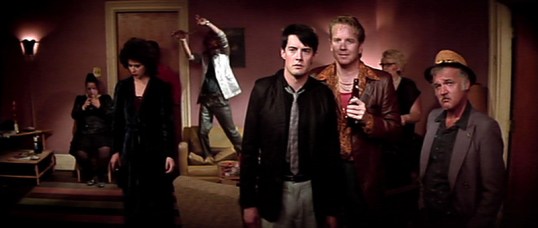
First released in 1986 and still regularly watched and imitated, Blue Velvet is one of the most straight forward films that David Lynch ever made.
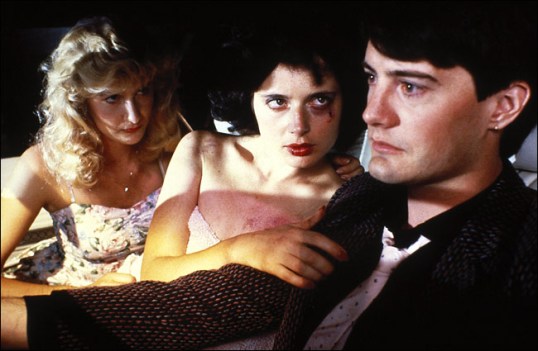
For all the talk about it being a strange and surreal vision of small town America, the plot of Blue Velvet is not difficult to follow. After his father has a stroke that leaves him confined to a hospital bed, Jeffrey Beaumont (Kyle MacLachlan) returns home from college. Lumberton appears to be a quiet and friendly little town, with pretty houses and manicured lawns and friendly people. Jeffrey, with his dark jacket and his expression of concern, appears a little out-of-step with the rest of the town. He’s been away, after all. One day, while walking through a field, Jeffrey discovers a rotting, severed ear. Jeffrey picks up the ear and takes it Detective Williams (George Dickerson). Detective Williams, who looks like he could have stepped straight out of an episode of Dragnet, is such a man of the innocent 1950s that his wife is even played by Hope Lange.
“Yes, that’s a human ear, alright,” Williams says, deadpan.
Blue Velvet (1986, dir by David Lynch, DP: Frederick Elmes)
With the help of Detective Williams’s blonde and seemingly innocent daughter, Sandy (Laura Dern), Jeffrey launches his own investigation into why the ear was in the field. He discovers that Lumberton has a teeming criminal underworld, one that is full of men who are as savage as the ants that we saw, in close-up, fighting over that ear in the field. Jeffrey discovers that a singer named Dorothy (Isabella Rossellini) is being sexually blackmailed by a madman named Frank Booth (Dennis Hopper). When Dorothy discovers Jeffrey hiding in her closet (where he had been voyeuristically watching her and Frank), it leads to Jeffrey and Dorothy having a sadomasochistic relationship. “Hit me!” Dorothy demands and both the viewer and Jeffrey discover that he’s got his own darkness inside of him. “You’re like me,” Frank hisses at Jeffrey at one point and, if we’re to be honest, it almost feels like too obvious a line for an artist like David Lynch. Lynch once described the film as being “The Hardy Boys in Hell,” and the plot really is as straightforward as one of those teenage mystery books.
That said, Blue Velvet also features some of Lynch’s most memorable visuals, from the brilliant slow motion opening to the moment that the camera itself seems to descend into the ear, forcing us to consider just how fragile the human body actually is. The film goes from showcasing the green lawns and blue skies to Lumberton to tossing Jeffrey into the shadowy world of Dorothy’s apartment building and suddenly, the entire atmosphere changes and the town becomes very threatening. We find ourselves wondering if even Detective Williams can be trusted. That said, my favorite visual in the film is a simple one. Sandy and Jeffrey walk along a suburban street at night and the camera shows us the dark trees that rise above them, contrasting their eerie stillness to Sandy and Jeffrey’s youthful flirtation.
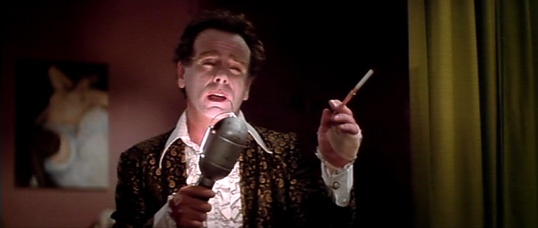
Dean Stockwell in Blue Velvet
Dean Stockwell shows up as Ben, an associate of Frank’s who lip-synchs to Roy Orbison’s In Dreams while Frank himself seems to have a fit of some sort beside him. In retrospect, Blue Velvet played a huge role in Dennis Hopper getting stereotyped as an out-of-control villain but that doesn’t make him any less terrifying as Frank Booth. Hopper, recently sober after decades of drug abuse and self-destructive behavior, summoned up his own demons to play Booth and he turns Frank into a true nightmare creature. Isabella Rossellini is heart-breaking as the fragile Dorothy. That said, the heart of the film belongs to Kyle MacLachlan and Laura Dern and both of them do a wonderful job of suggesting not only the darkness lurking in their characters but also their kindness as well. For all the talk about Lynch as a subversive artist, he was also someone who had a remarkable faith in humanity and that faith is found in both Jeffrey and Sandy. MacLachlan and Dern manage to sell moments that should have been awkward, like Sandy’s monologue about the returning birds or Jeffrey’s emotional lament questioning why people like Frank have to exist. Both Jeffrey and Sandy lose their innocence but not their hope for a better world.
BlueVelvet is a straight-forward mystery and a surreal dream but mostly it’s an ultimately hopeful portrait of humanity. The world is dark and full of secrets, the film says. But that doesn’t mean that it can’t be a beautiful place.
Blue Velvet (1986, dir by David Lynch, DP: Frederick Elmes)
After watching 1967’s The Graduate, I defy anyone to listen to Simon and Garfunkel sing about the darkness without immediately picturing a young-looking Dustin Hoffman (he was 30 when the film was made but he was playing 22) standing on a moving airport walkway with a blank expression on his face.
If you don’t picture that, maybe you’ll picture Dustin Hoffman floating in a pool, wearing dark glasses and barely listening to his parents asking him about graduate school.
Or maybe you’ll remember him driving his car across the Golden Gate bridge. Or perhaps sitting at the bottom of his pool with a scuba mask on. Or maybe you’ll see him awkwardly standing at the desk in the lobby of a fancy hotel, trying to work up the courage to get a room. Or maybe you’ll just see him and Katharine Ross sitting at the back of that bus with a “what do we do now?” expression on their faces.
(Supposedly, that expression was not planned and was just a result of the shot running longer than expected.)
Ah, The Graduate. Based on a novel by Charles Webb, Buck Henry’s script remains one of the quotable in history. “Mrs. Robinson, you’re tying to seduce me …. aren’t you?” “Plastics.” “Elaine!” Myself, I have an odd feeling of affection for the line “Shall I get the cops? I’ll get the cops.” Perhaps that’s because the line is delivered by a young and uncredited Richard Dreyfuss, appearing in his second film and adding to the film’s general atmosphere of alienation.
Alienation is the main theme of The Graduate. As played by Hoffman, Benjamin Braddock feels alienated from everything. He was a track star. He was a top student in high school and college. Now, he’s just a college graduate with no idea what he wants to do with the rest of his life. One can argue, of course, that Braddock brings a lot of his alienation on himself. He can be a bit judgmental, even though he’s the one who is having an adulterous affair with Mrs. Robinson (Anne Bancroft) while also falling for Mrs. Robinson’s daughter, Elaine (Katharine Ross). His parents (William Daniels and Elizabeth Wilson) can be overbearing but it’s possible they have a point. Is he planning on spending the rest of his life floating in their swimming pool? Benjamin says that he just needs time to finally relax. After being pushed and pushed to be the best, he just wants time to do what he wants to do before his life becomes about plastics. When I first saw this movie, I was totally on Benjamin’s side. Now, as I’ve gotten older, I’ve started to understand where his parents were coming from. Still, it’s hard not to feel that Benjamin deserves at least a little bit of time to enjoy himself. That’s what Mr. Robinson (Murray Hamilton) thinks, at least initially.
Mrs. Robinson is the most interesting character in the film, a force of chaos who lives to disrupt the staid world around her. She’s bored with her marriage and her conventional but empty lifestyle so she has an affair with Benjamin. Later, she grows bored with Benjamin and his desire to “just talk” for once and she moves on from him. Benjamin and Elaine are both likable and you find yourself wishing the best for them but Mrs. Robinson is the character who you really remember. Mrs. Robinson grew up without losing her sense of rebellion. One doubts that Benjamin and Elaine are going to do the same.
A portrait of American suburbia and 60s alienation, The Graduate would prove to be one of the most influential social satires ever made. A box office hit, it was nominated for seven Academy Awards. It was nominated for Best Picture, Best Director (Mike Nichols), Best Actor (Dustin Hoffman), Best Actress (Anne Bancroft), Best Supporting Actress (Katharine Ross), Best Adapted Screenplay (Buck Henry and Calder Willingham), and Best Cinematography (Robert Surtees). The Simon and Garfunkel songs that set the film’s mood were, for the most part, not eligible. (Only Mrs. Robinson was written specifically for the film.) I would argue that the film deserved to be nominated for its editing as well. In the end, the film only won one Oscar, for Mike Nichols. But, regardless of what awards it won or lost, The Graduate‘s legacy lives on.
In 1995’s Get Shorty, John Travolta stars as Chili Palmer.
Chili is a loan shark for the mob, an effortlessly cool guy who lives in Miami and who loves to watch old movies. Chili may work for the Mafia and he may make his living by intimidating people but he doesn’t seem like such a bad guy, especially when compared to someone like Ray “Bones” Barboni (Dennis Farina). Bones is an uncouth and rather stupid gangster who steals Chili’s leather jacket from a restaurant. Chili reacts by breaking Bones’s nose with just one punch. Bones reacts by trying to shoot Chili but instead, he gets shot by Chili himself. (The bullet only grazes his forehead.) Chili can do all this because he’s protected by Momo (Ron Karasbatsos) but, after Momo drops dead after having to walk up several flights of stairs just to then be given a surprise birthday party, Chili suddenly finds himself working for Bones. (This all happens in the first few minutes of this perfectly paced film.)
Bones, eager to humiliate Chili, sends him to Vegas to collect on a debt owed by a dry cleaner named Leo (David Paymer). Leo is thought to be dead but Bones wants to collect the money from Leo’s widow. It’s not the sort of thing that Chili likes to do so instead, he ends up going to Hollywood to collect a debt from B-movie director Harry Zimm (Gene Hackman). Chili happens to like Harry’s movies. He also likes Harry’s current girlfriend and frequent co-star, actress Karen Flores (Rene Russo).
Chili ends up in Hollywood, a town where everyone has some sort of hustle going. Chili finds himself dealing with drug dealers (Delroy Lindo), egocentric film stars (Danny DeVito), stuntmen-turned-criminals (James Gandolfini), and the widow (Bette Midler) of a screenwriter. Chili also finds himself looking to escape from the debt collection business by becoming a film producer. Harry has a script that he wants to make. Chili proposes a film based on the story of Leo the dry cleaner. Danny DeVito’s Martin Weir wants to be a “shylock” in a movie just so he can show off his intimidating stare. (“Is this where I do the look?” he asks while listening to the pitch.) Get Shorty is a whip-smart satire of Hollywood, one in which the gangsters want to be film people and all of the film people want to be gangsters. It features wonderful performances from the entire cast, with Travolta epitomizing cool confidence as Chili Palmer. Hackman, Russo, DeVito, Gandolfini, and Lindo are all excellent in their supporting roles but I have to admit my favorite performance in the film is probably given by Dennis Farina, who turns Bones Barnobi into a very believable (and a believably dangerous) buffoon.
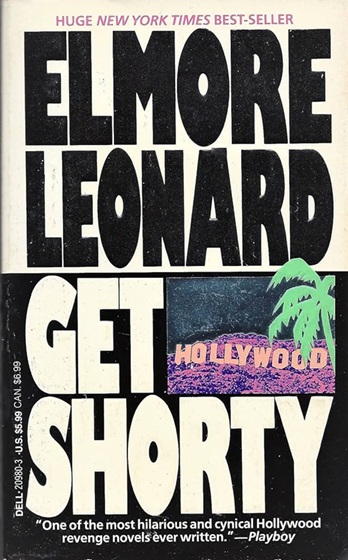
GetShorty is based on a book by Elmore Leonard. First published in 1990, the book is a quick and entertaining read, one that reminds us that Leonard was one of the best “genre” writers of his time. When I read that book, I was surprised to see how closely the movie stuck to the book’s plot. Much of the film’s dialogue is right there in the book. It’s a book that practically shouts, “Turn me into a movie!” and fortunately, director Barry Sonnenfeld did just that.
 Through the Shattered Lens