4 Or More Shots From 4 Or More Films is just what it says it is, 4 shots from 4 of our favorite films. As opposed to the reviews and recaps that we usually post, 4 Shots From 4 Films lets the visuals do the talking!
Today, we honor the legacy of a man who was not just a great horror star but also a great actor. period Christopher Lee worked with everyone from Laurence Olivier to Steven Spielberg to Peter Jackson to Martin Scorsese. Though he turned own the chance to play Dr. No, Lee later did go play a Bond villain in The Man with The Golden Gun. He was one of those actors who was always great, even if the film wasn’t.
That said, it’s for his horror films that Lee is best known. He was the scariest Dracula and the most imposing Frankenstein’s Monster. He played mad scientists, decadent aristocrats, and even the occasional hero. Christopher Lee was an actor who could do it all and today, on what would have been his birthday, we honor him with….
6 Shots From 6 Christopher Lee Films
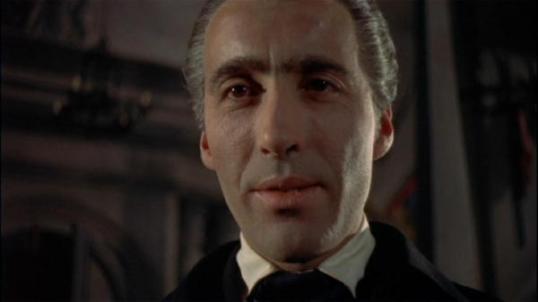
The Horror of Dracula (1958, dir by Terence Fisher, DP: Jack Asher)
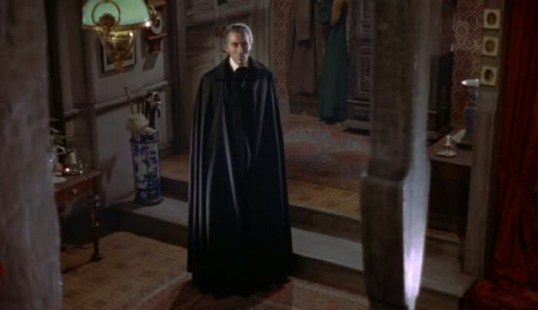
Count Dracula (1970, dir by Jess Franco, DP: Manuel Merino and Luciano Trasatti)
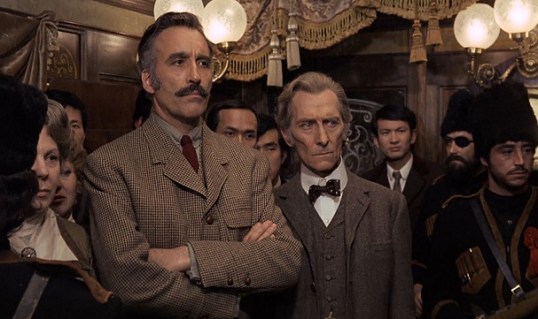
Horror Express (1972, dir by Eugenio Martin, DP: Alejandro Ulloa)
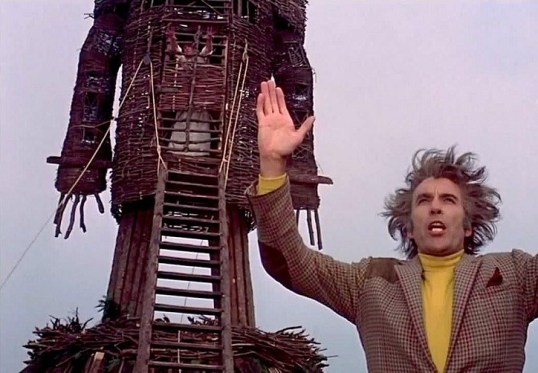
The Wicker Man (1973, dir by Robert Hardy. DP: Harry Waxman)
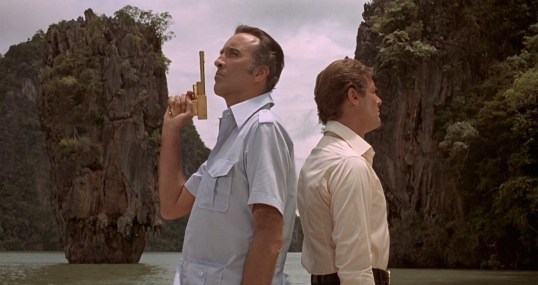
The Man With The Golden Gun (1974, dir by Guy Hamilton, DP: Ted Moore and Oswald Morris)
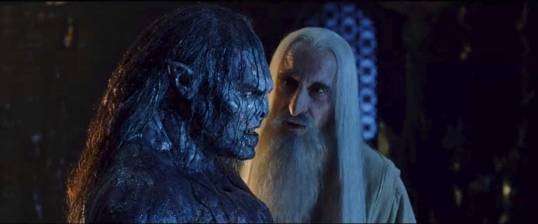
Lord of the Rings: The Fellowship of the Ring (2001, dir by Peter Jackson, DP: Andrew Lesnie)
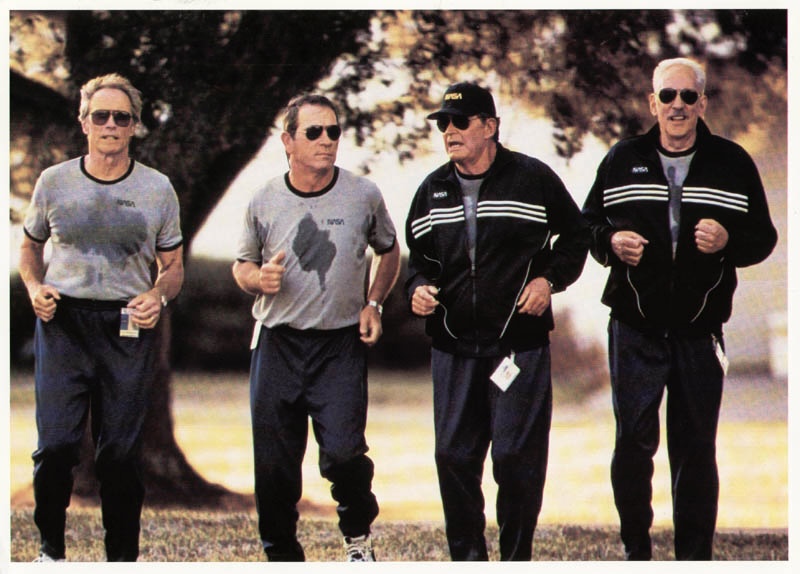
One of the funniest scenes in SPACE COWBOYS (2000) takes place when Jay Leno interviews the characters of Frank Corvin (Clint Eastwood), Hawk Hawkins (Tommy Lee Jones), Jerry O’Neill (Donald Sutherland) and Tank Sullivan (James Garner). The scene I’m referring to involves a question asked of “babe magnet” Jerry O’Neill. Only a few moments of Jay Leno’s material made it into the completed film, but the interview was filmed in front of a real Tonight Show audience. Leno made monologue jokes about Viagra, Matlock (1986), and prostate problems. Leno ad-libbed with the actors like he would in a real interview. I’ve included the additional scenes here!
Here at The Shattered Lens, we’re definitely celebrating Clint Eastwood’s May 31st birthday. As part of that celebration, I decided to revisit his 2000 film, SPACE COWBOYS.
SPACE COWBOYS opens in 1958 on the day that Air Force Test Pilot Frank Corvin (Clint Eastwood) and his team of Hawk Hawkins (Tommy Lee Jones), Jerry O’Neill (Donald Sutherland), and Tank Sullivan (James Garner) find out that their test program is being shutdown due to the formation of NASA. Their dreams of someday making it to space are crushed, and to make it worse, they were stabbed in the back by their leader Bob Gerson (James Cromwell) and not invited to be part of NASA’s new testing program. Fast forward to the present time, where a Soviet communications satellite seems to be unresponsive and NASA is working with Russian General Vostov (Rade Serbedzija) to figure out how to keep it from crashing back to Earth. The satellite is a relic of the Cold War that somehow ended up with a guidance system on board that’s so old that it was designed by Frank, and the young folks don’t know how to work with it. And to complicate things even further, the guidance system can only be fixed on site, which means in space. So it seems that NASA finally needs Frank after all this time, and he’ll only agree to help if he’s able to bring his old team on board. Their old nemesis Bob, the project’s manager at NASA, reluctantly agrees. We see that he’s still the same bastard he’s always been as he and General Vostov are holding back critical information about the cargo of the satellite. So let the training and preparation for the mission begin!
The premise of SPACE COWBOYS may not be very realistic, but I think it’s one hell of a fun movie, especially during its first half. I really enjoy watching this amazing cast of veteran actors do their thing. Of course they get the cool walk into NASA headquarters wearing sunglasses and leather jackets, while N’ Sync’s “Space Cowboy” plays over the soundtrack. Clint Eastwood plays the character he has perfected over his career, that of the tough, grizzled leader with a dry sense of humor. Tommy Lee Jones is the fearless hotshot who has never been good at following orders, but has the kind of talent that everyone wishes they had. Jones is actually by far the youngest of the primary cast, a full 16 years younger than Eastwood. Donald Sutherland gets some of the best laughs as the ladies man of the team. The scene where he answers Jay Leno’s question about his reputation as a lothario made me laugh out loud! James Garner’s character became a Baptist minister after his days with the Air Force and prays often for the group. He’s good here, but his character is the least memorable. With their mission labeled “The Ripe Stuff” by the media, watching these great older actors go through their training, and deal with their much younger counterparts and the NASA brass, is a joy. I also want to shout out William Devane as the NASA flight director for the mission. He has a couple of really strong scenes.
The legendary cast of this film can’t help but give a seasoned moviegoer like me a warm sense of nostalgia based on their amazing body of work. I remember introducing KELLY’S HEROES to my son when he was a boy. He watched my DVD over and over again. Seeing Eastwood and Sutherland together here brought those memories back. One of my very favorite revenge films is ROLLING THUNDER with William Devane and Tommy Lee Jones. Seeing them together here helps me remember just how great they are in that badass classic. Heck, Garner’s character name of “Tank” Sullivan takes me back to one of the very first movies our family rented when we got our VCR in the mid-80’s! Do y’all remember Garner’s film TANK from 1984? I certainly do!
I will admit that once the crew takes off and begins the actual mission, which comprises about the last 45 minutes of the film, the entertainment level goes down a couple of notches for me. The technical aspects of completing the mission are not as interesting to me as the character interplay in the earlier portions of the film. With that said, there are still some exciting moments to be had, including the nailbiter of a landing at the end.
I enjoyed revisiting SPACE COWBOYS after quite a few years. This movie is ultimately a crowd pleaser, and for me, it does its job well. Enjoy the trailer below:
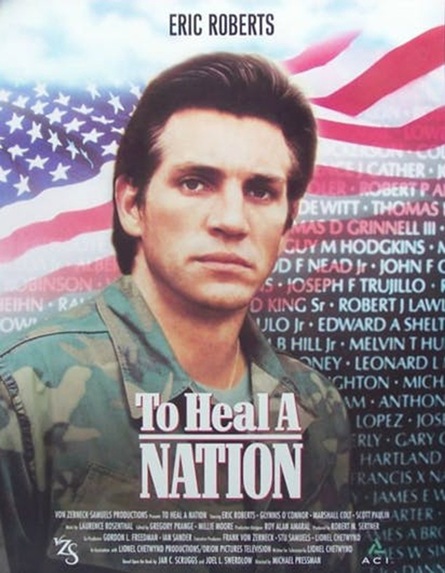
In 1988’s To Heal A Nation, Eric Roberts stars as Jan Scruggs.
When we first meet Scruggs, the year is 1971 and he’s taking his seat on a commercial airliner. When the blonde woman sitting beside him starts to flirt with him, Scruggs mentions that he’s happy because he’s finished up his tour of duty in Vietnam. Upon hearing that Scruggs is a Vietnam vet, the woman immediately requests to be moved to a different seat.
Eight years later, things haven’t gotten much better. Scruggs works for the Department of Labor in Washington D.C. He’s married to Becky (Glynnis O’Connor) but he’s struggling to deal with the past. He drinks too much. He has trouble sleeping. He doesn’t feel like he can open up about the things that he saw in Vietnam because nobody wants to talk about it. He was one of the thousands of people who served in Vietnam who now feel as if they’ve been abandoned by their country. However, after attending a showing of The Deer Hunter, Scruggs has a vision of a monument that that features the name of every American who was killed in the Vietnam Conflict.
Scruggs devotes the next several years of his life to getting the monument built, appealing to both the government and private citizens for funding. At first, everyone treats Scruggs and his efforts like a joke. Even some fellow veterans feel that Scruggs is pushing too hard and that he’s just going to end up embarrassing himself. But Scruggs refuses to give up and finally, with the support of a senator (Laurence Luckinbill) and a Texas millionaire named H. Ross Perot (Conrad Bachmann), Scruggs is able to make his dream a reality.
Based on the true story of the struggle to build the Vietnam Veterans Memorial in Washington, D.C., To Heal A Nation features a young Eric Roberts giving a nervy but likable performance as Jan Scruggs, a man who becomes so obsessed with building a monument to those who lost their lives in Vietnam that he occasionally seems like he’s close to going over the edge himself. It’s a good film for Memorial Day and one that still feels relevant today. The way that Scruggs was treated after returning from Vietnam is the way a lot of our veterans were treated and continue to be treated after returning from Iraq and Afghanistan. We love our soldiers when they fight in popular wars that result in a definite victory. When they serve in an unpopular war, they’re often deserted by people who don’t want to be reminded of recent history. One can certainly see that in the attempts by the national media to gloss over what happened during our final days in Afghanistan. This film is a reminder that no one should be forgotten.
Previous Eric Roberts Films That We Have Reviewed:
As some of our regular readers undoubtedly know, I am involved in hosting a few weekly live tweets on twitter and occasion ally Mastodon. I host #FridayNightFlix every Friday, I co-host #ScarySocial on Saturday, and I am one of the five hosts of Mastodon’s #MondayActionMovie! Every week, we get together. We watch a movie. We snark our way through it.
Tonight, for #MondayActionMovie, the film will be 1999’s Final Voyage!
It should make for a night of fun viewing and I invite all of you to join in. If you want to join the live tweets, just hop onto Mastodon, pull up Final Voyage on YouTube, start the movie at 8 pm et, and use the #MondayActionMovie hashtag!
Here at The Shattered Lens, we’re celebrating Clint Eastwood’s birthday on May 31st. I decided to revisit his 1999 film, TRUE CRIME.
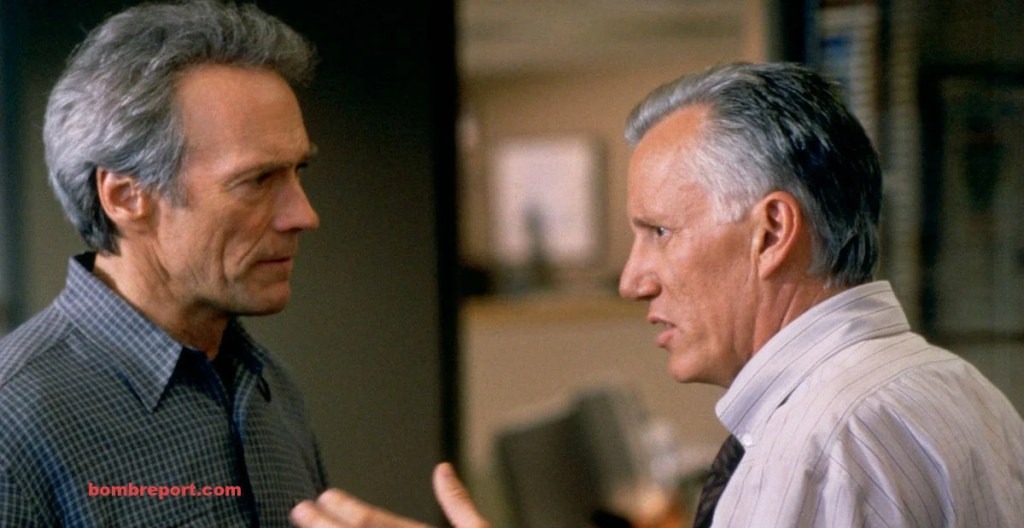
Clint Eastwood directs and stars as ace journalist, Steve Everett, who also happens to be a bad friend, a terrible dad, and an even worse husband. Literally the only thing that he’s got going for him is his “nose,” his ability to sniff out a story where no one else can. Even that has begun to fail him, mostly due to his recents bouts with alcoholism, which he seems to somewhat have a handle on at the time of this story. When a young, beautiful colleague tragically passes away in an auto accident, Steve is given her previous assignment to cover the execution of convicted murderer Frank Beechum (Isaiah Washington). Not the kind to write a human interest “puff piece” like the Oakland Tribune is wanting, Everett begins digging into the past and pretty soon that nose of his starts telling him that Beechum is a victim of circumstantial evidence. Despite his editor Bob Findley’s (Denis Leary) objections, he’s able to convince his newspaper boss Alan Mann (James Woods) to let him dig deeper into the story. As he tries to juggle his myriad personal problems with his growing belief in Beechum’s innocence, Everett is also facing a clock that is ticking down to the midnight execution. Will he be able to find the crucial piece of evidence that will set Beechum free?
TRUE CRIME appears to be somewhat of a forgotten Clint Eastwood film. I saw it at the theater when it came out in 1999, but it was not financially successful, only bringing in $16 Million at the box office. Regardless of that, I still love the film. It’s certainly not perfect. It’s probably too long, Beechum is probably too angelic after being “born again,” and the resolution may be a little unrealistic, but I still enjoyed every second of it. One of the coolest things about Clint Eastwood is his willingness to play such flawed men on screen, yet we still love him. He’s great in this film! Anyone who’s read much of my work knows that my love of actor James Woods goes back to being in junior high and renting his movies BEST SELLER and COP. It’s such a treat seeing the legendary pair on screen together even if Woods’ role is sort of a glorified cameo. Woods is hilarious in his limited screen time. My last shout out is to Isaiah Washington as the innocent man who’s about to be put to death. After all these years and appeals, he’s accepted his fate, but the scene where he tells Everett his story and Everett tells him that he believes he’s innocent is so powerful. Add to that Washington’s scenes with his wife and daughter, and I was very much emotionally invested in this film. Washington’s performance was key to the film working, and he’s great!
Overall, TRUE CRIME is a film that takes its sweet time, but it ultimately tells a tense, engrossing story that ratchets up the tension to 10 prior to its last second resolution. I consider it very underrated and highly recommend it. I’ve included the trailer below:
Today, we wish a happy birthday to Cillian Murphy!
A year ago, Murphy won the Oscar for his role in Oppenheimer. However, before playing the lead role in Christopher Nolan’s epic, Cillian Murphy been an intriguing cinematic presence for over two decades. I first became aware of him after watching Danny Boyle’s 2002 classic, 28DaysLater. Here he is, showing what he can do without even uttering a word of dialogue, in a haunting scene from that film.
4 Shots From 4 Films is just what it says it is, 4 shots from 4 of our favorite films. As opposed to the reviews and recaps that we usually post, 4 Shots From 4 Films lets the visuals do the talking!
Today, the Shattered Lens wishes a happy birthday to screenwriter Bob Gale! It’s time for….
4 Shots From 4 Films Written By Bob Gale
I Wanna Hold Your Hand (1978, dir by Robert Zemeckis, DP: Donald M. Morgan)
1941 (directed by Steven Spielberg, DP: William A. Fraker)
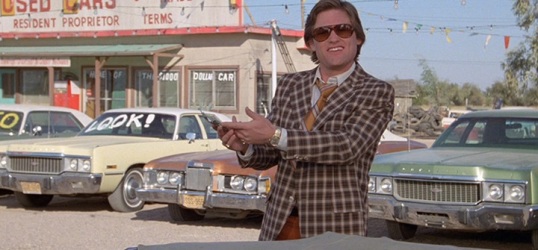
Used Cars (1980, dir by Robert Zemeckis, DP: Donald M. Morgan)
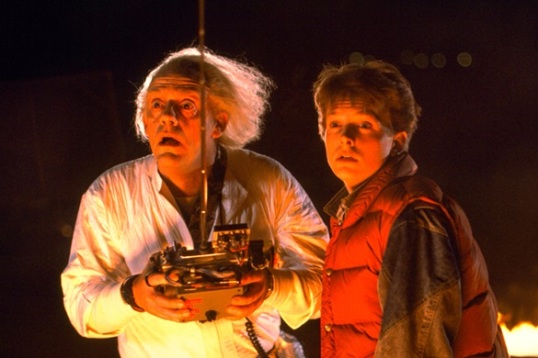
Back to the Future (1986, dir by Robert Zemeckis, DP: Dean Cundey)
One of the best action scenes in the Don Siegel / Clint Eastwood collaboration COOGAN’S BLUFF (1968)… I really enjoy this scene because Coogan tried to use Libby Raven, but she surprised him by being smarter than he thought she was. Enjoy this classic scene from COOGAN’S BLUFF!
Here at The Shattered Lens, we’re looking forward to celebrating the birthday of Clint Eastwood on May 31st. In anticipation, I decided to revisit COOGAN’S BLUFF (1968).
Clint Eastwood is Coogan, a tough as nails deputy sheriff from Arizona, who’s ordered by his boss, Sheriff McCrea (Tom Tully) to go to New York City and bring back the escaped killer James Ringerman (Don Stroud). When he gets to New York, he’s informed by Lieutenant McElroy (Lee J. Cobb) that Ringerman has overdosed on LSD while in the state’s custody, he’s now in the Bellevue Hospital, and he will not be released to Coogan until the state Supreme Court says so. Stuck in the Big Apple with nothing to do but flirt with probation officer Julie Roth (Susan Clark), Coogan decides to take matters into his own hands and get Ringerman out of the hospital early. He bluffs the attendants at the hospital into turning Ringerman over to him so he can catch the first plane back to Arizona. It seems like a good plan until he’s ambushed by Ringerman’s girlfriend Linny (Tisha Sterling) and his friend Pushie (David Doyle), he gets conked on the head, and he loses both his gun and his prisoner. Now, in trouble with Lieutenant McElroy and Sheriff McCrea, Coogan is ordered back home to Arizona. Determined to get Ringerman at any cost, Coogan stays in the city and leaves a trail of broken hearts and bruised bodies on his way to capturing his man!
Made in 1968 after Eastwood’s string of excellent spaghetti westerns with Sergio Leone, COOGAN’S BLUFF may be set in contemporary times, but Coogan still seems to be a product of the old west. A big part of the fun is watching him interact with the people of New York City, where everyone is trying to take advantage of him, whether it be the cab driver, the hotel clerk, or the hooker down the hall. When he finally gets to the police station, he sees a building that’s completely overrun with criminals and crazies. He soon finds that Lieutenant McElroy follows the law down to the letter, while he treats the law as more of a set of suggestions on his way to getting the bad guys. This leads to endless frustration and almost gets Coogan arrested multiple times throughout the film as he doesn’t want to deal with all the red tape. One thing that doesn’t change whether Coogan is in Arizona or New York is his success with the ladies. They all swoon and he more than willingly obliges. The only problem for his prospect of true love is the fact that getting his guy always comes first, and he’ll use that sex appeal to get whatever information he needs. One of the main action scenes in this film, the bar fight, is set up ironically when the woman he’s “using” turns the tables and instead sets him up to be pummeled.
COOGAN’S BLUFF is Eastwood’s first film with director Don Siegel, with whom he’d make DIRTY HARRY a few years later. You can definitely see the genesis of Harry Callahan in Walt Coogan, a man who does whatever it takes to stop criminals, is quick with a whip, and usually pisses off his superiors along the way. In some ways, you could say that Walt Coogan set the mold for the hero of cop films for the next couple of decades! It also has that sense of humor that would be a mark of Eastwood’s cop films. This one includes a funny thread that runs throughout where every person he meets assumes he’s from Texas because he wears a cowboy hat, and he always corrects them that he’s from Arizona. I get this as I always make sure people know that I’m from Arkansas!
Overall, I really enjoy COOGAN’S BLUFF due mainly to Clint Eastwood’s excellent performance in the lead role. It was a great start to his “post Leone” career and would influence action movie heroes from that point forward.




 Through the Shattered Lens