A Canadian Quickie With Lisa Marie: The Bloody Brood (dir. by Julian Roffman)


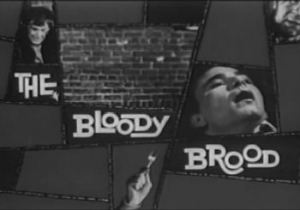
As part of my ongoing mission to see all of the film’s featured in Mill Creek’s 50 Chilling Classics box set, I watched a 65-minute Canadian film called The Bloody Brood last night.

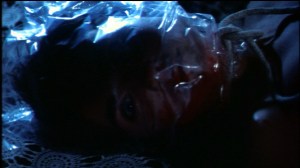
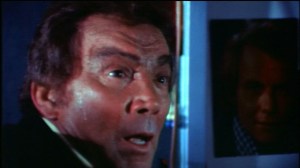
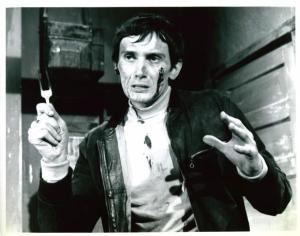
First released in 1959 and filmed in moody, noir-ish black-and-white, The Bloody Brood tells the story of a low-level drug dealer and aspiring beatnik named Nico (Peter Falk).  One night, while hanging out at the local coffeehouse and listening to decadent jazz, Nico witnesses a man drop dead of a heart attack.  Intrigued by the man’s sudden death, Nico and his nervous friend, a tv director named Francis (Ron Hartmann), decide that they want to experience what it would be like to deliberately kill someone.  Before you can say “Leopold and Loeb,” Nico and Francis are feeding a random stranger a hamburger laced with ground glass.  That stranger, a hard-working telegram delivery man named Ricky (George Sperdakous), later dies of an intestinal hemorrhage.

Unknown to Nico and Francis, Ricky has an older brother named Cliff (Jack Betts) and Cliff doesn’t believe that his brother’s death was an accident.  With the covert help of Detective McLeod (Robert Christie), Cliff starts to investigate his brother’s death.  Cliff eventually meets Ellie (Barbara Lord), a disillusioned woman who has fallen in with Nico and his murderous crowd.

The Bloody Brood is an unexpected surprise, a genuinely entertaining B-movie that more than overcomes the confines of its low-budget and limited running time.  While Peter Falk is the obvious center of the picture and steals every scene that he’s in with his coldly charismatic style of evil, the entire film is well cast and well acted with Hartmann and Betts both bringing unexpected nuance to their roles.  However, the real star of the film is director Julian Roffman who gives the film a shadowy and threatening noir-look. 

In many ways, The Bloody Brood represents everything I love about the low-budget, often sordid B-movies of the 50s and 60s.  Working with limited resources and a small cast, director Julian Roffman managed to create a genuinely memorable movie.  Films like The Bloody Brood continue to serve as proof that you don’t need millions of dollars to make a good film.  You just need a strong creative vision and the imagination to make that vision a reality.

Trailer: Brave


 This trailer has been out for a while but when I saw it tonight before the Avengers, I realized that if there’s any movie that I’m truly looking forward to seeing later this year, it’s the latest offering from Pixar, Brave. 

And no, it’s not just because this film is about one of my fellow flame-haired ones…

Well, maybe a little.

A Grindhouse Quickie with Lisa Marie: The Demon (dir. by Percival Rubens)


Last summer, I decided to watch and review all 50 of the films to be found in Mill Creek’s Chilling Classics box set.  Mill Creek, of course, is a company that’s best known for releasing box sets that seem to primarily feature low-budget films that, for whatever reason, have now found themselves in the public domain.  If you’re a fan of old school B-movies in general, then you probably know just how fun it can be to read the back of a Mill Creek boxset and discover what obscure films are waiting inside.  The thing that I especially love about Mill Creek is the fact that — in the best grindhouse tradition — they describe every film that they distribute (whether it’s George Romero’s Night of the Living Dead or something like Las Vegas Bloodbath) as being a “classic.”

So, anyway, I started to watch and review the films in the Chilling Classics box set but, as 2011 drew to a close, things got rather hectic and busy here at the TSL Bunker.  In between covering the Oscar season and keeping the world supplied with weekly trailer posts, I had to set aside my plans to review the entire boxset for another day. 

Well, I’m happy to say that day is here!  Last night, I dug out the old Chilling Classics box set and I watched a South African slasher film from 1981, The Demon.

The Demon actually tells two separate but connected stories.  In the first story, a teenage girl is kidnapped from her bedroom by a masked killer.  Her distraught family calls in a tormented psychic who quickly proves himself to so superfluous and useless that you’d forget all about him except he’s played by the late Cameron Mitchell. 

If you’re a fan of old school grindhouse and exploitation films then you’ve undoubtedly seen a handful of films featuring Mr. Mitchell.  A former “legitimate” actor who, early on in his career, appeared in things like Death of a Salesman, Mitchell eventually became better known for appearing in low-budget exploitation films.  Mitchell could always be counted on to shamelessly overemote and, regardless of the film he was appearing in, he was always a lot of fun to watch.  If nothing else, Mitchell always seemed to be rather amused by the films he found himself in.  It’s a shame that Cameron Mitchell died before Quentin Tarantino could engineer a comeback for him. 

In The Demon, Cameron Mitchell spends most of his limited screen time standing on a rocky cliff while staring down at the ocean below and having psychic visions that don’t really seem to have much to do with anything else happening in the film.  Actually, visions is the wrong word.  As Mitchell says, “Sometimes…I get these feelings.  Vibes, as the kids would say.”

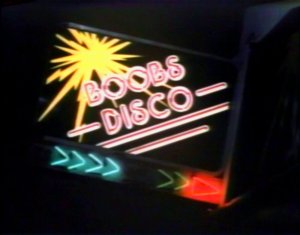
And the kids are in a lot of trouble because our nameless killer has moved on to the city where he spends his time hanging around outside of a place called Boobs Disco and stalking two teachers named Mary (Jennifer Holmes) and Jo (Zoli Markey).  This is the film’s second storyline and it mostly consists of Mary spotting the killer out of the corner of her eye and Jo pursuing a relationship with the most boring man on the planet.

Like quite a few films that seem to pop up in various Mill Creek box sets, The Demon is technically a pretty bad film but, once you accept that fact, it’s also an occasionally entertaining mess that delivers a handful of effectively creepy moment.

The scenes featuring Cameron Mitchell are entertaining for exactly the reason that you think they are.  These scenes are such obvious filler and were so obviously added as an excuse to get a “name” actor to join the cast that it’s impossible not to admire the nerve of the filmmakers.  They weren’t going to let a silly thing like narrative cohesion get in the way of producing a 90 minute film.  Playing the world’s worst psychic, Cameron Mitchell delivers his lines with such a truly unfocused intensity that I actually spent the first half of the movie convinced that he was the murderer.  The final fate of Mitchell’s character is truly shocking (if just because it kind of comes out of nowhere) and Mitchell plays his final scene as if he’s starring in a dinner theater production of some lost Shakespearean play.

If the scenes featuring Mitchell are mostly entertaining for being so bad, the scenes in which the nameless killer stalks Mary and Jo are actually pretty well done and the final confrontation between the final girl and the killer is handled surprisingly well (though I couldn’t help but roll my eyes at the fact that the film contrives to have the final girl fight for her life while topless).  The killer’s lack of personality makes him all the more intimidating and both Jennifer Holmes and Zoli Markey are likable and believable in the roles of Mary and Jo.  If nothing else, The Demon proves that even a really poorly produced horror film can be partially redeemed (if not saved) by a likable cast of potential victims.

Finally, and perhaps most importantly, The Demon — like many forgotten exploitation flicks — serves as a valuable time capsule of the society that produced it.  To offer up just one example:

Burn “The Wicker Tree”


Honestly, friends, sometimes a person just doesn’t even know where to begin. I suppose I could individually list the catalogue of atrocities that make up writer-director Robin Hardy’s The Wicker Tree, but frankly that would mean spending more time talking about this film than I really have the energy to, and besides, our nearest thing to a “star” critic here at Through The Shattered Lens, Lisa Marie Bowman, has already done a pretty damn fine job of performing a blow-by-blow dissection of this thing’s rotted corpse in her capacity as occasional scribe over at HorrorCritic.com, so there’s no real need to duplicate what’s been done before. Allow and/or indulge me, then, as I take a slightly different tack and document my personal journey of despair with Hardy’s exercise in highly confused pointlessness.

To begin with, I should point out that the original Wicker Man is quite likely one of my ten-or-so all-time favorite films. Critics who say it’s “not actually a horror movie” are quite right, of course — it’s a unique — hell, frankly singular — amalgamation of so many different styles that the end product is well and truly unclassifiable. Part horror flick, sure, but also part musical, part (very) black comedy, part clash-of-cultures melodrama, part satire on Christian piousness, and part period-piece-albeit-in-a-then-contemporary-setting, it stands on its own as the only thing quite like it ever made. Screenwriter Anthony Shaffer perhaps put it best when he stated that his main goal was to pen a meditation on the nature of sacrifice, and everything else just sort of took off from there.

Obviously, there are so many elements about the first film that the 2011 “thematic sequel” could never hope to duplicate — songwriter Paul Giovanni is no longer with us, so right off the bat we know the music’s not going to be nearly as good because, quite frankly, it can’t be. Anthony Shaffer has passed away and therefore whatever follow-up material comes about wouldn’t in any way be his vision for how the story could or should  continue. Edward Woodward has likewise left behind this mortal coil, and his character died at the end anyway, so replicating his magnificently anally-retentive performance is probably going to prove to be out of the question, as well.  Christopher Lee is, while still awesome as hell,  also extremely frail and old at this point. And anyway — The Wicker Man still retains all its poignancy and power to this day and has only gained luster over the past 40 years. The abominable Nicolas Cage/Neil LaBute remake proved that revisiting the material was a lost cause, so why bother, five years on from that failed experiment,  with any sort of a sequel, “thematic” or otherwise?
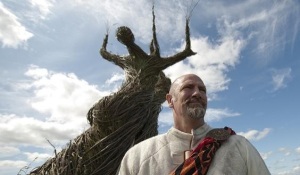
Unfortunately, Robin Hardy wrote a book some years back called Cowboys For Christ that updated some of the concepts from his earlier film and he got the notion that it would make a decent-enough little flick. He was able to scour up $7 million-plus worth of financing, and got the folks at Anchor Bay so interested they promised not only a widespread “home viewing platform” release (and I caught this on a free screener copy that was sent my way so therefore can’t fairly comment on any extras the DVD and Blu-Ray might contain), but a even a little theatrical run, as well. It never made it to my area, and disappeared after a week from the markets it did make it into, but still —the fact that they chose to give this thing some theatrical burn when it seemingly had DTV written all over it was enough for me to, foolishly, get my hopes up.

I guess we believe what we want to believe (which is rather one of the points of the first film, after all), and a steady stream of reviews for this one that placed it at the “embarrassingly bad” end of the spectrum at worst to “maybe not quite as horrible as I’d been fearing but still pretty goddamn awful” at best weren’t enough to dampen my enthusiasm at this point. I figured it just had to be better than most folks were giving it credit for, because there’s just no conceivable way it couldn’t retain, say, at least 1/100th of the darkly charismatic charm of the first film, even if entirely by accident, right? After all, the original director was on board, and Anchor Bay wasn’t so ashamed of his finished product that they tried to hide the thing away at the bottom of some film vault (although given that it’s shot on HD, perhaps a “film” vault wouldn’t be the right place to stick it in, anyway).

It’s certainly fair to say that I wasn’t expecting greatness, or even anything of the sort, but something that still somehow cleaved to even a miniscule fraction of the spirit of the original would have been good enough for me. Unfortunately, what I got was a story about two painfully stereotypical Jesus-lovin’ Texas yokels who have gone on a mission (more typical of Mormons than of born-againers, it must be said) to evangelize in some small Scottish town that apparently has never heard the “good news.” One of our less-than-convincingly-portrayed country bumpkins, Beth Boothby (Brittania Nicol), was apparently a famous country singer with something of a “reputation” before turning her life over to Christ, while the other, her fiancee Steve Thomson (Henry Garrett), is little more just a walking, talking cowboy hat. Once in the “heathen land” of Scotland,  they enjoy the decidedly non-Southern hospitality of local nuke plant owner Sir Lachlan Morrison (Graham McTavish, in something more akin to a respectable performance than his colleagues seem capable of) and his OTT-in-the-deception-deaprtment wife, Delia (Jacqueline Leonard), but of course the dastardly couple, whose power plant has through some unexplained (and probably inexplicable, so it’s just as well Hardy doesn’t even try) means left the entire town sterile, have other plans for their simple-minded God-fearin’ visitors, plans that the Texas two-steppers are apparently too stupid to suss out even as they’re practically being openly prepared for the burning stake and, get this, the dinner table!

Yes, evidently the heathen folk of the United Kingdom’s northern reaches have taken to cannibalism in the four decades or so since our last visit, and while Hardy seems to think this somehow ups the “black comedy” factor of the proceedings, really it just serves as a cop-out by more clearly delineating who are the “good guys” here and who are the “bad guys,” a simple-minded, black-and-white approach that the first Wicker Man never resorted to even when Sgt. Howie was being burned alive (in, it must be said, one of the most visually dramatic sequences ever committed to celluloid).

And that’s a pretty much the problem at the crux of The Wicker Tree in a nutshell — sure, there are numerous and obvious others, ranging from wretched acting to dully-executed visuals to poor pacing to obvious run-time padding to inarticulate (at best) dialogue to recycled-into-a-less-involving-context story ideas to laughably one-dimensional caricatures standing in place of real, actual characters — but at the end of the day, it’s Hardy’s mistrust of his audience’s ability to make up our own collective mind, and the blatantly heavy-handed approach he takes in explaining everything for us that stems from that mistrust, that makes this such a condescending failure. I could live with the far-less-subtle approach to the “clash of cultures” theme that he takes here in comparison with the first film. I could live with the nowhere-near-as-compelling music. I could live with the rather — uhmmm — “broad strokes” with which he paints each and every character . I could live with the pointless and frankly even a bit insulting to the guy Christopher Lee cameo. Hell, I could even live with the Christian turning the tables on her pagan pursuers and winning in the end. But what I absolutely can’t abide is that Hardy thinks we’re all so unsophisticated and beneath the task of understanding his apparently-in-his-mind-quite-complex-and-challenging-themes that we need for him to hammer them home with a with a burning wicker stake through our heads. He’s had 40 years to think about how he wants to follow up a genuine, justly-lauded classic and this is what he comes up with? Set fire to me now, please, before the third installment, which he’s already working on, ever sees the light of day.
6 Trailers for Cinco De Mayo


Hola and happy Cinco De Mayo!  I’m not sure if Cinco De Mayo is as big a deal up north as it is down here in the Southwest but today is going to be one of the few Saturdays that I don’t go to the movies.  Instead, I will be observing this day with friends, family (I am a fourth Spanish), and cerveza.  But first, here’s the latest edition of Lisa Marie’s Favorite Grindhouse and Exploitation Trailers…

(Be warned: Some of these trailers are a tad bit more explicit than some of the other trailers that I’ve featured as a part of this series.  Watch with caution.)

1) Tombs of the Blind Dead (1971)

This is one of the first of the great Spanish horror films. 

2) Return of the Evil Dead (1973)

The Blind Dead returned in this gory and violent sequel.  One of my prize possessions is my Blind Dead box set, which was released (in the shape of a coffin, no less) by Blue Underground.

3) Vampyros Lesbos (1971)

This is the German trailer for Vampyros Lesbos, directed by the infamous Jess Franco.  Just try to guess what this film is about…

4) Oasis of the Living Dead (1981)

In a career that has spanned over 500 films, Jess Franco has dealt with not only lesbian vampires but zombies as well…

5) Night of the Bloody Apes (1969)

From Rene Cardona comes this surprisingly bloody films about what happens when an ape’s heart is transplanted into a normal human being.  Fortunately, there’s a wrestler around to save the day…

6) The Werewolf Vs. The Vampire Woman (1970)

Finally, let’s end things with a Paul Naschy film, shall we?

Happy 71st Birthday, Citizen Kane!


It’s May 1st and do you know what that means? 

Okay, yes, it is May Day and apparently, that’s a big deal to a certain class of political activist.  But, let’s be honest — political causes are forgotten from decade to decade.  However, a great film lives forever.

And, for me, today is all about one of the greatest films ever made.

71 years ago today, on May 1st, 1941, Orson Welles’s masterpiece Citizen Kane was first released to a movie-going public that wasn’t quite ready for it.  And that was their loss because Citizen Kane has proven itself to be one of those rare films that remains just as entertaining and fascinating the 100th time you watch it as it was the first time.

One of my fondest memories is of the first time I saw Citizen Kane in film class.  As I sat there listening to our professor drone on about the historical importance of what we were about to see, I was fully prepared to watch Citizen Kane and dismiss it — as I had so many other critically beloved films — as just being another overrated, academically-embraced movie. 

“After all,” I thought as the movie started, “I already know Rosebud is a sled* and I haven’t even seen the freaking film.  What’s the point?”

And as the film played out in the darkened auditorium, I soon discovered exactly what the point was.  The point was that Citizen Kane is one of the greatest and most watchable films ever made.  It’s that rare “important” film that’s actually fun to watch.  It didn’t matter that I already knew what Rosebud was.  In fact, I didn’t even think about it.  I was too busy enjoying Joseph Cotten’s sly turn as Jedadiah Leland and the sleazy, pragmatic villainy of Ray Collins as “Boss” Jim Gettys.  I was too busy cringing in a combination of sympathy and embarrassment as poor Susan Kane (Dorothy Comingore) made her disastrous operatic debut.  I sat there and I was transfixed by a flawless cast that brought a vibrant life to even the smallest of roles.  (My personal favorite was Paul Stewart’s wonderfully cynical performance as Raymond the Butler.)  But most of all, I sat there in awe of the talent of Orson Welles.  At that time, I knew little about Welles’ subsequent career troubles.  I just knew that I was watching a masterpiece.

I wish I could write more (because there’s so much more to say about this film) but now’s my time to curl up on the couch in front of the TV and watch one of the greatest films ever made…

—

* And don’t you even think of going, “How about a spoiler warning!?” about that whole Rosebud comment.  Seriously, if you didn’t already know that Rosebud was a sled then I have nothing to say to you.

6 Trailers For A Sunday


Hi!  I apologize for being a day late with this week’s edition of Lisa Marie’s Favorite Grindhouse and Exploitation Film trailers.  In the future, I may just start regularly posting these on Sunday morning as opposed to Saturday.  But that’s something that can be decided in the future.  For the present, the trailers are the only thing that matters…

1) Witchboard (1986)

This trailer is short but effective.  The guy with the beard scares me every time.

2) Jennifer (1978)

Guess which earlier movie inspired this one?

3) Dr. Terror’s House of Horrors (1965)

When you’ve got a named like Dr. Terror, you might as well get a house of horrors.

4) The Hand (1981)

Continuing on a theme that was introduced in the previous trailer, this film is apparently about a disembodied hand creating mayhem.  It was directed by Oliver Stone who later gave the world Wall Street 2: Money Never Sleeps.

5) Death Smiles At Murder (1973)

This film is from the infamous Joe D’Amato and apparently, it features a cameo from Klaus Kinski.  That’s how you know it’s good.  Plus, I love the title.

6) Evil Toons (1990)

Wow, this looks terrible, doesn’t it?  Still, I have to include it because it’s just such a purely grindhouse trailer, featuring everything from a gimmick to a somewhat reputable actor who obviously was having trouble paying his rent back in 1990.

A Quickie With Lisa Marie: The Raven (dir. by James McTeigue)


The Raven, a largely disappointing thriller that just opened this weekend, takes place in 1849 in Baltimore, Maryland.  A mysterious killer is terrorizing the city and, as Inspector Fields (Luke Evans) quickly deduces, he’s patterning his murders after the works of an alcoholic and disreputable writer named Edgar Allan Poe (played here, in the style of Robert Downey, Jr., by John Cusack).  Fields recruits Poe to help catch the killer but the killer has other plans.  He kidnaps Edgar’s fiancée  Emily(Alice Eve*) and then challenges Edgar to a game.  The killer will continue to commit random murders and, with each murder, he’ll include a clue to finding Emily.  However, Edgar also has to write a story inspired by the killer’s crimes.  Desperate to save Emily, Edgar agrees…

I wouldn’t necessarily say that I had high hopes for The Raven but, on the basis of the trailer, I was hoping that it would at least be an entertaining and self-aware genre piece.  Unfortunately, The Raven isn’t even that.  Instead, it’s a slowly paced, predictable film that’s not even awful enough to be fun.  John Cusack has a few enjoyably over-the-top moments as Edgar Allan Poe and Brendan Gleeson is always fun when he’s being all blustery but the rest of the cast barely seems to be awake.  (In particular, poor Luke Evans struggles to look like he’s interested in anything that’s happening on-screen.)  Director James McTeigue comes up with a lot of striking images but the film is so oddly edited that the scenes never seem to flow together and the end result is a film that feels oddly static and listless.

—

*Alice Eve has heterochromia, just like me!  Yay for both of us!

What Lisa Watched Last Night: Saved By The Bell: Wedding in Las Vegas (dir. by Jeff Melman)


Recently, I spent the night watching a bunch of commercials for Everest College that had been recorded onto my DVR.  Occasionally, the Everest commercials were interrupted by 1994’s made-for-tv movie Saved By The Bell: Wedding in Las Vegas.

Why Was I Watching It?

Back when I was like 10, I used to always watch Saved By The Bell: The New Class every Saturday morning.  Even at that age, I knew that show was kinda stupid and that Dustin Diamond’s Screech Powers was one of the most annoying television characters of all time.  But I still watched it and occasionally, I would catch a rerun of the Old Class as well.  (Quite honestly, up until a few years ago, there was never a time that reruns of Saved By The Bell weren’t being broadcast somewhere.)  By the time I was in high school, I appreciated Saved By The Bell as being almost a type of performance art.

As of late, it’s been difficult to find Saved By The Bell reruns on television and that made me a little bit sad because I felt like my childhood was disappearing and that I might be turning into an adult.  So, imagine how happy I was when I discovered that MTV2 now shows a two hour-block of Saved By The Bell every afternoon and, thanks to the wonderful thing that is the DVR, I can watch them without having to quit my job to do so.  Yay!

Two weeks ago, MTV2 showed the final Saved By The Bell movie, 1994’s Wedding in Las Vegas.  Though I knew, of course, that Zack (Mark-Paul Gosselaar) and Kelly (Tiffani Amber Thiessen) had gotten married at the end of the original series, I had never actually seen the wedding.  And I have to admit that I really didn’t have much desire to see the wedding until it suddenly showed up on my DVR…

What Was It About?

This is one of those rare cases where the film’s title truly tells you everything you need to know.  Zack and Kelly get married in Las Vegas while their friends Screech, Slater (Mario Lopez), and Lisa (Lark Voorhees) have wacky adventures of their own.  Zack has $1,200 dollars to try to put on his dream wedding but, as often happens in the world of Saved By The Bell, there are countless complications that are largely the result of Zack being a sociopathic pathological liar.  Zack loses all of his money but, instead of telling Kelly the truth, he attempts to win the money by becoming a male escort.  Meanwhile, Slater falls in love with a girl who is being pursued by the Mafia and Lisa (Hey, I just noticed that we have the same name!  Yay!) ends up flirting with a hot guy who has a pony tail and who, fortunately, happens to be as rich as everyone else that she went to high school with.

What Worked And What Did Not Work?

Normally, I separate this into two separate questions but that’s kind of pointless when you’re dealing with something like Saved By The Bell: Wedding Las Vegas.  The main thing that works about a show like Saved By The Bell is that absolutely nothing really works.  It’s all very silly, shallow, predictable, dated, occasionally cringe-worthy, and, in its way, very calming.  Despite the film’s many flaws, it’s difficult to really justify criticizing it too harshly because you know what you’re getting into when you decide to watch something called Saved By The Bell: Wedding In Las Vegas in the first place.

Almost everyone in the cast is really cute in a 90s kinda way and even the usually horrible Dustin Diamond (who I hated even when I was ten years old and watching him on the New Class) is tolerable in Las Vegas.  Though the film — much like the series — is focused on Mark-Paul Gosselaar as Zack, I’ve always felt that Zack was overrated.  Mario Lopez, with his confident smile and perfectly chiseled body, was (and still is) the hot one.   Whereas Zack always seemed to have an off-putting air of entitlement, Slater knew what he wanted and he took it.  That trend continues in Wedding In Las Vegas where Slater won’t even let the Mafia stand in the way of getting a date.

This film is technically a comedy though you don’t so much laugh with it as you laugh at it.  However, there was one moment that made me genuinely laugh out loud and that was the scene where “the gang” visits a 24-hour wedding chapel and director Jeff Melman gives us a quick tracking shot of the long line of couples waiting to get married.  Along with the expected Elvis impersonators, there’s also a very pregnant girl standing next to a scared-looking boy who has an old man pointing a shotgun at him.  That made me laugh.

This is yet another one of the shows where every single problem could have been avoided by the characters just not acting like idiots.  Seriously, I don’t know what’s worse — that Zack felt that it would be better to become a male escort as opposed to just telling Kelly the truth or that Kelly so quickly forgave him.  (Me, I would have been so mad at him but it doesn’t seem to bother Kelly that her future husband lied to her on the night before their wedding.)

As I stated before, there’s a lot that technically doesn’t work about Wedding in Las Vegas but it is Saved By The Bell, after all.

“Oh my God!  Just like me!” Moments

If ever get married in Las Vegas, I imagine it’ll be quite a bit like Saved By The Bell: Wedding in Las Vegas, in that I fully expect that 1) I’ll stay at a nice hotel, 2) I’ll get a mani/pedi with my best girlfriend, and 3) the Mafia will somehow be involved. 

That said, Dustin Diamond will not be invited to my wedding.

Lessons Learned

Nothing can stand in the way of true love.  Especially when you’re rich and white.

Film Review: 96 Minutes (dir. by Aimee Lagos)


Bleh.

I’ve read a lot of really over-the-top laudatory reviews of 96 Minutes, an independent urban crime film that’s opening in limited release this weekend.  Reviewers and bloggers are describing this film as being insightful and powerful and important.  Here’s a quote from one review that was posted over on the IMDb: “I would encourage all of those who see the (film’s) themes as stereotypical to get outside of their own box for 2 minutes and spend some time with those who will you give example after example of how the youth in this country still struggle with the same things as they did 10, 20, and 30 years ago.”

And again, I say “Bleh.”  I saw 96 Minutes last night.  It’s a movie that’s full of good intentions but so what?  A bad movie is a bad movie, regardless of the noble intentions of the filmmakers.

The film starts out with four people in a car.  Dre (Evan Ross) is driving while, in the passenger’s seat, his jumpy friend Kevin (J. Michael Trautman) points a gun at two girls huddled in the backseat: Carley (Brittany Snow) and her friend Lena (Christian Serranos).  Lena, by the way, has been shot in the head.  The film proceeds to show us (by jumping back and forth in time) how this situation came to be and guess what?  It all unfolded exactly how you think it did so the end result is like being stuck with someone who continues to tell you the same long story even after you’ve said, “Yes, you already told me all this.”

From what I’ve been able to gather from online research, 96 Minutes was (much like Crash, which this film resembles) inspired by an actual carjacking that involved the film’s director. As such, 96 Minutes starts out by informing us that the film we’re about to see is “Based on true events.”  That should have been a warning because, while the whole “based on a true story” thing is usually a good sign when it comes to an old school exploitation film, it’s almost always the kiss of death when it comes to well-meaning but overly earnest independent cinema.  Ironically, films that are “based on true events” often feel rather false and predictable and the end result is a movie that comes across like an overlong version of one of those awful Mutual of Omaha “Ah-ha Moment” commercials.

(“My name is Carley and this is my Ah-ha moment.  Oh my God, we were getting carjacked!  At that moment, so many things went through my head…”  “Brought to you by Mutual of Omaha, proud sponsor of life’s Ah-ha Moments…”)

In the film’s defense, it is well-acted (especially by Evan Ross, who has a very quiet power) and director Aimee Lagos comes up with a few strong visuals but ultimately, it doesn’t add up to much.  The film feels predictable and the fractured narrative structure doesn’t provide any unexpected insight into the characters or their actions.  The scenes with Kevin and Dre feel as if they were clumsily lifted from a hundred other urban crime films, right down to the predictable pairing of a complete psycho with a sensitive criminal who wants to go straight.  Meanwhile, Carley and especially Lena come across not so much as actual characters but more as dramatic devices.  This wouldn’t be so much of a problem if this was a 15-minute short film about the quirks of fate but stretched out to 96 minutes, the film’s characters and themes feel quite thin indeed.

In many ways, 96 Minutes reminded me quite a bit of last year’s Another Earth.  Much like Another Earth, 96 Minutes doesn’t have much to say but it pretends like it does and I imagine that a quite a few gullible viewers will be tricked into thinking that they’re watching something powerful and important play out in the screen in front of them.  If they’re anything like the members of the Another Earth cult, they’ll probably get really offended over any suggestion that the film they’ve just watched isn’t a masterpiece.  Well, my reply to them is this: If the film was really as great and important and insightful as some people are claiming then you wouldn’t care what I have to say about it.  If this review makes you defensive, it’s because you know I’m right.