 Harry Mitchell (Roy Scheider) is a businessman who has money, a beautiful wife named Barbara (Ann-Margaret), a sexy mistress named Cini (Kelly Preston), and a shitload of trouble. He is approached by Alan Raimey (John Glover) and informed that there is a sex tape of him and his mistress. Alan demands $105,000 to destroy the tape. When Harry refuses to pay, Alan and his partners (Clarence Williams III and Robert Trebor) show up with a new tape, this one framing Harry for the murder of Cini. They also make a new demand: $105,000 a year or else they will release the tape. Can Harry beat Alan at his own game without harming his wife’s political ambitions?
Based on a novel by the great Elmore Leonard and directed by John Frankenheimer, 52 Pick-Up is one of the best films to ever come out of the Cannon Film Group. Though it may not be as well-known as some of his other films (like The Manchurian Candidate, Seconds, Black Sunday, and Ronin), 52 Pick-Up shows why Frankenheimer was considered to be one of the masters of the thriller genre. 52 Pick-Up is a stylish, fast-paced, and violent thriller. John Glover is memorably sleazy as the repellent Alan and the often underrated Roy Scheider does an excellent job of portraying Harry as a man who starts out smugly complacent and then becomes increasingly desperate as the story play out.
One final note: This movie was actually Cannon’s second attempt to turn Elmore Leonard’s novel to the big screen. The first attempt was The Ambassador, which ultimately had little to do with Leonard’s original story. Avoid The Ambassador but see 52 Pick-Up.
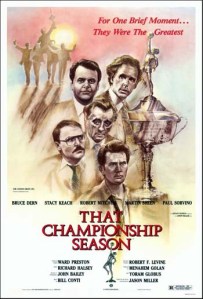 Four former high school basketball players and their coach gather for a reunion in Pennsylvania. Twenty-five years ago, they were state champions. Now, they are all still struggling with the legacy of that championship season. George (Bruce Dern) is the mayor of Scranton and is in a fierce race for reelection. Phil (Paul Sorvino) is a wealthy and corrupt businessman who is having an affair with George’s wife. James (Stacy Keach) is a high school principal who is still struggling to come to terms with his abusive father. James’s younger brother, Tom (Martin Sheen), is an alcoholic who can not hold down a steady job. The Coach (Robert Mitchum) remains the Coach. All four of the men still want his approval, even though they know that he is actually an old bigot who pushed them to cut too many corners on their way to the championship.
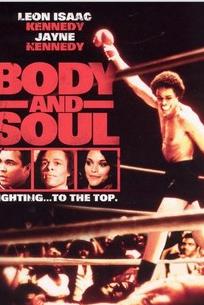 When his little sister falls ill with sickle-cell anemia, Leon Johnson (Leon Isaac Kennedy) has to make a decision. He can either finish his education, graduate from medical school, and treat her as a doctor or he can drop out of school, reinvent himself as “Leon the Lover,” and make a fortune as a professional boxer! At first, Leon’s career goes perfectly. He is winning fights. He is making money. He has a foxy new girlfriend (played Leon Isaac Kennedy’s then-wife, Jayne Kennedy.) But then the fame starts to go to Leon’s head. He forgets where he came from. He’s no longer fighting just to help his sister. Now, he’s fighting for his own personal glory. When Leon finally gets a title shot, a crooked boxing promoter known as Big Man (former JFK in-law Peter Lawford, looking coked up) orders Leon to take a dive. Will Leon intentionally lose the biggest fight of his life or will he stay in the ring and battle Ricardo (Al Denava), a boxer so evil that he literally throws children to the ground? More importantly, will he make his trainer (Muhammad Ali, playing himself!) proud?
 Chuck Norris is J.J. McQuade, Texas Ranger!
 Europe, during World War I. The beautiful dancer, Mata Hari (Sylvia Kristel), is in love with two different soldiers, one German and one French. (The soldiers, played by Olivier Tobias and Christopher Cazenove, are also friends though they are now on opposite sides of the Great War.) Forced into the world of decadent, high class espionage by Frau Doktor (Gaye Brown), Mata Hari sleeps with everyone, shares information with both the Germans and the French, and tries to prevent more people from dying. Just as in history, Mata Hari ultimately has to face a firing squad but not before taking part in threesomes, voyeurism, and a topless sword fight.
 “The family is like a drug and we’re all junkies.” So says Charley Warner (Vincent D’Onofrio), one of the many pissed off people at the center of Crooked Hearts.
 The time is World War II and, for the British, the American army is “overpaid, oversexed, and over here.” David Halloran (Harrison Ford) is a pilot who has been stationed in England. With no loved ones to worry about, David has no fear of flying over occupied France and dropping bombs on the Nazis below. But then David meets an English nurse, Margaret (Lesley-Anne Down). As David falls in love, he loses his enthusiasm for the war because he now has “a reason to live.” The only problem is that Margaret is already married to Paul (Christopher Plummer), an officer in British Intelligence. When David accepts an assignment to fly a British agent into France, he is shocked when the agent turns out to be Paul. When David’s plane crashes, he and Paul have to work together to complete Paul’s mission and escape back to Britain.
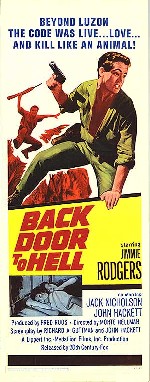 The time is World War II. The place is the Philippines, shortly before the famous return of Douglas MacArthur. Three U.S. soldiers have been sent on a very important mission to knock out a Japanese communication center before the American invasion. Lt. Craig (Jimmie Rodgers) is their leader and he worries that he might not have what it takes to kill a man. Sgt. Jersey (John Hackett) is cynical and tough. Cpl. Burnett (Jack Nicholson) is the radio man with a sarcastic sense of humor. They have been told to meet up with a rebel leader named Miguel but, shortly after arriving, they discover that Miguel has been killed and the new leader is Paco (Conrad Maga), who distrusts the Americans almost as much as he dislikes the Japanese. Meanwhile, a Japanese captain (Joe Sison) threatens to execute all of the children in a nearby village unless the Americans either surrender or are captured.
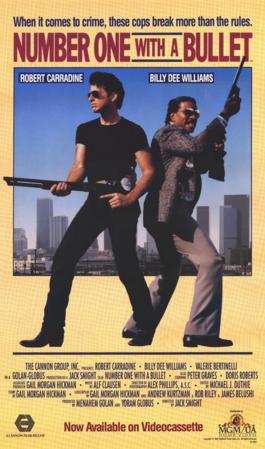 Number One With A Bullet is the story of two cops. Nick Barzack (Robert Carradine) is so crazy that the all criminals have nicknamed “Beserk.” (Who says criminals aren’t clever?) Nick’s partner, Frank Hazeltine (Billy Dee Williams) is so smooth that jazz starts to play whenever he steps into a room. Nick keeps a motorcycle in his living room, wants to get back together with his wife (Valerie Bertinelli), and has an overprotective mother (Doris Roberts). Hazeltine is Billy Dee Williams so all he has to worry about is being the coolest man on Earth. Their captain (Peter Graves!) may want them to do things by the book but Nick and Hazeltine are willing to throw the book out if it means taking down DaCosta, a so-called respectable citizen who they think is actually the city’s biggest drug lord.
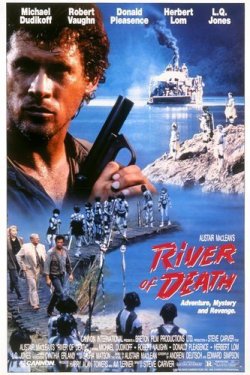 In the Amazon, natives are dying of a mysterious disease. Could it have anything to do with a German war criminal named Wolfgang (played by Robert Vaughn) who is living in a cave that is decorated with a Nazi flag? A scientist (Victor Melleney) and his daughter, Anna (Sarah Maur Thorp), are determined to find out. They hire a tough explorer, John Hamilton (Michael Dudikoff), to lead them up the river but John does not do a very good job because the scientist ends up dead and Anna ends up kidnapped.
 Through the Shattered Lens