I’m back!
Even though it has only been a week since I last did a movie a day, I feel like I’ve been gone forever. Thank you to everyone who commented or messaged me while I was gone. It turned out that I just had a bad sinus infection. It was painful as Hell but, with the help of antibiotics and the greatest care in the world, I’m recovering.
Last week, I asked if anyone had any suggestions for what the 68th movie a day should be. Case suggested Hoosiers and so it shall be.
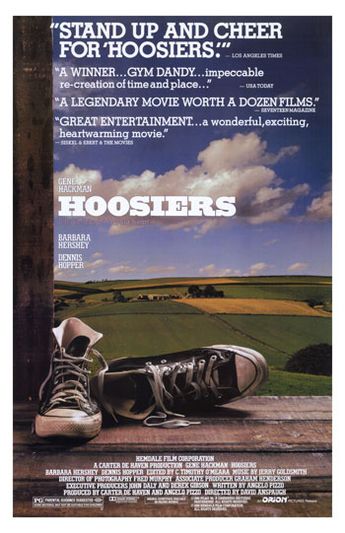 In 1951, Norman Dale (Gene Hackman) arrives in the small Indiana town of Hickory. He is a former college basketball coach who has been hired to coach the high school’s perennially struggling basketball team. Emphasizing the fundamentals and demanding discipline from his players, Dale struggles at first with both the team and the townspeople. When he makes an alcoholic former basketball star named Shooter (Dennis Hopper) an assistant coach, he nearly loses his job. Eventually, though, the Hickory team starts winning and soon, this small town high school is playing for the state championship against highly favored South Bend High School.
For many people, Hoosiers is not just “a basketball movie.” Instead, it is the basketball movie, the movie by which all other sport films are judged. Hoosiers is inspired by a true story. In 1954, small town Milan High School did defeat Muncie for the Indiana State Championship and they did it by two points. Otherwise, Hoosiers is heavily fictionalized and manages to include almost every sports film cliché that has ever existed. How good a coach is Norman Dale, really? Almost every game that Hickory wins is won by only one basket.
Why, then, is Hoosiers a classic? Much of it is due to director David Anspaugh’s attention to period and detail. Some of it is due to Gene Hackman, who gives a tough and unsentimental performance. Whenever Hoosiers starts to cross the line from sentimental to maudlin, Hackman is there to pull it back to reality with a gruff line delivery. Even his romance with the one-note anti-basketball teacher (Barbara Hershey) works. Hickory feels like a real place, with a real history and inhabited by real people.
And then there’s Dennis Hopper. Along with Blue Velvet, Hoosiers was Hopper’s comeback film. After spending twenty years lost in the Hollywood wilderness, better known for abusing drugs and shooting guns than acting, Hopper had just come out of rehab when he was offered the role of Shooter. Amazingly, he turned the role down and told the producers to offer it to his friend, Harry Dean Stanton.
According to Peter L. Winkler’s Dennis Hopper: Portrait of an American Rebel, this is what happened next:
Stanton (who, ironically, was also considered for Hopper’s role in Blue Velvet) called Hopper up and asked, “Aren’t you from Kansas?”
“Yeah.”
“Didn’t you have a hoop on your barn?”
“Yeah.”
“I think you may be the guy that David Anspaugh’s looking for.”
Harry Dean Stanton was right. Dennis Hopper, still very much in recovery, totally inhabited the role of the alcoholic Shooter and gave one of the best performances of his often underrated career. Both Shooter and the actor playing him surprised everyone by doing a good job and Hopper received his only Oscar nomination for acting for his performance in Hoosiers. (He had previously been nominated for co-writing Easy Rider.)
You don’t have to like basketball to enjoy the Hell out of Hoosiers.
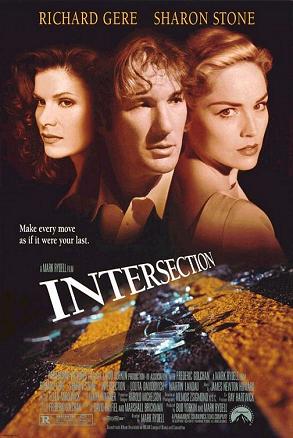
 George O’Brien (Jim Metzler) is a former executive at a San Diego computer company who is driving across Nevada. He is heading to Reno, where he plans to set up a company with the embezzled millions that he has hidden in his trunk. When he spots former Vegas showgirl Patti (Jennifer Rubin) standing on the side of the road, he stops to pick her up. She explains that her car broke down and she needs a lift. George is happy to give her a ride. The only problem is that Patti is traveling with her boyfriend, Chevy (Kyle Secor). At first, Chevy just seems to be a goofy guy who talks too much. However, Chevy is actually a hitman, traveling to Vegas to kill a gangster (Jerry Orbach). After the hit, Chevy abandons George in the desert and steals his car. Determined to get his money, George pursues Chevy and Patty across the desert.
 Monroe (C. Thomas Howell) is a young lawyer who moves to California and gets a job working for his Uncle Max (Terry Kiser). Max wants Monroe to concentrate on evicting beach bums. Monroe wants to play beach volleyball. Together, they solve crimes. No, actually, Max orders Monroe to evict Zack (Peter Horton), a former volleyball champion who was once “king of the beach.” Zack agrees to coach Monroe and his goofball friend, Wiley (Christopher Rydell) in a volleyball tournament. But when Zack misses a match because he is having underlit, PG-13 sex with his ex-wife (Harley Jane Kozak), uncoached Monroe accidentally breaks Wiley’s arm. Now, Zack has to step in as Monroe’s partner and reclaim his status as king of the beach!
 Sometimes, you watch a movie and all you cay say, at the end, is “What the Hell were they thinking?”
 This one is just dumb.
 Edward Furlong is Ron Decker, a spoiled 18 year-old from a rich family who is arrested and sent to prison when he’s caught with a small amount of marijuana. Being younger and smaller than the other prisoners, Ron is soon being targeted by everyone from the prison’s Puerto Rican gang to the sadistic Buck Rowan (Tom Arnold). Fortunately, for Ron, prison veteran Earl Copen (Williem DaFoe) takes him under his wing and provides him with protection. Earl is the philosopher-king of the prison. As he likes to put it, “This is my prison, after all.” If he can stay out of trouble, Ron has a chance to get out early but, with Buck stalking him, that’s not going to be easy.
 Seven strangers are invited to a remote island by a mysterious billionaire named Osiris. There is a doctor, a dancer, an auto mechanic, a mercenary, a football player and his agent, and a member of the Yakuza. The auto mechanic points out that, in Egyptian mythology, Osiris judged mankind’s sins. For some reason, none of the seven think twice about going to the island but, once they arrive, they soon discover that they should have. Osiris is willing to give them seven million dollars but to get it, they have to reach the other end of the island without being killed by Osiris or his men.
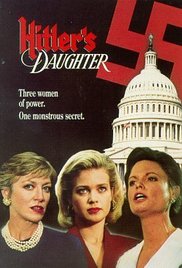 Ted Scott (Patrick Cassidy), a White House press aide, is contacted by his former professor, Dr. Bauman (Donald Davis). Bauman gives Ted a file that he claims will prove that not only did Adolf Hitler have a daughter but she was subsequently smuggled into America and is now on the verge of occupying the White House. Ted thinks that Bauman’s crazy but then Bauman is murdered and Ted is framed for the crime. With both the police and the bad guys after him and with time running out, Ted must now figure out who is Hitler’s daughter. Is it Sharon Franklin (Melody Anderson), the famous TV anchorwoman who is having an affair with a Senator? Is it Patricia Benedict (Veronica Cartwright), the wife of the Vice President? Or is it Senator Leona Crawford Gordon (Kay Lenz), who has just been put on the opposition party’s presidential ticket?
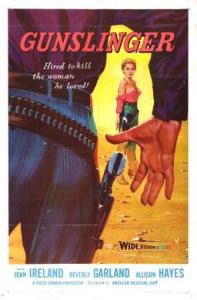 Welcome to Oracle, Texas. It’s a dusty little town in the old west. Marshal Scott Hood (William Schallert) may uphold the law but everyone knows that the town is actually run by Erica (Allison Hayes), the owner of the local saloon. Erica knows that a railroad may be coming to town so she comes up with a plan to buy all the land around Oracle. She sends her lackey, Jake (Jonathan Haze), to each landowner. Jake buys the land then murders the landowner so that he can get the money back.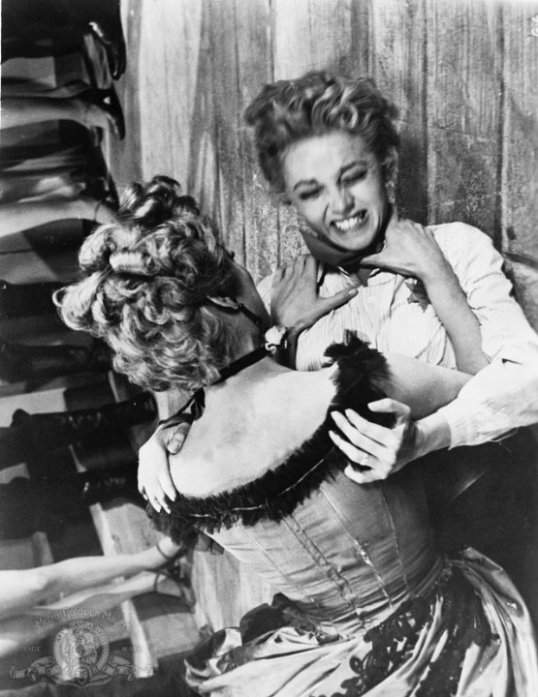
 Through the Shattered Lens