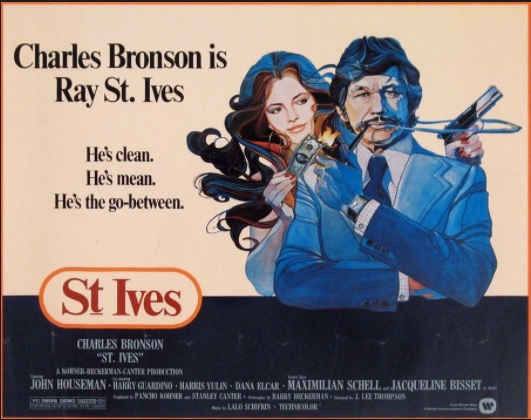
A Movie A Day #174: St. Ives (1976, directed by J. Lee Thompson)


Raymond St. Ives (Charles Bronson) is a former cop-turned-writer who desperately needs money.  Abner Procane (John Houseman) is a wealthy and cultured burglar who needs someone to serve as a go-between.  Five of Procane’s ledgers have been stolen.  The thieves are demanding a ransom and Procane believes that St. Ives is just the man to deliver the money.  But every time that St. Ives tries to deliver the money, another person ends up getting murdered and St. Ives ends up looking more and more like a suspect.  Who is the murderer?  Is it Janet (Jacqueline Bisset), the seductive woman who lives in Procane’s mansion?  Is it Procane’s eccentric psychiatrist (Maximillian Schell)?  Could it be the two cops (Harry Guardino and Harris Yulin) who somehow show up at every murder scene?  Only Ray St. Ives can solve the case!

Charles Bronson is best remembered for playing men of few words, the type who never hesitated to pull the trigger and do what they had to do.  St. Ives was one of the few films in which Bronson got to play a cerebral character.  Ray St. Ives may get into his share of fights but he spends most of the film examining clues and trying to solve a mystery.  The mystery itself is not as important as the quirky people who St. Ives meets while solving it.  St. Ives has a great, only in the 70s type of cast.  Along with those already mentioned, keep an eye out for Robert Englund, Jeff Goldblum, Dana Elcar, Dick O’Neill, Daniel J. Travanti, Micheal Lerner, and Elisha Cook, Jr.  It’s definitely different from the stereotypical Charles Bronson film, which is why it is also one of my favorites of his films.  As this film shows, Bronson was an underrated actor.  In St. Ives, Bronson proves that, not only could he have played Mike Hammer, he could have played Philip Marlowe a well.

St. Ives is historically significant because it was the first Bronson film to be directed by J. Lee Thompson.  Thompson would go on to direct the majority of the films Bronson made for Cannon in 1980s, eventually even taking over the Death Wish franchise from Michael Winner.
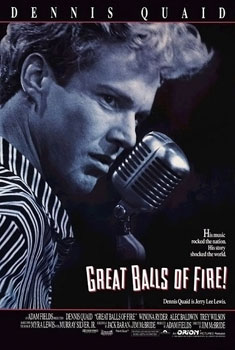
A Movie A Day #173: Great Balls of Fire! (1989, directed by Jim McBride)


In the 1950s, Jerry Lee Lewis (Dennis Quaid) plays what his cousin, Jimmy Swaggart (Alec Baldwin), calls the devil’s music.  After signing a contract with Sam Phillips (Trey Wilson), Jerry becomes a star with his wild man persona and crazed piano playing.  When Elvis is drafted, it appears that Jerry is destined to take over as the new King of Rock and Roll.  But, then, while touring England, the press discovers that Jerry is married to his 13 year-old cousin, Myra (Winona Ryder).  When Jerry refuses to apologize for his private life, his career falls apart.
The real Jerry Lew Lewis has stated many times that he hates this musical biopic and that it has very little in common with his actual life.  Jerry has a point.  Great Balls of Fire is a highly stylized film, one that greatly sanitizes both the life of Jerry Lee Lewis and the early days of rock and roll.  In the film, there’s no struggle or even hard work on the road to becoming a star.  Jerry just drops off a recording of himself playing piano and viola! He’s a star!  Soon, teenagers are dancing around his convertible, both civil rights protestors and white Southern cops start dancing whenever they see him driving down the street, the local radio DJ waves whenever he sees them, and Jerry’s sneaking into Mississippi so that he can marry his thirteen year-old cousin.

Great Balls of Fire! takes a superficially mater of fact approach to Jerry’s marriage to Myra, neither condemning nor excusing, though it does cheat by casting the 18 year-old Winona Ryder as the 13 year-old Myra.  (If the film had cast an actress who was closer to Myra’s actual age, Great Balls of Fire! would never have been released.)  Fortunately, history helped the movie out by making Jimmy Swaggart into Jerry’s main critic.  Alec Baldwin’s performance as Jimmy Swaggart makes his interpretation of Donald Trump look subtle, nuanced, and award-worthy.

Dennis Quaid, at the height of his 80s stardom, is ideally cast as Jerry Lee Lewis, giving a good if broad performance and doing a convincing job lip-syncing to the music.  Quaid has said that he was struggling with an addiction to cocaine while filming Great Balls of Fire! and that might have made him the perfect actor to play the always conflicted and always wild Jerry Lee Lewis.  The best thing about the film is that Jerry Lee Lewis provided the music, re-recording his best known songs.  While the movie may not tell the true story of Jerry Lee Lewis, it does feature enough of his music that it is obvious why Jerry Lee Lewis nearly became the king of rock and roll.


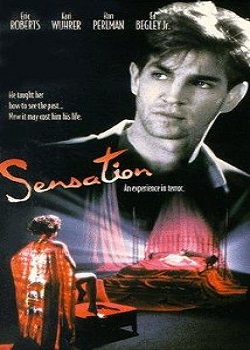
A Movie A Day #172: Sensation (1994, directed by Brian Grant)


Doctor Ian Burton (Eric Roberts) is a college professor who believes that objects retain impressions of the past.  To prove his theory (and hopefully, not lose tenure), Burton recruits one of his students, Lila Reed (Kari Wuhrer), who has shown that she may have psychic abilities.  Lila holds objects and she sees the past.  At first, she is intrigued but then she realizes that she keeps seeing the same woman in her visions.  The woman was a former student of Burton’s.  She was murdered and the good Doctor Burton is the number one suspect.  Can Lila use her power to solve the crime and clear Burton’s name?  Or is Burton guilty and using her for something more sinister than just testing a thesis?
Sensation is one of the many softcore neo-noirs that used to regularly appear, “after hours,” on HBO and Cinemax in the 1990s.  Sensation has a tagline (“An experience in terror”) that it never lives up to but it is still watchable because of the combination of the sexiness of Kari Wuhrer and the strangeness of Eric Roberts.  The tawdry mystery will not fool anyone and Wuhrer’s visions were all done better in The Dead Zone but Sensation deserves some credit for at least trying to be a little more creative than the average 1990s straight-to-video release.

Keep an eye out for Ron Pearlman, as the lead detective on the case.  He does not get to do much but he’s still Ron Pearlman!


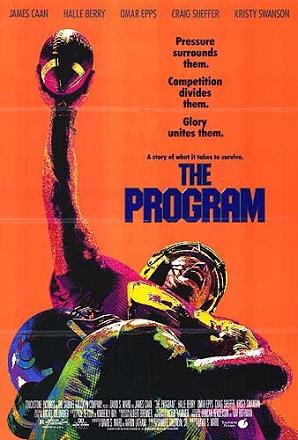
A Movie A Day #171: The Program (1993, directed by David S. Ward)


There’s not a single sports cliché that goes untouched in The Program.
A veteran college football coach who, after two disappointing seasons, is now being told that he must get wins at any cost?  Check!

A cocky senior quarterback who is trying to live up to his father’s expectations?  Check!

A cocky freshman who matures during the season?  Check!

A cocky NFL prospect who suffers a career ending injury?  Check!

Corrupt rich backers?  Check!

Beer?  Check!

Steroids?  Check!

Hazing?  Check!

Football groupies?  Check!

Halle Berry wasted in a one-note role?  Check!

Kristy Swanson as the one girl on campus who is not impressed by football?  Check!  Check!  Check!

The Program has its good points.  James Caan does a good job as the coach and Andrew Bryniarski, playing a player who is always on the verge of flying into roid rage, dominates every scene in which he appears.  Kristy Swanson looks good in a tennis outfit, so it’s not all bad.  But Craig Sheffer is neither credible nor likable as the star quarterback and there is not a single scene that won’t be seen coming.

When The Program came out in 1993, it included a scene where the team bonded by laying down in the middle of a busy street, while cars zoomed by on either side of them.  Things turned out alright for the people in the movie but, for the idiots who tried to imitate the stunt in real life, it was a different story.  It turns out that, in real life, drivers don’t always stay in their lane and, if you lay down in the middle of the street, there is a good chance that you are going to get run over.  After several deaths, the scene was taken out of the film.  If you’re going to die for a movie, do it for a movie better than The Program.

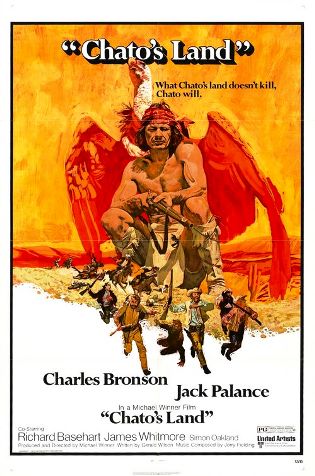
A Movie A Day #170: Chato’s Land (1972, directed by Michael Winner)


Don’t mess with Charles Bronson.

That’s the main lesson that can be taken away from Chato’s Land.  In this western, Bronson plays Chato, an Apache who enters the wrong saloon and is forced to shoot a racist sheriff in self-defense.  Former Confederate Captain Quincey Whitemore (Jack Palance) forms a posse to track Chato down but soon discovers that his posse is not made up of the best and brightest.  Instead, most of them are sadistic racists who just want to kill Apaches.  Despite Whitemore’s efforts to stop them, the posse rapes Chato’s wife and kills his best friend.  Chato trades his white man’s clothes for a loin cloth and sets out for revenge.

Chato’s Land is historically significant because it was the first of many films that Charles Bronson made with Michael Winner.  The most famous Bronson/Winner collaboration was Death Wish, which also featured Charles Bronson as a man who seeks revenge after his wife is raped.  What is surprising about Chato’s Land is how little screen time Bronson actually has.  Most the film is spent with the posse, which is full of familiar faces (Richard Jordan, Simon Oakland, Victor French, Ralph Waite, and James Whitmore all report for duty).  It actually works to the film’s advantage, making Bronson even more intimidating than usual.  There’s never any doubt that Chato is going to kill every member of the posse but since almost every member of the posse is loathsome, that’s not a problem.

It’s possible that Chato’s Land was meant to be an allegory for the Vietnam War, which is probably giving Michael Winner too much credit.  (In an interview, the author of Death Wish, Brian Garfield, once shared an anecdote about Winner inserting a shot of three nuns into Death Wish and bragging about how the shot was meaningless but that it would fool the critics into thinking he was making a grand statement about something.)  Like most of Winner’s films, Chato’s Land is good but not great.  There are parts of the movie that drag and Jack Palance and Charles Bronson don’t get to share any big scenes together, which seems like a missed opportunity.  Bronson, who was always underrated as an actor, gives one of his better performances as Chato.  Chato does not say much but Bronson could do more with one glare than most actors could do with a monologue.  In Europe, Bronson was known as Il Brutto and Chato’s Land features him at his most brutal.

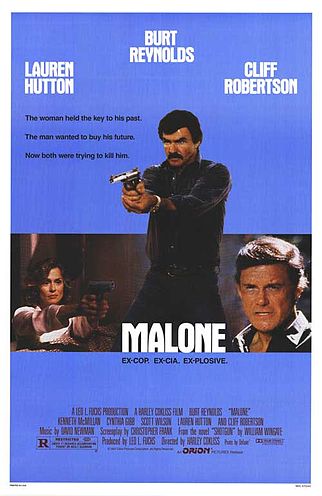
A Movie A Day #169: Malone (1987, directed by Harley Cokeliss)


It’s Burt Reynolds vs. Cliff Robertson.  Cliff has got the money but Burt’s got the mustache and the toupee.
Robertson plays Charles Delaney, a wealthy businessman who, with the help of a mercenary army, has bought nearly all the land in a small Oregon town.  Only the owner of a local gas station, Paul Barlow (Scott Wilson), has refused to sell.  Delaney and his men think that they can intimidate Paul into selling but what they do not realize is that Paul has a houseguest.  Richard Malone (Burt Reynolds) was driving through town when his car broke down.  While waiting for it to get fixed, he has been staying with Paul and his teenage daughter, Jo (Cynthia Gibb).  What no one knows is that Malone used to be an assassin for the CIA.

If ever there was a film that demanded the talents of Charles Bronson, it is Malone.  The tough and ruthless title character would have been a perfect Bronson role, especially if Malone had been made twenty years earlier.  Instead, the role went to Burt Reynolds, who was on the downside of his career as an action hero.  Sometimes, Burt tries to play the role as serious and emotionally guarded.  Then, in other scenes, Burt will suddenly smile and wink at the camera as he briefly turns back into the Bandit.  This is not one of Burt’s better performances.  He gets good support from the entire cast, including Lauren Hutton as his CIA handler, but, in most of his scenes, Burt comes across as being tired and his toupee makes him look like The Brady Bunch‘s Robert Reed.  Burt was 51 when he made Malone and he looked like he was at least ten years older, making the scenes where Jo comes onto him even more improbable.

Where Malone succeeds is in the action scenes.  Along with Burt’s final assault on Delaney’s compound, there is also a classic showdown in a barbershop.  Malone had a budget of ten million dollars.  How many blood squibs did that buy?  Pay close attention to the scene where two hitmen attempt to surprise Malone in his room and find out.

Malone is may not feature Burt at his best but it is still a damn sight better than some of the other films that awaited Burt once his starpower started to diminish.  Mad Dog Time, anyone?

A Movie A Day #168: The Harder They Fall (1956, directed by Mark Robson)


In his final film role, Humphrey Bogart exposes the seamy side of boxing.
Bogart plays Eddie Willis, a washed-up former sportswriter who, because he desperately needs the money, accepts a job offer from crooked boxing promoter, Nick Benko (Rod Steiger).  Eddie is working as a publicist for a South American boxer named Toro (Mike Lane).  Toro is big, strong, and not very bright.  He is not a great boxer but he does not realize that because the Mob has been fixing all of his fights.  After a punch drunk former boxer dies in the ring while fighting Toro, Toro wants to quit and return home to Argentina.  Eddie, who has grown sympathetic to Toro, convinces Toro to fight one last time, against the world champion, Buddy Brannen (Max Baer).  Eddie tells Toro that he does not have a chance of winning but at least he will be able to return home with money for his parents.  However, Benko has other plans for Toro’s money.

Bogart was visibly dying of cancer when he made this tough and uncompromising expose of the racket behind the fight game.  This was his final performance but it is also one of his best.  Even sick and more weary than usual, Bogart could still summon up righteous fury at the type of men that would exploit a fighter like Toro.  His scenes with Rod Steiger are charged with intensity, with Bogart’s film star charisma colliding with Steiger’s stylized method acting.  Both on-screen and 0ff, Humphrey Bogart was an actor who always stood up for the little guy.  Though the film itself may be predictable and Toro is sometimes too saintly to be believed, The Harder They Fall is still a proper finale to an important and distinguished career.

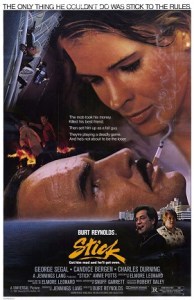
A Movie A Day #167: Stick (1985, directed by Burt Reynolds)


Stick (Burt Reynolds) is a veteran car thief who has just gotten out of prison.  No sooner has Stick arrived home in Florida then he accompanies his friend, Rainy (Jose Perez), on a drug deal that goes bad.  When Rainy is killed, Stick goes into hiding.  He manages to get a stable job, working as a chauffeur for an eccentric millionaire (George Segal).  He gets a new girlfriend (Candice Bergen) and starts to bond with his teenage daughter (Tricia Leigh Fisher).  Stick wants to go straight but, before he can, he knows that he has to confront the men who murdered Rainy.
Stick starts out strong.  The first half of the film finds Burt, who was often as underrated as a director as he was as an actor, in pure Sharky’s Machine mode, mixing the steamy Florida atmosphere with quirky character comedy and hardboiled action.  Adapting his own novel, Elmore Leonard wrote the screenplay and Stick seems like a classic Leonard hero, a criminal with his own moral code.  

But then Stick falls apart during the second half and it becomes obvious why both Reynolds and Leonard often cited this film as being one of the biggest disappointments of their careers.  Universal Studios disliked Burt’s first cut of the film and brought in a second screenwriter, who beefed up the action scenes and added the subplot with Stick’s teenage daughter.  Reynolds reshot the second half of the movie, no longer playing Stick as a tough criminal but instead as another variation on the Bandit.  The end result is a very disjointed movie, with Burt looking bored.

It does not help that the movie’s main villain is played by Charles Durning, who wears an orange fright wig and several Hawaiian shirts.  Durning was an actor who gave many great performances but never was he as miscast as when he played a drug dealer in Stick.

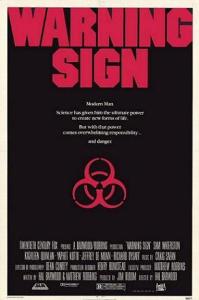
A Movie A Day #166: Warning Sign (1985, directed by Hal Barwood)


The world might end, again.

There is a laboratory in the middle of the desert.  While everyone thinks that the lab is developing pesticides, it is actually a secret government facility where the scientists have developed a chemical that will turn anyone exposed to it into a homicidal maniac.  While the scientists are celebrating the success of their project, Dr. Tom Schmidt (G.W. Bailey — yes, Captain Harris from the Police Academy movies) steps on a vial and releases the chemical.  The lab locks down and the army (led by Yaphet Kotto) arrives.  The government wants to let the scientists kill each other off but a pregnant security guard (Kathleen Quinlan) is also trapped in the lab and her husband, the county sheriff (Sam Waterston), is determined to get her out.

Warning Sign was blandly directed by Hal Barwood, a longtime associate of both George Lucas and Steven Spielberg.  (Barwood wrote the script for Spielberg’s The Sugarland Express and designed the title sequence for Lucas’s THX 1138.)  Barwood tried to take a very Spielbergian approach to Warning Sign, a mistake because successfully imitating Spielberg is easier said than done.  Replace the shark with germs and the ocean with a lab on lock down and Warning Sign is  like Jaws, without any of the suspense or humor.  Sam Waterston’s germaphobic sheriff feels like a knock off of Roy Scheider’s aquaphobic police chief while Jeffrey DeMunn, as an alcoholic scientist, stands in for both Richard Dreyfuss and Robert Shaw.    With the violence and the gore kept to a minimum, this is one of the most tasteful zombie films ever made.  Just compare it to George Romero’s The Crazies (or even the remake) to see how needlessly safe Warning Sign is.

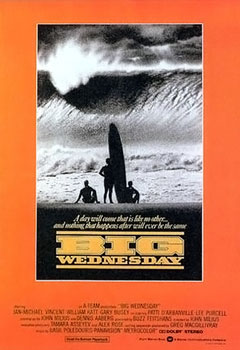
A Movie A Day #165: Big Wednesday (1978, directed by John Milius)


If there is a male bonding hall of fame, Big Wednesday has to be front and center.
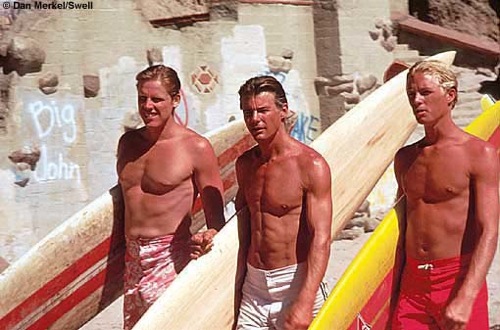
This episodic movie follows three legendary surfers over twelve years of change and turmoil.  Jack Barlowe (William Katt) is the straight arrow who keeps the peace.  Leroy “The Masochist” Smith (Gary Busey) is the wild man.  Matt Johnson (Jan-Michael Vincent) is the best surfer of them all but he resents both his fame and the expectation that he should be some sort of role model for the younger kids on the beach.  From 1962 until 1974, the three of them learn about love and responsibility while dealing with cultural turmoil (including, of course, the Vietnam War) and waiting for that one legendary wave.

After writing the screenplays for Dirty Harry and Apocalypse Now and directing The Wind and The Lion and Dillinger, John Milius finally got to make his dream project.  Big Wednesday was based on Milius’s own youth as a California surfer and he has said that all three of the main characters were based on different aspects of his own personality.  Expectations for Big Wednesday were so high that Milius’s friends, George Lucas and Steven Spielberg, exchanged percentages points for Star Wars and Close Encounters of  The Third Kind for a point of Big Wednesday.  The deal turned out to be worth millions to Milius but nothing to Lucas and Spielberg because Big Wednesday was a notorious box office flop.  Warner Bros. sold the film as a raunchy comedy, leaving audiences surprised to discover that Big Wednesday was actually, in Milius’s words, a “coming-of-age story with Arthurian overtones.”

I can understand why Big Wednesday may not be for everyone but it is one of my favorite movies.  It is one of the ultimate guy films.  Some of the dialogue and the narration may be overwrought but so are most guys, especially when they’re the same age as the surfers in Big Wednesday.  We all like to imagine that we are heroes in some sort of epic adventure.  The surfing footage is amazing but it is not necessary to be a surfer to relate to the film’s coming-of-age story or its celebration of the enduring bonds of friendship.  Katt, Vincent, and Busey all give great performances.  Considering their later careers, it is good that Big Wednesday is around to remind us of what Gary Busey and Jan-Michael Vincent were capable of at their best, before their promising careers were derailed by drugs and mental illness.  Be sure to also keep an eye out for infamous 70s character actor Joe Spinell as an army psychiatrist, a pre-Nightmare on Elm Street Robert Englund, playing a fellow surfer and providing the film’s narration, and Barbara Hale, playing the patient mother of her real-life son, William Katt.

One final note: At a time when the shameful stereotype of the psycho Vietnam vet was becoming popular and unfairly tarnishing the reputation of real-life vets, Big Wednesday was unique for featuring a character who not only joins the Army but who appears to return as a better person as a result.