 1930s. New York City. For years, Stephanie St. Clair (Cicely Tyson) has been the benevolent queen of the Harlem underworld, running a successful numbers game and protecting her community from outsiders. However, psychotic crime boss Dutch Schultz (Tim Roth) is determined to move into Harlem and take over the rackets for himself. With the weary support of Lucky Luciano (Andy Garcia), Schultz thinks that he is unstoppable but he did not count on the intervention of Bumpy Johnson (Laurence Fishburne). Just paroled from Sing Sing, Bumpy is determined to do whatever has to be done to keep Schultz out of Harlem.
When I reviewed The Cotton Club yesterday, I knew that I would have to do Hoodlum today. Hoodlum and The Cotton Club are based on the same historic events and both of them feature Laurence Fishburne in the role of Bumpy Johnson. Of the two, Hoodlum is the more straightforward film, without any of the operatic flourishes that Coppola brought to The Cotton Club. Fisburne is surprisingly dull as Bumpy Johnson but Tim Roth goes all in as Dutch Schultz and Andy Garcia is memorably oily as the Machiavellian Luciano. Hoodlum is about forty minutes too long but the gangster action scenes are staged well. Bumpy Johnson lived a fascinating life and it is unfortunate that no film has yet to really do him justice, though Clarence Williams III came close with his brief cameo in American Gangster. (Interestingly enough, Williams is also in Hoodlum, playing one of Shultz’s lieutenants.)
One final note: Hoodlum features William Atherton in the role of District Attorney Thomas E. Dewey. Atherton plays Dewey as being a corrupt and sleazy politician on Luciano’s payroll. In real life, Dewey was known for being so honest that Dutch Schultz actually put a contract out on his life after he discovered that Dewey could not be bribed. I am not sure why Hoodlum decided to slander the subject of one of America’s most famous headlines but it seems unnecessary.

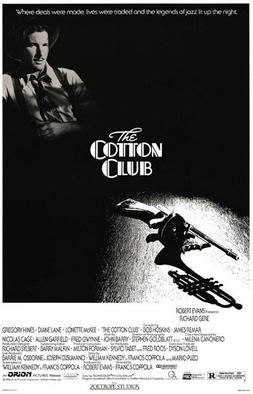 The time is the 1930s and the place is New York City. Everyone wants to get into the Cotton Club. Owned by British gangster Owney Madden (Bob Hoskins), the Cotton Club is a place where the stage is exclusively reserved for black performers and the audience is exclusively rich and white. Everyone from gangsters to film stars comes to the Cotton Club.
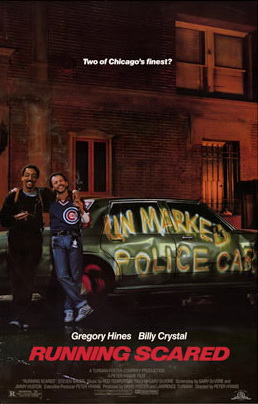 Running Scared is weird but good.
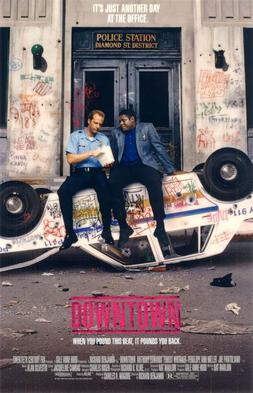 Alex (Anthony Edwards) is a patrolman assigned to the nicest neighborhood in Philadelphia but, after he gets in trouble for pulling over a wealthy businessman (David Clennon), he is told that he can either be suspended or he can take a transfer downtown, to the Diamond Street precinct. Alex takes the transfer, even though everyone on the force says that “not even the Terminator would go to Diamond Street.” Alex gets assigned to work with seasoned Sgt. Dennis Curren (Forest Whitaker), who is still emotionally scarred by the death of his former partner and does not want to have to babysit a naive white cop from the suburbs, especially one who is obsessed with the Beach Boys. At first, Alex struggles with his new assignment and his new partner but, when an old friend is murdered by a notorious hitman (Joe Pantoliano), Alex is determined to crack the case and bring the killer to justice.
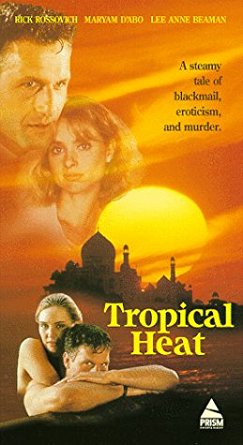 In India, a maharaja is killed when an elephant steps on him. His widow, an American named Beverly (Maryam d’Abo) stands to receive five million dollars but the life insurance company wants to make sure that the maharajah is actually dead before paying. Luckily, insurance exec Carolyn (Lee Anne Beaman) knows the world’s stupidest private investigator, a man named Gravis (Rick Rossovich). Gravis is busy house sitting a friend’s mansion and says he does not want to go to India but, after having sex with Carolyn in the pool, he changes his mind. Once he arrives, he casually investigates the maharaja’s death whenever he is not busy having sex with Beverly. During the course of his “investigation,” Gravis meets a young Indian woman (Asha Siewkumar), who thinks that there is more to the maharjah’s death than just a rogue elephant. Gravis has sex with her, too. Eventually, the movie runs out of people for Gravis to have sex with and it ends.
 Dr. Judd Stevens (Roger Moore) is a mild-mannered Chicago psychologist who has never been in any trouble, so why has one of his patients and his receptionist been murdered? Lt. McGreavy (Rod Steiger), who has a personal grudge against Stevens, thinks that the doctor himself might be responsible. Dr. Stevens thinks that the first murder was a case of mistaken identity and that he is being targeted for assassination. Detective Angeli (Elliott Gould) says that he is willing to consider Stevens’s theory but can Stevens trust him? Or should Dr. Stevens put his trust in a veteran P.I. (Art Carney) or maybe even his newest patient (Anne Archer)?
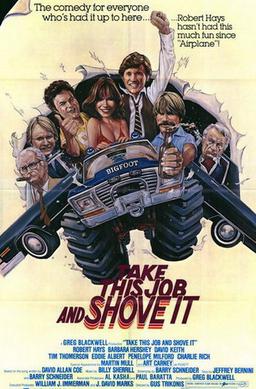 Originally from a small town in Iowa, Frank Macklin (Robert Hays) is a hotshot young executive with The Ellison Group. When Frank is assigned to manage and revitalize a failing brewery in his hometown, it is a chance for Frank to rediscover his roots. His childhood friends (played by actors like David Keith, Tim Thomerson, and Art Carney) may no longer trust him now that Frank wears a tie but it only takes a few monster truck rallies and a football game in a bar for Frank to show that he is still one of them. However, Frank discovers that the only reason that he was sent to make the brewery profitable was so that his bosses could sell it to a buffoonish millionaire who doesn’t know the first thing about how to run a business. Will Frank stand by while his bosses screw over the hardworking men and women of the heartland? Or will he say, “You can take this job and shove it?”
 Old west outlaw Frank Calder (Oliver Reed) wants to learn how to read so he and his gang ride into the nearby town and kidnap Melissa Ruger (Candice Bergen). Because he saw her reading to a group of children, Calder assumed that Melissa was a school teacher. Instead, Melissa is the wife of a brutal cattle baron and hunter named Brandt Ruger (Gene Hackman). Even after Calder learns the truth about Melissa’s identity, he keeps it a secret from his gang because he knows that they would kill her and then kill him as punishment for kidnapping the wife of a man as powerful as Brandt. Stockholm Syndrome kicks in and Melissa starts to fall in love with Calder. Meanwhile, Brandt learns that his wife has been kidnapped and, with a group of equally brutal friends, he sets out to get her back. In Brandt’s opinion, Calder has stolen his personal property. Using a powerful and newly designed rifle, Brandt kills Calder’s men one-by-one until there is a final, bloody confrontation in the desert.
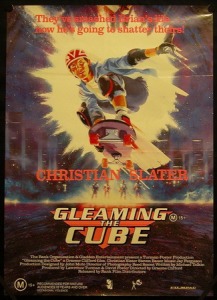 Brian Kelly (Christian Slater) is a California skater with a rebellious attitude and an adopted Vietnamese brother named Vinh (Art Chudabala). When the movie starts, all Brian cares about is not selling out and finding empty pools to skate. He even hires an airplane to fly him and his friends over Orange County so they can get a bird’s-eye view of the layout. Vinh is more worried about his job with the Vietnamese Anti-Community Relief Fund. The fund has been set up to send medical supplies to Vietnam but, when Vinh comes across a discrepancy in the shipping records, he realizes that something else is going on. When Vinh turns up dead in a hotel room, everyone else may believe that it is suicide but Brian knows that his brother was murdered. With the help of his fellow skaters and a sympathetic cop (Steven Bauer), Brian sets out to bring his brother’s killers to justice.
 Cory Webster (a young Josh Brolin, who looks identical to older Josh Brolin) is an amateur skateboarder from the Valley who hopes to win a downhill competition and score some sweet corporate sponsorship. Chrissy (Pamela Gidley) is an innocent blonde from Indiana who is staying with her brother in Venice Beach. Cory and Chrissy are in love but there is only one problem. Chrissy’s brother is Tommy Hook (Robert Rusler), leader of The Daggers, a punk skateboard gang. There’s no way Hook is going to let his sister go out with someone from the Valley.
 Through the Shattered Lens