(As some of you may have noticed, I shared this movie last year as well. I figured I might as well post it again this year. Plus, it’s Boris Karloff, Jack Nicholson, and Dick Miller! Why not post it again?)
Have you ever woken up and thought to yourself, “I’d love to see a movie where a youngish Jack Nicholson played a French soldier who, while searching for a mysterious woman, comes across a castle that’s inhabited by both Dick Miller and Boris Karloff?”
Of course you have! Who hasn’t?
Well, fortunately, it’s YouTube to the rescue. In Roger Corman’s 1963 film The Terror, Jack Nicholson is the least believable 19th century French soldier ever. However, it’s still interesting to watch him before he became a cinematic icon. (Judging from his performance here and in Cry Baby Killer, Jack was not a natural-born actor.) Boris Karloff is, as usual, great and familiar Corman actor Dick Miller gets a much larger role than usual. Pay attention to the actress playing the mysterious woman. That’s Sandra Knight who, at the time of filming, was married to Jack Nicholson.
Reportedly, The Terror was one of those films that Corman made because he still had the sets from his much more acclaimed film version of The Raven. The script was never finished, the story was made up as filming moved alone, and no less than five directors shot different parts of this 81 minute movie. Among the directors: Roger Corman, Jack Hill, Monte Hellman, Francis Ford Coppola, and even Jack Nicholson himself! Perhaps not surprisingly, the final film is a total mess but it does have some historical value.
(In typical Corman fashion, scenes from The Terror were later used in the 1968 film, Targets.)
Have you ever woken up and thought to yourself, “I’d love to see a movie where a youngish Jack Nicholson played a French soldier who, while searching for a mysterious woman, comes across a castle that’s inhabited by both Dick Miller and Boris Karloff?”
Of course you have! Who hasn’t?
Well, fortunately, it’s YouTube to the rescue. In Roger Corman’s 1963 film The Terror, Jack Nicholson is the least believable 19th century French soldier ever. However, it’s still interesting to watch him before he became a cinematic icon. (Judging from his performance here and in Cry Baby Killer, Jack was not a natural-born actor.) Boris Karloff is, as usual, great and familiar Corman actor Dick Miller gets a much larger role than usual. Pay attention to the actress playing the mysterious woman. That’s Sandra Knight who, at the time of filming, was married to Jack Nicholson.
Reportedly, The Terror was one of those films that Corman made because he still had the sets from his much more acclaimed film version of The Raven. The script was never finished, the story was made up as filming moved alone, and no less than five directors shot different parts of this 81 minute movie. Among the directors: Roger Corman, Jack Hill, Monte Hellman, Francis Ford Coppola, and even Jack Nicholson himself! Perhaps not surprisingly, the final film is a total mess but it does have some historical value.
(In typical Corman fashion, scenes from The Terror were later used in the 1968 film, Targets.)
Time to reach deep inside that trick-or-treat bag and take a look at what’s stuck deep in the corners. Just when you thought it was safe, here’s five more thrilling tales of terror:
YOU’LL FIND OUT (RKO 1940; D: David Butler) – Kay Kyser and his College of Musical Knowledge, for those of you unfamiliar…
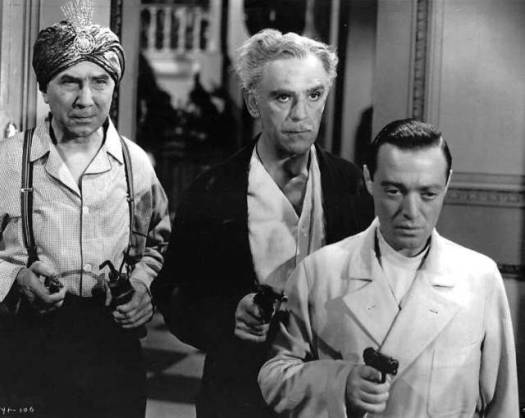
…were a Swing Era band of the 30’s & 40’s who combined music with cornball humor on their popular weekly radio program. RKO signed them to a movie contract and gave them this silly but entertaining “old dark house” comedy, teaming Kay and the band (featuring Ginny Simms, Harry Babbitt, Sully Mason, and the immortal Ish Kabibble!) with horror greats Boris Karloff , Bela Lugosi , and Peter Lorre . It’s got all the prerequisites: secret passageways, a creepy séance, and of course that old stand-by, the dark and stormy night! The plot has Kyser’s…
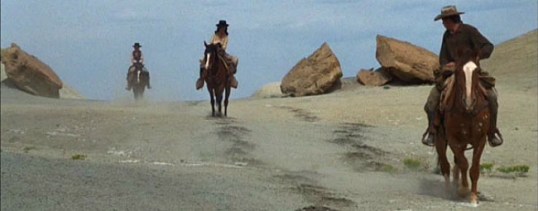
Three cowboys — Vern (Cameron Mitchell), Wes (Jack Nicholson), and Otis (Tom Filer) — are riding their horses across the old west when they come upon a cabin that is inhabited by one-eyed Blind Dick (Harry Dean Stanton) and his friends. Though they suspect that Dick may be an outlaw, the cowboys accept his offer to stay the night. The next morning, they wake up to discover that they are surrounded by a posse. Mistaken for members of Dick’s gang, Vern and Wes go on the run. Eventually, they find themselves hiding out at the home of Evan (George Mitchell), Catherine (Katherine Squire), and their daughter, Abigail (Millie Perkins). While Wes and Vern wait for their chance to escape, the posse grows closer and closer.
A minimalistic western with a fatalistic outlook, Ride In The Whirlwind is today best known for being a pre-Easy Rider credit for Jack Nicholson. Nicholson not only co-produced the film but he also wrote the script. With that in mind, it’s not surprising that Nicholson not only gets the best lines but that he also comes close to getting the girl. Of all the roles that Nicholson played before his star-making turn in Easy Rider, Wes probably comes the closest to being what would be considered to be a typical Jack Nicholson role. Wes is sarcastic, quick with a quip, and alienated by mainstream society (represented here by the relentless posse). Nicholson gives a confident performance and it is interesting to see him co-starring with some of the same actors, like Harry Dean Stanton, who would continue to be associated with him once he became a star. Though the film may be dominated by Nicholson, Stanton also makes a strong impression and comes close to stealing the whole movie.
(Also of note is an early appearance by Rupert Crosse. Years later, Crosse was set to co-star with Nicholson in The Last Detail but his early death led to Otis Young being cast in the role.)
With its dark outlook and anti-establishment theme, Ride In The Whirlwind was before its time and it struggled at the American box office. (According to Monte Hellman, it was very popular in France.) It would be another three years before American culture would catch up with Nicholson’s anti-establishment persona and Easy Rider would make him a star.
The time is World War II. The place is the Philippines, shortly before the famous return of Douglas MacArthur. Three U.S. soldiers have been sent on a very important mission to knock out a Japanese communication center before the American invasion. Lt. Craig (Jimmie Rodgers) is their leader and he worries that he might not have what it takes to kill a man. Sgt. Jersey (John Hackett) is cynical and tough. Cpl. Burnett (Jack Nicholson) is the radio man with a sarcastic sense of humor. They have been told to meet up with a rebel leader named Miguel but, shortly after arriving, they discover that Miguel has been killed and the new leader is Paco (Conrad Maga), who distrusts the Americans almost as much as he dislikes the Japanese. Meanwhile, a Japanese captain (Joe Sison) threatens to execute all of the children in a nearby village unless the Americans either surrender or are captured.
The main reason that most people will probably want to see this low-budget, black-and-white war film is because it features a youngish Jack Nicholson in a supporting role. (It was one of two films that a pre-stardom Nicholson made in the Philippines with director Monte Hellman.) This is one of the best of Nicholson’s pre-Easy Rider performances, with none of the stiffness that’s evident in most of his early work. Nicholson is relaxed and there are even a few hints of the persona that would eventually make him famous.
This was not just an early role for Nicholson. This movie was also an early work of Monte Hellman’s, who went on to direct some of the biggest cult films of the 70s. Hellman makes the most of his low-budget, emphasizing character over action and complexity over simple flag-waving. There is a hard edge to Back Door To Hell. When Craig asks Paco to interrogate a Japanese soldier, both the movie and Paco understand that Craig is asking Paco to torture the prisoner, something that Craig cannot do because he is bound by international law. After conducting his interrogation, Paco does not hesitate to call the American out on his hypocrisy, even while ordering the prisoner to be executed. By the end of the movie, the surviving soldiers and rebels are so emotionally drained that they cannot even celebrate the liberation of the Philippines. When someone asks, “What do we do now?,” no one has an answer. Even beyond the presence of Jack Nicholson, Back Door To Hell is an effective and underrated war film.
(As some of you may have noticed, I shared this movie last year as well. However, since the video that I embedded in the previous post was subsequently taken down, I figured I might as well post it again this year. Plus, it’s Boris Karloff, Jack Nicholson, and Dick Miller! Why not post it twice?)
Have you ever woken up and thought to yourself, “I’d love to see a movie where a youngish Jack Nicholson played a French soldier who, while searching for a mysterious woman, comes across a castle that’s inhabited by both Dick Miller and Boris Karloff?”
Of course you have! Who hasn’t?
Well, fortunately, it’s YouTube to the rescue. In Roger Corman’s 1963 film The Terror, Jack Nicholson is the least believable 19th century French soldier ever. However, it’s still interesting to watch him before he became a cinematic icon. (Judging from his performance here and in Cry Baby Killer, Jack was not a natural-born actor.) Boris Karloff is, as usual, great and familiar Corman actor Dick Miller gets a much larger role than usual. Pay attention to the actress playing the mysterious woman. That’s Sandra Knight who, at the time of filming, was married to Jack Nicholson.
Reportedly, The Terror was one of those films that Corman made because he still had the sets from his much more acclaimed film version of The Raven. The script was never finished, the story was made up as filming moved alone, and no less than five directors shot different parts of this 81 minute movie. Among the directors: Roger Corman, Jack Hill, Monte Hellman, Francis Ford Coppola, and even Jack Nicholson himself! Perhaps not surprisingly, the final film is a total mess but it does have some historical value.
(In typical Corman fashion, scenes from The Terror were later used in the 1968 film, Targets.)
Directed by the legendary Monte Hellman, China 9, Liberty 37 is a revisionist take on the western genre. Fabio Testi plays Clayton Drumm, a legendary gunslinger who is about to be hung for murder. At the last minute, men from the railroad company show up and arrange for Clayton be released. They want him to kill a rancher who is refusing to sell his land. Clayton agrees but, before he leaves for his mission, he gives a brief interview to a writer from “out East.” Cleverly, the writer is played by director Sam Peckinpah, to whose films China 9, Liberty 37 clearly owes a huge debt.
After telling the writer that his eastern readers have no idea what the west is truly like, Clayton rides out to the ranch. Along the way, he gets directions from a nude lady (Jenny Agutter) who is swimming in a nearby stream. When Clayton reaches the ranch, he meets his target. Matthew Sebanek (Warren Oates) is himself a former gunslinger who used to kill people for the railroads. From the minute they meet, Matthew knows who Clayton is and why he is there. Both Clayton and Matthew have grown weary of killing and, instead of having the expected gunfight, they instead become fast friends. Matthew allows Clayton to stay at the ranch and introduces him to his wife, Catherine, who it turns out was the same woman who Clayton talked to earlier.
Catherine loves Matthew but resents his rough ways and feels that he treats her like property. One night, she and Clayton go for a nude swim and then make love. When Matthew finds out, he strikes his wife and, in self-defense, she stabs him in the back. Believing Matthew to be dead, she and Clayton go on the run.
Matthew is not dead and, once he’s recovered from being stabbed, he and his brothers set off to track down the two lovers. While Matthew chases after Clayton, he is being pursued by Zeb (Romano Puppo), another gunslinger who has been hired by the railroad to kill both Matthew and Clayton.
As a western, China 9, Liberty 37 is more interested in its characters than in the usual gunfights. There are no traditional heroes or villains and Monte Hellman emphasizes characterization over action. Even while he is relentlessly pursuing Clayton and Catherine, Matthew admits that he does not blame Catherine for leaving him. As for Clayton and Catherine, they are both consumed by guilt over their affair. This is one of the few westerns where the main character often refuses to fire his gun.
As Clayton, Fabio Testi is stiff and inexpressive, but Jenny Agutter and Warren Oates are terrific. Though their films were never as critically or financial successful, Warren Oates and Monte Hellman had as strong of a director/actor partnership as Martin Scorsese and Robert De Niro. China 9, Liberty 37 was the fourth and final movie that Monte Hellman and Warren Oates made together. It was also Oates’s last western before his untimely death in 1982.
Director Monte Hellman is as well-known for the films he did not get to make as for the ones he actually did make. (Originally, Quentin Tarantino wanted Hellman to director Reservoir Dogs. When Tarantino changed his mind and decided to direct it himself, Hellman was relegated to serving as executive producer. A lot of recent film history would be very different if Tarantino and Hellman had stuck to the original plan.) Like a lot of the films that Hellman actually did get to make, China 9, Liberty 37 was only given a sparse theatrical release and was often shown in a heavily edited version. It has only been recently that the full version of China 9, Liberty 37 has started to show up on TCM. It is an interesting revisionist take on the western genre and must see for fans of Monte Hellman, Jenny Agutter, and Warren Oates.
Have you ever woken up and thought to yourself, “I’d love to see a movie where a youngish Jack Nicholson played a French soldier who, while searching for a mysterious woman, comes across a castle that’s inhabited by both Dick Miller and Boris Karloff?”
Of course you have! Who hasn’t?
Well, fortunately, it’s YouTube to the rescue. In Roger Corman’s 1963 film The Terror, Jack Nicholson is the least believable 19th century French soldier ever. However, it’s still interesting to watch him before he became a cinematic icon. (Judging from his performance here and in Cry Baby Killer, Jack was not a natural-born actor.) Boris Karloff is, as usual, great and familiar Corman actor Dick Miller gets a much larger role than usual. Pay attention to the actress playing the mysterious woman. That’s Sandra Knight who, at the time of filming, was married to Jack Nicholson.
Reportedly, The Terror was one of those films that Corman made because he still had the sets from his much more acclaimed film version of The Raven. The script was never finished, the story was made up as filming moved alone, and no less than five directors shot different parts of this 81 minute movie. Among the directors: Roger Corman, Jack Hill, Monte Hellman, Francis Ford Coppola, and even Jack Nicholson himself! Perhaps not surprisingly, the final film is a total mess but it does have some historical value.
(In typical Corman fashion, scenes from The Terror were later used in the 1968 film, Targets.)
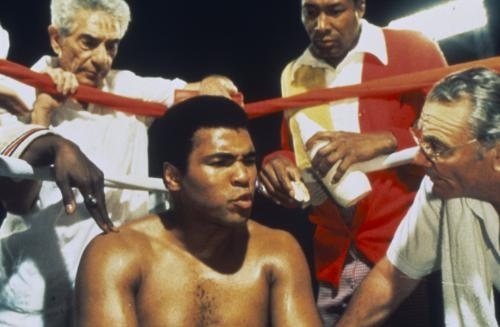
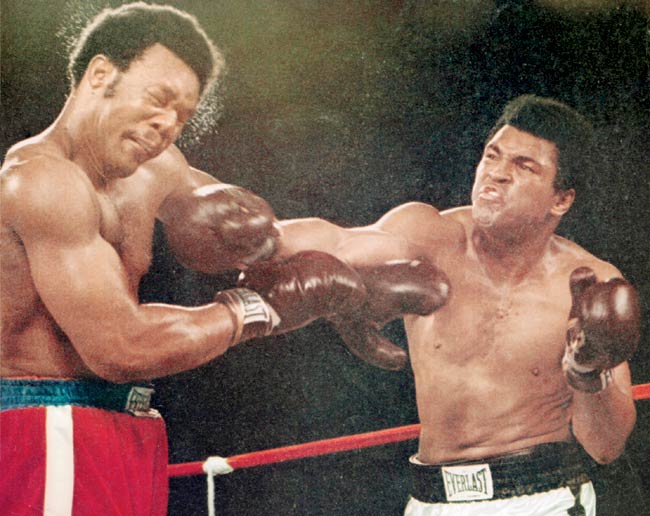
The Greatest opens with 18 year-old Cassius Clay (played by Chip McAllister as a teenager and, as an adult, by Muhammad Ali himself) winning the light heavyweight gold medal at the 1960 Rome Olympics. Returning home to Kentucky, Clay discovers that not even a gold medal can protect him from racism. Angered after a restaurant refuses to serve him and his friend, Clay throws his gold medal into the Ohio River. Under the training of Angelo Dundee (Ernest Borgnine), Clay turns pro and defeats Sonny Liston (Roger E. Mosley) for the heavyweight championship. Inspired by Malcolm X (James Earl Jones), Clay also joins the Nation of Islam and changes his name to Muhammad Ali. As heavyweight champion, Ali battles not only his opponents in the ring but racism outside of it. The Greatest follows Ali as he loses his title for refusing to be drafted and concludes with the famous Rumble in the Jungle, where Ali won the title back from George Foreman.
Sadly, Muhammad Ali has never been the subject of a truly great feature film. Even Michael Mann’s Ali failed to really capture the mystique that made Ali into such an iconic figure. The Greatest is interesting because Ali plays himself. Unfortunately, The Greatest proves that Ali may have been a great showman but he was not a natural actor. You only have to watch the scene where Ali tries to hold his own with Robert Duvall to see just how stiff an actor Muhammad Ali really was. Ali’s best scenes are the ones where he is trash talking his opponents or training. The film opens with Ali jogging while George Benson sings The Greatest Love Of All, a scene that is made all the more poignant when you compare the athletic and confident Muhammad Ali of 1977 with the frail, Parkinson’s stricken Ali of today.
Instead of recreating any of Ali’s legendary fights, The Greatest instead uses actual footage of the matches. The real life footage is the best part of the film. After all these years, Ali’s fights against Sonny Liston, Joe Frazier, Ken Norton, and George Foreman remain exciting to watch. Otherwise, The Greatest is too episodic and low budget to do justice to Muhammad Ali’s story.
If you want to see a truly great film about Ali and his legacy, watch the 1996 documentary When We Were Kings, 2009’s Facing Ali or 2013’s The Trials of Muhammad Ali. Ali is such an iconic figure that it may be impossible for any feature film to properly do justice to his life and legacy. These three documentaries come close.
(Director Tom Gries died during the filming of The Greatest. The movie was completed by Monte Hellman.)
I have to admit that I’m not a huge Western fan. In fact, I can probably count the number of westerns that I’ve actually enjoyed on one hand. However, at the same time, those westerns that I did enjoy also happen to be some of my favorite films of all time. When done poorly, a western can be nearly unwatchable. When done right, however, nothing beats a good western.
Case in point: 1966’s The Shooting.
The Shooting tells the story of Willett Gashade (played by Warren Oates), a former bounty hunter who now makes his living a miner. At the start of the film, he returns to his camp after being gone for several days. At the camp, he discovers one man dead, one man missing, and one sole survivor, the good-natured by simple-minded Coley (Will Hutchins). The panicky Coley explains that the camp was attacked by an unseen gunman and says that it was because the missing man had apparently ridden down “a man and a little person” in a nearby town. How any of this relates to the rest of the film is open to interpretation.
For that matter, the entire film is open to interpretation. That’s one reason why I love it.
The next day, an unnamed, black-clad woman (Millie Perkins) appears at the camp. She hires Gashade and Coley to lead her to a town that lies some distance away, on the other side of an inhospitable desert. Gashade is suspicious of the haughty woman but the far more trusting Coley takes a liking to her immediately.
As Gashade and Coley lead the Woman across the desert, there are hints both obvious and subtle that all is not as it seems. The Woman, at one point, demands to be led in the wrong direction. At another point, the woman suddenly shoots and kills her horse. Eventually, the three of them are joined by Billy Spears (played by a young but already sardonic Jack Nicholson), a well-dressed gunman whose sinister smile does little to hide an obvious sadistic streak and who takes a cruel enjoyment out of taunting and bullying Coley. It all leads to a shockingly violent and deliberately enigmatic conclusion that raises more questions than it answers.
As directed by Monte Hellman (one of the best directors of the 60s and 70s), the film is less concerned with conforming to the rigid expectations of the western genre and, instead, uses the genre as a way to explore the American culture of violence. With its cynical dialogue and its stark imagery of a harsh journey through a seemingly endless desert, it’s little surprise that The Shooting is considered to be an existential western.
Fortunately, The Shooting contains a quartet of fine performances that hold the viewer’s interest, even when the story runs the risk of becoming incoherent. Millie Perkins, who made her film debut playing the title role in 1959’s The Diary of Anne Frank, brings an air of genuine menace to the role of the Woman while Will Hutchins provides the movie with a much-needed heart. The main appeal of the film, of course, is to see two iconic actors performing opposite each other and neither Warren Oates nor Jack Nicholson disappoints. Of the two, Nicholson (who co-produced the film with Hellman) has the showier role and he is obviously having a lot of fun playing such an unrepentant villain. Meanwhile, Warren Oates comes across like a hard-boiled film noir hero who has somehow found himself trapped in a western.
Needless to say, with its deliberately obscure storyline and its refusal to provide a traditional conclusion, The Shooting is not a movie for everyone. However, for those willing to take a chance, The Shooting can be a very rewarding film.


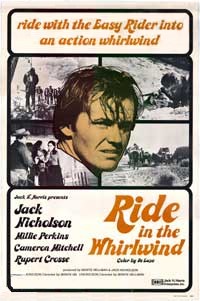 Three cowboys — Vern (Cameron Mitchell), Wes (Jack Nicholson), and Otis (Tom Filer) — are riding their horses across the old west when they come upon a cabin that is inhabited by one-eyed Blind Dick (Harry Dean Stanton) and his friends. Though they suspect that Dick may be an outlaw, the cowboys accept his offer to stay the night. The next morning, they wake up to discover that they are surrounded by a posse. Mistaken for members of Dick’s gang, Vern and Wes go on the run. Eventually, they find themselves hiding out at the home of Evan (George Mitchell), Catherine (Katherine Squire), and their daughter, Abigail (Millie Perkins). While Wes and Vern wait for their chance to escape, the posse grows closer and closer.
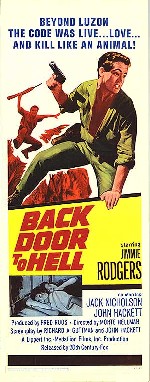 The time is World War II. The place is the Philippines, shortly before the famous return of Douglas MacArthur. Three U.S. soldiers have been sent on a very important mission to knock out a Japanese communication center before the American invasion. Lt. Craig (Jimmie Rodgers) is their leader and he worries that he might not have what it takes to kill a man. Sgt. Jersey (John Hackett) is cynical and tough. Cpl. Burnett (Jack Nicholson) is the radio man with a sarcastic sense of humor. They have been told to meet up with a rebel leader named Miguel but, shortly after arriving, they discover that Miguel has been killed and the new leader is Paco (Conrad Maga), who distrusts the Americans almost as much as he dislikes the Japanese. Meanwhile, a Japanese captain (Joe Sison) threatens to execute all of the children in a nearby village unless the Americans either surrender or are captured.
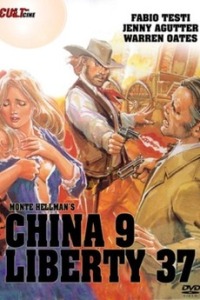 Directed by the legendary Monte Hellman, China 9, Liberty 37 is a revisionist take on the western genre. Fabio Testi plays Clayton Drumm, a legendary gunslinger who is about to be hung for murder. At the last minute, men from the railroad company show up and arrange for Clayton be released. They want him to kill a rancher who is refusing to sell his land. Clayton agrees but, before he leaves for his mission, he gives a brief interview to a writer from “out East.” Cleverly, the writer is played by director Sam Peckinpah, to whose films China 9, Liberty 37 clearly owes a huge debt.
 Catherine loves Matthew but resents his rough ways and feels that he treats her like property. One night, she and Clayton go for a nude swim and then make love. When Matthew finds out, he strikes his wife and, in self-defense, she stabs him in the back. Believing Matthew to be dead, she and Clayton go on the run.
 As a western, China 9, Liberty 37 is more interested in its characters than in the usual gunfights. There are no traditional heroes or villains and Monte Hellman emphasizes characterization over action. Even while he is relentlessly pursuing Clayton and Catherine, Matthew admits that he does not blame Catherine for leaving him. As for Clayton and Catherine, they are both consumed by guilt over their affair. This is one of the few westerns where the main character often refuses to fire his gun.
 Director Monte Hellman is as well-known for the films he did not get to make as for the ones he actually did make. (Originally, Quentin Tarantino wanted Hellman to director Reservoir Dogs. When Tarantino changed his mind and decided to direct it himself, Hellman was relegated to serving as executive producer. A lot of recent film history would be very different if Tarantino and Hellman had stuck to the original plan.) Like a lot of the films that Hellman actually did get to make, China 9, Liberty 37 was only given a sparse theatrical release and was often shown in a heavily edited version. It has only been recently that the full version of China 9, Liberty 37 has started to show up on TCM. It is an interesting revisionist take on the western genre and must see for fans of Monte Hellman, Jenny Agutter, and Warren Oates.
 Through the Shattered Lens