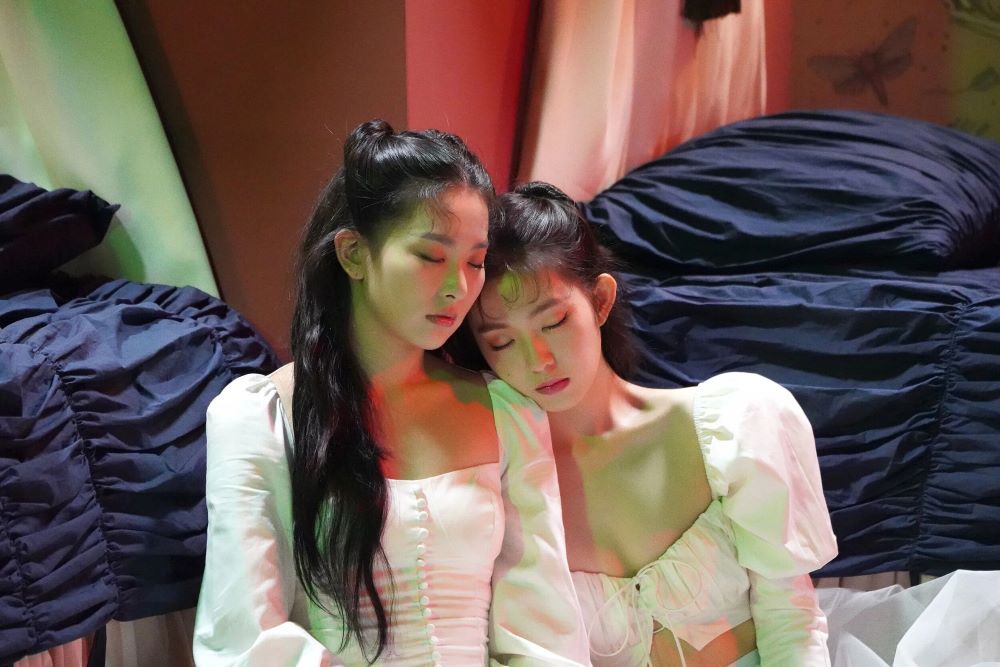
“Monster” by Irene & Seulgi (sub-unit of the K-pop girl group Red Velvet) dives into a dark and captivating space, blending eerie visuals with a sound that really sticks with you. The music video channels the vibe of classic sapphic vampire films, especially those atmospheric, haunting works by Jean Rollin. Irene takes on the role of a succubus-like figure, this hypnotic presence who seems to dominate Seulgi both visually and emotionally. Their movements, cold doll-like expressions, and the green light symbolizing possession all come together to paint a picture of seduction as a form of power struggle, where desire and control are beautifully intertwined.
Sonically, the song pushes boundaries with a mix of dark pop, industrial beats, and dubstep textures. The production is sharp, with synths that cut through like shadows and a bassline that grabs hold and won’t let go. Irene and Seulgi’s vocals glide between whispery softness and fierce intensity, capturing the delicate balance of temptation and danger that drives the song’s energy. The repetitive hook has a spell-like quality, reinforcing the feeling of being caught by this irresistible “monster.”
What really makes “Monster” stand out is how the song and video come together to create a seamless fusion of horror and sensuality. This isn’t just spooky imagery matched with a dark sound—it’s a fully immersive experience that captures the intoxicating mix of fear and desire. The supernatural themes of possession and seduction fit perfectly with the song’s hypnotic beats and evocative vocal delivery. “Monster” tells a story framed in shadows and light, a stylish journey where eroticism and horror enhance each other, pulling the listener deeper into its mesmerizing hold.
Monster
My move is unique Not ordinary 1 2 5 to 7 I’m a dancer in the darkness I’ll crack every joint in my body And come close to your bed I’ll horribly steal your heart And dominate you
Under a single lighting, why are there two shadows? I guess something else woke up inside me I’m a little monster, be scared of me I’m bothering you making you dream only about me I’ll dance and play as I cast a spell On your body in a nightmare I’m a little monster I’m a little monster
I rose from The ashes in the cold ground From dusk to dawn I still exist I don’t hate this madness I’m having fun You can’t get out Don’t run away, you’ll get hurt I save you and tease you again Oh I’m perfect and messed up again
I’m a little monster, be scared of me I’m bothering you making you dream only about me I’ll dance and play as I cast a spell On your body in a nightmare I’m a little monster I’m a little monster
See, I’m just playing No bad intentions I’m small but dangerous Who would refuse me? It’s time for the red sun to rise at dawn Now that you are relieved You try to come out of the dream But monster lives forever
I’m a little monster, be scared of me I’m bothering you making you dream only about me I’ll dance and play as I cast a spell On your body in a nightmare I’m a little monster I’m a little monster I’m a little monster
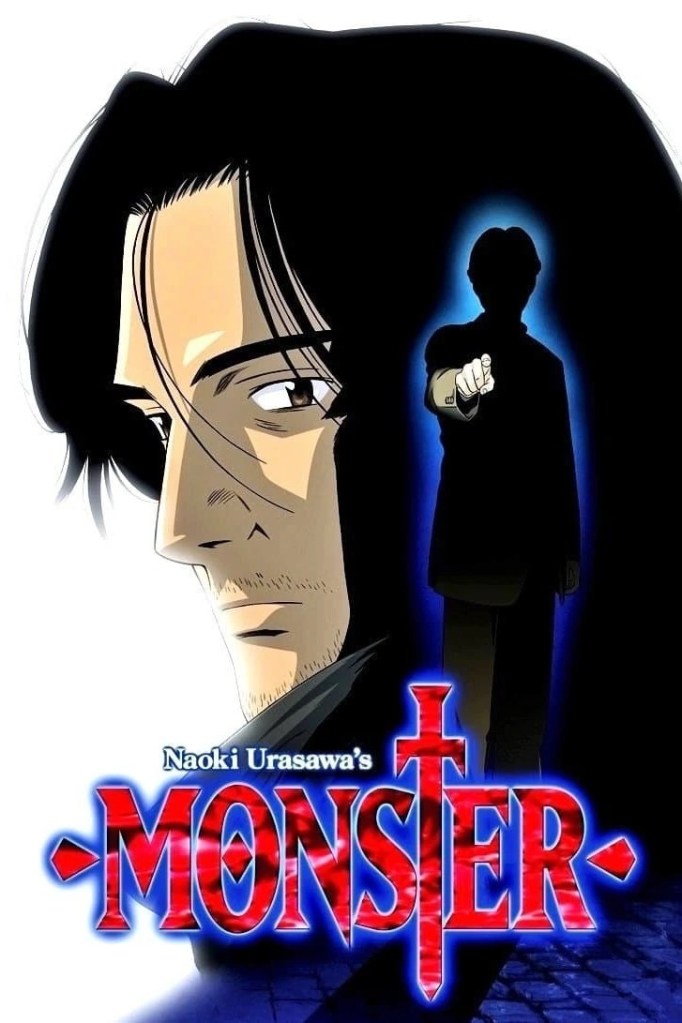
Naoki Urusawa is widely considered one of the great mangaka (comic artist who illustrates and/or writes manga) and some sees him as one of the great storytellers of our time. His work ranges from science fiction (20th Century Boys) to sports (Happy!) and to psychological thriller (MONSTER). It is his foray into the psychological thriller realm that we are here today.
MONSTER was originally published through 18 volumes from December 1998 to December 2001. This is a rarity amongst non-shonen manga which tend to be the type of manga that remains the most popular and non-ending publishing run. Urusawa’s psychological thriller wasn’t initially seen as something that would become popular and well-received when he first approached his editor about the idea for the epic story. Yet, despite his editor’s misgivings, MONSTER gained not just critical-acclaim but a strong following not just from manga readers, but from those who usually do not subscribe to what some would see as just another comic. It is this crossover appeal along all types of readers that would see Urusawa’s dark work sell over 20 million copies sold.
Like all popular manga, MONSTER would get an anime adaptation that ran from early April 2004 and to the series’ finale late September 2005. Just like its manga, the anime series would come to be known as one of the great anime series of the past 25 years. Where some anime adaptations of popular and critically-acclaimed works tend not reach the same level quality, MONSTER avoids the pitfalls of telling such a dense and heavy story by taking on the challenge and letting the series run for as long as it needs to be able to tell a faithful adaptation.
MONSTER the anime I would put up with all the other great live-action thrillers whether film or tv and for the most part would surpass most of them. The sophistication of its execution from the making the complex plot of the story easy to follow without dumbing it down for the general audience and, this is where MONSTER hits the mark, in keeping a steady and pace that neither rushes things or keep scenes last longer than they should before boredom begins to creep in.
Those who are not big on the cutesy and/or the hyper-action of most anime that tend to be popular with the general public, I suggest taking on MONSTER and just see just how mature and sophisticated the medium can be in addition to the rest.
And so, another Cannes film festival has come to a close! Despite my initial predictions and some generally respectful reviews, Ken Loach did not win a third Palme d’Or for The Old Oak so I’m happy about that. Here’s what did win:
COMPETITION
Palme d’Or: “Anatomy of a Fall,” Justine Triet
Grand Prix: “The Zone of Interest,” Jonathan Glazer
Director: Tran Anh Hung, “The Pot au Feu”
Actor: Kōji Yakusho, “Perfect Days”
Actress: Merve Dizdar, “About Dry Grasses”
Jury Prize: “Fallen Leaves,” Aki Kaurismaki
Screenplay: Sakamoto Yûji, “Monster”
OTHER PRIZES
Camera d’Or: “Inside the Yellow Cocoon Shell,” Thien An Pham
Short Films Palme d’Or: “27,” Flóra Anna Buda.
Short Films Special Mention: “Fár,” Gunnur Martinsdóttir Schlüter
Queer Palm: “Monster”
UN CERTAIN REGARD
Un Certain Regard Award: “How to Have Sex,” Molly Manning Walker
Jury Prize: Asmae El Moudir, “Hounds”
Best Director Prize: “The Mother of All Lies,” Asmae El Moudir
Freedom Prize: “Goodbye Julia,” Mohamed Kordofani
Ensemble Prize: “The Buriti Flower,” cast and crew
New Voice Prize: “Omen,” Baloji
DIRECTORS’ FORTNIGHT
Europa Cinemas Label: “Creatura,” Elena Martín
Society of Dramatic Authors and Composers Prize: “A Prince,” Pierre Creton
CRITICS’ WEEK
Grand Prize: “Tiger Stripes,” Amanda Nell Eu
French Touch Prize: “It’s raining in the house,” Paloma Sermon-Daï
GAN Foundation Award for Distribution: Pyramide Films, “Inshallah a boy”
Louis Roederer Foundation Rising Star Award: Jovan Ginić, “Lost Country”
As far as the Oscars are concerned, I think the big winner at Cannes was Martin Scorsese’s Killers of the Flower Moon. Yes, it was screened out of competition but the response to the film was so enthusiastic that it pretty much confirmed that, for now, it’s the Oscar front runner. If nothing else, the response temporarily silenced those who have been insisting that Killers of the FlowerMoon would be a disappointment. (Bizarrely, there’s a whole generation of film commentators who seem to be obsessed with claiming that Scorsese is somehow overrated. I’d hate to think this is all about something as petty as Scorsese’s criticism of the Marvel films but then again, we live in petty times.) I would also keep an eye on Jonathan Glazer’s The Zone of Interest, which many expected would win the Palme but which had to settle for the jury prize. From what I’ve read, Glazer’s film sounds like it could be an Oscar contender.
The initial line-up for the 2023 Cannes Film Festival was announced today. Usually, films are added (and occasionally even withdrawn) after the initial announcement so this list will probably be added to in the days and weeks to come:
COMPETITION:
Club Zero, Jessica Hausner
Asteroid City, Wes Anderson
The Zone of Interest, Jonathan Glazer
Fallen Leaves, Aki Kaurismaki
Les Filles D’Olfa (Four Daughters), Kaouther Ben Hania
Anatomie D’une Chute, Justine Triet
Monster, Kore-eda Hirokazu
Il Sol Dell’Avvenire, Nanni Moretti,
La Chimera, Alice Rohrwacher,
About Dry Grasses, Nuri Bilge Ceylan,
L’Ete Dernier, Catherine Breillat,
The Passion of Dodin Bouffant, Tran Anh Hung,
Rapito, Marco Bellocchio,
May December, Todd Haynes,
Firebrand, Karim Ainouz,
The Old Oak, Ken Loach,
Perfect Days, Wim Wenders,
Banel Et Adama, Ramata-Toulaye Sy,
Jeunesse, Wang Bing,
OUT OF COMPETITION:
Killers of the Flower Moon, Martin Scorsese
The Idol, Sam Levinson
Cobweb, Kim Jee-woon
Indiana Jones and the Dial of Destiny, James Mangold
Jeanne du Barry, Maiwenn
MIDNIGHT SCREENINGS:
Omar la Fraise, Elias Belkeddar
Kennedy,” Anurag Kashyap
Acide, Just Philippot
SPECIAL SCREENINGS:
Retratos Fantasmas (Pictures of Ghosts), Kleber Mendonca Filho
Anselm, Wim Wenders
Occupied City, Steve McQueen
Man in Black, Wang Bing
CANNES PREMIERE:
Le Temps D’Aimer, Katell Quillevere,
Cerrar Los Ojos, Victor Erice,
Bonnard, Pierre et Marthe, Martin Provost,
Kubi, Takeshi Kitano
For Oscar watchers, the big news is probably that both Asteroid City and Killers of The Flower Moon will be premiering at Cannes. Asteroid City is the latest from Wes Anderson and, to be honest, I have my doubts about it as an Oscar contender. The trailer indicates that it’s very, very quirky. While Anderson did receive some Oscar recognition for Grand Budapest Hotel, a good deal of that film’s success was due to Ralph Fiennes’s lead performance. Fieness kept Grand Budapest rooted in a stylized reality. I’m not sure if anyone in the cast of Asteroid City is going to perform the same duty. If Asteroid City is going to become an Oscar contender, a good showing at Cannes would definitely help.
As for Killers of the Flower Moon, it’s being shown out of competition. I can understand the logic. With all of the high expectations that come along with being Martin Scorsese’s latest film (as well as being the first Scorsese film to feature both De Niro and Di Caprio), it’s best not to run the risk of being snubbed by the unpredictable Cannes jury. The last thing anyone wants is for the narrative to shift from “sure-fire contender” to “late career disappointment.”
The Cannes Film Festival runs from May 16th to May 27th!
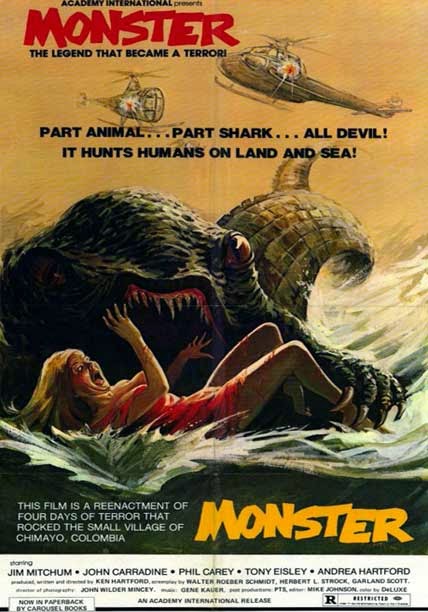
Today, we have a little indie film from 1980. This film was released under several names, including Monster. However, I prefer the title under which it has been included in several Mill Creek box sets: Monstroid: It Came From The Lake!
Monstroid tells the story of what happens when a monster emerges from a lake and starts killing people in Columbia. Superstitious villagers blame a local woman whom they believe to be a witch. Even though the town priest (and no horror fan should be surprised to discover that the priest is played by John Carradine) claims that he can exorcise the evil spirits that have possessed her, the villagers would rather burn her at the stake. Meanwhile, the local Big Evil Corporation has sent in Travis (James Mitchum) to take care of the monster!
And what a monster! Listen, there’s a lot of negative things that I could say about this low-budget film but the monster is simply adorable and must be seen by anyone who appreciates the rubber monsters that populated horror films in the days before CGI.
Plus, how can you resist a film that features not only Robert Mitchum’s son but John Carradine as well?
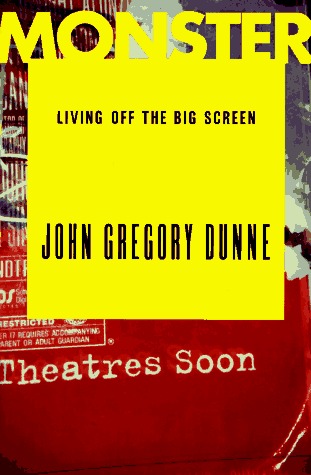
First published in 1997, Monster is a memoir about working in Hollywood. It follows eight years in the life of John Gregory Dunne (who wrote the book) and his wife, Joan Didion. While Dunne (who passed in 2003) and Didion (who passed away a few weeks ago) were best-known as essayists and novelists, they also had a hand in writing a number of films. As such, it shouldn’t be surprising that, along with being a portrait of Hollywood, Monster is also the story of the making of one particular film.
That said, Monster is not the story of the making of a great film.
It’s also not the story of the making of a terrible film.
Instead, it’s the story of the making of a thoroughly mediocre and forgettable film. The film in question is Up Close and Personal, which still pops up on HBO occasionally. Up Close and Personal tells the story of a self-righteous news producer — a gentleman with the laughable name of of Warren Justice — who finds and grooms an aspiring reporter named Tally (Michelle Pfeiffer). While Warren (played by Robert Redford) teaches her how to work the camera and deliver the news, they fall in love. Then Tally’s career skyrockets, Warren’s career goes downhill, and eventually Warren ends up dying. Boo hoo.
Monster tells the story of how Dunne and Didion were originally hired to adapt a biography of Jessica Savitch, a real-life anchorwoman who eventually got hooked on cocaine, who was physically abused by her mentor, and who eventually ended up dying in a car crash. Realizing that real life might be too depressing to generate a hit film, the executives at Disney instead decided that they wanted Dunne and Didion to turn Savitch’s Hellish life story into a sentimental romance. The drug abuse was dropped. Savitch’s death was abandoned. Her abusive boyfriend was transformed into the saintly character of — snicker — Warren Justice.
(Dunne actually devotes a good deal of space to explaining why they named the character Warren Justice. Warren was a good “everyman” name and Dunne was apparently under the belief that Justice was a common surname in the South because he knew someone from Florida whose last name was Justice. The logic is understandable, if flawed. I’ve lived in the South almost my entire life and I’ve never met anyone named Justice. Still, writers of Dunne and Didion’s caliber should have known better than to try to get away with such an easily mocked name.)
For eight years, Dunne and Didion write and rewrite Up Close and Personal and, along the way, a large number of Hollywood figures are attached to the film. Ultimately, it’s directed by a fellow named Jon Avent, who were told has a strong ego. Actually, the entire book is full of people who have strong egos. Scott Rudin, for example, is in the book, demanding that that Dunne and Didion focus on appealing to as wide an audience as possible. “It’s about two movie stars,” Rudin explains when Dunne worries that the film doesn’t actually have anything to say.
While Up Close and Personal is going through the pains of production, Dunne and Didion work on a number of other studio films, few of which come to production and none of which sound like they would have been particularly good had they been produced. Ultimatum is a thriller about a terrorist plot. Dunne and Didion correctly realize that the title needs to be changed to something less generic but their proposed replacement, Ploot, sounds like the title for a film about a flatulent goblin. A bit more intriguing is their attempt to write a serious movie about aliens for the infamous producer Don Simpson. Simpson comes across as being savvy but unfocused, which is actually a pretty good description of just about everyone in the book. The Hollywood of Monster is a town and an industry controlled by former outsiders who are determined to reinvent themselves as tough guys.
And Dunne did a pretty good job of capturing the town. The book is written with a dry wit and, as acidic as many of the passages are, Dunne doesn’t let himself off the hook. He’s as open about his role in the making of a thoroughly forgettable film as he is about everyone else’s role. There’s little concern for art or higher truth to be found in Dunne’s Hollywood. Instead, the entire town is a monster.
It’s a good book and a memorable portrait of the American film industry in the 1990s.
Aileen Wurnos was often described as being America’s first female serial killer.
Wurnos was born in 1956, in Rochester, Michigan. From the start, her life was a mess. Her father was both a diagnosed schizophernic and a sex offender who was incarcerated when Aileen was born and who hung himself in his jail cell when Aileen was 13. (Aileen reportedly never met him.) Aileeen’s mother abandoned her children when Aileen was four, leaving Aileen and her younger brother to be raised by their alcoholic grandparents. Aileen later said that she was regularly beaten by both grandparents and sexually abused by her grandfather. Aileen also said that she spent her youth dreaming of being famous and being loved, like Marilyn Monroe.
By the time she was eleven, Aileen was already having sex in return for food, cigarettes, and drugs. She was pregnant at 14, which she later said was the result of being raped by a friend of her grandfather’s. She gave up her son for adoption and dropped out of school when she was 15, the same year that her grandmother died of live failure. Kicked out of the house shortly afterwards, Aileen survived through sex work and lived a semi-nomadic existence. While other people her age were starting high school and looking forward to the future, Aileen was living in the woods and going for days without food.
Aileen Wurnos and her husband
By 1976, she had hitchhiked her way down to Florida and her life briefly seemed to turn around when she met and married a wealthy 69 year-old man named Lewis Fell. Fell was president of a yacht club and prominent enough that his marriage to Aileen was announced in the society pages. That marriage didn’t last, however. Aileen was arrested and served with a restraining order for reportedly beating Fell in much the same way that she later said her grandfather beat her. They were divorced within weeks and, for the next 13 years, Aileen’s life consisted of one arrest after another. She returned to sex work, hitchhiking on the highways. With her looks fading due to her lifestyle, Aileen resorted to carrying around a picture of her adopted sister’s children, showing it to potential customers and telling them that she needed money so that she could go to Miami and be with them, in an attempt to play on her customer’s sympathy. Wurnos was repeatedly raped and beaten by the men who picked her up. By the time she came to fame, she was suffering from PTSD and, in her own words, hated the world and men especially.
Wurnos shot and killed at least seven men in Florida in 1989 and 1990. At her trial, she claimed that every shooting was self-defense. She said that she had been raped and nearly killed by her first victim, who had previously be arrested for rape. She went on to say that all of her subsequent victims had been planning on raping but sh shot them first. Once she was on death row and waiting to be executed, she changed her story several times and said that only the first of the shootings was in self-defense and that the rest were simple robberies. The men, she explained, picked her up. She took their money and then she shot them because she didn’t want them reporting her to the police. Of course, she then later told documentarian Nick Broomfield that all of the killings actually were self-defense but that she changed her story because she hated Death Row and she was eager to die. There were a lot of stories when it came to Wurnos and determining what was true was often difficult.
That said, while Wurnos was undoubtedly a female serial killer, I doubt that she was our first. It depends on what you consider a serial killer to be, with some FBI profilers claiming that Wurnos was unique in that she eventually grew to enjoy killing and that she set out each night looking for someone to kill. That said, throughout history, there have been stories about women who married and murdered multiple men, the infamous black widows. Between 1884 and 1908, Belle Gunness murdered at least 14 people in Illinois and Minnesota. Working with her boyfriend, Martha Beck murdered an estimated 20 people in the late 40s. If so inclined, one could go all the way back to ancient Rome and read about the poisoner Lucasta, whose victims reportedly included at least one emperor.
So, no, Aileen Wurnos was not the first female serial killer but she was the first one to come to prominence after the term was coined. She was the first well-known female serial killer of the post-Ted Bundy era. And because she also committed her crimes at the dawn of the 24-hour media cycle, she achieved a level of fame that was denied to Gunness, Beck, and even Lucasta. Aileen held press conferences as she waited for her execution date. She made the news by alternatively praising and cursing the people who had arrested her and sent her to Death Row. She yelled at judges and threatened reporters. She was, for lack of a better term, good television. She became an icon to some, a sex worker who turned the tables on the potential killers who picked her up. She was also the subject of two documentaries from Nick Broomfield.
That was how I first found out about her. 2003’s Aileen: Life and Death of a Serial Killer used to air on HBO frequently. The film followed the final days of Wurnos’s life and featured an interview with her in which she went from being surprisingly lucid and articulate to being frighteningly unhinged. While a sympathetic Broomfield tried to get her to discuss the circumstances that led to her committing the murders, Wurnos ranted about how the prison was using “sonic pressure” to control her mind. In 2002, when Wurnos was executed, her last words were to compare herself to the “mother ship” from Independence Day and to promise that she would return. With her wild eyes, rotting teeth, and unpredictable anger, Wurnos was frightening but, at the same time, there were brief moments of clarity where Wurnos seemed to understand the gravity of both what she had done and her current situation.
Charlize Theron as Aileen Wurnos
The same year that Broomfield released his documentary and a year after Wurnos was executed, a film called Monster was released. The feature directorial debut of Petty Jenkins, Monster starred Charlize Theron as Aileen Wurnos. Theron, who also signed on as a co-producer, would win her first Oscar for her performance as Wurnos and, indeed, when the film was first released, the majority of the attention centered on how the glamorous Theron transformed herself into the not-so glamorous Aileen Wurnos. Theron famously gained weight and wore prosthetic teeth in order to resemble Wurnos but, as anyone who has seen Broomfield’s documentaries can tell you, she also captured Wurnos’s odd speech patterns and her jittery physical movements. Theron perfectly recreated Wurnos’s trademark wide smile, which somehow managed to be both vulnerable and menacing at the same time. Theron deserved the praise that she got for her performance and she certainly deserved to win that Oscar. And yet, so much attention was paid to Theron’s performance and her physical transformation, that the overall film itself was a bit overshadowed. Along with being one of the saddest films ever made, Monster is a portrait of life on the fringes and of existence in the shadows of conventional American society.
The film opens with Wurnos siting underneath a highway overpass and staring down at a loaded gun, debating whether or not she should just end it all. Occasionally, she provides narration, discussing how she eventually came to find herself homeless and struggling to survive. Her narration frequently switches from being insightful and darkly comedic to being angry and bitter, often in the same sentence. Deciding not to kill herself, she instead goes to a gay bar when she meets another outsider, Selby Wall (Christina Ricci). Selby awkwardly flirts, telling Aileen that she’s the most beautiful woman in the bar. Aileen replies that she’s “not into women.” (Of course, she also lies and claims that she’s only in the bar because her truck broke down and she’s just waiting for a ride.) Yet, before long, Selby and Aileen are in love.
Selby was a heavily fictionalized version of Aileen’s real girlfriend, who didn’t want to have anything to do with Monster and who requested that her real name not be used in the film. In the film’s reimagining of the story, Selby has been exiled to Florida from Ohio, rejected by her religious father. Selby lives with her homophobic aunt but yearns for escape. That’s what Aileen provides for her and, to an extent, Selby provides the same thing to Aileen. There’s an unexpected sweetness to the early scenes between Aileen and Selby, albeit a sweetness that it continually undercut by the fact that we know we’re watching a movie about a serial killer. We watch as they go roller skating together and as they share their first kiss afterwards. We watch as they run off together and as they get their first place together and yet, at the same time, we also watch as Selby pressures Aileen to continue “hooking” so that Aileen will have enough money to support the two of them. As played by Ricci, Selby is a character about whom many viewers will have mixed feelings. When she first appears, it’s hard not to have sympathy for her. She seems to be a naïve outsider. But, as the film continues, she sometimes reveals herself to be just as manipulative as Aileen. Selby may claim to be shocked when she discovers that Aileen has been killing and robbing the men who pick her up but, just like Aileen, we don’t quite buy it. Selby knew what was going on, even if she wasn’t willing to admit it to herself.
In the film, Aileen’s first murder is presented as having been committed in self-defense. The man is a rapist and a sadist and was clearly planning to kill Aileen once he was done with her. Again, as portrayed in both the film and Wurnos’s version of events, he unquestionably got what he deserved. With one notable exception, Aileen’s subsequent murders are presented a bit more ambiguously. The majority of the men that Aileen meets are threatening, even if she shoots most of them before they get a chance to try anything. One can understand why some felt that the film was a bit too sympathetic to Aileen while, at the same time, also acknowledging that the men who would pick up a hitchhiker and expect sex in return are not exactly going to be the greatest group of guys.
Only Aileen’s final victim is presented as being a sympathetic figure. Played by the great Scott Wilson, he picks up Aileen just to get her out of the rain, refuses her offer of sex, and says that he and his wife would be willing to help her get to wherever she needs to go. He picks Aileen up for her own safety but, when Aileen tries to get out of the car, he sees her gun and Aileen kills him to keep him quiet. It’s a powerful scene, brilliantly acted by both Theron and Wilson and it’s hard to watch. (It’s also debatable whether or not it actually happened, which is the danger when it comes to making a movie about someone like Aileen Wurnos.) It’s this scene that shows how far Wurnos has gone. “You don’t need to do this,” he tells her and Wurnos knows that he’s right but, by this point, she’s beyond going back.
The only other truly and unconditionally kind character in the film is Thomas (Bruce Dern), a former biker who allows Aileen to keep her things in his storage locker and who is perhaps the only character to really care about Aileen as a human being. (Even Selby mostly views Aileen as a way to escape her current life.) Thomas is a Vietnam vet, one who suffers from PTSD and who, as a result, understands Aileen’s anger and mood swings. Dern doesn’t get a lot of screen time but he’s a welcome presence whenever he shows up. In the end, though, Aileen knows that even Thomas’s kindness can’t save her from what’s going to happen.
As I said before, it’s a sad film. It’s always watchable because Theron, Ricci, and Dern all give such good performances but it’s still a film that’ll leave you shaken. It’s a trip to the fringes, the corners of existence where there are no exits beyond death. Those who have criticized the film for taking Wurnos at her word do have a point but, at the same time, Theron is often as frightening as she is sympathetic. The viewer may understand why Wurnos does what she does but they still would not want Wurnos anywhere near them. I imagine that, for every viewer who sympathizes with Wurnos, an equal number will breathe a sigh of relief at the knowledge that Wurnos was subsequently executed by the state of Florida. Myself, I’ve always been against the death penalty, regardless of who is sitting on death row or what their motives may have been. At the same time, I can understand why others support it. It’s a frightening world and the death penalty allows people to feel that there are consequences for committing the worst of crimes.
Monster was a critical and, somewhat surprisingly, a commercial hit. Theron won an Oscar and proved herself to be a serious actress. (One doubts Theron would have ever played Furiosa if she hadn’t first played Aileen Wurnos.) Though Patty Jenkins were struggle to get several other projects going, it wasn’t until 2017 that she would make a second film. That film, of course, would be Wonder Woman, a film that was as joyous as Monster was dark.
Is Meg Myers singing about killing a person or about killing an emotion? I think you can view the song and the video either way. The video is wonderfully atmospheric and, yes, the underwater scenes totally freak me out. Meg Myers is an artist who definitely deserves to be better known.
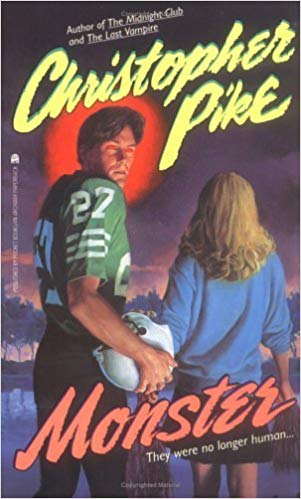
“They were no longer human…” the cover of 1992 first edition of Christopher Pike’s Monster announces and indeed, they’re not! That cover, I should add, makes the book look a lot more light-hearted than it is. It makes it look like it’s some sort of sci-fi comedy about a demonically possessed football player when there’s actually very little about this book that could be considered light-hearted.
This book is dark. Like, seriously, dark.
It opens with popular high school student Mary Carlson walking into a party while carrying a shotgun. She blows away a football player named Todd and then a cheerleader named Kathy and then she points the gun at her own boyfriend, Jim. Fortunately, the new girl at school, Angela, manages to distract Kathy just long enough for Jim to take off running into the woods. Mary goes chasing after him but she gets arrested before she guns him down as well. It’s probably a good thing that Jim survived because, without him, how would the football team ever win another game? After all, the team sucked just last season before all of the players and the cheerleaders suddenly got super strong!
Anyway, Mary says that she was shooting her friends because they were no longer human and, according to her, the three of them have been picking up people and killing them in a warehouse. Police Lt. Nguyen doesn’t believe her but Angela feels a bit of an obligation to investigate Mary’s story. And really, it’s the least she can do considering that she promptly starts flirting with Jim right after Mary’s arrested.
It quickly becomes obvious that something strange has happened to all of the school’s athletes and cheerleaders. Maybe it has something to do with the mysterious crater from which the town gets its drinking water. Angela notices that Jim tends to eat everything in sight, including a raw hamburger. After she and Jim make out and she ends up getting some of his blood on her, she soon finds that she’s eating everything in sight. Is it possible that some sort of monster has not only taken over Jim but is now taking over Angela as well!?
Yes, it is. That’s bad news for Kevin, who is Angela’s BFF and who is totally in love with her even though she only views him as being a very good friend. Oh, poor Kevin! Kevin is one of the few wholly sympathetic characters in the book and he still ends up with a broken neck. Like I said, this book is dark!
It all ends on an appropriately dark note and I guess that’s the important thing. This book was written in 1992 and, at the time it was written, it was probably meant to be a metaphor about the dangers of having unsafe sex, as Angela is infected after fooling around with Jim. Reading it today, though, it feels more like a commentary on just unsafe school has become over the past decade. Mary Carlson, blowing away her friends because they’re “not human,” brings to mind so many recent gun-related tragedies. It’s a bit difficult to read.
Anyway, Monster is a seriously dark book but still an effectively macabre story. Nobody was as skilled at traumatizing young readers as Christopher Pike!
Since this is the first post of the first day of Horrorthon, it just seemed appropriate to select the video of Big Data’s Monster as music video of the day. This wonderfully paranoid video will inspire you to put Alexa back in the box. Or, at the very least, to consider doing it. I mean, could you really live without her? Anyway, this video has a nice sort of Wes Craven/John Carpenter feel to it. Those glowing red eyes are haunting.
It’s a well acted video too and Big Data was kind enough to list the full cast and crew on YouTube. (More artists should do this.) Here they are:
Special thanks to alldayeveryday productions, De Boer Media
EXTRA SPECIAL THANKS to the Gudis Family for their incredible generosity.
As for the rest of October, I can’t guarantee that every music video that we’re going to share this month is going to have a horror theme. To be honest, there aren’t that many good horror-themed music videos out there and we already featured the majority of them over the past two Octobers. I mean, there’s only so many times that we can analyze Number ofthe Beast. Still, we’ll be keeping our eyes open for any good videos we may have missed and, as we do every October, we’ll do our best to keep things properly spooky here at the TSL Bunker!
Enjoy October and get ready for the greatest Horrorthon ever!




 Through the Shattered Lens