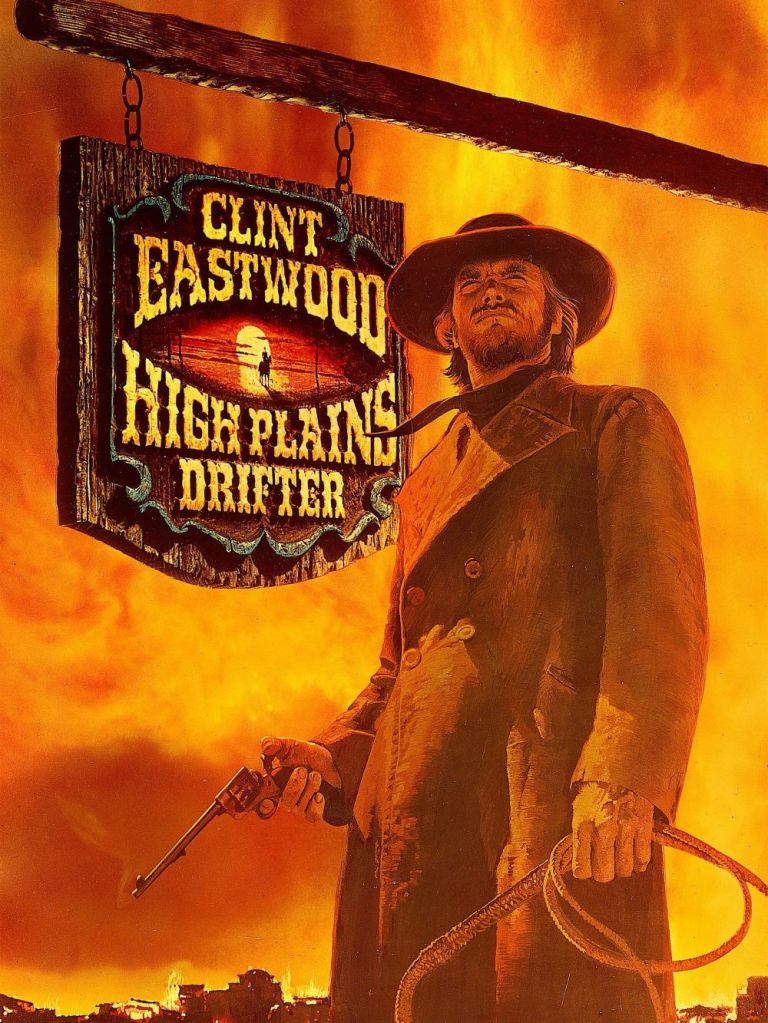
Horror Review: High Plains Drifter (dir. by Clint Eastwood)


“Don’t count on me to make you feel safe.” — The Stranger

High Plains Drifter stands as one of the bleakest, most enigmatic entries in Clint Eastwood’s filmography—a Western that bleeds unmistakably into the realms of psychological and supernatural horror. This 1973 film is not just another dusty tale of lone gunfighters and frontier justice. It’s a nightmare set in broad daylight, a morality play whose hero is more monster than man.

Eastwood’s Stranger comes riding into the town of Lago from the shimmering desert, a silhouette both akin to and apart from his famed Man With No Name persona. The townsfolk are desperate, haunted by fear—less afraid of imminent violence, more of the sins they’ve half-buried. This is a place where a lawman was brutally murdered by outlaws while the townspeople looked away, their silence paid for with cowardice and greed. When the Stranger assumes command, he does so with often-gleeful sadism—kicking people out of their hotel rooms, replacing the mayor and sheriff with the dwarf Mordecai, and ordering that the entire town be painted red before putting “Hell” on its welcome sign.

There’s a surface plot: the Stranger is hired to protect Lago from the same three outlaws who once butchered its marshal. But he’s there for far more than that. The story unspools through dreamlike sequences, flashbacks that suggest the Stranger may well be an avenging spirit or a revenant—the dead lawman, spectral and merciless, returned to claim what the townsfolk owe to Hell itself.

The horror here isn’t about jump scares or gothic haunted houses. The supernatural lurks everywhere and yet nowhere. The Stranger moves with the implacable calm—and violence—of a slasher villain, transforming Lago into his personal stage for retribution. His nightmares, full of images of past atrocities, are painted with the same vivid brutality as the daytime violence. Eastwood’s use of silence, the squint of a face, the twitch of a pistol replaces musical cues in amplifying dread. The sound design evokes otherness—a howling wind, footsteps echoing across empty streets—that builds a shadow of terror around the Stranger’s presence.

This violence is hurried and brutal; its sexual politics unflinching. When the Stranger enacts revenge, he punishes not just the outlaws, but the townsfolk complicit in their crimes. There is little comfort in his sense of justice—the pleasures he takes border on sadistic. The film’s moral ambiguity cuts deeper than most Westerns or horrors: this is not a clear-cut tale of good versus evil, but a brutal reckoning of collective guilt, cowardice, and corruption.

Lago itself acts almost like a town stuck in purgatory—a holding pen between redemption and eternal damnation. The infamous “Welcome to Hell” sign the Stranger paints at the town’s entrance serves as a grim message. It’s no welcome to law and order, but a symbolic beacon to the very outlaws the Stranger is hired to confront, suggesting that Lago is a place where sin festers and punishes itself. The town’s dance with Hell is both literal and metaphorical. The inhabitants aren’t just awaiting judgment; they have invited it in their desperate attempts to hide their cowardice and greed under the guise of civilization.

This notion of Lago as purgatory stands in sharp contrast to other recent horror Westerns, which serve as prime examples of the genre’s thematic spectrum. These films tend to focus on the primal terror of nature barely held at bay by the fragile veneer of civilization the settlers claim. They pit human beings against the ancient, untamed forces of the wilderness—whether monstrous creatures or surreal phenomena—emphasizing that the supposed order and progress of the West remain fragile and constantly threatened. This dynamic symbolizes the uneasy balance between civilization’s reach and nature’s primal power, often revealing how thin and tenuous that barrier truly is.

Among these, Bone Tomahawk and Ravenous stand out as vivid examples. Bone Tomahawk confronts menacing cannibals lurking in the wild, reminding viewers that the West’s order is fragile and under perpetual threat from untamed wilderness. Ravenous uses cannibalism and survival horror as metaphors for nature’s savage predation hidden beneath the polite façade of civilization—nature’s horrors masked but not erased.

By contrast, High Plains Drifter directs its horror inward, exposing the corruption that manifest destiny imposed on settlers themselves. Instead of fearing nature as an external force, the film presents settlers as haunted by their own moral failures and complicity in violence and betrayal. The Stranger’s vengeance is a reckoning with the darkness festering inside the community, a brutal meditation on guilt, collective cowardice, and the price of greed disguised as progress.

Eastwood’s film strips away the mythic promises of the American West as a land of freedom and opportunity, revealing instead the brutal reality of communities locked in complicity, violence masquerading as justice, and the moral rot at the heart of manifest destiny. This moral ambiguity and psychological depth give High Plains Drifter a unique position in the horror Western subgenre, elevating it beyond simple scares to a profound exploration of American cultural myths.

The Stranger is not a traditional hero but a spectral judge, embodying divine or supernatural retribution. His calm yet ruthless punishment exposes the cruelty, cowardice, and malevolence within Lago’s population, meting out a justice that is neither neat nor forgiving. His supernatural aura and sadistic tendencies make him an unforgettable figure of terror and fate.

Visually, the film’s harsh daylight contrasts with the romanticized Western landscapes of earlier films. Instead of shadows hiding evil, blinding light exposes the town’s moral decay. Characters are reduced to symbols of greed, fear, and cruelty, highlighting that the true horror lies within human nature and the failure to uphold justice.

High Plains Drifter operates on multiple levels—a Western, a ghost story, a horror film, and a dark morality play. It is a relentless meditation on justice and punishment and a dismantling of the traditional Western hero myth. Through layered narrative, stark visuals, and Eastwood’s chilling performance, it remains an essential entry in the horror Western canon.

For those seeking a Western that doesn’t just entertain but unsettles and challenges, High Plains Drifter offers an unforgiving descent into darkness. It strips away the comforting myths of the frontier and exposes the raw, rotting core beneath. Unlike other modern horror Westerns such as Bone Tomahawk and Ravenous, which confront external terrors lurking in the wilderness, this film turns its gaze inward—on the moral decay, guilt, and violence festering within the settlers themselves. It’s a brutal, haunting reckoning, and Eastwood’s Stranger is the cold, relentless agent of that reckoning. This is a journey into a hell both literal and psychological, where justice is merciless and safety is a long-forgotten promise.

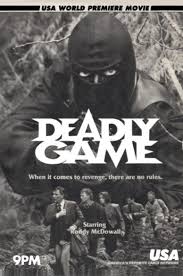
Film Review: High Plains Drifter (dir by Clint Eastwood)


In 1973’s High Plans Drifter, Clint Eastwood plays …. The Stranger.

No, not the Man With No Name.  The Stranger has a name but he chooses not to share it.  That said, when one person says that he doesn’t even know the Stranger’s real name, the Stranger replies, “Yes, you do.”  The Stranger appears to emerge from the heat of the desert, riding into the small mining town of Lago and gunning down the three bullies that the townspeople hired to protect them after the murder of their town marshal.  With no other option, the townspeople accept the Stranger as the town’s new protector.

The Stranger is drawn to the town and the townspeople but he doesn’t seem to particularly like any of them, with the exception of Mordecai (Billy Curtis), the dwarf that the Stranger appoints as the town’s new sheriff.  The townspeople, the majority of whom are cowardly and motivated by greed, aren’t particularly likable themselves.  The Stranger rules the town like a dictator, kicking everyone out of the hotel so that he can have it for himself and ordering that every building in the town be painted red.  Over the town’s welcome sign, he paints one word: “Hell.”  When the townspeople see how well the Stranger can shoot, they celebrate in the belief that they’ll always be safe.  The Stranger responds by leaving town just as three sadistic outlaws, led by Stacey Bridges (Geoffrey Lewis), approach.  The Stranger may be looking for revenge on Bridges but he also seems as if he wants to make the town suffer for its sins as well.

Much as with the case of The Man With No Name, the Stranger is not motivated by kindness or any sort of concern for the safety of the townspeople.  He often shows a cruel-streak when it comes to dealing with the cowardly townspeople.  He doesn’t attack unless he’s attacked first but once you’re on his bad side, he’ll gun you down without a hint of emotion.  When the Stranger sleeps, he is haunted by nightmares of the previous marshal (played by Buddy Van Horn, Clint Eastwood’s stunt double) being murdered by Bridges and his men while the townspeople stood by and did nothing.  We learn that the townspeople, worried that it might be bad for their business interests, didn’t even give the late marshal a decent headstone after his death.  One woman mentions that spirits can’t rest unless they have a proper marker….

Getting the idea?

High Plains Drifter is probably the closest that Eastwood has ever come to making a supernatural horror film.  The Stranger may or may not be a vengeful ghost (the movie leaves that for you to decide) but he turns the small town of Lago into his own personal version of Hell and, when he attacks the men who killed the marshal, he moves with the ruthless determination of a slasher villain.  The scene where Bridges and his men ride into the town is like a filmed nightmare.  This is a dark film, one in which Eastwood’s Stranger is not the hero because he’s particular heroic but just because everyone else in the film is so bad.

This was also Eastwood’s second film as a director (following Play Misty For Me) and also the first of many westerns that Eastwood would direct.  The imagery is often haunting, all the more so because some of the most violent scenes take place in broad daylight.  The scenes where the Stranger seems to materialize out of the desert’s heatwaves perfectly capture the mythology of the old west and its “heroes.”  Eastwood gets good performances out of his ensemble cast and, even more importantly, he shows that Eastwood the director had a perfect understanding of Eastwood the actor.  As the Stranger, Eastwood says more with a snarl or a half-smile than most actors could say with a multi-page monologue.

High Plains Drifter is violent, often disturbing, and ultimately unforgettable.

What Lisa Watched Last Night #162: Manny Dearest (dir by Chad Krowchuk)


Last night, as thunder rumbled outside and the skies were lit up by lighting, I curled up on the couch and I watched the latest Lifetime original film, Manny Dearest!

Why Was I Watching It?

A Canadian film called Manny Dearest?  As soon as I saw the title, I assumed that it had to be a sequel to Degrassi: The Next Generation, one that would follow Manny Santos as she searched for love and success in Hollywood.

(Before you say that was a silly assumption on my part, just consider the number of Degrassi actors who regularly appear on the Lifetime network.)

Anyway, it turned out that I was wrong but I was already live-tweeting the movie so I kept watching.

What Was It About?

Karen (Ashely Scott) needs someone to help watch her two sons.  Alex (Mitch Ryan) is a male nanny, otherwise known as a manny.  Now, if this was a Hallmark film, Karen and Alex would fall in love and Alex would end up dumping her fiancée, a recovering alcoholic named Greg (Woody Jeffreys).  But, since this is a Lifetime film, Alex turns out to be just a little crazy.  Not only does he become obsessed with Karen and plot to get Greg out of the picture but he also teaches Karen’s sons some questionable lessons about how to deal with bullies.

What Worked?

This was actually one of the better Lifetime films that I’ve seen this year.  Yes, it was obvious that Alex was going to turn out to be crazy but that’s Lifetime.  When you sit down to watch a Lifetime movie, you know that the nanny is always going to turn out to be crazy.  It would have been a betrayal of the audience to not have Alex turn out to be just a little insane.

Mitch Ryan did an excellent job playing Alex.  Even though he was crazy and a murderer and he regularly drugged other people, Alex was still strangely likable.  Last night, the majority of twitter was Team Alex.  We especially enjoyed it when he scared the Hell out of a bully who was giving Karen’s son a hard time.  Take that, bully!  Add to that, Alex cooked, he did the dishes, he cleaned the house, and, whenever he showed up at the house at 3 in the morning, he was very careful about not waking anyone up.

My favorite character was Cori (Jordan Largy), a single mother who took one look at Alex and decided that she liked what she saw.  The thing I liked about Cori is that she always said exactly what was on her mind and she didn’t let anything hold her back.  Cori was the type of person who, when she brought her daughters over to play with Karen’s sons, greeted Alex by saying, “We thought we’d come by for a quickie.”

At this point, it’s a bit of a cliché for me to praise a Lifetime film for taking place in a nice house but, seriously, Karen had a really nice house.

What Did Not Work?

I guess some people would say that it was a problem that the villain was a hundred times more likable than the people he was menacing but not me.  This is was a fun and entertaining Lifetime movie.  As far as I’m concerned, it all worked.

“Oh my God!  Just like me!” Moments

At one point, when Alex tells Cori that he’s not interested, Cori responds with, “Your loss.”  I once said the same thing while breaking up with someone and I felt good about myself for a whole month afterward.

Lessons Learned

I like to think that, between watching Degrassi and Lifetime films like this one, I’ve learned a good deal about Canada.  For me, the most Canadian moment of Manny Dearest came when the police approached Alex and, despite having guns, did not open fire on him.  Restraint, it’s very Canadian.

Love you, Canada!

A Movie A Day #66: Deadly Game (1991, directed by Thomas J. Wright)


Seven strangers are invited to a remote island by a mysterious billionaire named Osiris.  There is a doctor, a dancer, an auto mechanic, a mercenary, a football player and his agent, and a member of the Yakuza.  The auto mechanic points out that, in Egyptian mythology, Osiris judged mankind’s sins.  For some reason, none of the seven think twice about going to the island but, once they arrive, they soon discover that they should have.  Osiris is willing to give them seven million dollars but to get it, they have to reach the other end of the island without being killed by Osiris or his men.
Of the many movie adaptations of The Most Dangerous Game, this is probably the worst.  The cast, which includes Michael Beck, Marc Singer, Jenny Seagrove, Mitch Ryan, John Pleshette, Soon-Tek Oh, and Roddy McDowall, isn’t bad but the script is terrible, full of overwrought dialogue and plot holes.  Across the island, Osiris has left clues that are designed to trigger flashbacks and lead to each member of the seven explaining what it is that they did in the past.  But for that to work, Osiris would have to know exactly what route the seven of them were going to use to cross the island and he would also have to know who would still be alive by the time that they came across each clue.  Also, whenever they come across the clue, everyone stands around and wastes valuable time arguing about it.  Considering that there are armed men trying to kill them, no one seems to be in that much of a hurry to make it to the other side of the island.  The flashbacks themselves are interesting in how clumsily they are put together.  40ish Marc Singer plays himself as a senior in high school.

Like Hitler’s Daughter, Deadly Game was originally made for the USA network.  The first time I saw it was in the UK where, for some reason, it seemed to air frequently during the mid-1990s.  (Possibly this was because it starred quintessential Hollywood Brit Roddy McDowall.  That’s the only reason I can think of.)  It’s now on YouTube, for anyone who wants to sit through it.

A Movie A Day #33: Two-Minute Warning (1976, directed by Larry Peerce)


mpw-8771

For the longest time, I thought that Two-Minute Warning was a movie about a gang of art thieves who attempt to pull off a heist by hiring a sniper to shoot at empty seats at the Super Bowl.  As planned by a master criminal known as The Professor (Rossano Brazzi), the sniper will cause a riot and the police will be too busy trying to restore order to notice the robbery being committed at an art gallery that happens to be right next to the stadium.

I believed that because that was the version of Two-Minute Warning that would sometimes show up on television.  Whenever I saw the movie, I always through it was a strange plan, one that had too many obvious flaws for any halfway competent criminal mastermind to ignore them.  What if the sniper was captured before he got a chance to start shooting?  What if a riot didn’t break out?  The sniper spent the movie aiming at empty seats but, considering how many people were in the stadium, it was likely that he would accidentally shoot someone.  Were the paintings really worth the risk of a murder charge?

Even stranger was that Two-Minute Warning was not only a heist film but it was also a 1970s disaster film.  Spread out throughout the stadium were familiar character actors like Jack Klugman, John Cassevetes, David Janssen, Martin Balsam, Gena Rowlands, Walter Pidgeon, and Beau Bridges.  It seemed strange that, once the shots were fired and Brazzi’s men broke into the gallery, all of those familiar faces vanished.  When it comes to disaster movies, it is an ironclad rule that at least one B-list celebrity has to die.  It seemed strange that Two-Minute Warning, with all those characters, would feature a sniper shooting at only empty seats.  For that matter, why would there be empty seats at the Super Bowl?

That wasn’t the strangest thing about Two-Minute Warning, though.  The strangest thing was that Charlton Heston was in the film, playing a police captain.  In most of his scenes, he had dark hair.  But, in the scenes in which he talked about the art gallery, Heston’s hair was suddenly light brown.

Recently, I watched Two-Minute Warning on DVD and I was shocked to discover that the movie on the DVD had very little in common with the movie that I had seen on TV.  For instance, the television version started with the crooks discussing their plan to rob the gallery.  The DVD version opened with the sniper shooting at a couple in the park.  In the DVD version, there was no art heist.   The sniper had no motive and no personality.  He was just a random nut who opened fire on the Super Bowl.  And,  in the DVD version, he did not shoot at empty seats.  Several of the characters who survived in the version that I saw on TV did not survive in the version that I saw on DVD.

What happened?

The theatrical version of Two-Minute Warning was exactly what I saw on the DVD.  A nameless sniper opens fire and kills several people at the Super Bowl.  In 1978, when NBC purchased the television broadcast rights for Two-Minute Warning, they worried that it was too violent and too disturbing.  There was concern that, if the film was broadcast as it originally was, people would actually think there was a risk of some nut with a gun opening fire at a crowded event.  (In 1978, that was apparently considered to be implausible.)  So, 40 minutes of new footage was shot.  Charlton Heston even returned to film three new scenes, which explains his changing hair color.  The new version of Two-Minute Warning not only gave the sniper a motive (albeit one that did not make much sense) but it also took out all of the violent death scenes.

Having seen both versions of Two-Minute Warning, neither one is very good, though the theatrical version is at least more suspenseful than the television version.  (It turns out that it was better to give the sniper no motive than to saddle him with a completely implausible one.)  But, even in the theatrical version, the potential victims are too one-dimensional to really care about.  Ultimately, the most interesting thing about Two-Minute Warning is that, at one time, an art heist was considered more plausible than a mass shooting.

tmw

Film Review: Chandler (1971, directed by Paul Magwood)


C1971chandler1handler (Warren Oates) is a former private investigator who quits his job as a security guard and gets back into the detective game.  An old friend of his, Bernie Oakman (Charles McGraw), hires Chandler to follow and protect a woman named Katherine Creighton (Leslie Caron).  Katherine is scheduled to testify against gangster John Melchior (Gordon Pinset) and Oakman tells Chandler that he believes Melchior may be planning on murdering her.  What Chandler does not know is that Oakman is being manipulated by a corrupt federal agent, Ross Carmady (Alex Dreier), who is planning on duping Chandler into killing Melchior so that Carmady can take over Melchior’s racket.  Though Chandler tries not to get emotionally involved in his cases, he ends up falling for Katherine.

In case you are keeping count, Chandler is the sixth Warren Oates film that I’ve reviewed this week.  Some of that is because TCM devoted all of Monday to showing his films but it’s also because Warren Oates was a really cool actor who died too soon and never got as much credit as he deserved.  Warren Oates combined the talent of a leading man with the face of a character actor and, as a result, he played some of the most memorable supporting roles of the 60s and 70s.  He was the tough guy who could talk a mile a minute and his upturned grin always showed up at the most unexpected of times.  Warren Oates brought humanity to outcasts and sympathy to villains.

Chandler is one of Warren Oates’s few leading roles.  Unfortunately, it’s not much of a showcase.  Director Paul Magwood and producer Michael Laughlin felt that the then-head of MGM, James Thomas Aubrey, interfered with the production of the film.  After the film’s release, Magwood and Laughlin took out a full-page, black-bordered ad in Variety that read:

Regarding what was our film Chandler, let’s give credit where credit is due. We sadly acknowledge that all editing, post-production as well as additional scenes were executed by James T. Aubrey Jr. We are sorry.

Chandler is a strange film to watch.  The plot is complicated but nothing really happens until the downbeat ending.  Much like Robert Altman’s far more successful The Long GoodbyeChandler tries to contrast the title character’s old-fashioned 1940s style and moral code with the 70s.  Chandler, who always wears a suit and drives an old car, is meant to be a man out of time.  Warren Oates does a good job, giving a Humphrey Bogart-style performance.  But since Chandler doesn’t seem to be sure what it is trying to say about either the 40s or the 70s, it’s all for naught.

Chandler is a forgettable film, one that is only worth watching for the rare chance to see Warren Oates as a leading man.

Warren Oates in Chandler

Warren Oates as Chandler