What Lies Beneath (2000, directed by Robert Zemeckis)


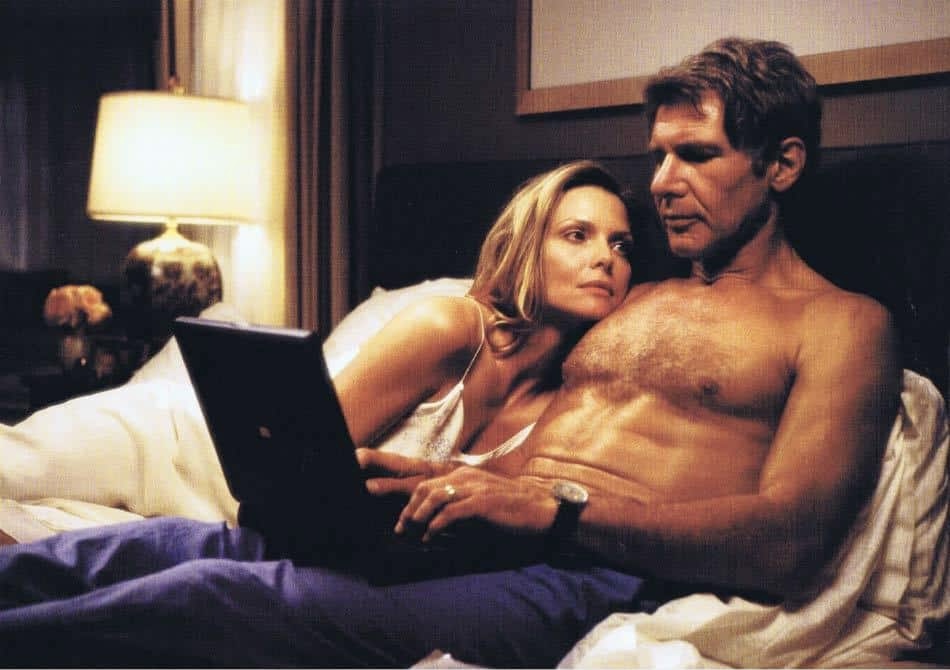
Claire (Michelle Pfeiffer) is a former cellist who is still struggling to recover from a serious car accident and who has been at loose ends ever since her daughter left for college.  Claire’s husband, Norman (Harrison Ford), is a scientist and a college lecturer.  After their neighbor, Mary (Miranda Otto), disappears, Claire becomes convinced that Mary’s husband (James Remar) did something to her.  Claire also becomes convinced that Mary’s ghost is trying to contact her, by appearing in the lake and filling the bathtub up with water whenever Claire isn’t looking.  Norman tells Claire that she’s imagining things and pushes her to see a therapist.  As Claire investigates, she discovers that Norman knows more than he’s letting on.

What Lies Beneath is a long and drawn-out ghost story that Robert Zemeckis made because he had time to kill while the filming of Cast Away was on hiatus so Tom Hanks could lose weight and grow a beard.  That this movie was not a personal project for Zemeckis is reflected in his direction, which is surprisingly impersonal for a Zemeckis film.  The film is a showcase for Michelle Pfeiffer, who gives a good performance as the emotionally fragile Claire and holds the film’s many disparate elements together.  Harrison Ford sometimes seems disinterested but his casting still pays off when Norman gets to say and do some things that you normally would never expect Harrison Ford to do.

I remember seeing this in a theater in 2000 and being surprised by the ending.  Looking back on it today, I just can’t believe that I sat through the entire movie.

Wolf (1994, directed by Mike Nichols)


Will Randall (Jack Nicholson), the editor-in-chief of a New York Publishing house, doesn’t get much respect, not from his wife (Kate Nelligan), not from his boss (Christopher Plummer), and certainly not from Stuart Swinton (James Spader), the sleazy executive who is plotting to steal his job and destroy his marriage.  But then, one night, Will runs over a black wolf on a country road.  When he tries to helps it, the wolf bites him.  Soon after, Will starts to feel different whenever the moon is full.

I remember that, when Wolf came out in 1994, some people said that casting Jack Nicholson as a werewolf seemed like typecasting.  Nicholson apparently understood this as well so he actually downplays his usual mannerisms for the first part of the movie and gives a convincing performance as a harried executive who is worried he’s about to lose his job.  It’s only after he is bitten that Will Randall starts to come alive.  Not only does he develop the predator instinct necessary to survive in New York City but he also, without fear, pursues his boss’s daughter, Laura (Michelle Pfeiffer, at her most beautiful).  Typecast or not, Jack Nicholson is excellent in Wolf.  Equally good is James Spader as Will’s business rival, who starts to show some predator-like aspects of his own.

Director Mike Nichols was not normally a horror director and, around the midway point, his direction falters and there are times when he just seems to be going through the motions.  He gets good performances from his cast but doesn’t know how to craft a good jump scare.  The best parts of the movie are when Wolf uses lycanthropy as a metaphor for petty office politics, with Will “marking” his territory while talking to Stewart and showing a renewed killer instinct.  Wolf works better as a social satire than as a horror movie.

Fans of Frasier will be happy to see David Hyde Pierce in a small but key role.  He delivers the film’s best line.  Fans of Friends may also notice David Schwimmer in a small role.  He says nothing worth remembering.  Their presence, though, is a reminder of just how much American culture changed in 1994.  By the end of the year, both went from small roles in Wolf to co-starring in the two of the most popular sitcoms in America.

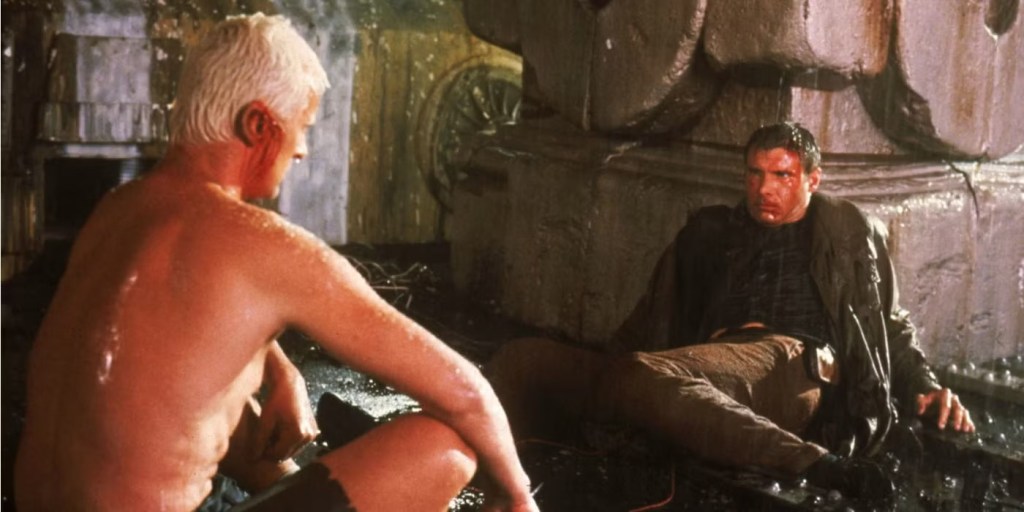
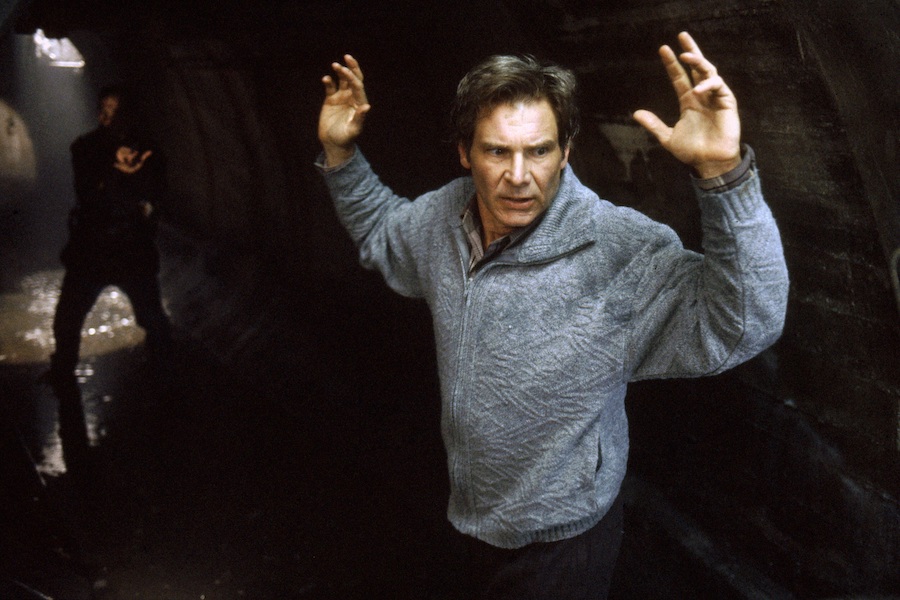
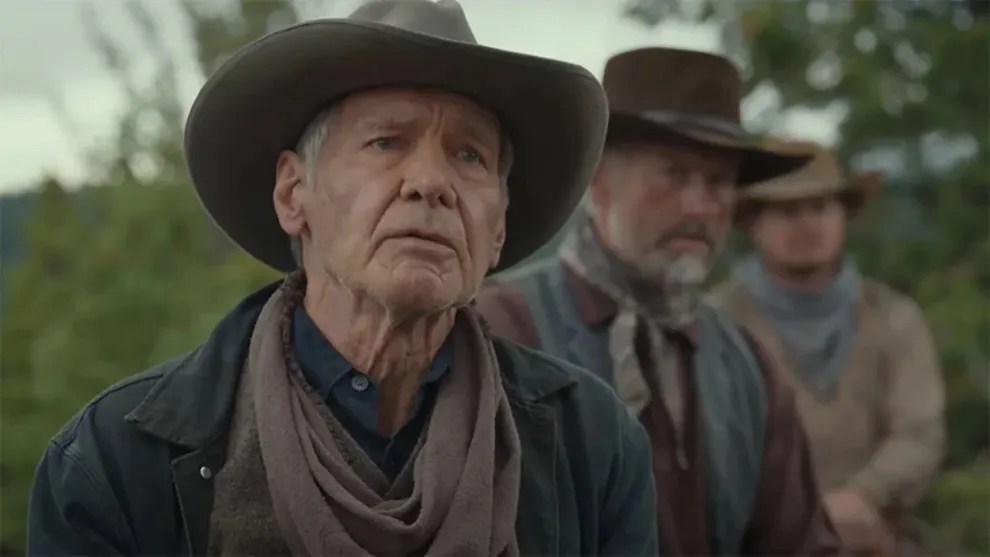
4 Shots From 4 Films – Harrison Ford Edition!


4 Shots From 4 Films is just what it says it is, 4 shots from 4 of our favorite films. As opposed to the reviews and recaps that we usually post, 4 Shots From 4 Films lets the visuals do the talking.

Today is Harrison Ford’s 83rd birthday. There’s not much I can say about Ford other than my movie going life pretty much started as a 4 year old with the STAR WARS movies. As I was growing up, he was one of the biggest stars on the planet, and his movies were almost always really good. He’s quite simply one of the best.

Enjoy 4 shots from 4 films, with Harrison Ford!

Blade Runner (1982)
The Fugitive (1993)
What Lies Beneath (2000)
1923 (2022-2025)

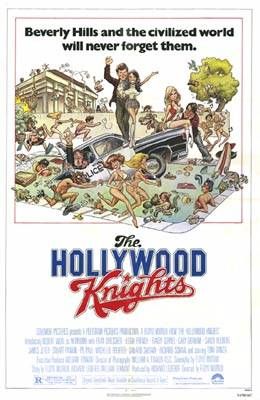
The Hollywood Knights (1980, directed by Floyd Mutrux)


Halloween Night, 1965.  While the high school holds a pep rally and the Beverly Hills Homeowners Association debate the best way to tackle the problem of juvenile delinquency, the Hollywood Knights hang out at Tubby’s Drive-In, their favorite burger joint.  The Hollywood Knights are a car club and a group of fun-loving rebels, determined to have a good time and to always humiliate Officers Clark (Sandy Helberg) and Bimbeau (Gailard Sartain).  In practice, this amounts to a lot of jokes about flatulence and Newcomb Turk (Robert Wuhl) mooning the cops every chance the he gets.  I’m hoping a stunt butt was used for the mooning shots.  If I had known watching Hollywood Knights would mean seeing Robert Wuhl’s bare ass a dozen times over 91 minutes, I wouldn’t have started the movie.

The humor is crude but the movie has a serious side, one that was cribbed from American Graffiti.  Duke (Tony Danza), a senior member of the club, is upset that his girlfriend (Michelle Pfeiffer, in her film debut) is working as a car hop.  He’s also sad that his buddy, Jimmy Shine (Gary Graham), is leaving in the morning for the Army.  Jimmy’s not worried about being sent to Vietnam because Americans are only being sent over there as advisors.  Hollywood Knights doesn’t end with a Graffiti-style epilogue but if it did, Jimmy would be the one who never came home.  The serious scenes work better than the comedy, due to the performances of Gary Graham, Michelle Pfeiffer, and Tony Danza.  I can’t believe I just said that either.  Danza, though he’s way too old to be playing a high school student, is actually really good in this movie.  Pfeiffer doesn’t get to do much but, from her first scene, it’s easy to see why she became a star.  The camera loves her and she brings her character to life, despite not having much screen time.

Unfortunately, the drama takes a back seat to a lot of repetitive humor.  The problem isn’t that the humor is crude.  One thing that has always been true is that, regardless of the year, teenage boy humor is the crudest humor imaginable.  Even back in prehistorical times, teenage boys were probably drawing dirty pictures on the walls of their caves.  The problem is that the humor is boring and Robert Wuhl is even more miscast as a high school student as Tony Danza was.  Fran Drescher plays a high school student with whom Turk tries to hook up.  Drescher, like Pfeiffer, comes across as being a future star in the making.  Robert Wuhl comes across as being the future creator of Arli$$.

The Hollywood Knights has a bittersweet ending, the type that says, “It’ll never be 1965 again.”  This movie made me happy that it will never be 1965 again.  1965 should have sued The Hollywood Knights for slander.  Hollywood Knights tried to mix the nostalgia of American Graffiti with the raunchiness of Animal House but it didn’t have the heart or creativity of either film.  At least some of the member of the cast went onto better things.


April True Crime: The Wizard of Lies (dir by Barry Levinson)


For many people, Bernie Madoff is a still a name that summons hate.

Madoff was the owner of Bernard L. Madoff Investment Securities, a firm that was a family business.  He ran it with his two sons, Mark and Andrew, and he gained a reputation for being a financial wizard, someone who never lost money and who always returned a profit for everyone who trusted him with their money.  He was someone who took money from the famous and the ordinary, the rich and the middle class, and he promised everyone that he would do wonderful things with that cash.  He lived in a fabulous home in New York City.  He had business and political connections.  His firm was, at one point, ranked as the sixth biggest on Wall Street but Madoff, himself, tried to keep a low-profile.

Of course, Madoff was a liar.  While his brokerage firm actually did make money, the asset management part of his business was actually a massive Ponzi scheme.  He took his clients’ money for himself and then kept everyone at bay by sending them fake documents that showed how well their investments were doing.  As long as the economy remained strong, Madoff had nothing to worry about.  People gave him their money, assumed it was safe, and then went away.  But when the stock market crashed in 2008, Madoff realized that his panicked clients would be coming for their money and he wouldn’t be able to give it to them.

Overnight, Madoff’s life collapsed.  He spent the rest of his days in prison, having been turned in by his own sons.  One son committed suicide, the other would die of cancer with his last words apparently being that his father was dead to him.  It was the biggest case of financial fraud in United State history and the majority of Madoff’s clients lost all of the money that they had given to him.  It was subsequently learned that many people had spotted red flags when it came to Madoff and his business.  (The fact that Madoff claimed to never lose money should have been a huge one.)  But Madoff invested his money in politicians and he never faced a real investigation until it was too late.  Madoff spend the rest of his days as a symbol of everything wrong with Wall Street.

Not surprisingly, quite a few movies were inspired by Bernie Madoff’s crimes, some of them featuring characters based on him and a few being about the case itself.  Produced by HBO, 2017’s The Wizard of Lies stars Robert De Niro as Madoff, Michelle Pfeiffer as his wife, and Alessandro Nivola as his son, Mark.  Directed by Barry Levinson, The Wizard of Lies follows Madoff as his Ponzi scheme collapses and it shows how the grand deception started.  Robert De Niro plays Madoff as being essentially soulless, a sociopath who knew he would eventually get caught but who just couldn’t bring himself to stop stealing people’s money.  Indeed, as played by De Niro, Madoff comes across as being one of the most joyless criminal masterminds in history.  He’s fooled everyone but he can’t enjoy it.  The impression that one gets is that Bernie Madoff was a pretty boring guy.  Perhaps that’s why people were willing to trust him with their money.  Someone that boring had to be trustworthy!  Many people have claimed that there’s no way that Mark and Andrew Madoff couldn’t have know what their father was doing.  In the film, one gets the feeling that Mark and Andrew knew something was going on but they decided to willfully blind themselves to what was happening around them.  The film hints that was Madoff’s secret power.  No one wanted to admit that his success was too good to be true.

The Wizard of Lies really doesn’t reveal anything new about the Madoff case.  Madoff’s crimes were actually pretty simple.  He wasn’t a criminal genius.  He was just someone who understood the importance of telling people what they wanted to hear.  Still, it’s a well-acted movie and, if you’re just looking for the facts of the case, The Wizard of Lies will give them to you.

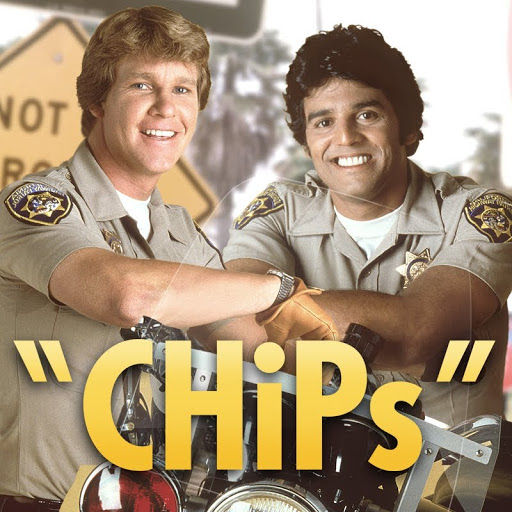
Retro Television Review: CHiPs 3.11 “The Watch Commander”


Welcome to Late Night Retro Television Reviews, a feature where we review some of our favorite and least favorite shows of the past!  On Mondays, I will be reviewing CHiPs, which ran on NBC from 1977 to 1983.  The entire show is currently streaming on Prime!

This week, a new boss gets on everyone’s nerves!

Episode 3.11 “The Watch Commander”

(Dir by Don Weis, originally aired on November 17th, 1979)

There’s a new watch commander and he’s not making any friends.  Lt. Harold Bates (Granville Van Dusen) previously worked in the PR Department at Sacramento and he sets out to make a bad impression from the minute that Sgt. Getraer first introduces him to the cops working out of the Los Angeles precinct.  Lt. Bates is all about following the book.  He notes every flaw, from a missed button to poor gas mileage.  Getraer tries to get him to understand that there’s more to being a cop than just following regulations and that being a member of the Highway Patrol means having to make split-second decisions.  Bates wants to know why Ponch isn’t wearing a regulation shirt.

In some ways, this is as close as CHiPs will ever get to The Caine Mutiny.  Nobody removes Bates from command but Bates still struggles to recover from making a terrible first impression and his own Queeg-like personality doesn’t help things.  His attempts to call out the members of the Highway Patrol who get the worst gas mileage backfires when Officer Grossman siphons gas out of Bates’s car, leading to Bates appearing at the bottom of the list.  Bates has no idea how to talk to or trust people.  Jon Baker tries to offer a helping hand, especially since both he and Bates served in Vietnam.  He invites Bates to go skydiving with him over the weekend.  Bates assumes it’s a set-up and turns him down.

We do get the usual car crashes and a subplot about a bunch of thieves who are stealing trucks from loading docks but the majority of this episode takes place at headquarters.  Ponch, who is said to still be on limited duty, is recovering from his accident and one gets the feeling that this episode was developed so Erik Estrada could be a part of the story without actually having to spend too much time on his bike.  (Estrada actually did injure himself during filming and those injuries were written into the show.)  In some ways, this is CHiPs at its most realistic because everyone always hates the new boss, especially one who thinks that he knows everything.

Going back to The Caine Mutiny, it was impossible not to feel sorry for Queeg, who was not a bad guy but instead just someone who wasn’t good at talking to people and who ultimately was let down by the people who should have been supporting him.  I never felt that type of sympathy for Bates, who really did just come across as being a jerk.  Thank goodness for Robert Pine, whose steadiness as Sgt. Getraer is well-used by this episode.  Pine is there to support Bates but he also protects his men.  This episode features Getraer at his most likable.  Everyone should be so lucky as to have a Getraer in their life.

Scenes I Love: “Look at Us!” from Ladyhawke


I love Richard Donner’s Ladyhawke . In the following scene, our hero Navarre (Rutger Hauer) has stormed a church, looking to reach the wicked Bishop (played by Wargames‘ John Wood). It’s in an effort to force the Bishop to break the curse that turns Navarre into a wolf by night and his love, Isabeau (Michelle Pfeiffer) into a Hawk by day. He’s reached the Bishop, but believes that Isabeau is surely gone, having asked a old friend to take her life should Navarre fail. I chose this part partially because I love the look on Navarre’s face on hearing Isabeau’s voice. He looks at her almost as if he’s seen her for the first time. He’s just so entranced, but then he quickly remembers what he needs to do, and his voice booms through the church. I wish this video wasn’t cut as short as it is.

Enjoy!

#SundayShorts with LADYHAWKE (1985)


Since Sunday is a day of rest for a lot of people, I present #SundayShorts, a weekly mini review of a movie I’ve recently watched. This week I got carried aways so it’s #SundayNotSoShorts!

We meet petty thief Gaston “The Mouse” Gaston (Matthew Broderick) as he’s finding a way to escape from the horrific dungeons of the medieval city of Aquila. Being the only person to ever escape the prison, the evil Bishop of Aquila (John Wood) orders his soldiers to find Gaston and kill him. When it appears that he’s about to be recaptured and killed, Captain Etienne Navarre (Rutger Hauer) appears and rescues him. Navarre, who’s accompanied by a hawk, forces Gaston to go with him where they seek lodging in the barn of a local farmer. That night while Gaston is out gathering wood, the duplicitous farmer attempts to kill him, but he is saved again, this time by a large black wolf. Freaked out by this seemingly random event, Gaston runs back to the barn and finds a young lady named Isabeau (Michelle Pfeiffer), but no sign of Captain Navarre. Isabeau isn’t surprised about the events that Gaston describes to her. As a matter of fact, he sees the wolf join Isabeau in the yard as she’s taking a leisurely stroll that evening. The next morning, Navarre has returned and tells Gaston that he needs his help to complete his plan to kill the Bishop. Not wanting to get involved, Gaston escapes that night and is immediately captured again by the Bishop’s soldiers. Saving Gaston a second time doesn’t go well for Navarre, when both he and the hawk are shot with arrows by the soldiers prior to dispensing of them. An injured Navarre forces Gaston to take his horse and deliver the injured hawk to a monk named Imperius (Leo McKern) who resides in a ruined castle in the area. At the castle that night, Gaston sees Isabeau with an arrow in her shoulder. Imperius tells him of a satanic curse that has been placed on husband and wife, Navarre and Isabeau, by the evil Bishop because she spurned his advances. The curse dooms them to always being together, yet eternally apart. Thus, by day Isabeau is a hawk, and by night Navarre is a wolf. After learning this, Gaston is now ready to help Navarre in his plan. Is there any way to reverse the curse, or is vengeance against the Bishop the best thing that can be hoped for? You’ll just have to watch and see!

LADYHAWKE is a film that checks quite a few boxes. It has some good action scenes. Rutger Hauer makes for a strong hero who can handle his fists and his swords in numerous fight scenes, and he looks damn awesome astride his beautiful horse! It also has some good comedy, which is mostly provided by Matthew Broderick. His petty thief has a running commentary where he talks to God anytime that he’s alone and needing help. He has this way of making promises, while also hedging his bets, so he doesn’t box himself in with promises that he has no chance to keep. I recognized myself in those conversations. The film has an air of magic and romance. Rutger Hauer and Michelle Pfeiffer are a beautiful couple. The idea that they are lovers caught up in a curse, but who still love and care for each other every day is hard to resist. This desire to see them break that curse is what gives me a real rooting interest in the outcome. The film is a story of redemption for the monk Imperius whose drunken betrayal helped put the two lovers in this position. And it’s a story of good trying to triumph over evil, with evil being vividly portrayed in the character of the Bishop. Leo McKern and John Wood embody the characters of Imperius and the Bishop perfectly. Director Richard Donner handles all of these different facets in a fun and entertaining way. I think LADYHAWKE still holds up well as a nice piece of 80’s entertainment!  

Five Fast Facts:

  1. Spike II, the hawk featured in this movie, worked in the Universal Bird Show until 2000, when she was transfered to the National Audubon society and became an Audubon Ambassador until she died in May 2007.
  2. If you needed proof that celebrities aren’t like the rest of us, three of the castles used for this movie were owned by Italian movie director Luchino Visconti and his family.
  3. Producer and director Richard Donner originally cast Kurt Russell as Navarre. When Russell dropped out a few days before principal photography began, the part was handed to Rutger Hauer.
  4. When Matthew Broderick’s character Gaston is escaping the dungeon at the beginning of the film, you can hear someone say ‘cut’ just before Phillipe says, “It’s not unlike escaping Mother’s womb.”
  5. As enjoyable as the film is, LADYHAWKE was a disappointment at the box office. It grossed a little over $18 million on a budget of $20 million, ranking 48th in the North American box office for 1985.

Retro Television Reviews: Fantasy Island 4.11 “The Artist and the Lady/Elizabeth’s Baby”


Welcome to Retro Television Reviews, a feature where we review some of our favorite and least favorite shows of the past!  On Tuesdays, I will be reviewing the original Fantasy Island, which ran on ABC from 1977 to 1986.  Almost the entire show is currently streaming is on Youtube, Daily Motion, and a few other sites.
Sorry for the late review!  I’m currently on Vicodin (nothing to worry about) and it set me far behind today.

Episode 4.11 “The Artist And The Lady/Elizabeth’s Baby”

(Dir by Michael Vejar, originally aired on January 17th, 1981)

This week, we have two new fantasies.  One is surprisingly sweet.  The other is about as dumb as can be.

Poor Tattoo!  Because Mr. Roarke is busy with the good fantasy this week, it largely falls on Tattoo to play host for the bad fantasy.  Kermit Dobbs (Don Most) is a nerdy art teacher who wants to be a real artist.  Before leaving to oversee the good fantasy, Roarke gives Dobbs a potion that, when Dobbs drinks it, gives him the talent of Patrick O’Herlihy (Peter Brown), a mad Irish artist who, for some reason, lives in the wilds of Fantasy Island.  What Dobbs doesn’t know that is that the potion not only gives him Patrick’s talent but it also apparently gives him the knowledge of every woman that Patrick has slept with on the island.  When Kermit paints a picture of a Deborah Dare (Michelle Pfeiffer — wait, what!?) and knows just where to place her birthmark, it leads to the men on the Island chasing Kermit into the wilderness.

It’s in the wilds that Kermit meets Patrick and they spend some time drinking and talking about art.  Eventually, Kermit gives up his claim to Patrick’s talent and he leaves the island with Deborah.  Meanwhile, all the men on the Island now want to kill Patrick so I’m not really sure that this qualifies as a good ending.

That was all really stupid, with every actor in the fantasy going overboard with their characters.  Don Most apparently went a week without shaving before appearing on this episode, in an attempt to come across as someone with an artistic soul.  It didn’t work.

The far better fantasy featured Eve Plumb as Elizabeth Blake, a woman who is pregnant and who know that she will probably die in childbirth.  Her fantasy is to have a chance to see what her daughter’s future life will be like.  Though reluctant, Mr. Roarke travels with her to three separate years in the future.  (Interestingly enough, even though they eventually end up traveling 20 years into the future, the world still looks like the 70s.)  At first, Elizabeth is happy to see that her daughter will have an apparently happy childhood but things get progressively darker until finally, Lisa Blake (Alison Arngrim) has run away from home and is working as a prostitute.  Mr. Roarke allows Elizabeth to talk to Lisa (hey!) on the condition that Elizabeth not reveal her identity.  Elizabeth is able to convince Lisa to go back home.

It’s a sweet but rather sad story.  Even as Elizabeth leaves Fantasy Island with the knowledge that she was able to help her daughter, she still leaves with the knowledge that she’s going to die in childbirth.  In the lead role, Eve Plumb is as good as Don Most was bad.

That one good fantasy is so good that it saves the episode.  That bad fantasy is so bad that it keeps this episode from being the classic that it should have been.  Such is life on Fantasy Island.


Music Video of the Day: Gangsta’s Paradise by Coolio (1995, directed by Antoine Fuqua)


Michelle Pfeiffer not only starred in Dangerous Minds but she also appeared in the subsequent music video for Coolio’s Gangsta’s Paradise.  It looks like she found an even worse school than the one from the movie.  How many schools have people lifting weights in the middle of the hallways?

For a while, in 1995, this song was everywhere.  It never recovered from being parodied as Amish Paradise.  Director Antoine Fuqua has gone on to have a notable career as feature film director.

Enjoy!