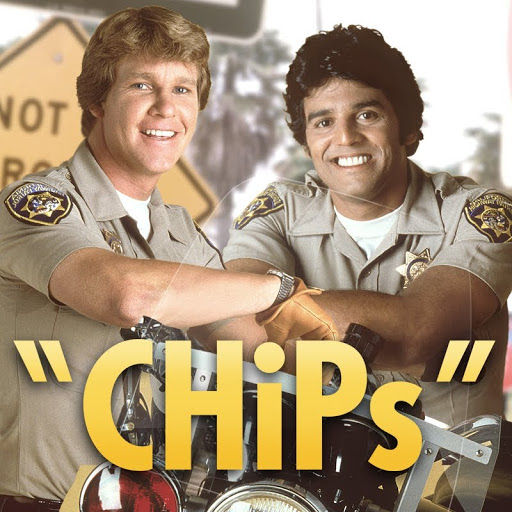
Late Night Retro Television Review: CHiPs 4.4 “The Poachers”


Welcome to Late Night Retro Television Reviews, a feature where we review some of our favorite and least favorite shows of the past!  On Mondays, I will be reviewing CHiPs, which ran on NBC from 1977 to 1983.  The entire show is currently streaming on Prime!

This week, Ponch brings us all closer together.

Episode 4.4 “The Poachers”

(Dir by Barry Crane, originally aired on October 19th, 1980)

In the beautiful hills surrounding Los Angeles, Jon and Ponch (but mostly Ponch because, as of the start of season four, this is The Ponch Show) pursue two poachers (Robert F. Lyons and Michael Gwynne).  However, Ponch is not the only one after the poachers.  A Native American grandfather named Nathan (Michael Ansara) is in the hills with his grandson (Tony Raymond) and, together, they shoot arrows at the poachers.

Hey, that’s attempted murder!

Well, no matter.  No one like poachers, least of all me.

While Ponch captures the poachers and befriends the grandfather, the rest of the Highway Patrol spend their time at the drag strip and try to win races and set records.  Ponch insists that he should be the one allowed to represent the force on the track and he’s probably right because he’s Ponch and this is The Ponch Show.  Instead, Sgt. Getraer — who technically outranks Ponch but who knows how long that will last — takes to the track himself and amazes everyone with his speed.  Woo hoo!  Meanwhile, poor Baker stands in the background and perhaps remembers how, when the show started, he actually got to do stuff other than follow Ponch around.

This episode was nothing special.  It was well-intentioned with its anti-poaching storyline but it also featured even more cliches than usual.  Michael Ansara was himself not Native American.  He was born in Syria.  The actors who played his son and his grandfather were also not Native American, at least not as far as I could detect from their IMDb profiles.  In short, this was an episode about the wisdom of Native Americans that doesn’t appear to have featured any actual Native Americans.

All that said, it was nice to Robert Pine get to have some fun with the role of Sgt. Getrear.  Pine’s tough-but-fair performance as Getraer has often been this show’s secret weapon and, in this episode, he at least got to smile for once.  He earned it!

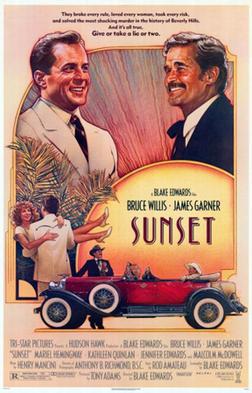
Sunset (1988, directed by Blake Edwards)


In 1920s Hollywood, famed comedian Alfie Alperin (Malcolm McDowell) has made the transition from screen stardom to working behind the scenes as a producer and studio head.  With the coming of the talkies and the death of silent cinema, Alfie plans to make his mark with an epic western starring Tom Mix (Bruce Willis) as Wyatt Earp.  The real Wyatt (James Garner) is hired to act as an on-set consultant.  Wyatt’s former girlfriend, Christina (Patricia Hodge), is now married to Alfie.

What Mix and Earp discover is that, despite his beloved public image, Alfie is actually a monster who is involved with organized crime and sex trafficking and who has the police on his payroll.  While searching for Christina’s missing son (Dermot Mulroney), Mix and Earp get caught up in a murder involving Alife’s sister (Jennifer Edwards) and a gangster named Dutch (Joe Dallesandro).  At the first Academy Awards are handed out in Beverly Hills, Tom Mix and Wyatt Earp prepare for the final showdown with their producer.

The idea behind Sunset was promising.  Wyatt Earp, a real cowboy who survived the end of the West, teams up with Tom Mix, a movie cowboy who is trying to survive the end of the silent era.  (Earp and Mix were friend in real life, as well.)  Bruce Willis comes across as being too contemporary in the role of Tom Mix but James Garner plays Wyatt Earp with a weary dignity and Malcolm McDowell does a convincing Charlie Chaplin impersonation.  Unfortunately, Blake Edwards’s direction allows the story to meander and the mystery itself is so full of red herrings that it’s impossible to follow.  Edwards didn’t seem to know if he wanted this movie to be a buddy comedy, an elegiac tribute to the end of the silent era, or a satire of Hollywood.  He tried to include elements of all three but the movie itself just doesn’t come together.  Only Garner and McDowell emerge from the film relatively unscathed.

Fortunately, for Bruce Willis, Die Hard was released just two months after Sunset.

Retro Television Review: Thief (dir by William A. Graham)


Welcome to Retro Television Reviews, a feature where we review some of our favorite and least favorite shows of the past!  On Sundays, I will be reviewing the made-for-television movies that used to be a primetime mainstay.  Today’s film is 1971’s Thief!  It  can be viewed on Tubi and YouTube.

Neal Wilkinson (Richard Crenna) would appear to be living a great life.  He has a nice house in the suburbs.  He has a beautiful girlfriend named Jean Melville (Angie Dickinson).  As he heads into middle-age, he is still fit and handsome and charming.  He dresses well, or at least well by the standards of the early 70s.  (By the standards of today, a few of his ties are a bit too wide.)  Everyone believes that Neal has a nice and comfortable job as an insurance agent.

Of course, the truth is far different.

Neal is a veteran con man and a thief.  He’s just recently been released from prison and his deceptively friendly parole officer (played by the great character actor, Michael Lerner) is convinced that Neal will screw up again eventually.  And, of course, Neal has screwed up.  A gambling addict, he is $30,000 in debt.  Can Neal steal enough jewelry from enough suburban homes to pay off his debt?  Can a man like Neal change his ways?

This is a surprisingly somber made-for-TV movie.  Just from the plot description and the film’s first few minutes, you might expect Thief to be a light-hearted caper film in which Neal and Jean work together to pull off one last heist so that Neal can retire.  Instead, Neal spends almost the entire film lying to Jean and there’s hardly a light moment to be found.  Neal says that he wants to retire from his life of crime but, as the film makes clear, that’s a lie that he’s telling himself.  Neal cannot stop stealing and gambling because he’s as much of an addict as the wild-haired junkie (Michael C. Gwynne) who briefly confronts Neal at the parole office.  At one point, Jean tells Neal, “The more I know you, the less I know you,” but the truth of the matter is that Neal is so deep in denial about the futility of his life that he doesn’t even know himself.

It’s not a particularly happy film.  Richard Crenna is ideally cast as Neal, playing him with enough charm that the viewer can buy that he could talk his way out of being caught in a stranger’s backyard but with also with vulnerability that the viewer can see his fate, even if he can’t.  Thief also provides a rare opportunity to see Cameron Mitchell playing a sympathetic role.  Mitchell is cast as Neal’s attorney, who continually tries to get Neal to stop messing up but who ultimately knows that his attempts to reform Neal are just as futile as Neal’s attempts to go straight.

The movie ends on a surprisingly fatalistic note, one that suggests that there’s only one way to truly escape from a life of crime.  I can only imagine how viewers responded in 1971, when they turned on their television and found themselves watching not a light-hearted caper film but instead a bleak examination of criminal ennui.  It’s not a happy film but it is more than worth watching for Richard Crenna’s lead performance.

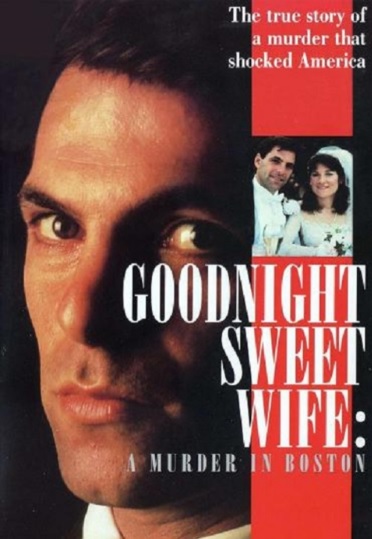
October True Crime: Goodnight Sweet Wife: A Murder In Boston (dir by Jerrold Freedman)


1990’s Goodnight Sweet Wife opens with a frantic 9-11 call.

A man named Charles Stuart (Ken Olin) calls the Boston Police Department and says that he and his pregnant wife have just been shot.  He says that he got lost while trying to drive home and that a black man got in the car, made Charles drive to a remote location, robbed Charles and his wife, and then shot them.  When the police finally manage to track Charles down, he’s nearly dead as a result of having been shot in the stomach.  Carol was shot in the head and is pronounced dead shortly after arriving at the hospital.  Her baby, named Christopher, is delivered via C-section but dies a few days later.

The city of Boston is outraged as the crime makes national news.  The story that thousands hear is that Charles Stuart, a hard-working and financially successful man who has never had any trouble with the police, took one wrong turn, ended up in a “bad” neighborhood, and lost his wife and his son as a result.  As Charles recovers in the hospital, the police make capturing his assailant their number one priority and soon, black men are being stopped and frisked in the streets.

With the entire world mourning the loss of Carol and Christopher Stuart, there are only a few people in Boston who are willing to take a careful look at Charles’s story.  There are quite a few inconsistencies in Charles’s story, not the least of which was his claim that he was shot in a nearly deserted area of town when the neighborhood is actually one of Boston’s busiest.  Some start to suspect that Charles killed his wife and then shot himself to make it look like a robbery and the fact that Charles nearly died from his wound is not proof that Charles was actually the victim but instead just a sign that Charles didn’t know where to shoot himself in order to not nearly die.  However, even with all of the inconsistencies in Charles’s story, the police still announce that they’ve arrested a man for the crime.  Charles even identifies the suspect, William Bennett, as being the murderer.

Of course, as is revealed in flashbacks, Charles Stuart is a murderer and he’s not a particularly clever one.  He’s the type of murderer who openly talked to people about how he was considering committing a murder.  He’s the type who roped his own brother into helping him fake the robbery.  Far from being the successful professional that he presented himself as being, Charles was mediocre broker who depended on his wife’s salary to finance his lifestyle.  With Carol pregnant and planning on quitting her job to be a full-time mother, Charles decided to kill her for the insurance and he also figured that he would be able to get away with it as long as he blamed the crime on a black man.

Tragically, it turned out that Charles Stuart was almost right.  In both the movie and in real life, Charles Stuart was believed because he didn’t look like what most people thought a criminal looked like.  He was a young, handsome, middle class white guy and because he couldn’t face the prospect of having to cut back financially, he killed his wife and his son and he nearly put an innocent black man in prison.  The film does a good job of depicting the consequences of both Stuart’s crime and the rush to judgment on the part of the police.  Ken Olin plays Charles Stuart as being outwardly friendly but empty on the inside, a cold sociopath who is incapable of truly caring about anyone but himself.  In real life, Stuart chose to jump into the Mystic River rather than face the consequences of his actions.  Stuart’s brother, who helped Charles fake the robbery and later turned Charles into the police, died in a homeless shelter 30 years later.  Carol’s family set up a scholarship fund in her name to aid students in Mission Hill, the neighborhood where Charles claimed he had been hijacked.  One of the scholarship’s first recipients was the daughter of William Bennett.

Film Review: L.A. 2017 (dir by Steven Spielberg)


L.A. 2017 is the Steven Spielberg film about which you’ve probably never heard.

To a certain extent, that’s understandable.  Spielberg was only 24 when, in 1971, he directed L.A. 2017.  It was a film that he directed for television.  In fact, it was only his third directorial assignment.  As opposed to the huge budgets that we tend to associate with a typical Spielberg production, L.A. 2017 was made for about $300,000.  The entire film was shot in about 12 days.  In fact, with a running time of only a scant 69 minutes, L.A. 2017 hardly qualifies as a feature-length film.  L.A. 2017 has never been released on DVD or Blu-ray, making it a true oddity in Spielberg’s filmography.  Despite the fact that Spielberg has credited L.A. 2017 with opening a lot of doors for him, it’s an almost totally forgotten film.

Of course, some of that is because L.A. 2017 really isn’t a film at all.  Instead, it was an episode of a television show called The Name of the Game.  The show was about Glenn Howard (Gene Barry), a magazine publisher, and the reporters who worked for him.  L.A. 2017 was unique in that it was the show’s only excursion into science fiction.  In fact, from everything that I’ve read about the show, it appears that L.A. 2017 was nothing like any of the other episodes of The Name of the Game.  This episode was also unique because Spielberg directed it as if he was making a feature, as opposed to just another installment in a weekly series.  If not for the opening credits (which announce, among other things, that we’re watching a Robert Stack Production), one could easily imagine watching L.A. 2017 in a movie theater, perhaps as a double feature with Beneath The Planet Of The Apes.

L.A. 2017 opens with Glenn driving down a mountain road in California.  He’s heading to a pollution summit and, as he drives along, he awkwardly dictates an editorial into a tape recorder.  Glenn worries that society may have already ruined the environment to such an extent that the Earth cannot be saved.  As if to prove his point, Glenn starts to cough as he’s overcome by all of the smog in the air.  His car swerves into a ditch and Glenn is knocked unconscious.

Welcome to the future

When he wakes up, he finds himself being rescued by men wearing wearing protective suits and masks.  The sky is a sickly orange and an ominous wind howls in the background.  Glenn’s rescuers take him to an underground city where he discovers that, somehow, he has traveled through time.  The year is now 2017, which in this film looks a lot like the 70s except that everyone’s now underground and the landline phones are extra bulky.  (Needless to say, watching 1971’s version of 2017 in 2019 is an interesting experience.)  It turns out that the pollution got so bad that the surface of the planet became uninhabitable.  The U.S. is now run by a corporation that is headquartered in Detroit.  (Presumably, the Corporation is a former car company.)  The U.S. is also at war with England, for some reason.  No mention is made about what’s happened to Canada but, if Detroit’s still around, I assume at least some of Canada managed to survive as well.

The …. uh, Future.

Everyone in the future drinks a lot of milk and, when they’re not listening to cheerful announcements, they’re listening to the soothing music that the Corporation provides for them.  Everyone in the future is also very friendly.  We know this because everyone keeps assuring Glenn that he’s surrounded by friends.  In fact, everyone in the future refers to one another by their first name because “it’s friendlier.”  It’s also the law.  It turns out that there’s a lot of laws in the future.  In fact, the underground cities are pretty fascist in the way that they handle things.  There are constant announcements encouraging people to pursue a career in law enforcement and anyone who disagrees with the Corporation ends up in a straight jacket.  Glenn feels that maybe he’s been brought to the future so he can start a new magazine and challenge the status quo.  The Corporation disagrees….

This is what happens when you don’t go underground in the future.

Okay, so there’s nothing subtle about L.A. 2017.  From the villainous corporation to the heavy-handed environmental message, there’s nothing here that you haven’t seen in dozens of other sci-fi films.  But the lack of subtlety doesn’t matter, largely because Spielberg directs with so much energy and with such an eye to detail that it’s impossible not to get sucked into the story.  As opposed to the somewhat complacent Spielberg who has recently given us rather bland and safe blockbusters like Lincoln, The BFG, and The Post, the Spielberg who directed L.A. 2017 was young and obviously eager to show off what he could do with even a low budget and that enthusiasm is present in every frame, from the wide-angle shots of Glenn driving his car to the scenes of Glenn looking up at the shadowy executives and scientists who are staring down at him when he’s first brought to the underground city.  As opposed to the sterile vision of so many other future-set films, Spielberg’s future feels as if it’s actually been lived in.  When Glenn finds himself in a new world, it comes across as being a real world as opposed to just a narrative contrivance.

Of course, because L.A. 2017 was just one episode in a weekly series, Glenn couldn’t remain in the future and L.A. 2017 returns Glenn to the present in the most contrived and predictable way possible.  Still, L.A. 2017 remains an entertaining example of what a young and talented director can do when he’s determined to be recognized.  Watching the film, it’s easy to draw a straight line from Spielberg doing L.A. 2017 to doing Duel and then subsequently being hired for Jaws.

Incidentally, Joan Crawford is somewhere in this film.  Crawford worked with Spielberg when he directed her in the pilot for Night Gallery and she was one of his first major supporters in Hollywood.  Apparently, in L.A. 2017, she plays one of the people staring down at Glenn when he’s first brought into the underground city.  I haven’t found her yet but she’s apparently there somewhere.

Unfortunately, L.A. 2017 has never been released on DVD or Blu-ray but it is currently available on YouTube.

Film Review: Payday (dir by Daryl Duke)


First released way back in 1972, Payday tells the story of Maury Dann (played by the late, great Texas actor, Rip Torn).

Maury is a country singer.  He sings songs about wholesome values and good country girls.  His music isn’t exactly ground-breaking but his fans still love him and it’s easy to see why.  The movie opens with Maury performing in a small, country club and his charisma is undeniable.  He has a good singing voice and he easily dominates the stage.  Between songs, he flashes a friendly but slightly mischievous smile.  After his performance, he is perfectly charming when he meets his older fans.  And, when he meets a younger fan, he takes her outside and has sex with her in the backseat of his Cadillac.  He does this while her boyfriend is wandering around the parking lot looking for her.

Maury is a man who is in control when he’s on stage.  However, when he’s off-stage, the real Muary comes out.  When he’s not singing and basking in the applause of his fans, Maury is …. well, he’s a total mess.  Actually, mess doesn’t quite do justice to just how screwed up Maury Dann is.  He cheats on his girlfriend.  He pops pills constantly.  He treats the members of his band with a casual cruelty.  When Maury’s off-stage, that charming smile changes into a rather demented smirk.  Just when you think Maury’s done the worst possible thing that he could do, he does something even worse.

Payday follows Maury as he is driven through the South, singing songs and ruining lives.  Along the way, he gets into a fight with his mother and then a fight with his ex-wife and eventually, a fight with the boyfriend of that younger fan from the start of the movie.  We watch as Maury drinks, bribes DJs, and frames his employees for all sorts of crimes.  It’s an episodic film about a man who seems to understand that he’s destined to self-destruct no matter what he does.

Payday is very much a film of the early 70s.  Though the film may be about a self-destructive country star, it’s hard not to suspect that — as with most of the films from that era — Maury and his adventures were meant to be a metaphor for America itself.  Country Western is a uniquely American genre and by showcasing the damage that Maury does to everyone around him, the film seems to be suggesting that Maury’s sins are also America’s sins.  The people who idolize Maury and make him a star despite all of his flaws are the same people who reelected Richard Nixon and supported sending young men to die in Vietnam.

It’s all a bit much for one film to carry on its shoulders and spending two hours with Maury Dann is not exactly a pleasant experience but the film works because of the performance of Rip Torn.  When Torn died earlier this week, there was a lot of discussion about which performance was his best.  Quite a few people on twitter cited his roles in Defending Your Life and The Larry Sanders Show.  I personally mentioned The Man Who Fell To Earth and Maidstone.  But if you really want to see what made Rip Torn such a great actor, you simply must watch Payday.  Maury is a jerk with little in the way of redeeming qualities but Torn gives such a fearless and cheerfully demented performance that it’s impossible not to get caught up in his story.  As much as you want to look away, you can’t because Rip Torn keeps you so off-balance that you cannot stop watching.  Torn is smart enough to play Maury with just enough self-awareness that the character becomes fascinatingly corrupt as opposed to just being a self-centered jerk.

Finally, Payday simply feels authentic.  The film was made way before my time but I’m a Southern girl who has spent enough time in the country to know that the backroads of rural America haven’t changed that much over the past few decades.  At times, while watching Payday, I felt like I was back on my granduncle’s farm in Arkansas, walking through high grass and listening to the cicadas while watching the sun go down.

Payday is definitely a film that’s worth the trouble to track down.  Watch it and appreciate the fearless genius of the great Rip Torn.

Film Review: Cherry 2000 (dir by Steve De Jarnatt)


Okay, so this one is kind of weird.

Remember how, a few nights ago, I watched and reviewed something called Prison Planet?  No?  Well, I don’t blame you.  I wish I could forget about it too.  Anyway, the movie that aired right before Prison Planet was yet another futuristic tale that was largely set in a desert wasteland.  This movie was originally released in 1988 and the title was Cherry 2000.

Cherry 2000 takes place in 2017, or perhaps I should say that it takes place in 2017 as imagined by someone in 1988.  In this film’s version of 2017, both the economy and the environment are a mess, America is divided into warring urban and rural zones, and all human emotion and creativity is being stifled by government bureaucracy.  In short, Cherry 2000‘s version of 2017 is a lot like the real world’s version of 2017…

In the future, everyone’s still obsessed with getting laid but all of the bureaucratic red tape has made things difficult.  Having sex now means first getting a lawyer to draw up a contract.  In order to avoid all of the legal complications, men are now marrying specially designed sex robots.  Again, this probably seemed way out there in 1988 but, in the current world, it just looks like my twitter timeline.

(Do they have sex robots for women in the world of Cherry 2000?  As far as I could tell, all of the sex robots in the film were designed for men’s pleasure, which doesn’t seem quite fair.)

Anyway, Sam Treadwell (David Andrews) is a business executive who thinks that he is deeply in love with his robot wife, Cherry 2000 (Pamela Gidley).  However, a mix of sex and a broken washing machine causes Cherry to short-circuit.  When Sam tries to get her repaired, he’s told that it’s a lost cause.  Cherry is beyond repair.  Add to that, apparently the Cherry 2000 model is no longer being manufactured.  If Sam wants a new Cherry, he’s going to have to go into Zone 7 and get one out of an abandoned factory.

So, of course, that’s what Sam does.  The only problem is that Sam is a business guy and Zone 7 is the most dangerous place in the world.  Why is it so dangerous?  Because it’s ruled by a warlord named …. Lester.  (No offense meant to anyone named Lester but that’s not exactly the most intimidating name in the world.)  Lester is played by B-movie mainstay Tim Thomerson, who appears to be having fun whenever he appears on-screen.

To help guide him through Zone 7, Sam hires E (Melanie Griffith).  E is the film’s saving grace, largely because she kicks everyone’s ass.  The great thing about E is that, from the minute she first appears, she makes no secret of the fact that she finds Sam and his sex robot to be just as pathetic and ridiculous as we do.  Griffith plays the role with just the right mix of humor and annoyance.  If I ever have to guide anyone through a desert wasteland to a sex robot factory, I hope that I can do it with half as much style and panache as E.

Anyway, Cherry 2000 is a weird little mix of the western and science fiction genres.  For a film about sex robots, it actually has a rather goofy and almost innocent feel to it.  It’s a film that raises a lot of issues but which is also smart enough not to spend too much time on any of them.  Director Steve De Jarnatt also directed one of my favorite 80s movies, the charming apocalyptic love story Miracle Mile.  Cherry 2000 may be a mess but it’s definitely a watchable mess.

The TSL’s Horror Grindhouse: The Terminal Man (dir by Mike Hodges)


Check out the poster for 1974’s The Terminal Man.

Look at it carefully.  Examine it.  Try to ignore the fact that it’s weird that George Segal was once a film star.  Yes, on the poster, Segal has been drawn to have a somewhat strange look on his face.  Ignore that.  Instead, concentrate on the words in the top left corner of the poster.

“ADULT ENTERTAINMENT!” it reads.

That’s actually quite an accurate description.  The Terminal Man is definitely a film for adults.  No, it’s not pornographic or anything like that.  Instead, it’s a movie about “grown up” concerns.  It’s a mature film.  In some ways, that’s a good thing.  In some ways, that’s a bad thing.

Taking place in the near future (and based on a novel by Michael Crichton), The Terminal Man tells the story of Harry Benson (played, of course, by George Segal).  Harry is an extremely intelligent computer programmer and he’s losing his mind.  It might be because he was in a serious car accident.  It may have even started before that.  Harry has black outs and when he wakes up, he discovers that he’s done violent things.  Even when he’s not blacked out, Harry worries that computers are going to rise up against humans and take over the world.

However, a group of scientists think that they have a way to “fix” Harry.  It’ll require a lot of brain surgery, of course.  (And, this being a film from 1973, the film goes into excruciating details as it explains what’s going to be done to Harry.)  The plan is to implant an electrode in Harry’s brain.  Whenever Harry starts to have a seizure, the electrode will shock him out of it.  The theory is that, much like Alex in A Clockwork Orange 0r Gerard Malanga in Vinyl, Harry will be rendered incapable of violence.

Of course, some people are more enthusiastic about this plan than others.  Harry’s psychiatrist (Joan Hackett) fears that implanting an electrode in Harry’s brain will just make him even more paranoid about the rise of the computers.  Other scientists worry about the ethics of using technology to modify someone’s behavior.  Whatever happens, will it be worth the price of Harry’s free will?

But, regardless of the risks, Harry goes through with the operation.

Does it work?  Well, if it worked, it would be a pretty boring movie so, of course, it doesn’t work.  (Allowing Harry’s operation to work would have been like allowing King Kong to enjoy his trip to New York.)  Harry’s brain becomes addicted to the electrical shocks and, as he starts to have more and more seizures, Harry becomes even more dangerous than he was before…

The Terminal Man is a thought-provoking but rather somber film.  On the one hand, it’s a rather slow movie.  The movie does eventually get exciting after Harry comes out of surgery but it literally takes forever to get there.  The movie seems to be really determined to convince the audience that the story it’s telling is scientifically plausible.  On the other hand, The Terminal Man does deal with very real and very important issues.  Considering how threatened society is by people who cannot be controlled, issues of behavior modification and free thought will always be relevant.

Though the film may be slow, I actually really liked The Terminal Man.  Judging from some of the other reviews that I’ve read, I may be alone in that.  It appears to be a seriously underrated film.  As directed by Mike Hodges, the film is visually stunning, emphasizing the sterility of the white-walled hospital, the gray blandness of the doctors, and the colorful vibrancy of life outside of science.  Though he initially seems miscast, George Segal gives a good and menacing performance as Harry.

The Terminal Man requires some patience but it’s worth it.

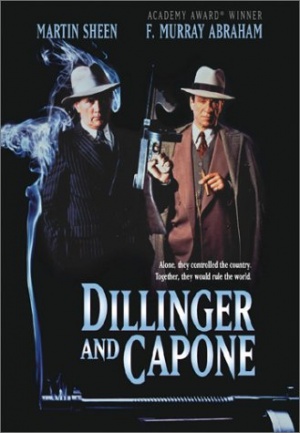
A Movie A Day #123: Dillinger and Capone (1995, directed by Jon Purdy)


1934.  Chicago.  The FBI guns down a man outside of a movie theater and announces that they have finally killed John Dillinger.  What the FBI doesn’t realize it that they didn’t get Dillinger.  Instead they killed Dillinger’s look-alike brother.  The real John Dillinger (played by Martin Sheen) has escaped.  Over the next five years, under an assumed name, Dillinger goes straight, gets married, starts a farm, and lives an upstanding life. Only a few people know his secret and, unfortunately, one of them is Al Capone (F. Murray Abraham).  Only recently released from prison and being driven mad by syphilis, Capone demands that Dillinger come out of retirement and pull one last job.  Capone has millions of dollars stashed away in a hotel vault and he wants Dillinger to steal it for him.  Just to make sure that Dillinger comes through for him, Capone is holding Dillinger’s family hostage.
This film, which was produced by Roger Corman, combines two popular but probably untrue rumors, that Dillinger faked his own death and that Al Capone had millions of dollars stashed somewhere in Chicago.  Though the two never met in real life (and moved in very different criminal circles), the idea of bringing Dillinger and Capone together sounds like a good one.  Unfortunately, the execution leaves a lot to be desired.  Sheen and Murray are both miscast in the lead roles, with Sheen especially being too old to be believable as the 40 something Dillinger, and the script never takes advantage of their notoriety.  In this movie, Dillinger could just as easily be any retired bank robber while Capone could just as easily be any unstable mob boss.  In classic Corman fashion, more thought was given to the title than to the story.

One things that does work about the movie is the supporting cast, which is full of familiar faces.  Clint Howard, Don Stroud, Bert Remsen, Jeffrey Dean Morgan, Catherine Hicks, Maria Ford, and Martin Sheen’s brother, Joe Estevez, are all present and accounted for.  Especially be sure to keep an eye out for Jeffrey Combs, playing an FBI agent who suspects that Dillinger may still be alive.  He may not get to do much but he’s still Jeffrey Combs.

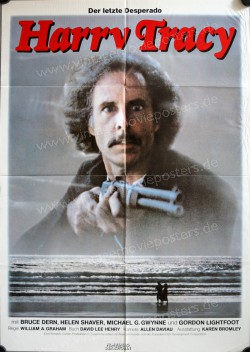
A Movie A Day #76: Harry Tracy, Desperado (1982, directed by William A. Graham)


The year is 1902.  The old west is coming to an end.  Almost all of the famous outlaws are either dead or imprisoned.  Only a few, like Harry Tracy (Bruce Dern), continue to make a living by robbing banks and trains.  Though he is often captured and even sentenced to death a few times, Harry is always able to escape.  His latest escape, from a prison in Washington, has led to the largest manhunt in American history.  Harry is being pursued by a trigger-happy army, led by U.S. Marshal Morrie Nathan (played by singer Gordon Lightfoot).  Harry has been in this situation before but this time, things are different.  Harry is traveling with Catherine Tuttle (Helen Shaver), the daughter of a local judge.  Harry and Catherine are in love but that does not matter to the men with the guns.

Harry Tracy is a sadly overlooked and elegiac western from Canada.  It is based on a true story.  Outlaw Harry Tracy really did escape from several prisons and he eventually was the target of the largest manhunt in U.S. history.  (His relationship with Catherine was apparently created for the film.)  In real life, Harry was reportedly considered to be more ruthless than Jesse James and he killed not only members of law enforcement but also members of his own gang.  The movie’s Harry is a much more gentle character.  In the film, Harry only kills in self-defense and he robs banks not because he’s greedy but because it’s the only life that he has ever known.  Harry is a relic of a time that it coming to a close.  In one scene, he is shocked to come across a man driving a car.  For an outlaw who usually makes his escape on horseback, the new century does not hold much promise.

In the tradition of Butch Cassidy and the Sundance Kid, Harry Tracy mixes comedy with tragedy.  The film’s defining image is Harry fleeing from his latest robbery and dropping most of the money in the process.  Harry often seems to be bewildered by all the fuss that people are making over him.  Bruce Dern and Helen Shaver are great as Harry and Catherine.  Even the casting of Gordon Lightfoot works.  (Lightfoot also wrote the movie’s theme song.)

Harry Tracy is an overlooked classic about the end of the old west and the beginning of the modern era.