Retro Television Review: St. Elsewhere 2.9 “AIDS and Comfort”


Welcome to Retro Television Reviews, a feature where we review some of our favorite and least favorite shows of the past! On Fridays, I will be reviewing St. Elsewhere, a medical show which ran on NBC from 1982 to 1988.  The show can be found on Hulu and, for purchase, on Prime!
This week, St. Elsewhere makes history.

Episode 2.9 “AIDS and Comfort”

(Dir by Victor Lobl, originally aired on December 21st, 1983)

A city councilman named Anthony Gifford (Michael Brandon) has checked into St. Eligius under an assumed name.  He’s complaining about fatigue.  His lymph nodes are swollen.  His immune system seems to be shutting down.  Dr. White and Dr. Westphall look at the man’s x-rays and Dr. White says that it looks like Gifford might be suffering from a newly discovered disease that no one knows much about.  The name of that disease is AIDS.

“Could he be …. gay?”  Dr. White asks.

Westphall initially scoffs.  He points out that Gifford is married and has two children.  When Gifford is asked directly about his personal life, he admits to having affairs but is quick to say that they were all with women.  Westphall later says that Gifford is either lying or they’ve discovered something entirely new about the virus and they need to call the CDC….

Today, with all we know about HIV and AIDS, it’s a bit jarring to hear some of the dialogue in this episode.  Doing some research, I discovered that this was the first ever episode of network television to deal with the AIDS epidemic and that it aired at a time when there were still a lot of unanswered questions about how the disease was spread.  (For instance, the episode aired shortly after the HIV virus has been discovered.)

When words get out that Gifford is a patient at the hospital and that he has AIDS, panic erupts.  No one donates to the hospital’s blood drive because they’re scared the needles have somehow gotten infected.  Even usually sympathetic characters — like Luther and Dr. Fiscus — refuse to be anywhere near the isolation ward.  Gifford’s doctor, Peter White, requests that Gifford’s case be given to another doctor.  Later, White asks everyone is Westphall is mad at him.  Morrison replies that White acted unethically.  White blames his wife and her fears of him contracting the disease by being in the same room as Gifford.  (Not surprisingly, White is also the one who, because he won’t stop whining about his job, is responsible for word spreading about Gifford having AIDS.)

After spending nearly the entire episode denying it, Gifford finally admits to having had affairs with other men.  As he leaves the isolation ward, he’s besieged by reporters.  Getting in the elevator, he sees that someone has spray-painted “AIDS” on the wall.  Before he leaves, he asks Westphall how long he has.  Westphall grimly replies that most AIDS patients die within two years.

Later, while talking to Dr. Craig and Nurse Rosenthal, Westphall says, “Yeah, I know that’s how I felt about it at first. Then I started to think, Who am I? Why should any of us be penalized, fatally, for choosing a certain lifestyle, especially when you realize that it all boils down to chance anyway? And I tell you something I don’t give a damn for all this talk about morality and vengeful gods and all that. If you have AIDS, you’re sick, you need help. That’s all that matters. And that’s why we’re here, right?”

And yes, it’s a bit jarring to hear Westphall refer to being a gay as a “choosing a certain lifestyle,” but you again you have to consider when this episode aired and that it was also the first network television show to feature a storyline about AIDS.  When this episode aired, saying that “If you have AIDS, you’re sick, you need help …. that’s all that matters,” took a certain amount of courage.  For many viewers, this episode was probably the first they ever really heard about AIDS.

This episode dealt very honestly with AIDS.  It actually helped that all of the character didn’t have the type of “perfect” reaction that television shows often present characters as having.  Even Dr. Westphall, usually presented as being this show’s beacon of moral clarity, had to deal with his own prejudices.  When it comes to a controversial topic, television shows too often portray their lead characters as being saints.  This episode portrayed the staff of St. Elsewhere as being flawed and imperfect and, as such, it was a very effective and thought-provoking hour.
Made-For-Television Movie Review: Red Alert (dir by William Hale)


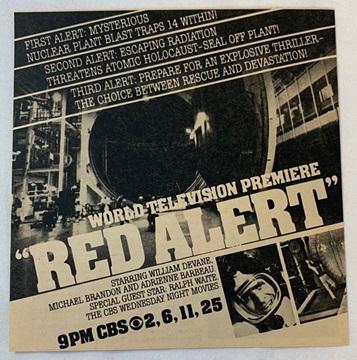
The 1977 made-for-television movie, Red Alert, opens with a man walking through a cemetery on a rainy day.  As we watch Howard Ives (Jim Siedow) move amongst the tombstones, we hear his thoughts.  He’s a sad and bitter man, wondering why he’s wasted so many years of his life at work.  He thinks about someone close to him who has died.  He’s obviously very troubled.

(Of course, any horror fans in the audience will immediately recognize Jim Siedow from his role as the Drayton Sawyer in the the original Texas Chainsaw Massacre.  He was troubled in that film as well!)

Howard works at the local nuclear power plant.  Ominously, when the film cuts to the plant, the first thing we see is a leak of very hot water.  I don’t know much about nuclear power plants but I imagine any type of leak is not a good thing.  The water leak causes the computer that runs the plant assuming that a nuclear disaster is minutes away from happening.  The compound is automatically sealed off, trapping fourteen men (including Howard), inside the reactor.  As Commander Stone (Ralph Waite) tries to keep a possible nuclear disaster from occurring, two investigators (played by William Devane and Michael Brandon) try to determined whether the accident was the result of a malfunction or of deliberate sabotage.  When the local sheriff (M. Emmet Walsh) informs them that Howard Ives’s wife has committed suicide, the investigators look into the troubled man’s history.  Eventually, the two investigators realize that the only way to prevent a nuclear disaster is by risking their lives by entering the sealed-off power plant.  The two investigators attempt to do their work under the cover of night and without causing a panic.  Needless to say, it doesn’t work.  One of them calls his wife (Adrienne Barbeau) and tells her that she needs to leave the area.  She tells her mother, who then tells her neighbor and soon the airport is crowded with people looking to get out of town.

Red Alert contrasts the intuitive approach of the two inspector with Commander Stone’s insistence that every bit of a data be fed to his computer before any decisions are made.  Stone’s hands are so tied by protocol and red tape that he stands by while the fourteen men who are trapped in the nuclear power plant die.  Wisely, though, the film doesn’t turn Stone into a cardboard villain.  He’s very much aware of what will happen if the plant suffers a core meltdown.  When one of his assistants mentions that he hasn’t been given any instructions on how to evacuate the town in case the plant does explode, Stone tells him that no plans have ever been drawn up because the plans would be useless.  There would be no way to evacuate everyone in time.

In the end, Red Alert is scary not because it deals with nuclear power but because it presents us with a world where no one — not even Devane and Brandon’s heroic investigators — seems to know what to do.  Everyone is slowed down by a combination of red tape and their own personal angst.  Devane is a strong investigator because, as a widower whose only son died in Vietnam, he has no family to worry about.  Unlike everyone else in Red Alert, he has nothing left to lose.  In the end, the film suggests that the only way to save the world is to cut yourself off from it.

Red Alert is a compelling and intelligent thriller, one that is well-acted by the entire cast and which builds up to strong conclusion.  The film’s anti-nuclear message is a bit heavy-handed but I imagine it was an accurate reflection of the fears that people were feeling at the time.  Today, the film works best as a warning about bureaucracy and depending too much on AI to make important, life-or-death decisions.  In the end, it’s human ingenuity that saves the day and that message is timeless.

Late Night Retro Television Reviews: Monsters 1.18 “The Match Game”


Welcome to Late Night Retro Television Reviews, a feature where we review some of our favorite and least favorite shows of the past! On Wednesdays, I will be reviewing Monsters, which aired in syndication from 1988 to 1991. The entire show is streaming on Tubi.

Agck!  The monsters are going to get me for being so late in posting this review!

Episode 1.18 “The Match Game”

(Dir by Michael Brandon, originally aired on April 15th, 1989)

So, if you’ve ever wanted to see Tori Spelling’s head literally get squeezed into nothingness, this is the episode for you.

Spelling plays Beverly, a teenage girl who enjoys breaking into old houses and playing the match game.  That’s the game where you and your friends sit in a circle and a match is passed from person to person.  The person holding the match tells a story until their flame dies.  Then the next person continues the story until their match dies.  The whole idea is to see just how grotesque things can get by the time the story finally ends.  I played a variation of the game when I was in high school.  Admittedly, my friends and I did it in our creative writing teacher’s classroom and we used an hourglass instead of a match and our stories usually turned pretty perverse by the time the third person got their chance to contribute.

Tori Spelling is not the only familiar face to be found here.  Her boyfriend is played by Sasha Jenson, who will forever be known as Dazed and Confused‘s Don Dawson.  Spelling’s best friend is played by Ashley Laurence, who was the lead in the first Hellraiser.  Spelling is not the only well-known actor here but she is the only one to give an amazingly bad performance.  That’s not a surprise, of course.  Spelling has never been a particularly good actress and she did this episode around the same time that she was playing Screech’s girlfriend on Saved By The Bell.  Credit where credit is due, she is better here than she was on Saved By The Bell.

When Paul (Byron Thames), the newcomer to the group, gets his chance to hold the match, it doesn’t go out until he’s gone into great detail about Hubert Waverly, the horribly deformed man who once lived in the house where the group is playing their game.  This brings Hubert to life.  Jenson and Spelling are taken out quickly.  Finally, it occurs to the two survivors that Paul can vanquish Hubert by finishing the story.  That’s good and all but the episode never really explains why Paul’s match didn’t go out the first time.  How did he know about Hubert?  Did Hubert spring from Paul’s mind?  These are important questions that the show just kind of pushes to the side.

Oh well!  This is still an atmospheric episode and probably as close as this show has gotten to being scary since that episode about the makeup box.  Even Tori Spelling’s bad performance felt oddly appropriate for what was essentially a 30-minute 80s slasher film.  I enjoyed this episode so much that I might even go find that old box of matches that we keep out in the garage….

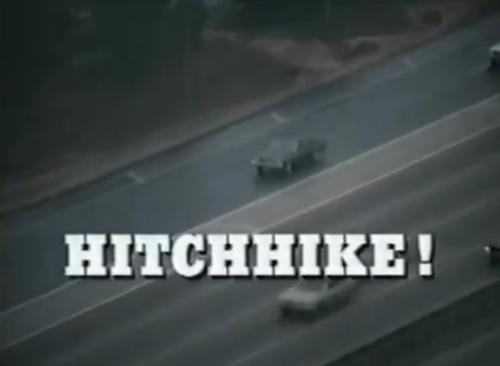
Retro Television Reviews: Hitchhike! (dir by Gordon Hessler)


Welcome to Retro Television Reviews, a feature where we review some of our favorite and least favorite shows of the past!  On Sundays, I will be reviewing the made-for-television movies that used to be a primetime mainstay.  Today’s film is 1974’s Hitchhike!  It  can be viewed on YouTube!

Claire Stevens (Cloris Leachman) is an emotionally vulnerable woman who is dealing with her loneliness and depression by driving to San Francisco to visit her sister.  As she’s driving, she spots a young man named Keith (Michael Brandon).  Keith is standing on the side of the road and holding out his thumb.  At first, Claire does the smart thing and she drives by him without stopping.  However, Claire starts to feel guilty so she turns around and — NO, CLAIRE!  WHAT ARE YOU THINKING!? — offers him a ride.  It turns out that he’s going to San Francisco as well!

At first, the drive is awkward.  Keith says that he doesn’t want to talk and he doesn’t appreciate it when Claire tries to make him listen to the classical music station.  But, as they drive, Keith starts to let down his defenses.  He says that he wishes that he could just sail away on the ocean.  He encourages Claire to embrace life and to just go for it.  They stop at a pier and have lunch.  Claire buys Keith a silly white hat and she places it on his head because, as she puts it, “it’s cute.”  Keith argues with her but he doesn’t take off the hat.  However, when Keith spots some cops, he immediately leads Claire away from them.

The viewer watches all of this with a sense of dread because the viewer knows what Claire doesn’t.  The viewer knows that Keith is the son of a wealthy man.  The viewer knows that Keith had been having an affair with his stepmother, who was only a few years older than Keith.  And the viewer knows that Keith murdered his stepmother with the same weapon that he’s currently carrying in his bag.  The police are looking for Keith and Keith is willing to do just about anything to stay free.

I have to admit that I yelled a little when Claire offered Keith a ride because it was such an obviously stupid thing to do.  Everyone knows that it’s never a good idea to pick up a hitchhiker.  And, if you’re a woman who is driving down an isolated road by yourself, the last thing you should ever do is offer a ride to some strange man standing on the side of the road.  Claire’s actions were foolish but, because she was played by Cloris Leachman, it was still hard not to sympathize with her.  Claire is someone who feels as if she’s been abandoned by the world and, quite obviously, she sees Keith as a kindred spirit.  Over the course of their journey, it becomes obvious that Claire is using Keith as a substitute for what she’s missing in her life.  He becomes both a son and a companion to her.  Unfortunately, Keith tends to go into a rage whenever he sense anyone getting too close to him.

Hitchhike! is a short movie and, for all the dramatic build-up, it ends on a rather anti-climatic note.  Cameron Mitchell shows up as a detective who is looking for Claire and Keith and he gives a mannered performance that is oddly over-the-top by even his generous standards.  That said, Michael Brandon has the blandly handsome look of a generic but charming serial killer while Cloris Leachman gives a credible and sympathetic performance as Claire.  If nothing else, this film can be watched with The Hitcher as a double feature.  Never stop your car for anyone!

Scenes That I Love: The Opening of Four Flies On Grey Velvet (Happy Birthday, Dario Argento)


Since today is Dario Argento’s 80th birthday, I’m going to share a scene that I love that he directed.

I love the opening of Argento’s 1971 giallo, Four Flies On Grey Velvet.  This was Argento’s third film as a director and it tells the story of an American drummer who gets caught up in a gruesome murder.  In the opening credits, we watch as Michael Brandon drums away and finds time to take care of a distracting fly.  In just a matter of minutes, Argento tells us everything we need to know about our hero and the role that he’ll be playing in this film.  Like the best drummers, he holds everything together and that’s a good skill to have because, in typical Argento fashion, his entire life is about to fall apart.

From Four Flies on Grey Velvet:

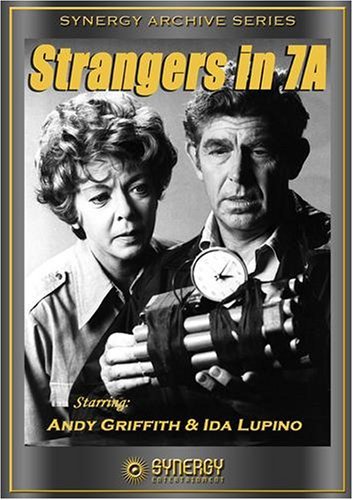
The Strangers in 7A (1972, directed by Paul Wendkos)


Artie Sawyer (Andy Griffith) is a man who no one respects.  Having recently been fired from his long-time job, he’s forced to take a job as a superintendent for an apartment building in New York.  The tenants don’t think much of him.  His wife, Iris (Ida Lupino), is getting tired of his self-pity.  The only person who seems to like Artie is Claudine (Susanne Benton).  The young and beautiful Claudine approaches Artie in a bar and, after flirting with him, reveals that she needs a place to stay.  Artie agrees to let Claudine check out Apartment 7A.  At the apartment, Claudine rolls around in the bed, dances seductively, and then reveals that she has three male friends who are going to be staying in the apartment with her.  Billy (Michael Brandon), Virgil (Tim McIntire), and Riff (James A. Watson, Jr.) all served in Vietnam together and now they need to crash at the apartment for a while.  Artie can either let them stay or they can reveal to his wife that he was at a bar, trying to pick up young women.

Led by the psychotic Billy, the three men are planning on robbing the bank next door.  When Artie, who is having doubts about whether or not it was a good idea to let four obviously unstable people live rent-free in his building, discovers their plans, he and Ida are taken hostage.  When the bank robbery goes wrong, Billy tries to use the hostages and a bomb as leverage for his escape from the police.

As far as films about bank robberies goes, The Strangers in 7A is no Dog Day Afternoon.  While it’s interesting to see the usually confident Andy Griffith play a loser, he never seems like enough of a loser that he would actually risk a job that he clearly needs just because Claudine flashed a little leg at him.  Even when he’s playing a character who is down on his luck, he’s still Andy Griffith.  Along with the lead role being miscast, the bank robbers are too generic to really be credible or threatening.  Susanne Benton is sexy as the femme fatale and Ida Lupino is sympathetic as Artie’s wife but otherwise, The Strangers in 7A is forgettable.

The Strangers in 7A was made for television.  At the time, Andy Griffith was still trying to escape being typecast as Mayberry’s amiable Sheriff Taylor.  Griffith was a convincing villain in movies like Pray For The Wildcats and Savages but he’s just not believable as a loser in this film.

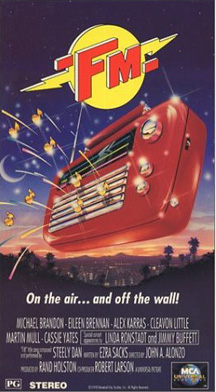
A Movie A Day #182: FM (1978, directed by John A. Alonzo)


Hey, California!  Are you ready to soft rock!?
That is the question asked by FM, a movie about rock that tries to stick it to the man with some of the safest, least revolutionary music ever recorded.

FM is centered around Q-Sky, an FM radio station in Los Angeles.  Because the laid back station manager (Michael Brandon) allows his DJs to program their own music with little commercial interruption, Q-Sky has become one of the most popular radio stations in California.  The corporate suits, though, demand that Q-Sky play less music and air more commercials, especially one that is specifically designed to get mellow Californians to join the Army.  When Brandon refuses, he is fired.  Outraged, Q-Sky’s motley crew of DJs (who include Martin Mull, Cleavon Little, Eileen Brennan, and even former football great Alex Karras) barricade themselves in the station and lead a protest by playing their music without commercials.

That would all be well and good except that the DJs spend most of their time playing songs by such noted rockers as Jimmy Buffett, Billy Joel, and REO Speedwagon.  A major set piece of the film is Q-Sky’s attempt to secretly broadcast a Linda Ronstadt concert that is being sponsored by a rival station.  At a time when Johnny Rotten was still singing Anarchy in the UK,  Q-Sky’s idea of rebellion was to go from Bob Seger to James Taylor with limited commercial interruption.

The always reliable Martin Mull is always good for some laughs and this was the only movie directed by award-winning cinematographer John A. Alonzo so, if nothing else, FM always looks good.  With its ensemble cast and episodic narrative, FM tries hard to be an Altmanesque satire but, ultimately, it fails because the revolution is not going to sound like The Doobie Brothers.

(Even though The Doobie Brothers clearly rock.)

“Who likes The Doobie Brothers?”

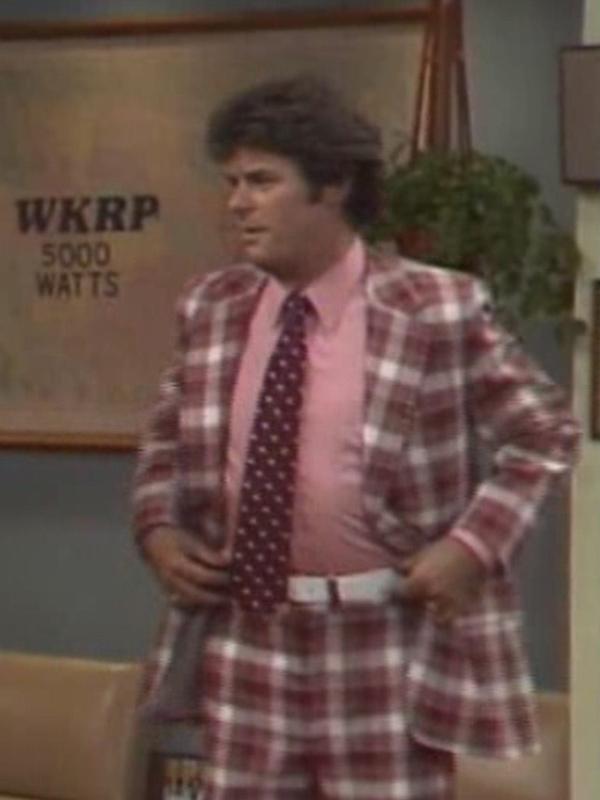
Because Michael Brandon looked like Gary Sandy and Martin Mull possessed a passing resemblance to Howard Hesseman, some reference books state that FM was the inspiration for WKRP in Cincinatti.  However, the first season of WKRP was already in production before FM was released to theaters and FM was such a financial flop that it is doubtful it inspired anything.

Add to that, while Venus Flytrap probably could have made it work, Dr. Johnny Fever would never have fit in at Q-Sky.  Johnny’s frequent acid flashbacks would have unnerved the mellow Q-Sky vibes.  Herb Tarlek, on the other hand…

“It must be a struggle to match the belt with the shoes.”
“Sometimes, I can’t do it.”


Horror on the Lens: Deadly Messages (dir by Jack Bender)


Today’s horror on the lens is a made-for-TV movie from 1985!

In Deadly Messages, Kathleen Beller plays a woman named Laura who witnesses a murder and then becomes convinced that the murderer is after her.  She also finds a Ouija board that continually sends her the same message: “I am going to kill you.”  The police are skeptical of Laura.  Even worse, her boyfriend (Michael Brandon) is skeptical!  And, needless to say, Laura may have some secrets of her own…

Deadly Messages is a lot of fun.  Thank you to frequent TSL commenter Trevor Wells for suggesting this movie!

Enjoy!

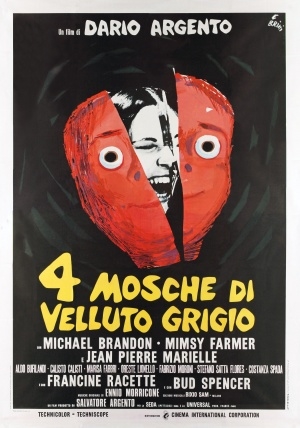
The Films of Dario Argento: Four Flies On Grey Velvet


quattro_mosche

After the good but somewhat generic Cat o’Nine Tails, Dario Argento returned to form with his third film, 1971’s Four Flies on Grey Velvet.

It’s not particularly easy to describe the plot of Four Flies because, much like The Bird With The Crystal Plumage, the storyline is less important than the way that Argento tells it.  The film tells the story of Roberto Tobias (Michael Brandon), a drummer with an up-and-coming rock band in Rome.  In many ways, Roberto is a typical drummer.  He’s the guy who, even though he’s often obscured in the background, keeps things balanced.  He has a loving wife, Nina (Mimsy Farmer), a nice house, and worldly, politically woke friends who smoke weed and praise art.  Admittedly, one of those friends does tell a rather gruesome story about witnessing a beheading in Saudi Arabia which leads to Roberto having a reoccurring nightmare but otherwise, Roberto would appear to have a great life.

(Incidentally, Roberto’s nightmares are Argento at his best.)

So, why is this stable and easy-going guy suddenly being followed by a mysterious man in a suit?  And why, when Roberto confronts the man, does he discover that there’s yet another mysterious figure — this one wearing a mask — following him and taking pictures?

That’s the mystery that opens Four Flies on Grey Velvet but it’s not the only mystery to be found in the film.  In fact, this movie finds Argento at both his most macabre and his most playful.  At times, he literally seems to be seeing just how far he can push and how complicated he can make things before totally losing his audience.  The film may start with Roberto being followed and having nightmares but eventually, it comes to involve everything and everyone from Nina’s enigmatic cousin, Dalia (Francine Racette) to a beatnik named God (played by none other than spaghetti western mainstay, Bud Spencer) to a flamboyant private investigator (Jean-Pierre Marielle).  (By today’s standards, the portrayal of the gay detective has a few cringey moments but you have to remember that Four Flies On Grey Velvet was made in 1971.  It was nothing less than revolutionary for an Italian film of that era to portray an openly gay contemporary character in any type of positive light.)  To top it all off, the solution to the film’s main mystery is discovered through optography, the long-since discredited idea that an eye will “save” the last image seen before death.  It’s ludicrous but Argento pulls it off with a cheerfully over-the-top style that perfectly matches the film’s twisted plot.  After the toned down Cat o’Nine Tails, Four Flies was Argento’s way of reminding viewers of who he truly was as a filmmaker.

The film’s brilliant opening sets the tone for the entire film.  Watch it below and thank me later:

It’s rare that anyone every really discusses the acting in an Argento film.  Argento has himself admitted that he doesn’t worry much about actors and many of his films have been released in badly dubbed versions, which often makes it difficult to fairly judge any of the performances.  That said, Roberto Tobias is one of my favorite Argento protagonists and it’s all due to Michael Brandon’s performance.  Brandon makes Roberto into such a nice guy and does such a good job of capturing his descent into paranoia that it’s impossible not to get caught up in his story.  (I would even argue that the long-haired and politically concerned Roberto is almost an autobiographical stand-in for Argento himself.)  Though I can’t really explain why without running the risk of spoiling a major part of the movie, Mimsy Farmer is also excellent.  Reportedly, Argento originally wanted to cast Mia Farrow and you can imagine a post-Rosemary’s Baby pre-Woody Allen Farrow in the role.  But I’m glad that Argento couldn’t get her because Mimsy Farmer gives a close to perfect performance.

Four Flies was the third and final part of Argento’s “animal trailer,” and, at the time, Argento declared that Four Flies would also be his final giallo film.  He followed up Four Flies with The Four Days, a historical comedy that was considered to be such a failure that, after its release, Argento returned to the safety of the giallo genre and gave the world one of his greatest triumphs, Deep Red.  However, if The Four Days had been a success and Four Flies had been Argento’s final giallo film, it would have been a triumphant note to go out on.

Here’s the very misleading trailer that was used for Four Flies On Grey Velvet‘s American release.

http://www.youtube.com/watch?v=raTtFzQ1vNo

And here’s the even more obscure European trailer!

Back to School Part II #7: Cage Without A Key (dir by Buzz Kulik)


Cage-without-a-key_tv-guide-poster

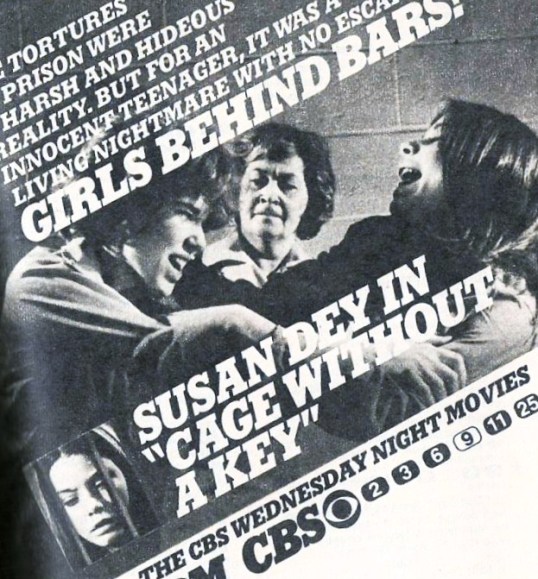
For the fifth film in my Back To School series of reviews, I watched Cage Without A Key, a made-for-TV movie from 1975.

17 year-old Valerie Smith (Susan Dey) would appear to have everything.  She has a loving mother and a loyal best friend.  She just graduated from high school and has been accepted to a good college.  She’s looking forward to going down to San Francisco for the weekend before starting her summer job.  The future look great and, of course, that means that she’s about to make the biggest mistake of her life.

And she’s going to do it 70s style!

When her car breaks down on the way to San Francisco, she makes the mistake of accepting a ride from a long-haired guy in a Volkswagen microbus.  Buddy Goleta (Sam Bottoms, in full 70s weirdo mode) went to high school with Valerie and appears to have a crush on her.  Buddy also appears to be a little bit crazy himself as he tells everyone that he meets that Valerie is “my old lady.”  Finally, Buddy pulls over to a convenience store and kills everyone inside.  Since Valerie’s in the microbus, she gets arrested along with Buddy.  Since Buddy claims that he and Valerie are lovers, she’s convicted of being an accessory and is sentenced to a … REFORM SCHOOL!

(Cue dramatic music.)

The warden — Mrs. Little (Katharine Helmond) — insists that she’s not running a prison.  Instead, she’s running a very progressive school where the students all happen to be thieves and murderers.  The school even has pleasant euphemisms for all the standard prison film elements.  For instance, no one is put in solitary confinement.  Instead, they’re sent to meditation.

Anyway, while Valerie waits for her dedicated public defender (David Brandon) to prove her innocence and get her out of reform school, she finds herself being approached by the various gangs who run the school.  Valerie says she doesn’t want anything to do with any of that.  She just wants to fly under the radar until she’s set free.  But then she’s approached by a predatory lesbian and, as we all known from watching other prison films, nothing will make you join a gang faster than being approached by a predatory lesbian…

Okay, Cage Without A Key is not exactly Orange Is The New Black.  What it is, however, is a time capsule of the time it was made.  Everything from the slang to the clothes to the attitudes to the squishy, upper class liberalism of Valerie’s lawyer practically screams 1970s.

Add to that, classic film lovers will appreciate the fact that the evil gang leader is named Suzy Kurosawa!

Incidentally, Cage Without A Key was written by Joanna Lee, who readers of this site will probably best remember for playing one of the alien invaders in Plan 9 From Outer Space.

http://www.youtube.com/watch?v=8jU37bRN5t0