Days of Paranoia: Edmond (dir by Stuart Gordon)


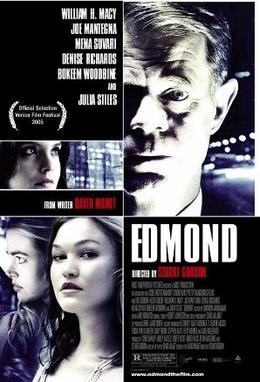
Based on a one-act play by David Mamet, 2005’s Edmond tells the story of Edmond Burke (William H. Macy).

Edmond shares his name (if not the actual spelling) with the philosopher Edmund Burke.  Edmund Burke was a strong believer that society had to put value in good manners to survive and that religious and moral institutions played an important role in promoting the idea of people treating each other with respect and decency.  Edmund Burke knew what he believes and his writings continue to influence thinks to this day.  Edmond Burke, on the other hand, doesn’t know what he believes.  He doesn’t know who he wants to be.  All he knows is that he doesn’t feel like he’s accomplished anything with his life.  “I don’t feel like a man,” he says at one point to a racist bar patron (played by Joe Mantegna) who replies that Edmond needs to get laid.

On a whim, Edmond steps into the shop of a fortune teller (Frances Bay), who flips a few Tarot cards and then tells Edmond that “You’re not where you’re supposed to be.”  Edmond takes her words to heart.  He starts the night by telling his wife (played by Mamet’s wife, Rebecca Pidgeon) that he’s leaving their apartment and he won’t be coming back.  He goes to the bar, where he discusses his marriage with Mantegna.  He goes to a strip club where he’s kicked out after he refuses to pay $100 for a drink.  He goes to a peep show where he’s frustrated by the glass between him and the stripper and the stripper’s constant demand that he expose himself.  He gets beaten in an alley by three men who were running a three-card monte scam.  Edmond’s problem is that he left home without much cash and each encounter leads to him having less and less money.  If he can’t pay, no one wants to help him, regardless of how much Edmond argues for a little kindness.  He pawns his wedding ring for $120 but apparently, he just turns around and uses that money to buy a knife.  An alley-way fight with a pimp leads to Edmond committing his first murder.  A one-night stand with a waitress (a heart-breaking Julia Stiles) leads to a second murder after a conversation about whether or not the waitress is actually an actress leads to a sudden burst of violence.  Edmond ends up eventually in prison, getting raped by his cellmate (Bookem Woodbine) and being told, “It happens.”  Unable to accept that his actions have, in one night, led him from being a businessman to a prisoner, Edmond says, “I’m ready to go home now.”  By the end of the film, Edmond realizes that perhaps he is now where he was meant to be.

It’s a disturbing film, all the more so because Edmond is played by the likable William H. Macy and watching Macy go from being a somewhat frustrated but mild-mannered businessman to becoming a blood-drenched, racial slur-shouting murderer is not a pleasant experience.  Both the play and the film have generated a lot of controversy due to just how far Edmond goes.  I don’t see either production as being an endorsement of Edmond or his actions.  Instead, I see Edmond as a portrait of someone who, after a lifetime of being willfully blind to the world around him, ends up embracing all of the ugliness that he suddenly discovers around him.  He’s driven mad by discovering, over the course of one night, that the world that is not as kind and well-mannered as he assumed that it was and it all hits him so suddenly that he can’t handle it.  He discovers that he’s not special and that the world is largely indifferent to his feelings.  He gets overwhelmed and, until he gets his hands on that knife, he feels powerless and emasculated.  (The knife is an obvious phallic symbol.)  It’s not until the film’s final scene that Edmond truly understands what he’s done and who he has become.

Edmond is not always an easy film to watch.  The second murder scene is truly nightmarish, all the more so because the camera remains on Edmond as he’s drenched in blood.  This is one of William H. Macy’s best performances and also one of his most disturbing characters.  That said, it’s a play and a film that continues to be relevant today.  There’s undoubtedly a lot of Edmonds out there.
The Films of 2024: Reagan (dir by Sean McNamara)


In Reagan, Dennis Quaid stars at the 40th President of the United States.

Framed as a story being told by a former KGB agent (Jon Voight) who is attempting to make a younger politician understand why Russia lost the Cold War, Reagan starts with Reagan’s childhood, includes his time as an actor and as the anti-communist head of the SAG, and then gets into his political career.  Along the way, several familiar faces pop up.  Robert Davi plays a thuggish Russian leader.  Mena Suvari plays Reagan’s first wife while Penelope Ann Miller plays his second.  Xander Berekely plays George Schultz (who was just previously played by Sam Waterston in The Dropout miniseries.)  C. Thomas Howell, Kevin Dillon, Dan Lauria, and Lesley-Anne Down all have small but important roles.  And the usual suspects when it comes to conservative filmmaking — Nick Searcy, Kevin Sorbo, and Pat Boone — are there to compliment Voight and Davi.  I was a little surprised to see that Dean Cain was not present.

As usually happens to films that feature sympathetic Republicans, Reagan was slammed by critic but better-appreciated by the audience for which the film was made.  I wasn’t particularly surprised.  Movie critics tend to be liberal and Reagan is very much not that.  For a professional film critic, a film like Reagan must be met with snark and derision because otherwise, one would risk cancellation.  Don’t get me wrong.  I’m not saying that there aren’t things to criticize about Reagan the film.  I’m just saying that one should always keep in mind that critics have their own individual biases.  One reason why the Rotten Tomatoes score is such an unfortunate development is because it ignores the fact that most films have things that work and things that don’t work and that quality is often in the eye of the beholder.  Instead, it just tells us that a film is either a 90% or a 10%.

As for Reagan, it’s definitely a bit on the heavy-handed side but, then again, I think the same can be said for just about every political film that’s come out over the last few decades.  For those who claim Reagan is somehow more heavy-handed than most, I invite them to sit through Rob Reiner’s LBJ.  Indeed, the only director who has really shown a willingness to admit that a President can be both good and bad was Oliver Stone and when was the last time anyone watched NixonReagan is at its weakness when it tries to recreate Reagan’s time as an actor.  Dennis Quaid gives a good and charming performance throughout the film but he’s also 70 years old and, in the scenes where he plays the youngish Ronald Reagan, all of the soft-lighting and Vaseline on the lens ends up making him look like a wax figure.  Once Reagan gets older, Quaid is allowed to act his age and both he and the film become much more convincing.  I enjoyed the film once Reagan became President, though you should understand that I have biases of my own.  I’m a fan of low taxes and individual freedom, which is why I’m also not a fan of communism or, for that matter, any extreme ideology that attempts to tell people how to live or think.  “Tear down this wall!” Regan says while standing in front of the Berlin Wall and it’s a rousing moment, both in reality and on film.

In the end, Reagan is a film that will be best appreciated by people who already like Ronald Reagan.  Yes, the film is heavy-handed and the framing device is a bit awkward.  But Dennis Quaid’s heartfelt (and, towards the end, heartbreaking) performance carries the film.  The film is not at all subtle but you know what?  I’ve seen a countless number of mediocre films that have portrayed Reagan negatively, often with as little nuance and just as heavy-handed an approach as Reagan uses in its positive portrayal of the man.  I sat through The Butler, for God’s sake.  There’s nothing wrong with having a film that looks at the man from the other side.  Those who like Ronald Reagan will feel vindicated.  Those who don’t will say, “What was up with that Pat Boone scene?”

Lisa Marie’s 16 Worst Films of 2020


Well, it’s nearly February so I guess it’s time for me to start listing my picks for the best and the worst of 2020.

It’s pretty much a tradition here at the Shattered Lens that I always end up running behind as far as posting these lists are concerned.  I always think that I’m going to have everything ready to go during the first week of January but then I realize that there’s still a host of movies that I need to see before I can, in good conscience, post any sort of list.  In fact, as I sit here writing this post, I’m watching some films that could very well make it onto my best of 2020 list.

Of course, the list below is not my best of 2020 list.  Instead, below, you’ll find my picks for the 16 worst films of 2020.  Why 16 films?  Because Lisa doesn’t do odd numbers!

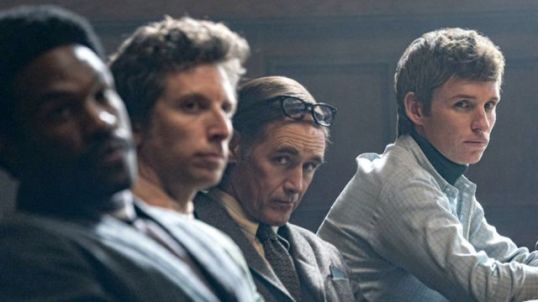
It probably won’t be a surprise you to see some of these films on the list.  For instance, I don’t think anyone will be shocked to see The Grudge or After We Collided mentioned.  However, I imagine that some people will be surprised to see The Trial of the Chicago 7 on the list.  What can I say?  The more I thought about it, the more it represented everything that I dislike about mainstream Hollywood filmmaking.  The fact that it’s probably going to be a major Oscar contender made it even more important to list it.  I’m sure there’s a lot of critics, for instance, who wish they had found room for Green Book when they were compiling their 2018 lists.

In the end, of course, this list is my opinion.  You’re free to agree or disagree.  That’s the wonderful thing about having an opinion.

(Also be sure to check out my picks for 2019, 20182017201620152014201320122011, and 2010!)

And now, the list:

16. John Henry (dir by Will Forbes) — I actually feel kind of bad for listing this silly B-movie as one of the worst of 2020 but it was just so slowly paced and thematically muddled that I really didn’t have a choice.

15. The Binge (dir by Jeremy Garelick) — Doing The Purge with drugs and alcohol as opposed to murder is actually a pretty cool idea so this movie has no excuse for being so dull.  There is one fun dance number that livens things up, which is why The Binge is listed at number 15 as opposed to number 3.

14. Once Upon A Time In London (dir by Simon Rumley) — London has a rich and exciting history when it comes to organized crime but you wouldn’t know that from watching this dull film.

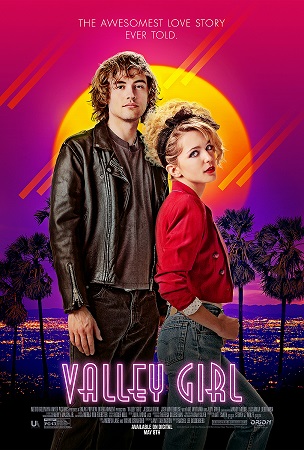
13. Valley Girl (dir by Rachel Lee Goldenberg) — This remake was a boring jukebox musical that featured 30 year-old high school students and unimaginative use of a host of 80s songs.  (A girl at the beach says that she just wants to have fun.  Can you guess what song the cast started singing?)

12. Ava (dir by Tate Taylor) — Jessica Chastain’s an assassin and …. *yawn.*  Tate Taylor was exactly the wrong director to be expected to do anything interesting with this story.

11. Blumhouse’s Fantasy Island (dir by Jeff Wadlow) — My fantasy would be for a better film.  Boom!  Roasted!  (Actually, I bet I’m the thousandth blogger to have said that.)

10. The Grudge (dir by Nicolas Pesce) — Eh.  Who cares?

9. Artemis Fowl (dir by Kenneth Branagh) — This was a confusing movie that mixed the least interesting parts of the Harry Potter franchise with the least interesting bits of the Marvel Cinematic Universe.

8. The Murder of Nicole Brown Simpson (dir by Daniel Farrands) — I actually defended The Haunting of Sharon Tate but this semi-follow up was just too distasteful.  What was the deal with Nicole being dragged across the ceiling?  Both Mena Suvari and Nick Stahl deserve better.  So does director Daniel Farrands, for that matter.

7. The Dalton Gang (dir by Christopher Forbes) — Never has the old west looked so cheap.

6. After We Collided (dir by Roger Kumble) — This was marginally better than the first After but that’s not saying much.  The total lack of chemistry between the two romantic leads makes it difficult to care about whether or not they ever end up together.  The cloying cameo from writer Anna Todd (“What have you written?”  “Oh, this and that,”) almost made me throw a shoe at my TV.

5. The Trial of the Chicago 7 (dir by Aaron Sorkin) — I liked Joseph Gordon-Levitt’s performance and the scene where Bobby Seale gets gagged in court was powerful and disturbing.  Otherwise, this movie represented Hollywood at its most vapid.

4. Sergio (dir by Greg Barker) — This was a muddled and poorly acted commercial for the United Nations.

3. A Fall From Grace (dir Tyler Perry) — Tyler Perry’s beard was the best thing about this movie.

2. The Last Thing He Wanted (dir by Dee Rees) — This was the first bad film that I saw in 2020 and it’s remained here, near the bottom of the list, for 12 months.  This movie was a muddle mess that thought it had more to say than it did.  It did feature a good performance from Willem DaFoe, which saved it from being the worst film of the year.  Instead, that honor goes to….

1. Let Them All Talk (dir by Steven Soderbergh) — This mind-numbingly dull film from Steven Soderbergh seems to be determined to troll everyone who has ever said that they’d watch Meryl Streep in anything.

Coming up tomorrow: my favorite songs of 2020!

TSL Looks Back at 2020:

  1. My Top 20 Albums of 2020 (Necromoonyeti)
  2. 25 Best, Worst, and Gems That I Saw In 2020 (Valerie Troutman)
  3. Top 10 Vintage Collections (Ryan C)
  4. Top 10 Contemporary Collections (Ryan C)
  5. Top 10 Original Graphic Novels (Ryan C)
  6. Top 10 Ongoing Series (Ryan C.)
  7. Top 10 Special Mentions (Ryan C.)
  8. Top Ten Single Issues (Ryan C)

The TSL’s Grindhouse: The Murder of Nicole Brown Simpson (dir by Daniel Farrands)


Last year, I was one of the few people willing to defend The Haunting of Sharon Tate, which I felt was an effective film despite its rather icky premise.  I thought that the film managed to maintain a compelling atmosphere of dread and I also thought that, though somewhat miscast, Hilary Duff gave a good performance in the lead role.  Finally, I felt that, despite the exploitative nature of the film, the film was firmly on the side of Sharon Tate and the other victims of the Manson Family.  Though the title may have been offensive, the film itself was better than it had any right to be.

I really can’t say the same for The Murder of Nicole Brown Simpson, which is from the same production team as The Haunting of Sharon Tate and which imagines the final days in the life of another famous homicide victim.  Mena Suvari stars as Nicole Brown Simpson, the ex-wife of football player OJ Simpson (played, in a hyperactive manner, by Gene Freeman).  The film follows Nicole as she deals not only with her abusive ex-husband but also with shady friends like Faye Resnick (Taryn Manning) and slightly less-disreputable friends like Kris Jenner (Agnes Bruckner).

In the film, Nicole also has a short-lived affair with a handsome but unstable drifter named Glen Rogers (Nick Stahl).  In real life, Glen Rogers is currently incarcerated in Florida, where he awaits execution for a series of murders.  Rogers has confessed to killing people all across the country, though there’s some doubt as to whether or not Rogers was being honest when he did so.  (Rogers later recanted the confession.)  Rogers’s brother has claimed that Glen confessed to murdering Nicole Simpson and Adam Goldman, saying that he was actually hired to do so by OJ Simpson.  (Technically, Glen Rogers said that Simpson hired him to steal some jewelry but also gave him permission to kill Nicole if he felt that it was necessary.)  The film presents Rogers’s story as being fact, complete with a scene of OJ meeting with Glen shortly before the murders occur.

Other than making the case that Glen Rogers murdered Nicole and Ron, the majority of the film is just Mena Suvari walking around Los Angeles and talking to her friends about how she has a feeling that something terrible is going to happen.  Whereas The Haunting of Sharon Tate was willing to challenge the audience’s expectations by, at least briefly, changing history and presenting an alternate version of what could have happened that day in 1969, The Murder of Nicole Brown Simpson is pretty much a grim march towards death, with each scene bringing the audience closer and close to the night of the actual murderers.  If the film actually presented Nicole as being a fully-realized character as opposed to just a doomed victim, the story’s fatalistic atmosphere would work on an existential level but since the film doesn’t seem to care about who Nicole was before she died, it all just feels very sleazy.

Towards the end of the film, there’s an odd scene where an unseen force suddenly starts to violently throw Nicole across her bedroom, sending her against the walls and, at one point, pinning her to the ceiling.  It’s a weird scene because it comes out of nowhere and it’s never explained whether it really happened or if Nicole was imagining being attacked.  It doesn’t belong in this film and yet, it’s also the only moment when this film feels in any way unpredictable.  Is the film trying to suggest that death, as a paranormal entity, was stalking her even before the night of her murder or was the scene just tossed in to liven up what is otherwise a rather slowly paced movie?  Who knows?  Again, if the film had really explored the issue of whether or not fate is predetermined and inevitable, it would have made for a far more interesting story than the rush job that this film appears to have been.

Mena Suvari and Nick Stahl are two actors who probably deserve better than this.  Stahl is especially effective as the creepy but handsome Glen Rogers.  Visually, the film is full of Hollywood glamour and ominous shadows.  It’s not a bad-looking film, at all.  Technically, The Murder of Nicole Brown Simpson is well-made but, at the same time, it’s all just so astoundingly pointless.  The memory of Nicole Simpson deserved better.


Film Review: Factory Girl (dir by George Hickenlooper)


Oh God.  Factory Girl.

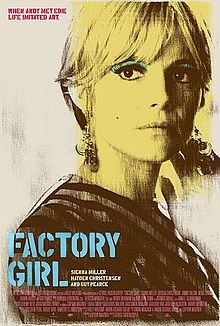
Released in 2006, Factory Girl was a biopic about Edie Sedgwick, the tragic model/actress/artist who was briefly both Andy Warhol’s muse and one of the most famous women in America.  Before I talk too much about this film, I should probably admit that I’m probably the worst possible person to review a movie about Edie Sedgwick.

Why?

Allow me to repost something that I wrote when I reviewed Edie’s final film, Ciao Manhattan:

“In the late 60s, Edie Sedgwick was a model who was briefly the beautiful face of the underground.  Vogue called her a “youthquaker.”  She made films with Andy Warhol, she dated the rich and the famous and for a brief time, she was one of the most famous women in America.  But a childhood full of tragedy and abuse had left Edie fragile and unprepared to deal with the pressures of being famous.  She was fed drugs by those who claimed to care about her, she had numerous mental breakdowns, and, when she was at her most vulnerable, she was pushed away and rejected by the same people who had loved her when she was on top of the world.  Edie died because, when she asked for help, nobody was willing to listen.


Edie Sedgwick (1943 — 1971)

I guess I should explain something.  I don’t believe in reincarnation but if I did, I would swear that I was Edie Sedwick in a past life.  Of all the great icons of the past, she, Clara Bow, andVictoria Woodhull are the ones to whom I feel the closest connection. (Edie is the reason why, for the longest time, I assumed I would die when I was 28.  But now I’m 29, so lucky me.)”

(Incidentally, I wrote that two years ago and I’m still alive so, once again, lucky me.)

Anyway, my point is that I’m always going to be a hundred times more critical of a film about Edie Sedgwick as I would be about any other film.  If you’re already guessing that I didn’t particularly care for Factory Girl, you’re right.  However, there are some people whose opinions I respect and some of them love this film.

Anyway, Factory Girl is a biopic that’s structured so conventionally that it even opens with Edie (played by Sienna Miller) narrating her story to an unseen interviewer.  I can count on one hand the number of successful biopics that have featured someone telling the story of their life to an unseen interviewer.  It’s a conventional and kind of boring technique.  Anyway, the film follows all of the expected beats.  Edie arrives in New York.  Edie is spotted by Andy (Guy Pearce).  Edie makes films with Warhol.  Her famous dance in Vinyl is recreated.  Edie becomes Andy’s platonic girlfriend but then, she meets and falls in love with Bob Dylan…

Oh, sorry.  He’s not actually Bob Dylan.  According to the credits, his name is Folksinger.  He says Bob Dylan type stuff.  He rides around on a motorcycle.  He carries a harmonica.  Oh, and he’s played by Hayden Christensen.

See, the first half of Factory Girl is actually not bad.  Sienna Miller gives a pretty good performance as Edie, even if she never comes close to capturing Edie’s unforced charisma.  Despite being several years too old, Guy Pearce is also credible as Andy Warhol.  The film itself is full of crazy 60s clichés but, even so, that’s not always a terrible thing.  Some of those 60s clichés are a lot of fun, if they’re presented with a little imagination.

But then Hayden Christensen shows up as Bob Dylan and the film loses whatever credibility it may have had.  Hayden, who gave his best performance when he played a soulless and largely empty-headed sociopath in Shattered Glass, is totally miscast as a musician who once said that if people really understood what his songs were about, he would have been thrown in jail.  The film attempts to portray Dylan and Warhol as two men fighting for Edie’s soul but Christensen is so outacted by Guy Pearce that it’s never really much of a competition.  Even though the film makes a good case that Edie’s relationship with Andy was ultimately self-destructive, Guy Pearce is still preferable to Hayden Christensen trying to imitate Dylan’s distinctive mumble.

Anyway, Factory Girl doesn’t really work.  Beyond the odd casting of Hayden Christensen, Factory Girl is too conventionally structured.  In its portrayal of the Factory and life in 1960s New York, the film never seems to establish a life beyond all of the familiar clichés.  (Before anyone accuses me of contradicting myself, remember that I said that the old 60s clichés are fun if they’re presented with a little imagination.  That’s a big if.)  At no point, while watching the film, did I feel as if I had been transported back to the past.  If you want to learn about Edie Sedgwick, your best option is to try to track down her Warhol films.

Edie!

Embracing the Melodrama Part II #98: American Beauty (dir by Sam Mendes)


American_Beauty_posterWhat crap!

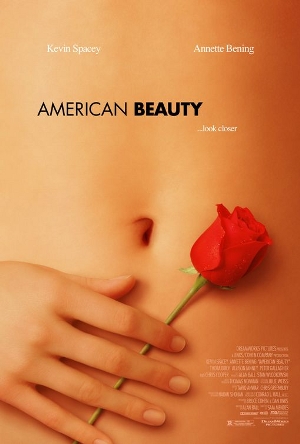
I know, I know.  “American Beauty is an incisive satire that looks at the stifling conformity of American suburbia with Kevin Spacey giving the definitive portrait of the male midlife crisis and blah blah blah blah blah blah.”  Listen, American Beauty is a terrible film.  I don’t care if it won a lot of Oscars, including the 1999 award for best picture.  American Beauty is a shallow film that, at its worst, is deeply misogynistic.

American Beauty tells the story of two people.  They’re married.  They live in the suburbs.  They have a teenage daughter who is a cheerleader.  They pretend to have the perfect life but actually, everyone’s extremely unhappy.

WOW!  OH MY GOD!  PEOPLE ARE SECRETLY UNHAPPY IN THE SUBURBS!?  MY MIND IS BLOWN!  WOW, NO ONE’S EVER HAD THAT THOUGHT BEFORE!  OH.  MY.  GOD!

Anyway, the husband is named Lester (Kevin Spacey).  Lester’s a loser.  He narrates the film and he’s played by Kevin Spacey so you’re supposed to think that he’s really this great guy who deserves better but honestly, Lester’s a whiny little jerk.  He’s upset because, now that he’s an adult, he misses being a teenager.  Life hasn’t turned out the way that he wanted it to.  Boo hoo.  As I said, Lester is kind of whiny but the film treats him like he’s an enlightened truth seeker.  In order to keep the audience from realizing that Lester is a loser, the film surrounds him with one-dimensional stereotypes.

And really, Lester is the ultimate male fantasy.  Everything that he says and thinks is wise.  His every thought and feeling matters.  To its discredit, the world has failed to recognize that Lester’s vapid thoughts are worthwhile.  Lester quits his job and finds employment working in fast food.  Lester fantasizes about fucking his daughter’s best friend (Mena Suvari).  Lester starts to smoke weed with his teenage neighbor (Wes Bentley).  In real life, Lester would just be another pathetic guy having a midlife crisis but, in the world of American Beauty, he’s a seeker of truth,

Anyway, eventually, Lester gets shot in the back of the head and dies but that doesn’t keep him from still narrating the film.  You just can’t shut him up.

Meanwhile, Lester’s wife is Carolyn (Annette Bening) and wow, is she evil!  Get this — she actually tries to keep the house clean, is obsessive about her job, and wants her family to eat dinner together.  Oh my God, so evil!  She ends up having an affair with Buddy Kane (Peter Gallagher) and, when they have sex, we’re supposed to laugh at them because they’re so cartoonishly loud.  And when Lester catches them, the audience is expected to applaud and say, “Way to go, Lester!”  The film ridicules Carolyn’s affair but it idealizes Lester’s sexual fantasies.  Lester’s determination to be independent and do what he wants is presented as being heroic.  Carolyn’s determination to have a life that does not revolve around her pathetic husband is presented as being villainous.

And why is that?

Basically, it comes down to the fact that Lester has a penis whereas Carolyn has a vagina.

American Beauty is probably one of the most misogynistic films that I have ever seen, one in which men are exclusively victims of all those unreasonable and untrustworthy women.  Whiny loser Lester is presented as being a hero.  Ricky, the next door neighbor played by Wes Bentley, spends his time going on and on about the beauty of an empty bag and we’re supposed to see some sort of higher truth in his pretentious blathering.  Meanwhile, Carolyn is portrayed as being a shrew.  Lester’s teenager daughter (Thora Birch) is a spoiled brat.  Lester’s sexual obsession, the cheerleader played by Mena Suvari, is presented as being a suburban seductress but, in the film’s eyes, she’s partially redeemed when she suddenly admits to being a virgin.

(The film seems to think that the revelation that teenagers lie about sex is truly shocking.  This is one of those films that makes you wonder if the filmmakers have ever hung out with anyone outside of their own small circle of friends.)

One huge subplot deals with Ricky’s father, a military guy played by Chris Cooper, mistakenly believing that Lester is gay.  And, honestly, American Beauty would have been a better film if Lester had been a gay man and if, instead of buying a new car and getting a crappy job, Lester had dealt with his identity crisis by coming out of the closet.  Certainly, a lot of Lester’s anger would have made a lot more sense if he was a man struggling to come to terms with his sexuality as opposed to being a man who just doesn’t like his job and is upset that his wife no longer has the body of a 17 year-old.

(We are, of course, supposed to be shocked when Cooper suddenly reveals that he himself is gay.  But, honestly, the film’s plans for Cooper are obvious from the minute he first appears on-screen and dramatically squints his eyes in disgust at the sight of two men jogging together.  Cooper is a good actor but he’s terrible in American Beauty.)

It would have taken guts to make Lester gay and, at heart, American Beauty is a very cowardly film.  It attacks easy targets and it resolutely refuses to play fair.  So desperate is it to make Lester into a conventional hero that it refuses to let anyone around him be human.  As a result, a talented cast is stuck playing a collection of one-note stereotypes.  No wonder a lot of people love this film — it makes you feel smart without requiring that you actually think.

American Beauty was written by Alan Ball and directed by Sam Mendes.  Both Ball and Mendes have subsequently done far better work, which is good because American Beauty is a terrible movie.  The script is a pretentious mess and Mendes never seems to be quite sure what exactly he’s trying to say from scene-to-scene.

American Beauty did win best picture but who cares?

It’s a crappy film.