Today would have been Max von Sydow’s 97th birthday. In today’s scene that I love, von Sydow plays a disarmingly polite assassin.
From 1975’s Three Days of the Condor:
Today would have been Max von Sydow’s 97th birthday. In today’s scene that I love, von Sydow plays a disarmingly polite assassin.
From 1975’s Three Days of the Condor:
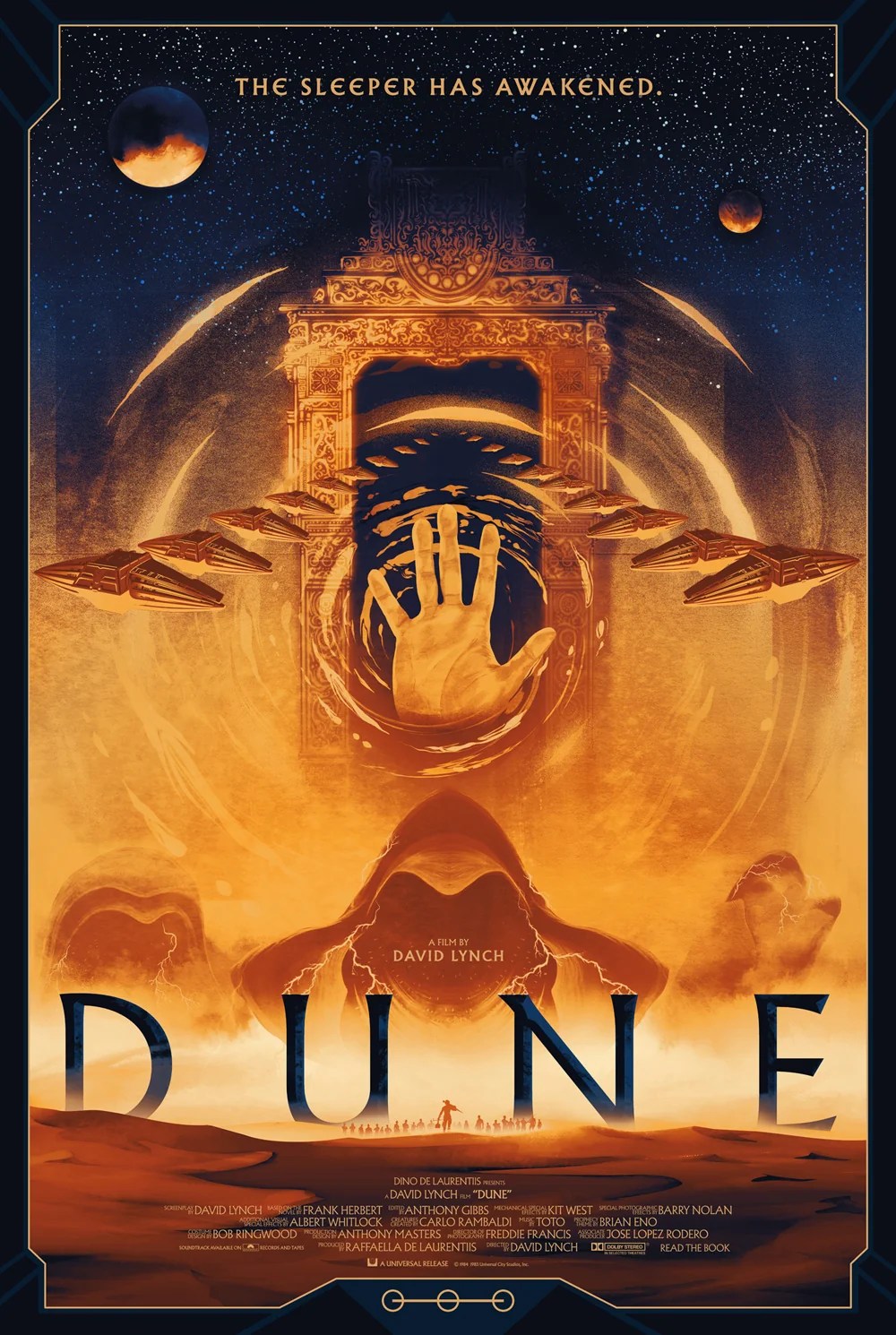
“The sleeper has awakened.” — Paul “Muad’Dib” Atreides
David Lynch’s Dune is one of those movies that somehow manages to be both a spectacular failure and a strangely hypnotic piece of cinema at the same time. It feels like a film willed into existence through pure creative tension: on one side, Frank Herbert’s dense, political, and spiritual sci‑fi novel; on the other, David Lynch’s surreal, psychological, dream‑logic sensibility. The result is a singular oddity—visually bold, dramatically uneven, and endlessly fascinating if you’re in the mood for something that feels more like a hallucination than a conventional space opera.
To call the adaptation ambitious is underselling it. After the collapse of Alejandro Jodorowsky’s infamous attempt to adapt Dune, the project eventually landed at Universal with producer Dino De Laurentiis, and Lynch—fresh off The Elephant Man—was brought in to turn Herbert’s galaxy‑spanning book into a two‑hour‑ish feature. On paper, it seems like inspired casting: Lynch had the visual imagination and emotional intensity to do something memorable with the material. But he was never a natural fit for streamlined blockbuster storytelling. His instincts live in mood, subconscious imagery, and uneasy psychological textures rather than clean plot mechanics. You can feel that clash all over the final film, and it’s part of what makes it so weirdly compelling.
Right from the opening, Dune doesn’t hold your hand. Princess Irulan’s floating head lays out a massive info‑dump about spice, the Imperium, and Arrakis that plays like someone reading you the glossary at the back of a sci‑fi novel. It’s dense, awkward, and kind of charming in its sincerity. The movie takes Herbert’s universe extremely seriously—no wink, no irony, no attempt to sand off the stranger edges. The Bene Gesserit, mentats, feudal houses, and prophecies are all presented straight, as if the audience will either keep up or be left behind. There’s something almost punk about that level of commitment.
Kyle MacLachlan, in his debut as Paul Atreides, is perfectly cast for Lynch’s take on the character. He’s got this earnest, slightly naive presence that gradually hardens as the story pushes him toward messiah status. Instead of leaning into a swashbuckling hero archetype, Lynch frames Paul’s evolution as something interior and dreamlike, almost like a spiritual awakening happening inside a hostile universe. Paul’s visions aren’t giant, crystal‑clear CGI prophecy sequences; they’re fragmented, flickering images, whispers, and flashes of desert and blood. You can feel Lynch trying to drag the sci‑fi epic into his own subconscious, even if the narrative doesn’t always keep up.
The supporting cast is packed with strong, sometimes delightfully bizarre performances. Francesca Annis gives Lady Jessica a sensual, haunted calm that fits the Bene Gesserit’s mix of discipline and manipulation. Jurgen Prochnow’s Duke Leto radiates dignified doom; he feels like a man who knows he’s walking into a trap but can’t step off the path. Then you get to the Harkonnens, where Lynch just lets his freak flag fly. Kenneth McMillan’s Baron is a grotesque comic‑book monster, oozing, cackling, floating on anti‑grav tech, and reveling in cruelty. It’s not subtle, but it is unforgettable. And of course Sting as Feyd‑Rautha, stalking around in barely‑there outfits and sneering like a rock star beamed in from another film entirely, just adds to the movie’s fever‑dream energy.
Visually, Dune is a feast and sometimes a bit of a choke. The production design leans into a kind of retro‑futurist baroque: cavernous sets, ornate technology, and spaces that feel less like functional environments and more like places out of a dark fantasy. Lynch and cinematographer Freddie Francis infuse everything with shadow, smoke, and texture, so even the quiet scenes feel heavy and loaded. The sandworms are huge, tactile, and worshipful in scale; the way they burst from the desert feels more like a religious manifestation than a monster attack. Even if you’re lost in the plot, the images stick with you—daggers, stillsuits, weirding whispers, blood on sand.
The sound and music do a ton of work in giving the film its identity. The score, primarily by Toto with contributions from Brian Eno, is this fusion of 80s rock sensibility and orchestral grandeur. It shouldn’t work, but it does; the main theme swells with tragic heroism, while other cues veer into eerie, synthy territory that matches Lynch’s off‑kilter tone. The sound design around the “weirding” abilities, the internal monologues, and the roar of the sandworms all help sell the world even when the script is sprinting past exposition. It’s one of those films where you might not fully grasp every detail, but the combined force of image and sound makes you feel like you’ve visited a real, deeply strange place.
The big structural problem, and the thing that most clearly separates Lynch’s adaptation from Denis Villeneuve’s two‑part version, is time and emphasis. Lynch is trying to cram the entire arc of Dune into a single film, and that means the plotting goes from methodical to breakneck halfway through. The first half lingers on the setup—Caladan, the move to Arrakis, the betrayal—while the second half rockets through Paul’s Fremen transformation, the guerrilla war, the sandworm riding, and the final confrontation. Subplots are hinted at and dropped, character arcs feel truncated, and the voiceover is forever trying to patch gaps the edits created. Themes like ecological transformation, the manipulation behind religious prophecy, and the long‑term horror of Paul’s rise are mostly reduced to gestures.
The best way to see Dune in Lynch’s version is actually through the extended cut, which adds a bit more context to certain scenes and lets the film breathe slightly more than the theatrical release. The theatrical cut is so aggressively compressed that pieces of motivation and setup just vanish, leaving the story feeling even more disjointed. The extended version restores some of the connective tissue—especially around Paul’s early time with the Fremen, the political maneuvering in the lead‑up to the final act, and the way certain characters orient themselves in the larger conflict. It doesn’t magically fix the studio‑driven structure or the inherent weirdness of Lynch’s choices, but it does make the film feel a little more complete, a little closer to the director’s original vision. It’s still messy, but less like a rushed homework assignment and more like a genuinely eccentric, if compromised, longform take on Herbert’s world.
Tonally, Lynch and Villeneuve are almost mirror images. Lynch’s film is cramped, loud in its weirdness, and often grotesque, playing like a baroque horror‑opera about destiny. Villeneuve’s is stately, slow‑burn, and solemn, more interested in the weight of empire, colonialism, and religious manipulation. Even their takes on Paul are distinct. In Lynch’s film, Paul ultimately plays more like a triumphant chosen one; whatever ambiguity is there gets overshadowed by the climactic victory and the literal act of making it rain as a grand, almost celebratory miracle. Villeneuve leans harder into the darker implications: Paul is framed as a potentially dangerous figure whose rise may unleash something terrible, and his two‑part arc emphasizes the holy war and fanaticism coalescing around him instead of treating his ascension as a clean win. Where Lynch’s ending lands somewhere between pulp myth and studio‑mandated uplift, Villeneuve’s execution feels closer to a tragedy about messianic power.
Knowing all that, Lynch’s Dune ends up feeling like a relic from an era when studios occasionally handed gigantic, unwieldy properties to filmmakers with intensely personal styles and just hoped for the best. It doesn’t “work” in a conventional plot sense, and if you’re coming to it after the sleek coherence of Villeneuve’s films, it can feel like a chaotic, cluttered alternate‑universe version of the same story. But that alternate universe has its own power. There’s a raw, handmade intensity to Lynch’s take—a sense that he’s trying to turn Dune into a waking dream about destiny, decay, and the seduction of power, even as the studio scissors are hacking away at his vision.
In the end, David Lynch’s Dune is a beautifully broken thing: a movie that fails as a straightforward adaptation but succeeds as a cinematic experience you can’t quite shake. Villeneuve gives you a clearer, more faithful, and philosophically aligned Dune, the one that explains itself and lets you sit with its implications. Lynch gives you the nightmare version, messy and compromised, but pulsing with strange life. If Villeneuve’s two‑part saga is the definitive modern telling, Lynch’s film—especially the extended cut—remains the haunting alternate path, a vision of Arrakis filtered through a very particular mind, sandblasted, grotesque, and unforgettable.
That #FridayNightFlix conversation about Flash Gordon really reminded me of how much I love that film. It’s hard for me to pick just one scene that I love but today, I’ve decided to go with the football scene.
In this scene, Flash earns the title of savior of the universe. Or, at least he does until Zarkov accidentally knocks him out. Between the Queen soundterack, Melody Anderson chanting, Ornella Muti vamping, Brian Blessed mugging, and Max Von Sydow doing his thing, this is a true scene that I love!
In 1939, an ocean liner named the MS St. Louis set sail from Hamburg. Along with the crew, the ship carried 937 passengers, all of whom were Jewish and leaving Germany to escape Nazi persecution. The ship was meant to go to Havana, where the passengers had been told that they would be given asylum. Many were hoping to reunite with family members who had already taken the voyage.
What neither the passengers nor Captain Gustav Schroeder knew was that the entire voyage was merely a propaganda operation. No sooner had the St. Louis left Hamburg than German agents and Nazi sympathizers started to rile up anti-Semitic feelings in Cuba. The plan was to prevent the passengers from disembarking in Cuba and to force the St. Louis to then return to Germany. The Nazis would be able to claim that they had given the Jews a chance to leave but that the rest of the world would not take them in. Not only would the Jews be cast as pariahs but the Germans would be able to use the world’s actions as a way to defend their own crimes.
Captain Schroeder, however, refused to play along. After he was refused permission to dock in Cuba, he then attempted to take the ship to both America and Canada. When both of those countries refused to allow him to dock, Schroeder turned the St. Louis toward England, where he planned to stage a shipwreck so that the passengers could be rescued at sea. Before that happened, Belgium, France, the Netherlands, and the United Kingdom jointly announced that they would accept the refugees.
Tragically, just a few days after the passengers disembarked, World War II officially began and Belgium, France, and the Netherlands all fell to the Nazi war machine. It is estimated that, of the 937 passengers on the St. Louis, more than 600 of them subsequently died in the Nazi concentration camps.
The journey of the St. Louis was recreated in the 1976 film, Voyage of the Damned, with Max von Sydow as Captain Schroeder and a collection of familiar faces playing not only the ship’s passengers and crew but also the men and women in Cuba who all played a role in the fate of the ship. In fact, one could argue that there’s a few too many familiar faces in Voyage of the Damned. One cannot fault the performances of Max von Sydow, Malcolm McDowell, and Helmut Griem as members of the crew. And, amongst the passengers, Lee Grant, Jonathan Pryce, Paul Koslo, Sam Wanamaker, and Julie Harris all make a good impression. Even the glamorous Faye Dunaway doesn’t seem to be too out-of-place on the ship. But then, in Havana, actors like Orson Welles and James Mason are awkwardly cast as Cubans and the fact that they are very obviously not Cuban serves to take the viewer out of the story. It reminds the viewer that, as heart-breaking as the story of the St. Louis may be, they’re still just watching a movie.
That said, Voyage of the Damned still tells an important true story, one that deserves to be better-known. In its best moments, the film captures the helplessness of having nowhere to go. With Cuba corrupt and the rest of the world more interested in maintaining the illusion of peace than seriously confronting what was happening in Germany, the Jewish passengers of the St. Louis truly find themselves as a people without a home. They also discover that they cannot depend on leaders the other nations of the world to defend them.
Defending the passengers falls to a few people who are willing to defy the leaders of their own country. At the start of the film, Nazi Intelligence Chief Wilhelm Canaris (Denholm Elliott) explains that Captain Schroeder was selected specifically because he wasn’t a member of the Nazi Party and could not be accused of having ulterior motives for ultimately returning the passengers to Germany. Canaris and his fellow Nazis assume that anti-Semitism is so natural that even a non-Nazi will not care what happens to the Jewish passengers. Instead, Schroeder and his crew take it upon themselves to save the lives of the passengers. It is not Franklin Roosevelt who tries to save the passengers of St. Louis. Instead, it’s just a handful of people who, despite unrelenting pressure to do otherwise, step up to do the right thing. Max von Sydow, who was so often cast in villainous roles, gives a strong performance as the captain who is willing to sacrifice his ship to save his passengers.
Flaws and all, Voyage of the Damned is a powerful film about a moment in history that must never be forgotten.

Today’s horror scene that I love features Linda Blair in 1977’s The Exorcist II: The Heretic, the sequel to the film for which she received an Oscar nomination.
Linda Blair was only 13 when she was cast a Regan McNeil, the girl who is possessed by a demon in The Exorcist. She was nominated for Best Supporting Actress, only losing the award after it was revealed that Mercedes McCambridge had dubbed Blair for the scenes in which she was possessed. Blair has gone on to have a long career, appearing in movies that may not have been as honored by the Academy as The Exorcist was but which are still often very entertaining when taken on their own terms.
In The Exorcist II, Blair returned to the role of Regan. Now in her late teens, Regan says that she can’t remember anything about being possessed. Father Philip Lamont (Richard Burton) and Dr. Gene Tuskin (Louise Fletcher) think that Regan is repressing her memories and, in this scene …. well, I don’t really know how to describe this scene. Seriously, The Exorcist II is such a strange movie! Basically, Dr. Tuskin has a hypnosis machine while allows people to link minds. Dr. Tuskin links with Regan’s mind and then Lamont links with Tuskin’s mind. It’s all incredibly silly but it does allow for this scene in which “good Regan” shares the screen with “possessed Regan.”
Here is a weird scene from a weird movie, featuring a total of four Oscar-nominated performers. (For the record, Burton was nominated multiple times and, the same year he appeared in this film, he also appeared in Equus, for which he received his final nomination. Louise Fletcher won for One Flew Over The Cuckoo’s Nest. Max von Sydow would later be nominated for Pelle the Conqueror and Extremely Loud and Incredibly Close. And, of course, Linda Blair was nominated for The Exorcist.)
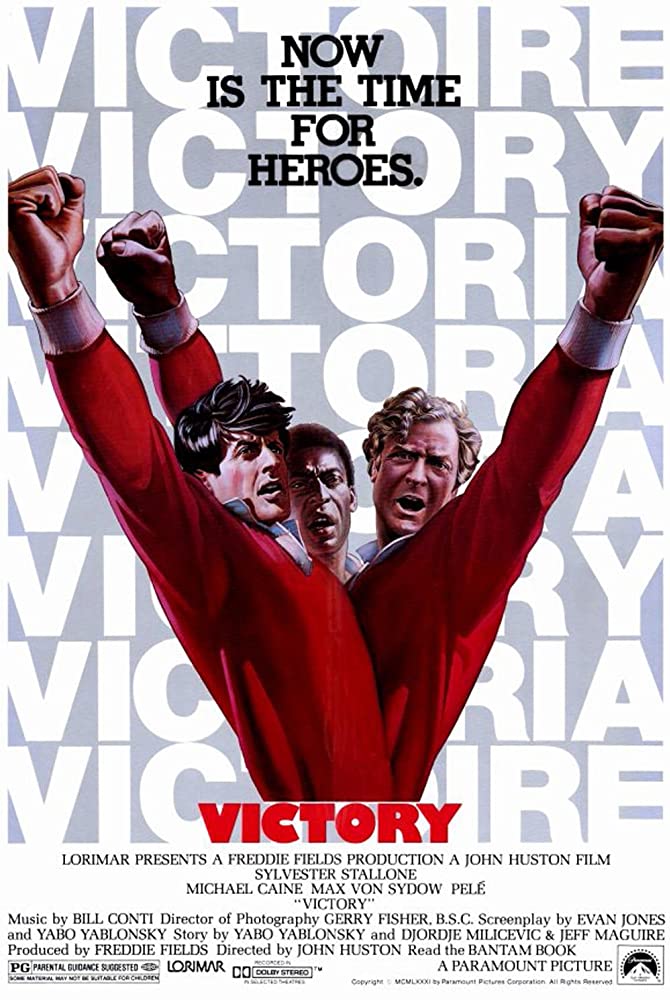 In 1942, during the height of World War II, Nazi Major Karl von Steiner (Max von Sydow) is surprised to discover that professional English footballer John Colby (Michael Caine) is a prisoner of war in France and that he has formed his own soccer league with his fellow POWs. Seeing a chance for a propaganda coup, von Steiner arranges for a team led by Colby to be travel to occupied Pairs where they will play a match against the German national team.
Colby agrees, on the condition that it be a real game and that the teams not just be made up of officers. At the insistence of his senior officers, Colby also allows an American prisoner named Robert Hatch (Sylvester Stallone) to serve as the team’s trainer. Hatch is plotting to use the match as a cover for his own escape. When it appears that there’s a chance for the entire team to escape during the match, Colby and his team are forced to choose between defeating the German team or making a run for freedom.
I think that, for most people, that wouldn’t be too difficult of a decision to make. If I have to choose between escaping a POW camp or winning a match, I’m going to go down the tunnel and do what I have to do to make it across the English channel. In the movie, though, it’s a matter of pride and I think Michael Caine is probably the only actor who could make such a conflict feel credible. Though Stallone got both top billing and a romantic subplot with a member of the Resistance, it’s Michael Caine’s movie all the way through. From the minute he demands to know “what the bloody hell” is going on, Michael Caine owns Escape to Victory.
Escape to Victory is an old-fashioned war film. Think of it as being The Great Escape with tons of soccer kicked in. Fans of the game will probably enjoy seeing legendary players like Pele and Bobby Moore cast as the POWs who make up Colby’s team. The movie has some slow spots but it’s ultimately a rousing adventure, featuring good performances from Caine, von Sydow, and Sylvester Stallone. It’s interesting to see Stallone cast as someone who isn’t automatically the best player on the field.
The film is based on a true story, one that sadly did not share this film’s happy ending. In 1942, a group of Ukrainian POWs played an exhibition match against their German captors. When the POWs won the match, the Germans responded by executing the majority of the players. The true story of the Death Match (as it was later called) was told in 1962, in a Hungarian film called Two Half Times In Hell.
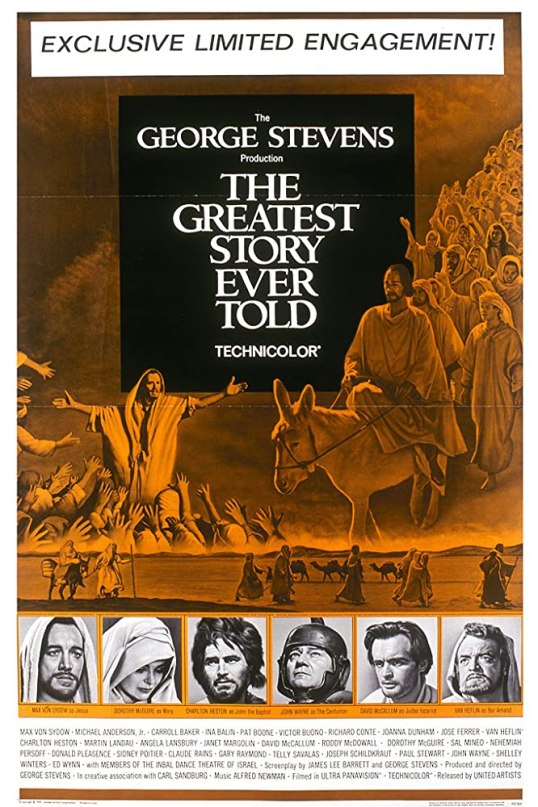
The 1965 biblical epic, The Greatest Story Ever Told, tells the story of the life of Jesus, from the Nativity to the Ascension. It’s probably the most complete telling of the story that you’ll ever find. It’s hard to think of a single details that’s left out and, as a result, the film has a four hour running time. Whether you’re a believer or not, that’s a really long time to watch a reverent film that doesn’t even feature the campy excesses of something like The Ten Commandments.
(There’s actually several different version of The Greatest Story Ever Told floating around. There’s a version that’s a little over two hours. There’s a version that’s close to four hours. Reportedly, the uncut version of the film ran for four hour and 20 minutes.)
Max von Sydow plays Jesus. On the one hand, that seems like that should work because Max von Sydow was a great actor who gave off an otherworldly air. On the other hand, it totally doesn’t work because von Sydow gives an oddly detached performance. The Greatest Story Ever Told was von Sydow’s first American film and, at no point, does he seem particularly happy about being involved with it. von Sydow is a very cerebral and rather reserved Jesus, one who makes his points without a hint of passion or charisma. When he’s being friendly, he offers up a half-smile. When he has to rebuke his disciples for their doubt, he sounds more annoyed than anything else. He’s Jesus if Jesus was a community college philosophy professor.
The rest of the huge cast is populated with familiar faces. The Greatest Story Ever Told takes the all-star approach to heart and, as a result, even the minor roles are played by actors who will be familiar to anyone who has spent more than a few hours watching TCM. Many of them are on screen for only a few seconds, which makes their presence all the more distracting. Sidney Poitier shows up as Simon of Cyrene. Pat Boone is an angel. Roddy McDowall is Matthew and Sal Mineo is Uriah and John Wayne shows up as a centurion and delivers his one line in his trademark drawl.
A few of the actors do manage to stand out and make a good impression. Telly Savalas is a credible Pilate, playing him as being neither smug nor overly sympathetic but instead as a bureaucrat who can’t understand why he’s being forced to deal with all of this. Charlton Heston has just the right intensity for the role of John the Baptist while Jose Ferrer is properly sleazy as Herod. In the role Judas, David McCallum looks at the world through suspicious eyes and does little to disguise his irritation with the rest of the world. The Greatest Story Ever Told does not sentimentalize Judas or his role in Jesus’s arrest. For the most part, he’s just a jerk. Finally, it’s not exactly surprising when Donald Pleasence shows up as Satan but Pleasence still gives a properly evil performance, giving all of his lines a mocking and often sarcastic bite.
The Greatest Story Ever Told was directed by George Stevens, a legitimately great director who struggles to maintain any sort of narrative momentum in this film. Watching The Greatest Story Ever Told, it occurred to me that the best biblical films are the ones like Ben-Hur and The Robe, which both largely keep Jesus off-screen and instead focus on how his life and teachings and the reports of his resurrection effected other people. Stevens approaches the film’s subject with such reverence that the film becomes boring and that’s something that should never happen when you’re making a film set in Judea during the Roman era.
I do have to admit that, despite all of my criticism of the film, I do actually kind of like The Greatest Story Ever Told. It’s just such a big production that it’s hard not to be a little awed by it all. That huge cast may be distracting but it’s still a little bit fun to sit there and go, “There’s Shelley Winters! There’s John Wayne! There’s Robert Blake and Martin Landau!” That said, as far as biblical films are concerned, you’re still better off sticking with Jesus Christ Superstar.
The 1966 film, The Quiller Memorandum, is a diabolically clever little spy thriller.
The film opens with a British secret agent getting gunned down while trying to make a call from a phone booth in Berlin. While we never learn the exact name of the agency that the man was working for, we do discover that they don’t take kindly to their agents getting gunned down in phone booths. They send in another agent, an American named Quiller (George Segal), to take his place.
In Berlin, Quiller’s boss is a man named Pol (Alec Guinness). Pol explains that the man in the phone booth was actually the second of his agents to be assassinated in Berlin. All of the agents were looking for information about a Neo-Nazi group called Phoenix. Pol tells Quiller that it is vitally important they discover just where, in Berlin, Phoenix is headquartered. Quiller is given a few items that were found on the dead man in the phone booth: a bowling alley ticket, a swimming pool ticket, and a newspaper article about a school where it was discovered that one of the teachers had Nazi sympathies.
Though The Quiller Memorandum was undoubtedly produced with the hopes of capitalizing on the popularity of the Bond films, Quiller is no James Bond. We know that as soon as we see him. It’s not just that Quiller’s an American while Bond was British. It’s also that James Bond was played by the cool and calculating Sean Connery while Quiller is played by George Segal. Whereas Connery’s Bond never loses his confidence, Segal’s Quiller comes across as being, at first, a bit cocky and, as a result, we worry about him. Whereas Connery’s Bond rarely gave his actions a second thought, Segal brings a slightly neurotic edge to Quiller. You take one look at Connery’s Bond and you know that he’s going to survive no matter what. Quiller, however, you never get that feeling. When he’s in danger, you worry about him because it’s easy to imagine him turning up like the man in the phone booth.
And, indeed, it doesn’t take long for Quiller to get captured by the members of Phoenix. A man bumps him with a suitcase, injecting a drug into his system that makes Quiller become drowsy. When Quiller awakens, he’s being interrogated by an erudite man named Oktober (Max von Sydow). Oktober’s an aristocrat. He speaks in a very calm tone, rarely showing any hint of anger. The only thing that betrays his evil nature are his eyes, which are cold and soulless.
Even though Quiller survives the interrogation, it’s tempting to give up on him. After all, Quiller got captured so easily and Oktober seems so clever that you kind of find yourself wondering if maybe the agency made a mistake when they gave this mission to Quiller. That’s where The Quiller Memorandum surprises you, though. Quiller turns out to be a lot more clever and resourceful than anyone gave him credit for being and, for that matter, the film itself turn out to have a few more twists and turns in store for the viewer.
It’s a clever and enjoyable spy film, featuring wonderful performances from Segal, Guinness, von Sydow, and Senta Berger as the teacher who may be in love with Quiller or who may have an agenda of her own. The film may be a spy thriller but Michael Anderson directs it as if its a film noir, full of shadowy streets and morally ambiguous characters. The script, by Harold Pinter, encourages us to trust no one and Anderson’s direction reminds us that we made the right decision. On the dark streets of Cold War Berlin, no one is who they seem.
The Quiller Memorandum is a must-see for fans of 60 spy films. Watch it with someone who you think you can trust.

Other Entries In The 18 Days Of Paranoia:
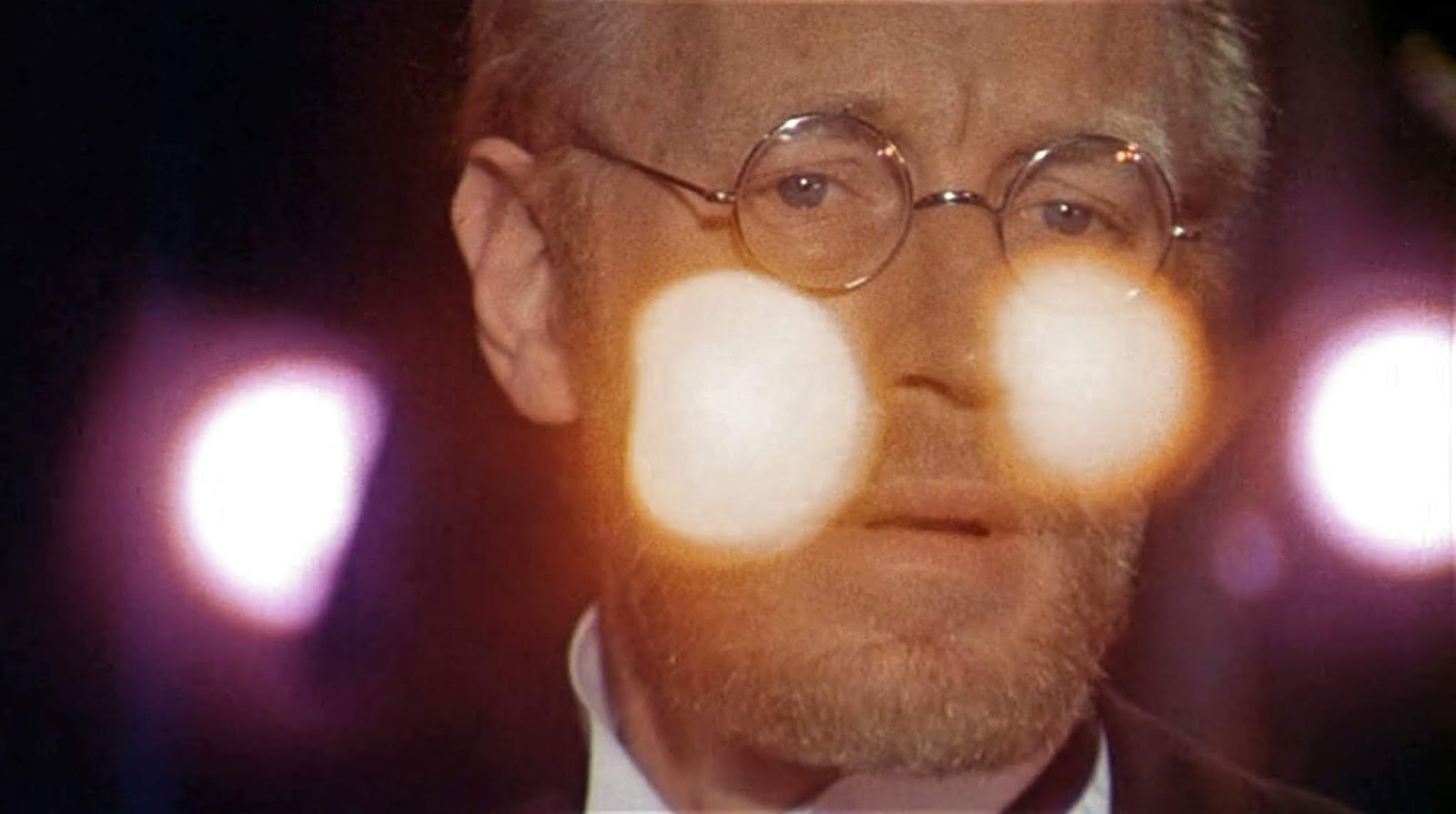
Steppenwolf (1974, directed by Fred Haines)
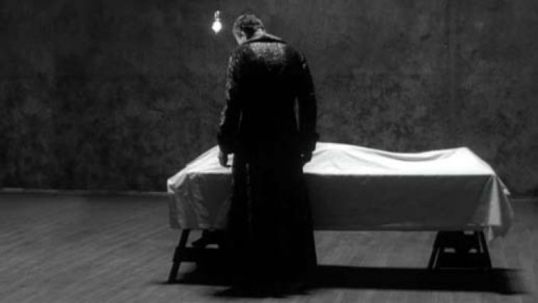
I woke up to the sad news that Max von Sydow, one of the greatest actors of all time, died yesterday. He was 90 years old and he leaves behind a truly amazing filmography. He played saints, sinners, assassins, exorcists, generals, poets, doctors, and even ordinary men who were just trying to make it day-to-day. That he was nominated for only two Academy Awards over a career that lasted 71 years was a major oversight on the Academy’s part. He was an actor who was as capable in arthouse films as he was in the latest installment of a legendary sci-fi franchise.
It’s hard to take a career as long and productive as von Sydow’s and narrow it down to just four shots from four films so I’m not going to try. The shots are below are some of my favorite von Sydow performances but they’re hardly definitive. Max von Sydow gave so many good and memorable performances that it’s hard to know where to start. Below are 4 shots from 4 films from a truly remarkable career.
Max von Sydow, R.I.P.
4 Shots From 4 Films
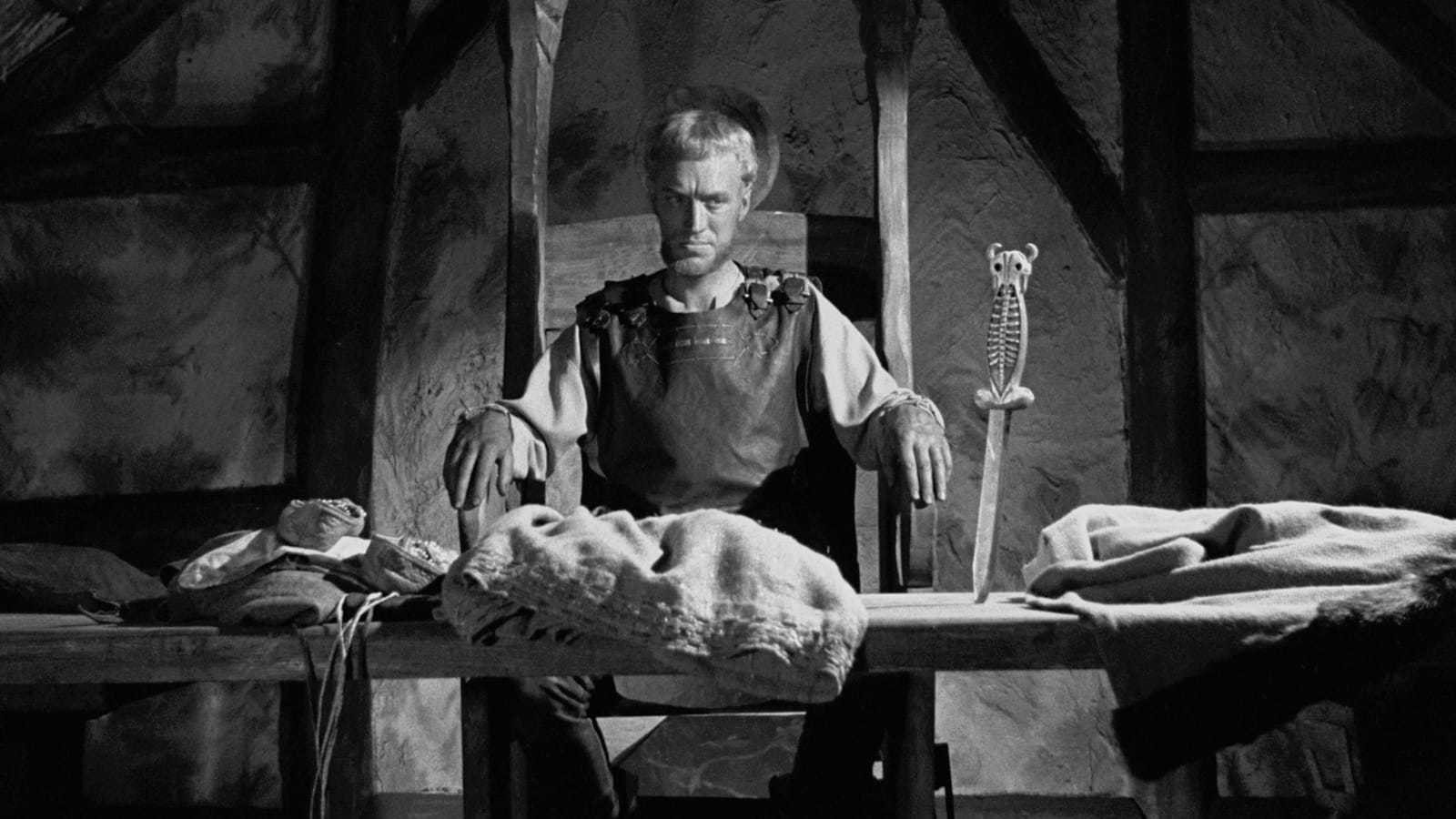
The Virgin Spring (1960, directed by Ingmar Bergman)
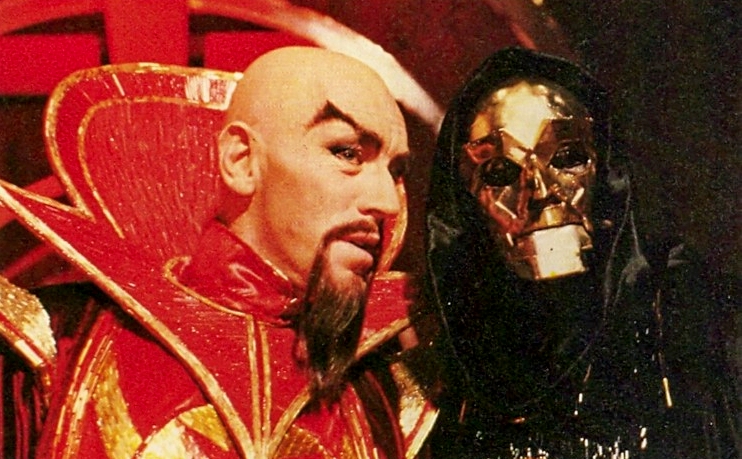
Flash Gordon (1980, directed by Mike Hodges)
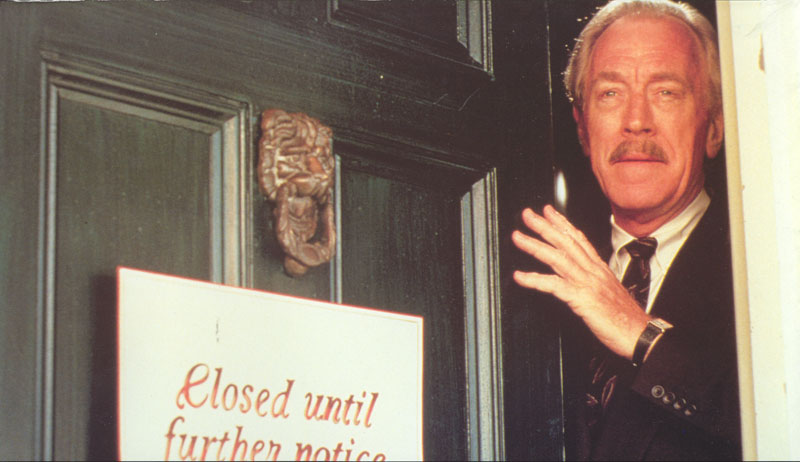
Needful Things (1993, directed by Fraser C. Heston)
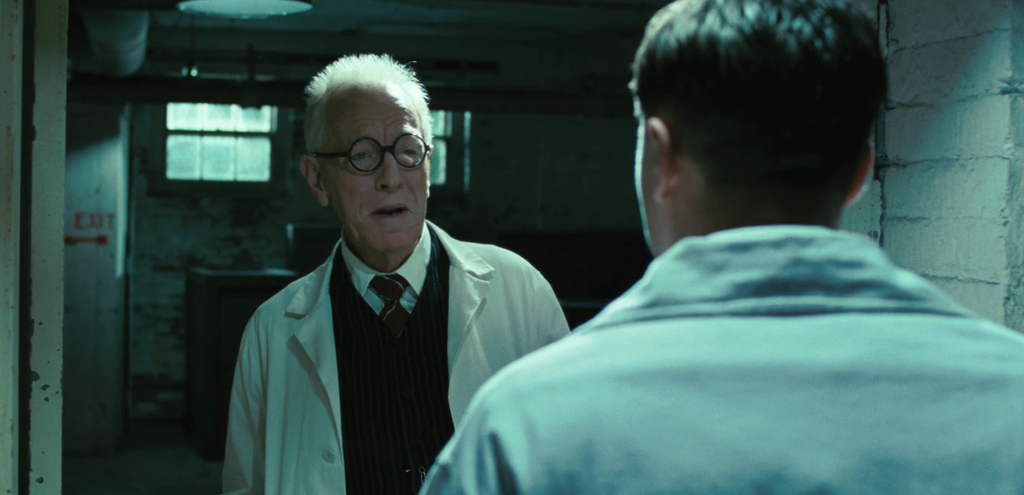
Shutter Island (2010, directed by Martin Scorsese)
An Ingmar Bergman horror film?
Indeed. Despite the fact that Bergman’s bleak imagery and existential themes undoubtedly influenced any number of horror filmmakers (Wes Craven’s Last House On The Left was essentially a remake of Bergman’s The Virgin Spring), the 1968 film, Hour Of The Wolf was Ingmar Bergman’s only official horror film.
Of course, it’s also an Ingmar Bergman film, which means that it’s also a meditation on relationships, regret, the difficult of ever knowing what’s truly going on inside someone else’s head, and the artificiality of the artistic process. It tells the story of a painter named Johan Borg (Max Von Sydow) and his pregnant wife, Alma (Liv Ullman) and their life on an isolated island. Alma is worried about Johan’s feelings towards his former muse and ex-lover, Veronica Vogler. Johan is haunted by nightmarish visions of menacing figures and the feelings that demons are pursuing him.

The film opens with a title card, informing us that the story that we’re about to see is true and that it’s an attempt to reconstruct the final days of Johan’s life before his mysterious disappearance. Of course, as anyone who has seen enough found footage films can tell you, the title card is a lie and there never was a painter named Johan Borg, or at least not one who mysteriously vanished while living in an isolated house on an island. Instead of being meant to convince us that we’re about to see a true story, the title card instead establishes that what we’re about to see can be considered to almost be a dark fairy tale. The title card is the film’s way of saying, “Once Upon A Time…..” It’s also a reminder that most fairy tales are considerably more grim than what those of us raised on Disney might expect.
(No coincidentally, the title Hour of the Wolf came from Swedish folk lore. The Hour of the Wolf is the time between 3 and 5 in the morning, during which it is said that most births and deaths occur.)
While the opening credits flash by on a dark screen, we hear the sounds of men working and anyone who has any experience in theater will immediately realize that we’re listening to a set being built. As the opening credits come to an end, we hear Bergman shouting out, “Action!” Our next shot is Alma standing outside of the house that she shared with Johan. Alma looks straight at the camera as she tells us that she still doesn’t know what happened to Johan. She tells the unseen Bergman that she’s revealed to him everything that she knows.
It’s an interesting opening, one that reminds the audience that what they’re seeing is merely a recreation of what might have happened on Johan and Alma. When Alma speaks to Bergman, there’s an interesting subtext to her words and her tone and one gets the feeling that Alma and the director are meant to have a history of their own. It’s almost as if the film is saying that the story’s meaning can only be found in what we can’t see, in what’s going on behind the camera. That seems especially true when you consider that, when Hour of the Wolf was filmed, Liv Ullman, who played the pregnant Alma, actually was pregnant with Bergman’s child and that Bergman himself later said that Johan Borg’s nightmares were recreations of Bergman’s own nightmares. It’s perhaps a little too easy to imagine that the demons that inspire Johan’s art are the same demons that inspired Bergman’s films and that this film is both an apology to Ullman for his own neurotic tendencies and a tribute to her willingness to put up with him.

Hour of the Wolf is a bleakly effective film, one that works as both a dissection of an unstable relationship and a portrait of a man who may be losing his mind. Von Sydow plays the haunted Johan as a charismatic but introverted artist, a troubled individual who can only truly express what’s happening in his mind through his art. Indeed, Johan’s tragedy seems to be that the joy he gets from creating can only come from the pain that he suffers from imagining and dreaming. Ullman is heart-breaking as she tries to keep her husband from succumbing to his own darkness while, at the same time, trying not to get sucked into the darkness herself. About halfway through the film, Johan confesses to committing a shocking crime and, like Alma, you don’t know whether to believe him or to believe that he’s reached the point where he can’t tell the difference between reality and his nightmares. Ullman plays the scene with the perfect combination of fear and sadness, sympathy and revulsion. As for Von Sydow, he brings to life both the natural arrogance of an artist and the terror of someone who suspects that he has no control over his own existence.
Visually, this film is bleak by even the standards of Bergman. The black-and-white cinematography plays up not just the shadows of the night but also the brutal desolation of Johan and Alma’s life on the island. It reminds us that Johan is an artist living in a world without color. Bergman views Johan and Alma through a detached lens, recording the collapse of their lives but, at the same time, keeping his distance as if to protect the audience from getting trapped inside of Johan’s madness.
Hour of the Wolf may have been Ingmar Bergman’s only official horror film but it’s definitely an effective thriller, one that manages to explore both Bergman’s signature themes while also keeping the audience off-balance and wondering what might be lurking in the darkness. It may not be one of Bergman’s “best-known” films but it’s definitely one for which to keep an eye out.
 Through the Shattered Lens