Horror Film Review: The Sentinel (dir by Michael Winner)


Here’s the main lesson that I’ve learned from watching the 1977 horror film, The Sentinel:

Even in the 1970s, the life of a model was not an easy one.

Take Alison Parker (Cristina Raines) for instance.  She should have everything but instead, she’s a neurotic mess.  Haunted by a traumatic childhood, she has attempted to commit suicide twice and everyone is always worried that she’s on the verge of having a breakdown.  As a model, she’s forced to deal with a bunch of phonies.  One of the phonies is played by Jeff Goldblum.  Because he’s Goldblum, you suspect that he has to have something up his sleeve but then it turns out that he doesn’t.  I get that Jeff Goldblum probably wasn’t a well-known actor when he appeared in The Sentinel but still, it’s incredibly distracting when he suddenly shows up and then doesn’t really do anything.

Alison has a fiancée.  His name is Michael Lerman (Chris Sarandon) and I figured out that he had to be up to no good as soon as he appeared.  For one thing, he has a pornstache.  For another thing, he’s played by Chris Sarandon, an actor who is best known for playing the vampire in the original Fright Night and Prince Humperdink in The Princess Bride.  Not surprisingly, it turns out that Michael’s previous wife died under mysterious circumstances.  NYPD Detective Rizzo (Christopher Walken) suspects that Michael may have killed her.

(That’s right.  Christopher Walken is in this movie but, much like Jeff Goldblum, he doesn’t get to do anything interesting.  How can a movie feature two of the quirkiest actors ever and then refuse to give them a chance to act quirky?)

Maybe Alison’s life will improve now that she has a new apartment.  It’s a really nice place and her real estate agent is played by Ava Gardner.  Alison wants to live on her own for a while.  She loves Michael but she needs to find herself.  Plus, it doesn’t help that Michael has a pornstache and may have killed his wife…

Unfortunately, as soon as Alison moves in, she starts having weird dreams and visions and all the usual stuff that always happens in movies like this.  She also discovers that she has a lot of eccentric neighbors, all of whom are played by semi-familiar character actors.  For instance, eccentric old Charles (Burgess Meredith) is always inviting her to wild parties.  Her other two neighbors (played by Sylvia Miles and Beverly D’Angelo) are lesbians, which the film presents as being the height of shocking decadence.  At first, Alison likes her neighbors but they make so much noise!  Eventually, she complains to Ava Gardner.  Ava replies that Alison only has one neighbor and that neighbor is neither Burgess Meredith nor a lesbian.

Instead, he’s a blind priest who spends all day sitting at a window.  He’s played by John Carradine, who apparently had a few hours to kill in 1977.

But it doesn’t stop there!  This movie is full of actors who will be familiar to anyone who enjoys watching TCM.  Along with those already mentioned, we also get cameos from Martin Balsam, Jose Ferrer, Arthur Kennedy, Eli Wallach, Richard Dreyfuss, and Tom Berenger.  There are 11 Oscar nominees wasted in this stupid film.  (Though, in all fairness, Christopher Walken’s nomination came after The Sentinel.)

Personally, The Sentinel bugged me because it’s yet another horror movie that exploits Catholic iconography while totally misstating church dogma.  However, the main problem with The Sentinel is that it’s just so incredibly boring.  I own it on DVD because I went through a period where I basically bought every horror film that could I find.  I’ve watched The Sentinel a handful of times and somehow, I always manage to forget just how mind-numbingly dull this movie really is.  There’s a few scary images but mostly, it’s just Burgess Meredith acting eccentric and Chris Sarandon looking mildly annoyed.  If you’ve ever seen Rosemary’s Baby, The Exorcist, or The Omen, you’ll figure out immediately what’s going on but The Sentinel still insists on dragging it all out.  Watching this movie is about as exciting as watching an Amish blacksmith shoe a horse.

There’s a lot of good actors in the film but it’s obvious that most of them just needed to pick up a paycheck.  I’ve read a lot of criticism of Cristina Raines’s lead performance but I actually think she does a pretty good job.  It’s not her acting that’s at fault.  It’s the film’s stupid script and lackluster direction.

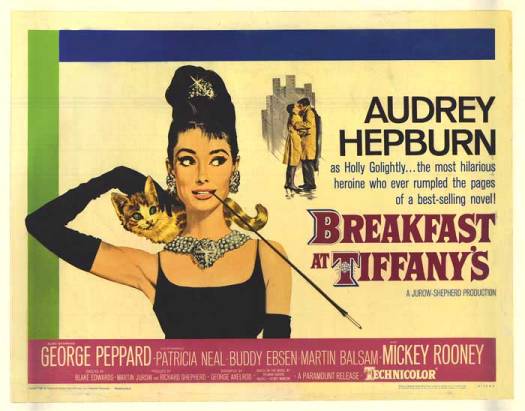
My Huckleberry Friend: BREAKFAST AT TIFFANY’S (Paramount 1961)


gary loggins's avatarcracked rear viewer

(“Breakfast at Tiffany’s” airs tonight, 6/12/17 at 8:00 EST on TCM as part of their month-long salute to Audrey Hepburn.)

“You mustn’t give your heart to a wild thing. The more you do, the stronger they get, until they’re strong enough to run into the woods or fly into a tree. And then to a higher tree and then to the sky” – Audrey Hepburn as Holly Golightly in BREAKFAST AT TIFFANY’S.

From it’s hauntingly romantic theme “Moon River” to it’s sophisticated screenplay by George Axelrod, BREAKFAST AT TIFFANY’S is a near-perfect movie. The bittersweet comedy-drama stars Audrey Hepburn in an Oscar nominated performance as Holly Golightly, a New York “party girl” who winds up falling for struggling writer George Peppard. That Hepburn didn’t get the Oscar (Sophia Loren took it home that year for TWO WOMEN) is one of the Academy’s greatest crimes. The film has a very personal connection with…

View original post 1,020 more words

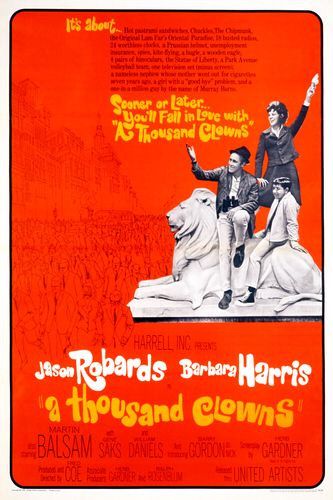
Lisa Reviews An Oscar Nominee: A Thousand Clowns (dir by Fred Coe)


thousand_clowns

The 1965 film A Thousand Clowns is one of the most annoying films to ever be nominated for best picture.

I know what you’re thinking.

Really, Lisa — even more annoying than Extremely Loud and Incredibly Close?

Well, no.  No movie is as annoying as Extremely Loud and Incredibly Close.  In fact, even if it didn’t particularly work for me, I can kind of understand why A Thousand Clowns was apparently a box office success in 1965.  To be honest, part of my annoyance with the film comes from the fact that not only can I understand why other people would love it but I probably would have loved it if I had been alive to see it when it was first released.  A Thousand Clowns isn’t an awful film but to say that it has not aged well is a bit of an understatement.

It tells the story of Murray Burns (Jason Robards).  Murray lives in a cluttered New York apartment with his 12 year-old nephew, Nick (Barry Gordon).  Seven years ago, Nick’s mother abandoned him with Murray.  Murray views Nick as being his own son.  Nick worships his Uncle Murray.  Murray randomly sings Yes, Sir, That’s My Baby.  Nick picks up on the habit and is soon wandering around and humming Yes, Sir, That’s My Baby.  By the end of A Thousand Clowns you will be so freaking sick of hearing that song.  (Fortunately, Murray never sings Send In The Clowns.  The film dodged a bullet on that one.)

Murray’s a nonconformist, the type who starts his day by standing outside and mocking everyone who is getting ready to go to work.  Murray used to have a job.  He was a TV writer.  He wrote jokes for a detestable entertainer known as Chuckles The Chipmunk (played by noted Broadway director Gene Saks).  Five months ago, Murray quit his job.  He’s now unemployed and proud of it.  He swears that he will never again sacrifice his freedom for a paycheck.  He raises Nick to take the same attitude towards life.

Two social workers, Albert (Williams Daniels) and Sandra (Barbara Harris), show up at Murray’s apartment.  They say that unless Murray gets a job and proves that he’s a good guardian, Nick will be taken away from him.  Murray explains that he’s a nonconformist and that he’s raising Nick to reject anything conventional.  Albert is offended.  Sandra is charmed.  Soon, Sandra and Murray are going for bike rides through New York City.  Murray sings Yes, Sir, That’s My Baby some more…

And it all sounds good but the film just didn’t work for me.  First off, I’ve actually experienced what it’s like to grow up with a frequently unemployed father and, sorry, it’s not all studio apartments and cheerful trips to Central Park.  Secondly, A Thousand Clown‘s message of carpe diem might have seemed groundbreaking in 1965 but today, it just seems like a cliché.  I mean, everyone claims to be a nonconformist today.

Watching the film, it’s hard not to feel that it doesn’t really play fair.  It’s easy for the film to always portray Murray as being enlightened when the only people who ever disagree with him are humorless strawmen.  Albert is a self-righteous prig while Chuckles The Chipmunk is a heavy-handed caricature, the type of TV star who could only be created by a writer who is resentful that more people are watching TV than reading his latest masterpiece.  Martin Balsam appears as Murray’s brother, Arnold, and gets a chance to defend his decision to lead a normal, conventional life.  When it comes to the brothers, the film obviously want us to side with Murray but instead, you feel more sympathy for Arnold, largely because Martin Balsam was such an authoritative actor that your natural tendency is to assume that he must know what he’s talking about.  It’s interesting to note that it was Balsam, as the voice of mainstream conformity, that won the film’s only Oscar.

Jason Robards was not even nominated, though his performance is often better than the material.  He and Barbara Harris have a sweet chemistry, even though Harris is stuck playing a rather demeaning role.  (When we first meet Sandra, she is dating Albert and assuming that he’s correct about anything.  Then she falls for Murray and assumes that he is the one who is correct about everything.  What the film never bothers to really explore is what Sandra herself thinks about anything.)  But then you’ve got Barry Gordon, who, in the role of Nick, comes across as being a bratty know-it-all weirdo.  Nick is so obnoxious that it undercuts the movie’s claim that Murray deserves to be his guardian.

Also not nominated, despite the film winning a best picture nomination, was the director, Fred Coe.  (Nominated in his place were William Wyler for The Collector and Hiroshi Teshigahara for The Woman In The Dunes.)   His omission is less surprising than that of Jason Robards.  If you didn’t know that A Thousand Clowns was based on a stage play, you’d guess it after watching the first ten minutes of the film.  Despite a few shots of Murray and Sandra in New York City, A Thousand Clowns never breaks free of its stage origins.  Taking place on largely one set, it feels rather confining for a film meant to celebrate nonconformity.

As I said, I didn’t care much for A Thousand Clowns but I can understand why it was probably a hit with 1965 audiences.  Murray’s a transitional figure, standing between the Beats and the Hippies.  With America’s confidence shaken by the Kennedy assassination and growing social unrest, I’m sure a lot of people wanted to drop out of society just like Murray.  To be honest, a lot of people feel like that right now.  I just hope that, if you do decide to follow Murray’s example, you’ll sing something less annoying than Yes, Sir, That’s My Baby.

A Thousand Clowns was nominated for best picture but it lost to a film that Murray probably would have hated, The Sound of Music.

A Movie A Day #33: Two-Minute Warning (1976, directed by Larry Peerce)


mpw-8771

For the longest time, I thought that Two-Minute Warning was a movie about a gang of art thieves who attempt to pull off a heist by hiring a sniper to shoot at empty seats at the Super Bowl.  As planned by a master criminal known as The Professor (Rossano Brazzi), the sniper will cause a riot and the police will be too busy trying to restore order to notice the robbery being committed at an art gallery that happens to be right next to the stadium.

I believed that because that was the version of Two-Minute Warning that would sometimes show up on television.  Whenever I saw the movie, I always through it was a strange plan, one that had too many obvious flaws for any halfway competent criminal mastermind to ignore them.  What if the sniper was captured before he got a chance to start shooting?  What if a riot didn’t break out?  The sniper spent the movie aiming at empty seats but, considering how many people were in the stadium, it was likely that he would accidentally shoot someone.  Were the paintings really worth the risk of a murder charge?

Even stranger was that Two-Minute Warning was not only a heist film but it was also a 1970s disaster film.  Spread out throughout the stadium were familiar character actors like Jack Klugman, John Cassevetes, David Janssen, Martin Balsam, Gena Rowlands, Walter Pidgeon, and Beau Bridges.  It seemed strange that, once the shots were fired and Brazzi’s men broke into the gallery, all of those familiar faces vanished.  When it comes to disaster movies, it is an ironclad rule that at least one B-list celebrity has to die.  It seemed strange that Two-Minute Warning, with all those characters, would feature a sniper shooting at only empty seats.  For that matter, why would there be empty seats at the Super Bowl?

That wasn’t the strangest thing about Two-Minute Warning, though.  The strangest thing was that Charlton Heston was in the film, playing a police captain.  In most of his scenes, he had dark hair.  But, in the scenes in which he talked about the art gallery, Heston’s hair was suddenly light brown.

Recently, I watched Two-Minute Warning on DVD and I was shocked to discover that the movie on the DVD had very little in common with the movie that I had seen on TV.  For instance, the television version started with the crooks discussing their plan to rob the gallery.  The DVD version opened with the sniper shooting at a couple in the park.  In the DVD version, there was no art heist.   The sniper had no motive and no personality.  He was just a random nut who opened fire on the Super Bowl.  And,  in the DVD version, he did not shoot at empty seats.  Several of the characters who survived in the version that I saw on TV did not survive in the version that I saw on DVD.

What happened?

The theatrical version of Two-Minute Warning was exactly what I saw on the DVD.  A nameless sniper opens fire and kills several people at the Super Bowl.  In 1978, when NBC purchased the television broadcast rights for Two-Minute Warning, they worried that it was too violent and too disturbing.  There was concern that, if the film was broadcast as it originally was, people would actually think there was a risk of some nut with a gun opening fire at a crowded event.  (In 1978, that was apparently considered to be implausible.)  So, 40 minutes of new footage was shot.  Charlton Heston even returned to film three new scenes, which explains his changing hair color.  The new version of Two-Minute Warning not only gave the sniper a motive (albeit one that did not make much sense) but it also took out all of the violent death scenes.

Having seen both versions of Two-Minute Warning, neither one is very good, though the theatrical version is at least more suspenseful than the television version.  (It turns out that it was better to give the sniper no motive than to saddle him with a completely implausible one.)  But, even in the theatrical version, the potential victims are too one-dimensional to really care about.  Ultimately, the most interesting thing about Two-Minute Warning is that, at one time, an art heist was considered more plausible than a mass shooting.

tmw

Bronson’s Best: The Stone Killer (1973, directed by Michael Winner)


Stone_killerAfter tough New York detective Lou Torrey (Charles Bronson) lands in hot water for shooting and killing a teenage cop killer, he moves to Los Angeles and gets a job with the LAPD.  Working under an unsympathetic supervisor (Norman Fell), saddled with an incompetent partner (Ralph Waite), and surrounded by paper pushing bureaucrats, Torrey still tries to uphold the law and dispense justice whenever he can.  When a heroin dealer is murdered while in Torrey’s custody, Torrey suspects that it might be a part of a larger conspiracy, involving mobster Al Vescari (Martin Balsam).

Vescari is plotting something big.  It has been nearly 40 since the “Sicilian Vespers,” the day when Lucky Luciano, Frank Costello, and Busy Siegel killed all of the original mafia dons at the same time.  Viscari has invited mafia leaders from across the country to attend a special anniversary dinner.  During the dinner, all of Vescari’s rivals will be assassinated.  To keep things a secret, Vescari will not be using any of his usual hitmen.  Instead, he has contracted a group of mentally unstable Vietnam vets, led by Lawrence (Stuart Margolin).

Charles Bronson has always been an underrated film star.  His legacy has been tarnished by the cheap films he made for Cannon and, unlike Clint Eastwood, he never got a chance to really take control of his career and reinvent his image.  But during the 1970s, not even Clint Eastwood was a more convincing action star than Charles Bronson.  Bronson may have never been a great actor but he was an authentic tough guy with a physical presence that dominated the screen.

It was during this period that Bronson made his first four movies with director Michael Winner.  Though Death Wish and The Mechanic are the best known, The Stone Killer may be the best.  Tough, gritty, and action-packed with a great car chase, The Stone Killer was filmed on location in Los Angeles and some of the best parts are just the scenes of Bronson awkwardly interacting with the local, California culture.  If you have ever wanted to see Charles Bronson deal with a bunch of hippies, this is the film to see.  The Stone Killer also has more of social conscience than the usual 70s cop film, with Bronson’s character not only condemning excessive police brutality but also his racist partner.

(Ironically, Bronson and Winner would follow The Stone Killer with Death Wish, a film that many critics condemned as being racist and which suggested that the police were not being brutal enough.)

The other thing that sets The Stone Killer apart is that it has a great cast, featuring several actors who would go on to find success on television.  Balsam, Fell, and especially Waite and Margolin are all great.  Keep an eye out for a very young John Ritter, playing one of the only cops in the film who is not portrayed as being either corrupt or incompetent.

Though it may not be as well-known as some of his other action films, The Stone Killer is one of Bronson’s best.

Lisa Marie Reviews An Oscar Winner For Labor Day: On The Waterfront (dir by Elia Kazan)


On-the-Waterfront

I like On The Waterfront.

Nowadays, that can be a dangerous thing to admit.  On The Waterfront won the Oscar for Best Picture of 1954 and Marlon Brando’s lead performance as boxer-turned-dockworker Terry Malloy is still regularly cited as one of the best of all time.  The scene where he tells his brother (played by Rod Steiger) that he “could have been a contender” is so iconic that other films still continue to either parody or pay homage to it.  On The Waterfront is one of those films that regularly shows up on TCM and on lists of the greatest films ever made.

And yet, despite all that, it’s become fashionable to criticize On The Waterfront or to cite it as an unworthy Oscar winner.  Certain film bloggers wear their disdain for On The Waterfront like a badge of honor.  Ask them and they’ll spend hours telling you exactly why they dislike On The Waterfront and, not surprisingly, it all gets tedious pretty quickly.

Like all tedious things, the answer ultimately comes down to politics.  In the early 50s, as the House UnAmerican Affairs Committee conducted its search for communists in Hollywood, hundreds of actors, writers, and directors were called before the committee.  They were asked if they were currently or ever had been a member of the Communist Party.  It was demanded that they name names.  Refusing to take part was career suicide and yet, many witnesses did just that.  They refused to testify, apologize, or name names.

And then there was the case of Elia Kazan.  When he was called in front of HUAC, he not only testified about his communist past but he named names as well.  Many of his past associates felt that Kazan had betrayed them in order to protect his own career.  On The Waterfront was Kazan’s answer to his critics.

In On The Waterfront, Terry Malloy’s dilemma is whether or not to voluntarily testify before a commission that is investigating union corruption on the waterfront.  Encouraging him to testify is the crusading priest, Father Barry (Karl Malden), and Edie (Eva Marie Saint), the saintly girl who Terry loves.  Discouraging Terry from testifying is literally every one else on the waterfront, including Terry’s brother, Charlie (Rod Steiger).  Charlie is the right-hand man of gangster Johnny Friendly (a crudely intimidating Lee J. Cobb), who is the same man who earlier ordered Terry to throw a big fight.

At first, Terry is content to follow the waterfront of code of playing “D and D” (deaf and dumb) when it comes to union corruption.  However, when Johnny uses Terry to lure Edie’s brother into an ambush, Terry is forced to reconsider his previous apathy.  As Terry gets closer and closer to deciding to testify, Johnny order Charlie to kill his brother…

The issue that many contemporary critics have with On The Waterfront is that they view it as being essentially a “pro-snitch” film.  It’s easy to see that Elia Kazan viewed himself as being the damaged but noble Terry Malloy while Johnny Friendly was meant to be a stand-in for Hollywood communism.  They see the film as being both anti-union and Kazan’s attempt to defend naming names.

And maybe they’re right.

But, ultimately, that doesn’t make the film any less effective.  Judging On The Waterfront solely by its backstory ignores just how well-made, well-acted, well-photographed, well-directed, and well-written this film truly is.  Elia Kazan may (or may not) have been a lousy human being but, watching this film, you can’t deny his skill as a director.  There’s a thrilling grittiness to the film’s style that allows it to feel authentic even when it’s being totally heavy-handed.

And the performances hold up amazingly well.  Marlon Brando’s performance as Terry Malloy gets so much attention that it’s easy to forget that the entire cast is just as great.  Rod Steiger makes Charlie’s regret and guilt poignantly real.  Karl Malden, who gets stuck with the film’s more pedantic dialogue, is the perfect crusader.  Eva Marie Saint is beautiful and saintly.  And then you’ve got Lee J. Cobb, playing one of the great screen villains.

The motives behind On The Waterfront may not be the best.  But, occasionally, a great film does emerge from less than pure motives.  (Just as often, truly good intentions lead to truly bad cinema.)  Regardless of what one thinks of Elia Kazan, On The Waterfront is a great work of cinema and it’s on that basis that it should be judged.

On_the_Waterfront_poster

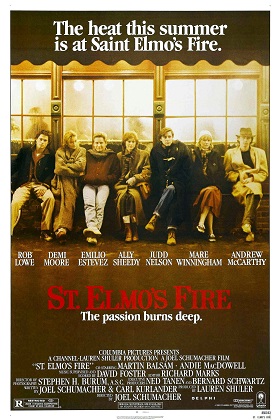
Embracing the Melodrama Part II #73: St. Elmo’s Fire (dir by Joel Schumacher)


St_elmo's_fire

Oh my God!  Aren’t rich, white people just like the worst!?

Actually, usually I would never say something like that.  I usually find class warfare to be tedious and I personally think poor people can be just as annoying as rich people.  I had no interest in the whole Occupy Wall Street thing and I once referred to V For Vendetta as being V For Vapid.

No, I may not be much of a class warrior but then again, that may be because I never met any of the characters at the center of the 1985 film St. Elmo’s Fire.  Seriously, if anything could turn me into a slogan-spouting, window-smashing revolutionary, it would be having to deal with any of the self-centered, entitled characters in St. Elmo’s Fire.

St. Elmo’s Fire is about a group of seven friends, three of whom are played by actors who co-starred in The Breakfast Club.  These friends all met at and are recent graduates from Georgetown University.  St. Elmo’s Fire follows them as they laugh, love, drink, do drugs, and try to figure out what they want to do with the rest of their lives.

For instance, there’s Billy (Rob Lowe), who has big hair and wears one dangling earring.  Billy was in a fraternity and spends most of the movie wishing that he still was.  Billy also plays the saxophone and he has a wife and a kid who he has pretty much abandoned … well, you know what?  I like Rob Lowe.  He seems like a fun guy and his DirectTV commercials were all classics but oh my God, does he ever give a bad performance in St. Elmo’s Fire.  Some of it is because Billy is not a very likable character.  He’s supposed to be the rough-around-the-edges, secretly sensitive rebel type but ultimately, he just comes across as being a loser.

And then there’s Jules (Demi Moore), who does too much cocaine and, as a result, finds herself fearing that she’s on the verge of being sold into a sexual slavery.  Jules doesn’t get to do much other than be rescued by the other characters.  Fortunately, when it looks like the group is drifting apart, Jules attempts to commit suicide and brings everyone back together.  Way to be a plot device, Jules!

Wendy (Mare Winningham) is the sweet but insecure virgin who has a crush on Billy.  Wendy works as a social worker and ends up getting insulted by the very people that she’s trying to help.  Winningham gives one of the film’s better performances but you can’t help but feel that Wendy deserves better friends.

Speaking of good performances, Andrew McCarthy also gives a pretty good one.  McCarthy plays Kevin Dolenz, the idealistic writer who everyone is convinced is gay because he hasn’t had sex in 2 years.  However, Kevin is actually in love with his best friend’s girlfriend.  As written, Kevin runs the risk of coming across as being insufferably moralistic but McCarthy gives a likable performance.  He turns Kevin into the nice guy that we all want to know.

And then there’s the Breakfast Club alumni.

Alec Newberry (Judd Nelson) was the vice-president of the Georgetown Democrats but now, because it pays better, he’s taken a job working for a Republican senator.  Alec’s girlfriend is Leslie (Ally Sheedy).  Alec obsessively cheats on Leslie, claiming that he can’t be loyal to her unless she’s willing to marry him.  The group of friends is largely centered around Alec and Leslie though it’s never really clear why.  Alec and Leslie are boring characters and, as a result, they’re a boring couple.

And then there’s Kirby (Emilio Estevez).  Estevez gives a likable performance but he often seems to be appearing in a different movie from everyone else.  Kirby is working on his law degree and he’s in love with a hospital intern named Dale (Andie MacDowell).  Unfortunately, Dale isn’t as interested in Kirby as he is in her so Kirby responds by stalking her and trying to change her mind.  There’s an earnestness and sincerity to Kirby that makes you like him, even if his behavior is actually rather creepy.

As for the film itself — well, it’s directed by Joel Schumacher and there’s a reason why Schmacher has the reputation that he does.  As a director, Schumacher is good at gathering together an attractive cast but he has close to no idea how to tell a compelling story.  St. Elmo’s Fire plods along, dutifully telling its story but providing little insight or surprise.

If you’ve read some of my previous reviews, you’re probably expecting this to be the point where I argue that St. Elmo’s Fire works as a time capsule.  But, honestly, this film doesn’t have enough insight to really work as a time capsule.  I mean, if you love 80s hair and 80s fashion, you might enjoy St. Elmo’s Fire but, then again, you could always just do a google image search and have the same basic experience.

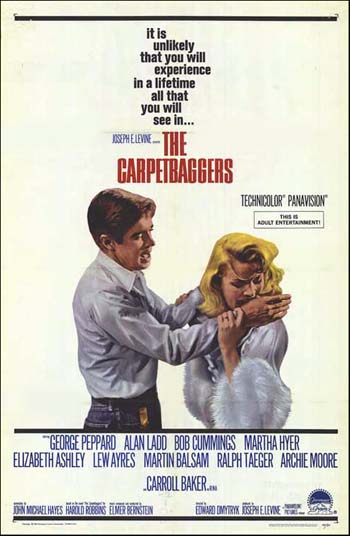
Embracing the Melodrama Part II #28: The Carpetbaggers (dir by Edward Dmytryk)


The_Carpetbaggers_1964_poster

The 1960s was apparently a bad time for talented old school Hollywood filmmakers getting sucked into making big budget, excessively lengthy films.  Joseph L. Mankiewicz spent most of his career making movies like All About Eve and then, in 1963, he ended up directing Cleopatra.  Elia Kazan went from A Face In The Crowd to The Arrangement.  John Huston went from Treasure of the Sierra Madre and The African Queen to directing not only The Bible but Reflections in a Golden Eye as well.

And then there’s Edward Dmytryk.  Dmytryk may not be as highly regarded by modern critics as Mankiewicz and Huston but he still directed some of the best film noirs of the 1940s.  His 1947 film Crossfire was nominated for best picture and probably should have won.  In 1952, he directed one of the first true crime procedural films, The Sniper.  His 1954 best picture nominee, The Caine Mutiny, featured one of Humphrey Bogart’s best and most unusual performances.

And yet, in 1964, he somehow found himself directing The Carpetbaggers.

The Carpetbaggers tells the story of Jonas Cord (George Peppard).  Jonas is the son of the fabulously wealthy Jonas Cord, Sr. (Leif Erickson).  At the start of the film, father and son do not get along.  Senior resents that Junior is more interested in piloting airplanes than in learning the family business.  Junior is angry that Senior has married Jonas’s ex-girlfriend, actress Rina Marlowe (Carroll Baker).  In fact, as far as Jonas, Jr. is concerned, Nevada Smith (Alan Ladd) is more of a father to him than his actual father.

Nevada Smith is Jonas, Sr.’s best friend and occasional business partner.  He’s a former cowboy who, we are told in a lengthy bit of exposition, is legendary for tracking down and killing the three men who killed his parents.  (As we listen to Jonas, Jr. tell the entire lengthy story, we find ourselves thinking, “Okay, so why not make a movie out of that story?”  Well, they did.  Two years after the release of The Carpetbaggers, Steve McQueen starred in Nevada Smith.)  Nevada’s also a film star whose career is in deep decline.

Speaking of deep decline, Jonas, Sr. ends up having a heart attack and dramatically dropping dead before he can get a chance to disinherit his son.  Jonas, Jr. inherits the Cord fortune and the Cord business and proceed to spend the next two and a half hours abusing everyone who gets close to him.  He even mistreats his loving and neurotic wife, Monica (Elizabeth Ashley, giving the only really memorable performance in the entire film).

Yes, there’s really no reason to have any sympathy at all for Jonas Cord, Jr. but the film insists that we should because he’s the main character and he’s played by the top-billed star.  We’re also told that he’s a brilliant aviation engineer and I guess we’re supposed to admire him for being good at what does.  We also discover that Jonas believes that his mother was insane and that she passed down her insanity to him.  He fears that he’ll pass the crazy gene to any of children that he might have so that’s why he pushes everyone away.  Just in case we don’t understand how big a deal this is to him, the camera zooms in for a closeup whenever Jonas is reminded of his mother.

(In the 60s, all mental instability was represented via zoom lens.)

However, Jonas isn’t just into airplanes!  He also buys a movie studio, specifically because Rina Marlowe is under contract.  Soon, Jonas is directing movies his way.  Jonas also finds himself falling in love with another actress (Martha Hyer) so, of course, he starts treating her badly in an effort to push her away.

What can be done to save the tortured soul of Jonas Cord?  Maybe he just need to get beaten up by Nevada Smith…

The Carpetbaggers was based on a novel by Harold Robbins.  The novel was apparently quite a scandal when it was originally published.  People read it and they wondered, “Who was based on who?”  Well, if you’ve ever seen The Aviator, it’s not that difficult to figure out.  Jonas Cord, eccentric movie mogul and obsessive pilot, was obviously meant to be Howard Hughes.  Rina Marlowe was meant to be Jean Harlow, a fact that can be guessed just by looking at the last names.  And I’m guessing that Nevada Smith was probably based on former President Warren G. Harding because … well, why not?

I suppose that, by the standards of 1964, the film version of The Carpetbaggers would have been considered risqué.  For a modern audience, the main appeal of something like The Carpetbaggers is to see what was once considered to be shocking.  The film is overlong, George Peppard doesn’t exactly figure out how to make Jonas into the compelling  rogue that he needs to be, the clothes and the sets are a lot more interesting than any of the dialogue (but not interesting enough to carry a nearly 3 hour movie), and the film’s pacing is so off that some scenes seem to go on forever while others are way too short.  But, as a cultural and historical artifact, The Carpetbaggers does hold some interest.

The Carpetbaggers was made at a time when Hollywood felt it was under attack from both television and European cinema.  With a film like The Carpetbaggers, the studios were saying, “See!?  Television will never be able to make a film this long and big!  And those Europeans aren’t the only ones who can make a movie about sex!”  Of course, as so often happened during this time, the studios failed to take into account that size and length don’t always equal quality (and ain’t that the truth?).  As for the sex — well, we hear a lot more than we actually see.  The Carpetbaggers is one of those films where everyone talks about sex, largely because showing sex wasn’t really an option.  (And it should be noted that most of the sex talk is delivered in the language of euphemism.)  As a result, The Carpetbaggers feels incredibly tame by today’s standards.  As a result, your main reaction to The Carpetbaggers will probably be to marvel at what was considered daring and shocking 50 years ago.

(And before we get too cocky and quick to dismiss those who came before us, let’s consider how our current films will look to movie audiences five decades from now…)

As far as biopics of Howard Hughes are concerned, The Carpetbaggers in no Aviator.  However, it is an occasionally interesting historical artifact.

Shattered Politics #16: Ada (dir by Daniel Mann)


Ada_posterSouthern melodrama!

Speaking as a Southerner (well, a Southwesterner), I’ve always found in interesting that the rest of America loves to talk about how much they hate us but, at the same time, they also love books and movies set down here.  From the era of silent cinema to today with films like August: Osage County, people up north are obsessed with Southern melodrama.

It’s interesting because I’ve lived down south for most of my 29 years and there’s really not any more melodrama down here than there is anywhere else.  In fact, one of the main reasons that I enjoy watching Southern melodramas is because I enjoy seeing what the folks up north actually believe to be true.  I watch and I think to myself, “Northerners actually believe this shit.”  And then I laugh and laugh.

Take, for example, the 1961 film Ada.  Ada is pure Southern political melodrama.  (Admittedly, one of the best political films of all time — All The King’s Men — is a Southern melodrama but, to put it politely, Ada is no All The King’s Men.)

Ada tells the story of Bo Gillis (Dean Martin), a guitar-playing, singing sheriff who is running for governor of an unnamed Southern state.  Bo is running as a reform candidate but actually he’s just a figurehead for the wealthy and corrupt Sylvester Marin (Wilfred Hyde-White).  Bo is popular with the crowds, he has a great speech writer named Steve (played by the great character actor, Martin Balsam), and he has ruthless supporters who are willing to do anything to get him elected.  What he doesn’t have is a wife.  But that changes when he meets a prostitute named Ada (Susan Hayward) and marries her three weeks before the election.

At first, Sylvester demands that Bo get the marriage annulled.  Bo, however, refuses.  Fortunately, it turns out that the wife of Bo’s opponent is a drug addict.  Sylvester’s henchman Yancey (Ralph Meeker) leaks the news to the press and Bo is elected governor.

The only problem is that, once Bo is elected, he declares the he wants to run an honest administration and he starts to question Sylvester’s orders.  After the lieutenant governor is forced to resign, Ada lobbies to be appointed to the job.  Soon after Ada is confirmed, Bo is nearly blown up in his car.  While Bo is recovering, Ada serves as acting governor.  Will Ada be able to defeat Sylvester and convince Bo that she wasn’t responsible for trying to get him killed?

Watch and find out!

Or don’t.

Ada truly puts the drama into melodrama.  (It does not, however, bring the mellow.)  This is one of those films that’s full of overheated (yet strangely forgettable) dialogue and vaguely familiar character actors speaking in thick Southern accents.  Susan Hayward is so intense that you worry she might have killed a grip before shooting her scenes while Dean Martin spends most of the movie looking as if he’s waiting for the Rat Pack to show up and take him to a better party.

This is one of those films that you watch and you think to yourself, “Northerners actually believe this shit.”

And then you laugh and laugh.

12 Reasons To Love 12 Angry Men


Everyone already knows that the 1957 Best Picture nominee 12 Angry Men is a classic.  We all know the film’s story — a teenage boy is on trial for murdering his family.  11 jurors want to convict.  1 juror doesn’t.  Over the next few hours, that one juror tries to change 11 minds.  Some of the jurors are prejudiced, some of them are bored, and some of them just want to go home.  And, as the film reminds us, all 12 of them have a huge  responsibility.  You don’t need me to tell you that this is a great movie.  Therefore, consider this to be less of a review and more of an appreciation of one of the best movies ever made.

1) The film is the feature debut of director Sidney Lumet.  As any student of American film can tell you, Sidney Lumet was one of the most important directors in the history of cinema.  After beginning his career in television, Lumet made his film directing debut with 12 Angry Men and he was rewarded with a much deserved Oscar nomination for best director.

2) The film’s story is actually a lot more complex than you might think.  12 Angry Men is such an influential film and its story has been imitated so many times that it’s easy to forget that the film’s plot is a lot more nuanced than you might think.  Despite what many people seem to think, Juror Number 8 never argues that the defendant is innocent.  Instead, he argues that the state has not proven its case beyond a reasonable doubt and, as a result, the defendant cannot be convicted.  That’s an important lesson that is too often forgotten.

3) The movie celebrates the power of one person determined to do the right thing.  Again, that’s a lesson that remains very relevant today.

4) As Juror Number Eight, Henry Fonda makes human decency believable.

5) As the angry and bullying Juror Number Three, Lee J. Cobb is the perfect antagonist.

6) As Juror Number Ten, Ed Begley makes Cobb seem almost reasonable.  To be honest, the scene where Begley’s racist ranting causes all of the other jurors to stand up and turn their back on him feels a bit too theatrical.  But it’s still undeniably effective.  Alone among the jurors, Juror Number Ten is the only one without any hope of redemption.  It’s a bit of a thankless role but Begley does what he has to do to make the character believable.

7) E.G. Marshall makes the wealthy Juror Number Four into a worthy opponent of Fonda without crossing the line into prejudice like Cobb and Begley.  In many ways, Marshall’s role is almost as important as Fonda’s because Marshall’s performance reminds us that not all disagreements are the product of ignorance or anger.

8) As the Jury Foreman, Martin Balsam is the epitome of every ineffectual authority figure.

9) As Juror Number Seven, Jack Warden is hilariously sleazy.

10) As Juror Number Nine, Joseph Sweeney grows on you.  The first time I saw the film I thought that Sweeney went a bit overboard but, on more recent viewings, I’ve come to appreciate Sweeney’s performance.

11) As Juror Number Twelve, Robert Webber is hilariously shallow.  Juror Number Twelve is in advertising and Webber seems like he was right at home on Mad Men.

12)  Though they don’t get as much of a chance to make an impression, John Fiedler, Jack Klugman, Edward Binns, and George Voskovec all do good work as the other jurors.  If there’s ever been a film that proves the value of a great ensemble, it’s 12 Angry Men.