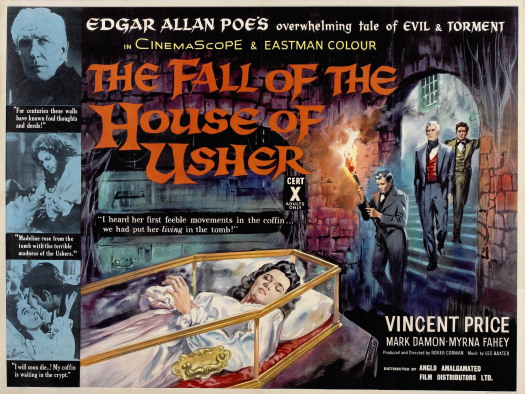
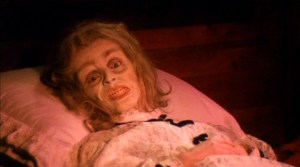
Horror Movie Review: The Fall of the House of Usher (dir by Roger Corman)


The 1960 film, The Fall Of The House of Usher, opens with Phillip Winthrop (Mark Damon) riding his horse across a desolate landscape.

There’s a foreboding mansion in the distance but what the viewer immediately notices is that the land around the mansion looks almost post-apocalyptic.  Even though the film is set in the 1800s, the misshapen trees and the high winds all bring to mind a film set in a nuclear-scarred world, the type where you expect to find radioactive mutants hiding behind every tree and rock.

Phillip is a young aristocrat who is traveling to the home of the Usher family.  He is engaged to marry Madeleine Usher (Myrna Fahey) but, as soon as he arrives at the mansion, her older brother, Roderick (Vincent Price, with no mustache and blonde hair), informs Phillip that he will never be allowed to marry Madeleine.  Roderick explains that the Usher family is cursed and he even takes Phillip on a tour of Usher family history, showing him a series of truly hideous paintings of past Ushers.  One Usher was a murderer.  Another Usher was blackmailer.  An Usher wearing a pirate’s cap is identified as being a slave trader.  The Ushers are cursed, with each family member destined to become insane.  Roderick’s mission is to bring the Usher bloodline to a close and that means that Madeleine cannot marry.

Phillip disagrees, especially when the sickly Madeleine herself says that she wants to escape from her seemingly mad brother.  With the house itself continually shaking as if it’s on the verge of collapsing, Phillip becomes determined to take Madeleine away.  Roderick tries to warn him not to.  Even the friendly butler, Bristol (Harry Ellerbe), encourages Phillip to give up.  But Phillip remains stubborn and determined.  However, when Madeleine suddenly collapses and dies, it appears that Phillip’s plans to marry her are at an end.  But is Madeleine truly dead?

Based on a short story by Edgar Allan Poe, this was, at the time, the most expensive film that Roger Corman and American International Pictures had ever made.  (It was also their first color film.)  Of course, the budget was still just $300,000 and the Usher mansion was largely constructed out of props that were borrowed from other films.  That said, the film had a name star and, with its vivid colors and its fiery finale, it certainly looked like a big-budget film.  This film marked the first collaboration between Vincent Price and Roger Corman and it was a box office success, making  a million dollars at a time when a million dollars really meant something..  Corman and Price would go on to do several other Poe adaptations together, all of which were distinguished by Price’s villainous performances and Corman’s pop art visuals.

Seen today, The Fall of the House of Usher can seem to be a bit slow.  With only one location and a cast of only four actors, it often feels a bit stagey.  Mark Damon is rather stiff as Phillip.  (One can see why he abandoned acting to become a producer.)  But Vincent Price’s performance as Roderick Usher continue to entertain, with Price delivering every line of dialogue with his trademark aristocratic archness.  There’s nothing subtle about Price’s performance but Price’s tendency to overact perfectly matched Corman’s vivid visuals and it’s interesting to watch a hyperactive Price performance paired with the type of dull performance that Mark Damon offers up.

The fiery finale still packs a certain punch and, watching it, one can see why Corman and Price said, “Let’s do this again!”  The Fall of the House of Usher (which is also available on some streaming sites as simply House of Usher) remains an enjoyable macabre Halloween treat.
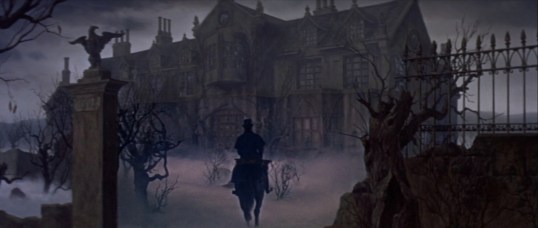
House of Usher (1960, dir by Roger Corman, DP: Floyd Crosby)


Lisa Reviews An Oscar Nominee: The Longest Day (dir by Ken Annakin, Andrew Marton, Bernhard Wicki, Gerd Oswald, and Darryl F. Zanuck)


As my sister has already pointed out, today is the 73rd anniversary of D-Day.  With that in mind, and as a part of my ongoing mission to see and review every single film ever nominated for best picture, I decided to watch the 1962 film, The Longest Day!

The Longest Day is a pain-staking and meticulous recreation of invasion of Normandy, much of it filmed on location.  It was reportedly something of a dream project for the head of the 20th Century Fox, Darryl F. Zanuck.  Zanuck set out to make both the ultimate tribute to the Allied forces and the greatest war movie ever.  Based on a best seller, The Longest Day has five credited screenwriters and three credited directors.  (Ken Annakin was credited with “British and French exteriors,” Andrew Marton did “American exteriors,” and the German scenes were credited to Bernhard Wicki.  Oddly, Gerd Oswald was not credited for his work on the parachuting scenes, even though those were some of the strongest scenes in the film.)  Even though he was not credited as either a screenwriter or a director, it is generally agreed that the film ultimately reflected the vision of Darryl F. Zanuck.  Zanuck not only rewrote the script but he also directed a few scenes as well.  The film had a budget of 7.75 million dollars, which was a huge amount in 1962.  (Until Steven Spielberg’s Schindler’s List, The Longest Day was the most expensive black-and-white film ever made.)  Not only did the film tell an epic story, but it also had an epic length.  Clocking in at 3 hours, The Longest Day was also one of the longest movies to ever be nominated for best picture.

The Longest Day also had an epic cast.  Zanuck assembled an all-star cast for his recreation of D-Day.  If you’re like me and you love watching old movies on TCM, you’ll see a lot of familiar faces go rushing by during the course of The Longest Day.  American generals were played by actors like Robert Mitchum, Robert Ryan, Henry Fonda, and John Wayne.  Peter Lawford, then the brother-in-law of the President of the United States, had a memorable role as the Scottish Lord Lovat, who marched through D-Day to the sounds of bagpipes.  When the Allied troops storm the beach, everyone from Roddy McDowall to Sal Mineo to Robert Wagner to singer Paul Anka can be seen dodging bullets.  Sean Connery pops up, speaking in his Scottish accent and providing comic relief.  When a group of paratroopers parachute into an occupied village, comedian Red Buttons ends up hanging from the steeple of a church.  When Richard Beymer (who is currently playing Ben Horne on Twin Peaks) gets separated from his squad, he stumbles across Richard Burton.  Among those representing the French are Arletty and Christian Marquand.  (Ironically, after World War II, Arletty was convicted of collaborating with the Germans and spent 18 months under house arrest.  Her crime was having a romantic relationship with a German soldier.  It is said that, in response to the charges, Arletty said, “My heart is French but my ass is international.”)  Meanwhile, among the Germans, one can find three future Bond villains: Gert Frobe, Curt Jurgens, and Walter Gotell.

It’s a big film and, to be honest, it’s too big.  It’s hard to keep track of everyone and, even though the battle scenes are probably about an intense as one could get away with in 1962 (though it’s nowhere near as effective as the famous opening of Saving Private Ryan, I still felt bad when Jeffrey Hunter and Eddie Albert were gunned down), their effectiveness is compromised by the film’s all-star approach.  Often times, the action threatens to come to a halt so that everyone can get their close-up.  Unfortunately, most of those famous faces don’t really get much of a chance to make an impression.  Even as the battle rages, you keep getting distracted by questions like, “Was that guy famous or was he just an extra?”

Among the big stars, most of them play to their personas.  John Wayne, for instance, may have been cast as General Benjamin Vandervoort but there’s never any doubt that he’s playing John Wayne.  When he tells his troops to “send them to Hell,” it’s not Vandervoort giving orders.  It’s John Wayne representing America.  Henry Fonda may be identified as being General Theodore Roosevelt II but, ultimately, you react to him because he’s Henry Fonda, a symbol of middle-American decency.  Neither Wayne nor Fonda gives a bad performance but you never forget that you’re watching Fonda and Wayne.

Throughout this huge film, there are bits and pieces that work so well that you wish the film had just concentrated on them as opposed to trying to tell every single story that occurred during D-Day.  I liked Robert Mitchum as a tough but caring general who, in the midst of battle, gives a speech that inspires his troops to keep fighting.  The scenes of Peter Lawford marching with a bagpiper at his side were nicely surreal.  Finally, there’s Richard Beymer, wandering around the French countryside and going through the entire day without firing his gun once.  Beymer gets the best line of the film when he says, “I wonder if we won.”  It’s such a modest line but it’s probably the most powerful line in the film.  I wish The Longest Day had more scenes like that.

The Longest Day was nominated for best picture of 1962 but it lost to an even longer film, Lawrence of Arabia.

Happy Birthday Vincent Price: THE FALL OF THE HOUSE OF USHER (AIP 1960)


gary loggins's avatarcracked rear viewer

I’ve covered Vincent Price’s film work 17 times here, which must be some kind of record. Can you tell he’s one of my all-time favorite actors? Vincent Leonard Price, Jr. was born May 27, 1911 in St. Louis, Missouri. The elegant, eloquent Price was also an avid art collector and gourmet cook of some note. He’s justifiably famous for his film noir roles, but Price etched his name in cinematic stone as one of filmdom’s Masters of Horror.

Price starred in his first fright film way back in 1940 with THE INVISIBLE MAN RETURNS . But it wasn’t until 1953’s 3-D outry HOUSE OF WAX that he became tagged as a horror star. Later in that decade, he made a pair of gimmicky shockers for director William Castle ( THE HOUSE ON HAUNTED HILL , THE TINGLER), and in 1960 began his collaboration with Roger Corman on movies based (loosely, mind you) on the works of Edgar Allan Poe. The first…

View original post 584 more words

Documentary Review: Seduced and Abandoned (dir by James Toback)


I recently watched James Toback’s 2013 Seduced and Abandoned on HBO.  This documentary failed to seduce me but it certainly left me feeling abandoned.

Seduced and Abandoned follows James Toback and Alec Baldwin as they wander around the Cannes Film Festival, interviewing filmmakers and attempting to raise money for Toback’s latest film.  That film, incidentally, is a remake of  Last Tango In Paris.  Though neither Toback nor Baldwin goes into too much detail about the film (and I’m not exactly convinced that they’re all that serious about it to begin with), we do learn that this remake would be set in Iraq.  Alec Baldwin would play a right-wing CIA agent while Neve Campbell  would play a leftist journalist.  We watch as Baldwin and Toback pitch this film to a countless number of potential producers and ask for twenty million dollars.  Without fail, every producer replies that he loves Alec Baldwin but he’s not willing to spend that type of money on him because Baldwin is not a bankable star.  As Baldwin and Toback frequently lament, nobody seems to care what the film is about.  Instead, they’re only interested in making money.

And this brings us to this documentary’s main problem.  It would be easier to agree with them about businessmen sacrificing art for greed if not for the fact that the movie that Toback and Baldwin are talking about making sounds like perhaps the worst fucking film ever pitched.  A remake of Last Tango in Paris starring Alec Baldwin, directed by James Toback, and taking place in Iraq?  Are you freaking kidding me?  I would never pay money to see a movie that sounded that pretentious.  I would never ask anyone else to buy me a ticket for this movie.  If I saw this movie on HBO, I would cancel my cable subscription.  Seriously, no way.

And yes, I do understand Baldwin and Toback’s point.  They’re arguing that a politically-themed, Iraq-set remake of Last Tango In Paris could not be made today because the system has been set up to silence the voice of artists. The industry is more concerned with making money than making an artistic statement.  I happen to agree 100% but that still doesn’t change the fact that Toback and Baldwin’s film sounds terrible.

Toback and Baldwin interview everyone from Ryan Gosling to Jessica Chastain to Martin Scorsese to Francis Ford Coppola and the one thing that every interview has in common is the sound of Toback’s braying laughter.  It’s a very forced and calculating laugh, one that seems almost as fake as Toback’s pseudo-intellectual persona.  And that’s the other big problem with Seduced and Abandoned.  Toback and Baldwin never really come across as being the rebels that they obviously believe themselves to be.  Even when Toback is talking to the financiers that he and Baldwin appear to blame for ruining the movies, it’s obvious that Toback wants us to impressed by the fact that he knows so many fabulously wealthy people.  In the end, the film feels self-congratulatory in the most undeserving of ways.

And yet, there are occasional moments where the film, almost despite itself, manages to escape from the suffocating egos of James Toback and Alec Baldwin.  The section of the film that deals with the history of Cannes Film Festival is fascinating and Martin Scorsese is such a lively and sincere artist that it’s impossible not to enjoy his interview.  (In many ways, Scorsese seems to be the anti-Toback.)  For a few seconds, Alec Baldwin stops being insufferable long enough to do a reasonably humorous impersonation of Woody Allen.  If you’re a student of Italian cinema, you’ll be happy to see a brief appearance from Mark Damon, a former actor turned producer who appears in several Italian spaghetti westerns in the late 60s.  Damon is the first producer to have to sit through Toback’s pitch and its fascinating to watch just how indifferent he is to idea of remaking Last Tango In Paris with Alec Baldwin and James Toback.

Mark Damon aside, Seduced and Abandoned is a documentary that fails to do the former and will probably inspire many viewers to do the latter.

Horror Film Review: Black Sabbath (dir. by Mario Bava)


For my latest horror review, I will be reviewing another classic film from one of my favorite directors, Mario Bava.  Following the suggestion of my twitter friend Tom, I spent last night watching Bava’s 1963 classic Black Sabbath.

Starring Boris Karloff, Black Sabbath is a compilation film that’s made up of three different horror-themed stories.  Originally entitled Three Faces of Fear, Black Sabbath has been released in many different versions over the years.  Depending on which version you seen, the stories may be in a different order than in the order that Bava intended.  The version I watched was the original, uncut, Italian-language version that was released by Anchor Bay.  For those of you who want to truly experience the genius of Mario Bava, this is the version to see.

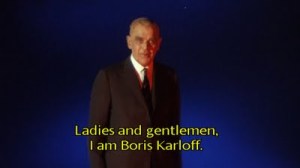
Black Sabbath begins with Boris Karloff playing himself, giving a deliberately over-the-top introduction and informing us that there could very well be vampires and werewolves sitting next to us in the theater.  Yes, it’s silly and yes, it’s campy but it’s also a lot of fun.  A lot of this is because these words are delivered by Karloff, an actor who could make even the silliest of dialogue sound important.  The other part is that, as silly as the introduction may be, it’s beautiful to look at.  Instead of going for the standard spooky narrator in a cobweb-filled library approach, Bava frames Karloff standing against a brilliant dark blue backdrop that establishes that this isn’t just your typical horror host … this is BORIS FREAKIN’ KARLOFF!

After Karloff’s introduction, we move on to the first of Black Sabbath’s three separate stories, The Telephone.

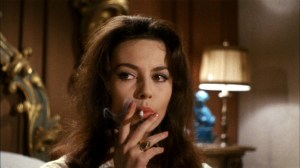
In The Telephone, Michele Mercier plays a Parisian prostitute who returns to her apartment after an evening out.  As she tries to change for bed, her bright red telephone rings.  Every time Mercier opens the phone, she hears a man’s voice taunting and threatening her.  Finally, the caller claims to be Frank, Mercier’s former pimp who has just escaped from prison.  The terrified Mercier calls her estranged lesbian lover (Lydia Alfonsi).  Alfonsi comes over to the basement to comfort Mercier.  However, what Mercier doesn’t realize is that it wasn’t Frank calling her.  It was Alfonsi, pretending to be Frank.  However, needless to say, there’s more twists to come before the night’s over.

Of the three segments, The Telephone is probably the least succesful if just because it has the most pedestrian plot.  At the same time, this segment also show just how good Bava was at creating tension even with so-so material.  Speaking as someone who has been stalked in the past, I can say that both Mercier and Bava perfectly captures the way that one seemingly simple intrusion on your privacy can leave you suddenly feeling very isolated and very alone.  Finally, even after the segment’s over, it’s impossible to forget the sight of that vibrantly red phone sitting like a lurking monster in that artfully drab apartment.

The Telephone is followed by probably the film’s most famous segment, The Wurdalak.

Based on a short story by Tolstoy, The Wurdalak opens with a Russian nobleman (played Italian exploitation mainstay Mark Damon) on a long trip through the Russian wilderness.  He comes across a headless corpse with a dagger plunged into its heart.  Damon takes the dagger as a morbid souvenir of his trip.

As night falls, Damon comes across a small cottage and asks the family inside for shelter.  Inside the cottage, Damon discovers a wall that is covered with daggers similar to the one he found earlier.  His hosts explain that the daggers belong to the family patriarch, Gorcha (Boris Karloff).  Gorcha left five days earlier to kill a wurdolak (or vampire, by any other name).  As the family waits for Gorcha to return, not knowing whether or not he himself is now a vampire, Damon finds himself falling in love with Gorcha’s daughter.  When Gorcha finally does return, it’s obvious that he’s not the same man he was when he originally left.

Of the three segments, The Wurdolak is probably the most obviously Bavaesque and a whole lot of the same images and themes would later turn up in Bava’s masterwork, Kill, Baby, Kill.  Everything, from the constantly howling wind to the sense of isolation to the well-meaning but ultimately impotent upper-class hero, is classic Bava.  Special mention should also be made of Boris Karloff’s performance here.  Because Karloff was best known for appearing in “monster” movies, he never gets enough recognition for being a pretty good actor.  His performance here, which is full of malice and threat, is just as menacing as his earlier appearance in the introduction was fun and campy.

The final segment of the film is entitled The Drop of Water.

In many ways, The Drop of Water is the simplest segment of the film but for me, personally, it’s also the scariest.  In London, a nurse (Jacqueline Pierreux) is called to a large house to prepare a medium for burial.  While doing this. the nurse notices a large (and, quite frankly, kinda gaudy) ring on the medium’s finger.  The nurse steals the ring and returns to her own apartment.  As soon as she goes to her apartment, she finds herself haunted by increasingly ominous events: a buzzing fly refuses to leave her alone, the sound of water dripping echoes through the apartment, the lights go on and off, and — naturally — a mysterious figure suddenly appears in her bedroom.

Mixing the sense of growing paranoia that characterized The Telephone with Wurdolak’s sense of predestined, metaphysical doom, The Drop of Water is the perfect concluding chapter of Black Sabbath.  It also happened to scare the Hell out of me.  Along with Bava’s usual superb direction, this film was distinguished by some wonderfully creepy make-up work.  Seriously, once that mysterious figure reveals itself, you’ll wish it hadn’t.

I usually don’t enjoy compilation films because, too often, it seems that you’re lucky if you get just one above average story surrounded by a bunch of forgettable filler.  Far too often, the stories themselves don’t seem to go together.  Instead, they just appear to have been tossed together randomly with the weakest of possible connection.  Black Sabbath is an exception and that’s largely because of Mario Bava’s iconic direction.  The stories aren’t linked together by plot as much as their linked together by motif and theme.  Each story — from the emphasis on isolation to the creative use of color to suggest mood and menace — is linked by Bava’s style.  Boris Karloff may have been the name emphasized in the credits but the true star of Black Sabbath is Mario Bava.

The genius of Bava wasn’t in the originality of the stories he told but instead, in the new ways that he found to tell familiar stories.  Usually, I hate it when directors describe themselves as being about “style” as opposed to “substance.”  Too often, it seems like that’s just an excuse to not come up with an interesting story.  However, Bava is one of the few directors about whom the term “style over substance” can be used as a compliment.  Bava knew how to make style into art and he certainly did that in Black Sabbath.

6 Trailers For An Out Of Control Youth


For this week’s edition of Lisa Marie’s Favorite Grindhouse and Exploitaiton Trailers, we actually have a loose theme as opposed to just me tossing up random stuff.  That theme: Out Of Control Youth. (Cue dramatic DAH-DAH-DAAAAAH music)

Normally, I try to avoid doing “theme” trailer posts because they require way too much concentration on my part.  However, this week, as I selected the trailers I wanted to feature, I slowly realized that I was doing just that and I was actually being a pretty good job at it. 

Take heart, Out of Control Youths.  This post is dedicated to you.

1) Black Mama, White Mama (1972)

I may be wrong but just judging from the trailer, I think this film might be about “women in chains.”  Pam Grier, of course, everyone knows.  The white mama was played by Margaret Markov, who later married exploitation film producer Mark Damon.

2) Over the Edge (1979)

This one shows up on cable a lot and it’s actually pretty good.  Check out the hair on Matt Dillon.

3) Suburbia (1984)

Eventually, I guess the kids from Over the Edge grew up to be the kids from Suburbia.  I’ve got this one on DVD but every time I’ve tried to watch it, I’ve ended up falling asleep.  Not necessarily because the film is bad.  I just always end up trying to watch it at 4 in the morning for some reason.

4) Certain Fury (1985)

I just love that the credits at the end of the trailer announce that this film features a “special appearance” from Peter Fonda.

5) Mission Hill (1982)

“Mission Hill: A Neighborhood where anything can happen…”  This is the type of film that I often fantasize about appearing in.  Naturally, I would be the girl singing.  I can’t really sing but that’s what post-production dubbing is for, right?

6) Devil Times Five (1974)

This is another one that I have on DVD but I haven’t found the time to watch yet.  This appears to be a film in which psycho children kill … well, everything.  All I know is that if I’m ever taking a bath and some little child comes wandering in with a bunch of fish, I’m jumping up and running.  I don’t care how wet and naked I am.