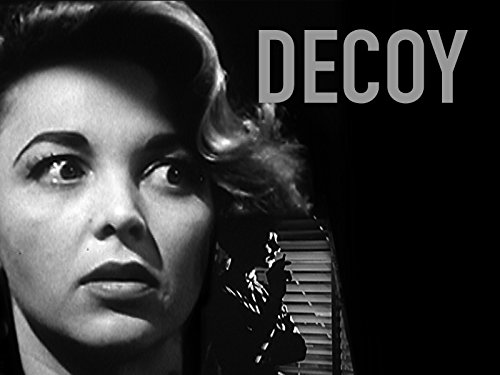
Welcome to Retro Television Reviews, a feature where we review some of our favorite and least favorite shows of the past! On Thursdays, I will be reviewing Decoy, which aired in Syndication in 1957 and 1958. The show can be viewed on Tubi!
This week, Casey learns about the dangers of reefer!
Episode 1.24 “Saturday Lost”
(Dir by Stuart Rosenberg, originally aired on March 24th, 1958)
Casey and her partner-of-the-week (played by Simon Oakland) are investigating the death of Geraldine “Geri” Wilson, a quiet and studious college student who was found dead on the side of the road after attending a college football game with her sister, Beth (Barbara Lord). Beth, who couldn’t even remember her own name when she was first found the morning after, isn’t much of a witness. She can’t remember what happened that night but, as she and Casey sit in one Geri’s old hangouts, she recognizes Ken Davidson (Larry Hagman), a student who was with them at the football game. Beth remembers that Ken and Geri had a fight.
The stunned Ken says that he had no reason to kill Geri.
Casey replies, “Marijuana gave you a reason!”
Casey has figured out, from listening to the way the spacey Beth talks, that Beth and Geri smoked “reefer” the night of the football game. Casey is convinced that, in a marijuana-crazed state, Ken tossed Geri out of the car. To help jog Beth’s memory, she has her partner drive Beth, Ken, and Casey along the same route where Geri’s body was found.
“Where did you get the reefers, sonny!?” Casey demands of Ken.
Beth suddenly remembers that she’s the one who bought the marijuana. Beth says that it only cost a dollar and that Ken himself didn’t indulge. Instead, it was just Beth and Geri who got stoned. Beth was driving when Geri opened the car door and fell out. “Faster! Faster!” Beth says, a line that immediately brings to mind the 30s anti-drug film, Reefer Madness.
(Why wasn’t Ken driving if he was the only one who wasn’t stoned?)
Back at police headquarters, Casey looks at the camera and tell us that the case has been dismissed. However, Beth will never forget that her sister died because Beth bought “reefer.”
Beverly Garland is, as always, excellent and a young Larry Hagman does well as Ken. But Barbara Lord overacts to such an extent that you really find yourself wondering if maybe she actually popped a bunch of amphetamines as opposed to smoking weed. Indeed, Beth and Geri’s story would be plausible with a lot of different drugs but it’s not particularly plausible with marijuana. There’s also a rather bizarre cameo from a young William Hickey (you’ll recognize the voice), playing a hipster who spouts a lot of nonsense. If anything, Hickey’s hipster comes across as if he’d be more likely to know where to get weed on campus than Ken but Casey just lets him wander off. In the end, this episode feels like a version of the urban legend about the girl who walked into an airplane propeller because she took too many pills.
Larry Hagman, I should mention, was a proud member of the Hollywood counter-culture and was very open about his own use of marijuana. (Apparently, he was introduced to it by Jack Nicholson, who felt it would help Hagman cut back on his drinking.) I wonder if anyone ever asked him about this episode.
Nominated for Best Picture of 1987, Moonstruck is a film about love, romance, New York City, and being Italian.
Loretta Castorini (Cher) is a widow and a bookkeeper who lives with her parents, Cosmo (Vincent Gardenia) and Rose (Olympia Dukakis) in Brooklyn. When her boyfriend, Johnny (Danny Aiello), asks Loretta to marry him, Loretta says yes even though she knows that, while she likes him, she’s not really in love with him. After he proposes, Johnny reveals that he has to go to Sicily to see his “dying” mother. He asks Loretta to pay a visit to his estranged brother, Ronny (Nicolas Cage), and invite him to the wedding. Loretta, a strong believer in family and the importance of following tradition, agrees.
Loretta finds Ronny working in the bakery that he owns. Ronny is not thrilled to learn that his brother has gotten engaged. Ronny reveals that he has a wooden hand. He lost his real hand when he accidentally placed it in a bread slicer while having a conversation with Johnny. After he lost his hand, Ronny’s then-fiancée left him. Ronny has never forgiven Johnny for the loss of his hand. “I lost my hand! I lost my bride!” Ronny yells to the heavens. Loretta, however, immediately understands that Johnny actually hurt his hand to get his fiancée to break up with him. A conversation at Ronny’s apartment leads to the two of them impulsively sleeping with each other. The next day, Ronny promises to never bother Loretta again if she agrees to go the opera with him.
What the guilt-stricken Loretta doesn’t know is that her father is having an affair himself and it turns out that Cosmo and Mona (Rose Gilette) enjoy the opera as well. Meanwhile, Rose finds herself tempted by a lecherous college professor named Perry (John Mahoney).
There’s a lot of stereotypes to be found in Moonstruck. Of course, passionate Ronny loves the opera. Of course, the simple but well-intentioned Johnny abandons his fiancée so that he can rush to Sicily to be with his “dying” mother who, it turns out, isn’t dying at all. Of course, Loretta slaps Ronny and tells him to snap out of it. (I should note that I’m a fourth Italian myself so I could definitely relate to some of this film. I’ve never liked opera, though.) Fortunately, the film’s cast is so perfectly chosen and John Patrick Shanley’s script so adroitly maintains the balance between the broad comedy and the small dramatic moments that it doesn’t matter that all of the characters are a bit stereotypical. The film comes to a wonderful life. It’s impossible not love these characters, flaws and all. Cher and Olympia Dukakis deserved the Oscars that they both won for this film. Vincent Gardenia deserved the nomination that he received. Nicolas Cage, Danny Aiello, and John Mahoney were not nominated but they should have been. In particular, John Mahoney is heart-breaking in his small role, playing the type of lecherous character that most films would have just portrayed as being a cardboard buffoon. As for Nicolas Cage, Moonstruck is a film that features both his trademark eccentricity and his ability to show the real and vulnerable human being underneath all of the bluster. Moonstruck is a film about the search for love and the glory of finding it. It’s a wonderfully romantic film, even if almost all of that love seems to involve infidelity. As directed by Norman Jewison, Moonstruck not only celebrates falling in love but also celebrates being lucky enough to do so in New York City. It’s a love letter not just to its characters but to the city as well.
Moonstruck was nominated for Best Picture but it lost to a far more epic production, The Last Emperor.
Welcome to Late Night Retro Television Reviews, a feature where we review some of our favorite and least favorite shows of the past! On Mondays, I will be reviewing CHiPs, which ran on NBC from 1977 to 1983. The entire show is currently streaming on Freevee!
This week, Jon Baker gives up a dream.
Episode 1.7 “Taking Its Toll”
(Dir by Georg Fenady, originally aired on November 3rd, 1977)
Inspired by his hero Joseph Wambaugh, Jon Baker is writing a book. It’s a novel all about the crazy things that he has seen as a member of the California Highway Patrol. Ponch is one of the main characters. Of course, Baker is mostly focusing on all of the times that Ponch has screwed up. On his writer’s board, Baker has cards that read, “Ponch Falls In Glue,” “Ponch Loses His Bike,” and “Ponch Rips His Pants.” Ponch, when he discovers what Jon is doing, isn’t necessarily happy about being held up to ridicule but then Baker promises to portray Ponch as a hero, a modern-day Roman centurion who rides his bike like a horse into battle.
This episode provides Baker with plenty of material. Two blonde surfer dudes are robbing people who are stopped at toll booths and then making their escape in stolen sports cars. As well, a man crashes his car and, when the highway patrol investigates, they discover a bomb in the back seat! The bomb squad is called but what about the innocent motorcyclist who is trapped underneath the car? If the bomb blows up, not only will the motorcyclist be killed but so will Ponch, the officer who is trying to keep him calm. (Don’t worry, the bomb doesn’t blow up.) As well, when a truck carrying a bunch of onions has an accident, it leads to onions all over the road! Ponch, Baker, Bear, and even Gatraer end up shedding some tears while directing traffic.
It sounds like it will make a great book but, unfortunately, Baker discovers that, as a cop, he’s not really allowed to freely write a book about his experiences. Instead, he has to clear everything with the legal department and then ask permission before even trying to get the book published. (As Gatraer explains it, the California Highway Patrol has to protect its image.) To Ponch’s disappointment, Baker abandons the book and throws away his plot cards. Fear not, though! Ponch says he’s going to write his own book and even commandeers Baker’s typewriter to do so.
(Yes, a typewriter. Seriously, I can’t imagine writing anything without having the ability to just highlight a paragraph and delete the entire thing without the click of a button.)
This was one of those day-in-the-life episodes that didn’t really add up to much. Interestingly enough, the emphasis was often less on Baker and Ponch and more on the idea of the entire California police force — from the Highway Patrol to the Sheriff’s Department to the Bomb Squad — all working together to keep people safe. The best part of the episode came early on with an exciting chase between Baker and the toll thieves. For the most part, though, this episode just left me thinking about how an episode that featured Baker writing a book somehow still managed to largely focus on Ponch. Watching this episode, I could understand why Larry Wilcox was reportedly not always happy with the direction of the show. Even when its about Baker, CHiPs is still largely the Ponch Show.
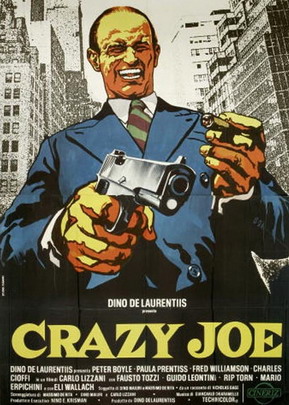
Crazy Joe (Peter Boyle) is a gangster with a chip on his shoulder and a self-taught intellectual who can (misquote) Sartre and Camus with the best of them. Sick of being taken for granted, Joe and his brother, Richie (Rip Torn), attempt to challenge the Mafia establishment. The mob sets Joe up and gets him sent to prison. While doing time, Joe befriends a Harlem gangster named Willy (Fred Williamson). Refusing to associate with the other Italian prisoners, Joe allies himself with the black inmates and even helps to start a riot over the prison’s inhumane conditions. When he is released, Joe hits the streets of New York with a vengeance, now backed up by Willy and his criminal organization.
Crazy Joe is based on the life of Joey Gallo, who was briefly a New York celebrity, hobnobbing with actors like Jerry Orbach and writers like Norman Mailer before he was gunned down at Umberto’s Clam Shop in Little Italy. Though the names were changed to protect the guilty, Eli Wallach plays Vito Genovese, Charles Cioffi plays Joe Columbo, and Luther Adler is Joe Profaci. Fred Williamson’s character is based on the infamous Nicky Barnes.
Crazy Joe is a good and violent mix of the gangster, prison, and blaxploitation genres. Despite wearing an unfortunate toupee, Peter Boyle is great at putting the crazy in Crazy Joe and Fred Williamson ups the coolness factor of any movie he appears in. Keep an eye out for Henry Winkler, giving a very un-Fonzie performance as Joe’s right-hand man.
“I got something for your mother and Sonny and a tie for Freddy and Tom Hagen got the Reynolds Pen…” — Kay Adams (Diane Keaton) in The Godfather (1972)
It probably seems strange that when talking about The Godfather, a film that it is generally acknowledged as being one of the best and most influential of all time, I would start with an innocuous quote about getting Tom Hagen a pen.
(And it better have been a hell of a pen because, judging from the scene where Sollozzo stops him in the street, it looked like Tom was going all out as far as gifts were concerned…)
After all, The Godfather is a film that is full of memorable quotes. “Leave the gun. Take the cannoli.” “I’m going to make him an offer he can’t refuse.” “It’s strictly business.” “I believe in America….” “That’s my family, Kay. That’s not me.”
But I went with the quote about the Reynolds pen because, quite frankly, I find an excuse to repeat it every Christmas. Every holiday season, whenever I hear friends or family talking about presents, I remind them that Tom Hagen is getting the Reynolds pen. Doubt me? Check out these tweets from the past!
But all that love also makes The Godfather a difficult film to review. What do you say about a film that everyone already knows is great?
Do you praise it by saying that Al Pacino, Robert Duvall, James Caan, Diane Keaton, Marlon Brando, John Cazale, Richard Castellano, Abe Vigoda, Alex Rocco, and Talia Shire all gave excellent performances? You can do that but everyone already knows that.
Do you talk about how well director Francis Ford Coppola told this operatic, sprawling story of crime, family, and politics? You can do that but everyone already knows that.
Maybe you can talk about how beautiful Gordon Willis’s dark and shadowy cinematography looks, regardless of whether you’re seeing it in a theater or on TV. Because it certainly does but everyone knows that.
Maybe you can mention the haunting beauty of Nina Rota’s score but again…
Well, you get the idea.
Now, if you somehow have never seen the film before, allow me to try to tell you what happens in The Godfather. I say try because The Godfather is a true epic. Because it’s also an intimate family drama and features such a dominating lead performance from Al Pacino, it’s sometimes to easy to forget just how much is actually going on in The Godfather.
The Godfather tells the story of the Corleone Family. Patriarch Vito Corleone (Marlon Brando) has done very well for himself in America, making himself into a rich and influential man. Of course, Vito is also known as both Don Corleone and the Godfather and he’s made his fortune through less-than-legal means. He may be rich and he may be influential but when his daughter gets married, the FBI shows up outside the reception and takes pictures of all the cars in the parking lot. Vito Corleone knows judges and congressmen but none of them are willing to be seen in public with him. Vito is the establishment that nobody wants to acknowledge and sometimes, this very powerful man wonders if there will ever be a “Governor Corleone” or a “Senator Corleone.”
Vito is the proud father of three children and the adopted father of one more. His oldest son, and probable successor, is Sonny (James Caan). Sonny, however, has a temper and absolutely no impulse control. While his wife is bragging about him to the other women at the wedding, Sonny is upstairs screwing a bridesmaid. When the enemies of the Corleone Family declare war, Sonny declares war back and forgets the first rule of organized crime: “It’s not personal. It’s strictly business.”
After Sonny, there’s Fredo (John Cazale). Poor, pathetic Fredo. In many ways, it’s impossible not to feel sorry for Fredo. He’s the one who ends up getting exiled to Vegas, where he lives under the protection of the crude Moe Greene (Alex Rocco). One of the film’s best moments is when a bejeweled Fredo shows up at a Vegas hotel with an entourage of prostitutes and other hangers-on. In these scenes, Fred is trying so hard but when you take one look at his shifty eyes, it’s obvious that he’s still the same guy who we first saw stumbling around drunk at his sister’s wedding.
(And, of course, it’s impossible to watch Fredo in this film without thinking about both what will happen to the character in the Godfather, Part II and how John Cazale, who brought the character to such vibrant life, would die just 6 years later.)
As a female, daughter Connie (Talia Shire) is — for the first film, at least — excluded from the family business. Instead, she marries Sonny’s friend Carlo Rizzi (Gianni Russo). And, to put it gently, it’s not a match made in heaven.
And finally, there’s Michael (Al Pacino). Michael is the son who, at the start of the film, declares that he wants nothing to do with the family business. He’s the one who wants to break with family tradition by marrying Kay Adams (Diane Keaton), who is most definitely not Italian. He’s the one who was decorated in World War II and who comes to his sister’s wedding still dressed in his uniform. (In the second Godfather film, we learn that Vito thought Michael was foolish to join the army, which makes it all the more clear that, by wearing the uniform to the wedding, Michael is attempting to declare his own identity outside of the family.) To paraphrase the third Godfather film, Michael is the one who says he wants to get out but who keeps getting dragged back in.
And finally, the adopted son is Tom Hagen (Robert Duvall). Tom is the Don’s lawyer and one reason why Tom is one of my favorite characters is because, behind his usual stone-faced facade, Tom is actually very snarky. He just hides it well.
Early on, we get a hint that Tom is more amused than he lets on when he has dinner with the crude Jack Woltz (John Marley), a film producer who doesn’t want to use Johnny Fontane (Al Martino) in a movie When Woltz shouts insults at him, Tom calmly finishes his dinner and thanks him for a lovely evening. And he does it with just the hint of a little smirk and you can practically see him thinking, “Somebody’s going to wake up with a horse tomorrow….”
However, my favorite Tom Hagen moment comes when Kay, who is searching for Michael, drops by the family compound. Tom greets her at the gate. When Kay spots a car that’s riddled with bullet holes, she asks what happened. Tom smiles and says, “Oh, that was an accident. But luckily no one was hurt!” Duvall delivers the line with just the right attitude of “That’s my story and I’m sticking to it!” How can you not kind of love Tom after that?
And, of course, the film is full of other memorable characters, all of whom are scheming and plotting. There’s Clemenza (Richard S. Catellano) and Tessio (Abe Vigoda), the two Corleone lieutenants who may or may not be plotting to betray the Don. There’s fearsome Luca Brasi (Lenny Montana), who spends an eternity practicing what he wants to say at Connie’s wedding and yet still manages to screw it up. And, of course, there’s Sollozzo (Al Lettieri, playing a role originally offered to Franco Nero), the drug dealer who reacts angrily to Vito’s refusal to help him out. Meanwhile, Capt. McCluskey (Sterling Hayden) is busy beating up young punks and Al Neri (Richard Bright) is gunning people down in front of the courthouse. And, of course, there’s poor, innocent, ill-fated Appollonia (Simonetta Stefanelli)…
The Godfather is a great Italian-American epic, one that works as both a gangster film and a family drama. Perhaps the genius of the Godfather trilogy is that the Corleone family serves as an ink blot in a cinematic rorschach test. Audiences can look at them and see whatever they want. If you want them and their crimes to serve as a metaphor for capitalism, you need only listen to Tom and Michael repeatedly state that it’s only business. If you want to see them as heroic businessmen, just consider that their enemies essentially want to regulate the Corleones out of existence. If you want the Corleones to serve as symbols of the patriarchy, you need only watch as the door to Michael’s office is shut in Kay’s face. If you want to see the Corleones as heroes, you need only consider that they — and they alone — seem to operate with any sort of honorable criminal code. (This, of course, would change over the course of the two sequels.)
And, if you’re trying to fit a review of The Godfather into a series about political films, you only have to consider that Vito is regularly spoken of as being a man who carries politicians around in his pocket. We may not see any elected officials in the first Godfather film but their presence is felt. Above all else, it’s Vito’s political influence that sets in motion all of the events that unfold over the course of the film.
The Godfather, of course, won the Oscar for best picture of 1972. And while it’s rare that I openly agree with the Academy, I’m proud to say that this one time is a definite exception.

 Crazy Joe (Peter Boyle) is a gangster with a chip on his shoulder and a self-taught intellectual who can (misquote) Sartre and Camus with the best of them. Sick of being taken for granted, Joe and his brother, Richie (Rip Torn), attempt to challenge the Mafia establishment. The mob sets Joe up and gets him sent to prison. While doing time, Joe befriends a Harlem gangster named Willy (Fred Williamson). Refusing to associate with the other Italian prisoners, Joe allies himself with the black inmates and even helps to start a riot over the prison’s inhumane conditions. When he is released, Joe hits the streets of New York with a vengeance, now backed up by Willy and his criminal organization.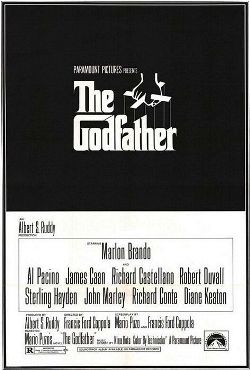
 Through the Shattered Lens