It’s strange to hear Leslie Nielsen drop an F bomb.
That was my main though I watched Camouflage. Leslie Nielsen plays a hard-boiled private detective named Jack Potter who reluctantly takes on an apprentice named Matty McKenzie (Lochlyn Munro). Mostly to get Matty, a failed stage actor, out of his hair, Jack sends him to handle a minor case in the small town of Beaver Ridge. The minor case becomes a major case when it becomes clear that a murder is being planned.
Camouflage starts out like a typical Leslie Nielsen mockbuster, with Nielsen providing a ridiculous, Frank Drebin-style narration. But the film itself develops into a dark comedy where Matty finds himself in a small town where everyone’s got secret. Nielsen gives an almost-serious performance as Potter, playing him as a cynic with a tragic backstory and little patience for his protegee. There’s a tonal imbalance between the moments of broad comedy and the more serious moments and the film doesn’t work as a result but it is interesting to see a post-Airplane! Leslie Nielsen playing things relatively straight.
One interesting thing about Camouflage is that it was written by Billy Bob Thornton and Tom Epperson but, in the final cut, the screenplay is credited to Reginald Perry. (The small town setting is one that Thornton used frequently in his scripts and it’s easy to imagine him playing the role of Jack Potter in alternate version of this film.) Camouflage reportedly sat on the shelf for quite a while before it was finally given a release and Nielsen’s narration often feels like it was something that was added in post-production to try to both bring the disjointed film together and to draw in the Naked Gun fans. I have a feeling the story behind this film is probably more interesting than the film itself.
2013’s Assault on Wall Street tells the story of Jim Braxford (Dominic Purcell), a security guard who loses all of his money due to some bad investments that he had no control over and whose wife, Rosie (Erin Karpluk), kills herself rather than continue her expensive medical treatments. Jim snaps and, after listening to a bunch of angry people on MSNBC, he decides to take violent vengeance on Wall Street, targeting brokers and CEOs and ultimately launching an all-out assault on a firm owned by the cartoonishly evil Jeremy Stancroft (John Heard).
Full of anti-capitalist rhetoric and heavy-handed plot developments, Assault on Wall Street finds director Uwe Boll in a political mood. Because the film deals with economic anxiety to which everyone can relate, this film is slightly more effective than Boll’s usual films but that still doesn’t mean that it’s particularly good. It’s one of those films that takes forever to get where it’s going and the film also suffers due to Boll’s confounding decision to cast Dominic Purcell in the lead role. The blank-eyed, flat-voice Purcell gives such a spectacularly dull performance that one wonders if he was constructed out of charisma anti-matter. It doesn’t help that Purcell’s three best friends are played Edward Furlong, Michael Pare, and Keith David, all of whom come across like they would have been a better pick for the lead role.
The film ends with a spate of violence that I remember that I found to be a bit shocking when I first saw the film on cable in 2013. Of course, today, such violence has been normalized and is often celebrated on social media. I imagine that members of the creepy Luigi death cult would probably claim that Jim Braxford didn’t go far enough in his murder spree.
Two of my favorites, Eric Roberts and Lochlyn Munro, have supporting roles in this film. Munro is Jim’s broker, who makes the mistake of complaining about how he had to cancel his planned vacation to Barbados as a result of the economic meltdown. Roberts plays the lawyer who agrees to help Jim get justice but who ultimately proves to be no help at all. Both of them are memorable in their small roles, which once again leaves us to wonder why, with all the talent available, Uwe Boll apparently decided to make Dominic Purcell his muse. That was a bad investment.
Previous Eric Roberts Films That We Have Reviewed:
If there’s any true crime book that I recommend without hesitation, it’s Our Guys by Bernard Lefkowitz.
First published in 1997, Our Guys deals with a terrible crime that occurred in the leafy suburban community of Glen Ridge, New Jersey. In 1989, it was an affluent community that loved its high school football team and where conformity and financial success were the most valued qualities the someone could have. On March 1st, a 17 year-old girl was invited to a house party where, after she was convinced to head down to the basement, she was raped with a broomstick and a baseball bat by several members of the football team. The girl was intellectually disabled and was later determined to have an IQ of 64. Her name has never been revealed to the public. In his book, Lefkowitz assigned her the pseudonym of Leslie Faber.
The crime was terrible. So was the aftermath. When one of the witnesses went to a teacher with what he saw happen in the basement, the town responded by rallying around the accused. Initially, Leslie was accused of lying. Then, as it became clear that something actually had happened in that basement, Leslie was accused of bringing it on herself. Leslie, who was desperate to have friends and who was later determined to be psychologically incapable of saying “no” or even understanding what consent meant, was cast as a wanton seductress who led the members of the football team astray. A girl who went to school with Leslie even tape recorded a conversation with Leslie in which Leslie was manipulated into saying that she had made the entire thing up. It also undoubtedly didn’t help that some of the accused boys had fathers who were on Glen Ridge’s police force.
It’s a book that will leave you outraged. Lefkowitz not only examined the crime itself but also the culture of the town and its general attitude that “boys will be boys.” Despite the fact that they had a losing record and the fact that one of them was infamous for exposing himself every chance that he got, the football team was viewed as being made up as winners. They were allowed to party every weekend with their parties becoming so legendary that they bragged about them in their yearbook quotes. With a group of supportive girlfriends doing their homework for them, the football team was free to do whatever they wanted and, by the time they were seniors, they were infamous for being voyeurs. While one football player would have sex, all the others would hide in a closet and watch. When one of the football players stole $600 from one of his classmates, his father paid back the money and no one was ever punished. In a town that valued material success above all else and viewed being different as a sign of weakness, Leslie and her family were treated as being outcasts. In the end, three of the football players were sentenced to prison. One was sentenced to probation. A few others accepted plea deals and had their arrests expunged from the record. Years later, one of the guys who was in the basement but not charged would murder his wife while home on leave from the military.
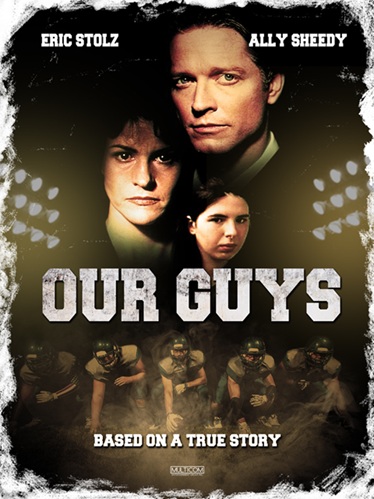
In 1999, Our Guys was adapted into a made-for-television movie. Featuring Heather Matarazzo as Leslie, Ally Sheedy as the detective who investigated her rape, Eric Stoltz as the lawyer who prosecuted the case, and Lochlyn Munro as a cop who starts out on the side of the football team before realizing the truth, Our Guys simplifies the story a bit. While the book focused on Glen Ridge and the culture of celebrating winners no matter what, the film focuses on Sheedy as the detective and her disgust with the suburbs in general. Unfortunately, by not focusing on the culture of the town, the film presents the rape as being the bad actions of a group of dumb jocks as opposed to an expression of Glen Ridge’s contempt for anyone who was viewed as being on the outside. What Lefkowitz showed through a precise examination of the town and its citizens, the film quickly dispenses by having Stoltz and Sheedy make a few pithy comments about how much the town loves it football team. The story will still leave you outraged and Heather Matarazzo gives a heart-breaking performance as Leslie. But, for those wanting the full story of not only what happened in Glen Ridge but also how it happened, the book is the place to find it.
The 1992 Best Picture winner, Unforgiven, begins as a story of frontier justice.
In Kansas, a young and cocky cowboy who calls himself the Schofield Kid (Jaimz Woolvett) rides up to an isolated hog farm. He’s looking for Will Munny (Clint Eastwood), a notorious outlaw with a reputation for being a ruthless killer. Instead, he just finds a broken down, elderly widower who is trying to raise two young children and who can barely even manage to climb on a horse. Will Munny, the murderer, has become Will Munny the farmer. He gave up his former life when he got married.
The Schofield Kid claims to be an experienced gunfighter who has killed a countless number of men. He explains that a group of sex workers in Wyoming have put a $1,000 bounty on two men, Quick Mike (David Mucci) and his friend, Davey Bunting (Rob Campbell). Quick Mike cut up one of the women when she laughed at how unimpressively endowed he was. While Davey didn’t take part in the crime, he was present when it happened and he didn’t do anything to stop it. The local sheriff, a man named Little Bill Daggett (Gene Hackman), had Davey give the woman’s employer several horses as compensation. The Kid wants Munny to help him collect the bounty.
At first, Munny refuses to help the Kid. But, when he realizes that he’s on the verge of losing his farm, Munny changes his mind. He and his former partner, Ned Logan (Morgan Freeman), join with the Kid and the three of them head to Wyoming. Along the way, they discover that the Kid is severely nearsighted and can hardly handle a pistol.
Meanwhile, in the town of Big Whiskey, Wyoming, Little Bill ruthlessly enforces the peace. He’s a charismatic man who is building a house and bringing what many would consider to be civilization to the Old West. When we first meet Little Bill, he seems like a likable guy. The town trusts him. His deputies worship him. He has a quick smile but he’s willing to stand his ground. But it soon becomes apparent that, underneath that smile and friendly manner, Bill is a tyrant and a petty authoritarian who treats the town as his own personal kingdom. Little Bill has a strict rule. No one outside of law enforcement is allowed to carry a gun in his town. When another bounty hunter, English Bob (Richard Harris), comes to town to kill the two cowboys, Little Bill humiliates him and sends him on his way but not before recruiting Bob’s traveling companion, writer W.W. Beauchamp (Saul Rubinek), to write Bill’s life story. Bill’s not that much different from the outlaws that he claims to disdain. Like them, Bill understands that value of publicity.
Unforgiven starts as a traditional western but it soon becomes something else all together. As the Schofield Kid discovers, there’s a big difference between talking about killing a man and actually doing it. Piece-by-piece, Unforgiven deconstructs the legends of the old west. Gunfights are messy. Gunfighters are not noble. Davey Bunting is the only man in town to feel guilty about what happened but, because he’s included in the bounty, he still dies an agonizing death. Quick Mike is killed not in the town square during a duel but while sitting in an outhouse. Ned and Munny struggle with the prospect of going back to their old ways, with Munny having to return to drinking before he can once again become the fearsome killer that he was in the past. And Little Bill, the man who says that he’s all about taming the west and bringing civilization to a lawless land, turns out to be just as ruthless a killer as the rest. A lot of people are dead by the end of Unforgiven. Some of them were truly bad. Some of them were good. Most of them were in the wrong place at the wrong time. Everyone’s got it coming, to paraphrase Will Munny.
With its violent storyline, deliberate pacing, and its shots of the desolate yet beautiful western landscape, Clint Eastwood’s film feels like a natural continuation of the Spaghetti westerns that he made with Sergio Leone. (Unforgiven is dedicated to both Leone and Don Seigel.) Unforgiven was the first of Eastwood’s directorial efforts to be nominated for Best Picture and also the first to win. It’s brutal meditation on violence and the truth behind the legends of the American frontier. Eastwood gives one of his best and ultimately most frightening performances as Will Munny. Gene Hackman won his second Oscar for playing Little Bill Daggett.
Unforgiven holds up well today. Hackman’s Little Bill Dagget feels like the 19th century version of many of today’s politicians and unelected bureaucrats, authoritarians who claims that their only concern is the greater good but whose main interest is really just increasing their own power. Unforgiven remains one Clint Eastwood’s best films and one of the best westerns ever made. Leone would have been proud.
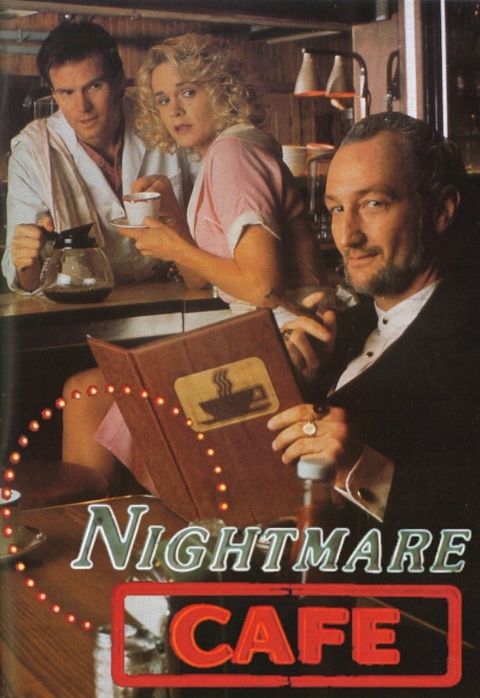
Welcome to Late Night Retro Television Reviews, a feature where we review some of our favorite and least favorite shows of the past! On Mondays, I will be reviewing Nightmare Café, which ran on NBC from January to April of 1992. The entire show is currently streaming on YouTube!
This week, a dying detective is allowed a chance to solve one last case.
Episode 1.4 “The Heart of Mystery”
(Dir by John Harrison, originally aired on March 20th, 1992)
This week’s episode of Nightmare Café is the first to largely focus on a guest star. While Jack Coleman and Lindsay Frost do play roles in this week’s episode and Robert Englund’s Blackie actually gets to do more than usual, the majority of the episode is still dominated by Timothy Carhart as Detective Stan Gates.
One dark night, Stan chases a young thief (played by Alfonso Quijada) into a dark alley. When the thief pulls a gun on him, Stan explains that he’s a police officer and he’s not trying to take the thief to jail. He explains that he knows the young man is on drugs and is not in full control of his actions. He asks the young man to give him the gun.
Meanwhile, in the nearby Nightmare Café, a bored Frank and Fay are playing a game of Clue. (Colonel Mustard did it.) Stan walks into the café and asks for a cup of coffee. Robert Englund’s Blackie suddenly appears sitting in a booth and eating from a bag of popcorn. He introduce himself to Stan and then leads Stan over to a window. Looking through the window, Stan can see himself and the thief in the alley. The thief has fired the gun and the bullet appears to be suspended in the air. Blackie explains that the café has slowed down time to give Stan the chance to solve one last case before the bullet hits and kills him.
The case involves the death of Charlotte Bening (Laura Mae Tate), a wealthy woman with whom Stan was in love. One night, when Stan was investigating a break-in at her mansion, Stan fired his weapon at what he believed to be the burglar. Someone hit him from behind, knocking him out. When Stan woke up, he discovered that the person who was actually shot was Charlotte! While the police ruled it an accidental shooting, Stan was convinced that someone specifically set him up. Could it have been Charlotte’s brother, a frustrated artist named Philip (Denis Forest, who also appeared in last week’s episode of Friday the 13th)? Or could it have been …. well, there is no one else, actually. The great Lochlyn Munro does make a brief appearance as one of Charlotte’s more aggressive suitors but he’s only onscreen for a few minutes. There’s not much suspense to this mystery.
That said, I did enjoy this episode of Nightmare Café, which not only pays homage to film noir but which also features Robert Englund at his quippy best as he passive-aggressively pushes Stan into solving the case. Fay does briefly leave the café so that she can pretend to be the producer of a true crime series and interview some of the people who knew Charlotte and Stan but, for the most part, this episode is centered around Timothy Carhart and Robert Englund and both of them carry things nicely. Though the episode’s format probably confused those who, on the basis of the previous three episode, didn’t realize that Nightmare Café was originally envisioned as being an anthology series, The Heart of Mystery holds up very well.
At the Houston Federal Building, a disgruntled domestic terrorists sets off a bomb that not only rocks the building but also unleashes a government-designed nerve gas that turns anyone exposed to it into an animalistic, rage-fueled zombie who attacks everyone that they see. Soon, the building is full of former friends and co-workers who are now obsessed with ripping each other to shreds. The few people who were not exposed to the nerve gas are hiding on the top floor. Under the reluctant leadership of Cale (Jason London), they try to figure out how to escape from the building.
Meanwhile, on the outside, Police Chief Grosso (C. Thomas Howell) and Fire Chief Lohan (Lochlyn Munro) attempt to rescue as many people as they can before the building is blown up. The scientist on the scene (Robert Carradine) sees all of this as a research opportunity while a sinister government agent (Judd Nelson) conspires to keep word about what has happened from reaching the public.
With its images of suit-and-tie wearing madmen trying to kill everyone in the building, The Terror Experiment may seem like it would have much in common with The Belko Experiment (which came out a few years after Terror Experiment) but actually, The Terror Experiment is mash-up of Die Hard and 28 Days Later, with Jason London and Lochlyn Munro filling in for Bruce Willis and Reginald Veljohnson. With its frequent scenes of formerly normal people suddenly going mad and turning into homicidal maniacs, The Terror Experiment has its effective moments and Jason London does the best that anyone probably could with the role of the film’s reluctant hero. But the film also suffers because you never really get to know who any of these people were before they were trapped in the building and there aren’t really any emotional stakes to whether or not they’ll manage to get out. As well, the scenes outside the building often fill like filler that was included so that some “name” actors could be recruited to appear in the film. Howell, Carradine, and Nelson are all fine in their roles but the only thing they add to the movie is an opportunity to recreate the one of the most crowd-pleasing moments from the finale of Die Hard.
The Terror Experiment is occasionally diverting but it’s hard not to feel that it never really reaches its potential.
Here’s the trailer for Totally Killer, the latest Blumhouse horror film to go straight to Prime. The premise looks intriguing but it’s also true that Blumhouse always seems to send their weakest stuff straight to Prime.
Welcome to Retro Television Reviews, a feature where we review some of our favorite and least favorite shows of the past! On Sundays, I will be reviewing the made-for-television movies that used to be a primetime mainstay. Today’s film is 1996’s When Friendship Kills! It can be viewed on YouTube!
After the divorce of her parents, Lexi Archer (Katie Wright) moves to Seattle with her mother (Lynda Carter). Lexi is having a tough time adjusting to the divorce, especially since her father (Josh Taylor) is convinced that he’s a better parent than Lexi’s mother has ever been. Still, Lexi is hoping to make a good impression at her new high school and she gets off to an effective start by not only winning a spot on the school’s volleyball team but by also becoming friends with the most popular girl in school, Jen Harnsberger (Marley Shelton).
The wealthy Jen is a straight-A student and a star volleyball player and she appears to have a very bright future ahead of her. Jen not only shows Lexi around the high school but she also shows Jen that one way to eat without gaining weight is to throw up after every meal. Jen is bulimic and soon, Lexi is anorexic. Eventually, Lexi is collapsing on the volleyball court and Jen is angrily denying that she has a problem and the whole things leads to tragedy.
Obviously, eating disorders are a serious issue and When Friendship Kills is honest about not only the pressures that lead to so many girls and women developing body image issues but it also deals with the danger of having a relapse. Growing up attending dance classes, I met and hung out with a lot of girls who had “tricks” for keeping their weight down and I recognized all of them in the characters of Jen and Lexi. This film hits all of the usual plot points that we’ve come to expect from 90s films about eating disorders, from the volleyball coach saying that the already thin Lexi needs to lose weight to the scenes of Lexi staring in the mirror and seeing a distorted version of herself to Lexi’s father demanding that a feeding tube be used on his daughter, regardless of what Lexi’s mother might think.
That said, many viewers will find the most interesting thing about this movie to be that it features an early performance from Ryan Reynolds. Reynolds plays the role of Ben, a friendly jock who asks Lexi out on a date. Reynolds doesn’t do much in the film but he does show some hints of the amiable goofiness that would later become his trademark. If one wanted to view this film as being a part of a Deadpoolorigin story, they certainly could.
As well, Lochlyn Munro also appears in the film! It’s not really a melodramatic made-for-television movie unless Lochlyn Munro has a role. In this particular film, Munro played a sleazy photographer who approached Jen and told her that she had the perfect look to be a model and invited her back to his studio. Of course, when Jen brought Lexi to the studio with her, the photographer rather rudely announced that Lexi didn’t have the right look to be a model. This led to Lexi refusing to eat and becoming hollow-eyed and skeletal and Katie Wright, it must be said, did a wonderful job portraying Lexi’s transformation from being hopeful to being haunted by her own self-image. Marley Shelton did an equally good job of portraying Jen’s more cheerful style of self-destruction.
When Friendship Kills is an effective if predictable eating disorder film. The film originally aired under the title A Secret Between Friends, which is a far more honest title than the over-the-top When Friendship Kills. Friendship does not kill in this movie but self-starvation does.
The Detective Knight trilogy comes to a close with Detective Knight: Independence.
If you haven’t been keeping up with the wonderfully pulpy adventures of Detective James Knight, here’s a quick refresher of what happened last year. First off, in Detective Knight: Rogue, Detective Knight (Bruce Willis) sought vengeance after his partner, Fitz (Lochlyn Munro), was seriously wounded during a robbery. Fitz recovered but not before Knight has dispensed some vigilante justice of his own. The surviving bad guys went to prison but sadly, so did Detective Knight.
Fortunately, Detective Knight was released from prison in Detective Knight: Redemption. He was released because a cult of people who dressed up like Santa Claus and who chanted, “Ho! Ho! Ho!” while committing their crimes were terrifying the city. With the help of Detective Knight, the police were able to stop the Santa Cult.
In Detective Knight: Independence, Knight is once again on the police force. He and Fitz are still quick to shoot first and ask questions later. That said, Knight is trying to make amends with his estranged wife and spend more time with his daughter. That’s not going to be easy, though, because there’s a new threat in town …. just in time for the 4th of July!
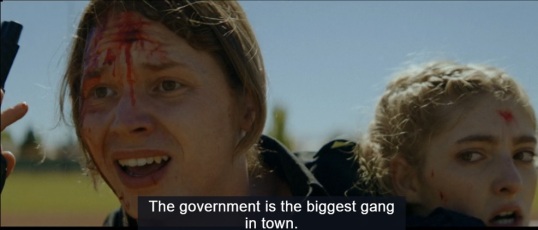
Dezi (Jack Kilmer) is an EMT who has always dreamt of being a cop. Unfortunately, he’s never been able to qualify for the force. Even when he shows up at a cop bar and just tries to have a beer in peace, the bartender approaches him with a baseball bat and two detective toss him out of the place. When Dezi is subsequently fired for refusing to give aid to a wounded man (the man in question was a bank robber and Detective Fitz actually told Dezi to go help a bleeding civilian in the bank and leave the robber to die), Dezi snaps. First, Dezi steals a uniform, a badge, and a gun. After dispensing some vigilante justice on some muggers, Dezi decides that he would like to rob a bank. Yes, you read that correctly. In just a matter of hours, Dezi goes from pretending to be a cop to pretending to be a criminal. As the film progresses, it starts to become pretty clear why the police force didn’t want to hire this guy in the first place.
Unfortunately, for Dezi, his fellow EMT and occasional lover, Ally (Willow Shields), had a connection to Detective Knight and soon, Knight is on Dezi’s trail. It all leads to a 4th of July confrontation on a baseball field.
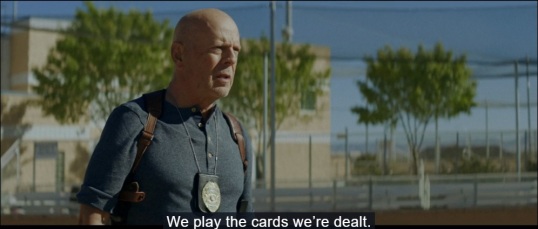
Even though Bruce Willis is playing the title character, he’s not present for much of Detective Knight: Independence. As with the other two Detective Knight films, it’s obvious that Willis was only on set for a day or two. While Willis is still a physically imposing actor, there’s none of the wise guy swagger that made Willis a star. Instead, Detective Knight is a fairly grim character. As always, it’s a bit difficult to watch Willis in films like this, especially with the knowledge of his recent health struggles. That said, the Detective Knight films are definitely the best of Willis’s final films and, despite the limitations imposed by his health, Willis comes across well in them. Considering that this is Willi’s final film, certain lines hit in a way that they otherwise might not.
As with the previous Detective Knight films, the majority of the screen time is given over to the man that the Detective is pursuing. Jack Kilmer gives a strong performance as the unbalanced Dezi. When he first appears, he’s almost a sympathetic character. The cops were being bullies when they kicked him out of their bar. His boss was being unreasonable when she announced that, rather than suspend him, she was just going to fire him because she didn’t like his attitude. When Dezi first puts on his stolen badge and uniform, it’s hard not to sympathize with his happiness because he finally has what he wants. But almost immediately, the power goes to his head and he loses control. He becomes a frightening character but still, it’s hard not to feel sorry for him as he yells, “I’m not the bad guy!” Of course, Dezi is the bad guy and the tragedy of his character is that he’ll never be able to understand why that is.
He’s right, you know.
For those of us who remember him in films like Die Hard, Pulp Fiction, and The Sixth Sense, late-era Bruce Willis films can be difficult to watch and I understand and respect why some people simply can’t bring themselves do it. And, obviously, several of Willis’s later films do leave one feeling as if the actor has been exploited by filmmakers who cared less about his legacy and more about making money off of his name. That said, the Detective Knight films do not feel exploitive, certainly not in the way that many of his 2022 films did. Instead, the trilogy serves as a tribute to Willis and his status as one of the world’s most popular movie stars. As pulpy as it may be, Detective Knight:Independence allows Bruce to go out on a good note.
After having been arrested in front of his wife and daughter, football player-turned-criminal Casey Rhodes (Beau Mirchoff) has been sent to prison. In the same prison is Rhodes’s nemesis, former Detective James Knight (Bruce Willis). Knight has been imprisoned for murdering the two villains from Detective Knight: Rogue, finally answering the age-old question of what happens to an action hero after the end credits roll. In prison, both men meet Ricky Conlan (Paul Johansson), a former convict who is now a chaplain. Conlan is big on encouraging everyone in prison to set aside their differences and come together as one big community of sinners seeking redemption.
Meanwhile, as Christmas approaches, New York City finds itself under siege. Terrorists are dressing up like Santa Claus and robbing banks, chanting “Ho! Ho! Ho!” as they do so. Their leader alternates between handing out candy canes and tossing live grenades at people. He becomes known as The Christmas Bomber and he announces that he’s only robbing the banks to get back at the 1%. He’s a revolutionary, you see.
He’s also a prison chaplain. That’s right, Ricky Conlan is the Christmas Bomber and he’s decided that Casey is going to be newest member of his operation! He even stages a jailbreak, releasing the entire population of Riker’s onto the streets of New York. The only prisoner who voluntarily chooses not to escape is Detective Knight. Impressed by his refusal to escape when he had the chance, NYPD Capt. Anna Shea (Miranda Edwards) arranges for Detective Knight to be released from prison so that he can head up the search for Conlan and the commie Santas.
Meanwhile, Knight’s partner, Eric Fitzgerald (Lochlyn Munro), has traveled to New York to help out with the investigation. In the previous movie, when we last saw Detective Fitzgerald, he was in the hospital after having been shot by Casey Rhodes. Fitzgerald may be in a wheelchair now but he’s still good with a gun and he also mentions that the doctors think that he should be able to walk again by Memorial Day. Fitzgerald doesn’t let being in a wheelchair prevent him from investigating and confronting New York’s power brokers, including the oily mayor (John Cassini).
Detective Knight: Redemption was one of the films that Bruce Willis filmed shortly before the announcement that he would be retiring from acting. Though he’s definitely the main attraction here and he still looks convincing firing a gun during the film’s finale, Willis’s screen time is limited and it’s also obvious that a stand-in was used for a few of the scenes that involved his character. There are a handful of fleeting moments where we get to see some hints of the wiseguy charisma that was Willis’s trademark but, for the most part, Detective Knight is written to be a man of few words. When he made this film, Willis still had his screen presence but it’s still difficult to watch with the knowledge that he was struggling with his health during filming.
With Willis largely sidelined, it falls to Munro, Johansson, and Mirchoff to keep the action moving and all three of them prove themselves to be up to the challenge. Johansson, in particular, is so wonderfully over-the-top in his villainy that it’s impossible not to be entertained whenever he’s onscreen. The film’s plot does have a few interesting twists. Conlan presents himself as being a revolutionary who is dedicated to bringing down the 1% but Casey eventually realizes that, much like Die Hard‘s Hans Gruber, he’s ultimately just a greedy thief. Conlan’s gang is a mix of hardened escaped prisoners who are looking for revenge on the system and confused kids who quickly discover that the revolution is a lot scarier than they thought it would be. The story may sometimes be too quick to ask the viewer to suspend their disbelief but the plot moves quickly and, just as he did with GasolineAlley, director Edward Drake doesn’t allow the film’s low budget to prevent him from choreographing a few impressive action scenes.
Ultimately, of course, the main reason to see Detective Knight: Redemption is that it features a bunch of Santa Clauses chanting “Ho! Ho! Ho!” while robbing banks. Who can resist that?
 It’s strange to hear Leslie Nielsen drop an F bomb.




 Through the Shattered Lens