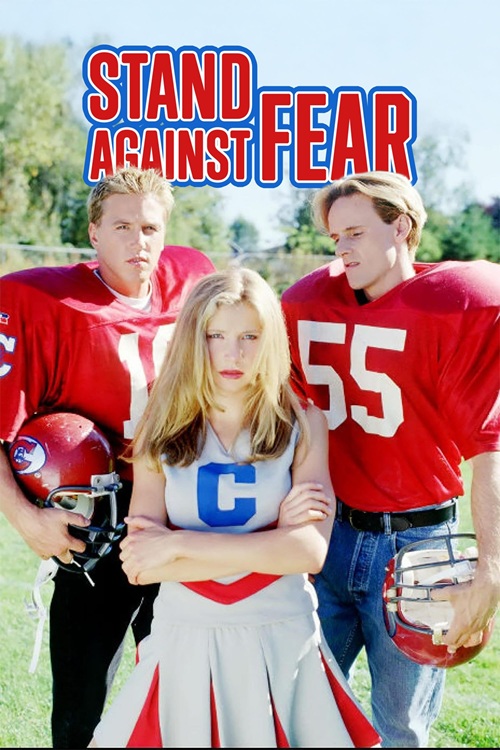
I Watched Stand Against Fear (1996, Dir. by Joseph L. Scanlan)


“Boys will be boys.”

That’s something that I heard a lot back when I was cheerleading in high school.  A football player grabbed your ass while he was running out on the field?  Someone told you that the team lost because you didn’t smile more?  At the after-game party, you were called a tease if you didn’t drink enough to excuse whatever happened later that night?  It was all just a case of boys being boys.

“They’ll grow out of it.”  “They’re under a lot of pressure right now.”  “Your job is help them celebrate when they win and to make them feel better when they lose.”  I heard all of that back when I was cheerleading and, because I usually heard it from older women who were supposed to be looking out for me, I usually accepted it.  If someone said something that made me cry, I told myself it was my fault for not understanding how difficult it was to be a good player on a bad team.  If someone accused me of sending out mixed signals or giving someone the wrong idea, I didn’t say, “That’s your problem for not paying attention.”  Instead, I felt guilty about it, as if I had done something wrong.  My job was to support the team.  I was there to cheer for the boys.  Half of the time, I loved being a cheerleader.  I loved the sisterhood.  I love the thrill of pumping up the people in the bleachers.  I enjoyed feeling as if I had played a role whenever one of our teams won a game.  The other half of the time, I was a nervous wreck because I worried I had done something wrong.

I guess that’s why I related to the main character in Stand Against Fear when I watched it earlier today.  (It’s on YouTube.)  Sarah Chalke plays a cheerleader who is inappropriately touched by a football player (Lochlyn Munro).  He thinks that he can get away with anything because he’s the star of the football team and his father’s rich.  When the police and the school refuse to do anything, the cheerleader sues the football player for sexual harassment.

I don’t know if this movie was based on a true story but watching it brought back a lot of memories of high school.  The dread of knowing that you’re going to be treated like an object, the fear of not fitting in, and the helplessness of knowing that no one is going to be on your side, Stand Against Fear captured all of that.  When Sarah Chalke and her family finally stood up for themselves, I wanted to cheer.  It was inspiring to see.

As for me, it wasn’t until a few years after I graduated from high school that I looked back and realized just how messed up all of that was.  Whenever I run into any of my old cheerleading friends today, we inevitably start talking about the past and we always agree that we spent way too much time worrying about the boys when we should have been worrying about ourselves.  As this movie shows, it takes strength to stand up for yourself but it’s always the right thing to do.

Retro Television Reviews: When Friendship Kills (dir by James A. Conter)


Welcome to Retro Television Reviews, a feature where we review some of our favorite and least favorite shows of the past!  On Sundays, I will be reviewing the made-for-television movies that used to be a primetime mainstay.  Today’s film is 1996’s When Friendship Kills!  It  can be viewed on YouTube!

After the divorce of her parents, Lexi Archer (Katie Wright) moves to Seattle with her mother (Lynda Carter).  Lexi is having a tough time adjusting to the divorce, especially since her father (Josh Taylor) is convinced that he’s a better parent than Lexi’s mother has ever been.  Still, Lexi is hoping to make a good impression at her new high school and she gets off to an effective start by not only winning a spot on the school’s volleyball team but by also becoming friends with the most popular girl in school, Jen Harnsberger (Marley Shelton).

The wealthy Jen is a straight-A student and a star volleyball player and she appears to have a very bright future ahead of her.  Jen not only shows Lexi around the high school but she also shows Jen that one way to eat without gaining weight is to throw up after every meal.  Jen is bulimic and soon, Lexi is anorexic.  Eventually, Lexi is collapsing on the volleyball court and Jen is angrily denying that she has a problem and the whole things leads to tragedy.

Obviously, eating disorders are a serious issue and When Friendship Kills is honest about not only the pressures that lead to so many girls and women developing body image issues but it also deals with the danger of having a relapse.  Growing up attending dance classes, I met and hung out with a lot of girls who had “tricks” for keeping their weight down and I recognized all of them in the characters of Jen and Lexi.  This film hits all of the usual plot points that we’ve come to expect from 90s films about eating disorders, from the volleyball coach saying that the already thin Lexi needs to lose weight to the scenes of Lexi staring in the mirror and seeing a distorted version of herself to Lexi’s father demanding that a feeding tube be used on his daughter, regardless of what Lexi’s mother might think.

That said, many viewers will find the most interesting thing about this movie to be that it features an early performance from Ryan Reynolds.  Reynolds plays the role of Ben, a friendly jock who asks Lexi out on a date.  Reynolds doesn’t do much in the film but he does show some hints of the amiable goofiness that would later become his trademark.  If one wanted to view this film as being a part of a Deadpool origin story, they certainly could.

As well, Lochlyn Munro also appears in the film!  It’s not really a melodramatic made-for-television movie unless Lochlyn Munro has a role.  In this particular film, Munro played a sleazy photographer who approached Jen and told her that she had the perfect look to be a model and invited her back to his studio.  Of course, when Jen brought Lexi to the studio with her, the photographer rather rudely announced that Lexi didn’t have the right look to be a model.  This led to Lexi refusing to eat and becoming hollow-eyed and skeletal and Katie Wright, it must be said, did a wonderful job portraying Lexi’s transformation from being hopeful to being haunted by her own self-image.  Marley Shelton did an equally good job of portraying Jen’s more cheerful style of self-destruction.

When Friendship Kills is an effective if predictable eating disorder film.  The film originally aired under the title A Secret Between Friends, which is a far more honest title than the over-the-top When Friendship Kills.  Friendship does not kill in this movie but self-starvation does.