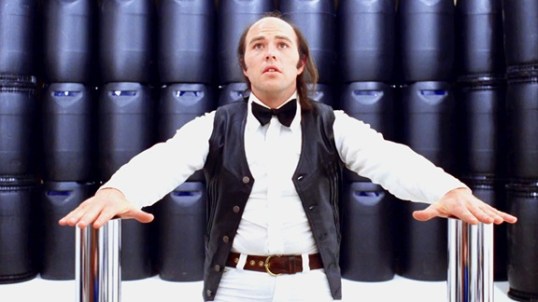
October Positivity: Past Shadows (dir by Peter J. Eaton)


When this 2021 film started, I noticed that the only immediately familiar name in the opening credits was Corbin Bernsen, who was the third-billed member of the cast.  Bernsen’s presence in the film did not surprise me.  Bernsen has appeared in several faith-based films and he’s even directed a few.

What did surprise me was just how briefly Bernsen’s appearance actually waas.  It’s a blink-and-you’ll miss it appearance and, unless I somehow missed it, I don’t think he actually has a line of dialogue in the film.  He plays the uncle of one of the film’s main characters.  He’s an archeologist and, whenever he finds any ancient glass at the site of any of his digs, he sends it to his nephew.  The nephew eventually decides to put all that glass to good use by taping it all together and using it as the frames for his previously frameless glasses.  Suddenly, whenever he puts on the glasses, he can see the past!

That’s good because one of his professors has felt guilty ever since his grandson was kidnapped.  So now, he can just put on the glasses and see who did the abducting.  Yay!  However, another professor — a physicist — wants the glasses for himself so he drugs our hero and steals the glasses.  Luckily, everything works out in the end.  Bad professor goes to jail.  Good professor stops drinking and is reunited with his family.  And the guy with the glasses gets a recording contract in Nashville.

I guess the glasses are meant to represent faith.  And the bad scientist is meant to represent everyone who says that science is more important than faith.  I’m not sure that glasses that allow you to see into the past is the best way sell the idea of faith.  I mean, if you’re so inclined, I guess you could spend as much time as you want praying for a pair of magic glasses that will allow you to see into the past but, at some point, you’re going to have to admit that there’s no such thing as magic glasses, no matter how much you want to believe in them.  In this case, the scientist laughing at you would be proven right.

I had another thought while watching this film.  A good sound mix is really important.  If you want people to get anything out of your movie, it’s important that they be able to hear what your characters are saying.  It’s important that the characters actually sound like they’re all in the same room as opposed to just standing in a booth and reading their lines off a piece of paper.  The sound was all over the place.  Sometimes, I had to strain to hear everything.  Sometimes, I winced because the movie was too loud.  Considering how talky this film is and how often the action segues into flashback, this movie needed a much cleaner sound to it.  There’s more to making a good film than focusing the image, though this film struggled with that as well.

Anyway, the most interesting thing about this film is Corbin Bernsen showing up for 2 minutes and not saying anything.  Has Bernsen become the poor man’s Eric Roberts?

Late Night Retro Television Review: Monsters 2.17 “One Wolf’s Family”


Welcome to Late Night Retro Television Reviews, a feature where we review some of our favorite and least favorite shows of the past! On Wednesdays, I will be reviewing Monsters, which aired in syndication from 1988 to 1991. The entire series is streaming on YouTube.

This week, Jerry Stiller is a werewolf!

Episode 2.17 “One Wolf’s Family”

(Dir by Alex Zamm, originally aired on February 11th, 1990)

In this rather heavy-handed episode of Monsters, Jerry Stiller and Anne Meara star as Victor and Greta, two immigrants who have built a successful life for themselves in America.  Victor is very proud of his heritage and his success.  He’s even more proud of the fact that he and Greta are pure-bred werewolves.  He expects his daughter, Anya (Amy Stiller), to marry a purebred werewolf.

(Ben was apparently busy when they shot this episode.)

So, how will Victor react when he discovers that Amy’s fiancé, Stanley (Robert Clohessy), is a were-hyena!?

*sigh*

Okay, I will give some credit here.  The scene where Victor meets Stanley and they all gather around the kitchen table for dinner does have some funny moments.  Stanley, being a hyena in human form, cannot stop laughing, even when he’s being insulted.  And when Jerry Stiller launches into a rant about how no daughter of his is going to hang out on the roadside and eat trash, I did laugh.  This was largely due to Jerry Stiller’s delivery of the line.  Jerry Stiller was always funny whenever he started to rant.

Otherwise, this episode was pretty disappointing.  There’s a subplot about a nosey neighbor named Agnes (Karen Shallo).  Agnes is upset to discover that her neighbors are werewolves that keep dead bodies in their refrigerator so that they’ll have something to snack on.  “It’s bad enough that they’re immigrants!” Agnes says.  And yes, I get it.  Agnes is supposed to be a small-minded suburbanite who doesn’t understand that America is a country of immigrants and all the rest.  The problem is that, regardless of how Agnes feels about immigrants, she has every right to be concerned about living next door to a werewolf who keeps a dead body in his refrigerator.  When she sees Victor eating a foot, it totally makes sense that she would be upset about it.  The show’s satire would have worked if Agnes’s sole objection to them had been that they were immigrants.  (It would have been even funnier if Agnes has absolutely no problem living next door to werewolves as long as they were born in America.)  But by making them werewolves and having Agnes be upset by the fact that they were werewolves, the show instead suggests that Agnes might have a point.

Not that it matters.  Stanley turns into a hyena and rips off Agnes’s head and brings it to Victor and Greta as a gift.  Stanley is accepted into the family while Jerry Stiller howls a the moon.

Political satire is always hit-and-miss and this episode was definitely a mess.  It’s a shame because Jerry Stiller and Anne Meara were definitely funny people.  (If you’ve ever seen the documentary Have A Good Trip, there’s a scene where Ben Stiller tells a story about accidentally taking several tabs of LSD in college and, in a panic, calling his father for help.  “I know what you’re going through,” Jerry told him, “I once smoked an entire Pall Mall cigarette.”  “My father was Jerry Stiller, not Jerry Rubin,” Ben explains.)  This is one of those episodes that I was really hoping would be good but it just didn’t work.

Horror On TV: One Step Beyond 2.1 “Delusion” (dir by John Newland)


On tonight’s episode of One Step Beyond.

A young woman (Suzanne Pleshette) desperately needs a blood transfusion.  Fortunately, the police have managed to track down one of the only people to share her blood type, an accountant named Harold Stern (Norman Lloyd).  Harold seems like a nice, rather mild-mannered guy and he has a long history of donating blood.  However, when the police approach him, Harold refuses to donate.

“What type of crumb are you!?” the police demand.

Harold explains that, whenever he gives someone blood, he develops a psychic connection with that person.  He can see their future.  And that’s simply a burden that he can no longer shoulder….

This episode of One Step Beyond originally aired on September 15th, 1959.  Norman Lloyd, who plays Harold, got his start as a member of Orson Welles’s Mercury Theater and he also played the villain in Alfred Hitchcock’s Saboteur.  (Speaking of Hitchcock, Suzanne Pleshette played the doomed school teacher in The Birds.)  When Lloyd appeared in this episode of One Step Beyond, he was 44 years old.  He would go on to live for another 62 years, making his final film appearance at the age of 101!

Retro Television Review: The Love Boat 4.27 “Maid for Each Other/Lost and Found/Then There Were Two”


Welcome to Retro Television Reviews, a feature where we review some of our favorite and least favorite shows of the past!  On Wednesdays, I will be reviewing the original Love Boat, which aired on ABC from 1977 to 1986!  The series can be streamed on Paramount Plus!

This week, a baby is abandoned, an aunt visits, and for some reason, Joe Namath is on the boat.

Episode 4.27 “Maid for Each Other/Lost and Found/Then There Were Two”

(Dir by Howard Morris, originally aired on May 9th, 1981)

Ted Harper (Joe Namath) boards the boat with his best friend, Richard Henderson (Fred Willard).  Ted and Richard were fraternity brothers.  While in college, the members of the frat decided that, whenever one of them got married, some money would be contributed to a pot.  The last single member of the frat would end up getting all of the cash, which is now up to $60,000.  Ted and Richard are the last two single members of the frat and they’re competing to see who can hold out the longest.

(Can we just agree that guys are weird?)

Ted has a plan to get the money. He’s gotten his ex-girlfriend, Paula (Karen Grassle), to agree to trick Richard into falling in love with and marrying her, in exchange for some of the money.  However, Richard is smarter than Ted realizes and instead offers Paula even more of the money to get Ted to marry her.  However, Karen falls for Ted for real.  Karen and Ted do get married when the ship docks in Mexico.  When Richard announces that he paid Karen to marry Ted, Ted is hurt at first but then he realizes that he was willing to do the same thing to Richard and nothing matters more than love.  Awwww!

Now, it may seem strange to cast Joe Namath and Fred Willard as friends.  To me, it’s even stranger that this was not the first time that Joe Namath, who was not much of actor, appeared on The Love Boat.  Just as he did the last time he was on the boat (and also just as he did when he last visited Fantasy Island), Namath wanders through the story with a goofy grin on his face.

Speaking of goofy, Gopher is super-excited when his wealthy aunt Loretta (Jane Powell) boards the boat.  Loretta, however, is scared to tell Gopher that she has lost all of her money and is now working as a maid.  Loretta need not have worried.  I mean, it’s not as if Gopher has a particularly glamorous job.  Plus, Loretta’s not going to be poor for long, not after she meets and falls in love with wealthy Duncan Harlow (Howard Keel).

Finally, Eddie Martin (Gary Burghoff) is a mechanic on the Love Boat who decides to abandon his baby with the captain.  The captain, who apparently doesn’t know much about the people who work for him, has no idea who the baby’s father is.  But when the baby is taken ill and needs a transfusion of super-rare AB blood, Eddie is forced to stand up and accept the responsibility of being a father.  Good for him, I guess.  Personally, I like fathers who don’t abandon their babies in the first place.

This was a fairly bland episode.  The fourth season is nearly over and, with this cruise, everyone seemed to mostly be going through the motions.  This episode seemed like a collection of stories that the show had already handled (and handled better) in the past.

Next week …. season 4 comes to an end!

Horror Scenes That I Love: Damien Puts A Teacher In His Place in Damien: Omen II


1978’s Damien: Omen II is a perfectly ludicrous film that mixes soapy melodrama with apocalyptic horror.  It’s a fascinating mismash that doesn’t really work and often, the most dramatic scenes are also the ones most likely to draw a chuckle from the viewer.  That said, there are a few good moments.

For instance, I’ve always liked this scene where young Damien (Jonathan Scott-Taylor) shows up one of his teachers.  It’s a good thing that Lance Henriksen stepped in when he did!


Book Review: Revolution In The Head by Ian MacDonald


Since today would have been the 84th birthday of John Lennon, I want to take a minute to recommend a book called Revolution In The Head.

First published in 1994 and subsequently revised two more times, Revolution In The Head is both a chronological history of the songs that the Beatles recorded and a cultural history of the 60s.  By examining the recording of each song, Ian MacDonald not only describes how each song reflects (or doesn’t reflect) what was happening in the group at the time but also how the Beatles’s changing sound reflected what was happening in the world at the time.  Author Ian MacDonald was clearly a Beatles fan but, more importantly, he was not an apologist and, in the book, he’s just as quick to criticize as he is to praise.  While he praises the majority of the band’s recordings, there’s more than a few that he totally dismisses.  It’s a well-researched and passionately argued book, one that makes interesting reading for both fans of the group and history nerds like myself.

As for the Beatles themselves, they come across as fully developed people.  MacDonald neither idealizes nor demonizes the group and instead focuses on the idea of them as working musicians who usually collaborated well together as a group but sometimes feared and resented that they were losing their individual identities.  Neither Lennon nor Paul McCartney are presented as being saints and MacDonald doesn’t shy away from showing how frayed their relationship had become by the time the group split up.  (They’re portrayed as developing a classic love/hate relationship with each other.)  But both are also presented as being talented artists who were capable of creating beautiful music that would survive the test of time.  For all the conflict and for all the times that Lennon complained about McCartney’s commercial sensibilities and for all the times that McCartney complained that Lennon was not committed to keeping the Beatles going, they were still capable of creating songs like Eleanor Rigby and A Day In The Life.

A lot of Beatles fans will probably disagree with MacDonald’s opinions.  He’s surprisingly dismissive of a lot of George Harrison’s songs, including the wonderful While My Guitar Gently Weeps.  But that’s okay!  There’s nothing wrong with having differing opinions.  It’s actually a good thing.

6 Shots From 6 Films: Jess Franco Edition


4 Shots From 4 Films is just what it says it is, 4 shots from 4 of our favorite films. As opposed to the reviews and recaps that we usually post, 4 Shots From 4 Films lets the visuals do the talking!  (And yes, sometimes we do more than just 4 shots!)

Today, we honor the one and only Jesus “Jess” Franco!

6 Shots From 6 Jess Franco Films

The Awful Dr. Orloff (1962, dir by Jess Franco, DP: Godofredo Pacheco)

Count Dracula (1970, dir by Jess Franco, DPs: Manuel Merino and Luciano Trasatti)

Vampyros Lesbos (1970, dir by Jess Franco, DP: Manuel Merino)

A Virgin Among The Living Dead (1970, dir by Jess Franco, DP: anyone’s guess)

Female Vampire (1973, dir by Jess Franco, DP: Jess Franco)

Oasis of the Zombies (1981, dir by Jess Franco, DP: Max Monteillet)

Horror on the Lens: Bride of the Monster (dir by Edward D. Wood, Jr.)


Bride of The Monster (1955, dir by Ed Wood)

Since tomorrow will be the great man’s birthday, it seems appropriate that today’s horror film on the lens is Edward D. Wood’s 1955 epic, Bride of the Monster.

(Much like Plan 9 From Outer Space, around here, it is a tradition to watch Bride of the Monster in October.)

The film itself doesn’t feature a bride but it does feature a monster, a giant octopus who guards the mansion of the mysterious Dr. Vornoff (Bela Lugosi).  Vornoff and his hulking henchman Lobo (Tor Johnson) have been kidnapping men and using nuclear power to try to create a race of super soldiers.  Or something like that.  The plot has a make-it-up-as-you-go-along feel to it.  That’s actually a huge part of the film’s appeal.

Bride of the Monster is regularly described as being one of the worst films ever made but I think that’s rather unfair.   Appearing in his last speaking role, Lugosi actually gives a pretty good performance, bringing a wounded dignity to the role of Vornoff.  If judged solely against other movies directed by Ed Wood, this is actually one of the best films ever made.

(For a longer review, click here!)

October Positivity: The Friend (dir by Robert Thomason and Gary T. Smith)


Having been recently diagnosed with serious heart problems and having also recently lost his wife in a car accident, James Bragg (Gary T. Smith) collapses when he’s informed that he has been fired from his job.  When he opens his eyes, he discovers that his office is on fire.  A man in a suit (Clay Butler) claims to be an agent with the Department of Homeland Security and he explains that the building has been bombed.

“By who?” James asks.

“Al Qaeda.  Boko Haram.  Mexican drug cartels,” the man replies.

James asks for the man for his name.  The man smiles and says that must people call him Bub.

Bub leads James through the burning building, explaining that he’s taking James to safety.  However, as the flames grow higher, James hears a voice saying, “Don’t follow him.”  Bub says that the voice is just a ploy of the terrorists but James isn’t quite so sure….

As soon as I tell you that 2023’s The Friend is faith-based film, you’ll probably be able to guess where this story is going.  Will James follow Bub onto the elevator going down or will he listen to the voice telling him not to follow.  Will James remember that Bub is a nickname for Beezlebub, one of the more fearsome of the demons that are said to populate Hell?  Will James make peace with the death of his wife and find the strength to continue?  Who will James’s new friend be?  Will it be Bub or will it be the older man who always seems to be showing up in the background?

Again, you can probably guess where all this is heading but The Friend is still a well-made and surprisingly well-acted meditation on life, death, and faith and, with the exception of two scenes, it’s a film that does a good job of avoiding the preachiness that one expects to find in films like this.  Along with co-directing and co-writing the script, Gary T. Smith starts in the film and he gives a good performance as a man overwhelmed by both his mortality and the loss of the person who gave his life meaning.  Smith does a good job of showing how it’s the little things that hurt us the most when we’re missing someone.  Even an act of kindness, like a co-worker expressing sincere sympathy, can cause the pain of a recent loss to flare up.  Of course, for many viewers, the film will work because it makes Bub a government agent.  The implication, whether deliberate or not, is that an authoritarian like Bub is right at home working as a federal agent and that he has no problem using James’s understandable fear of a terrorist attack as a way to convince James to give up everything that was previously important to him.  Obviously, I don’t know that the filmmaker had any sort of political statement in mind when they made Bub an agent of Homeland Security but it does certainly provide an interesting subtext to the film.

Actually, I’m a bit surprised that Bub didn’t apply for a job with TSA.  Imagine the pain and misery he could spread there!


Late Night Retro Television Review: Baywatch Nights 2.13 “Nights to Dragon One”


Welcome to Late Night Retro Television Reviews, a feature where we review some of our favorite and least favorite shows of the past!  On Tuesdays, I will be reviewing Baywatch Nights, a detective show that ran in Syndication from 1995 to 1997.  The entire show is currently streaming on YouTube!

This week, Mitch and Ryan play a deadly game!

Episode 2.13 “Nights to Dragon One”

(Dir by Richard Friedman, originally aired on February 16th, 1997)

Mitch and Ryan are hired to discover what has happened to a father and his daughter.  When last seen, they were entering a mysterious building.  The father was a lifelong adventurer and he had apparently heard that the building was home to “the ultimate game.”  Along with daughter, he had to play.  Now, they’re both missing.

So, of course, Mitch and Ryan enter the building and soon find themselves in a computer-simulated dungeon, complete with traps, deadly archers, random flames, and a cackling Game Master (Vincent Schiavelli) who occasionally materializes so he can taunt Mitch and Ryan about their lack of progress in the game.

Ryan is actually excited about playing the game, explaining the she played an earlier version of it when she was in college.  All Mitch cares about is saving the man and his daughter.  Mitch doesn’t get the point of computer simulations and virtual reality and all that sort of thing.  Mitch probably thinks that email is just a fad as well.  Mitch is the guy who goes to an escape room and, instead of reading the clues, just tries to break the door down.

And yet, it’s Mitch who ends up entering and winning the final confrontation with the Game Master, even though Ryan points out that it would make more sense for her to do it because she’s actually played the game before.  Sorry, Ryan.  The Hoff is here to save the day so just stand back and be quiet, I guess.

Vincent Schiavelli is a welcome presence as the Game Mater and he at least seems to be having fun with his role.  That said, this is the worst episode of Baywatch Nights that I’ve seen so far and that includes out of the episodes from the non-supernatural first season as well.  A huge problem is that the game itself is just boring.  Mitch and Ryan have to make their way through a corridor of laser beams.  Mitch and Ryan have to avoid the arrows being shot at them by a mysterious archer.  Considering that this is a computer simulation where, in theory, anything could happen, this episode is a huge missed opportunity.  Things should have been a lot stranger than they were.

Finally, this is one of those episodes where the camera never stops moving.  As opposed to being disorientating or frightening, the constant movement just becomes annoying.  There’s only so many Dutch angles that can be used in one scene before they lose their effectiveness.

This game could have been a lot of fun but instead, it’s just kind of dull.  The Hoff wins but honestly, I feel like I could have won it as well.  The Hoff/Angie chemistry is still strong but it’s not enough to save this middling episode.