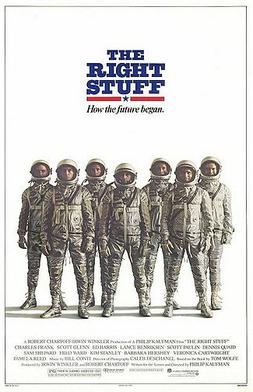
Lisa Marie Reviews An Oscar Nominee: The Right Stuff (dir by Philip Kaufman)


There’s a brilliant scene that occurs towards the end of 1983’s The Right Stuff.

It takes place in 1963.  The original Mercury astronauts, who have become a symbol of American ingenuity and optimism, are being cheered at a rally in Houston.  Vice President Lyndon Johnson (Donald Moffat) stands on a stage and brags about having brought the astronauts to his supporters.  One-by-one, the astronauts and their wives wave to the cheering crowd.  They’re all there: John Glenn (Ed Harris), Gus Grissom (Fred Ward), Alan Shephard (Scott Glenn), Wally Schirra (Lance Henrisken), Deke Slayton (Scott Paulin), Scott Carpenter (Charles Frank), and the always-smiling Gordon Cooper (Dennis Quaid).  The astronauts all look good and they know how to play to the crowd.  They were chosen to be and sold as heroes and all of them have delivered.

While the astronauts are celebrated, Chuck Yeager (Sam Shepard) is at Edwards Air Force Base.  Yeager is the pilot who broke the sound barrier and proved that the mythical “demon in the sky,” which was whispered about by pilots as a warning about taking unnecessary risks, was not waiting to destroy every pilot who tried to go too fast or too high.  Yeager is considered by many, including Gordon Cooper, to be the best pilot in America.  But, because Yeager didn’t have the right image and he had an independent streak, he was not ever considered to become a part of America’s young space program.  Yeager, who usually holds his emotions in check, gets in a jet and flies it straight up into the sky, taking the jet to the edge of space.  For a few briefs seconds, the blue sky becomes transparent and we can see the stars and the darkness behind the Earth’s atmosphere.  At that very moment, Yeager is at the barrier between reality and imagination, the past and the future, the planet and the universe.  And watching the film, the viewer is tempted to think that Yeager might actually make it into space finally.  It doesn’t happen, of course.  Yeager pushes the jet too far.  He manages to eject before his plane crashes.  He walks away from the cash with the stubborn strut of a western hero.  His expression remains stoic but we know he’s proven something to himself.  At that moment, the Mercury Astronauts might be the face of America but Yeager is the soul.  Both the astronauts and Yeager play an important role in taking America into space.  While the astronauts have learned how to take care of each other, even the face of government bureaucracy and a media that, initially, was eager to mock them and the idea of a man ever escaping the Earth’s atmosphere,  Chuck Yeager reminds us that America’s greatest strength has always been its independence.

Philip Kaufman’s film about the early days of the space program is full of moments like that.  The Right Stuff is a big film.  It’s a long film.  It’s a chaotic film, one that frequently switches tone from being a modern western to a media satire to reverent recreation of history.  Moments of high drama are mixed with often broad humor.  Much like Tom Wolfe’s book, on which Kaufman’s film is based, the sprawling story is often critical of the government and the press but it celebrates the people who set speed records and who first went into space.  The film opens with Yeager, proving that a man can break the sound barrier.  It goes on to the early days of NASA, ending with the final member of the Mercury Seven going into space.  In between, the film offers a portrait of America on the verge of the space age.  We watch as John Glenn goes from being a clean-cut and eager to please to standing up to both the press and LBJ.  Even later, Glenn sees fireflies in space while an aborigines in Australia performs a ceremony for his safety.  We watch as Gus Grissom barely survives a serious accident and is only rescued from drowning after this capsule has been secured.  The astronauts go from being ridiculed to celebrated and eventually respected, even by Chuck Yeager.

It’s a big film with a huge cast.  Along with Sam Shepherd and the actors who play the Mercury Seven, Barbara Hershey, Pamela Reed, Jeff Goldblum, Harry Shearer, Royal Dano, Kim Stanley, Scott Wilson, and William Russ show up in roles both small and large.  It can sometimes be a bit of an overwhelming film but it’s one that leaves you feeling proud of the pioneering pilots and the brave astronauts and it leaves you thinking about the wonder of the universe that surrounds our Earth.  It’s a strong tribute to the American spirit, the so-called right stuff of the title.

The Right Stuff was nominated for Best Picture but, in the end, it lost to a far more lowkey film, 1983’s Terms of Endearment.  Sam Shepard was nominated for Best Supporting Actor but lost to Jack Nicholson.  Nicolson played an astronaut.
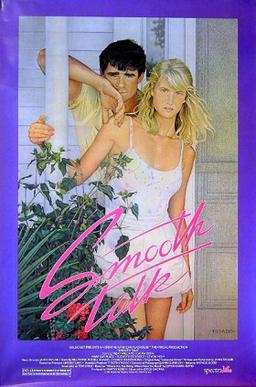
Insomnia File #32: Smooth Talk (dir by Joyce Chopra)


What’s an Insomnia File? You know how some times you just can’t get any sleep and, at about three in the morning, you’ll find yourself watching whatever you can find on cable? This feature is all about those insomnia-inspired discoveries!

If you were having trouble getting to sleep around one in the morning last night, you could have turned over to This TV and watched Smooth Talk, a disturbingly creepy coming-of-age film from 1985.

Connie Wyatt (played by Laura Dern in one of her first film roles) is fifteen years old and ready to discover the word.  It’s the summer and, for Connie and her friends, that means going to the mall, trying to capture the attention of the cute boys who go to their school, and lying to her parents about where she goes at night.  (She tells them that she and her friends have been going to the same movie, night-after-night.)  She likes it when the boys in the mall smile at her but not when the stranger honk their car horn at her whenever she walking at night.  Connie thinks of herself as being an independent adult, even though she’s not sure what that means.

Connie does know that she doesn’t want to be like her mother (Mary Kay Place).  Her mother, who claims that she was once a great beauty herself, complains that all Connie does is indulge in “trashy daydreams.”  Her mother tells Connie to be careful about who she flirts with and constantly demands that Connie stay home and help to paint the house.

Connie also doesn’t want to be like her older sister, June (Elizabeth Berridge).  June is obviously her mother’s favorite.  June never sneaks out.  June never rebels.  Whenever Connie and her mother argue, June always take their mother’s side.

In fact, the only member of her family that Connie’s close with is her father (Levon Helm).  Her father is always cheerful and always in a good mood.  Somehow, the constant tension in the house never seems to get to him and he never seems to be worried about anything.  He’s nice but he’s hardly an authority figure.

And then there’s an older man (Treat Wiliams).  When we first see him, he’s sitting outside of a diner and casually watching all of the teenage girls as they walk by.  (We all know the type.)  When he sees Connie and her friends, he looks over at Connie and tells her, “I’m watching you.”  Later, when Connie is alone at her house, the man pulls up in front of her house and starts to talk to her.

His name, he explains, is Arnold Friend.  “A. Friend,” he puts it.  That’s what he wants to be to her.  When she asks how old he is, he says that he’s 18, though he’s clearly closer to 30.  He’s handsome and he’s charming but there’s something off about him.  He shows Connie his car.  “Arnold Friend” is written on the side.  “33, 19, 17,” is written on the back.  Written next to a dent: “A woman driver did this.” Sitting in the car is a friend of Arnold’s, a man who hides his face behind a portable radio.

“He’s strange,” Arnold explains with a sly smile, before suggesting that Connie get in the car with them…

Smooth Talk is based on a short story by Joyce Carol Oates and, oh my God, is it ever creepy!  The first half of the movie plays out like a typical coming-of-age teen film but then Arnold shows up in that car and the film turns into a nightmare.  I spent almost the entire movie cringing, mostly because I once was Connie Wyatt, the only real difference being that I was even younger when I decided that I understood how the world worked better than my parents and I started rebelling.  As I watched the movie, I found myself wondering what I would have done if Arnold Friend had pulled up in front of my house.  Would I have gotten in the car or what I would have run back into the house, locked the door, and called the police?  I’d like to think I would have done the smart thing but … no.  Doing the smart thing would have meant admitting that the adults were right and there were situations that I couldn’t control or even really understand.

Laura Dern was 18 years old when she played 15 year-old Connie and she gave an amazing and naturalistic performance.  When Treat Williams first appeared as Arnold, I thought that he was overacting but, as the film progressed, I came to see that he was actually perfectly cast and giving exactly the type of performance that the movie’s story needed.  Arnold Friend, who speaks in outdated slang and always seems to be trying just a little bit too hard, has to be a slightly ridiculous figure because otherwise, no one would drop their guard enough to get into his car.  As I watched the movie, I realized that it was a mistake to think of Arnold as being a human being.  Instead, he’s a nightmare come to life.

Smooth Talk was a deeply unsettling film about growing up in an increasingly dangerous world.  It’s right up there with Out of The Blue, Christiane F, and Blue Velvet among nightmarish coming-of-age stories.

Previous Insomnia Files:

  1. Story of Mankind
  2. Stag
  3. Love Is A Gun
  4. Nina Takes A Lover
  5. Black Ice
  6. Frogs For Snakes
  7. Fair Game
  8. From The Hip
  9. Born Killers
  10. Eye For An Eye
  11. Summer Catch
  12. Beyond the Law
  13. Spring Broke
  14. Promise
  15. George Wallace
  16. Kill The Messenger
  17. The Suburbans
  18. Only The Strong
  19. Great Expectations
  20. Casual Sex?
  21. Truth
  22. Insomina
  23. Death Do Us Part
  24. A Star is Born
  25. The Winning Season
  26. Rabbit Run
  27. Remember My Name
  28. The Arrangement
  29. Day of the Animals
  30. Still of The Night
  31. Arsenal

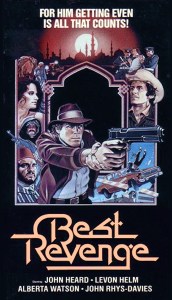
A Movie A Day #195: Best Revenge (1984, directed by John Trent)


Damn … John Heard died.

I know that almost everyone knows John Heard as either the father from Home Alone or as the detective on The Sopranos or maybe even the executive in Big.  Over the course of his long career, John Heard played a lot of neglectful fathers, greedy businessmen, and corrupt politicians.  Heard was good in all of those roles but he was capable of so much more.  Though he did not get many chances to do so, he could play heroes just as well as villains.

One of his best performances is also one of his least seen.  In Best Revenge, he plays Charlie.  Charlie is a laid back drug dealer, someone who would probably hate and be hated by most of the authority figures that Heard was best known for playing.  Charlie is the ultimate mellow dude, without a care in the world.  All he wants to do is play his harmonica and spend time with his girlfriend (Alberta Watson).  However, an old friend (Stephen McHattie) wants Charlie to help smuggle 500 keys of hash from Tangiers to America.  Charlie wants nothing to do with it but then he finds out that the Mafia will kill his friend unless the drugs make it across the ocean.  Charlie and his friend Bo (Levon Helm of The Band) fly over to Morocco but are betrayed.  Charlie ends up in a prison cell, from which he has to escape so that he can rescue Bo, smuggle the drugs, and get revenge on those who betrayed him.

Because of the prison aspect and the fact that Charlie wears a fedora, Best Revenge was sold as being a combination of Midnight Express and Raiders of the Lost Ark but actually it is a character study disguised as an action film.  Despite the title, Best Revenge is more interested in the real-life logistics and hassles of being an international drug dealer than in any sort of revenge.  Though it is a role far different from the ones he may be best known for, John Heard was perfectly cast as a small-time drug dealer who suddenly finds himself in over his head.  Heard gives such a good  and sympathetic performance that this film, along with his work in Cutter’s Way and Chilly Scenes of Winter, shows what a mistake was made when Heard became typecast as the bad guy.

Best Revenge was filmed in 1980 but not released until four years later.  Along with appreciating Heard’s performance, keep an eye out for Michael Ironside in an early, blink-and-you’ll-miss-it role.